Landscape designer Randy Laurie helps homeowners realize an eco-friendly oasis for strolling, entertaining and enjoying those ‘golden hour’ sunsets
A living sculpture garden in Mission Hills


Photographers from around the world have captured the extraordinary, miraculous moment of birth in a mesmerising series of raw images.
The breathtakingly intimate photographs, which featured in this year’s International Birth Photography Awards, convey both the agony and ecstasy associated with giving birth.
The global contest, in collaboration with Atkins Lab, was founded by award-winning birth photographer Lacey Barratt, 36, from Melbourne, Australia, in an attempt to legitimise the stunning and intricate art of birth photography.
The striking images portray a selection of moments associated with birth, including delivery, postpartum, hardships and loss.
This year’s competition saw a record number of submissions as photographers from around the world entered their snaps to be considered for the awards.

The best overall photograph was awarded to Annemarie Fuckel from Germany.
Winners in other categories included: Paula Beltrao from Brazil for ‘Best in Birth’; Jessica Innnemee from the Netheralnds for ‘Best in Labour’; Mary Beliz from the US for ‘Best in Delivery’; Natalie Borders from the US for ‘Best in Postpartum’; and lastly, Ebony Ankins from Australia won ‘Best in Hardship and Loss’.
With almost 1,000 entries from around the world – including Brazil, Portugal, France, Germany, Australia and New Zealand, the judges had the difficult job of narrowing down the results.
The panel included reporters, doulas, previous winners of the competition, and other award-winning birth photographers.
For the second time since the start of the annual photography competition, the judges opened entries to a group of birthing stories that relate to hardships and loss, in recognition of the one in four birthing persons who experience miscarriage or infant loss.
Here, FEMAIL lists some of the stunning winning photographs from this year’s competition…


To see all the winning photographs, click here

Freeman Patterson is on his 45th trip to Namaqualand in South Africa.
The 85-year-old New Brunswick photographer wasn’t planning on taking a trip there this year, but when he heard that the region saw heavy winter rains, he knew he had to go.
On Wednesday, he drove for six hours to experience the rare phenomena called a super bloom. The last one, he says, was in 1996.
“It was just a panorama of colour, flowers on both sides of the road just as far as the eye could see,” he said.

“Thank God I’m a photographer because I really can’t describe with words. … The emotional impact is just quite overwhelming.”
Patterson is one of Canada’s most acclaimed photographers and has taught photography around the world. He’s best known for his representational and abstract images of nature, has written a number of books and continues to teach workshops.
Now, his life story is being shared in a new documentary directed by Scott Munn, who is originally from Saint John.
Four years ago, Munn reached out to Patterson to see if he’d be interested in meeting up to chat. As a photographer himself, Munn knew of Patterson growing up and owned one of his books which was gifted to him in college.
The two met for pizza and Munn said the conversation really wasn’t about photography at all, as it moved into the realm of spirituality and life’s purpose.
“Freeman is brilliant when you hear him speak. But his body has a certain energy to it that is just infectious,” said Munn.

He didn’t expect anything to come of the conversation, but after hours in that Pomodori Pizzeria in Rothesay, Munn suggested the idea of a film, which he says Patterson politely declined.
Two months later the project was still heavy on Munn’s mind, so he gave Patterson a call.
Munn said, unbeknownst to him, Patterson plans to donate his land on Shampers Bluff, when he dies, to build the Freeman Patterson Centre.

And coincidentally, Munn said two weeks before he called Patterson, the group raising money for the centre had suggested that a short film about Patterson’s life would really help the project.
“I contacted him at the exact moment that he was suddenly opened up to this idea. … And he said the words to me, ‘the universe is unfolding as it should,’ which ultimately became the title of the film,” said Munn.
“I’ll never forget that conversation. It truly was a watershed. It was a beautiful, beautiful moment of him saying yes to this.”

Patterson said Munn took the documentary slowly and was always considerate, showing “enormous respect.” He said he never felt pressured during the process.
Munn even got to go to South Africa to film during one of Patterson’s trips.

“There’s a significant age gap, obviously, between Freeman and myself, there’s 40 years almost exactly,” said Munn.
“But the time I spent with him in South Africa for nine days, camping in the wilderness, trying to keep up with Freeman Patterson was itself its own challenge, let alone trying to make a film that we’d be able to use.”
The documentary also explores Patterson’s two liver transplants 23 years ago, which Patterson said he wasn’t expected to survive.

Munn said he thinks a lot of people will connect with Patterson’s story. His impact as a photographer in New Brunswick, Munn said, is far-reaching, but it goes beyond that.
“All of those connections that he’s made with people, the people he’s inspired, that transcends a photograph that may be hanging in a gallery or on a wall,” said Munn.
“This is a person who is so passionate and is so curious about life.”
Munn said Patterson shows no signs of slowing down, reflective of his current adventure photographing the super bloom.

Patterson said a big part of his personal journey is to seek beauty wherever he finds it.
He said he doesn’t adopt the attitude that other things take precedence over the opportunity to see beautiful things.
“I feel that the time I spend here with these flowers — with this incredible beauty —- is as important a thing as I can do. And other things can wait.”
The documentary is streaming on CBC Gem and free public screenings of the film will be held on Sept. 24 at the Imperial Theatre in Saint John and on Sept. 28 at the Beaverbrook Art Gallery in Fredericton.

Sidewalk Chalk Art Contest and Historic Farmers Market still on in downtown Salem | South Central Illinois’ News, Sports and Weather Station

Photography is a dynamic art form that evolved, often reflecting the changing perspectives, experiences and influences of the photographer. Documenting the evolution of your photographic style is not only a valuable exercise for self-discovery. It also offers insights into your growth as an artist. Let’s explore the significance of tracking the evolution of your photography style and offer some practical tips for documenting this journey.

Every photographer embarks on a unique journey of self-discovery and artistic growth. As you progress, your interests, preferences and techniques will naturally shift, leading to changes in your photographic style. Documenting this evolution allows you to capture the essence of your creative transformation and provides a visual record of your artistic journey.
By comparing your early works with your current creations, you understand how your style has evolved and the factors that have influenced these changes.

As you document your journey, you’ll likely notice patterns and influences that have played a role in shaping your style. These could be inspired by changes in your surroundings, personal experiences, exposure to new techniques or interactions with other artists.
By identifying these patterns and influences, you gain insight into what resonates with you as a photographer, enabling you to refine your style with intention and authenticity. I was photographing people more and more, especially the more creative styles.

The evolution of your photographic style often involves periods of experimentation and exploration. Early in your journey, you may try various techniques, genres, and approaches to find what resonates most with you. Documenting these experimental phases allows you to trace your creative curiosity and the pivotal moments that led you to your current style.
Don’t shy away from recording your failures and successes alike. Each experiment contributes to your growth and adds depth to your narrative as an artist. We often learn more from our failures than our instant successes.

The evolution of your style may encompass both technical and creative changes. Document technical advancements such as improvements in equipment, editing techniques and compositional skills. Similarly, record creative shifts in your choice of subjects, themes, color palettes and storytelling methods.
By cataloging these changes, you create a comprehensive record of your artistic journey that highlights the technical prowess and creative depth you’ve developed over time.
Throughout your journey, you will reach significant milestones that mark your growth as a photographer. These milestones could include exhibitions, publications, awards, or personal breakthroughs where you achieved a level of artistic expression you hadn’t before.
Documenting these milestones not only serves as a reminder of your achievements. It also encourages to keep pushing your boundaries and embracing new horizons in your style. These milestones can also give you social credit and peer recognition which can help building a profitable business.

Visual documentation of your style’s evolution is a powerful way to visualize your progress. Create a visual timeline showcasing key images from different phases of your journey. Display them chronologically to witness your style’s transformation over time.
This visual representation not only reminds you of how far you’ve come but also instills a sense of pride in your growth and accomplishments as a photographer. This can be an online portfolio or in print. I like coffee table-style books with my creative portraits and such. I can look back over the years and see how far I have come.
Documenting the evolution of your photographic style is a testament to your growth as an artist. By capturing changes, identifying patterns, embracing experimentation, cataloging technical and creative shifts and reflecting on milestones, you create a record that encapsulates the essence of your creative journey.
Remember that the journey is as important as the destination. Embrace the shifts, adaptations, and discoveries that come with evolving your style. This documentation not only allows you to share your story with others but also serves as a source of inspiration, reminding you of the dedication and passion you’ve invested in your craft.
So, whether you’re just starting or have been photographing for years, begin documenting your journey today. Watch your evolution unfold through your images and celebrate the beautiful, ever-changing tapestry of your photographic style.
Happy shooting and refining your style!
Photo by Clemens van Lay on Unsplash


The National Mall is a place of imposing monuments, but also of memories of monumental events — Marian Anderson’s 1939 concert after being barred from Constitution Hall because of her race, the 1963 March on Washington for Jobs and Freedom, and the 1986 display of the AIDS Memorial Quilt.
It is the fleeting sort of monument that inspired “Beyond Granite: Pulling Together,” an installation of six artists’ works on the Mall. Organized by the Trust for the National Mall, the project will be on view from Aug. 18 to Sept. 18.
The phrase “pulling together” comes from educator and activist Mary McLeod Bethune’s account of how Anderson’s concert “told a story of hope for tomorrow — a story of triumph — a story of pulling together, a story of splendor and real democracy.”
“Over time, artists have come to us on an ad hoc basis,” says Teresa Durkin, executive vice president of the Trust for the National Mall. So the trust decided to undertake a pilot program to place temporary artworks on the Mall, the first time a curated multi-artist program has been exhibited there. The goal, Durkin says, was to try “to learn everything that we can by actually installing six different pieces across the whole length of the National Mall, all at once, in a curated exhibit.”
The idea began with the National Capital Planning Commission, which has long wrestled with the demand to place new landmarks on the Mall’s increasingly crowded 700 acres. NCPC and the trust agreed to experiment with a solution, Durkin says, “for this problem of ultimately not having enough land, if we continue to build permanent memorials on the National Mall.” The two organizations together applied for a $4.5 million Mellon Foundation grant to fund the undertaking.
To curate the project, the trust selected the Monument Lab, a Philadelphia nonprofit organization whose director is Paul M. Farber, also a senior research scholar at the University of Pennsylvania. As co-curator, he enlisted Salamishah Tillet, a professor and administrator at Rutgers University Newark and a Pulitzer Prize-winning critic-at-large for the New York Times.
“This was an opportunity to think about artists from a variety of practices, a variety of backgrounds,” Farber says, “who would answer the question that is at the center of this project — what stories remain untold on the National Mall? — in distinct but complementary ways.”
In choosing sites for the installations, the curators had to follow National Park Service guidelines and yield to practical considerations. All but one of the artworks will be on a hard, flat surface that can handle installation machinery, but several pieces will be placed near existing Mall features to which they respond.
Artist Vanessa German took on the subject of Anderson’s concert with a statue titled “Of Thee We Sing.” The other artists are Derrick Adams, Tiffany Chung, Ashon T. Crawley, Paul Ramírez Jonas and Wendy Red Star.
Red Star’s “The Soil You See … ” speaks to the ignored or abrogated U.S. treaties with Native Americans and will stand on Signers Island in Constitution Gardens, near the memorial to the signers of the Declaration of Independence. The piece is a seven-foot-high glass thumbprint that represents the many Crow chiefs who signed such treaties with a thumbprint.
“The ridges of the thumbprint are red, and in between the ridges it’s clear, and within the ridges are all the names of the different chiefs who signed those treaties between 1825 and 1880,” says Red Star, who grew up on a Crow reservation in Montana.
Chung’s “For the Living” is a world map of the routes taken by refugees from Southeast Asia in the 1970s. It purposefully lacks national boundaries, the Vietnam-born artist notes. “The map is from that particular refugee migration out of Southeast Asia after the war, but I want to open it up so that people can reflect on their own journeys.”
Two of the pieces rely on sound. Ramírez Jonas’s “Let Freedom Ring” is an automated carillon that plays 41 notes of “My Country ‘Tis of Thee” but leaves the 42nd note to a 600-pound bell that can be struck by visitors. “In a way, it’s a very straightforward thing,” Jonas says. “If you participate, the song is complete. And if you do not participate, the song is unfinished.”
Crawley’s “Homegoing” is a three-station memorial to AIDS victims, especially musicians, singers and choir directors from the Black Pentecostal tradition in which the artist was raised. The music was written or co-written by Crawley, who teaches at the University of Virginia.
Crawley — who is writing a book about the Hammond organ, the AIDS crisis, Black churches and popular culture — says he sees the sound installation as “the performance of the book … and a way to engage a different kind of audience that might not be interested in reading the book but would be interested in listening to some of the sonic materials.”
Adams’s “America’s Playground: DC” is an interactive piece that features at its center a large reproduction of a photograph of one of the first desegregated play areas in D.C. To Adams, playgrounds are inherently political.
“It’s a place where you have to learn negotiation,” he says. “It’s a place where you have to learn to take turns. It’s a place where you understand leadership, and take risks.”
While Adams’s piece turns on a single photo, German’s collage-statue of Anderson features many, including multiple views of the singer’s face and scenes of the diverse crowd at her 1939 concert on the steps of the Lincoln Memorial. Also incorporated are images of Sandhof lilies, which flower occasionally in a small area of Africa; hanging blue bottles like those the artist says were used by enslaved Africans on the Gullah “to capture evil spirits”; and a bodice trimmed with the notes to one of the songs Anderson performed, “Nobody Knows the Trouble I’ve Seen.”
The assemblage, German says, embodies “that sense of fight and spirit and love and just grit that makes you want to keep going.”
Of all the artists, German was the least impressed by her initial experience of the Mall. “Very cold,” she recalls. “A lot about war and men.”
Red Star first visited the Mall in 2018 but saw it anew when surveying it with the Monument Lab curators and her fellow artists last fall.
“What I noticed is that there really isn’t any color represented on the Mall,” she says. “That was surprising to me. Everything is, like, the color of the natural materials the monuments are made of,” she says. “So my thumbprint is red.”
Chung’s response to the Mall’s grandiosity was to devise the only installation that will hug the earth. “I want to create something that is not like a humongous, larger-than-life monument that reaches to the sky,” she says. “Instead, I would like to spread it onto the ground.”
“Monuments are my métier,” says Ramírez Jonas, who’s a professor and department chair at Cornell University, so he visits the Mall frequently. “It’s one of the few places in the country where people are deliberately visiting that site to look at monuments. Most of the time, people encounter monuments incidentally.
“Monuments should be open, so each individual can input what they think is significant,” he adds. “We have an ever-changing composition of our population. But we don’t have monumental forms that speak to that.”
For a month, “Beyond Granite: Pulling Together” will try to do just that. The attempt could lead to profound experiences, co-curator Tillet suggests.
“There’s an opportunity as you go from artwork to artwork,” she says, “or if you just sit in front of one of them, to really meditate, in community of other people at the Mall, what it means to be American, what it means to be at the Mall at this moment, and really for all of us to pull together to live up to the promise that the Mall has meant for so many people.”
Beyond Granite: Pulling Together Aug. 18-Sept. 18 at various locations on the National Mall. beyondgranite.org/exhibition.

The book, Find Your Frame: A Street Photography Masterclass features a forward by Kai Wong. The book, which costs $19.99 on Amazon is by Craig Whitehead unless you’re after the Kindle version. Just by browsing Craig’s website, you can find a bunch of photos that you’re bound to be inspired by. His images show beauty, irony, and color in ways that are only demonstrated by modern masters. Our readers were given an exclusive look at one of the chapters in the book for free. Please enjoy the chapter entitled Don’t be Shy down below.

Excerpted from Find Your Frame by Craig Whitehead
Be confident and leave your inhibitions at home, they’ll only hold you back
There’s a feeling you sometimes have when you’re about to take a picture. Your stomach drops and you get a surge of adrenaline, a fight-or-flight response. You might experience it as a social anxiety. Your mind might start racing, firing off questions… What will that person think of me? How do I get myself into the right position without attracting attention? Is this a good idea? That is your brain telling you that you’re looking at something compelling, something you must photograph. It’s your cue to run forward and hit the shutter.
Whenever I do workshops, beginners always ask me how to deal with that awkwardness? Everybody goes through it at the start, but you must get past it. Anyone who’s been shooting on the street for a while will have faced a moment like this. If they’ve pushed through, they will have come out the other side a different photographer. Even if you don’t and then go on to specialise in photographing people, you know that in 10 years’ time if you see a rare and interesting scene involving a person or some people that you absolutely must capture, you’re not going to miss it out of shyness. Because you’ve made that leap already.


I remember my awkward moment. There was a bus driver staring daggers at me, straight into the lens. I was on my bike, on my way home from work, when I rode past him. I braked, jumped off and headed back. I’d made this agreement with myself earlier that if I pulled the brakes for even a split second thinking this might be a good shot, I had to stop. Otherwise, I knew I’d find myself stewing with regret. This was the first time I followed through on that. At the time, it’s like there are two parts of you battling it out – the photographer, who just wants the shot, and the human thinking, ‘This is going to be weird, uncomfortable or dangerous.’ If taking a shot is dangerous, you must listen to that instinct, but if it’s just uncomfortable, you have to get over it.
It could be, as in my case with the bus driver, a situation where you feel some hostility or it could just be tricky engineering yourself into the right spot to get the composition you want. For some pictures to work, you want the person to look directly into the lens, so you need to step forward and get their attention to make that happen. Know that the shot is worth more than a stranger’s opinion of you. They might just think, ‘Oh, that guy was weird. Who cares?’ In seven years of doing this, I’ve only ever encountered one person who was angry. I’ve only been asked to delete a picture on two occasions, and both times it was all very polite.
You need to understand the effect of your body language. Avoid looking casual or lazy – like having one hand in your pocket, for example. If you act as if you’re doing something wrong, people will respond to you as though that’s the case. A simple smile goes a long way – I’ve got a shot from New York where the entire frame is filled with guys in suits holding umbrellas. But there were two people with them who weren’t in suits and I didn’t want to include them in the picture because they’d detract from it. To get the shot, I positioned myself between them and the suits. I turned round, caught their eyes and smiled. They saw that it was an interesting scene, too, and when I was done, they even asked me for a copy.
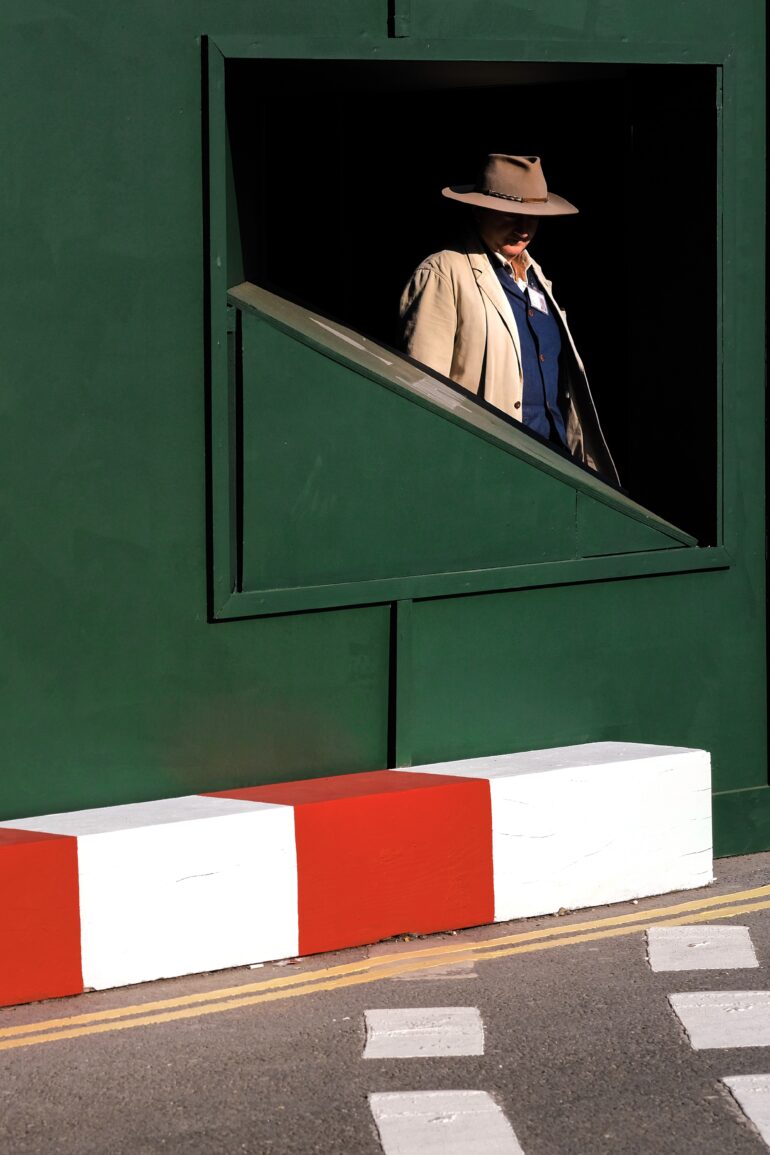
If there’s a stag do or similar going on, you’ll often find that one person in the group sees you taking the photo – but they’re in on the joke. They’re willing you on, thinking, ‘I want there to be a photo of this because it’s funny.’ And then you can get right into the frame. It’s about observing, interpreting any given situation and playing off that. But you can use all sorts of tricks. Occasionally, someone will spot that I’ve made eye contact with them accidentally while I’m getting an idea of what my composition is going to be and I don’t want them to be looking into the lens. But if I pick up the camera at that moment, that’s exactly what’s going to happen. So, I try to go incognito. I might walk past them, wait a few seconds and then double back on myself to quickly get the shot or I might get my phone out and hang there for long enough that I’ve melted into the background, almost becoming part of the street furniture. Once they forget you’re even there, you can take the shot and then off you go.
You can switch up the power dynamics, too. Say you frame up something so you’ve got your composition ready, and you’re waiting for someone to walk through to complete the shot. In this situation, people are aware of what you are doing and if they walk through, that’s their choice, so you can take as many shots as you want. But in some places, like the UK, people are inherently polite. You might be waiting for a subject to walk through your composition, but they see you with your camera, and stop, wary that they’re going to ruin the shot. In situations like this, I tend to drop the camera and give them a friendly grin to reassure them it’s okay for them to walk on. Then, the second they get level with me, I lift up the camera again and take the shot. That’s the easiest one when you’re starting out – framing up first and letting people walk through. There’s no risk there at all because it’s obvious what you’re doing.
Getting more confident on the street comes from spending time there. You don’t even need to have a camera with you. You can just walk around, watching the world. Athletes and gamers talk about being ‘in the zone’ and this is not so different. There’s a point at which you spend enough time in a space that you start understanding what’s about to happen and you can subconsciously pre-empt it. Eventually, you just get a gut feeling that makes you lift the camera at the right time and it all flows together.

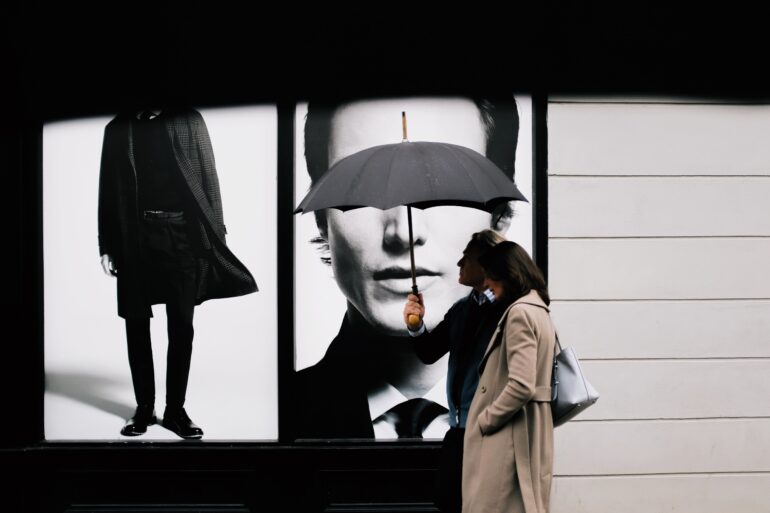
Craig Whitehead (@sixstreetunder) is a hugely experienced street photographer with a uniquely creative approach. Based in Cambridge, UK, but shooting internationally, his work focuses on color, composition and an innate sense of visual atmosphere.
Excerpted with permission from Find Your Frame: A Street Photography Masterclass (Frances Lincoln, an imprint of The Quarto Group, 2023) by Craig Whitehead. All photographs by Craig Whitehead. Find Your Frame publishes September 28, 2023 and can be purchased wherever fine books are sold. Learn more at quarto.com.






