Rowe Fine Art Gallery asks, what gets you in the mood?

Rowe Fine Art Gallery asks, what gets you in the mood?

Royal Jewels, fiber on gourd by Shirley Eichten Albrecht  (Courtesy/ Rowe Fine Art Gallery)

Royal Jewels, fiber on gourd by Shirley Eichten Albrecht (Courtesy/ Rowe Fine Art Gallery)

Artists get asked a lot of questions, but one of the most common just might be: What inspires you to create? In preparation for In the Mood, Rowe Fine Art Gallery’s latest show, which opens with a reception on Friday, Aug. 4, at 4 p.m., the gallery posed that very question to its own family of painters, sculptors and jewelers. As it turns out, inspiration can result in either a specific artwork or just the drive to spend time in the studio.

Navajo stone sculptor Alvin Marshall gets in the mood to create by waking up early, a practice his ancestors taught him. “As a Native American, I was told to rise before the sun, to welcome the sunrise and give the evening light blessings that you might awake in the morning and start all over,” says Alvin. “In my tradition, my work reflects the songs and the prayers that were set by my ancestors’ grandfathers’ grandmothers. I turn those songs and prayers into sculptures – living stones, living stories.”

Painter Julie T. Chapman, whose work has gone through a dramatic transformation over the past few years, says she used to be inspired by nature and wildlife, too. But sometimes inspiration changes as artists evolve. “Back when I was doing more representational work, I could point to the weather as inspiration,” Julie says, “but nowadays I’d be hard-pressed to do that, given the disruption in what I do. Now, it’s more like the chaos in the world/politics/our relationships to one another and the natural world that drive my work.”

Other artists point to specific moments – happy and sad – that inspired artwork. For sculptor Liam Herbert, the passing of his mother-in-law completely changed the course of his life. “As an artist, I have explored many mediums to express the entire gamut of life’s emotions,” reflects Liam. “Originally, my sculptural mediums included wood, mixed-media and bronze. That expanded when my wife’s mother passed away unexpectedly. Overwhelmed with grief, Sylvia and I attended a bereavement group for six weeks. I mentioned to the group that by the time I finished the course, I would create a wearable sculpture expressing what we were experiencing.”

Sculptor Ken Rowe also treasures the opportunity to get close to the animals he sculpts. “There’s an amazing array of animals I’ve had the absolute honor of working with, from wolves to grizzlies to mountain lions to rhinos,” he says. “In many cases, I’ve been able to handle the animal and then sculpt as I observe it right in front of me. It’s hard to describe how amazing it is to handle an animal like a grizzly, to feel its strength, see the texture of its hair, to feel the power of its breath on you.”

Come meet some of the gallery’s artists and see their latest works during In the Mood. The show runs through August. It’s the continuation of a year-long celebration of the art of storytelling. When you come right down to it, artists are storytellers, using paint, clay and precious metals the same way a writer uses words. There’s a story behind each of the paintings, sculptures and pieces of jewelry in the gallery – stay tuned as some of those stories are told throughout the year.

Rowe Fine Art Gallery represents traditional and contemporary southwestern artists. The gallery, located under the bell tower in Patio de las Campanas at Tlaquepaque Arts & Shopping Village, is open Monday through Thursday, 10 a.m. to 5 p.m., and Friday through Sunday, 10 a.m. to 6 p.m. For more information, call 928-282-8877, visit RoweGallery.com, or find us on Facebook, Instagram and Twitter.

Local artist/photographer to hold book signing during Thursday ArtWalk in downtown Casper

Local artist/photographer to hold book signing during Thursday ArtWalk in downtown Casper

CASPER, Wyo. – Suzette McIntyre will hold a signing for two of her books she has reissued during this month’s 1st Thursday ArtWalk on Aug. 3.

According to a release from the artist, the books “Reflections of Casper – An Artistic Interpretation from Past to Present” and “The Art of Being Alive – Wisdom on Living a More Vibrant Life” will be featured during the signing at ART 321 from 5 p.m. to 8 p.m. Both book focus on Casper history and changing times.

McIntyre grew up in Casper and began her artistic career while attending Casper College, where she “developed and honed her artistic skills before establishing her renowned photography business and book series,” according to her bio. “McIntyre, an internationally acclaimed photographer and author, has received widespread recognition for her signature style of photography.”

Copies of her books, along with keepsakes, cards and artwork of classic Casper landmarks, will be available for purchase during the event.

The full release follows:

Uncover the rich heritage of Casper, Wyoming and embrace the essence of vibrant living as Suzette McIntyre re-releases her two books, relevant to Casper’s changing times. – “Reflections of Casper” And “The Art of Being Alive”. This remarkable book signing event at ART 321 during the 1st Thursday ArtWalk on August 3 not only offers profound insights into vibrant living but also draws awareness to the fading icons and landmarks of Casper.

·      Book 1:”Reflections of Casper” – An Artistic Interpretation from Past to Present

Returning to her hometown of Casper, Wyoming, Suzette McIntyre presents a new perspective on the beloved town through her artistic lens. “Reflections of Casper” is an exquisite portrayal of the Milestones, Landmarks, and Heritage that have shaped the city’s vibrant history. With historic photos accompanying each piece, the book captures the essence of Casper’s transformation from its colorful past to its remarkable present. As Casper evolves and three major icons face disappearance, “Reflections of Casper” becomes a poignant tribute to the Natrona County’s past and an urgent call to protect the memory of its unique heritage. This book stands as a cherished keepsake and collector’s item, preserving the town’s legacy for generations to come.

·      Book 2:  “The Art of Being Alive” – Wisdom on Living a More Vibrant Life

In this inspiring photo essay, Suzette McIntyre offers profound insights gained from decades of exploration, journaling, and freewriting. Through words and captivating images, she unveils the significance of the Universal Power within each of us and its transformative impact on our lives. “The Art of Being Alive” guides readers on an exhilarating 7-step journey inward, embracing the art of living vibrantly amidst life’s challenges. This book was recently honored in Chicago by the International Indie Book Awards as the Best Gift Book of 2023, further cementing its place as a must-read for those seeking a deeper connection to existence.

About the Author:

Suzette McIntyre grew up in Casper, Wyoming. Her artistic journey began at Casper College, where she developed and honed her artistic skills before establishing her renowned photography business and book series. McIntyre, an internationally acclaimed photographer and author, has received widespread recognition for her signature style of photography. With a passion for the western wilderness, her coffee table books, canvases, and photographs grace galleries throughout Colorado and Wyoming. 

Join Suzette McIntyre at ART 321, located at 321 West Midwest in Casper, during the 1st Thursday ArtWalk on August 3rd from 5-8 pm. Be captivated by these timely books and meet the visionary artist in person. Signed copies of both books will be available for purchase, along with keepsakes, cards, and artwork of classic Casper landmarks.

For more information about the author and her works, contact her at 937-885-9766 or visit her website at www.photographybysuzette.com  

Amid success and sadness, Angus Cloud showed his love for Oakland and its community of artists

Amid success and sadness, Angus Cloud showed his love for Oakland and its community of artists
A mural in memory of “Euphoria” star Angus Cloud was recently painted by his friends on East 19th Street near Park Boulevard in Oakland, Calif., on Wednesday, Aug. 2, 2023. Angus, native of Oakland, died Monday at his parents house in Oakland. (Ray Chavez/Bay Area News Group)

As the death of Angus Cloud sent a shockwave through the entertainment industry, fans and critics wrote heartbreaking testimonials about the 25-year-old “Euphoria” actor, saying he could have been a great “unconventional leading man” and a global fashion icon whose beauty was both unusual and “transcendent.”

For those in Cloud’s hometown of Oakland, the loss was felt much more personally and profoundly. From staff and students at the Oakland School for the Arts, from which he graduated, to other local artists, people remembered him as one of the phenomenally gifted Oakland natives to make it big, as well as someone always happy to return home and support the community that nurtured his talent.

US actor Angus Cloud arrives to attend Variety’s 2022 Power of Young Hollywood at NeueHouse Hollywood on August 11, 2022 in Los Angeles, California. (Photo by Michael Tran / AFP) (Photo by MICHAEL TRAN/AFP via Getty Images) 

“The first time we met him this past Friday, at our record release celebration, he gave us our support,” said D.Bledsoe, a member of the rap collective MacArthur Maze, about Cloud’s last public appearance last week. Cloud attended the release party for the collective’s new album, “Blvck Saturday,” at the Torch Lounge on San Pablo Avenue.

“He wasn’t making the night about him, but he came there to show his love, which was really admirable,” D.Bledsoe said. “It was a blessing that someone of his status came out to celebrate our new work.”

Members of MacArthur Maze also appreciated that Cloud gave them a shout-out on his Instagram on July 18, directing his 7.3 million followers to watch a video of their track, “Thank You Have a Nice Day.” Cloud got to know the collective’s music through his childhood friend, Josh Kennedy, who serves as their photographer.

At the party, Kennedy shot multiple photos of his friend at the party, smiling and looking like he was in good spirits. He told The Sun that he was stunned to receive a call on Monday, learning that his friend was dead.

Oakland police, who are investigating Cloud’s death Monday morning, have not released information on how he may have died. In a 911 call at 11:30 a.m. Monday, a woman believed to be Cloud’s mother reported a “possible overdose” and said her son didn’t have a pulse, TMZ reported. Oakland police said Cloud was pronounced dead at the scene.

Cloud’s family said in a statement Monday that he had had long been open about his mental health struggles, while Cloud’s former manager, in a since-deleted Twitter thread, alleged that he was was battling “a severe” drug addiction that led to a stint in rehab, as well as relapses, a prior overdose and struggles to stay sober.

Cloud’s family also revealed that he had been in despair over the loss of his father, Conor Hickey, who died from cancer in May. Cloud recently returned from his father’s native Ireland, where he, his mother and two younger sisters traveled to hold several memorial ceremonies to spread Hickey’s ashes, the Daily Mail reported. However, a family friend told the Daily Mail that Cloud was “too traumatized” and in “too fragile” a state of mind to join his family for one of the ceremonies that took place at a family farm.

Kennedy acknowledged his friend’s addiction in an interview with The Sun and said “he’s been through a lot,” suggesting that some of his issues predated him becoming a star playing the kind-hearted drug dealer Fez on the hit teen series “Euphoria.” Kennedy also suggested that his friend liked coming back to Oakland as much as possible, in large part because people didn’t treat him like a celebrity.

On its Facebook page, the Oakland School for the Arts offered its “deepest condolences” to Cloud’s family and friends.  The school remembered him “as a multifaceted and talented artist in instrumental music, digital media and production design who had a huge presence at OSA.” The school’s post is noteworthy in that Cloud told the New York Times in 2022 that he didn’t act at all while in high school school, but instead focused on building sets and doing lighting and sound for its theater productions.

Acting suddenly became a possibility when he was discovered in 2018, while working as a waiter in New York City, he told the Times. A Hollywood talent Scott spotted him walking down the street in Greenwich Village and brought him to the attention of “Euphoria” creator Sam Levinson. Cloud’s talent and appear stood out enough that Levinson made him a co-star in the series, alongside future Emmy Award winner Zendaya, who also grew up in Oakland and attended the Oakland School for the Arts.

The school also praised Cloud for his skateboarding. Two weeks before his death, Cloud shared a nostalgic photo of when he spent time as a boy in the skateboard community at historic DeFremery Park in West Oakland. In his Instagram post, Cloud tagged local artist and arts educator Keith “K-Dub” Williams, who is known as the “godfather” of the Oakland skateboarding community for transforming the space, known as Town Park, into destination for youth and adults of all ages and skill levels, Huck magazine reported in 2015.

In his post, Cloud referred to Williams as his “godfather” and “Oakland royalty.” Following Cloud’s death, Williams paid tribute to his young friend, sharing a photo on Instagram of Cloud as a boy in a Town Park hoodie. He wrote, “You are loved by many.”

Cloud recently celebrated his hometown in another way, by working on the upcoming film, “Freaky Tales,” which is based on the childhood memories of “Captain Marvel” co-director Ryan Fleck, who was born in Berkeley and grew up in Berkeley and Oakland, according to Deadline. The film is set in Oakland in 1987 and is comprised of four interconnected stories, each featuring real-life locations and some historical events. Cloud co-stars in the film with Pedro Pascal, Ben Mendelsohn and Jack Champion, while Grammy-winning Oakland native Raphael Saadiq oversees the film’s music.

Fleck, who co-wrote and -directed “Freaky Tales” with his regular collaborator Anna Boden, took time to remember Cloud on Monday. On his Instagram, he shared a photo of the young actor, laughing on the set with Pascal.

Fleck captioned the photo: “Despite the smiles, this was actually one of the most intense days I’ve ever had on a movie set. Angus was breath of fresh air and always down to try anything. A true joy to work with. I didn’t know him long but I’ll miss him dearly.”

The Artist Xu Zhen—Prankster, Publisher, and Museum Founder—Has Returned to the Exhibition Stage With a New Show in China That Captures Our Need for Connection

The Artist Xu Zhen—Prankster, Publisher, and Museum Founder—Has Returned to the Exhibition Stage With a New Show in China That Captures Our Need for Connection

The art prankster Xu Zhen—who gained notoriety for trademarking his name as a brand and is sometimes hailed as “China’s Maurizio Cattelan”—has, after a period of focusing on facilitating other artists’ careers, made a comeback with a new solo show, this time enthralling audiences at the G Museum in Nanjing with paintings of social media screenshots. 

Situated on the 52nd floor, the museum space extends across all three skyscraper towers of Golden Eagle World, which also houses a colossal shopping mall and a luxurious hotel. The venue also provides a fitting backdrop to Xu Zhen’s exhibition. While Xu’s earlier works embraced politics and provocation—exemplified by his 2005 piece 12’91, a sculpture of a military tank with an exterior imprinted with hand and footprints—his focus has shifted towards critiquing China’s consumerist frenzy within the context of globalization. Combining diverse mediums like installation, photography, video, and performance, Xu delivers a playful synthesis of humor and subtle sarcasm.

Transforming the high-ceilinged galleries into a stunning display of both wall-scale and densely packed, smartphone-sized “social media screenshots,” Xu believes this series, titled “Passion,” encapsulates the essence of our present moment. “The pandemic and the resulting lockdowns have intensified our reliance on smartphones and social media,” Xu explained. This was especially apparent in the artist’s native Shanghai, which weathered strict lockdowns in pursuit of China’s zero-Covid policy. To produce the paintings, he extracts snippets of text from WeChat conversations and applies abstract brushstrokes to suggest the underlying sentiments and emotions of the text bubbles. Despite the smudged nature of the paintings, the familiar interface of messenger apps establishes an instant connection with viewers. 

Installation view of Xu Zhen’s “Passion” paintings at G Museum, Nanjing.

Installation view of Xu Zhen’s “Passion” paintings at G Museum, Nanjing.

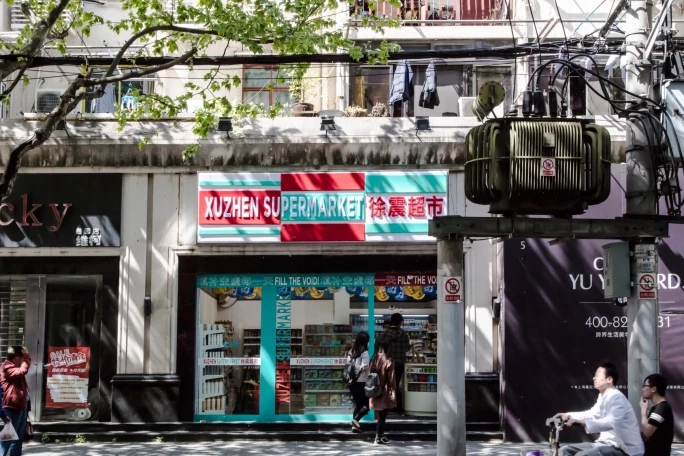
Seen as the leading and the most representative artist among his post-1970s peers (a Chinese term that refers to individuals born in or after the 1970s), Xu Zhen rose to fame in his early 20s, becoming the youngest Chinese artist to participate in the 49th Venice Biennale in 2001 (and later returning for the 2005 edition). Xu has also made notable waves in the art market. In 2018, his artwork Xuzhen Supermarket (2016)—a storefront full of empty productsfetched HK$2 million at Sotheby’s Hong Kong, marking the first piece of conceptual art to be auctioned in Asia. Notably, this piece was sold under the brand XU ZHEN®, a deliberate move to subsume his own identity within his art-making company, MadeIn Company. 

Xu also acts as his own gallerist while also collaborating with mega-gallery Perrotin. His entrepreneurial bent dates back at least to 1998, when he co-founded Shanghai’s first independent nonprofit organization, the BizArt Center. In 2006, together with fellow Shanghai artists, he founded Art-Ba-Ba (www.art-ba-ba.com), which remains one of China’s most vibrant online art publications. In 2014, he established MadeIn Gallery and launched the first “Xu Zhen Store.”  Xu’s unconventional path to becoming a generalist did not stop there. His latest venture is the MadeIn Art Museum, located on Chongming Island near Shanghai. The museum repurposes abandoned buildings from the 1970s, deliberately rejecting white-cube interiors and challenging the process of gentrification that is a hallmark of China’s private art museum landscape.

We caught up with Xu Zhen prior to his G Museum opening and talked about his new paintings, his various ventures, and the distinctive experience of making them in China.

Xu Zhen has been giving away small paintings from “Passion” for the past year.

Your work is often playful and conceptual. How have your newest “Passion” paintings become a vehicle for circulation in your conceptual practices?

This series may appear as mere paintings at first glance, but it represents one of the most ubiquitous interfaces in our lives: the various social media platforms that fill our existence, much like the iconic Campbell’s Soup cans in Warhol’s era. I believe these “messenger screenshots” embody a highly representative image of our time. Our emotions and thoughts today often stem from this interface. Toward the end of 2021, amidst the pandemic, I started exploring the realm of painting in relation to these images. Since the “Passion” series revolves around gesture and expression, I channeled the emotions I experienced as a “readymade” while personally painting each of them. Over the course of the pandemic, whether due to strict measures or not, our reliance on social media seems to have intensified. Shanghai, for instance, underwent a three-month lockdown last year, significantly affecting our sensitivity toward various forms of information.

During that period, individuals were bombarded with a constant influx of information, resulting in an atmosphere of anxiety across social media. This series of works encapsulates my perception of modern communication and information dissemination. The left side of the artwork is depicted in shades of gray that stand for the messages one receives, while the right side is represented by a vibrant green as a sign of the messages one sends, embodying the mood of a conversation. In many ways, our need for emotional support, as manifested in our reliance on social media, resonates with the emotions we observe in Abstract Expressionist paintings. That’s why I characterize this series with an impassioned, benevolent, and authentic sentiment.

I’m interested in the idea of omnimedia, which means that multiple ideas can be conveyed through different media, and these various media, in turn, contribute to the subject matter or the idea itself. In the case of the “Passion” series, I placed approximately 1,200 to 1,300 small paintings on the gallery walls, akin to the notion of the data cloud. A dialogue can be observed between shades of gray and green, reflecting the diverse range of emotions we encounter on our screens. As the quantity of these paintings reaches a certain threshold, they form a collective cloud. Whereas a data cloud is typically associated with intangible and virtual elements, the medium of painting enables us to perceive and touch this virtual concept. Here lies the uniqueness of the pictorial language that other mediums may struggle to replicate or replace.

MadeIn Gallery, front view.

You were the very first artist in China to form a company to sell artwork under your brand rather than your name. Later you became a gallerist and a museum founder. How did you become such a generalist in the art world?

I began my artistic career at a relatively young age, around 19 or 20 years old. Back then there was a period of “China fever” in the global art world that lasted until around 2007, during which time I found young artists like myself participating in exhibitions abroad almost every year. It seemed that the international community had a certain perception about China, and as an artist in the industry, I felt a certain obligation to cater to that perception. After actively working in the field for five or six years, I felt like I was becoming a representative of contemporary young Chinese artists—a label that was difficult to shake off. This led me to believe that contemporary art should not be so simplistic or full of routines.

I was also involved in running a nonprofit organization, BizArt Center, in Shanghai. For ten years, my colleagues and I curated numerous exhibitions and engaged in art media operations. The exposure to a wide range of practices gave me a deeper understanding of the constraints and limitations imposed on artists within the industry. I was prompted to rethink whether there were more possibilities for artists to explore. That’s when we decided to establish a brand and company model. Our primary motivation was to create a platform that provided freedom for artistic expression and enhanced efficiency. Subsequently, we established MadeIn Gallery in 2014, which has to date presented 50 to 60 exhibitions and supported 30 to 40 young artists. I like the efficiency. And this is a truly creative approach that is well suited to contemporary Chinese society in the context of globalization.

Xu Zhen, Xuzhen Supermarket (2016), in Shanghai’s Yu Yuan Lu.
Courtesy of Xu Zhen®.

Company and brand operation is essentially a business. So how does this business perform so far? How do you manage the gallery business as an artist yourself?

For the transaction—the artist’s price or market positioning—our approach is based on the premise that artistic creation should be interesting, of academic value, and sustainable for the artist and the market. We want a relatively benign market. We won’t have artists that are priced like a roller coaster.

As an artist myself, I have a clear understanding of how to select them. We look for artists who possess a distinct artistic style, innovative language, and the possibility of epochal significance. Sustainability is the main concern here. One of my roles as the owner is to ensure that the artists are truly “contemporary.” My experience in running a nonprofit organization helped me to work closely alongside artists with greater empathy. It also helped me to initiate or engage in conversations with them on art-making. I hope to spare young artists from some of the difficulties I have gone through. On the other hand, my team tends to work more on lending resources and focusing on the market aspects. 

Installation view, “XU ZHEN®: Embracing Chaos 1.0,” at the MadeIn Art Museum, 2022.

In the last two years, you established MadeIn Art Museum on an island quite remote from the epicenter of Shanghai’s art scene, and it also has an “anti-gentrification” hipster aesthetic. Were you deliberately breaking the systematic ecology of the Chinese art world?

MadeIn Art Museum has been one of my slowest endeavors. I had been engaged in various art projects on Chongming Island before, collaborating with the local government on land art festivals. Around four years ago, by a stroke of luck, I was introduced to this former chicken farm and was so impressed as to think about how to repurpose it. I knew there was a typical notion of what an art museum should be, but for me, art museums today are almost “living in the media.” Due to personal reasons, I have not traveled abroad since 2005 and have mostly stayed in Shanghai. The internet has become my primary source of information. Additionally, there is a growing presence of art online. The internet has also led to many painters adopting a color scheme suitable for screens. Then there is also the influence of fast, TikTok-like video clips. The contemporaneity in contemporary art today is fragmented, fluid, and characterized by sudden shifts. That’s why I’d say that at least half of today’s art museums exist within the realm of such media. I no longer feel entirely comfortable with gentrified aesthetics or museum architecture that is overly focused on design. I found it challenging to identify an architectural style that aligns with the contemporary nature I envisioned. After much deliberation, I decided to work with the existing site—a dilapidated factory building from the collectivist era, nestled amidst a primitive yet ever-changing vegetation system.

Considering China’s unique environment and social situation, is making art museums the most complicated thing you have done? What is your vision for the museum?

It’s fine for me now. In today’s China, you need a big heart to stay in business in this political and social context—you have to have resiliency. When it comes to the MadeIn Art Museum, our goal is never popularity, but to create something enjoyable for ourselves and for those who believe in or share our vision. This, I am confident, we can achieve. We also work to maintain a positive and constructive relationship with the public, abandoning the paternalistic and the overly politically correct. We don’t need more unsettling and authoritative art institutions. People live with their misunderstandings and prejudices, and art provides exactly such a space for pluralism and diverse perspectives.

There is no doubt that you have witnessed the Chinese contemporary art world’s ups and downs. How would you see the current situation of its art world and its artists? 

At the age of 46, and through observing my artist friends of all ages, I have come to realize that truly capable artists have long-term sustainability in their practice. However, for most individuals and organizations, there seems to be a three-to-five year cycle. From 2013 until now, I have witnessed a lack of accumulation [of experiences and practices] during the rise of the Chinese art museum system. Research programs and critique systems are lacking. Mere persistence is inadequate in terms of aesthetics, artistic language, and public engagement. Everything is focused on exhibiting as many works as possible. I’m not criticizing, but rather highlighting the current first phase of development of China’s art museum system.

What I’ve noticed is that young artists increasingly work like politicians or public servants—they recognize the power of discourse, values, and also acknowledge the various viewpoints of institutions, curators, media, critics, and collectors. They create art within the confines of this framework. One direct consequence is that they tend to avoid pursuing things that are outside the scope of those interests. But this phenomenon is not unique to China—it applies to young artists all around the world. 

Follow Artnet News on Facebook:
Want to stay ahead of the art world? Subscribe to our newsletter to get the breaking news, eye-opening interviews, and incisive critical takes that drive the conversation forward.

Fixing Seven Beginner and Pro Landscape Photography Mistakes |

Fixing Seven Beginner and Pro Landscape Photography Mistakes |

Photographers make mistakes; it is part of the hobby of photography. They happen from not knowing how to use the camera adequately, to forgetting to change a setting, to post-processing errors. This video covers seven landscape photography mistakes you can easily correct, whether you are a pro or a beginner.

Nigel Danson looks at seven things that can cause you to make mistakes in your photography and how to avoid them. In this video, Danson looks at mistakes from the technical side of camera settings to compositional mistakes one might make when taking photos.

Danson notes these are all mistakes that beginner photographers can make or even professional photographers, with several examples from his own experiences and portfolio serving as supporting examples throughout the video. Many of the mistakes in the video can be corrected with a little more attention while out in the field or preparation ahead of time to understand your camera gear and features before you head out.

I firmly believe in getting out there and making those mistakes so you can learn from them. It was refreshing to see that even professional landscape photographers like Danson still make errors out in the field. He did not express frustration from those mistakes, but instead, learned to be better prepared and minimize their occurrence in the future.

Today’s Photo from Ted Grussing Photography: Risk … Reward

Today’s Photo from Ted Grussing Photography: Risk … Reward

… risk … reward, is as old as life on earth … whether it be the simple act of committing yourself to the purpose of gathering food for the day or achievements in sports or business, always there is the necessity of putting yourself out there and being committed to achieving a goal … our daily gift!

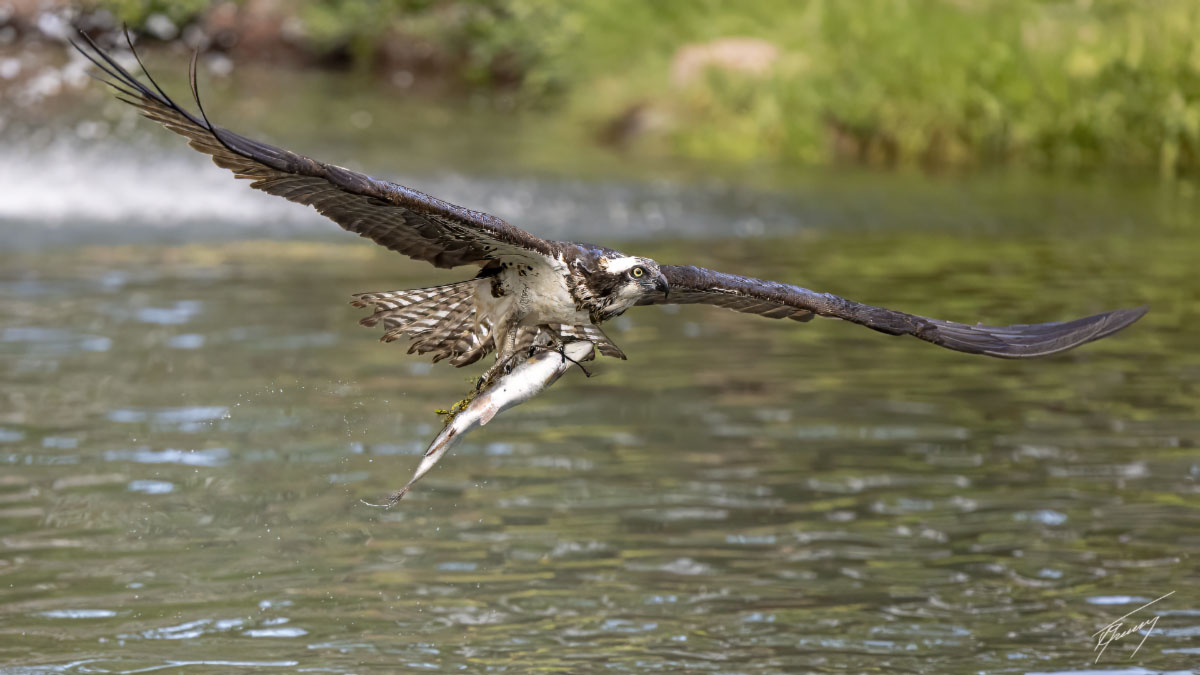
In the shot above our Osprey has set his sights on a trout swimming in the pond and his total focus is having his talons and the trout being in the same place at the same time!

Below, our Osprey has met all expectations and is making off with his reward … one of the finest trout dinners it is possible to get. Thanks to The Sedona Rainbow Trout Farm for providing me the opportunity to get these wonderful shots … check it out yourself … trout raised in and only kept in pure spring water! Doesn’t get any better than that and you do not have to make the high dive to get them.

Have a wonderful day … let a few smiles make their way across your face today and pass on a few compliments as you can … in the evening you will have a warm smile and feeling after a day well lived.

Cheers,

Ted

I lie down in slumber, and the peace of the world is
upon me. Though poverty abide with me, I pray that
courage and and gentleness forsake me not. And with
all living things out of the earth and out of other worlds
I believe I shall grow in the fields of God forever.

excerpt from A Psalm by Max Ehrmann

###

photo_tedgrussingThe easiest way to reach Mr. Grussing is by email: ted@tedgrussing.com

In addition to sales of photographs already taken Ted does special shoots for patrons on request and also does air-to-air photography for those who want photographs of their airplanes in flight. All special photographic sessions are billed on an hourly basis.

Ted also does one-on-one workshops for those interested in learning the techniques he uses.  By special arrangement Ted will do one-on-one aerial photography workshops which will include actual photo sessions in the air.

More about Ted Grussing


Healing Paws

Healing Paws

This is an advertisement

Artwork on display at the farmers market

Artwork on display at the farmers market

Sitting among her pieces of art on display at the Waxahachie Farmers Market, Victoria Garcia is completing a portrait of a cat while her mother, Alma Villarreal, is working on a landscape.

“This is very relaxing, and I really enjoy the many art crafts that I work on,” said Garcia, a sixth-year art education teacher at Walnut Grove Middle School in Midlothian. Her artwork includes handmade bead necklaces, different pottery items, paintings, and drawings.

This page requires Javascript.

Javascript is required for you to be able to read premium content. Please enable it in your browser settings.

6 NFT Artists And Experimental Studios To Watch In 2023

6 NFT Artists And Experimental Studios To Watch In 2023

When it comes to digital art, we have seen spectacular growth in the nonfungible token space over the past three years, and even more spectacular crashes with regards to the market value of collectible NFTs. While the collectibles category allowed collectors to gain decent investment returns at first, lately it feels like the overproduction of PFP collectibles (NFTs that can be used as social media profile pictures) led to a downward spiral of NFT price volatility. And yet, according to the data aggregator CryptoSlam, people are still making millions of dollars worth of NFT trades every day, roughly $118 million in the last week of June.

Clearly, the NFT art scene is far from over. The question is what digital art aficionados will value most in 2023.

NFTs are still a fantastic way to create global communities around artists and genres. NFTs are not only certificates of authenticity to certify a particular PFP belongs to someone. They are also a fantastic artistic medium, extremely versatile by design, and allowing for ambitious concepts and narratives. While there are many innovative artists creating NFTs, here are a few that have been experimenting with cutting edge technology to create unique styles that push the envelope:

Sara Ludy

The California-born Sara Ludy explores nature in uncanny ways that highlight its mysticism. Featured in exhibitions at leading institutions such as the Whitney Museum of American Art, Ludy combines a wide range of media like painting, AI, VR, video and websites to create her work. Her latest work Daance Dange Daice, a collaboration with Refraction, a DAO
DAO
focused on cultural production, and for the benefit of non-profit organization Rhizome, that has been at the forefront of digital art for almost three decades, is Sara’s first foray with AI.

Entangled Others Studio

The Argentinian artist Sofia Crespo and the Norwegian artist Feileacan McCormick form Entangled Others, a duo that uses cutting edge technology such as neural networks, AI image generation, 3D modeling and quantum computing to bring their ideas to life. Entangled Others explores different forms of life and makes poetry with technology. The duo’s work took center stage during a fundraiser for the Buffalo AKG Art Museum in 2022, resulting in a museum acquisition that bridged the NFT world to this more traditional artistic space.

Stevie P

Brooklyn-based Stevie P has a background in economics, and his artwork explores common internet scams and imaginary investment schemes, immersing his audience into a hilarious performance like no other. An extremely savvy coder, Stevie builds his projects from start to finish, investigating and utilizing smart contracts (blockchain native immutable programs) as part of the artwork. This prolific artist releases work on almost a monthly basis, keeping his audience (who he calls “his business associates”) asking for more. His latest project with the generative art powerhouse Art Blocks is Dopamine Machines (2023) and explores the language of internet advertising.

Keiken

Everyone admires the beauty in the worlds proposed by video games, but very few people know that some artists utilize them as artistic mediums. Keiken (Japanese for “experience”) is a collective based between Berlin and London that works across performance, video games, digital art and is famed for spending most of its time “working inside a gaming engine” where they make most of their artworks. Keiken creates speculative worlds that invite us to immerse ourselves in thinking about better futures. Their latest NFT work, Wisdoms for Neknel, which I had the pleasure to help lureleased alongside digital art publishers Daata and aided by AI, proposes people to experience a world where wisdom is a currency.

Jonas Lund

The Swedish born, Berlin-based artist Jonas Lund has been experimenting with blockchain technology for at least half a decade. A relentless innovator, Lund works across different media like sculpture, painting, AI, smart contracts and even tapestry-making. Always injecting a very healthy dose of humor into his work, the artist allows the audience to explore emerging technologies together with him. Lund launched a token, called JLT, in 2018 that allows its token holders to vote on decisions that affect his personal artistic practice. Currently, Jonas is set to launch the first Signature project of the up and coming platform Wild.xyz, called Most Accidents Happen at Home (2023).

Disclosure: I am part of the curation board at wild.xyz.

Felt Zine

This artist collective from New York City and Brooklyn have been portraying internet counter-culture since 2011. From music and parties, to digital art, and even launching their own marketplace, the always-in-motion iconoclasts are constantly innovating and creating new ways to perceive reality. Founded by Mark Sabb, and led by Dev Moore and Jawn Reyes, Felt Zine is a well-oiled machine. Most notably, their latest collaboration was with none other than Givenchy. Matthew Williams, the Creative Director at the luxury powerhouse, in conversation with Complex, said that the collaboration was strategic to create streetwear akin to contemporary art in web3.


NFTs have allowed for better pricing and discoverability of digital art as a whole, and created a flourishing market over the past five years. The above-mentioned artists and collectives show that there’s much more to NFTs than goofy jpegs. And they show that, in the metaverse, experimentation holds real value.

What Have I Learned About the Art Market Since January 2018? A Look Back and a Farewell

What Have I Learned About the Art Market Since January 2018? A Look Back and a Farewell

Every week, Artnet News brings you The Gray Market. The column decodes important stories from the previous week—and offers unparalleled insight into the inner workings of the art industry in the process.

This week, a sense of an ending…

Closing Time

If I’ve learned the wisdom of one journalistic adage since I joined the Artnet News staff full-time in January 2018, it’s not to bury the lede. So, in that spirit, this will be the final edition of the Gray Market in this space, as I say farewell to my friends and colleagues here to move onto something new (to be discussed in another place and time). 

For context, I first started the Gray Market as a freelancer in Los Angeles in December 2013. That means I’ve been writing under this name for about nine and a half years (technically 9.6, but who besides me is enough of a maniac about specificity to count?). For about five and a half of those years, meaning the majority of the column’s lifespan, its adopted home has been here at Artnet News. 

That stretch of time has involved a lot of personal change for me: relocating from the west coast to Brooklyn, watching both my parents retire, making it through the pandemic in good health (without leaving New York), congratulating at least a dozen new friends on becoming parents (y’all have been busy), and meeting my wife (and being smart enough to marry her, obviously), to name just a few milestones. “Bittersweet” is the word I’ve tended to fall back on to describe how leaving feels, but I hope it’s a mark of my development as a writer that I also feel like that word alone is woefully insufficient. 

But no one reads this column for extended personal reflections. What you come here for is reflections on the art business! And based on some of the stories this column addressed during my first few weeks on the job, five and a half years turns out to be an eye-opening span of time to look back on the news in this curious, one-of-a-kind industry. Besides just being downright eerie in the trajectory it reveals, this review also cements that even the most expected changes sometimes play out on an unexpectedly long timeline—and not always for the reasons we anticipate, either.

Case in point, my first Gray Market as an Artnet News employee focused on what was felt at the time as a tectonic shift in the business of American institutions: the Metropolitan Museum of Art’s announcement that it would begin charging a mandatory admission fee to non-residents of New York effective March 1, 2018. At that point, the cost for one typical out-of-state adult became $25, a figure that cultural commentators almost universally blasted for its perceived exclusionary effect. 

Fast forward to August 1, 2023the day that I filed the column you’re now readingand perhaps the biggest art story was the Guggenheim’s announcement that it will raise the price of its adult general admission ticket from $25 to $30. The new price matches the one implemented by the Met in July 2022, as well as by the Whitney Museum of American Art last month. (The Philadelphia Museum of Art also charges $30, while the Art Institute of Chicago charges $32.)

While it’s true that these latest price hikes prove that the financial struggles of even the U.S.’s most renowned museums have only worsened over the past half-decade, the reasons have shifted, too. Yes, running a top-flight institution continues to get more expensive because of inflation, upkeep, and the pressure to physically expand or renovate the premises in a sector where the bar is always being raised for the appearance of success. Museum leadership nationwide has found few, if any, new levers to pull to try to generate meaningful revenue to cover all of these escalating costs, too. 

Wu Tsang Anthem (2021). © Wu Tsang. Installation view, Wu Tsang: Anthem, Solomon R. Guggenheim Museum, New York, July 23–September 6, 2021. Photo: David Heald © Solomon R. Guggenheim Museum, 2021.

Wu Tsang Anthem (2021). © Wu Tsang. Installation view, Wu Tsang: Anthem, Solomon R. Guggenheim Museum, New York, July 23–September 6, 2021. Photo: David Heald © Solomon R. Guggenheim Museum, 2021.

Yet the shortfalls at major American museums have been exacerbated by two factors that were largely, if not totally, unforeseeable in January of 2018: the unionization wave that has walloped a sector historically content to pay staff less-than-subsistence wages, and Covid’s lasting legacy of reduced attendance at museums. For instance, Zachary Small of the Times relayed that annual visitor tallies at the Art Institute of Chicago are still down roughly 25 percent from pre-pandemic levels, while the Art Newspaper reported earlier this year that the Met’s 2022 attendance total had declined 34 percent relative to 2019. So while the underlying trend has been consistent throughout my time at Artnet News, the forces driving it have only multiplied.

What other telling stories were on the Gray Market docket in my opening weeks here? Well, in early January of 2018, David Zwirner announced plans to build a new $50 million, five-story gallery in Chelsea designed by Pritzker Prize-winning architect Renzo Piano. Zwirner targeted autumn of 2020 as a tentative opening date for the project. My take focused on the fact that it would also be Piano’s first ever commercial gallery, a natural next step for the museum-ification of the sector.

However, on July 26less than a week before the publication of the column you’re now reading, and nearly three years past Zwirner’s original ETA—the mega-gallery announced that the collaboration with Piano was no more. Zwirner has instead redirected the $50 million budget into two separate projects in Chelsea: a new 18,000-square-foot gallery on West 19th Street designed by longtime collaborator Annabelle Selldorf, and a 36,000-square-foot office space on West 20th Street that opened last month.

If you’re eager to label this news a turning point in the gallery business’s winners-take-all era, however, I’d recommend pumping the brakes. Zwirner isn’t spending any less money than he planned to; he basically just broke a dollar into two 50-cent pieces. The conversion also apparently netted him an extra 4,000 square feet of space. I do think the state of the market has a serious right hook in store for many galleries that expanded unnecessarily using the artificial sustenance of pandemic-era loans, but David Zwirner is not the place to look for evidence of the friction.

Yet the original project’s collapse does show how the über-professionalized, big-money art market is more exposed to external complications than ever before. Robin Pogrebin of the Times noted that the canceled, Piano-designed gallery “was part of a larger development by the investor Uri Chaitchik of Casco Development that encountered financial trouble during the pandemic.” Headwinds in the real-estate market can only fragment this kind of alliance if big-money developers see big-money galleries as viable partners in the first place. So even in its kiboshing, the Zwirner headquarters-not-to-be proves that these two adjacent industries see each other as equals to an extent they haven’t previously.

Rounding out the month of January 2018, In Other Words, the Charlotte Burns-helmed media wing of the now-defunct, Sotheby’s-owned advisory firm Art Agency, Partners, relayed rumors that Frieze was planning to augment its London and New York fairs with a new annual expo in Los Angeles in January 2019. While a representative from the fair brand neither confirmed nor denied the reporting at the time, it took only four more weeks for Frieze to officially announce the move (although the new fair’s dates would be in February 2019, not January 2019).

Visitors streaming into Frieze Los Angeles, 2023. Photo: Casey Kelbaugh. Courtesy of Casey Kelbaugh and Frieze.

Visitors streaming into Frieze Los Angeles, 2023. Photo: Casey Kelbaugh. Courtesy of Casey Kelbaugh and Frieze.

Now zoom ahead to July 13, 2023—three weeks prior to the publication of the column you’re now reading—when Frieze announced a different kind of stateside expansion: the acquisition of the Armory Show and the pending acquisition of Expo Chicago, two of the U.S.’s longest-running regional fairs. (The latter deal is slated to close later this year.) Although the Armory and Expo will continue operating under their own names with their existing directors now working alongside Frieze’s other fair brass, per a company statement, the transactions mean that four of Frieze’s seven annual events will now take place in the U.S., the world’s most robust art market. 

This creates a sharp contrast to the closest analogue we have, MCH Group’s short-lived campaign to acquire significant equity stakes in regional art fairs scattered across multiple countries between mid-2016 and late 2018. Which makes Frieze’s expansion-by-acquisition less a revolutionary development than a new strain of the same consolidation trend that has been playing out in the art business for most of this century, including the last five and a half years.

Even some of the smaller stories I touched on during the opening weeks of my Artnet News tenure have boomeranged back in strange ways in recent weeks. Also in late January 2018, Sotheby’s (then still under the leadership of CEO Tad Smith) announced that it had acquired Thread Genius, a startup described by Tech Crunch as offering “a set of algorithms that can both instantly identify objects and then recommend images of similar objects to the viewer.” In other words, its killer app was machine learning, an important stepping stone on the pathway to the more advanced artificial intelligence that is now an inescapable part of the art-business discourse in the summer of 2023. 

Yet almost no one cared about the acquisition at the time. Instead, the central art-tech story of 2018 was the blockchain, mostly as a means of creating either title registries for physical artworks or fractionalized investment opportunities for people who, frankly, I would advise to find better uses for their money. More than four years elapsed between Sotheby’s investment in Thread Genius and the public imagination’s takeover by ChatGPT, DALL-E, and their A.I.-driven competitors in mid-2022. As of my writing, another year has passed since that storming, and it’s an understatement to say we’re still short on clarity about the technology’s likely impact on the arts. This simple math underscores that even allegedly world-changing innovations need more time to take root than it often sounds like in the moment.  

Last but not least, in early February of 2018, I called a little attention to a talk at the 92nd Street Y between then-72-year-old mega-dealer Larry Gagosian and longtime associate Glenn Fuhrman, the financier and collector behind the FLAG Art Foundation. To me, the most newsworthy aspect of the chat was this brief exchange: 

Fuhrman: I can’t think of any other billion-dollar business in the world that theoretically could disappear because it’s so reliant on a leader. Is your business something that could survive you?

Gagosian: We are working on that… I don’t have children and that’s usually how these legacies are established… But this is something that is really important to me.

There can’t be more than about six people reading this column right now who don’t already know that its publication is only a week removed from that of New Yorker staff writer Patrick Radden Keefe’s endlessly discussed profile of a now-78-year-old Gagosian. Based on Keefe’s reporting, however, it almost sounds as if Gagosian’s thinking about his gallery’s long-term future (or at least his willingness to discuss it frankly) has regressed in the five-plus years since he spent a few words on it onstage with Furhman. 

Young buck Larry Gagosian cozying up to Leo Castelli in 1996. (Photo by Ron Galella, Ltd./Ron Galella Collection via Getty Images)

Young buck Larry Gagosian cozying up to Leo Castelli in 1996. (Photo by Ron Galella, Ltd./Ron Galella Collection via Getty Images)

In the piece, Gagosian distances the gallery’s recently formed advisory board from succession planning “per se,” and multiple episodes recounted by others (most notably Issy Wood, who he tried to recruit to the gallery) hinge on Gagosian’s unwillingness to even acknowledge that he’ll one day have to retire, let alone die. In other words, it’s not just that we’re still speculating about the same mega-dealer’s succession plan five and a half years later; it’s that we’ve arguably moved backwards even as the subject has become more relevant.

Fold these early 2018 stories and their 2023 sequels together, and you’re left with something that only time can make plain: namely, that for all the talk about seismic shifts, unprecedented developments, disruptive technology, and other factors, the art business is still largely riding the same trends captained by the same entities as it was when I started this job five and a half years ago. But the motives for these trends’ persistence haven’t necessarily been predictable. More importantly, they haven’t even necessarily been within the control of the people and businesses that have benefited from them the most.

Whether the impetus was a global pandemic, a cross-industry partnership gone awry, or a strategic pivot perhaps informed by a more ambitious rival’s earlier mistakes, there has been no surer way to play yourself in the art industry than to believe that the business is still small enough to give you and your partners even relative autonomy. At the same time, success still often demands an unshakable belief in yourself and your product, whether that means a new tech or the old standby of hard-charging salesmanship in an eternally subjective trade. It’s a paradox that no one should envy trying to manifest.

Sure, things in the art industry have changed since January 2018. They just haven’t done so at any uniform pace, or for uniformly foreseeable reasons. And even after accounting for the differences, most of the landscape looks similar to when I first started at Artnet News. 

In light of all that, my advice is to be skeptical anytime someone tells you they’re going to change anything structural in the medium term. But also keep in mind that the choice to change yourself and your circumstances is still often yours. 

‘Til next time, remember: no one’s here for a long time, so at least try to make it a good time while it lasts.

Follow Artnet News on Facebook:
Want to stay ahead of the art world? Subscribe to our newsletter to get the breaking news, eye-opening interviews, and incisive critical takes that drive the conversation forward.