Syracuse, N.Y.— The butter sculpture from the Great New York State Fair is now being recycled.MORE |800-pound butter sculpture at Great New York State Fair hi
Great NYS Fair butter sculpture recycled into renewable energy


Photographers from around the world recently submitted 20,000-odd images of bird species to the Bird Photographer of the Year contest. The showcase captures the diversity of the class Aves, as well as the dramatically different habitats the animals occupy and the ecological niches they inhabit.
(Un?)fortunately for you, this slideshow is not 20,000 pages long. But here’s the cream of the crop from those submissions: 27 award-winning images of the bevy of birds on our planet.
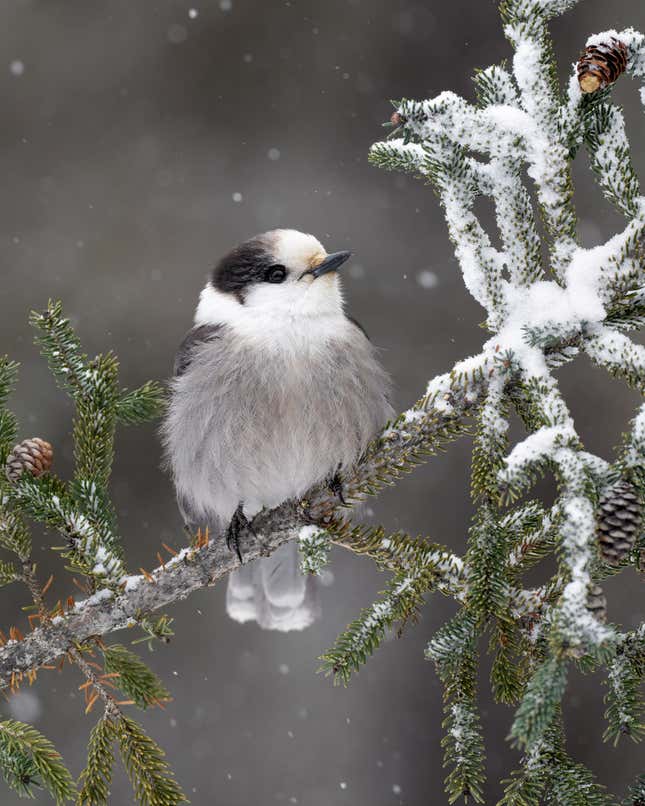
A Canada jay (Perisoreus canadensis) perches on a branch in upstate New York’s Adirondack Park. This photo was the bronze award winner in the Best Portrait category.
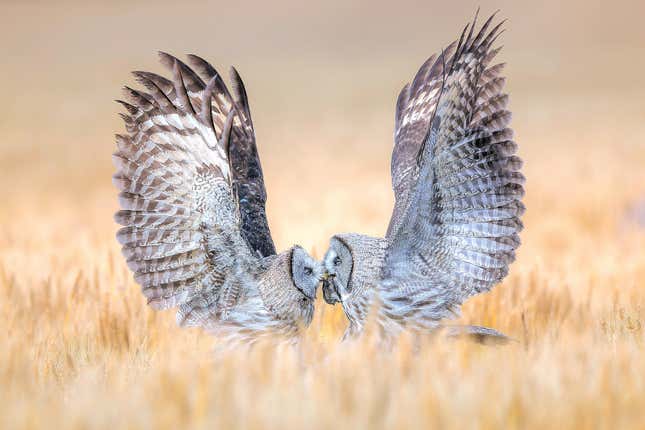
An adult great grey owl (Strix nebulosa) hands off prey to its juvenile. This image was the bronze award winner in the Bird Behavior category.
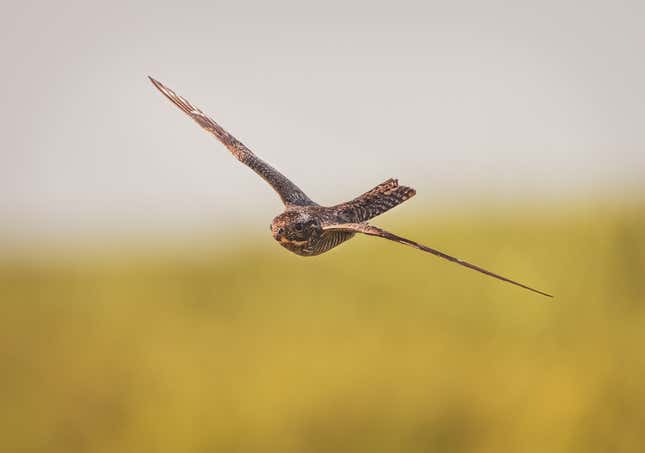
Spotted in Florida, this nighthawk took the bronze award for the Birds in Flight category.
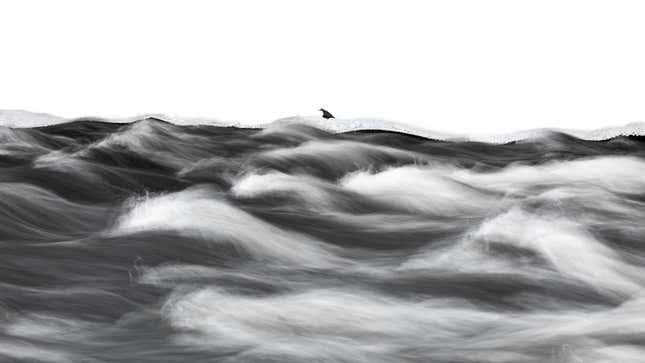
The white-throated dipper appears to float on the rushing waters of Finland’s Kitka River in this bronze award winner in the Birds in the Environment category.
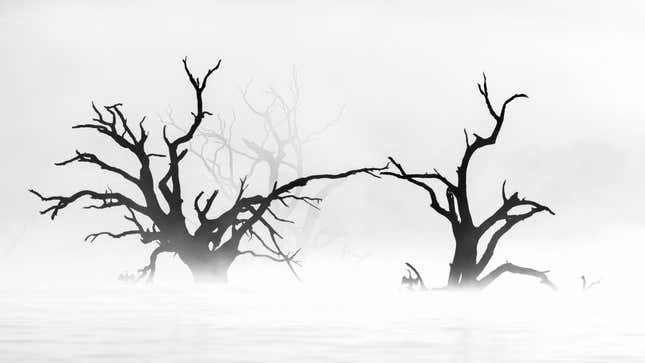
Another black-and-white shot from the competition features two Australasian darters stretching out their wings at the base of two gnarled dead trees. This image was the bronze award winner for the Black and White category.
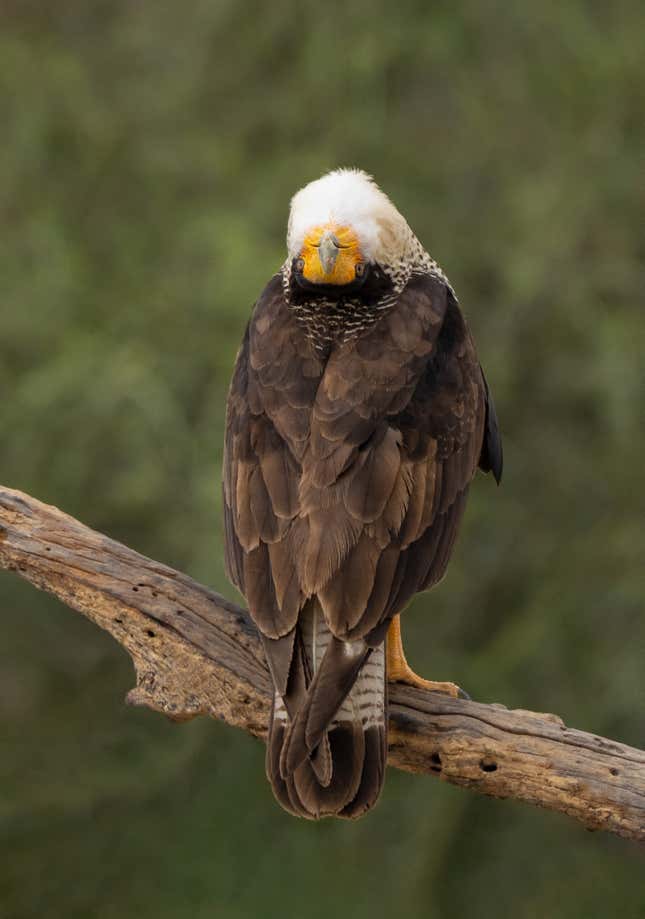
You’d be forgiven for looking twice at this image just to figure out what’s going on. In the shot, a crested caracara stretches its head all the way back to look behind its body at the photographer. This image was the bronze award winner in the Comedy Bird Photo category.
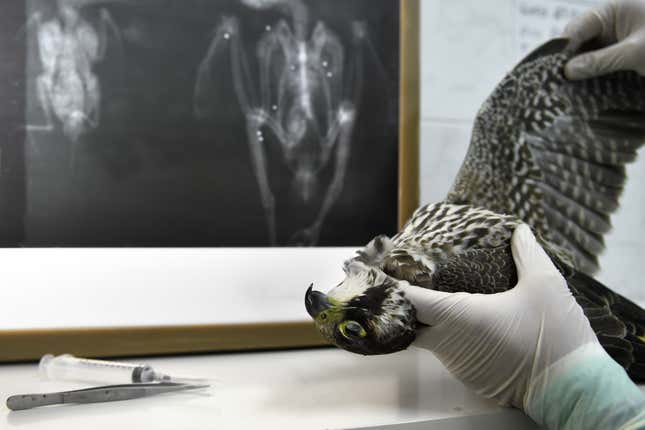
In this photo, a dead Peregrine flacon is held by a researcher at a rescue center in Livorno, Italy. A poacher killed the bird, and X-rays of the animal (seen in background) reveal lead shot in its body. This image was the bronze award winner in the Conservation (Single Image) category.
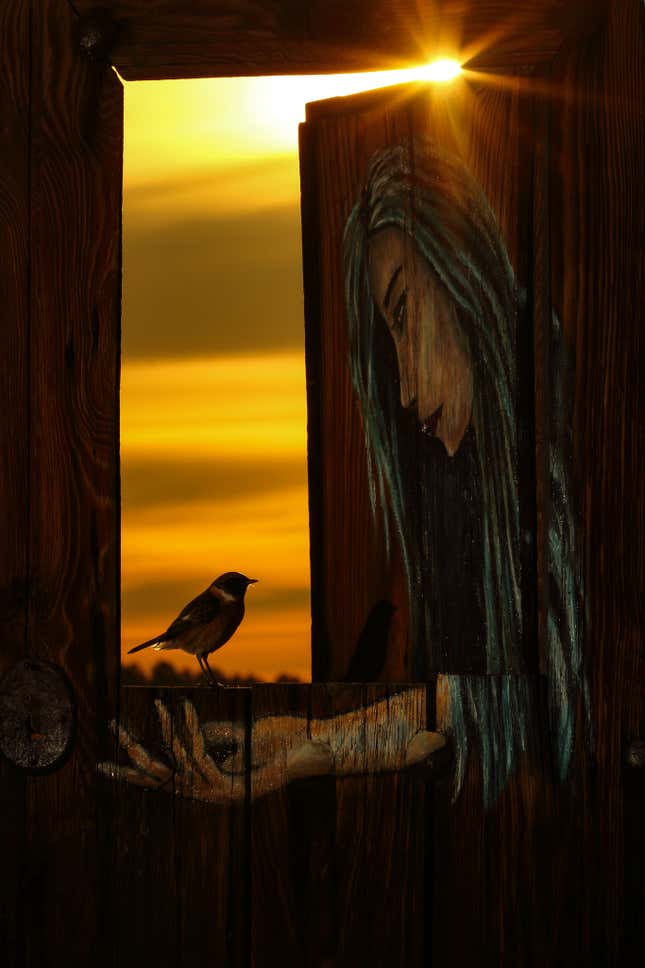
A stonechat (Saxicola rubicola) perches in the ajar doorway of an abandoned farmhouse. Note the hand of the painted woman in the image, which almost looks to hold the bird. This photo won the bronze award in the Urban Birds category.
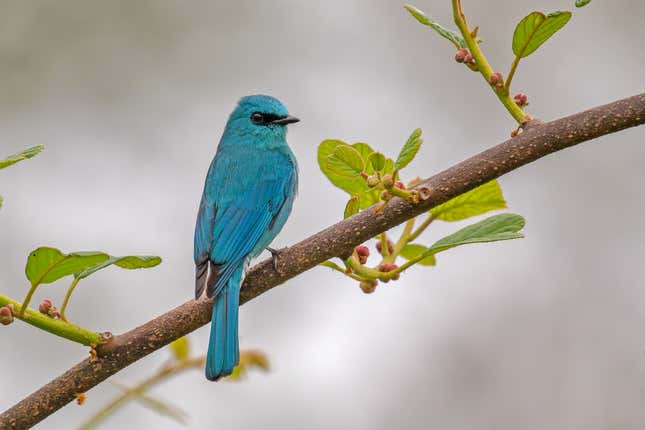
The gold award winner for the 11 and Under category captures the Verditer flycatcher (Eumyias thalassinus) in all its bluish-green glory.
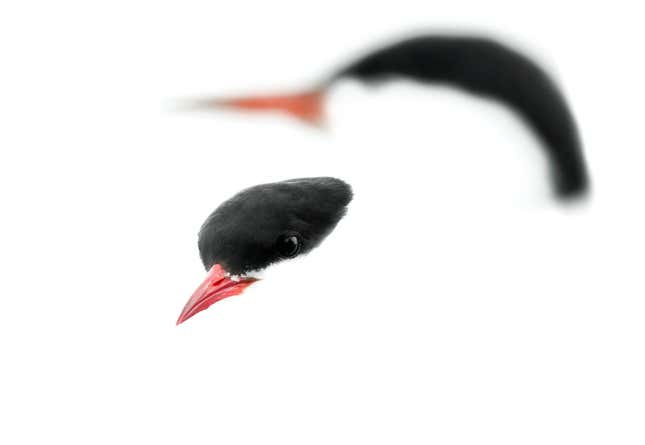
Two terns (the tops of their heads, at least) are captured in this shot taken on a Swedish inlet. The image is the gold award winner in the competition’s 12-14-Year-Old category.
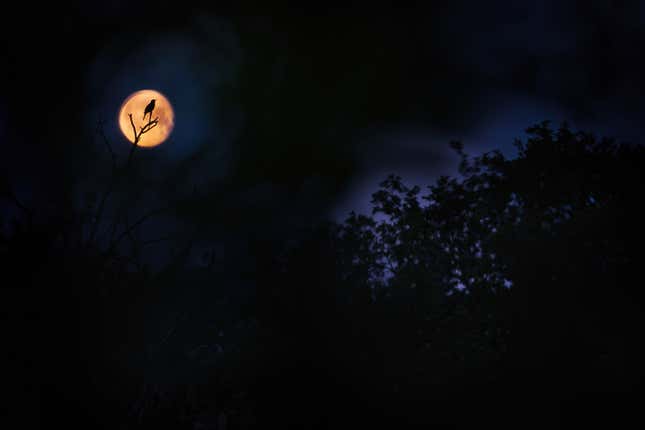
A striking shot of a blackbird set against a bright orange moon was this year’s Young Photographer of the Year winner. The image is also the gold award winner in the 15-17-Year-Old category.
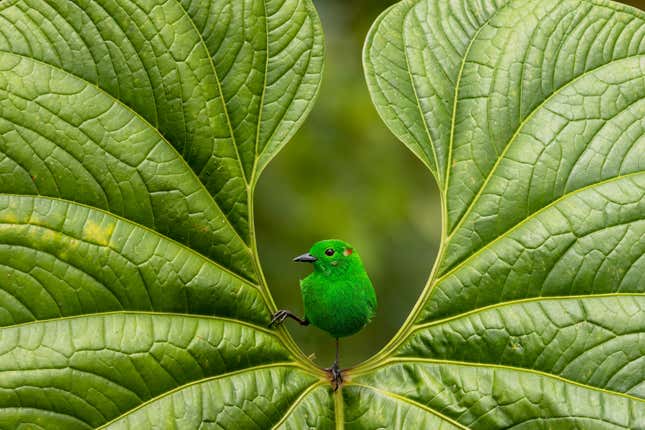
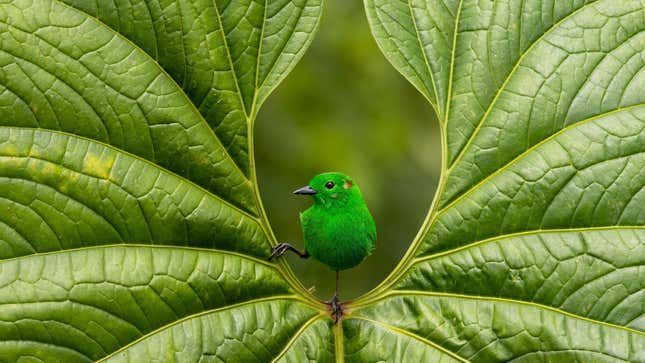
The gold award winner in the Best Portrait category is this captiving image of a glistening-green tanager (Chlorochrysa phoenicotis) in a large leaf in the Ecuadorian rainforest.
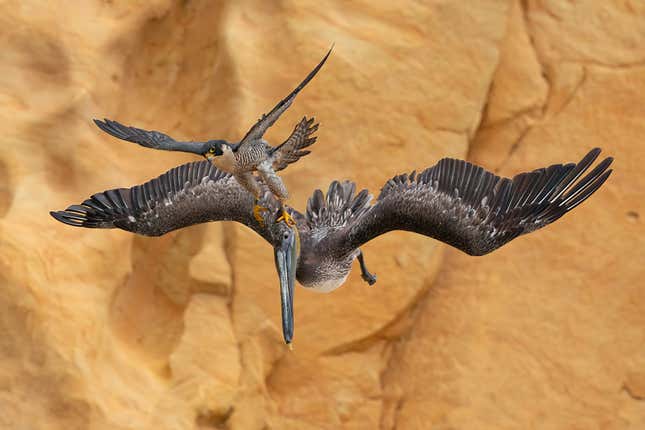
The winner of the gold award in the Bird Behavior category, and this year’s Bird Photographer of the Year, captured this shot of a Peregrine falcon striking a brown pelican that ventured too close to its nest.
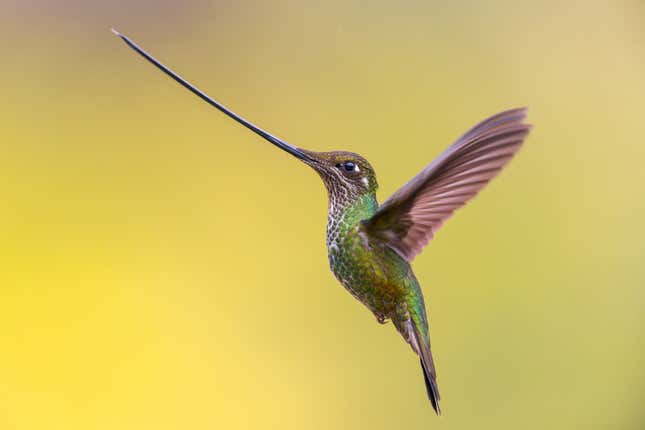
A sword-billed hummingbird in flight was the gold award-winning image for the Birds in Flight category.
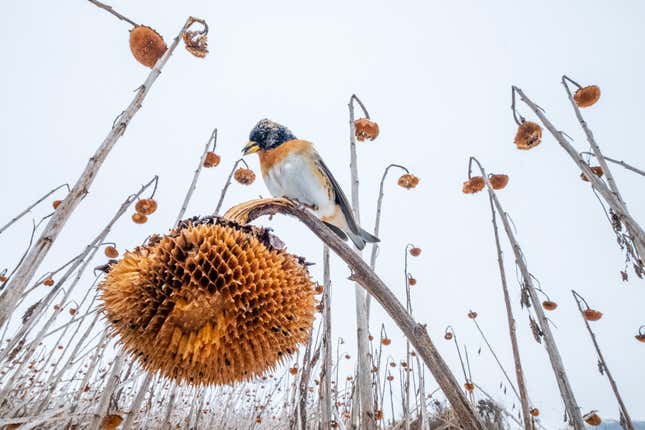
A white and orange brambling appears to match its environment: a grey sky and a field of dead sunflowers. The sunflowers were killed off by flooding, and this brambling found a happy perch atop one of the fallen flowers. The shot was the gold award winner for the Birds in the Environment category.
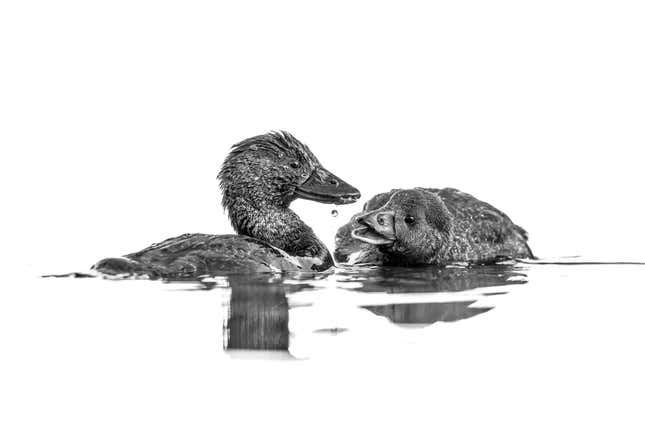
The gold award winner in the Black and White category is this Robert McCloskey-esque shot of two ducks. The duck on the right is a juvenile, apparently intrigued by a morsel in its mother’s mouth.
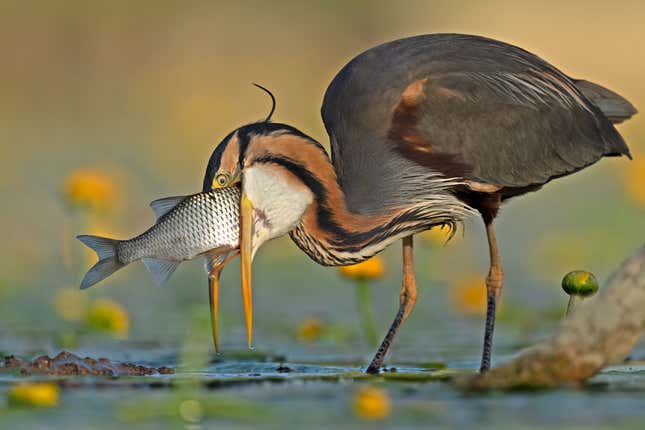
A purple heron gobbles down a large carp in this shot taken in Italy’s Lake Chiusi. The image is the gold award winner in the Comedy Bird Photo category.
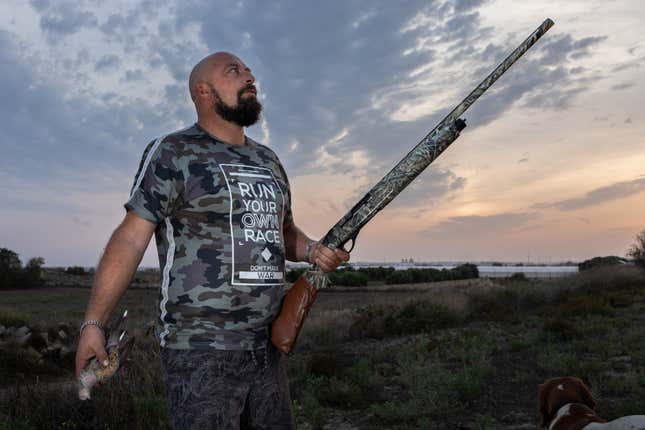
A hunter in Malta holds a legally-hunted European Turtle Dove in this gold award-winning image in the Conservation (Single Image) category. A spring hunting moratorium was in place in Malta between 2017 and 2022, but was lifted last year, exposing the doves to potential overhunting.
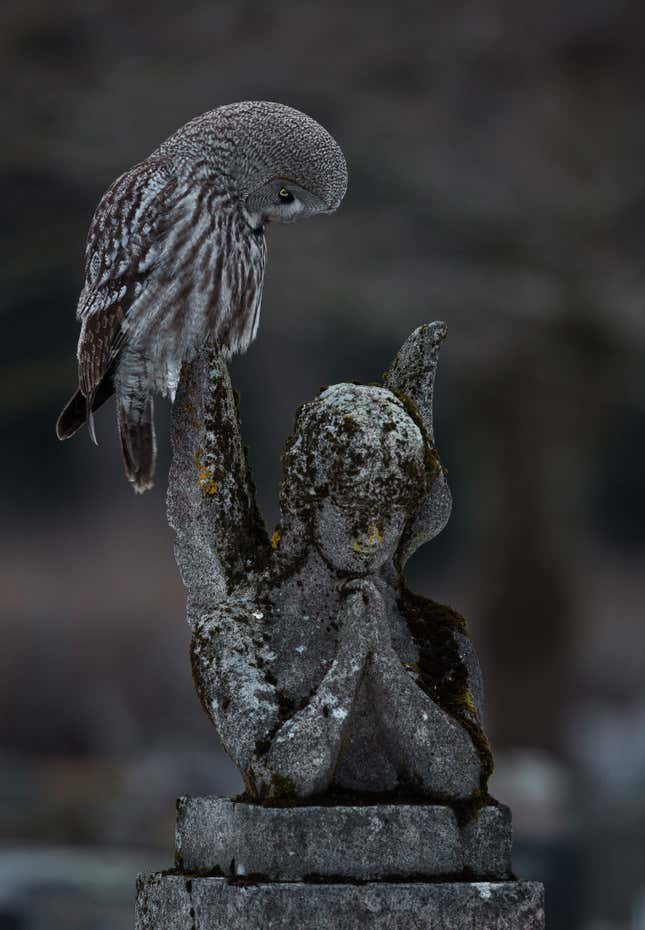
An owl in Helsinki ogles the stone angel on which it’s perched in this shot, which took home the gold award in the Urban Birds category.
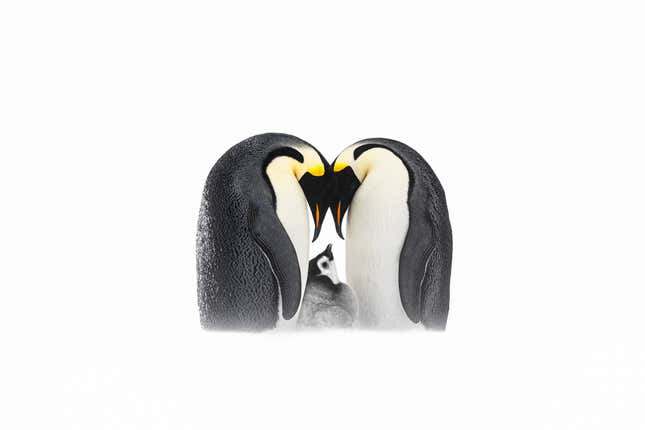
Emperor penguins stare at their chick in this shot. The parents’ posture evokes a sense of security around their progeny, especially surrounded by the harsh (and in this image, blindingly white) backdrop of Antarctica.
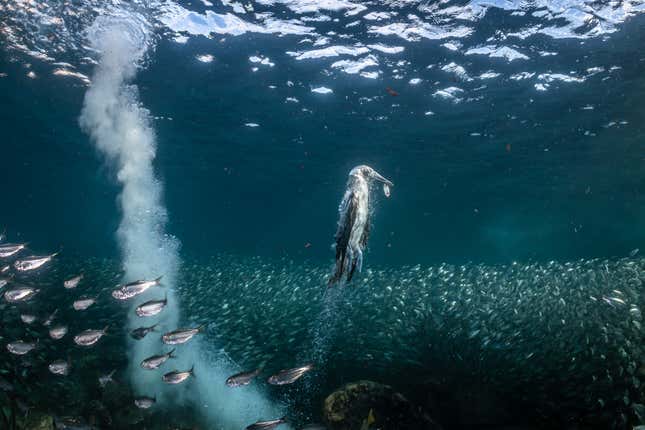
A blue-footed booby towing a sardine won the silver award for Bird Behavior, in the only featured image showing a bird underwater.
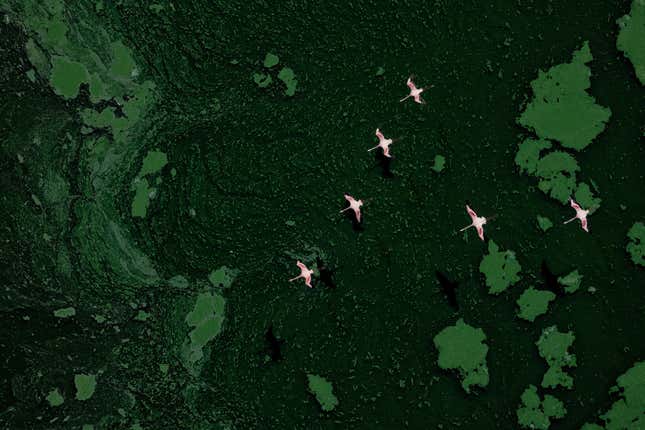
In this image, six flamingos fly over an algal bloom in a Kenyan lake, earning the silver award for the Birds in Flight category. The bright pink flamingos contrast nicely with the deep green of the algae below.
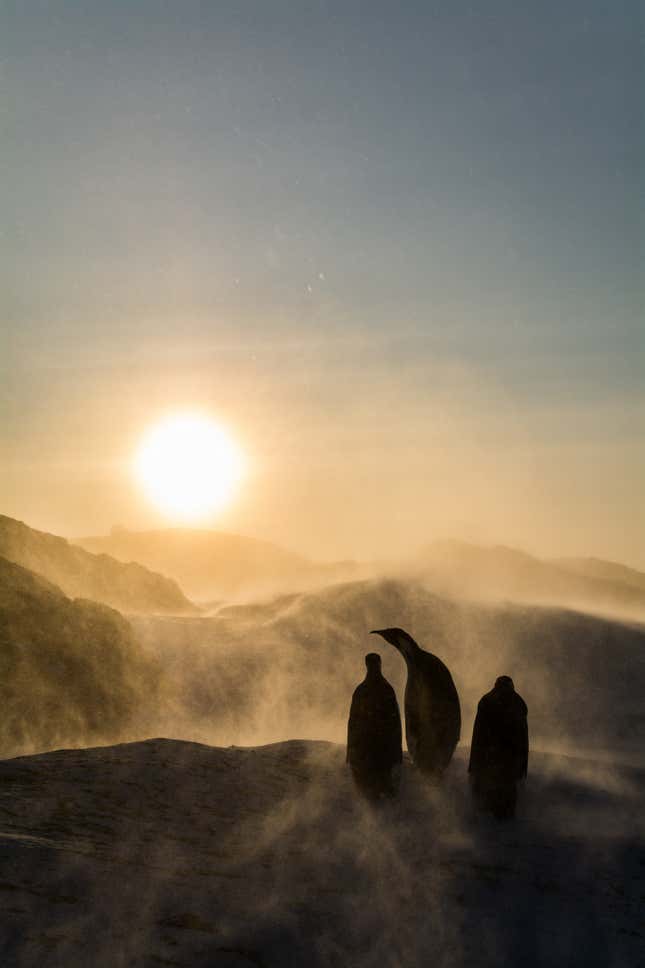
A trio of emperor penguins look out across their harsh landscape. Antarctica can be -104 degrees Fahrenheit (40 degrees Celsius), with gale-force winds. But in this moment, the sunny, snow-swept landscape appears serene.
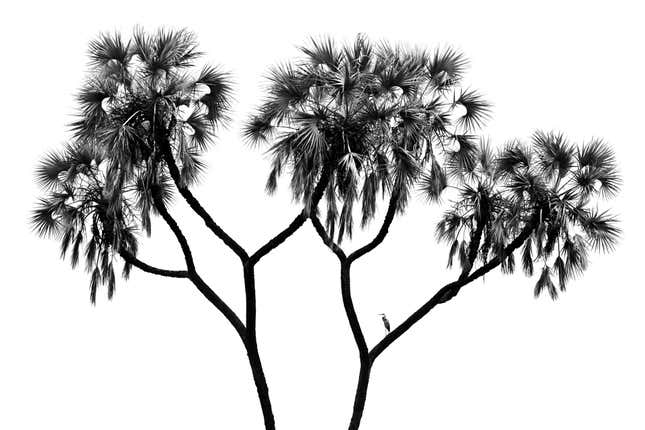
A black-headed heron (Ardea melanocephala) stands on a palm tree in Kenya’s Samburu National Reserve. This photo won the silver award in the black-and-white category.
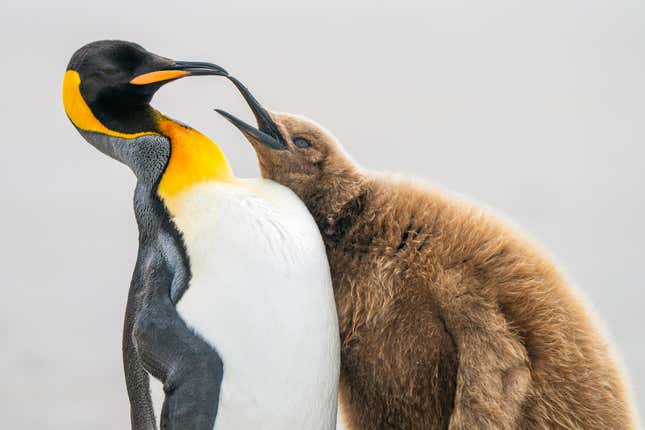
A juvenile king penguin, characterized by its chunky brown feathers and shown on the right, is seen bothering an adult. The amusing shot took home the silver in the Comedy Bird Photo category.
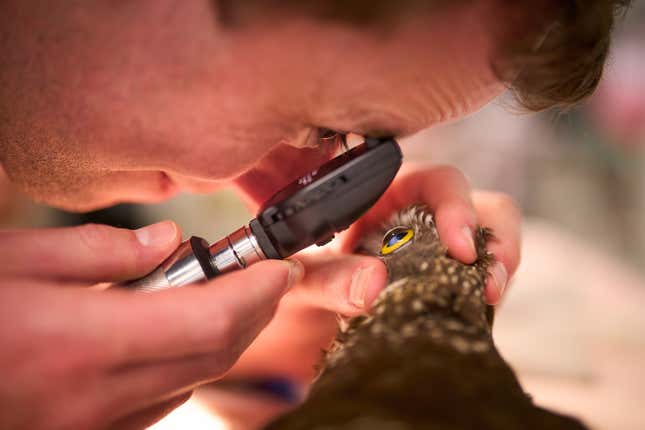
In this shot, a southern boobook, the smallest owl species in Australia, is being examined for possible eye injuries. The image won the silver award in the Conservation (Single Image) category.
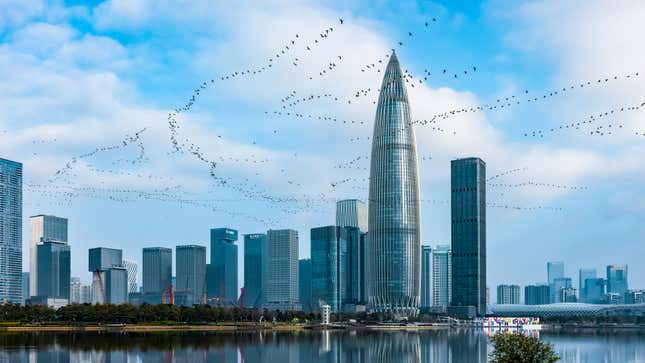
The silver award winner for the Urban Birds category is this image of migrating great cormorants, which flocked over the skyline of Shenzhen, China.

Israeli photographer Yaron Schmid claimed second place in the “Black and White” category of the International Bird Photographer of the Year competition for 2023 winners.
Read more:
Speaking to Ynet, he described how he captured his winning image in northern Kenya, in the Samburu Reserve. “It’s a reserve through which a river runs and most of the wildlife congregates around the river. The reason I and many others visit is because it’s an excellent place to see leopards and other big cats, numerous elephants, unique animals that live only there, and breathtaking landscapes.”
“One of the unique things about this area is the Doum palms, which have branches that split into two like the English letter ‘Y’. When I saw a vulture perched on one of the branches, contrary to my usual nature photography, I decided to capture it from a distance, so its silhouette would stand out amidst the palm branches. I converted the image to black and white due to the relatively harsh lighting and to simplify the image so the vulture would stand out more,” Schmid explained.
American photographer Jack Zhi claimed first place overall in the competition with his image titled “Grab the Bull by the Horns,” capturing a female bullfinch attacking a much larger rival in mid-air.
“For four years, I tried to capture the rare sight of a female bullfinch attacking a much larger rival in mid-flight. I love the expression in the rival’s eyes – surprised and frightened. The action was very fast, but I will remember this moment forever,” Zhi said. HE received a £5,000 prize for winning the competition.
More than 20,000 photographs from around the world were submitted to the competition. Photographers competed in various categories, including Best Portrait, Birds in the Environment, Attention to Detail, Black and White, Bird Behavior, Birds in Flight and Urban Birds.
Other photos that reached first places in the various categories


The second edition of Independent 20th Century will open at Cipriani South Street on 7 September with 33 international galleries exhibiting art made between 1900 and the early 2000s. “The more you search, the more you find,” Elizabeth Dee, the fair’s founder and CEO, told The Art Newspaper. “There is an endless broadening of understanding of this time period—it just feels vast.”
A large portion of the material on view was overlooked at the time of its making due to social and political prejudices. “With more investigation, the associations between artists become clearer,” Dee says, and keeping track of work created after 1970 has been easier, “but discovering how work by women, Black and queer artists from the 1910s and 20s was preserved by people who valued them is a gift”.
The fair was launched last year, after Dee noticed a shift in how people view the last century’s art and the growing number of museums attempting to correct and reorganise their collections to make room for previously unrecognised artists and their works. While the institutions have a mountainous amount of work ahead of them, the market interest for works by historically marginalized artists has experienced a significant rise.

Wanda Pimentel, Untitled, from the Path to the Superhuman Tie series, 1966 Courtesy Fortes D’Aloia & Gabriel, São Paulo/Rio de Janeiro
A striking case in the fair’s attempt to posthumously expand the reach of overlooked artists is Fortes D’Aloia & Gabriel’s solo stand for the Brazilian artist Wanda Pimentel (1943-2019), who never had a solo exhibition in the US in her lifetime. The meticulous presentation of Pimentel’s paintings of geometric precision and Pop Art exuberance (“a larger version of this booth could easily be shown at an institution like the Guggenheim”, Dee says) is the result of two years of research and preservation.
Another research-heavy participant is Hauser & Wirth Institute, whose two-person stand shows archives of the Pakistani artist Zahoor ul Akhlaq (1941-1999) and the American artist Mary Dill Henry (1913-2009). The entirely non-commercial presentation of the Swiss blue-chip’s recently established non-profit leg stems from collaborations with Asia Art Archive and Paul V. Galvin Library’s University Archives and Special Collections at Illinois Institute of Technology.
“We were drawn to Independent 20th Century’s focus on reassessing the canon to make it more inclusive and representative,” says Lisa Darms, Hauser & Wirth Institute’s executive director. “With the direct engagement with the public that the fair enables, and the opportunity for people to see selections from archives in person, we’re expecting to have some great conversations with fairgoers about the potential and importance of archives.”

Mary Dill Henry painting a mural Courtesy University Archives and Special Collections, Paul V. Galvin Library, Illinois Institute of Technology
Archives will also be a part of Donald Ellis Gallery’s stand, dedicated to baskets by the Washoe weaver Louisa Keyser, also known as Dat So La Lee (1829-1925). The Annabelle Selldorf-designed presentation will include vitrines with ephemera about the artist’s early market presence in Nevada during the heyday of the Arts and Crafts movement, in addition to displaying five of her rare baskets.
Meanwhile, Salon 94 Design’s stand will be a solo presentation of busts by the Baltimore-based ceramicist Myrtle Williams (born 1938), whose subjects include Ella Fitzgerald and Billie Holiday, as well as everyday women. The gallery’s owner, Jeanne Greenberg Rohatyn, explains: “In 1984, Williams found her hand in the ceramic studio of Montgomery County Community College where, until 2019, she envisioned, threw, coiled, carved, adorned, painted, glazed and fired some 300 ceramic Black female busts.” The design gallery’s participation for the second time speaks to the thinning hierarchies between not only histories but also creative practices.

Myrtle Williams, Flora Batson (Queen of Song), 1991 Photo: Joseph Painter, courtesy the artist and S94 Design. © Myrtle Williams
Neatness has always been a part of the Independent brand, but this sophomore edition particularly stands out with its intimate scale and inclusion of galleries lesser-known to American collectors. “We try to get galleries you don’t see everywhere or those that don’t do fairs; otherwise, the whole affair gets boring,” Dee says, and rotating 20% of the gallery list every year helps diversify the list and avoid filling stands with the usual suspects. “Showing the latest Damien Hirst in green isn’t going to excite our well-informed audience,” says Dee. “If we are going to look at the past, let’s do so maybe by talking about Coenties Slip and how, for example, gentrification changed the face of New York City.” (Coenties Slip is a piece of land in Manhattan’s Financial District that, in the 1950s and 60s, was home to artists like Agnes Martin, Robert Indiana and Ellsworth Kelly. Today, fittingly, it is a short walk from the Independent 20th Century’s Cipriani South Street venue.)
“The questions of ‘why this?’ ‘why now?’ really bring the fair forward,” says Dee, and within a commercial environment, she notes that “an intellectually generous approach” is still fundamental. “I am a big believer that no material should be dummied down,” she says, “and the original source should be brought forward as much as possible.”

No matter what genre you shoot, understanding how light behaves and knowing how to leverage it in your images makes all the difference when it comes to making compelling photos. If you are a landscape photographer and want to improve your work, check out this excellent video tutorial that offers a ton of excellent information on the types of light in the genre and how to use them.
Coming to you from Photo Tom, this great video tutorial discusses light in landscape photography. If you find yourself struggling to learn to read the light in a scene, one of the best things you can do is switch your camera to monochrome mode. By removing the color, you will be far better able to focus on the luminosity in the scene. And don’t worry: as long as you are shooting in raw (which you should always do in landscape work), your camera will save the full color information in the raw file, allowing you to edit it as you normally would. Check out the video above for the full rundown.
And if you really want to dive into landscape photography, check out our latest tutorial, “Photographing the World: Japan With Elia Locardi!”


Anyone who has trawled through a historic photo archive knows the feeling of spotting a large-format photo. Like spotting a beautiful woman in a crowd, it’s hard to drag your eyes away. That depth and clarity, which seems to top reality itself, has only ever been possible with a film plane measured in inches rather than millimeters.

I was obsessed with recreating the large format feel of a 10×8-inch film camera until the reality – scores of dollars spent for each frame and days of waiting to see the results, killed the dream.
Then I saw the June 2021 PetaPixel article on Ukrainian photographer Alexey Shportun, who partly recreated the large format look.
By replacing the plane where film usually sits with a white wall, Alexey then photographed the projected image with a digital camera looking inside the large format camera.
An important sidenote here — the credit for this idea should really go to Zev Hoover who perfected a more advanced version of the same technique years earlier using a Ukrainian-made lens, but whose breakthrough seemed to go largely unnoticed.
Soon after seeing the PetaPixel write-up, I bought a Soviet-era 10×8-inch FKD “pavilion camera” with a 300mm f/4.5 lens to test things out myself. It quickly became clear the technique showcased in that article is fundamentally flawed. The digital camera is looking at the projected image from “around” the main lens of the large format camera, so the image is distorted to the point that it’s dizzying to look at, even after severe tweaking in Photoshop. Additionally, the focus point is limited to one horizontal section of the image.

On the Facebook post beneath that PetaPixel article I wondered publicly: Instead of photographing a white plane with a digital camera poked into the front of a large format camera, why not capture the image projected onto translucent material from the back under a light-proof cloth? I received a couple of answers as to why it wouldn’t work, but none made sense to me.

I started by playing around with different materials to photograph the projected image on. First came the obvious frosted glass – a non-starter due to an intense hotspot and the grittiness of the image. Then I attempted to coat a pane of clear glass with oven-melted wax (a kitchen disaster).

The eureka moment finally arrived when I pulled a sheet of baking paper over the back of the Soviet camera where the film would usually sit. I remember the following moments well. My daughter, then a little over one-year-old, was playing on the floor next to me as I ducked under the black cloth to focus the Soviet camera and then photograph the crinkly paper with my Lumix GH5. When I emerged and looked at the photo I’d made of my barbeque outside on the terrace I was stunned. “YES!” I exclaimed.
My little girl was equally surprised at seeing me, fist in the air, making such a loud noise. “Yass!!” she echoed — arguably her first word in English.

After a little more tweaking I ended up at the ropey but functional point where the technique stands today. I use artist tracing paper stretched across the film plane and held in place with double-sided tape. I photograph the paper from inside a lightproof cloth tunnel with a handheld Lumix GX9 and a 17mm f/1.2 Olympus lens. The cloth is held in place with bulldog clips and my teeth.

One thing worth noting: That super fast lens is essential. Even in a sun-drenched scene it’s hard to get a shutter speed faster than 1/200th so getting a sharp image on an overcast day or in the shade can be a struggle with anything slower than f/2.0.

The first outing for this technique was in the summer of 2021 in Ukraine. I used it on a couple more shoots, including in Armenia, but perhaps the perfect subject for the camera was the 2023 Zheravna festival in Bulgaria, where no technology is allowed inside the venue (they let me in with the giant, antique camera), and entry is only permitted for those wearing traditional or historic clothing.
With that I’ll stop talking, and unroll the photos I made that day. I will answer as many questions about the technique as I can, as I continue to iron out the technique’s many flaws. Enjoy the pictures.


About the author: Amos Chapple is the senior photo correspondent for RFE/RL and is based in Prague. You can find more of his work on his website and Instagram.

The official start to the fall art season is upon us. Kids are back in school, the heat may soon abate, and the Ruinart is ready to be corked. That’s right, it’s Armory Art Week, whence a slew of fairs arrive in Manhattan, and galleries and museums across New York City celebrate the beginning of another action-packed year.
Below, enjoy our essential guide to the upcoming parade of art events.

Photo: Vincent Tullo. Courtesy The Armory Show.
When: VIP preview: Thursday, September 7; Public hours: Friday, September 8 and Saturday, September 9, 11 a.m. to 7 p.m.; Sunday, September 10: 11 a.m. to 6 p.m.
Where: Javits Center, Crystal Palace Entrance, 429 11th Avenue
What to Know: Is it a regional fair or an international one? That is the question on many art world observers’ lips these days, and the 2023 instantiation of the Armory Show may help settle the matter. Although the Armory show was bought by growing art-fair conglomerate Frieze earlier this year in a deal announced in July, expectations are that this edition will be unchanged by the acquisition.
It’s the fair’s third outing at the Javits Center, an enviable venue (and perhaps part of Frieze’s interest in buying the Armory Show). The event will host more than 225 galleries representing more than 35 countries and 800 artists.
This year also heralds the third edition of Armory Off-Site. The outdoor program will present three large-scale sculptures at the USTA Billie Jean King National Tennis Center during the U.S. Open, and present artworks in partnership with Times Square Arts at the organization’s Midnight Moment program.

Work by Lee Quiñones on view with Ross and Kramer Gallery, New York, at the Independent 20th Century fair at the Battery Maritime Building. Photo courtesy of Ross and Kramer Gallery, New York.
When: VIP preview: Thursday, September 7: 11 a.m. to 8 p.m.; Public hours: Friday, September 8 and Saturday, September 9: 12 p.m. to 8 p.m.; Sunday, September 10: 11 a.m. to 6 p.m.
Where: Battery Maritime Building at Cipriani South Street, 10 South Street
What to Know: For the sophomore edition of Independent 20th Century, which focuses on the rich artistic movements and artists of the period between 1900 and 2000, more than 30 galleries and non-profit organizations will showcase works at the historic Battery Maritime Building at Cipriani South Street, with 12 exhibitors including Almine Rech, Van Doren Waxter, and the Hauser & Wirth Institute making their debut at the fair.
Female artists are at the forefront this year, with highlights including a solo presentation of French artist Marie Laurencin, presented by Nahmad Contemporary, and Galerie Lelong and Co.’s presentation of an unseen body of work by the late artist Mildred Thompson.

Work by Ole Marius Jorgensen, exhibited at Momentum Gallery.
When: Public hours: Friday, September 8 and Saturday, September 9: 11 a.m. to 7 p.m.; Sunday, September 10: 11 a.m. to 6 p.m.
Where: Javits Center
What to Know: The long-awaited debut of Asia’s largest photography fair in the U.S. is finally upon us, promising an exposition of 60 international galleries that will “bring a new energy to the fall season in New York.” A range of video, virtual-reality, and photographic works will be on display under the guidance of art world veteran Helen Toomer, director of the New York edition.
Exhibitors include For Freedoms (New York), ROLF ART (Buenos Aires), Luis de Jesus Los Angeles (Los Angeles), Momentum (Miami), and 193 Gallery (Paris). Special programming will be presented by partners including Fotografiska New York and Gagosian Quarterly.

Yasmine K. Kasem’s work, curated by Rokhsane Hovaida, at Spring/Break Art Show Los Angeles 2022. Photo by Sarah Cascone.
When: First look: Wednesday, September 6: 11 a.m. to 5 p.m.; opening night: 5 p.m. to 8 p.m.; Public hours: Thursday, September 7 to Monday, September 11: 11 a.m. to 7 p.m.
Where: Old School, 32 Prince Street
What to Know: This smaller fair, which often makes use of unconventional venues, has been called “scrappy,” “beloved,” and even “undoubtedly the best New York City fair at which to snap up emerging artists at reasonable price points”—and that’s just in Artnet News.
Founded by Andrew Gori and Ambre Kelly in 2009, Spring/Break has engendered a crowd of devout cheerleaders over the intervening years, climbing from a fringe fair to a staple—a beloved (yes, we’ll say it again) diversion from the commerce of Armory Week. This year, Spring/Break hosts more than 120 curatorial projects with work from more than 400 artists at the former headquarters of Ralph Lauren.

A view of Art on Paper in New York City. Courtesy of Art on Paper.
When: VIP preview: Thursday, September 7: 5 p.m. to 6 p.m.; opening night: 6 p.m. to 9 p.m.; Public hours: Friday, September 8 and Saturday, September 9, 11 a.m. to 7 p.m.; Sunday, September 10: 11 a.m. to 6 p.m.
Where: Pier 36, 299 South Street
What to Know: The ninth edition of Art on Paper, which showcases… art on paper… returns to Manhattan’s Pier 36 during Armory Week with a robust 100-exhibitor lineup under the direction of Nato Thompson. Highlights include a dual presentation of Judy Pfaff and Barbara Zucker at Accola Griefen gallery, and ADLAR Studio will show prints by artists Kenny Scharf, Analia Saban, Shane Guffogg, Matthew Brandt, and the Haas Brothers.
 Rupture (2022). Courtesy of Salon Zürcher.” width=”1024″ height=”431″ srcset=”https://www.mecreates.com/story/news/wp-content/uploads/2023/09/MicrosoftTeams-image-20-1024×431.jpg 1024w, https://news.artnet.com/app/news-upload/2023/08/MicrosoftTeams-image-20-300×126.jpg 300w, https://news.artnet.com/app/news-upload/2023/08/MicrosoftTeams-image-20-50×21.jpg 50w, https://news.artnet.com/app/news-upload/2023/08/MicrosoftTeams-image-20.jpg 1031w” sizes=”(max-width: 1024px) 100vw, 1024px”>
Colleen Herman, Rupture (2022). Courtesy of Salon Zürcher.
When: Monday, September 4: 6 p.m. to 8 p.m.; Tuesday, September 5 and Wednesday, September 6: 2 p.m. to 8 p.m.; Thursday, September 7, Friday, September 8 and Saturday, September 9: 12 p.m. to 8 p.m.; Sunday, September 10: 12 p.m. to 5 p.m.
Where: Zürcher Gallery, 33 Bleecker Street
What to Know: This mini-fair, which has its other edition in Paris, bills itself as an alternative to “superstore-style fairs,” during Armory Week. The 29th edition of Salon Zurcher is titled “The 11 Women of Spirit, Part 8,” and features—you guessed it—work by women artists. Among the 11 Women showing work in Part 8 are Lauren Ball, Elizabeth Bisbing, and Agathe Bouton.

Visitors at Clio Art Fair. Courtesy of Clio.
When: VIP opening: Thursday, September 7: 6 p.m. to 9 p.m.; Public hours: Friday, September 8: 12 p.m. to 8 p.m.; Saturday, September 9: 2 p.m. to 8 p.m.; Sunday, September 10: 2 p.m. to 6 p.m.
Where: 550 West 29th Street
What to Know: The biannual art fair named after the Greek Muse of history and poetry returns to New York for its 15th edition, continuing its mission to give a platform to artists without exclusive gallery representation.
The alternative model lends itself to a more creative fair-going experience, and in addition to the 70 participating independent artists, this year’s event boasts a series of performances titled “Confess Your Dreams” and a special section titled “Losing Track of the Lost” that explores homelessness and social justice.
Follow Artnet News on Facebook:
Want to stay ahead of the art world? Subscribe to our newsletter to get the breaking news, eye-opening interviews, and incisive critical takes that drive the conversation forward.










