Explained: Art historian B N Goswamy’s work on Indian miniature painting tradition


Nov. 17—COEUR d’ALENE, Idaho — From big game in the most inaccessible of foreign lands to hummingbirds on a feeder in the handiest back yard, the principles of good wildlife photography can be translated to success by those willing to put in the work.
Learning to capture images that capture imaginations has been a quest of decades for the Mountain West’s Tim Christie. Christie divides his year between Idaho and Arizona, spends his days outdoors in the areas where critters are found and is rarely afoot without camera gear in hand. His advice for those who want to take the show-stopping photos of their dreams, whether for fun or profit or both, is condensed in three essential tips.
Know your gear
“The first step is to make sure you understand the technology of the camera in your hand,” Christie said. “While modern cameras are meant to be bulletproof, allowing you to just point and shoot and have everything come out perfectly, that doesn’t work reliably if everything is not right. If your subject is backlit, if there are obstacles between you and it to distract the autofocus, the camera won’t do it for you.
“More than just working out how the camera works, it’s well worth your time to learn photography from the ground up. Don’t let the fact you can do some things with the camera keep you from learning to do everything with the camera. Whether you take a class from someone who knows what they’re doing, or find a good book that outlines the basics and builds from there, it’s important to understand lighting and composition, to know how shutter speed and aperture affect your depth of field and so on. It’s simple stuff, but if you don’t know why things work, you’ll limit your ability to create the sort of magic you otherwise could.”
Elements of the art that are unchanged from the days of Ansel Adams are still important to understand today. In fact, they’re the key to unlocking the gear’s greatest potential and, in so doing, your own as well.”
Know the critters
“Like many photographers I know, I started out not planning to be a photographer but was introduced to the outdoors early on,” Christie said. “My mom and dad loved the outdoors and really liked to camp. I got interested in hunting and my dad, who didn’t hunt, would take me hunting and hooked me up with people who knew how to hunt. That’s something for which I’m immeasurably grateful, something I only partially appreciated at the time. He went out of his way to do for me what’s proven one of my life’s greatest favors.”
Christie was teaching classes on public speaking and interpersonal relations at North Idaho College when his interest in the science and art of real photography began to grow.
“I had a Kodak Instamatic, a little fixed-focus camera I was using to take well-composed photos of just the crappiest quality you could imagine,” Christie laughs. “I had a friend who taught a photography class and, when I signed up for one of his sessions, the first thing he told me to do was arm myself with a ‘real camera,’ which meant a 35 millimeter. I bought one second hand from a student in one of my classes and really impressed myself with the quality of the photos it took. Pretty soon, I discovered I was spending more time with the camera in my hand than I did with a rod or a gun. I invested in some decent lenses and went from there.”
The ability to put himself into position to see critters to photograph in the first place is one skill Christie already had.
“One of the true gifts hunting has done for me is, it’s let me see the world through the vision of an animal or a bird that makes me say, ‘Wow!'” he said. “It’s hard to describe to someone who doesn’t love the outdoors, but people who hunt, birds or elk or whatever, when you see an animal in a certain situation in a certain light, it takes your breath away, and that’s a gift I was given by hunting.
“I’ve learned to anticipate what’s going to happen next, and I can put myself into a position to make the most of what’s going to happen.”
Know the goals
Good photography of wild critters requires the same elements a good photo of anything would need, which means a good photo can be deconstructed by someone who looks at it from the photographer’s point of view.
“Look at magazines that have the sort of photos you’d want to capture, then figure out what makes that photo what it is,” Christie said. “The composition, the light, the expression on the critter’s face, all of those play a part. Great photographs create great emotional responses, the reaction that makes people say, ‘I wish I could have been there,’ or that makes them think of experiences they’ve had themselves. That’s what you’re after.”
Christie’s first show-stopping photo of a critter in the wild brought all three of those key elements together.
“I knew where some mountain goats were, in a national park in Canada,” he said. “It was March, and the temperature was 25 degrees below zero when I left my car. I could see the goats, and I climbed for an hour to get onto their ridgeline and be on the same level they were.”
The minute he got into position to take his first photo, the goats began moving away and both his effort and opportunity seemed lost.
“They didn’t run away exactly, but mountain goats don’t have to run,” Christie said. “They walked away until they had put a shoulder of the ridge between us, and I knew they’d be walking across the top of an avalanche chute where they were going.”
Christie followed carefully, taking his time. When he rounded the corner he found himself face to face with the billy of any hunter’s dreams.
“Mountain goats in the winter have some of the most glorious hair anyone could ever see,” Christie said. “They look like they’ve just been to the beauty parlor and gotten blow dried.”
Yards away, a record-book goat stood in the mountain breeze, his long, wispy hair floating against a background of royal blue on a day so clear you could see forever.
“I was so close, I’d made the goat nervous, so I carefully backed away, and that made him calm down,” Christie said. “He was standing on a precipice with all of the Canadian Rockies behind him, and I shot every frame of film I had.”
When the editor of American Hunter saw the images that had met Christie’s eye, his first cover photo was sold. The world was introduced to Christie’s photography with the magazine’s April, 1981 edition. Since then his work has appeared on magazine covers more than 500 times. From big game to birds on the wing, Christie’s mastery of the art is one he hopes to always continue to grow and improve.
“Any kind of photography can be really exhilarating, or you can wait around a lot and hope something happens and, when it does not, you can know at least you’ve been alive today and free on the Earth,” he said. “It’s a great way to enjoy a life.”
To see more of his work and to purchase his latest book, “Stories painted with light: Amazing wildlife photographs and how they were made,” visit www.timchristiephoto.com.
Kevin Tate is the weekend edition editor for the Daily Journal. Email kevin.tate@journalinc.com.


When the coronavirus pandemic hit, artists around the world faced a challenge. With museums, exhibitions, and art forums closed, they suddenly had nowhere to present their works to the public.
At least not in analog form.
“Many artists were left wondering how to sell and market their work,” says Alexandra Cozgarea, art curator at SAP. “That’s why we saw a great deal of hype around digital art at the time – and especially about artworks in the form of NFTs.”
SAP’s latest exhibition entitled “The Poetry of Blockchain” is the first it has staged exclusively for NFT art and features 47 works by 18 artists. But what exactly are NFTs?
NFT stands for non-fungible token. This is a unique, non-replaceable, and non-interchangeable digital object stored on a blockchain that acts as a certificate of authenticity and ownership of a physical or digital asset, such as a picture. It takes the form of a digital identifier composed of a unique string of characters.
If you want to buy NFT artworks, you need cryptocurrency and a crypto wallet – installed on your smartphone or other device – to store them in. You’re then ready to visit one of the many open platforms on the Internet, known as “NFT marketplaces,” where people can browse NFTs or search for works by specific artists. One of these marketplaces is OpenSea.
“These platforms work a little like galleries,” says Cozgarea. “Artists wishing to offer their work for sale there upload their pieces to the underlying blockchain to create NFTs in a process known as ‘minting.’”
These tokens can represent a single, unique asset or multiple copies of the same asset, in which case the image displayed on the platform will be identical but the digital identifier will be slightly different for each copy. This means an artist can mint an entire series of artworks and put them up for sale on an NFT marketplace.
“Many of the works on these marketplaces are created digitally and added straight to the blockchain as NFTs,” explains Cozgarea. “But it’s also possible to create NFTs from analog artworks such as oil paintings or sculptures. You would do this by photographing the artwork and uploading it as a JPG file.”
When you have selected an artwork you wish to buy, you place a bid for it on the platform or, if a fixed price is specified, make an offer. If the artist accepts your offer, the NFT is released and payment is made using the cryptocurrency deposited in your wallet. You then receive a link containing the address of the NFT and can transfer it to your wallet.
The acquired piece can be displayed at any time – as a JPG, video, or other file – by clicking a link or scanning a QR code. But the token itself stays in the buyer’s wallet.
“The artists exhibiting their NFTs at SAP in Walldorf copied their artworks onto a USB stick as files,” says Cozgarea. “The original artwork remains securely on the blockchain, so if the stick is lost or stolen, it makes no difference to ownership.”
“Many of my works are the result of several years of research, during which I investigate and change gaps in history, the background of coding, and the opaque influence of databases on the development of algorithms and the resulting creation of images. At every stage, I ask, ‘Who are we and what shapes our identity? What makes a person? What traces do we leave behind in the places where we live?’”
Johanna Reich, exhibiting artist
NFTs are having an impact way beyond the art market. The business world has recognized their potential, too. At SAP, a team spread across three continents is working on an NFT management solution that focuses on customer engagement and loyalty programs.
To showcase the possibilities of the solution, visitors at the opening night of the SAP art exhibition were invited to access NFTs created by SAP. Sven Haiges, a software developer at SAP Labs Munich, explains the background: “We are working with MetaBrewSociety, based in Bavaria, Germany. It’s a startup that has financed itself partly by selling NFTs. By scanning a QR code on one of the beer cans we ordered with them, customers and visitors at SAP events can now claim one of our own NFTs, created with our NFT management solution.”
“At the moment, only about 5% to 10% of the population understands crypto and NFTs, and they tend, of course, to be younger people,” says Haiges. But he fully expects the level of interest and engagement to grow.
Cozgarea sees NFTs as a response to digitalization and what she describes as its promise of openness, exchange, and – to some extent – democratization. “NFTs present a concept of ownership for the digital age. People are looking for something exclusive,” she says.
There are 47 works of art by 18 different artists on display at the SAP training center in Walldorf – all on monitors. The organizers decided against streaming the works live from the blockchain because that would have been very energy intensive.
“This exhibition contains exclusively digitally produced works,” says Cozgarea. “But it also includes works that are based on traditional art forms and play with the possibilities of digitalization, such as augmented reality.”
Reinhard Schmid, one of the exhibiting artists, says: “I created my first cryptoart in 2018 and have featured in many publications and exhibitions since then. ‘The Poetry of Blockchain’ is a massive highlight for me. The fact that a global player like SAP is exhibiting NFTs is an important milestone for both me as an artist and for the entire Web3 community.”
The exhibition runs until February 23, 2024. Check out a digital 360° tour of the exhibition.
Top image courtesy of SAP employee Juelma Guerreiro.

But since this episode aired, what more have they learned about Asahel Curtis?
“The response to the episode was amazing,” says Berger. “Viewers let us know that they had Asahel Curtis images in their scrapbooks at home. People were finding things like lantern slides in their garage. And so we suggested that people contact the Washington State Historical Society because they have the largest collection of Asahel Curtis images.
“And the head of collections, Margaret Wetherbee, said that they were about to embark on this project of digitizing 55,000 Asahel Curtis images … [their] entire collection. They’re working from the original glass plate and nitrate negatives, which they keep in a giant freezer because they’re so fragile.”
The digitization is going well but slowly, Berger reports: “They can do about a hundred images a day.” But amazing discoveries are being made already: “They’re finding everything from news photos [to] promotional photos of landscapes, pictures of all kinds of people in all walks of life.”
Berger offers a backstory for a few of the collection’s more striking images: “This is the old Washington Hotel in Seattle on Denny Hill. And of course, neither of them still exist. One was washed away and the other torn down.
“The hotel is rimmed in incredible lights. It’s a night shot. And this was part of a welcome for Teddy Roosevelt. In 1903 he visited Seattle, and the city fathers wanted the entire city lit up as a kind of welcoming beacon. And this hotel where Roosevelt stayed was the centerpiece … Taking a photograph like that at night, it’s pretty amazing.

Get unlimited access with a subscription
Essential Digital
$1 for 6 months
Subscribe Now
What’s included
Sunday Plus
92¢ per week
Subscribe Now
What’s included
Daily Plus
$2.99 per week
Subscribe Now
What’s included

The photographs by Mahatma Gandhi’s grandson, Kanu Gandhi, kick off the exhibition journey of a photo exhibition illustrating the socio-historical evolution of India, from Independence to the present day. It is titled “India Today: 17 Photographers from Independence to the Present” – an exhibition featuring over five hundred works displayed at the Magazzino delle Idee in Trieste, until February 18, 2024. The exhibition delves into challenging years, offering seventeen distinct perspectives on this theme. The photographers, all Indian, belong to different eras, allowing the exhibition to take viewers on a journey through seven decades of change, contradictions, and hopes captured through the lenses of artists who have made photography a tool for testimony and reflection.

It all begins in 1947 when India gains independence from Britain. From that moment, Hindus and Muslims engage in severe clashes leading to the exodus of many towards the two newly formed states – Pakistan and Bangladesh. This period also witnesses the assassination of Gandhi in 1948. The photographs by Kanu, his grandson, bear direct witness to the post-independence civil disobedience. The exhibition then proceeds chronologically. Through the lens of Bhupendra Karia, a teacher and theorist, we explore post-war rural India. Pablo Bartholomew guides us through the ’70s, a decade of enthusiasm and discovery on the streets of Delhi, Bombay, and Calcutta. Embracing the ’80s and ’90s, we encounter the work of Ketaki Sheth, capturing the metamorphosis of Bombay during the construction boom. Subsequently, Sheba Chhachhi, a feminist activist, marks a significant change in the ’90s with the series “Seven Lives and Dreams,” breaking the mold of reportage to explore the concept of reality.


Raghu Rai‘s work, a member of the Magnum agency, spans from the ’60s to the 2000s, portraying the Indian subcontinent with a documentary eye. As we enter the new millennium, it’s interesting to see how Indian photography begins to address urgent themes such as LGBTQ+ rights, with works by Sunil Gupta, Anita Khemka, Serena Chopra, and Dileep Prakash transforming individual stories into universal narratives. Other poignant themes include Vicky Roy, who fled home at eleven, addressing the plight of orphaned children living on the streets, while Amit Madheshiya captures audiences of itinerant cinemas, symbolizing the rural and traditional part of contemporary India.

The photography of the new millennium also embraces environmental and social issues. Senthil Kumaran Rajendran unveils the conflict between tigers and humans, Vinit Gupta bears witness to the struggles of indigenous populations against industrialization, and Ishan Tanka documents protests against dam construction. Soumya Sankar Bose commemorates the past with the reconstruction of the Marichjhapi massacre in 1979, while Uzma Mohsin explores the consequences of civil protest in contemporary India. The exhibition is enriched by 15 audio-video interviews conducted in India, providing an in-depth insight into the vision and inspiration of each artist.


I am always stricken by Luis Gallardo of LGM Studio’s work! Today, our featured project takes us to a house in the forest, where Luis immerses us deep in a world of reflections, context, light, and mood.
Throughout this project, it often feels like Luis’s photographs are a magic trick, and the house is appearing and disappearing before our eyes. It is a joy to view and fits in with the autumnal feeling in the air where I’m writing this from, so I’m very excited to share it with you! Luis has graciously shared some information with us about this project, so let’s get into the thick of it!

Luis starts “This shoot for Casa Cono was truly a special one for me. My journey with [the architect] Estudio Atemporal began in 2003, when Paul Curuchet and I studied architecture together. Later in 2012, a couple of years after I first started my professional photography career, Estudio Atemporal approached me to document Auditorio Blackberry. They were one of our first clients and Casa Cono marked our 47th project together.
It’s been an incredible privilege to have such a longstanding relationship with them. Over these 11 years, we’ve grown together professionally, and we’ve had the unique opportunity to give voice to their diverse architectural creations through our images, including Licoreria Limantour, Bar Zapote at Rosewood Mayakoba, Casa Altos Visitor Center and Casa Mola. Like all their projects, Casa Cono is a statement to their relentless commitment to design excellence, and I couldn’t be more honored to be their dedicated photographer.”

“The shoot days for Casa Cono were both exhilarating and challenging, as it is often the case when working in architectural photography,” Luis muses. “We spent two days on-site, from dawn till dusk, meticulously capturing the essence of this magnificent structure. It was great for us that Luciana de la Garza and Paul Curuchet, lead architects at Estudio Atemporal, came to the photo shoot and shared with us their passion for the project.”

“The house is located 3 hours away from Mexico City, where our studio is based, so the first thing we needed to coordinate was traveling and lodging logistics,” he explains. “One of the primary challenges I encountered was covering in photo compositions the multitude of options, as this house has all its facades open and the interior spaces are also connected in every view to the surrounding context.
The house is nestled within a forest, requiring the photographer’s skill to find the best spots for tripod placement while navigating the complexity of the terrain, requiring physical demand to ascend and descend slopes with wet ground, branches and rocks while carrying tripod, camera, lenses, and drone, adding to the complexity having to deal with the wind, the morning chill and to fly the drone while avoiding trees and obstacles around the house. All of these while the sun advanced as time passed.”

He continues, “Another challenge was to deal with changing natural light throughout the day, which, for an architectural photographer, means that some moments of light and shadow are not going to be repeated.
You can’t come back, so you need to choose where to be at a specific time and you have to move fast.
Given my passion for natural light, it was essential to capture those perfect moments when the interplay of light and architecture created magic. To overcome this challenge, we meticulously styled all the spaces before beginning the shoot and carefully planned our shooting schedule to align with the best lighting conditions. At times, we had to exercise patience and wait for the perfect moment to arrive.”

Luis’s ability to immerse us in the landscape surrounding this home is a testament to his ability to truly understand the architecture that he is photographing. The sense of place and mood he can convey through a 2D medium like photography is just wonderful.

It is as if we can feel the heat of the sun and the coolness of the shady shadows on our skin, smell the forest, and hear the leaves fluttering down into the pool.

In addition to his ability to teleport us to Casa Cono, Luis also does a marvelous job of crafting little moments with the help of the human figure, as we’ll see below. We are able to understand the scale of the spaces, as well as understanding the functionality and story of Casa Cono.


I adore this next photograph, where the outdoors drifts seamlessly inside Casa Cono. Luis’s photograph allows us to feel both part of nature and sheltered from it, in this living space.

I always appreciate Luis’s approach to photography and his restraint in post-processing. Unfussy, simple scenes captivate our attention. Shadows and highlights carve out the space and inform us of the lines and shapes present. Nothing feels forced or faked. We view Luis’s work, and in turn, the architect’s, as they truly are.

Another thing I will always love about LGM Studio is how Luis captures the interior spaces at dusk, so we can see the house aglow with warm practical lighting. There is a relaxing air about these images, like we’re invited to a dinner party at Casa Cono or are spending the weekend there.


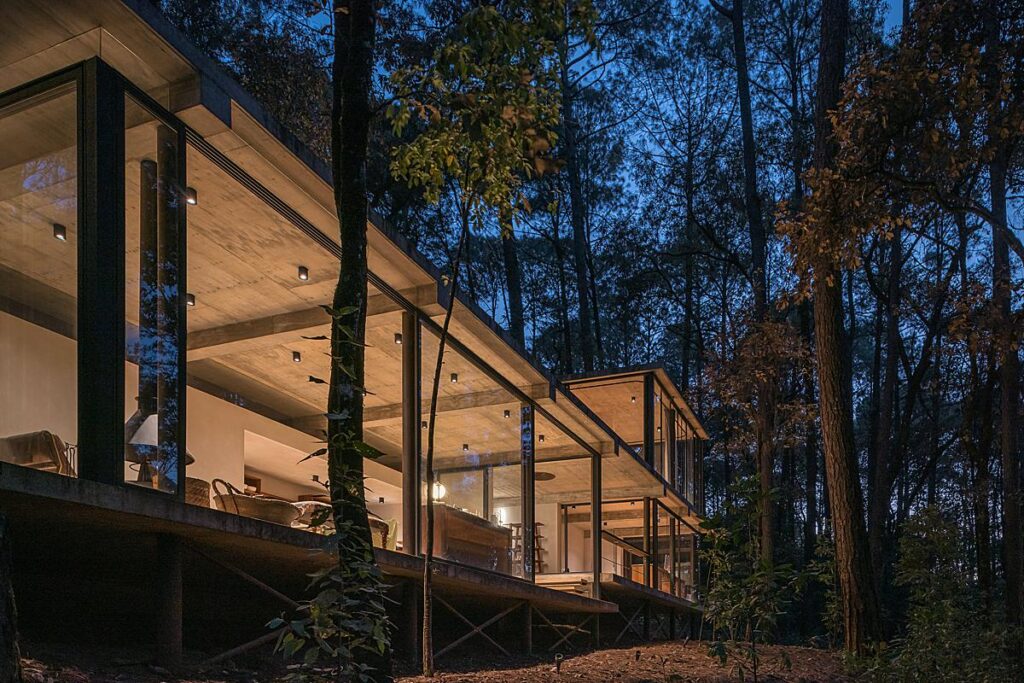
Back outside as the light falls, Casa Cono appears to blend in seamlessly with the surrounding trees. The reflections on the massive amounts of glazing, and the home’s materiality allow it to camouflage into the forest. Our brains work to gauge where the house stops and the woods begin, and I just love it.

I asked Luis about his favorite photograph and he shared, “There’s one particular shot that truly stands out. It’s a photograph of the main façade that faces the forest, allowing you to understand the structure’s modulation, the house’s placement on the terrain, and its delicate and thoughtful relationship with the surroundings, which was based on the premise of not cutting down a single tree.
From a technical standpoint, composing this photograph, which required to be captured from the lower part of the terrain, required the right equipment, including perspective correction lenses. Since the terrain had a slope, it was essential to balance the image and maintain vertical lines to capture the complete view of the façade. Regarding lighting, it was crucial to accentuate the harmony and warmth of both natural sunlight and the lighting design proposed by the architects. My work revolves around achieving the perfect balance between these two elements, without the use of flashes or additional lighting beyond what the space provides.”

“To fellow photographers embarking on similar architectural projects, I would offer these pieces of advice: First, immerse yourself in the architecture. Understand the architect’s vision and what makes the space unique.
Second, patience is key. Wait for the right light and moment —it can transform an ordinary shot into an extraordinary one.
Third, always pay attention to details. Architecture is all about the finer points, and capturing them can elevate your work.
Lastly, remember that your role is not just to document but to tell a story through your images. Let the design speak and create a visual narrative that resonates with viewers,” Luis says.

We’ll wrap this up with Luis’s parting words, where he says “I’d like to give a special shoutout to my partner, Adiranne, Ady, Montemayor. Her contributions to this project, and to all our work, cannot be overstated. She manages all the pre-production stages, handles art direction and styling during the shoot, and deserves a special mention when creating photographs because you need to move fast when it’s time to turn on/off lights, open/close windows and curtains, and light on the fire pit, especially at dusk when light changes so quickly.
She even plays a crucial role in all the work we do to final photographs through post-production and retouching of our images. Her dedication and creativity are an integral part of our success, and I couldn’t do it without her. Additionally, I’d like to express my gratitude to Estudio Atemporal for their trust and collaboration over the years. It’s been an incredible journey, and I’m excited to see where our partnership takes us next.”
What a team!
A huge thank you to Luis Gallardo, Ady Montemayor, and LGM Studio for sharing this beautiful project with us. You can see more of Luis’ incredible work at his website www.lgmstudio.com as well as his Instagram @lgmstudio.
If you have a project you’d like to be considered for Project of the Week, you can submit it here.

August 23, 1940 – November 10, 2023
Richard Britton, of Wind Point, 83, passed away at the Woods of Caledonia on Friday, Nov. 10, 2023.
He was born in Ohio on Aug. 23, 1940, to his parents, Willard and Lucille (née Young).
Richard served in the U.S. Army (1958-1962) before getting his BBA at the University of Toledo. After completing his studies, he went on to retire from Modine as an executive after 28 years of service.
He was a member of the Faithbridge Church in Racine, the Racine Yacht Club, and part of the Modine 20-year club.
Richard enjoyed traveling, sailing, movies, photography, eating chili dogs (with onions) and the desire to continue to learn about things that interested him in life. He cherished his time visiting with his grandchildren and was often seen laughing over many of life’s funny/not-so-serious moments. He very much loved his family and will be missed greatly.
Richard is survived by his wife of 31 years, Karen Van Lone; children, Steven (Jennifer), Shawn (Lisa), Christine (Pete Janovicz); and six wonderful grandchildren, Lauren, Amanda, Ryan, Sydney, Owen and Jacob.
A private celebration of Richard’s life will be held.
The family extends a heartfelt thank you to the staff at the Woods of Caledonia for the love and attention Richard received while under their care.
Obituary and photo of Richard Britton courtesy of Draeger-Langendorf Funeral Home.
The Racine County Eye, which includes the Kenosha Lens, is your source for local news that serves our diverse communities. Subscribe today to stay up-to-date with local news.
Follow us on Facebook: Racine County Eye or Kenosha Lens, and Twitter to make sure you get the latest news.





