Today
FYI Calendar: Bison Night tonight in Bella Vista


BLOOMINGTON, Ind. — Indiana University is investing in new leaders and initiatives in arts, humanities and culture. At a time of accelerating change in and around arts and humanities, the university will expand institutional support, create stronger connections between its hallmark strengths, and drive expanded cultural engagement with local communities across the state and beyond.
These commitments represent IU’s dedication to leveraging arts and culture to advance people’s understanding of the world and revitalize communities, bolstering the university’s reach and impact as a global arts and humanities leader.
Photo by Liz Kaye, Indiana University” src=”https://news.iu.edu/live/image/gid/2/width/500/height/333/10382_20230821_WOW_First_Day_LK_247.rev.1700150200.jpg” title=”20230821 WOW First Day (LK)” srcset=”https://news.iu.edu/live/image/scale/2x/gid/2/width/500/height/333/10382_20230821_WOW_First_Day_LK_247.rev.1700150200.jpg 2x, https://news.iu.edu/live/image/scale/3x/gid/2/width/500/height/333/10382_20230821_WOW_First_Day_LK_247.rev.1700150200.jpg 3x” data-max-w=”3200″ data-max-h=”2134″ loading=”lazy”>
New leadership positions in IU Research and at IU Bloomington will help maximize the impact of arts and humanities initiatives across IU’s campuses. Photo by Liz Kaye, Indiana University“Driven by the scholarship and creative activity of our world-renowned faculty, Indiana University’s reputation for excellence in the arts and humanities is unmatched,” IU President Pamela Whitten said. “As we build on IU’s longstanding commitments to arts and humanities research, we will help solve the world’s complex problems and foster greater understanding of humanity.”
To spearhead these efforts across multiple schools and campuses, IU has created two new leadership positions, one in IU Research and the other on the IU Bloomington campus. Together, they will help shape university and campus-wide strategy to maximize the impact of arts and humanities initiatives and research across IU’s world-class schools, including the Jacobs School of Music, the Herron School of Art & Design, and the Eskenazi School of Art, Architecture + Design; IU’s extensive humanities programs; and IU’s world-renowned museums, galleries and libraries, including the Eskenazi Museum of Art and Lilly Library.
Ed Dallis-Comentale was named assistant vice president for arts and humanities research, effective Nov. 13. In his new role, Dallis-Comentale serves as the chief arts and humanities research officer for all of IU’s campuses. Most recently, he served as director of both the Arts and Humanities Council at IU Bloomington and the Gayle Karch Cook Center for Public Arts and Humanities, and as strategic advisor for arts and humanities to the vice president for research.

Ed Dallis-Comentale has been named assistant vice president for arts and humanities research.“Research and creativity are crucial avenues to understand and address the most pressing challenges and exciting opportunities of our day,” said Russell Mumper, vice president for research. “I am confident that Ed’s leadership in this new role will catalyze new engagement of arts and humanities to grow research discovery, creative activity and translation of novel ideas into tangible impacts.”
As a member of the leadership team for IU Research and reporting to the associate vice president for research development, Dallis-Comentale will drive expansion of the already thriving arts and humanities ecosystem across IU, increasing external funding and partnerships, and building interdisciplinary research teams in support of the IU 2030 strategic plan.
To support this university-wide work, IU Research is also making several other strategic new and expanded investments, including overseeing the recently expanded Presidential Arts and Humanities Fellows Program and bolstering the Public Arts and Humanities Project. It has also launched the new Arts and Humanities Futures program, an initiative that will unite researchers from a broad scope of disciplines and create leading “think tanks” to address contemporary issues and inspire new ideas and innovations related to artificial intelligence, ecological resilience, Indigenous cultures and communities.
Additionally, IU Research will expand access to the Eastman Residency for the Arts and Humanities, which supports IU faculty by providing creative residencies on the IU-owned Eastman property on Martha’s Vineyard.
In conjunction with Dallis-Comentale’s appointment, and following consultation with academic deans and the IU Bloomington Arts & Humanities Council, IU Bloomington will launch a national search for a dynamic and visionary faculty innovator to serve as the senior campus-wide leader for arts and humanities.
Reporting to the IU Bloomington provost and executive vice president, this new senior leadership position for arts and humanities will collaborate across IU’s rich arts and cultural landscape to bring forward a comprehensive, future-facing vision and plan for arts and humanities on the campus.
Photo by James Brosher, Indiana University” src=”https://news.iu.edu/live/image/gid/2/width/500/height/333/10381_20231005_FirstThursdays_JB_1014.rev.1700148700.jpg” title=”First Thursdays Festival” srcset=”https://news.iu.edu/live/image/scale/2x/gid/2/width/500/height/333/10381_20231005_FirstThursdays_JB_1014.rev.1700148700.jpg 2x, https://news.iu.edu/live/image/scale/3x/gid/2/width/500/height/333/10381_20231005_FirstThursdays_JB_1014.rev.1700148700.jpg 3x” data-max-w=”3200″ data-max-h=”2133″ loading=”lazy”>
The IU Soul Revue performs during the First Thursdays Festival in the IU Auditorium at IU Bloomington. Photo by James Brosher, Indiana UniversityThese efforts will include increasing student and community engagement with IU Bloomington’s extraordinary offerings in arts and humanities; fostering new creative collaborations with cultural institutions and community organizations; and growing visibility and recognition for IU Bloomington’s local and global leadership in arts and humanities broadly.
“It is so often through engagement with the arts and humanities that we learn to question our assumptions, probe the contexts in which we live and dare to design transformative systems and objects,” said Rahul Shrivastav, IU Bloomington provost and executive vice president. “And this new leader will have the opportunity to steward those activities across the breadth of our campus’s schools and units, as well as in our engagements with stakeholders.”
Details regarding a search advisory committee and timeline will be shared in the coming days, along with interim leadership for the Bloomington Arts and Humanities Council and the Gayle Karch Cook Center for Public Arts and Humanities while the search progresses.
IU Bloomington has also committed funding for new faculty hires in arts, humanities and cultural areas, including music business, songwriting and videogame composition. The campus has begun arts-connected renovations that have so far included updates in the Jacobs School of Music’s Recital Hall, Ford Hall and Auer Hall.
Supported by dedicated arts and humanities leadership and through these initiatives and investments, IU will increase participation in artistic and cultural activities and curricular offerings, further develop new and innovative approaches in arts and culture, and grow IU’s connections locally and globally.
Chris Liu, associate vice president for research development: “Bringing together experts in the arts and humanities and other disciplines across IU’s campuses will lead to new, transformational, large-scale research that has the power to change mindsets, culture and society. I’m excited to work with Ed in supporting faculty research and creative activities across IU’s campuses.”
Rick Van Kooten, executive dean of the College of Arts and Sciences: “The arts and humanities play pivotal roles in shaping IU Bloomington students’ education and enriching their experiences both inside and outside the classroom, equipping our graduates with knowledge and skills that prepare them to lead meaningful lives and pursue rewarding careers. In addition, the wider IU community, the state and society benefit from the leading-edge research, creative activity and teaching in these disciplines by our preeminent faculty in the College. I commend this continued commitment to and investment in the arts and humanities that are the heart and soul of our university.”
Abra K. Bush, David Henry Jacobs Bicentennial Dean of the Jacobs School of Music: “We are delighted that the university and campus are investing in the arts and humanities in substantive ways and look forward to how this will strengthen existing partnerships and build new collaborations. Jacobs will be greatly enhanced by new faculty and opportunities to broaden our programs and respond to market trends in music higher education for the future.”
Peg Faimon, founding dean of the Eskenazi School of Art, Architecture + Design: “The Eskenazi School is excited for these new investments and the potential for new initiatives and collaborations across Indiana University and on the Bloomington campus. We look forward to enhancing the lives of our students, faculty, staff and the community.”
Greg Hull, dean of the Herron School of Art & Design: “IU has long been a driver of creative innovation in Indiana, which is evident in our state’s public art spaces, galleries, architecture, music, theaters, businesses and more. Reinforcing the value our university places on the arts and humanities and building upon the robust opportunities IU offers across its campuses will lead to continual advancements that benefit our state and beyond.”

For years, Made Here has brought local and regional documentaries to Vermont Public’s Main television channel. They air at 8 pm each Thursday, and now, you can also stream them on our website. Here in the 18th season, we’re providing more context on each film by bringing you interviews with the directors or subjects.
This week’s film is called Gabor, and it recounts the life of 95-year-old Hungarian-born photographer Gabor Szilasi, who has been based in Montreal since the late 1950s.
The documentary bills itself as a “quirky, feel-good portrait” of a giant of Canadian contemporary photography. It’s also an immigrant story that offers more than one lesson on how to age with elegance over animus.
The film was written and directed by Montreal-based filmmaker and photographer Joannie Lafrenière.
Vermont Public’s Jenn Jarecki sat down with Joannie Lafrenière to discuss Gabor. Their conversation below has been edited and condensed for clarity.
Jenn Jarecki: For those listeners who may not know of Gabor Szilasi, who is he? Will you tell us a little bit about him?
Joannie Lafrenière: Yes, with pleasure. So Gabor is from Hungary. So he arrive in Quebec in 1957 after the insurrection in Hungary. So he arrive with his dad, and he already start photographing in Hungary. But it was his job when he arrive in Quebec. So he first start doing photography in Office du Film — like, it’s not the NFB, National Film Board of Canada, but kind of — so he start photographing there for many years. And he became quite famous in Quebec. So start doing rural photography. Like, he immortalized a lot of not only landscape but mostly people. And after that, he became like, yeah, he became an important person in contemporary Canadian art.
Courtesy
/
Courtesy
So I discover him when I was studying photography in 2007. He got a retrospective exhibition in Joliette, so in Quebec. And I didn’t know him before, and I was really [blown away] by his photography, by the art of his image, like the poetry in it, the humor, the dignity, the respect. I really, really, really loved it. And I told myself, when I will be an adult, I will be a photographer.
Jenn Jarecki: How did Gabor’s approach to photography influence the way you shot this documentary about him?
Joannie Lafrenière: When I start thinking about the film, I was sure that I don’t want people from the museum, I don’t want these people to talk about the importance of the art of Gabor. I decide that we gonna meet people and follow Gabor on how he is doing all his photography. What is his magic touch?
So we follow him on different situations. So we get back on different rural place where we’ve already been. Like in the 70s. And we saw him encounter people, and it was very, very moving for me, how he dance with people, how he interact with them, and how he is curious about them. But people are also very curious about him.
Jenn Jarecki: The film is really playful, and it’s also really smile-inducing, you know, until it isn’t. Can you talk about how you chose to represent Gabor’s proximity to the Holocaust as a Jewish-born Hungarian during World War II?
Joannie Lafrenière: It was quite tough because Gabor is really optimist, joyful. But under this, there is — there is all this tough family situation that he was in through the Second World War. And it took him some time to talk to me about it. And it was some time, “I think we should talk about my mum.” And maybe the next time I saw him, he said, “Oh, no, I think we should — we should not talk about it.” And I was like, “Yeah, I think we definitely need to talk about it. But it says so much about you and how you decide to stay optimist.”
His path was tough and painful. And the last interview that we did together, I arrive at his home and he said, “OK, I’m ready. I wrote a letter. I wanna start with that.” And I was like, “Oh, OK, let’s do that.” And, for me, it was a good point to open up a discussion. And that’s how we decide to put it in the film.
Joannie Lafrenière
/
Courtesy
Jenn Jarecki: Joannie, I’m hoping that I can play a little bit of audio from one of the interviews you had with Gabor. And I’m wondering if you can translate it for us and then talk about its significance.
Joannie Lafrenière: Yes.
“Pour moi, la photographie c’est un poème. Mais la vidéo, le cinéma, c’est un roman.”
Gabor Szilasi
So yeah, that’s a lovely moment. The poetry of Gabor. So in this moment, Gabor talk to me about how he describe and he compare photography and cinema. So for him, photography, it’s more like a poem. And cinema is more like a novel. So I found that really powerful.
Jenn Jarecki: Joannie, why do you think Gabor’s work has been so well-received for so long?
Joannie Lafrenière: Yeah, I think it’s, there is different answer to that. His work is really powerful, I think, because for people who don’t know his work, when they discover it, it’s like they feel seen, or they feel it could be them. And in his poetry, is very luminous also, is very light-full.
And also, because Gabor, as we show in the film, is an amazing human being. So it’s not only his work, it his work talking about him also. So it’s, it’s quite an in-between. And I think there was a good timing for him also. And the fact that he’s an immigrant and the way you look through his new home. There’s many, many factor, but he’s an amazing photographer and a wonderful human being.
Gabor premieres on Vermont Public’s main TV channel on Thursday, Nov. 16 at 8:00 p.m.


The Northern Territory government has unveiled new designs for the National Aboriginal Art Gallery in Mparntwe (Alice Springs), with updates made to the interior atrium and facade.
In March 2022, the territory government appointed BVN and Susan Dugdale and Associates to design the gallery with landscape architecture to be completed by Aspect Studios and Clarsen and Clarsen. The project has been co-designed with the local Arrernte community as well as with input from First Nations peoples from across Australia through the National Reference Group, which comprises 11 members, nine of whom identify as First Nations people and three as Traditional Owners of the local estate group of Mparntwe.
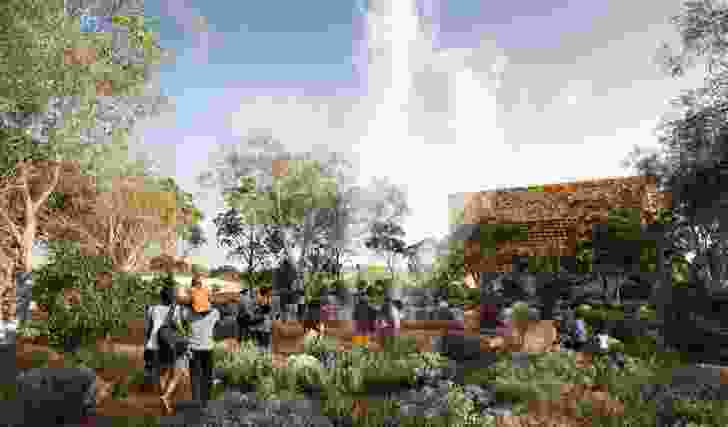
Gallery amenities and features remain relatively the same with a First Nations-led and governed gallery, a cultural welcoming circle, a four-storey atrium, a top-floor event and function space, a ground-floor cafe, an outdoor public area, healing gardens to protect and preserve sacred sites, and a Kwatye (water) play park still planned for the site.

View gallery
The pinkish, earthy shade of the atrium and stairwell area has been updated to a more neutral, creamy colour palette with the skylights above the stairwell redesigned.
Image:
Northern Territory Government
The atrium and stairwell has been redesigned with two oval-shaped skylights above the stairwell replacing three geometric triangular apertures. A walkway originally depicted as being suspended above the stairs and wrapping around to the right of the atrium has also been removed and substituted with a more subtle walkway to the left of the stairs.
View gallery
Render of the cultural welcome space.
Image:
Northern Territory Government
Plans state the vision for the gallery is to celebrate and display First Nations artwork, share stories and interpretations of the world’s oldest continuous culture, encourage local participation in arts programs and events, generate employment opportunities during the construction phase and upon completion of the gallery, as well as “create a high-quality cultural facility that stands as an iconic architectural statement, driving tourism, enhancing liveability, and promoting social and economic objectives.”
A tender for the construction of the project is now open until 14 December 2023. Construction is expected to commence in late 2027, with the gallery anticipated to open in early 2028.


Elon University’s Center for Race, Ethnicity and Diversity Education hosted a beading workshop, as well as an Indigenous digital art showcase, as part of its Native American and Indigenous Heritage Month celebration.
The workshop was led by Vickie Jeffries, a tribal administrator for the Occaneechi Band of the Saponi Nation, and took place in the CREDE office Nov. 13.
“Inventive Minds: An Indigenous Art Showcase” displayed a variety of artworks from different time periods. Set up in the CREDE office on the second floor of Moseley, viewers walked around and looked at art from museums, caves and more.
Sitting beside the art pieces were explanations of the meanings behind the works, such as the importance of the colors, symbols and history of the pieces. Attendees could also scan QR codes on the descriptions to learn more.
The showcase on Nov. 8 featured photographs of rock paintings found inside a cave in Alabama displayed as a group of works on one screen. According to the description, the paintings were discovered in an unnamed cave in 1999. While only a few of the paintings were pictured in the display, there were thousands of images found within the cave.
According to Jan Simek, an archeologist and professor at the University of Tennessee, the paintings are thought to have held spiritual importance because the region’s indigenous groups believed that caves were “portals to the underworld.”

Paintings from an unknown cave in Alabama on display in Elon’s Center for Race, Ethnicity and Diversity Education on the second floor of Moseley on Nov. 8. The creators of the paintings are unknown, as the art dates back to 660 and 949 C.E.
Many students involved in the CREDE’s African-American, Black, Latinx, Hispanic, Asian, Pacific Islander, Native American, Alaskan Native and Multiracial initiatives — or ALANAM — coordinated and attended the event as well.
Sophomore Maylee Clerici works in ALANAM initiatives as a student coordinator and member of the organization’s marketing team. She said that she played a role in choosing to display the rock paintings because they “reveal a little bit about the mystery of the past and how Native American communities thrived in those earlier years.”
According to Clerici, the artists are unknown.
“It’s a little bit unknown who the artists are but the artists date back to 660 and 949 C.E. during the woodland period,” Clerici said.
Another piece of artwork displayed was a painting featuring symbolism of turquoise. The piece, titled “Turquoise Water and Sky: The Stone and its Meaning,” comes from the Museum of Indian Arts and Culture in Santa Fe, New Mexico.
According to the painting’s description, turquoise represents the sky and the water in Native American culture, and is said to have healing and protective powers. It’s commonly used in Pueblo and Navajo ceremonies and gatherings, according to the MIAC.
Native American and Indigenous Heritage month continues through the entire month of November. The CREDE started its Heritage month celebrations with a kick-off event featuring indigenous artists, food and prizes on Nov. 1 and plans to continue the celebrations by supporting local Indigenous artists.
Junior Jorah Midgette is a member of ALANAM initiatives as well and said that the best way to get involved with NAHM activities and ALANAM events is to keep in touch with the CREDE. She also said that the goal of these events is to “prioritize space for native and indigenous students here on campus.”







