Following an Injury, Toledo Cross Country Runner Discovers Passion for Photography

Following an Injury, Toledo Cross Country Runner Discovers Passion for Photography


Stress fractures are a harsh reality for distance runners. It happens all the time. It happened to Xavier Gallo, a member of The University of Toledo’s men’s cross country team, while he was training for the 2021 season. Facing months of rehab, Gallo decided to make the most of his time on the sideline.

“I still really wanted to be a part of the team but, since I was injured, I couldn’t run for eight to 10 weeks,” said Gallo, a native of Dublin, Ohio. “So, I started coming to practice and taking photos.”

Following a stress fracture while training for the Toledo’s men’s cross country team 2021 season, Xavier Gallo discovered his love of photography, and was later hired as a marketing intern for the Toledo Athletic Department.

It was through documenting his teammates’ activities that Gallo discovered a passion for photography. When word spread that there was a capable photographer on the cross country team, Gallo was tabbed to photograph the 2021 Mid-American Conference Cross Country Championship for the Toledo Athletic Department. He also shot some Toledo football games that fall. His photos turned out to be excellent and were used on social media and the UT Athletic Department’s website.

Heather Lutz, UT’s associate athletic director for marketing, was impressed by Gallo’s work and hired him as a marketing intern in 2022. Gallo’s first official assignment as an intern was the 2022 football home opener.

“Xavier did a great job of capturing the experience of Toledo football, the big plays as well as the emotion of athletes and coaches,” Lutz said. “He did a tremendous job of telling the story of Toledo Football.”

Gallo parlayed that experience into an internship with a Michigan-based company, all the while still interning at UT. He soon discovered that the corporate life was not for him.

“I got the internship through a job fair here on campus,” said Gallo, a double major in marketing and entrepreneurship and innovation in the John B. and Lillian E. Neff College of Business and Innovation. “It was the kind of business where employees wore suits and ties and worked a traditional 9-to-5 shift.”

Gallo had no such concerns about creative freedom in his position at UToledo. He expanded his role into shooting and editing videos and found he had a knack for it. He created the 2021-22 and 2022-23 highlight videos that were played at the annual Rocket Awards reception. He felt as though the first video was slightly rushed so he spent extra hours compiling footage for the second video.

“I ended up putting in about 17 hours into sorting through and editing footage for the 2022-23 video,” said Gallo. “It was a lot of fun, and it’s something I’m most proud of.”

Gallo has worked with almost every sport at UT, taking photos and videos that are used on social media, graphics and emails. He also has a few other projects in the works, including a documentary focusing on the Toledo men’s cross country team, and a video recapping his work at the University. After graduation next spring, he plans to continue creating videos, either as a freelancer or with an agency.

In addition to working as a marketing intern, Gallo also is involved in the Launchpad Student Section. He took over the role of president in January 2022. As president, Gallo has contributed to an increase in student attendance at UT football and basketball games and helped grow a larger social media presence for the organization. He also works closely with the Athletic Marketing Department and administration to coordinate student tailgates.

Photo of Xavier Gallo, a member of The University of Toledo's men's cross country team, during a meet.

After sitting out the men’s cross country team 2021 season so his stress fracture could heal, Gallo returned to competition in 2022.

Gallo’s efforts have not gone unnoticed.

“The Launchpad has undergone significant improvements in the last year since Xavier became president,” said Vice President and Director of Athletics Bryan B. Blair. “I have no idea how he balances all this while being an excellent student and Division I athlete, but we are extremely fortunate to have him.”

“He has a huge passion for The University of Toledo,” said Director of Cross Country and Track and Field Andrea Grove-McDonough. “He’s a creative guy. There is no doubt he’s going places.”

Even though Gallo’s interests diverted his attention away from his sport, he still sees cross country as an important part of his life. After sitting out the 2021 season so his stress fracture could heal, Gallo returned to competition in 2022. He ran in four races in 2022, clocking a PR of 27:09.9 at Notre Dame’s Joe Piane Invitational, and also competed this fall.

“I had to get back to the physical state of being a runner,” Gallo said. “Eventually it came back. It was just tough to get there. It’s been a tricky time, but I’m happy to have had the opportunity to run with my guys again.”

Even though Gallo does not score among the team’s top runners, he has made an oversized impact on the cross country program and the Athletic Department overall.

“Xavier is one of those glue pieces in terms of culture, just an all-around great guy who is respected by his teammates,” said Grove-McDonough. “When you can’t necessarily make the same impact athletically as the number-one runner but you find a way to make an impact anyway, that’s something special. Xavier has that.”

UK celebrates America Recycles Day

UK celebrates America Recycles Day
Communities nationwide honor America Recycles Day on Nov. 15 by celebrating the impact of recycling. This year, UK Recycling is celebrating all week with a Sculpture Scavenger Hunt. Created by students in the UK College of Fine Arts School of Art and Visual Studies, these cardboard sculptures promote UK’s efforts to become a zero-waste campus.

Art Brut: Cancer Journey Ignites New American Dream

Art Brut: Cancer Journey Ignites New American Dream

You would be forgiven if you walked into Miriam Abascal Zimms’ home and forgot you were in someone’s house. Inside the doors, you’re instantly greeted by art from floor to ceiling. Whether it’s pieces she made, from Santa Fe or her native Guatemala, the variety is enough to make the waterfront views of Lutz’s Lake Brant the second-most visually impressive part of the property.

When you turn the corner, there is a row of world masks adorning the wall. Just below, you notice the sink and refrigerator and are reminded that this is, in fact, someone’s home and not a live-in art gallery.

That art just may be Zimms’ life, though.

It was not always that way. Zimms has been on a long journey to get to where she is today.

A first-generation immigrant, Zimms left her native Guatemala in 1971 when she was 4. Along with her mother, Rosa, the two set out for America hoping to create their own version of the American dream.

If Zimms’ life were a book, the first chapter would be her mother’s version of that dream.

“I always had this creative side to me as a child,” Zimms said. “But I couldn’t tell my mother I wanted to go to New York and be on Broadway.”

She doesn’t remember much from those first few years in the United States, but she remembers her mother working hard and persevering in the face of discrimination.

“I always had this creative side to me as a child. But I couldn’t tell my mother I wanted to go to New York and be on Broadway.”

– Miriam Abascal Zimms

To honor her mother’s dreams, Zimms embarked on a career in business. She worked as a consultant in solid waste management for county governments, corporations and institutions, helping to plan their conservation and sustainability strategies. She took great pride in running zero-waste and waste reduction programs.

She was making the planet a better place for future generations.

Sadly, Zimms was not far into her career when her mother passed. Zimms was just 26. Her mother was 58 when she died from metastatic breast cancer.

Three other women on her mother’s side had also been diagnosed with either skin cancer, breast cancer or both. And her maternal grandfather had passed away from stomach cancer.

Zimms knew her risks. She started doing self-breast exams immediately. Once a month. Every month. She also got annual MRIs.

For 17 years, she found nothing. Two hundred straight self-exams. Everything status quo.

Until one day in 2010, when she became the fifth woman in her family to have that dreaded realization.

She found a lump in her left breast.

“I was not shocked,” she said. “But I was surprised.”

The diagnosis was triple-negative breast cancer (TNBC). She was 43.

“I remember thinking, ‘Wow, I really have done everything I was supposed to do,’” she said. “I embraced a wellness lifestyle. I exercised. I was eating healthy because I saw the women in my family go from being fit, healthy women to their bodies changing when they hit menopause.”

Zimms came to Moffitt Cancer Center for her treatment.

Up first was three months of chemotherapy. Once that was finished, she underwent a double mastectomy and the start of breast reconstruction to begin the process of feeling whole again. Reconstruction required four surgeries over the course of three years to complete. She worked through it all.

During that time, through genetic testing, she learned she had a BRCA1 mutation. With a newly discovered risk for ovarian cancer, Zimms had her ovaries and fallopian tubes removed.

A few months after recovering from surgery, something still didn’t feel right. She brought up her concerns to her surgeons, John Kiluk, MD, and Philippe Spiess, MD, who called for a CT scan of her lower body.

That scan revealed a suspicious spot on her pelvis. The initial fear was that her breast cancer had spread.

“When that biopsy came back, I got a phone call saying, ‘Do you want the good news or the bad news?’ And I said, ‘Well, I’d like the good news first,’ and the good news was that it was not metastatic TNBC,” Zimms recalled. “But the bad news was that I had chondrosarcoma, primary bone cancer.”

If her first cancer diagnosis was surprising, this new diagnosis was a full-blown shock.

Miriam Abascal Zimms

Zimms found herself in a dark place during her recovery from chondrosarcoma, which had followed months of treatment for breast cancer. A chance visit to Moffitt’s Arts in Medicine studio introduced her to the Zentangle art style that would transform her life.

There had been little to no time to separate from the breast cancer, months of chemotherapy and all the surgeries, but she couldn’t take a break now. Her life was on the line.

Zimms underwent an internal hemipelvectomy. She had the majority of her left pelvis, hip ball and top part of her femur removed.

What followed was seven months of bed rest with in-home physical therapy, then one and a half years of additional in-home physical therapy. A lifetime of physical therapy became part of her new full-time job.

“The surgery saved my life,” Zimms said. “But it left me with the inability to use my left leg and took away many of the things I used to do. I’ve had to modify the way I live, including my energy level of productivity.”

During the months of not being able to leave her bed, the negative thoughts crept in.

“I felt like a helpless baby,” she said. “I needed a full-time caregiver to help me with everything. That was when I started to think about the loss of my primary female body parts. My breasts, fallopian tubes, ovaries and now my left pelvis.”

She was depressed. She was down. She was angry.

She describes the feeling as being on a bus. She was on her journey exploring how to live life after breast cancer. Suddenly, someone slammed on the brakes.

“The last four years just came flying forward,” she said. “And I had to deal with it.”

It was the darkest time in her life.

Then Moffitt’s Arts in Medicine program brought out a light in Zimms that had been dormant for decades.

The Arts in Medicine program started in 1998 and celebrates its 25th anniversary this year.

It began with a single artist and a cart full of art supplies. Frances Falk was the program’s first coordinator, serving in the role from 1998 to 2003. Falk would visit patients at their bedsides and in the lobbies and waiting areas, bringing art directly to the people.

Later that first year, the program added a musician and transitioned into an open studio for patients to visit while they were undergoing treatment.

The program is based off an expressive arts model. The idea is to use art for healing and self-discovery.

“Our artists and musicians are not practicing as therapists,” explained Amanda Bonanno, the program’s current coordinator. “They’re not coming up with goals or treatment plans. The control is all in the hands of the participant.”

portrait of blockquote author

“No one is going to interpret or impose any meaning on the artwork that is made. As a result, it’s oftentimes a process that opens people up to sharing, and that is their choice.”

– Amanda Bonanno, Arts in Medicine Program Coordinator

Bonanno joined Moffitt as the Arts in Medicine coordinator in 2016. She believes the open-endedness of the program gives patients the ability to feel free in their expression.

“No one is going to interpret or impose any meaning on the artwork that is made,” Bonanno said. “As a result, it’s oftentimes a process that opens people up to sharing, and that is their choice.”

Today, the program has seven artists-in-residence sharing both visual art and music across three Moffitt locations. That includes two art studios for anyone to visit during their time at Moffitt. True to the program’s origins, the artists still use the art carts to visit patients right where they are.

Zimms had visited the art studio at Moffitt’s Magnolia campus some during her breast cancer treatment. But during her recovery from hip surgery, something magical happened.

Marcia Brown was the artist-in-residence working in the studio that day. She had brought over a few projects to try, including Zentangle art, a creation of patterns using a repetition of dots, lines, curves and orbs.

Zimms initially declined. The rehabilitation process she was going through was brutal. She had to learn to sit, stand and walk again. The most basic movements came with a combination of pain and fear that was often overwhelming.

“I wasn’t in a space of wanting to put anything dark on paper,” she said. “It all felt so dark. But that’s the space I was in.”

That’s when Brown had the idea to flip the script. Instead of having Zimms put black ink on white paper, Brown suggested using a white pen on black paper.

Zimms took the supplies home, and the rest is history.

“At that point in my life, people were giving me books and all this big stuff to do at home, and I was not in a mental space to absorb any of that,” she said. “So I needed something small and fast.”

What followed was 300-plus pieces of Zentangle art tiles. People around Zimms quickly took notice.

“My husband and my stepdad would tell me I was really talented,” Zimms said. “But then one of the Moffitt artists asked me to start bringing some of my pieces in and said, ‘Wow, Miriam, you’re really doing something special here.’”

Miriam Abascal Zimms’ Zentangle art

Zimms describes her artistic style as “art brut,” a French term that refers to pieces made outside of the traditional definition
of fine art.

The decision was made to showcase Zimms’ art in Moffitt’s Healing Arts Gallery, which features art made by patients, families and staff. Each of her 300 pieces was framed and displayed for over a year. The pieces told the story of Zimms’ journey. From her breast cancer to chondrosarcoma. They are tributes to her husband, Mitch Kessler, and Moffitt, as well as loss, pain and suffering.

“I did get a lot of feedback from doctors, and people would write me saying that they would stop and look at it. It really did a lot of healing,” Zimms said. “Not just for the patients and families, but for team members who would stop every day on their way to the parking lot. It really touched a lot of people’s lives.”

Zimms left her career in waste management to focus on her chondrosarcoma recovery. Cancer may have taken that part of her life from her, but it ended up unlocking something different.

“I believe that allowed the left brain to shut down,” she said. “And what had been there when I was younger and very creative was allowed to completely blossom and show its face.”

Local libraries started noticing her work and invited her to host shows and speak to art groups.

“People started to ask me if they could purchase this piece or that piece,” she said. “That’s when things really started happening.”

Zimms suddenly found an additional life purpose as an artist and teacher of the Zentangle method and expressive arts, contributing greatly to her own healing. 

Arts commissions started calling. She was connected with Arts4All Florida, an organization that pairs artists with disabilities with galleries throughout the state. To date, her art has appeared in 10 galleries in Florida.

Zimms now spends her days working on new art projects and teaching Expressive Tangling, a combination of Zentangle and expressive arts, to groups both locally and virtually across the country. Although she still deals with chronic pain, PTSD and anxiety, her feelings of depression are no longer constant. They have begun to come and go.

She describes her artistic style as “art brut,” a French term that refers to pieces made outside of the traditional definition of fine art. Also known as outsider art, it’s often self-taught or discovered following a major loss or health impact.

In her art, Zimms has also started focusing on larger pieces, applying repetitive patterns using tangling strokes to showcase a theme of body loss. It’s a theme she knows all too well.

Zimms has 17 scars on her body to document her journey. Each of those 17 scars are showcased in her art.

“Body loss stays with us,” she said. “When there’s a piece of our physical body that’s been removed, it’s traumatic.”

If chapter 1 of her life story was her mother’s American dream, this was chapter 2. It was her American dream.

“It’s really an opportunity that came into my life thanks to the Arts in Medicine studio at Moffitt,” she said. “It came at a time that I needed something to give me purpose. It was a gift and a blessing.”

Zimms and her husband believe in the healing power of the arts, and they have become generous supporters of the Arts in Medicine program. They want to make sure all patients have access to these types of holistic support programs. In June 2022, they donated a piano to the cancer center in honor of Jerry Kessler. It now sits in the lobby of the Richard M. Schulze Family Foundation Outpatient Center with the intent of providing joyful music for years to come.

Zimms is now 10 years’ chondrosarcoma free and 13 years’ breast cancer free. She has yearly follow-up scans to keep an eye out for any signs of new disease.

“I witnessed my mother’s courage. I gained my knowledge and strength through her experience and then through my own,” Zimms said. “Even though she passed when I was young, her legacy is carried inside of me. And no one can take that away from me. Not even cancer.”

Miriam Abascal Zimms’ Zentangle art

Zentangle art is a creation of patterns using a repetition of dots, lines, curves and orbs. For Zimms, the artistic technique opened up a creative part of her that contributed to her healing.

This article originally appeared in Moffitt’s Momentum magazine.

Memorial sculpture of US general unveiled at UN Peace Park, Busan

Memorial sculpture of US general unveiled at UN Peace Park, Busan
A special ceremony unveiling a memorial sculpture of Gen. Richard S. Whitcomb, who served in the Korean War (1950-1953), took place at UN Peace Park in Busan, Saturday. Titled “Going to the future together,” the sculpture commemorating the US General was created by sculptor Kwon Chi-gyu, 57, who also created a sculpture of Ahn Jung-geun, an independence fighter during the Japanese colonial period, at the Ah…

Photography exhibition in Arizona to chronicle ‘facets of Korean life’

Photography exhibition in Arizona to chronicle ‘facets of Korean life’

Photographs on view in the “Wonders and Witness: Contemporary Photography from Korea” exhibition at the Center for Creative Photography. [MMCA]

A photography exhibition depicting “the diverse facets of Korean life” since the 1990s will kick off Saturday at the Center for Creative Photography (CCP) in Arizona.
 
Titled “Wonders and Witness: Contemporary Photography from Korea,” the exhibition was co-organized by the National Museum of Modern and Contemporary Art (MMCA) and the CCP.
 
The CCP is located in the University of Arizona’s Tucson campus and is home to some 110,000 works of famed American photographers.
 
It is the CCP’s first exhibition on Korean photography.
 
The photographs, by 12 Korean photographers, are from the MMCA’s collection and touch on subjects including literature, sociology, economy, and religion.
  

Related Article

The Center for Creative Photography in Arizona is pictured. [MMCA]

The Center for Creative Photography in Arizona is pictured. [MMCA]

The 12 photographers include Gwon Do-yeon, Kim Ok-sun, Kim Seung-gu, Kim Tae-dong and Lee Sun-min.
 
Descriptions on the photographs will be available in Korean, English and Spanish.
 
There will also be a symposium on Korean photography and public talks with the artists on Saturday and Sunday.
 
“Wonders and Witness: Contemporary Photography from Korea” continues until Jan. 27 next year. 
 
For more information, visit the CCP’s website.

BY SHIN MIN-HEE [shin.minhee@joongang.co.kr]

Colombian Artist Delcy Morelos Digs Deep at Dia, Transforming Dirt Into Fine Art

Colombian Artist Delcy Morelos Digs Deep at Dia, Transforming Dirt Into Fine Art

Encountering Earthly Paradise, Colombian sculptor Delcy Morelos’s fragrant dirt wall sculptures at the 2022 Venice Biennale, was an indisputable highlight of the international exhibition. Navigating the maze-like installation encouraged viewers to appreciate and engage with the earth—blended with hay, cassava flour, cacao powder, cloves, and cinnamon—in an entirely unexpected way, elevating the humble soil to the realm of fine art.

“The soil as a sacred element has been forgotten by contemporary civilization,” Morelos told me, speaking through a translator. “I like to show the earth/soil in a way that is has not been seen, so it appears very delicate, soft, and that it smells delicious. I make beautiful sculptures so that the earth/soil can be seen as beautiful.”

Though the biennale was something of a breakthrough moment for Morelos on the art-world stage, work was already well underway on her first U.S. solo show, which opened last month at the Dia Art Foundation in Chelsea.

“This has been one of the most complex projects that I have done,” Morelos said of the exhibition, which features two monumental new installations, Cielo terrenal (Earthly Heaven) and El abrazo (The Embrace). “We spent four years finding a way to make it happen.”

Delcy Morelos, Earthly Paradis (2022). Photo by Ben Davis.

Delcy Morelos, Earthly Paradise (2022) at the Venice Biennale international exhibition, “The Milk of Dreams.” Photo: Ben Davis.

Both pieces continue to explore our relationship to the earth, and Morelos’s desire to make it more sustainable, in keeping with her indigenous heritage, descended from the Emberá, the indigenous people of Panama and Colombia, on her grandmother’s side.

“Those who are making use of the land are not operating from a space of care and respect towards Mother Earth. The people who do are the ancestral cultures, for example in the Amazonian jungle, because they maintain thousand of years of traditions, caring for the jungle and the soil,” she said. “But it is not easy because people are always thinking about making money not protecting the earth. They don’t realize that when they destroy the land, they are destroying themselves, because we nourish ourselves from the earth, and we will return to the earth when we die.”

The show at Dia came about after a group trip that the foundation arranged to Colombia in 2019, on the occasion of Dan Flavin’s first show in the nation, at the Museo del Moderno de Medellin. Flavin, of course, is one of the artists at the core of Dia’s collection, which is focused on Minimalism and Land Art. But in recent years, the foundation has worked hard to expand its purview beyond the white male artists traditionally associated with those movements.

Colombia “was a learning trip,” said exhibition curator Alexis Lowry, who recently started a new job as curatorial director at Hauser and Wirth. “We visited Delcy’s studio and Jessica [Morgan, the director of Dia] and I walked out and immediately said ‘Well, that’s a show.’”

imageCielo terrenal (Earthly Heaven), 2023, at Dia Chelsea, New York (detail). Photo by Don Stahl, ©Delcy Morelos.” width=”1024″ height=”768″ srcset=”https://www.mecreates.com/story/news/wp-content/uploads/2023/11/Don_Stahl_DELCY-MORELOS-001-2048×1536-1-1024×768.jpeg 1024w, https://news.artnet.com/app/news-upload/2023/10/Don_Stahl_DELCY-MORELOS-001-2048×1536-1-300×225.jpeg 300w, https://news.artnet.com/app/news-upload/2023/10/Don_Stahl_DELCY-MORELOS-001-2048×1536-1-1536×1152.jpeg 1536w, https://news.artnet.com/app/news-upload/2023/10/Don_Stahl_DELCY-MORELOS-001-2048×1536-1-50×38.jpeg 50w, https://news.artnet.com/app/news-upload/2023/10/Don_Stahl_DELCY-MORELOS-001-2048×1536-1-1920×1440.jpeg 1920w, https://news.artnet.com/app/news-upload/2023/10/Don_Stahl_DELCY-MORELOS-001-2048×1536-1.jpeg 2048w” sizes=”(max-width: 1024px) 100vw, 1024px”>

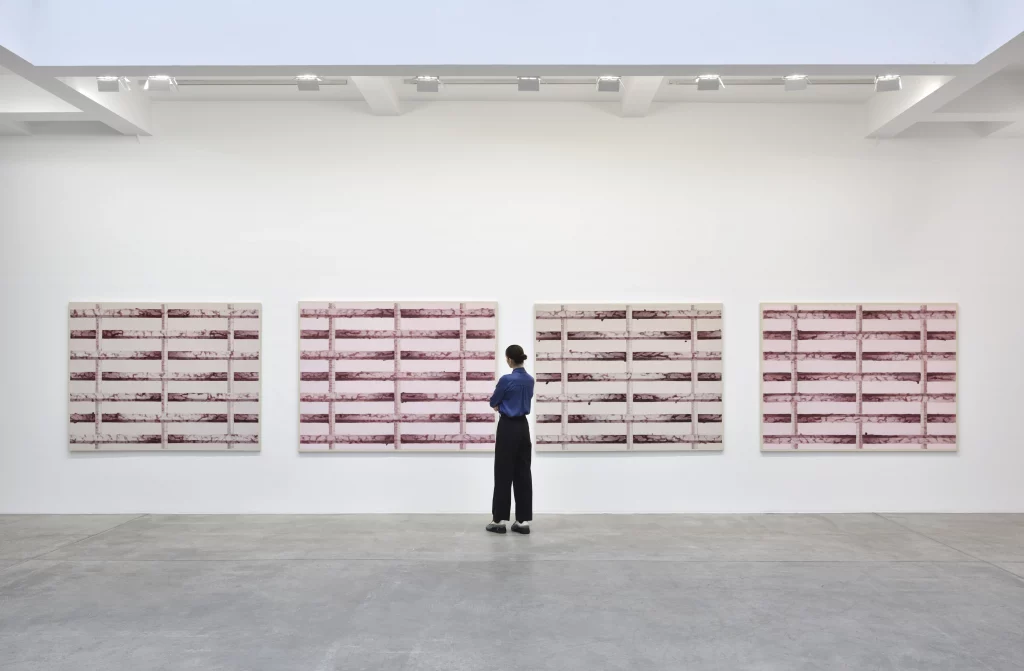
Delcy Morelos, Cielo terrenal (Earthly Heaven), 2023, at Dia Chelsea, New York (detail). Photo by Don Stahl, ©Delcy Morelos.

Visitors to the exhibition are first greeted by Cielo terrenal, in which Morelos has painted the floors and lower third of the gallery walls—up to the level of flooding caused by Hurricane Sandy in 2012—with a thin layer of water and acrylic binder mixed with soil sourced from Goshen, New York.

“Goshen is part of what’s known as the Black Dirt Region in the Hudson Valley. It’s incredibly rich in nutrients and some of the most fertile soil in the country,” Lowry said.

Morelos also used the soil mixture to coat various pieces of wood and lumber sourced from dumpsters at Dia’s outpost in Beacon, New York—remnants of construction projects from past exhibitions laid out in neatly stacked piles on the floor. The effect is a stark, monochromatic black.

“Delcy is really breathing new life into this material,” Lowry added. “She’s always done these earth-lined rooms with a consideration of life cycles and the idea that death fertilizes life—what is beneath the ground is composed of decay, but also constitutes growth.”

Delcy Morelos, El abrazo (The Embrace), 2023, at Dia Chelsea, New York (detail). Photo by Don Stahl, ©Delcy Morelos.

Delcy Morelos, El abrazo (The Embrace), 2023, at Dia Chelsea, New York (detail). Photo: Don Stahl, ©Delcy Morelos.

“The earth is expressed as the transforming matter of life in death and death in life,” Morelos agreed. She also wanted to incorporate earth from her native country, but import/export laws prevented her from shipping soil across international borders. Instead, the Dia fragments are paired with ceramics she made in Colombia from local black earth.

“They were made using this ancestral technique where you fire the clay over an open flame, so it both literally colors the ceramic, but also that color is then augmented naturally, with vegetal pigments,” Lowrey said.

“These elements are more organic, and they are remnants that are found in the jungle,” Morelos added. “It turns out that these elements that can be seeds, shells, and tree trunks that will nourish the plants that will be born in the future. There is a difference in form, but just the same, the elements from Dia can nourish the plants of the future.”

Less than two weeks after the artist’s New York debut, Morelos also opened her first solo show in France at Marian Goodman in Paris, where she just joined the roster. It is also the first time the 56-year-old artist has had formal gallery representation, despite having appeared in numerous biennials and institutional exhibitions.

There, Morelos created another site-specific installation for the gallery’s lower level, again painting part of the floor and walls with soil. But the exhibition also includes more market-friendly pieces, including hanging textiles and works on paper made over the past 20 years.

Installation view of “Delcy Morelos: El oscuro de abajo” at Galerie Marian Goodman, Paris. Photo: courtesy of Marian Goodman.

These earlier works showcase Morelos’s first forays into natural materials, such as red pigments and jute fiber. A reverence for the earth and the cycle of life is the through line across her practice.

“I am a witch—a witch is a woman of wisdom who learns from nature and its secrets,” Morelos said. “I come from a lineage of ancestral knowledge, and I understand that the soil is nourishment.”

At Dia, the second gallery is the show’s titular work, El abrazo, is a towering mound of earth liberally studded with individually placed stems of Hudson Valley hay. Lowry helped with the nearly two-month-long install process, and was chastised by the artist for attempting to insert multiple pieces at a time. “Delcy is the most detail-oriented artist you could possibly imagine,” the curator said.

Delcy Morelos installing El abrazo (The Embrace), 2023, at Dia Chelsea, New York. Photo by Don Stahl, ©Delcy Morelos.

Delcy Morelos installing El abrazo (The Embrace), 2023, at Dia Chelsea, New York. Photo by Don Stahl, ©Delcy Morelos.

Made from top soil recycled from a Manhattan roof garden, mixed with clay, an organic landscaping compound used to keep grass seed in place, and ground coconut husks, the piece is designed to be touched. Morelos found people were inevitably drawn to the earth at the Venice Biennale, and decided to embrace that impulse. She hopes this creates a sense of intimacy in the work, reminding the viewer of our ties to the earth.

In El abrazo, “the earth is a mountain that embraces you, because I think that people feel very alone living in the city and sometimes they need a hug,” Morelos said.

But the installation also appears to float above the gallery floor, its heavy mass improbably levitating in space in something of an engineering miracle.

“Because the earth is something that we always walk on, I wanted to elevate it,” the artist added, noting that the large scale is also meant to dwarf the viewer.

Both Dia installations take up the entirety of a dimly lit gallery. The aroma of Morelos’s earthen creations, which incorporate spices such as cinnamon and clove, hit your nose before your eyes adjust to the light, which is filtered through scrims installed on the skylights. (The artist recommends return visits with the changing seasons, to encounter the works under different lighting conditions.)

Delcy Morelos, El abrazo (The Embrace), 2023, at Dia Chelsea, New York (detail). Photo by Don Stahl, ©Delcy Morelos.

Delcy Morelos, El abrazo (The Embrace), 2023, at Dia Chelsea, New York (detail). Photo by Don Stahl, ©Delcy Morelos.

Olfactory elements have been a key part of her practice for least a dozen years, after Morelos was inspired to try and use soil to make cookies that recalled the scent of maternal milk, mixing in cacao butter, brown sugar, beeswax, cinnamon, and cloves. Over the years, she’s refined that process to give her more control over the organic elements, to prevent fermentation, mold, or fungus.

For Morelos, it’s important that her work activates the “senses that we have forgotten, such as the sense of touch and smell—too much importance is given to vision” she said. “The sense of smell activates our memories, and the memory will take you to those happy moments where you once were in the forest.”

But the artist is also looking to the future, with a career survey set to open at the Pulitzer Arts Foundation in St. Louis in March. It will feature work from the 1990s through to today, including a site-specific monumental earth work.

“The sculpture at the Pulitzer is about the obsession of being owners of the land. People put up nets, fences, and railings to delineate and separate land, saying this is ‘mine’ and that is ‘not mine,’” Morelos said. “But it is absurd to think that we can be owners of the earth. We form part of the earth and we are united with her—we are not her proprietors.”

Quotes from Morelos were translated by Amparo Vollert.

Delcy Morelos: El abrazo” is on view at Dia Chelsea, 537 West 22nd Street, New York, New York, October 5, 2023—July 2024.

Delcy Morelos: El oscuro de abajo” is on view at Galerie Marian Goodman, 79 and 66 Rue du Temple, 75003 Paris, October 14–December 21, 2023.

Delcy Morelos: Interwoven” will be on view at the Pulitzer Arts Foundation, 3716 Washington Boulevard, St. Louis, Missouri, March 8–August 4, 2024.

More Trending Stories:  

News Icon Barbara Walters’s $8 Million Estate Hits the Block at Bonhams, With Her ‘Audacious’ Jewelry Taking Center Stage 

There’s Much More to Caravaggio’s ‘The Cardsharps’ Than Vice. Here Are Three Facts That Offer a New Perspective on His Early Masterpiece 

Here’s Your Guide to the Priciest and Most Sought-After Artworks for Sale During New York’s $2 Billion Fall Auction Season 

Revealed: The Major Mystery Consignors of New York’s Multi-Billion-Dollar Fall Auction Season 

A Secret Room in a 16th-Century Italian Chapel, Where Michelangelo Hid—and Drew—for Months, Opens to the Public 

Christie’s Pulled Two Works by a Prominent Middle Eastern Artist From Sale After a Complaint 

A Nautical Chart Sold at Auction for $239,000 Is Revealed as the 4th Oldest of Its Kind and Is Now Tagged at $7.5 Million 

Follow Artnet News on Facebook:
Want to stay ahead of the art world? Subscribe to our newsletter to get the breaking news, eye-opening interviews, and incisive critical takes that drive the conversation forward.

Keele University opens punk photography display

Keele University opens punk photography display
Glen Matlock and Professor Bela Arora from Keele University at the launch event.Bela Arora

An exhibition tracing the punk era through photography has been opened at a university.

The display at Keele was launched by former member of the Sex Pistols, Glen Matlock, and features work from a range of rock photographers.

The aim of the collection is to “recapture the spirit of punk and give it context,” said the university.

“Punk: from Andy Warhol to Vivienne Westwood” is on until 20 December.

Keele University punk exhibition

Keele University

“This unique exhibition captures an incredible time in recent history that stemmed from a passion for music but then influenced fashion, society and culture,” said Prof Bela Arora.

The display is described by the university as a “visual journey of  punk, the last counter-cultural movement.”

The free exhibition is open until 20 December in the university’s Chancellor’s building.

An image from the punk display at Keele University

Keele University

Presentational grey line

Follow BBC West Midlands on Facebook, X and Instagram. Send your story ideas to: newsonline.westmidlands@bbc.co.uk

Related Internet Links

The BBC is not responsible for the content of external sites.

Native American Market Days: A celebration of Native American Diversity

Native American Market Days: A celebration of Native American Diversity

GRAND JUNCTION, Colo. (KKCO) – It’s a wrap for the three-day Native American Market here in Grand Junction.

The Native American Market Days Festival brings together indigenous artists and vendors; it’s a celebration of Native American diversity. On its last day, the event featured a world-champion hoop dancer, the Danza Aztec dance group, and bear dance singers.

The marketplace brought Native American jewelry, blankets, art, and so much more. “We bring these people here, and they have their own profession; most of it is the southwest, silver and turquoise, and what their gourds and their blankets, and just anything that these artists will produce,” said Chief Roland McCook, chairman of the Native American Cultural Programs. “So we give them a place to do this, and it’s very lively and colorful here, and everybody’s having a good time.






