Mexican Artist Fernando Laposse elevates the pollination process with his eccentric designs.
Fernando Laposse Excites Design Miami With His Furry, Surreal Sculptures


Ellen Pustejovsky holding one of her prints.
Ellen Pustejovsky has an eye for nature and people. A Black Hills-based landscape and portrait photographer, Pustejovsky has a flair for the dramatic, stirring emotions in those that gaze upon her work.
But Pustejovsky specializes in the artistic photography of beautiful geographic features and man-made structures across the United States.
Pustejovsky has been fascinated with photography since her childhood in Rapid City. Her first paying client was her junior year in high school.
Pustejovsky landscape photography in an office setting.
After graduating from Stevens High School, she studied under Steve Babbitt and Jerry Rawlings while a student at Black Hills State University.
Pustejovsky had an internship with a shoe company but realized her life wasn’t meant for the corporate world. So, she struck out on her own, and little-by-little built her portfolio and her reputation across the Black Hills.
Her work has been featured in Outdoor Magazine and by several apparel companies. She is also the recipient of several ADDY Awards.
From portraits and brand marketing, to her well-known landscape shoots, Pustejovsky has an eye for the outside – and inside – by working with her clients to find the perfect print to go with the style of home or office to match the flow of a room.
Pustejovsky works with each client to help them pick a print to best suit the décor of the room, while some clients have gone so far as to buy furniture to match the print they purchased. She likes a personal touch to her work. While you can go onto her website and purchase a smaller print, she prefers to communicate with a buyer to help them pick the right piece, no matter where they’re located, near or far.
Ellen Pustejovsky, owner of Ellen’s Collection, is a portrait and landscape photographer.
Clients local to the Black Hills get a bit of extra help from Pustejovsky. She will visit their home, or office, and help the client pick a piece that is best suited for the room.
“I personally deliver the artwork, and for a lot of my clients, they welcome me into their home and I come to their home first, measuring the space, what to print on and an appropriate size for a print to best fit the room,” Pustejovsky explained.
She continued, “It’s not just the artwork customers come to me for, but the service and experience, too. Once the customer receives the artwork, they usually follow up with a picture they send me of the print hanging in their home. It’s such a great feeling.”
Pustejovsky’s motto for her work is, “Simple is more.”
“For me, a life lived simply is a life worth living and the foundation of this mindset is rooted in the great outdoors,” explained Pustejovsky, “All of my ideas and creations are inspired by nature.”
Ellen’s Collection is available in different print sizes and material.
And nature is where she finds her inspiration, as evidenced by the majority of her work.
“I’ll bring the outdoors into your home through the large wall art I create, I’ll send you on a journey through the forest with my Trail Maps,” she added, “I’ll bring you on an adventure to a new location I stumbled upon during a shoot. The more engulfed in nature, the more life is lived glamorously simple.”
Pustejovsky’s artwork can be found on her website ellenscollection.co or feel free to check out her Instagram at @ellens_collection.
Contact Chuck Thompson at cthompson@rapidcityjournal.com
#lee-rev-content { margin:0 -5px; }
#lee-rev-content h3 {
font-family: inherit!important;
font-weight: 700!important;
border-left: 8px solid var(–lee-blox-link-color);
text-indent: 7px;
font-size: 24px!important;
line-height: 24px;
}
#lee-rev-content .rc-provider {
font-family: inherit!important;
}
#lee-rev-content h4 {
line-height: 24px!important;
font-family: “serif-ds”,Times,”Times New Roman”,serif!important;
margin-top: 10px!important;
}
@media (max-width: 991px) {
#lee-rev-content h3 {
font-size: 18px!important;
line-height: 18px;
}
}
#pu-email-form-breaking-email-article {
clear: both;
background-color: #fff;
color: #222;
background-position: bottom;
background-repeat: no-repeat;
padding: 15px 0 20px;
margin-bottom: 40px;
border-top: 4px solid rgba(0,0,0,.8);
border-bottom: 1px solid rgba(0,0,0,.2);
display: none;
}
#pu-email-form-breaking-email-article,
#pu-email-form-breaking-email-article p {
font-family: -apple-system, BlinkMacSystemFont, “Segoe UI”, Helvetica, Arial, sans-serif, “Apple Color Emoji”, “Segoe UI Emoji”, “Segoe UI Symbol”;
}
#pu-email-form-breaking-email-article h2 {
font-size: 24px;
margin: 15px 0 5px 0;
font-family: “serif-ds”, Times, “Times New Roman”, serif;
}
#pu-email-form-breaking-email-article .lead {
margin-bottom: 5px;
}
#pu-email-form-breaking-email-article .email-desc {
font-size: 16px;
line-height: 20px;
margin-bottom: 5px;
opacity: 0.7;
}
#pu-email-form-breaking-email-article form {
padding: 10px 30px 5px 30px;
}
#pu-email-form-breaking-email-article .disclaimer {
opacity: 0.5;
margin-bottom: 0;
line-height: 100%;
}
#pu-email-form-breaking-email-article .disclaimer a {
color: #222;
text-decoration: underline;
}
#pu-email-form-breaking-email-article .email-hammer {
border-bottom: 3px solid #222;
opacity: .5;
display: inline-block;
padding: 0 10px 5px 10px;
margin-bottom: -5px;
font-size: 16px;
}
@media (max-width: 991px) {
#pu-email-form-breaking-email-article form {
padding: 10px 0 5px 0;
}
}
.grecaptcha-badge { visibility: hidden; }

Today, the biggest Wrapped we’ve ever created debuted on Spotify. Not only is it live in a whopping 170 markets and 35+ languages, but it’s also taken on a more prominent role in our app, with integrations spanning DJ, audio listening rooms, Blend, merch, and more. In a year in which Spotify brought more to users than ever before, 2023 Wrapped stands to unite all of our offerings in one unforgettable experience.
This year’s personalized Wrapped experience is also full of new data stories, including a twist on Your Top Artist that showcases how your relationship with your favorites has changed over time. It also features Sound Town, which highlights the city that has the most similar taste profile to yours, and video thank you messages from your favorite artists—submitted by over 40,000 creators—right in the Wrapped experience.
It’s all the result of a special company-wide collaboration between teams across Spotify. As Global Head of Marketing Experience, Louisa Ferguson builds those connections across every moment of the campaign strategy, end-user journey, and global roll-out. A music and Wrapped fan herself, she’s especially excited for the ability for fellow fans to be able to share their Your Top Song playlists with friends—a long-awaited, much requested update.
For the Record asked Louisa to unpack the thinking, data, and creativity that contributed to 2023 Wrapped.
Every year, it feels like the world is moving faster. The internet is converging with real life. There’s something about this past year that felt especially chaotic with regards to how people consumed culture. We really wanted to acknowledge that feeling because it felt very accurate to 2023. Amidst all this, we realized that “your Wrapped doesn’t lie.” The data is real. And so we leaned into creating the realest Wrapped ever.
The Wrapped identity this year reinforces the “real” theme in a playful way. We were inspired by the nostalgia of early internet expressions, and the idea of crafting them through a modern lens. We used a layered approach to dial up and down various elements to create layouts that feel fluid and dynamic. We’re always looking to push the boundaries, and we know that every year, there’s debate that Wrapped inspires. We welcome that, and we expect this year will be no different.
I would also add that there’s so much time and thought around developing a scalable design system. You have to think about what will work for the languages across all the markets we’re working in. I think the team did an incredible job of marrying this nostalgic playfulness vibe with some of the very functional requirements that come with delivering this experience at an enormous scale.
Genre is a fan-favorite data story for sure. This year, we were especially interested in visualizing and quantifying the genres against one another, which we haven’t always done in the past. If you think about last year’s genreverse, those genres were all merchandised together—it was one next to the other. This year, we’re showing your relative listening when compared between genres, which meant we had to do something layered. We landed on a sandwich because it had both global relevance and could be customized in a fun way. There’s a bunch of different bread types, and then the genres take up different levels of height within the sandwich. It’s also just fun.
Wrapped is the capstone of what has been an incredibly delightful year of Spotify interactive experiences. We started off the year with Playlist in a Bottle and were overwhelmed by the positive user response. We expanded the My Top Five franchise. We also developed a genre-based experience called “Find Your Flow.” These experiences represent a new way of thinking about marketing and product at Spotify. And there’s more coming after Wrapped, which I won’t give away just yet.
Originally, we believed these experiences needed to be short and sweet. But we’ve found that there’s a cohort of fans that really want to go a level deeper. They want to engage. This was really exciting because it inspired us to do even more data-rich, complicated experiences. We also learned that market nuances really matter, and for Wrapped, these learnings just reinforced the need to think critically about global versus local campaign executions.
First and foremost, something that happens in real life is friends asking each other “what’s on your Wrapped?”
We’re also throwing tons of events around the world to celebrate the year in music. Those are going to be complemented by out-of-home experiences with interactive components. We’ll also reveal our top artist through a special billboard moment in several cities across the world. I think what’s become really wonderful about our Wrapped celebration for the global top artist in particular is that it’s given us permission to really deliver special experiences for fans. Some of our coolest, craziest work comes from those collaborations. Critically, it’s a celebration for the fans as much as the artist. We’re able to recognize both and celebrate the achievement.
I think it’s going to be a very strange battle between Fred again.. and Dizzy Gillespie. I’m all over the place! For podcast, it’s likely going to be Popcast, followed by The Daily. I’m just a New York Times girl, clearly.
Catch Louisa’s Top Songs of 2023, then head to Spotify Wrapped to find your own.

“I never really paid attention to politics before the 2016 election,” confided Japanese photographer Fumi Nagasaka over video call. Nagasaka moved to New York in 2002, witnessing two Obama wins before Trump’s divisive election victory seven years ago. “When it happened I just thought, ‘Okay, this country is falling apart’. Everybody started to be angry.”
Nagasaka’s concern then was about her practice: Leaving Japan for the United States had provided her with a sense of freedom to explore creative pathways she felt were otherwise limited. “In the US, it didn’t seem to matter what kind of education you had, as long you had talent and knowledge you had opportunities,” she said. In the aughts she began shooting American street style photography for a Japanese magazine, which would ultimately shape her more personal, culture-focused work. “I wasn’t confident with my English, but photography became a tool for me to meet people,” she explained.

Harnessing this sentiment, Nagasaka subsequently undertook a series of long-term projects examining adolescence across America, Japan, Canada and Europe, publishing the books “Untitled Youth” in 2016, “Teenage Riot” two years later, and in 2022, “Marching Wolves”. In 2017, incentivised by the election result and curious to rectify her unfamiliarity with the American South, she made the first of many trips that would become her new monograph, “Dora, Yerkwood, Walker County, Alabama.”
Travelling to Dora, a town of approximately 2,300 people, with her New York neighbor Tanya Rouse (a native of Alabama, her daughter had been one of Nagasaka’s earlier subjects), the photographer quickly became privy to the contrasts between New York City and the social and physical characteristics of the wider country. “I’d been to Los Angeles and San Francisco, but I’d never really been to a small rural town,” she recalled.

“I met some great people,” she continued. “It was Halloween and homecoming, so there were football games, a parade, a dance — it was the biggest event in town, so I photographed it.” She and Rouse decided then to return every year around the same time, and the new book is a rich and intimate document of their six years moving around the county.
Using a heavy duty, medium format camera however, Nagasaka’s presence initially garnered skepticism. While teens loosened when she shared her Instagram handle and they could trace her portfolio, others were harder to reassure. To remedy this, she contacted the local newspaper. “Everybody reads it, so we reached out about my project and an article came out. People started to understand what I did then, and I expanded the project.”

While working on the series in 2020, Nagasaka took on a separate commission to document the presidential election, an experience that further highlighted a gulf in the attitudes of the friends she had made and those back in New York, as well as compelling her to confront the disparities between the racial groups she encountered.
“Trump supporters were easy to find in Dora, they wore Trump hats and had Trump flags, but the Biden supporters were difficult. Nobody was putting signs up,” she remembered. “It was during Covid and in Yerkwood (a predominantly Black area south of Dora), nobody was outside. We knocked on doors, because I had photographed some people the year before, and were told that if they put signs outside, people would steal them.”

In the book itself, there are no images of flags or explicit references to politics, despite its role in the book’s genesis, having spurred Nagasaka’s initial intrigue in the South and the way politics reverberates in communities. As the photographer acknowledges in the book’s afterward, “Many people, including those who live there, sometimes associate the South with poverty and rural blight, and while it is undeniable that those things exist, what I found in Walker County was beautiful, charming and full of love.”
Instead, “Dora, Yerkwood, Walker County, Alabama” examines the human condition, employing the camera as a device to witness moments of joy and celebration, as well as quiet and tenderness. “This project changed my life and the way I see things, and this book is my love letter to the community,” asserted Nagasaka, whose care and warmth for the people she met is plain throughout.

“I didn’t want to bring politics into the project,” she continued, alluding to the book’s final form and the comfort she subsequently found in Walker County. “Even though that was happening in the town, I left it outside. I’m not a photojournalist, I’m an artist, and I was focused on celebrating this beautiful town.” Any political noise then, the viewer brings themselves, but what ultimately reads most prominently in the images is a sense of intimacy, extended from the community to Nagasaka and reciprocated in the work.
“Dora, Yerkwood, Walker County, Alabama” by Fumi Nagasaka is published by GOST Books and out now.

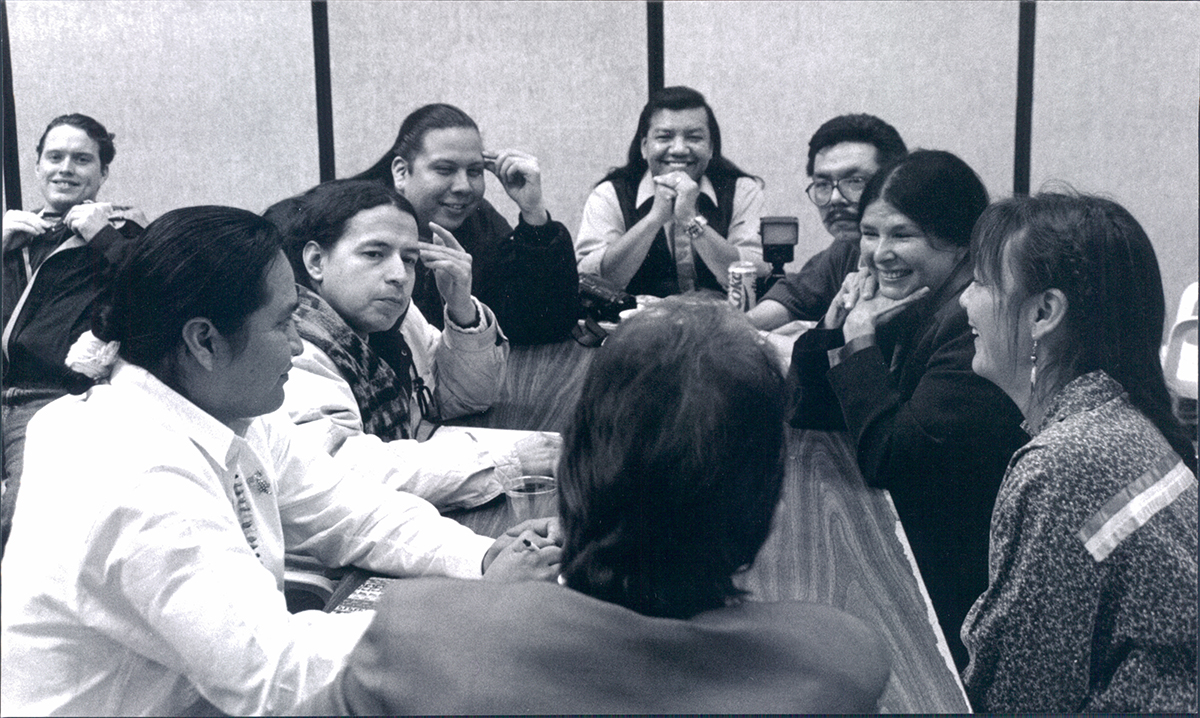
In addition to the films showcased, the In the Tradition: New Dimensions in Native American Film panel (moderated by writer, activist, and curator Paul Chaat Smith) brought together emerging and veteran artists, who discussed appropriation of Native stories, Native representation in the film industry, production opportunities, and the possibilities for change.
Panelists included Tantoo Cardinal, Alanis Obomsawin, Norman Patrick Brown, David Poisey, and Suzan Shown Harjo. Cardinal, who served as a Dramatic Competition Juror and starred in the Festival film Where the Rivers Flow North, also starred in seven other films at the Festival including award winner, Smoke Signals, and most recently, she acted in Martin Scorsese’s Killers of the Flower Moon. Obomsawin’s documentary Kanehsatake: 270 Years of Resistance was part of the 1994 program and she screened six other films at the Festival over the years. Brown and Poisey screened their films Awakening and Starting Fire with Gunpowder, respectively, during the Festival. And though Harjo did not have a film in the Festival, she shared insights from her career in journalism, policy advocacy, media, and film.
The Native Cinema section, later known as Native Forum, continued highlighting Native and Indigenous work during the Festival until 2004, screening over 160 films from artists around the world. The Festival retired the section in 2005, choosing to incorporate a steady stream of selected Native and Indigenous films into other Festival categories. In turn, the Indigenous Program, which formally began nearly 30 years ago, continues to support and elevate Indigenous artists and their stories. Recently the director of the Program highlighted accomplishments over the last year in his blog post An Indigenous Infinity: A Dispatch from Adam Piron.


In Here the Earth Grows Gold, NYC-based artist Suneil Sanzgiri uses 16mm film projection spliced with archival footage, animation, and interviews, alongside new sculptural assemblages comprised of bamboo, family photos, 3D renderings, anti-colonial publications, and nature imagery to examine the complexities of anti-colonialism, nationalism, and diasporic identity.
The work is deeply inspired by his family’s resistance while living in Goa, India, under Portuguese occupation. Through this debut solo exhibition, Sanzgiri links this legacy with that of African countries like Angola, South Africa, Morocco, etc, during the 1960s and 70s. Despite this personal anchor, the exhibition could stretch to any anti-colonial struggles raging today and inconsistencies of what’s regarded as official history versus one’s own lived history.
Until May 5, 2024






