BAUX Bio Colors Acoustic Panels Make Noise With Muted Colorways

BAUX Bio Colors Acoustic Panels Make Noise With Muted Colorways

BAUX joins the likes of ABBA, IKEA, and Volvo as an iconic Swedish export cementing itself in the zeitgeist with their inaugural launch into the American market upon the Bio Colors unveiling – six new pastel hues across the Origami Acoustic Pulp range made solely from natural ingredients. The fresh palette, inspired by traditional Nordic architecture, contemporizes their 100% bio-based product that originally launched in 2019 at the Stockholm Furniture Fair.

Individual acoustic tiles in six colors.

Colorways Yellow Terra, Red Mud, Green Soil, Blue Chalk, Natural Wheat, and Rose Clay

The breakthrough builds upon three decades of sustainable design and color theory informing the range’s nuanced narrative, which includes Yellow Terra, Red Mud, Green Soil, Blue Chalk, Natural Wheat, and Rose Clay. Each panel is a particular amalgam of biodegradable raw materials including plant extracts like cellulose fibers and citric acid, chalk, minerals, and earth pigments. Unlike other products that co-opt “green” language, these VOC-, plastic-, and petrochemical-free paints give a unique matte finish while delivering on the promise of a healthier indoor environment.

BAUX acoustic panels in office space.

It’s important to note the “origami” formwork as much as the aesthetic. Available in three linear styles – Sense, Pulse, and Energy – the durable yet lightweight tiles feature a nano-perforated surface, which accepts sound waves then stymied by the honeycomb chambers on the reverse. This architecture also reduces the amount of material used in the manufacturing process making it an inherently sustainable solution.

BAUX acoustic panels in dining space.

“BAUX’s unwavering commitment to sustainability is aligned with the broader design industry’s shift towards responsible choices, contributing to a circular economy,” says CEO and co-founder Fredrik Franzon. “In essence, at BAUX, we transcend the provision of acoustic panels; we humbly shape the future of interior architecture by seamlessly integrating sustainability, functionality, and aesthetics, with a special emphasis on the vibrant possibilities introduced by our Bio Colors range.”

BAUX acoustic panels in auditorium.

From the din of a burgeoning metropolis to the cacophony of a corporate coffee shop, acoustic considerations are becoming increasingly important. Architectural space has a significant impact on emotion with neurophysiological effects on the human brain. The auditory properties of an interior space have noteworthy implications on the design’s success, performance, and how the room is perceived. Sound mitigation is emerging as a fashionable tool to modify those beyond the context of a building requirement to combat noise pollution.

Baux acoustic panels in office space.

And gone are the days of specifiers requesting these products exclusively for the trade. Modern uses range from the traditional implementation in offices, academic settings, healthcare facilities, restaurants, and public forums to accessible applications in the home or even modification of privacy screens and furniture. BAUX seizes on the opportunity to contribute to the greater conversation on its use.

“The positive impact of our proprietary products addresses acoustic challenges in modern spaces and serves as a design element, allowing architects and designers to express creativity,” Franzon continues. “As these considerations become increasingly important, we remain at the forefront of redefining how individuals experience their built environment.”

BAUX acoustic panels in lobby.

For more information on the Acoustic Pulp Bio Colour line, visit baux.com.

With professional degrees in architecture and journalism, Joseph has a desire to make living beautifully accessible. His work seeks to enrich the lives of others with visual communication and storytelling through design. A regular contributor to titles under the SANDOW Design Group, including Luxe and Metropolis, Joseph serves the Design Milk team as their Managing Editor. When not practicing, he teaches visual communication, theory, and design. The New York-based writer has also contributed to exhibitions hosted by the AIA New York’s Center for Architecture and Architectural Digest, and recently published essays and collage illustrations with Proseterity, a literary publication.

MVA woos Japanese divers with photography seminar publicity

MVA woos Japanese divers with photography seminar publicity


1

Participants in the Marianas Diving Promotion underwater photography seminar take a commemorative photo at Laulau Beach in Saipan on Nov. 25, 2023. 


2

Participants in the Marianas Diving Promotion underwater photography seminar take a commemorative photo at Obyan Beach in Saipan on Nov. 25, 2023.


THE Marianas Visitors Authority is creating a media splash with the results of an underwater photography seminar recently held in the Marianas.

In collaboration with renowned diving photographer Sachi Murai of Japan and Marine Diving Web (marinediving.com) online magazine, MVA hosted the seminar last month with ten divers who had never visited the Marianas before. Prior to the event, Marine Diving Web published a series of articles with photos to promote the Marianas as the ideal destination for first overseas diving from Japan due to the islands’ proximity, clear waters, comfortable water temperature, and no language barriers owing to numerous Japanese diving guides available.

“The seminar and resulting media coverage aim to attract more first-time overseas divers with stunning photography and enticing stories, as the Marianas is the perfect destination for a first overseas dive trip,” said MVA Managing Director Christopher A. Concepcion.   “Saipan, Tinian, Rota, and the Northern Islands together offer a tremendous selection of beach, boat, and marine life encounter dives, perfect for even new divers.”

The seminar was held at two of the most popular dive sites in Saipan, Laulau Beach and Obyan Beach.  Eight articles have been published on Marine Diving Web, with one more planned for this month.  The articles are also being promoted via social media channels and advertising banners on the site.  In addition, more than 300 social networking posts have been made by the participants on their personal accounts, sharing their experience in Saipan.

“Sachi Murai was an ideal photographer to host this seminar.  He loves the ocean and is very familiar with our Marianas waters, having dived here many times, brought divers here on dive trips, and contributed to various articles about diving in Saipan, Tinian, and Rota,” said Concepcion. “We also thank our local dive operators for lending their support to the huge success of the seminar: Anclah Saipan, Aqua Gate Saipan, Make Sure Diving, Sakura Marine and Selfish Saipan.”

Marine Diving Web has 1,250,000 unique users.


3

Participants in the Marianas Diving Promotion underwater photography seminar at Obyan Beach in Saipan on Nov. 25, 2023. 


4

Ten divers from Japan participate in a critique session at Casa Urashima in Saipan  in November 2023 as part of a underwater photography seminar organized by the Marianas Visitors Authority and Marine Diving Web. 


SINWP Bird Photographer of the Year unveils stunning wildlife winners

SINWP Bird Photographer of the Year unveils stunning wildlife winners

The Society of the International Nature and Wildlife Photographers have recently announced the winners of the SINWP Bird Photographer of the Year 2023 competition. Organized in support of the RSPB, this competition helps to showcase some of the best wildlife photography from around the world. 

With 1,750 entries, the judges saw a huge range of feathered species from around the globe. However, there could only be one winner. The wildlife photographer to scoop the top prize was Gianpiero Ferrari, from Leicestershire, England. His image of a fieldfare enjoying an apple in the snow helped him win a collection of prizes worth £900. 

His winner was shot with his Canon EOS-1DX and 500mm f/4. The exposure was 1/200 sec at f/10,  ISO 500.

”The shot is from my home”, he explains. “After a snowfall during the night, several Fieldfare came in the garden to take advantage of the apple that I provided. This one was very aggressive and took over the entire garden chasing away all the other birds. I started to take some pictures from the house through a window, but I was not happy with the composition. I thought a ground level composition would have been much better. So first I had to build a pile of snow to use as a background and then lay on the ground under a camouflage blanket, waiting for the bird to return to eat the apples.”

This mother and baby image came second, and was shot in Trinity, Florida. It was shot with a Canon EOS R5 with an EF 100-400mm f/4.5-5.6L IS II USM (Image credit: Robert Gloeckner)

The third place went to Kevin Rooney from Gloucestershire, England, who took his image of an Oxpecker cleaning the nose of a buffalo in Mara North Conservancy in Kenya. He used a Canon 7D Mk II  with a Canon 100-400mm zoom. (Image credit: Kevin Rooney )

The competition raised over £2,200 for the Royal Society for the Protection of Birds – bringing the total raised for the conversation charity to over £13,000 in the six years of the contest.

• Check out the best lenses for bird photography

UWinnipeg launches research photography competition | University of Winnipeg News

UWinnipeg launches research photography competition | University of Winnipeg News

Calling all shutterbugs! The University of Winnipeg Research Office is excited to launch its first research photography competition.

Research in Focus is open to all UWinnipeg students, faculty, staff, retirees, and alumni.

“I am so excited to see Research in Focus submissions roll in,” said Dr. Jino Distasio, Vice-President of Research and Innovation. “This competition is an opportunity to share research from a vantage point we don’t often get to see on a larger scale. I suspect there will be a tremendous response to this competition, one that we can all celebrate together while featuring the incredible work that is done at UWinnipeg by faculty, students, staff, and alumni.”

Research in Focus is a chance to take viewers into the field, inside the lab, or onto the stage to visualize what researchers have witnessed, discovered, or created as they pursue academic excellence.

The competition will also serve as a reminder of the breadth and depth of research carried out by the UWinnipeg community.

Submissions are being accepted online now through February 7, 2024 in five main categories:

  • Artistry in Research: Images which represent the researcher’s work in music, drama, visual art, art history, and the humanities.
  • Community Catalysts: Images which demonstrate community impact or which represent research done with partners to benefit communities.
  • Faces of Discovery: Images which depict the people involved in research activities.
  • Fieldwork Frontiers: Images which demonstrate fieldwork.
  • Powered Perception: Images which reveal the subject in greater detail than is possible with the human eye, such as x-rays, microscopic images, computer models, drone photographs, etc.

A multidisciplinary jury will review the anonymized submissions in these five categories and judge their aesthetic appeal, creativity, and insight.

One winner and one runner-up will be chosen from each of the five main categories, as well as a grand prize winner. The grand prize winner will receive $500. Each of the five category winners will receive $300 and runners-up will receive $200.

The winner and runner-up in a sixth category, Viewer’s Choice, will be determined by public voting from February 12 to 25. A seventh and final category, Best Description, will celebrate the photograph with the best accompanying written description.

Winners will be announced during the 2024 Three-Minute Thesis competition on March 1 and will be displayed on campus and online.

All photos must be original work, taken by the entrant, and depict UWinnipeg-affiliated research. Entrants can submit up to one photo per category. A full list of contest rules is available in our Terms of Reference.

Photographers Warned They Could Be Sued for Grinch-Themed Shoots

Photographers Warned They Could Be Sued for Grinch-Themed Shoots

photographers warned grinch photoshoots lawsuits copyright infringement trademark dr seuss

Photographers have been warned about doing Grinch-themed photo shoots over the holidays due to “serious trademark infringement issues.”

Alongside traditional Santa photo sessions, Grinch-themed shoots are also popular among photographers during the Christmas period. However, photographers could allegedly risk being sued over this by Dr. Seuss Enterprises.

According to a report by Louisiana radio station 97.3 The Dawg, a social media post which cautioned photographers that using the Grinch theme for a shoot could attract legal action from Dr. Seuss Enterprises went viral among the lens community.

‘Protecting Photographers’

In the Facebook post, which amassed over 25,000 likes and 32,000 shares, Tennessee-based photographer Brittany Kay Photography reminded her followers that she would not be doing the Grinch-themed shoots over the holidays.

“Friendly reminder that doing Grinch photo sessions for a profit is a federal trademark infringement, and Dr. Seuss Int. literally hires out a team this time of year to reverse image search and sue photographers for profit,” Kay writes.

“So unless you got $120,000 for a license, that’s not a lawsuit you will win!

“This isn’t me trying to be a buzzkill. This is me just trying to protect newer photographers that aren’t aware of the situation.”

‘Cease and Desist Letters to Photographers’

As 97.3 The Dawg reports, Brittany Kay Photography provides no specific data on the likelihood of a photographer being sued by Dr. Seuss Enterprises.

However, according to an extensive report from TheLawTog.com which is cited by the radio station, Dr. Seuss Enterprises’ corporate counsel, Nicole Gates, reportedly sent cease and desist notices to infringing photographers who did Grinch-themed shoots.

And in 2019, PetaPixel covered an incident when Dr. Seuss Enterprises purportedly went on the offensive, sending an aggressive cease and desist letter to a photographer after their Grinch-themed holiday photo shoot went viral.

[embedded content]

While TheLawTog.com, a resource dedicated to legal issues in photography, reported that it could not fully verify the legitimacy of these notices from Gates — they do reportedly align with standard legal practices in such cases.

When a photographer uses images from Grinch sessions for advertising purposes, this supposedly not only constitutes copyright infringement of the original photographer’s work but also risks infringing upon the intellectual property rights associated with the Grinch character.

TheLawTog.com describes how copyright protects artistic works, and trademark laws protect brand identities, like logos and names, from being used in a manner that causes consumer confusion. For photographers, using the Grinch character or even the term “The Grinch” in marketing or sales could be seen as a violation of these laws.


Image credits: Header photo licensed via Depositphotos.

Giorgio Armani celebrates the sensual, timeless photography of Aldo Fallai

Giorgio Armani celebrates the sensual, timeless photography of Aldo Fallai

When Giorgio Armani emerged to prominence in 1970s Italy, he proposed a new way of dressing. It was epitomised by his riff on the suit jacket: stripping away its previously rigid structure and synonymy with stuffy formality, his take was defined by a languid elegance, unstructured in design and made to release the body from restriction. Such a philosophy has followed him throughout his career, across both his eponymous label and its various offshoots, including Emporio Armani. ‘It gives presence, stature and dignity,’ he told Wallpaper* of the tailored jacket in a conversation with Paul Smith. ‘And it is one piece: you attain more with less.’

In Florentine photographer Aldo Fallai – who he met when Fallai was still a graphic designer in Milan in the early 1970s – Mr Armani would find a natural ally. In 1977, they worked together for the first time; the resulting collaboration, which would span three decades, saw them refine a vision, particularly of masculinity, which was both widely influential and decidedly Armani. Rigorous in composition, yet imbued with a feeling of sensuality – often the images would celebrate the beauty of the human form – the photographs they produced together continue to define the spirit of the house today. 

Armani Aldo Fallai Exhibition

Armani Jeans S/S 1981 

(Image credit: Photography by Aldo Fallai)

Armani Aldo Fallai Exhibition

Emporio Armani A/W 1994 

(Image credit: Photography by Aldo Fallai)

And now, in Mr Armani’s Milanese hub and exhibition space, Armani/Silos, the designer pays ode to Fallai with a monographic exhibition of the photographer’s work, spanning 1977-2021 (until 11 August 2024). Curated by Mr Armani, his sister Rosanna Armani and Leo Dell’Orco, head of men’s collections, the wide-ranging exhibition celebrates what the designer calls an ‘artistic dialogue’, one largely led by an instinctual connection between the pair. Said to have been inspired by a melange of influences – from Tuscan mannerism and Caravaggio’s chiaroscuro to the pre-Raphaelites – Fallai’s evocative subjects include a man grasping a tiger cub under his arm (photographed in a circus in Palermo), couples in embrace or amid ruffled bedsheets, or model Antonia Dell’Atte playing a career woman on the Milanese street of Via Durini for a campaign in the 1980s.

‘Working with Aldo allowed me from the very beginning to transform the vision I had in my mind into real images: to communicate that my clothes were not just made in a certain way with certain colours and materials, but that they represented a way of life,’ says Mr Armani.

Armani Aldo Fallai Exhibition

Giorgio Armani A/W 1984-85

(Image credit: Photography by Aldo Fallai)

Armani Aldo Fallai Exhibition

Emporio Armani S/S 1993

(Image credit: Photography by Aldo Fallai)

‘Because style, for me, is a total form of expression. Together, with a constant fluid and concrete dialogue, we created scenes of life, evoked atmospheres and sketched portraits full of character. Today, looking back at everything we did, I myself am struck by the power that these shots still emanate, and by Aldo’s great ability to capture the nuances of personality.’

‘My work with Giorgio was the result of a natural, continuous dialogue and great trust on his part,’ adds Fallai. ‘I have vivid memories of our 30-year collaboration. Production was always agile and streamlined: we achieved the results with little means and no special effects. This, I think, appealed to the public.’ 

Aldo Fallai per Giorgio Armani, 1977-2021, open now until 11 August 2024.

Ticket are available here.

Watch the FAV-LE22 Fluid Audio Visualizer Turn Music Into Movement

Watch the FAV-LE22 Fluid Audio Visualizer Turn Music Into Movement

Nanoscale ferromagnetic particles are a truly strange substance. Suspended in an oily fluid, the particles can be made to “dance” under the influence of a strong magnetic source, spasming and gesticulating wildly with movements that almost seem alive. Korean artist and designer Dakd Jung uses the substance to impart his creation, the FAV-LE22 Fluid Audio Visualizer with a mesmerizing and otherworldly level of interactivity to add another dimension to music.

Originally developed by NASA in the 1960s, nanoscale ferromagnetic particles were first used for fuel transport in zero-gravity space, spacecraft, and sealing connections in space suits. Jung notes the substance was also suited as a damper for high-end speakers, alongside use in rotating shafts for motors, and for gas sealing.

“While researching ferrofluids, I discovered their interesting movement and prototyped ferromagnetic particles to respond to music,” explains Jung, “Immediately after posting the production video on social media and overseas community websites, the video spread quickly, and I noted how many people liked it.”

Small square-shaped white audio device with small circular window containing a globule of nanoscale ferromagnetic particles designed to move in relation to music set own top of a glossy white table top desk, surrounded by a pair of monitor speakers, desk lamp, books and other indeterminate objects. Backdrop of large windows in background.

Flooded with requests about collaborative opportunities and custom production designs, the artist/designer went to further develop the design into a production model. Thus began the development of the BurnSlap FAV-LE22 Fluid Audio Visualizer.

Top detail of the speaker grill of the square-shaped white audio device with small circular window containing a globule of nanoscale ferromagnetic particles designed to move in relation to music.

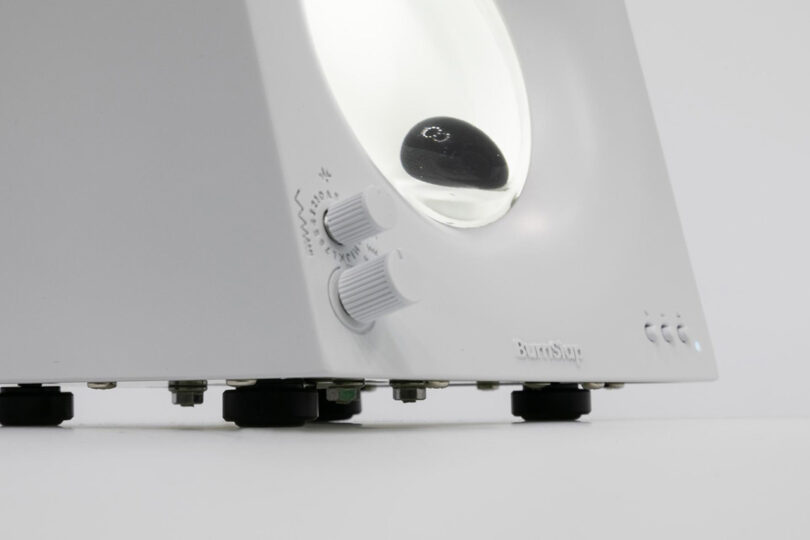
Lower half of the FAV-LE22 Fluid Audio Visualizer's control knobs and circular window showing the globule of nanoparticles at rest.

The biggest challenge proved to be keeping the ferrofluid from sticking to glass. “It is very tricky to keep the ferrofluid from sticking to the glass bottle,” explains the designer. “Most of the existing cheap magnetic fluid toys are difficult to use because the magnetic fluid easily sticks to the glass bottle or the magnetic fluid changes after a certain period of time.” He’d go onto develop a special proprietary glass surface processing technology that prevents magnetic fluid from sticking to the glass surface before moving onto developing the hardware circuit design and software algorithm to make the substance dance.

Detail view of the rear ports and power plug of the FAV-LE22 Fluid Audio Visualizer, alongside its feet stand.

The eventual fruit of his efforts, the FAV-LE22 visualizer, is outfitted with modest 5W speakers and can also be connected for pass-through for more robust audio playback support.

[embedded content]

Unsurprisingly, all of the attention online has made the $985 FAV-LE22 a very popularly sought-after device. Currently sold out with the first batch of visualizers shipped in late November, the designer will hopefully restock soon to bring the magnetic personality of his creation to more admirers.

Gregory Han is a Senior Editor at Design Milk. A Los Angeles native with a profound love and curiosity for design, hiking, tide pools, and road trips, a selection of his adventures and musings can be found at gregoryhan.com.

Watch the FAV-LE22 Fluid Audio Visualizer Turn Music Into Movement

Watch the FAV-LE22 Fluid Audio Visualizer Turn Music Into Movement

Nanoscale ferromagnetic particles are a truly strange substance. Suspended in an oily fluid, the particles can be made to “dance” under the influence of a strong magnetic source, spasming and gesticulating wildly with movements that almost seem alive. Korean artist and designer Dakd Jung uses the substance to impart his creation, the FAV-LE22 Fluid Audio Visualizer with a mesmerizing and otherworldly level of interactivity to add another dimension to music.

Small square-shaped white audio device with small circular window containing a globule of nanoscale ferromagnetic particles designed to move in relation to music.

Originally developed by NASA in the 1960s, nanoscale ferromagnetic particles were first used for fuel transport in zero-gravity space, spacecraft, and sealing connections in space suits. Jung notes the substance was also suited as a damper for high-end speakers, alongside use in rotating shafts for motors, and for gas sealing.

“While researching ferrofluids, I discovered their interesting movement and prototyped ferromagnetic particles to respond to music,” explains Jung, “Immediately after posting the production video on social media and overseas community websites, the video spread quickly, and I noted how many people liked it.”

Flooded with requests about collaborative opportunities and custom production designs, the artist/designer went to further develop the design into a production model. Thus began the development of the BurnSlap FAV-LE22 Fluid Audio Visualizer.

Top detail of the speaker grill of the square-shaped white audio device with small circular window containing a globule of nanoscale ferromagnetic particles designed to move in relation to music.

Lower half of the FAV-LE22 Fluid Audio Visualizer's control knobs and circular window showing the globule of nanoparticles at rest.

The biggest challenge proved to be keeping the ferrofluid from sticking to glass. “It is very tricky to keep the ferrofluid from sticking to the glass bottle,” explains the designer. “Most of the existing cheap magnetic fluid toys are difficult to use because the magnetic fluid easily sticks to the glass bottle or the magnetic fluid changes after a certain period of time.” He’d go onto develop a special proprietary glass surface processing technology that prevents magnetic fluid from sticking to the glass surface before moving onto developing the hardware circuit design and software algorithm to make the substance dance.

Detail view of the rear ports and power plug of the FAV-LE22 Fluid Audio Visualizer, alongside its feet stand.

The eventual fruit of his efforts, the FAV-LE22 visualizer, is outfitted with modest 5W speakers and can also be connected for pass-through for more robust audio playback support.

[embedded content]

Unsurprisingly, all of the attention online has made the $985 FAV-LE22 a very popularly sought-after device. Currently sold out with the first batch of visualizers shipped in late November, the designer will hopefully restock soon to bring the magnetic personality of his creation to more admirers.

Gregory Han is a Senior Editor at Design Milk. A Los Angeles native with a profound love and curiosity for design, hiking, tide pools, and road trips, a selection of his adventures and musings can be found at gregoryhan.com.