An Afghan Photographer’s Portrait of Her Mother

An Afghan Photographer’s Portrait of Her Mother

It was early fall, and my elderly mother, Laila, was in Mazar-e-Sharif Airport, trying to get out of Afghanistan. She needed to be quick: Two months earlier, the Taliban had regained power, and airports across the country were shutting down. Laila was sick; she had just tested positive for COVID-19 and needed to breathe from an oxygen tank that sat beside her wheelchair, like a sort of pet. It was Oct. 7, 2021, and my mother was leaving her beloved Afghanistan for the second time.

Laila gathers wild sage from the mountains near her home in Kabul in 2018. She used it to treat her high blood pressure as well as to soothe digestive problems and joint pain. (Mahbooba Hazara)
Laila and her husband, Mohammad, at the entrance to their home in Kabul. A small-business owner, Mohammad loved Laila very much. He was a kind man who often spent his retirement behind the pages of a book. He died in 2020 after a long illness. (Mahbooba Hazara)
Laila cleans her son Reza’s face in their home in Kabul. When Reza was 9 years old, he was paralyzed from the neck down by a car accident. Each day, Laila dressed his bedsores, fed and bathed him, took him out for exercise and changed his diapers. Despite his challenges, he grew into a tall man. (Mahbooba Hazara)
Each morning in Kabul, Laila prayed before making breakfast. She then went for a walk in the park. Lunch was cooked at home with her nurse. The afternoon was spent watching TV or looking after her grandchildren. After Mohammad was gone, she spent the nights with other family members, or they came to spend the night at hers. (Mahbooba Hazara)

Initially, airport officers deemed her too high a risk, worried that her health would fail mid-air. But my sister and brother, who were also there with their families, pleaded with them, saying they would not hold the airline responsible if something bad happened to her. Finally, she was allowed to board, but without the unwieldy oxygen tank. She knew this would be difficult — without it, there was a chance she could stop breathing. After very little consideration, Laila ripped the tubes from her nose. “I go with my children,” she told them, defiant.

Reza, sitting in their home in Kabul, under a picture of himself as a young boy, right before the accident. In 2021, shortly after Laila arrived in the United States, Reza died after a brief illness. Her other children do not have the heart to tell her. (Mahbooba Hazara)

Eventually, the airport gates opened, and the passengers boarded a bus that took them to a plane headed for Qatar. From Doha, she would fly to Germany and then on to the United States, where more of us were waiting for her, including me and two more of my brothers. As the plane departed Afghanistan, we tracked its path online, desperately hoping that she would not go into respiratory arrest. This was the most stressful moment of our lives: watching a little lit pin on a screen, over three excruciating hours, not knowing if our matriarch was able to breathe or not.

Laila sitting on a bench in Virginia in September 2022. (Mahbooba Hazara)

At last, Laila landed in Doha, where she was rushed to a hospital. There, she spent the next two weeks before starting the next leg of her journey.

Laila and her family watch TV in her daughter-in-law’s house in Virginia. Nearby, Laila lives with her youngest daughter, Mahbooba, a photographer. (Mahbooba Hazara)

For Laila, this salvation was about more than her physical safety. Getting on that plane and out of Afghanistan had not been her only concern. My mother was more afraid that members of the Taliban would identify her and our family. We are of Hazara ethnicity and have been heavily discriminated against over many years. We have several relatives and friends who have been killed in suicide attacks aimed at them because they are from our Shiite minority.

Laila and her eldest daughter, Halima, shop in a nearby mall to buy fabric to make new curtains for her home. She still suffers from the effects of COVID-19, which left her very weak, and uses a wheelchair on most days. (Mahbooba Hazara)

For this 74-year-old grandmother, the Taliban are the epitome of violence and brutality.

The first time Laila left Afghanistan was in 1979, when she and her husband, Mohammad (my father), fled after members of the communist government killed his cousin. They went west, to Iran, where they lived out the decade of our country’s Soviet occupation. It was here that Laila’s eight children were born, including me. She has always tried to give us a better life than the one we were dealt. When our brother Reza was 9 years old, he was involved in a car accident that left him in a coma. Our mother nursed him every day, into his adulthood. She saw it as her duty to protect us from the dangers and violence that lurked around every corner, and she never wanted us to know what sacrifices she made for her children.

Laila with a cup of green tea, her favorite, in her home in Virginia in July 2022. A lifelong drinker of green tea, she thinks it tastes excellent in America. (Mahbooba Hazara)

After Laila returned to Afghanistan in 2008, she was surprised by how her country had changed, how closed it had become for women. Even so, and despite being from the Hazara minority, Laila managed all sorts of feats, including becoming an extra in a Hollywood film shot in Afghanistan in 2010 (“Act of Dishonor”). In 2011, she worked with a U.S.-funded program in a village in her native Wardak province, helping women find work and achieve financial independence.

Laila cooks for two of her grandsons, Morteza, 11, and Sadra, 13, in Virginia in March 2022. Like her, they live in Alexandria and often visit Laila in her home after school. She is making their favorite dish — hash potatoes. (Mahbooba Hazara)

In 2020, she lost Mohammad, who was her biggest supporter. After a lifetime of his encouragement, she found herself suddenly alone. A year later, the Taliban swept to power.

Now, she lives with her children in the United States, in Alexandria in Virginia, where there is a large Afghan community. She is continually amazed at the differences between life in Afghanistan and in America, and how many opportunities there are for women and girls: how they can study whatever they want, how they can choose their careers, how they can safely come home after dark. After she experienced a lifetime of discrimination for being Hazara, America seems to have equality — at least on the surface.

Laila visits the physical therapist in Virginia. She lost one of her eyes to glaucoma and needs physical therapy. Sometimes, she has trouble with breathing and must use an oxygen tank. (Mahbooba Hazara)

Of course, she misses Afghanistan, mostly the land itself. When she was a girl, she would help her father work their fields in the central Wardak province, where they grew wheat, potatoes, turnips and carrots. She is far from her siblings, relatives and friends, and it pains her knowing what Afghan women are having to endure under Taliban rule. Life is difficult at home for everyone, but women have no individual or social freedoms; they cannot go to work or study. Laila and her daughters are physically free, but she is constantly thinking of her sisters back home and how their lives are dominated by oppression.

Laila watches a band (out of shot to the right) perform outdoors in Virginia in September 2022. Her newfound love of live music, particularly rock, has led her to attend performances in America — something she would never have been able to do in Afghanistan. (Mahbooba Hazara)

Laila longs to see Reza, whom she believes has been transferred to Germany for treatment. My siblings and I decided we could not tell her the truth, that he had died shortly after she left Afghanistan. It would be simply unbearable for her.

Laila and her family celebrate their first Nowruz (Persian New Year) in Virginia in March 2022. Laila has embroidered since she was a small girl, and this tablecloth was sewn by her. The spread has been decorated with pots of grass, symbolizing renewal. Laila is happy and content: She is surrounded by her family, who are safe. She prays to God, thanking him for accepting her New Year’s wishes. (Mahbooba Hazara)

For now, she is happy. Her children are artists, journalists and writers. We are thriving; we are safe. And we all owe our ability to think freely and creatively to our mother, whose hands are kind and whose heart cannot help but be warm.

Become a member today to receive access to all our paywalled essays and the best of New Lines delivered to your inbox through our newsletters.

Celebrity auctions boost sales in a turbulent year

Celebrity auctions boost sales in a turbulent year

“There are no sweeping generalisations in the art market,” says Elliot McDonald, senior vice-president of international gallery Pace. In an industry made up of mostly unique items, his assessment rang particularly true during the patchy year of 2023.

At auction, results were flattered by a surge in luxury goods and celebrity sales as the tumultuous geopolitical backdrop and general economic malaise took their toll in other categories. For the three major auction houses — Christie’s, Sotheby’s and Phillips — whose sales rely heavily on the thin $10mn-plus market, the unsettling backdrop contributed to a combined fall of 18 per cent to $11.2bn in auction sales in the year to December 14, according to analytics business Pi-eX.

While the numbers were impacted by 2022’s whopping $1.6bn made at Christie’s New York from the estate of Microsoft co-founder Paul Allen — “a difficult act to follow”, says Pi-eX chief executive Christine Bourron — she notes that all three houses had revenue falls across nearly all geographies. According to her data, the US and France fell the most, by 27 and 24 per cent respectively, followed by the UK, down 16 per cent. Auction sales in China fell 3 per cent, making it the second biggest market in this arena in 2023, after the US. Because of the Allen sale, Christie’s had the greatest fall at auction, of 30 per cent.

‘Dame mit Fächer’ (‘Lady with a Fan’) (1917-18) by Gustav Klimt was sold for $108.4mn (including fees) at Sotheby’s © Sotheby

The highest price of 2023 came courtesy of Sotheby’s, which sold Pablo Picasso’s “Femme à la montre” (1932) for $121mn ($139.4mn with fees), in line with expectations. It proved the only work to hammer for more than $100mn this year, though a late Gustav Klimt, “Lady with a fan” (1917-18), sold for $108.4mn once Sotheby’s fees were added in, and Christie’s reports a private sale “well above $100mn”, says its chief executive, Guillaume Cerutti.

Disappointing sales included that of the Chinese billionaire couple Liu Yiqian and Wang Wei at Sotheby’s in Hong Kong. Here, works by David Hockney, Zao Wou-Ki and Yayoi Kusama were among the unsold artists, while Amedeo Modigliani’s portrait “Paulette Jourdain” (c1919), bought for $42.8mn in 2015, sold for the equivalent of $30mn in October.

This auction was an extreme example of how single-owner and estate sales, which have provided the market’s pizzazz in recent years, are beginning to lose their shine. “There is no perfect solution,” Cerutti says, though he adds that a shift in the timing of the highest-wattage sales, to spread supply through the year, could help. “Right now, 50 per cent of our value comes from just two months,” he says.

A painting depicts a pool of water with water lilies and reeds
‘Le bassin aux nymphéas’ by Claude Monet made $74mn at Christie’s © Christie’s

Bucking the trend in 2023, albeit from a smaller base, was Bonhams, an auction house that specialises in a broader range of lower-priced art and which has invested heavily in its online reach in the past few years. The auction house’s revenues grew by 14 per cent to $1.1bn, with “healthy margins”, says chief executive Bruno Vinciguerra. Helping growth, he says, is the fact that “the top end of the market, which is immensely competitive, is only a small part of our business.” Bonhams therefore can avoid overambitious estimates to win consignments and limit incentives such as guarantees and other profit-sharing sweeteners.

Its variety of categories seems to chime with broadening taste. Among Bonhams’ top 10 prices in 2023 were the 18th-century bedchamber sword of Tipu Sultan (£14mn), an early 15th-century figure of Virupaksha (HK$38mn, £4.1mn) and a 2014 painting by Yoshitomo Nara (“Three Stars”, HK$36.8mn, £3.9mn). Vintage cars proved winners at Bonhams and Sotheby’s during 2023 while luxury goods, including handbags and jewellery, had their best year ever at Christie’s.

One area that Vinciguerra and others cite as increasingly popular is celebrity sales, where the owner proves more persuasive than the art — “this is the world we live in today,” he says. Bonhams’ star-studded offerings in 2023 included the personal collection of actor Roger Moore and the estate of broadcaster Barbara Walters. Sotheby’s provided the top-billing celebrity sale of the year, with its £40mn auction of 1,406 items that belonged to the late Queen frontman Freddie Mercury. The biggest gains were made for personal items, notably a silver Tiffany moustache comb, estimated at its retail price of £400-£600 and selling with Mercury added value for £152,400. Next up is the offering of 120 guitars and amps from the Dire Straits singer and songwriter Mark Knopfler (Christie’s, January 31) and, at Bonhams, costumes and props from The Crown (February 7).

A sword is engraved with patterns and words on its blade and handle
The 18th-century bedchamber sword of Tipu Sultan (£14mn) at Bonhams © Bonhams

The most surprising news of the year was that Endeavor, owner of Frieze, bought the Armory Show and Chicago Expo fairs. The move doubled Frieze’s events in the US, showing a commitment to this dominant region, while also pointing to the need to consolidate to find economies of scale as prices to build and run these temporary events rise. For gallery exhibitors, already stretched financially and physically, there is a difficult balance to strike between doing art fairs — which bring in about a third of their sales on average (though this is falling, according to the latest Art Basel & UBS report) — and sticking to their day-to-day business of putting on shows.

“We used to do a lot [of art fairs], some have been very good for us, but now we can’t do them all,” says gallerist Sundaram Tagore. For 2024, though, he has added the Aotearoa Art Fair in Auckland, New Zealand — acquired in March by the growing Art Assembly Group — to his roster.

Commercial galleries managed the cooler climes of 2023 by adopting seemingly opposing strategies. Smaller outfits, such as London’s Taymour Grahne and Roman Road, decided to abandon the traditional, single-venue, six-weekly exhibition programme in favour of more nomadic, advisory and pop-up businesses, while a new gallery, Akoje — co-founded by the England rugby star Maro Itoje — has adopted this model from the outset. Others, including Anat Ebgi, White Cube, Stephen Friedman, Alison Jacques and Selma Feriani, took advantage of the availability of real estate since the pandemic to grow their global footprints. 

A small silver comb with a handle that curves and tapers to a tip
Silver Tiffany moustache comb that belonged to Freddie Mercury sold at Sotheby’s for £152,400 © Sotheby’s

Those gallerists who report a good year of sales are aware of the fragility of the market in which they operate. “The reality we face is that certain areas do well, others don’t,” says Tagore, who marks his 25th year in business in 2024. “Our gallery has not suffered too much but you never know if we will be next.” The sweet spot for prices in the primary market seems to sit between $65,000 and $125,000: speculation has cooled below this level while the willingness of buyers to overpay in the hope of a rising tide has also lost its appeal.

The London gallerist Lyndsey Ingram finds that the key to success now is to have “a really tight, focused model, predicated on the understanding that people actually want what we are selling”. It is a far cry from the boom-period practice of creating indiscriminate desirability out of thin air.

Going into 2024, how best to represent living artists in a fragmented field looks likely to dominate the primary market. On the rise are artist agencies, which act more like sports management companies rather than as partners, who share in the upside — and sometimes downside — of their wards. It’s a nuanced change to the naked eye, but younger outfits such as London’s Guts Gallery talk of “championing instead of representing”, marking the shift in business models for the next generation of gallerists.

For the secondary market, the challenge will be how to manage the softening of the top end, which has masked problems lower down the food chain since the economic crash of 2008. Market observers note that even without any more surprise geopolitical crises, there are plenty of known distractions to come, including elections in the US, Russia, India, Germany and almost certainly the UK.

The auction houses point to the growth of new buyers this year — representing 35 per cent of clients at Christie’s, with a high proportion of millennials and Gen Z — as a source of cautious confidence going into the next season. Cerutti says: “2023 was a year of paradox. But we have made good business decisions and are well prepared for the future.”

Our favorite Rest of World photos from 2023

Our favorite Rest of World photos from 2023

Technology is reshaping the daily lives of the 4 billion people living outside the West. You can see it through the lenses of Rest of World’s photographers: From the quiet corners of coworking spaces in Colombia to talking card readers in India to large-scale water-guzzling EV factories and emoji-shaped pinãtas in Mexico.

In 2023, we sent 39 photographers to 31 cities and 22 countries, from Uganda to Iraq. Our photographers went to India in search of scam call centers and met with a crypto pastor in an Argentine prison. 

Take a look at some of our favorite photos from this year. 


A photo showing a monk recording a video of other monks on a mobile phone inside a building.

Cindy Liu for Rest of World

Cambodia’s Buddhist monks have become TikTok superstars, but seeking fame on TikTok could conflict with monastic code.

Photographer Cindy Liu traveled to Battambang to meet viral monks who are clashing with Buddhist authorities. According to tradition, monks are banned from drawing attention to themselves. But that hasn’t stopped them from using TikTok to preach, with some amassing more than half a million followers.


Alejandra Rajal for Rest of World

How China took over the world’s online shopping carts

To show the global growth of Chinese e-commerce platforms like Shein, Temu, and TikTok Shop, photographer Alejandra Rajal sourced the reflective and crinkled packaging sent by the e-commerce companies and laid them out in colorful patterns to highlight these companies’ scale and rise. You can see parts of her process here.


Deepti Asthana for Rest of World

How Urban Company built an empire of female gig workers in India

By getting access to training centers and clients’ homes, photographer Deepti Asthana shows us how gig work is transforming India’s beauty services industry from the inside. With a workforce that is one-third female, Urban Company is the biggest employer of women in India’s platform economy.


Online sports betting in South Asia has a new target: Archery

In the northeastern Indian state of Meghalaya, online streaming and digital payments have given new life to the traditional sport of archery. Kirtan P Deka photographed this century-old game as it found a new audience among online gamblers.


George Etheredge for Rest of World

Signal President Meredith Whittaker on resisting government threats to privacy

George Etheredge shot portraits of Meredith Whittaker just over a year after she took over as president of the Signal Foundation. The encrypted messaging app is on the front lines of encryption battles in India, Russia, and Iran.


Warun Siriprachai for Rest of World

How BYD snatched Tesla’s crown

In Bangkok, Warun Siriprachai met with a group of BYD electric car owners, a fast-growing community in Thailand. Selling vehicles at less than half the price of a Tesla, BYD dominates the Chinese EV market and has its sights set on the global arena.


Esther Ruth Mbabazi for Rest of World

Inside the world’s last internet cafes

For this project, six teams of photographers and writers set out to document some of the world’s last internet cafes. From backpacker haunts in Nepal to impromptu daycare centers in Mexico City, this visual experience captures a once ubiquitous environment that represented a high-tech future.


How viral memes conquered piñata design

In the lead-up to New Year celebrations, Angie Smith visited piñata vendors in Mexico City, where traditional piñata designs are quickly being replaced by more instagrammable ones.


Daro Sulakauri for Rest of World

The tech workers exiled from Europe’s last dictatorship

The political repression in Belarus forced huge numbers of people to leave the country, many of whom were tech workers. Photographers Daro Sulakauri and Andrej Vasilenko visited cities in Lithuania and Georgia to trace the journey of the Belarus tech community.


Harsha Vadlamani for Rest of World

Meet India’s MrBeast — selfless saint or fame-hungry vlogger?

In mid-February, photographer Harsha Vadlamani traveled to the suburbs of Hyderabad, India. There, he met a milkman’s family as they were surprised with a gift of over two dozen buffaloes and calves. The entire event was orchestrated by Harsha Sai, India’s most popular stunt philanthropist — working in an area of YouTube where generous acts of kindness are turned into spectacles and monetized for views.


Muhammad Fadli for Rest of World

The race to put Indigenous land on the map

On a balmy day in August, photographer Muhammad Fadli drove past expanding stretches of palm oil plantations to reach the Long Bangan community in Sarawak, Malaysia. To stop their ancestral land from being turned into plantations, these communities are using GPS and drones to “decolonize the map” and prove their land rights.


Saumya Khandelwal for Rest of World

Inside Foxconn’s struggle to make iPhones in India

Photographer Saumya Khandelwal documented how Foxconn, in its continued effort to build iPhones in India, flew hundreds of Chinese engineers to India. The Chinese workers struggled to bring Indian factories up to speed — and often clashed with their Indian counterparts.


An Rong Xu for Rest of World

Taiwan’s most popular EV company, Gogoro, wants to reach the world

In Taipei, An Rong Xu photographed the facilities of Gogoro, a Taiwanese company with a revolutionary EV network. Gogoro battery-swapping stations are as common as gas stations in Taiwan, and the network supports nearly 400,000 swaps a day.


A photo showing a man wearing VR glasses, seated in a chair at a desk in a co-working space.

Andres BO for Rest of World

How digital nomads have reshaped cities around the world

In Medellín, photographer Andrés BO visited coworking spaces where foreign coders and digital marketers crowd the tables, drinking pour-over coffee and enjoying loaded avocado toast. The increase in digital nomads can offer an economic boost to cities, but rising rents are leaving locals priced out.


Cesar Rodriguez for Rest of World

A new Tesla factory comes to a parched corner of Mexico

César Rodriguez traveled to drought-stricken Monterrey, Mexico, where working-class residents ration water while big companies like Heineken and Coca-Cola continue business as usual. With a massive Tesla factory on the horizon, locals are increasingly worried about the looming environmental threat.


Nipun Prabhakar for Rest of World

YouTube is bringing viral fame to one of Delhi’s oldest markets

Weaving through the narrow bylanes of one of India’s biggest markets, Nipun Prabhakar met traditional clothing store owners who are hiring YouTubers to market their wares.

Chris Dougherty funeral: Loved ones to say final goodbye to photographer killed in Chopper 6 crash

Chris Dougherty funeral: Loved ones to say final goodbye to photographer killed in Chopper 6 crash
image

The funeral for photographer Chris Dougherty, an Action News team member who died in the Chopper 6 crash, will be held Thursday.

#lee-rev-content { margin:0 -5px; }
#lee-rev-content h3 {
font-family: inherit!important;
font-weight: 700!important;
border-left: 8px solid var(–lee-blox-link-color);
text-indent: 7px;
font-size: 24px!important;
line-height: 24px;
}
#lee-rev-content .rc-provider {
font-family: inherit!important;
}
#lee-rev-content h4 {
line-height: 24px!important;
font-family: “serif-ds”,Times,”Times New Roman”,serif!important;
margin-top: 10px!important;
}
@media (max-width: 991px) {
#lee-rev-content h3 {
font-size: 18px!important;
line-height: 18px;
}
}

DSCENE INTERVIEW: The Dynamic World of Photographer Michel Haddi

DSCENE INTERVIEW: The Dynamic World of Photographer Michel Haddi
© Michel Haddi, Dominique-Swain, Max magazine, Los Angeles, 1997, Courtesy of 29 ARTS IN PROGRESS gallery

Michel Haddi, a prominent figure in fashion and portrait photography for over forty years, is celebrated for his unique and innovative approach. Currently based in London, Haddi’s artistic vision has been shaped by a diverse array of cultural and personal experiences. His latest exhibition, “Beyond Fashion” at 29 Arts in Progress gallery, is a testament to his extraordinary career, offering an in-depth look at his journey through photography.

This six-month exhibition provides an opportunity for both the public and collectors to immerse themselves in Haddi’s world. His images, infused with a distinctive street vibe and urban soul, also reveal a touch of irony and sensuality, mirroring his diverse personality. The exhibit showcases some of the most iconic photographs from his vast archive, featuring renowned figures, top models, and icons from the music and art worlds. These include memorable captures of David Bowie, Debbie Harry, Djimon Hounsou, John Galliano, Nicholas Cage, and Sarah Jessica Parker.

Haddi’s editorial work spans several continents, with contributions to major publications such as Italian Vogue, French Vogue, British Vogue, GQ, Vanity Fair, The Face, and Rolling Stone. His advertising portfolio is equally impressive, having worked with luxury brands like Armani, Yves Saint-Laurent, and Guerlain.

In this exclusive interview with DSCENE Magazine Editor Katarina Doric, Michel Haddi discusses the inspirations behind his distinctive style, the evolution of his photographic techniques, and the standout pieces in his “Beyond Fashion” exhibition. He also shares insights into the influence of his background on his work and his perspective on balancing irony and sensuality to craft compelling photographic narratives.

© Michel Haddi – Molly Sims_Citizen K Magazine, Miami, 2005 – Courtesy of 29 ARTS IN PROGRESS gallery

Michel, could you share with us what initially inspired you to pursue photography, especially with your unique blend of street vibe and urban soul? – In life you have the choice to have a normal life, which can be great too or to pursue a chimera or a dream. In short, I had no choices and I would have ended up on the other side of the fence, meaning a hoodlum, being raised in the worst suburb. I had no alternative, only to fend for myself. The most important goal I had was to be an artist, painter, director or being Leonard Bernstein. Life showed me another path- photography.

Over your 40-year career, how has your photographic style evolved and what has remained constant in your approach to photography? – Since the beginning I have only ever been interested with human feelings, meaning I never cared much of just a fashion image, which in all honesty you do not need to be a genius to do, but to create a magic image takes willpower, style, attitude. Since the last 70’s I pursued this goal without fear. It didn’t matter the formats, colour or black and white, I love to play and I am up for games all the time. 20 years ago I thought I was cool to take a self portraits looking like a Japanese Samurai, and why not snap images with a point and shoot camera, the funny side of the story back then is people thought I was insane. In the show in Milan there are some images shot that way. To come back to what you said, my style is “be there at the right time, right place”, have a laugh, don’t be too serious and if you can at the same time have a ball, it is all sweet.

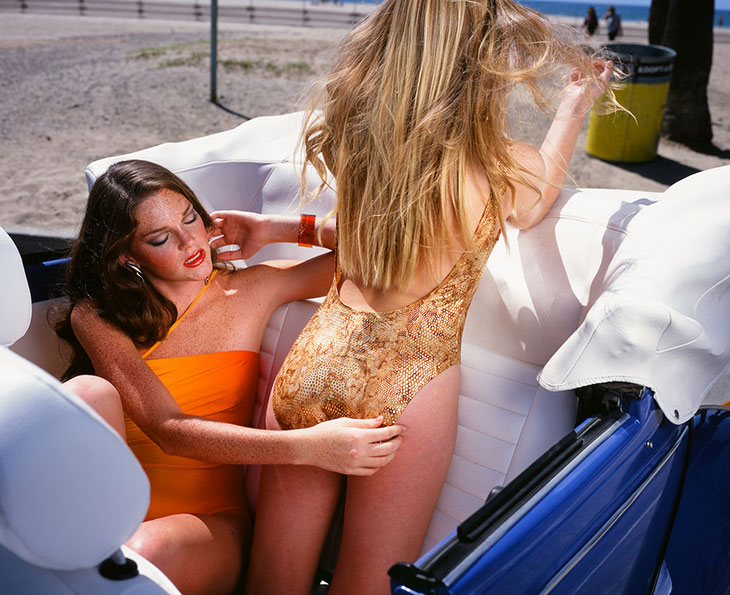
© Michel Haddi – Girls in a car, 20 Ans Magazine, Santa Monica Beach, Los Angeles, 1998 – Courtesy of 29 ARTS IN PROGRESS gallery

In your latest exhibition ‘Beyond Fashion’, which pieces do you feel most intimately represent your journey as a photographer? – There is an image of a flower, an Anterium with the antemine being hard and that flower is between the legs of my friend Natalia Avelon. A cover we shot for Playboy last year, Again, it all about showing things that are not there but more suggestive.

You’ve photographed many famous faces and icons. Is there a particular subject or shoot that. stands out as particularly memorable or significant in your career? – Maybe the Red Hot Chili Peppers, as I was in Berlin with them for Interview Magazine when the wall went down, so you can imagine the pandemonium and the racket, the fall of a great empire. The communist block that day went into a total oblivion. Anyway it was epic and as we went on the wall to break it and to work finishing the story for the mag.

The bottom line is I love to go against all odds, I decided to go to East Berlin the day after. Wrong choice. No one in sight, deserted land, total emptiness in East Berlin. But as soon as I came out of the cab and started to take pictures of the buildings and the rest, 5 army trucks came along armed to the teeth with AK47’s loaded to the gull. I can assure you they were pissed off as it was no tomorrow for them. I did laugh looking at these clowns, they didn’t like it and they wanted to take me in the woods…you know the meaning. Ah ha the cab driver just forced me back into his cab and we left without asking me where to go in East Berlin for coffee… ha ha. At the end of next year, I will release the Legend- The Red Hot Chili Peppers Berlin.

© Michel Haddi – Molly Sims, Citizen K Magazine_Miami, 2005 – Courtesy of 29 ARTS IN PROGRESS gallery

Being French Algerian, how have your cultural roots influenced your work? – In all fairness I was born in Saint Germain des Pres and educated in a rightwing orphanage, raised from the age of 9 by my mother who I rarely saw, and in a tough suburb. Even with all the bad things I saw, I am a French boy all the way. My blood heritage coming from many worlds made me see life differently. My Arabic side, well I embraced it but I have never been to Algeria and the closest I have been is Morocco, as I used to have a house there for 20 years.. I am of mixed blood with different cultures. My mum yes sure is Algerian from with Turkish and Moroccan background. We have certainly 1000 members of the Haddi tribe throughout the Arabic world. My father that I never knew, was French from Paris, Bourgeois, from a family dating back from the 14th century in France and from a recent DNA test of late, I can confirm I have indeed some Irish and Welsh with a touch of African. So as you can see, I have the same love to make a ring in sterling silver from the Dogon Tribe from Mali, as I do to conceive a campaign for a luxury brand from Paris.

As you know the French are the way they are, always complicated and striking for whatever reason, when it come to creating something luxurious, they are right at the top, so for me it was a total bonafide.

© Michel Haddi – Moschino Fashion Show, Vanity Fair, Milan, 2010 – Courtesy of 29 ARTS IN PROGRESS gallery

Your work is noted for its irony and sensuality. Can you elaborate on how you balance these elements to create a compelling narrative in your photographs? – Again this is my French, Arabic side playing out. Being sensual it is a must, you need this in order to get close to humans. I suppose in the semitic society, they for 5000 years wrote about sensuality, take for instance the Perfume Garden from the 15th century written by Muḥammad ibn Muḥammad al-Nafzawi, The book was made by the Factotum of the Pacha of Tunis, something like that for the Pacha to start again have desires (bare in mind the Factotum had no choices) the Pacha simply said, ever I become a man again, or your head rolls. Charming it is not ha ha, yet I learned all about sarcasm and irony in the UK . This is why I have been there since the late 70’s. In all fairness, and truth why do you want to show the world that you are extremely clever and very intelligent. Sod it just have fun and who cares.

As a photographer who has extensively worked in the fashion industry, how do you perceive the role of fashion in shaping cultural and artistic expressions? – Fashion per se and its primary goal is very boring. Many brands, I am talking about “fast fashion”, “cheap fashion”. There is no study of the human soul, just a way to make a quick buck. Now you go to the top of the pyramid, the gods among the gods. Well here the dialogue is totally different. It is a reflection day by day of our society and if you look carefully, you can feel the premises of whatever political statement is happening. It does become and extra class on sociology, that will take place at La Sorbonne in Paris. Again, what I said, only work if you have people around you who are in the same groove. Mark my words, search deep into what we are with all our strength and our failures, then you will be able to create a garment that is worth something. The best example of this is YSL.

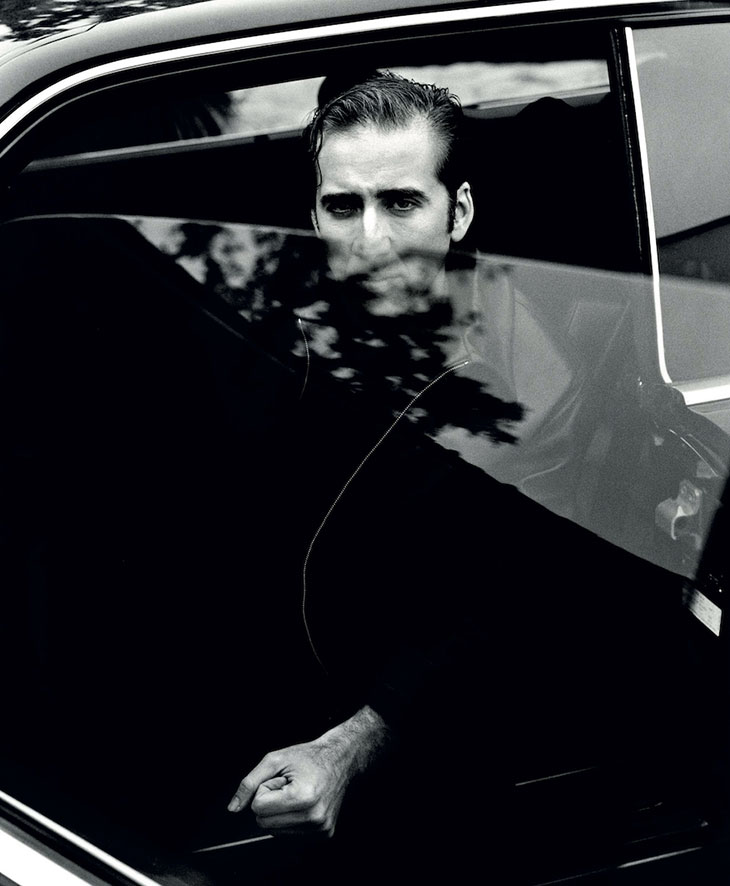
© Michel Haddi – Nicolas Cage, Detour Magazine, Los Angeles, 1991 – Courtesy of 29 ARTS IN PROGRESS gallery

What advice would you give to young photographers who aspire to carve out a career in fashion and portrait photography? – I have no advice to give, they might become competitors and that would be a problem ha..ha..,of course not! The only thing I will say to them is don’t listen to anyone and secondly don’t listen to me.. ha ha, the last just put your bollocks on the table and like a bull in a china shop, charge full steam ahead but of course make sure you use your head.

In your opinion, what is the power of photography in telling stories and capturing moments, and how has this shaped your approach to your art? – This has been my only goal all my life to telling a story. The rest, I not interested in. It is not relevant. Photography as a media is so powerful, from one image you can have the world going one way or the other way. For example The Times magazine I think did a series of very compelling ads to show you the power of an image. The first one, and this is very important, you see an image of a black man running with his hand and arm above a little old granny and I think it is correct to say that the majority of people will say here we go again, a black punching an old granny for her purse. In the second image, full frame, it is a different story and a different point of view. What do you see, yes of course the black man wutg the hand and the arm above the old granny, but well you see too a large piece of wood falling down from a scaffolding in the old granny’s head. All he does this gentle soul is to protect the granny. The perception is not the same correct. Tell a story that is true of your beliefs.

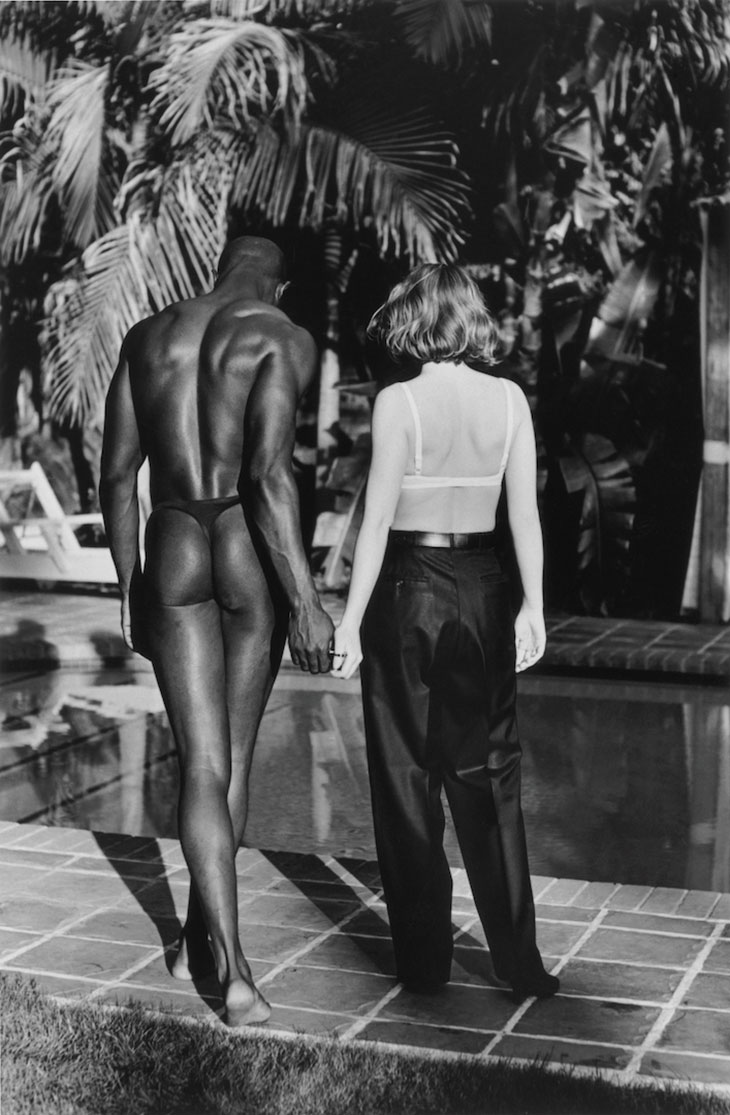
© Michel Haddi – Patsy Kensit _ Djimon Hounsou, Interview Magazine, Los Angeles, 1991 – Courtesy of 29 ARTS IN PROGRESS gallery

How has the advent of digital photography and social media impacted your work and the fashion photography industry as a whole? – I love it. Quicker to work and to play and you can interact with millions of people and everyone feels like a god! I loved it, digital is much quicker of course but bare in mind, if you think that the tools are going to help you to transform a shitty image unti a masterpiece, wakeup honey cos your image is still going to be a turd. It doesn’t matter what you used, a phone or your third eye, you need to create and this is where the problem arises. Creativity is not only a new version of photoshop or an AI tool. My wife taught me photoshop in order to stop me asking her to retouch all my images. Social networks are a blessing and a curse, You can interact with millions of people, make business moves, pretend to be a star. You can even throw up bile on whoever you like. It is Pandora’s box. Infine social networks are only a business tool. There is nothing personal about it, but it is on the the medias where simple mortals feel like gods and goddesses.

Keep up with Michael Haddi’s work on Instagram – @michelhaddistudio

Larry Fink, photographer who documented US society and always found the human angle

Larry Fink, photographer who documented US society and always found the human angle

Larry Fink, who has died aged 82, was an acclaimed photographer whose subjects ranged from jazz musicians to boxers and from members of Andy Warhol’s factory to celebrities such as Meryl Streep and Kate Winslet.

He called himself a “Marxist from Long Island” and there was fury in US Republican circles in 2004 when he put up a “satirical exhibit” consisting of a photograph of a smirking George W Bush lookalike, his left hand cupping the breast of a woman in a negligée, in the lobby of a US university humanities building. 

In an essay to accompany the exhibit, Fink attacked the “fundamentalist neoconservative conspiracy” and called Bush a “frat boy with charisma”. The woman in the photograph, he said, was a metaphor for the whole world.

'English Speaking Union, New York, New York,' December 1975


‘English Speaking Union, New York, New York,’ December 1975


Credit: Larry Fink/Courtesy Robert Mann Gallery via AP

Fink was best known for “Social Graces”, a 1979 exhibition at the New York Museum of Modern Art (published as a book in 1984) in which black-and-white photos of wealthy New Yorkers having a good time were juxtaposed with shots of his working class neighbours having more modest fun in Martins Creek, Pennsylvania where he lived on a farm.

Many detected an underlying political message in the contrast between hedonistic wealth and extreme poverty of 1970s America, but Fink denied the charge. “I’m a human person, not just a political person,” he told the Guardian in 2020. “I like people actually.”

'Pat Sabatine's 8th Birthday Party, Pennsylvania', 1977


‘Pat Sabatine’s 8th Birthday Party, Pennsylvania’, 1977


Credit: Larry Fink/Courtesy Robert Mann Gallery via AP

Though he felt an outsider in the glitzy world of Manhattan, he always sought the vulnerable human being behind the facade: “Emotions are primary to all of us, and it’s that which allows us the empathy factor. In my way of thinking that’s how I need to photograph, to go inside the other person somehow and find what it is about them which is also about me.”

The New York Times observed that Social Graces “does one of the things that straight photography does best: provide excruciatingly intimate glimpses of real people and their all-too-fallibly human lives.”

It was the element of compassion for his subjects, and his distinctive visual style – Fink always used a handheld flash separate from his camera – that led to commissions for The New York Times, Vanity Fair and GQ Magazine – and to solo exhibitions at the Whitney Museum, the Philadelphia Museum of Art and other venues around the world including the David Hill Gallery in London.

'George Plimpton and Devotees, Elaine's New York,' January 1999


‘George Plimpton and Devotees, Elaine’s New York,’ January 1999


Credit: Larry Fink/Courtesy Robert Mann Gallery via AP

One person Fink refused to photograph was Donald Trump. When Vanity Fair asked him to document the new president’s inaugural ball, he refused. “I didn’t want to photograph him… I thought he was a horrible person.” Instead, he photographed a women’s march the following day.

Larry Fink was born in Brooklyn, New York, on March 11 1941 to “leftist but bourgeois” parents. His father, Bernard Fink, was a lawyer in the insurance industry and his mother Sylvia, née Caplan, a political activist her son described as a “mink Marxist”. Great partygoers, they were fans of Cab Calloway and Count Basie, and moved in radical artistic circles. 

The family moved to Long Island where the teenage Fink began getting into trouble: “I was stealing cars and cursing out my algebra teacher and kicking the vice-principal in the groin”. Things improved when he was sent to a progressive boarding school in western Massachusetts, where he was inspired by the poetry of Allen Ginsberg and enjoyed midnight discussions about Marxist theory and Buddhism.

Larry Fink


Larry Fink


Credit: ©larryfink ©GeoffreyBerliner/ Larry Fink Studio

After leaving school and a very short stint at Coe College, Iowa, he hitchhiked round the mid-west, moved back to New York and became part of the Greenwich Village counter-culture scene. A favourite haunt was the Village Gate jazz club, where Charlie Mingus and John Coltrane were regulars and soon Fink was busy photographing the Beat poets, artists and musicians of the era.

He had taken up photography aged 13 after his father gave him a Rolleiflex camera and was later privately taught and mentored by photographer Lisette Model. He regarded the Beats as his first “tribe” and he went on to explore other tribes, once describing himself as “a witness for the investigation into what it meant to be alive”.

'Blue Horizon, Philadelphia, Pennsylvania' [a boxing venue]. December 1994


‘Blue Horizon, Philadelphia, Pennsylvania’ [a boxing venue]. December 1994


Credit: Larry Fink/Courtesy Robert Mann Gallery via AP

Notable among these were his photographs of boxers and gritty boxing venues which, instead or focusing on the gore and the violence, documented the post-match cameraderie and genuine affection among the fighters. His portraits included a ringside shot of Mike Tyson, whom he found “likeable”, taken at the budding champion’s training camp in Catskill, New York in 1986 a few months before he won his first heavyweight title.

In 1999 Fink was put under contract by Vanity Fair and for the next 12 years he documented the magazine’s famous Oscar parties, assembling a collection published and exhibited as “The Vanities”. Unlike other photographers who looked for smiles, he preferred to shoot celebrities in unguarded moments in the same way he would shoot anyone else. 

“At the beginning publicists wouldn’t let me near their people,”  he recalled. “But then I was branded as the ‘candid guy’. Then they started to like me; it became good to be ‘photographed by Larry’. Because the pictures are not mean, they didn’t mind.”

As well as his magazine work, Fink had an extensive advertising portfolio and taught photography at Bard College, New York for more than 40 years.

Fink’s first marriage to Joan Snyder was dissolved. He is survived by his second wife, Martha Posner, and a daughter from his first marriage.

Larry Fink, born March 11 1941, died November 25 2023