Chronicle Photographers Reflect on Their Most Memorable Photos of the Year

Chronicle Photographers Reflect on Their Most Memorable Photos of the Year

Jana Birchum

It’s hard to write about the year just past. It was so different than the previous few – 2020-2021 with endless COVID news, 2022 with the reemergence, tentative as it was. This year was often just bad news for my community – drag bans, gender affirming care bans, homophobia everywhere. It made me dig in more to the celebration of my community, as you can see here. All my good photos were of women, trans, and nonbinary folks this year. It’s getting hard for us to stay in Texas.


instagram.com/janab04

Brigitte Bandit, drag activist, at the Texas State Capitol. I didn’t feel like this was an easy shoot for her. The hearings at the Capitol on anything related to gay or trans issues are just soul-draining. The hate is so palpable. And it always dresses itself up as “concern for the children.” Brigitte teared up when we went inside. I admire her courage to confront the homophobes face-to-face in a 2-foot-tall Dolly Parton wig. (Photo by Jana Birchum)

If you want a (late) night of fun, go see one of the House of Lepore’s drag balls at Swan Dive. (Photo by Jana Birchum)

Unhoused women evicted from the Downtown Salvation Army shelter when it closed. Their fear and anger were so clear. (Photo by Jana Birchum)

John Anderson

On January 22, almost 10 months before the deadly Hamas attack on Israel, a small group of students peacefully gathered outside the annual Israeli-American Council summit at Fairmont Austin to protest Israel’s blockade of Gaza. With a significant police presence, most summit attendees ignored the protesters, but a few mocked and argued with them. The protest took place without incident but was a minor, local representation of the struggles the Palestinian people have endured for decades. At the global level, U.N. Secretary-General António Guterres acknowledged the Hamas terrorist attack “did not happen in a vacuum.”


johnandersonphotographer.com

Supporters of Palestine protested Israel’s blockade of Gaza during the Israeli-American Council summit at Fairmont Austin on January 22. (Photo by John Anderson)

On November 13, an estimated 10,000 protesters rallied at the Texas State Capitol and marched through Downtown to show support for Palestinians in Gaza and to oppose Israel’s deadly military retribution. (Photo by John Anderson)

Photo by John Anderson

David Brendan Hall

In music photography – the vast majority of what I contributed to the Chronicle this year – there are exceptionally rare moments when the first image captured during a shoot is the one. This was just such an instance, when Kendrick Lamar walked on stage for his headlining set at ACL Festival’s second weekend (Oct. 13), a bright, solid-white backdrop resulting in only his silhouetted profile. As I maneuvered through the remainder of the three songs (for those who may not know, the standard allotment in a photo pit for media photographers), I knew in the back of my mind that I had it, a photo which, for me – a longtime appreciator who’s made it a point not to miss any of his visionary tours in the past decade – felt definitive of Kendrick’s consistently raw, enigmatic presence. After lowering my camera, I instinctively let out an audible “fuck yeah.” A little bit of luck perfectly coalesced with years upon years refining the craft, and if that type of moment isn’t inspiration enough to continue creating no matter the odds, I don’t know what is.


instagram.com/dhallphoto

That shot of Kendrick Lamar (Photo by David Brendan Hall)

Karen O of the Yeah Yeah Yeahs dazzled with a twirl of color and pure joy on Sunday of ACL Festival’s second weekend (Oct. 15). (Photo by David Brendan Hall)

Jenny Lewis and Ben Gibbard of the Postal Service faced off for a sweet moment during their show at Germania Insurance Amphitheater (Sept. 9). (Photo by David Brendan Hall)

Isabella Martinez

This year has been an exhilarating journey for me, especially when it comes to capturing moments at Austin Psych Fest and Levitation – two standout festivals that have defined my 2023. Immersing myself in the vibrant tapestry of art woven into these events was a truly enriching experience. Among the many performances of the year, I selected snapshots of Ty Segall, Altin Gün, and A Place to Bury Strangers because their live sets were nothing short of extraordinary. The excitement I felt when I learned I would be photographing for both festivals was overwhelming, and I made it a mission to seize every opportunity to capture these remarkable artists. Witnessing Ty Segall shredding his iconic guitar solos was a breathtaking and emotional experience as it was the final leg under the Freedom Band name, along with his longtime bandmate Charles Moothart’s last show. This performance took the lead and created memories that lingered long after the music faded. Altin Gün’s Turkish psych-rock performance was also a standout at Levitation, keeping the crowd on their feet dancing throughout the night – an infectious energy that I loved and couldn’t enough of. Lastly, my final pick was of A Place to Bury Strangers, who took festival engagement to a new level. In essence, these photos encapsulate not just the visual aesthetics of the festivals but the profound impact these artists had on me long after they had performed.


instagram.com/peppermintgirlphotography

Oliver Ackermann from A Place to Bury Strangers finishing the set from the crowd during Austin Psych Fest’s kickoff night at Mohawk. (Photo by Isabella Martinez)

Ty Segall shredding a guitar solo at Stubb’s for Levitation. (Photo by Isabella Martinez)

Altin Gün playing an electrifying Levitation set at Empire Garage. (Photo by Isabella Martinez)

Staff Picks 2023: “It’s us, it’s who we are.” Terri O’Connor on her role and the importance of Native American artwork and culture

Staff Picks 2023: “It’s us, it’s who we are.” Terri O’Connor on her role and the importance of Native American artwork and culture

We’re revisiting some of our favorite stories of the year. This one was originally published July 20.

picked this one because I appreciate all the individual and groups of artists I have gotten the opportunity to talk to, but I think it is especially important to highlight Indigenous culture, history, and life given that our dominant culture is strategically designed to ignore, erase, or destroy those precious things, and Terri is a wonderful woman playing her part in fighting that. 

— Isaac Trussoni

Wisconsin is no stranger to the presence of deep, yet often under-discussed Native American history that ties in so closely with the state. While much of the visual representation of Native history is most immediately seen in the geography of Wisconsin, many artists are pushing for more visibility and vocality around Native history and culture through their own creations. 

Terri O’Connor is one such local artist. While Terri now lives in Poynette, Wisconsin, she has been around the Madison area since her early 20s. O’Connor’s passion for art started long before she found her way to Madison as art was second nature at home.    

“I started my art way back when I was young,” O’Connor told Madison365. “I just always dabbled in the art scene a bit, slowly working with the tribe on quite a few little projects that they had. My dad was an artist, so he had paintings that he had done in the house like some horses, I remember. I also had my mom’s brother who was an artist, so he did a lot of beautiful artwork, too, as a painter, as well. I saw that and was always interested in art.”

O’Connor grew up surrounded not just by art, but by Native American art and culture specifically that fueled a passion for learning more. Being raised on the Stockbridge-Munsee Band of Mohicans Reservation, O’Connor was exposed to culture and connections within the tribe that eventually led to working in smaller ways to provide artistic needs for her community. 

“Going to the Pow-Wows in the summertime was a huge influence on me,” said O’Connor. “I just loved the character. I’m a people person when I draw. I love looking at faces and I was intrigued with the history. I like old photos, so working at the museum, I got to see some of the history. It just really influenced me on the culture. The tradition of Native Americans’ respect for their elders, and the Pow-Wows as gatherings and always giving thanks. It’s basically a gathering to get together to see family and see people that you haven’t seen in a while.”

Connecting with people gave O’Connor the opportunity needed to practice her art in ways that may not be immediately thought of such as designing badges for the tribal Natural Resources Department, and logo design for businesses out of the tribe, such as Tribal Sun Soap. However, the most inspiring things for O’Connor’s artwork may just be the joining together of people in ways that uplift and support the community. 

“I did a piece honoring women called ‘The Gatherer,’ O’Connor said. “A lot of the women in our culture were gatherers of not only the food, but they were a great support for the community. I like to do a lot of my art in honor of men, women, and children, because it’s all part of us. We’re all part of that community. We all make a difference in all the things that we do and contribute to help each other. I think that’s true in all cultures.”

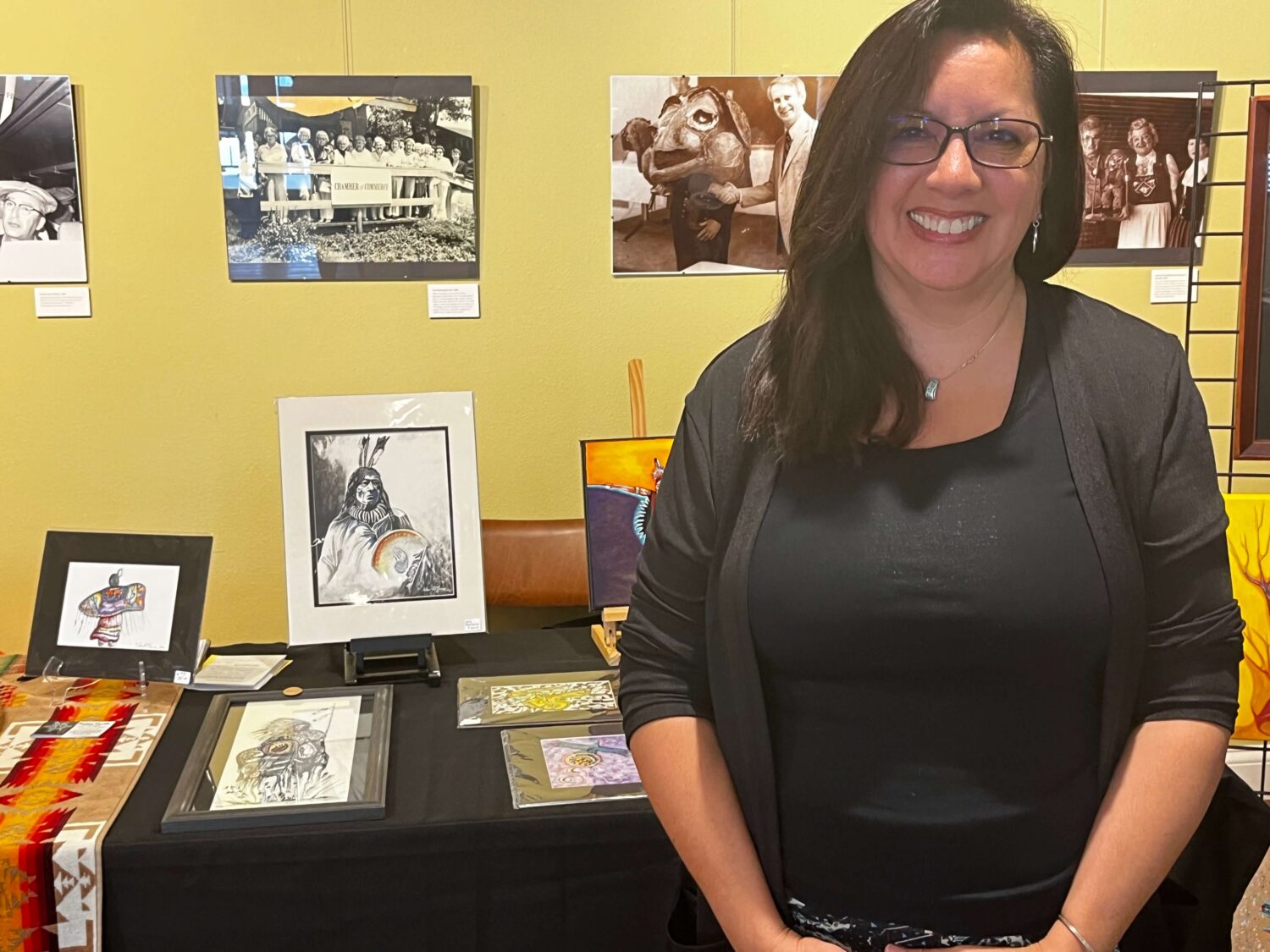
Terri O’Connor at the Native Art Marketplace in Mt. Horeb.
(Photo by Robert Chappell.)

One of the communities O’Connor has found herself in is with other local Native American artists who frequently do shows around the area such as the Native Art Marketplace that took place early last month in Mt. Horeb. It is in spaces such as these that she says people may be surprised to find art and culture in a variety of ways including storytelling and carvings as well.   

“There’s such a diversity with some of the artwork in Native culture,” expressed O’Connor. “You’ve got basketmakers and the beadwork that is amazing. There’s so many influential pieces of artwork that maybe a lot of people don’t even realize are out there.”

As time moves forward, many Native cultural traditions and ways of understanding are lost both to the cycle of life, but also to silence. As artists and community members such as O’Connor push to make their history, culture, and passion visible, it takes the community to respond and invest their interest and support in remembering the deep and beautiful Native history that is crucial to maintain for future generations. 

“We want to show people our culture and our passion for it while always having appreciation for everything that’s around us. We are a part of this earth, and there’s so many beautiful things of this earth for us to express and show in our art,” O’Connor said, praising the perseverance and continued collective effort of local artists, especially Native artists. 

“They’re multitalented and they need to be seen and heard because it’s part of our lives. It’s us, it’s who we are, and it’s great that it’s being recognized that we are artists. We are actual artists working out there, and doing it because we love it.”

Koffee With Karan 8: Sharmila Tagore On Bikini Magazine Shoot – “Photographer Was Worried, I Thought I Looked Very Nice”

Koffee With Karan 8: Sharmila Tagore On Bikini Magazine Shoot – “Photographer Was Worried, I Thought I Looked Very Nice”
Koffee With Karan 8: Sharmila Tagore On Bikini Magazine Shoot - 'Photographer Was Worried, I Thought I Looked Very Nice'

A throwback of Sharmila Tagore’s shoot. (courtesy: bombaybasanti)

New Delhi:

Hindi film veteran Sharmila Tagore was at her unfiltered best on Karan Johar’s chat show Koffee With Karan 8. The veteran actress attended the show with her son Saif Ali Khan. At the beginning of the show, Karan Johar spoke about her “famous bikini shot” – a photoshoot she did for a magazine back in the 60s. She also made headlines for the swimsuit she wore in the film An Evening In Paris. “Your famous bikini shot… You know the shot I am talking about. Nobody else wanted it to happen. Even the photographer had some anxiety issues about doing that,” Karan Johar said.

Sharmila Tagore replied, “Yes I do.” Saif Ali Khan added, “People in my boarding school used to ask me, is that your mum? I was very proud of it.” Sharmila Tagore added, “Yes, the photographer was slightly worried and I just thought I looked very nice. It really hurt me later because everybody interpreted it in such a way that I was upwardly mobile, I was trying to catch eyeballs. I didn’t feel like that. When it came out in Filmfare, I was in London and I was unaware till Shakti (Samanta) ji called me and said, will you come back quickly? There are terrible things happening here. He said if you want to be in the public eye, this is not the way to go.”

Sharmila Tagore mentioned that she sent a telegram to Tiger Pataudi. “I was very upset with all this… Completely opposite of what I thought would happen so, I sent a telegram because those days you could send telegrams. So, I sent it to Tiger and he said, I am sure you are looking very nice. So that was my support.”

“In many ways, you perhaps experienced trolling also first. A version of trolling, of what happens on social media now,” joked Karan Johar. “Totally, I can’t tell you…I believe questions were asked in the Parliament. It was not pleasant for me and learning I did. And after that, I was very careful and I chose Aradhana. It was RRR of our time,” Sharmila Tagore added.

Patrick Smyth: Big or small, shooting everything in sight

Patrick Smyth: Big or small, shooting everything in sight

Passion projects

Conversing with photographer Patrick Smyth

by Bondo Wyszpolski

Intrigued by the grimacing heads sculpted by Franz Xavier Messerschmidt in the late 18th century (and by the Getty’s “Vexed Man” in particular), Reidar Schopp invited several photographers to his San Pedro studio in order to shoot one another in facial poses — frowns, scowls, sneers — that would have made Messerschmidt proud. I too was invited, to stop by and observe, but pretty soon I’d entered the fray and was posing and photographing as well.

Matriarch from the Kayan tribe in Myanmar, March 2019, prior to the coup. Photo by Patrick Smyth

That was how I first met Patrick Smyth, a member of PADA (Photographers and Digital Artists), one of the seven artist groups associated with the Palos Verdes Art Center. We didn’t exchange more than a few words that day (despite scowling or sneering at one another), but that chance encounter several months ago led to us sitting in his Torrance backyard and discussing his photographs. It’s an extensive body of work, the images artful, often colorful, crisp and precise.

Therefore one would expect to hear tales of art classes, darkroom adventures and photography courses, let alone accounts of hours spent in photo galleries. But, no, it didn’t unfold in quite that way.

“I’m a full-time chemical engineer,” Smyth says, “and this is just a passion I have.”

If so, it’s a passion that most people — and I think most photographers — would envy.

Smyth was born and raised in a town of about a thousand people, tucked away in mid-America Kansas.

Patrick Smyth. Photo by Bondo Wyszpolski

“I went through 8th grade there. My father was an educator and my mother was in education as well.” Then they moved a couple of states west. “So I went to high school in Littleton, Colorado, and I went to the Colorado School of Mines, which is a small engineering school in Golden, Colorado.” That’s where he picked up a bachelor of science degree in chemical engineering. “Then I came out here as an engineer, and have been here since 1980.”

And you’ve been an engineer all that time?

“Yes.”

So you should be retiring at some point soon?

“Well, I’m still enjoying it,” Smyth replies. “I like mentoring the young engineers. I want to be in a position to retire to something, not necessarily away from something.” And what that means is: “Photography and more photography and travel.”

Homeschooled

Looking at Smyth’s body of work, one may be forgiven for assuming that he also has a background in the visual arts.

“I’ve never studied art,” he says, only adding that while he did indeed enjoy art class in grade school, he was more into sports. However, trips as a youngster with his family to the mountains and so forth instilled in him “a sense of wildlife and landscapes.” And one doesn’t need a Ph.D. from Harvard to appreciate the beauties of nature.

“I’m self-taught,” Smyth replies afterwards when asked where he learned his photographic expertise. He also notes that one can pick up pointers from YouTube. That said, he’s acquired some personal instruction along the way.

Blue hour in Bruges. Photo by Patrick Smyth

For example, while on a trip to London, where his daughter Pilar was studying at the time, Smyth was able to meet Gavin Hoey, whom he’d been following on YouTube. This came about through his wife, Doré, who arranged the meeting as a gift to her husband. They were invited to Hoey’s home, and Smyth received what he says was his first lesson in portrait photography.

Model in a Tuscan barn, the shot inspired after encountering Caravaggio’s works in Rome. Photo by Patrick Smyth

More recently, he and Doré were in Tuscany, Rome and Florence, where Smyth enrolled in a four-day workshop led by Damien Lovegrove, yet another UK photographer, “who wrote a book and got the attention of Martha Stewart.” Smyth also singles out the work of Haze Kware, who lives in France. “I’m attracted to his use of dancers, fabrics, and in Toulouse (where Kware lives) he shoots in the cathedral. I like that.”

But it was also while in Italy that Smyth sought out the paintings of Caravaggio (Michelangelo Merisi da Caravaggio, 1571-1610), known for his chiaroscuro and accentuated shadows.

“I don’t follow particular photographers,” he answers when asked, “but I like to go back to the masters in painting, and really draw inspiration from them.” As for Caravaggio, “I’m intrigued by his darks, and then the tenebrism. I really just discovered that as I started to shoot portraitures.”

And so, while in the Tuscany workshop, which utilized two professional models (a blonde, Leo Leblanche, and a brunette, Mischkah Scott), Smyth was mindful of what he’d observed in the Caravaggios, and I think it’s an influence that he’s called up and utilized, to some degree, ever since. It’s often a mixture of stark lighting and deep shadows.

Ballerina Ellen Bigelow, from their most recent session. Photo by Patrick Smyth

Back in this country, Smyth has been collaborating with ballerina and ballet instructor Ellen Bigelow. He first met her through PADA and photographed her in various colorful kimonos, and subsequently has shot pictures of her in balletic poses inside a rental dance studio in Torrance.

“Ellen’s just been great to work with,” he says, and receptive to his ideas as they try out one pose or another. “Some things will work, some things won’t. I’ve learned that, when you’re shooting a ballerina, what looks great to me may not be technically right for them.” But one thing’s for sure, he’s come up with some striking images of Ellen and hopes there’ll be more.

Wearing many hats

On his website, Smyth’s photographs are grouped by category, and there are quite a few of them: People, Wild Life, Scenics, Fine Art, Fashion, Fun, Places, Flora, Things, Macro, and one called the 100 Hats Project. But is there one category among these that he prefers above the others?

“I found myself not wanting to be in a certain genre,” he says, “and that’s why I have these categories. I’m kind of looking for shiny things, beautiful things, and so it’s not important for me to stay or hang in a certain niche. I think it opens up more of the world in photography,” and he mentions his Macro category which represents his photographic foray into the microscopic world. So in case you were wondering, it’s not all Stonehenge and dancers. “Things like that,” Smyth says, summing it up, “continue to keep it fresh and different.”

In his backyard, a macro shot. “Beauty is all around us. Sometimes we just have to look a little closer.” Photo by Patrick Smyth

In short, he’s open-minded and goes with what moves him at the moment.

And then there’s the 100 hats project, which began as a way of challenging himself, perhaps to test his personal comfort zone, because he’s been reluctant to simply walk up to people and ask if he can take their picture.

Suri tribe woman in the Omo Valley, Ethiopia, adorned in colorful flora and clay. Photo by Patrick Smyth

The theme of the project (which I imagine he could still add to) is “characters with hats/hats with character.” Although some of the capped and hatted folks (from infants to nonagenarians) he’s shot are friends, many are complete strangers. But the nature of this series led him, by way of approaching people, to “sort of overcome my insecurities.” Which never seems to be a problem for members of the paparazzi, some of the pushiest beings on the planet.

Smyth isn’t really thinking of assembling his hat photos into any sort of publication. “I did it just pretty much for me,” he says, “but at the same time there are so many stories behind the pictures.” Later in our conversation he says that maybe in his retirement he’ll gather some of those stories together, and then who knows what’ll happen after that.

Although he professes to be drawn to a multitude of subjects, my impression is that he’s more attuned to portraiture, or “the human element” as he puts it. Remember what Smyth said earlier, that after he’s set chemical engineering behind him what he’d like to pursue is “photography and more photography and travel.”

A Suri beauty in the Omo Valley, Ethiopia. Photo by Patrick Smyth

If we assemble all the pieces from what he’s been saying, one clear goal would be to photograph models in stunning locations, such as castles and cathedrals. And of course the models can’t be wearing just ordinary clothes, slacks and T-shirts and tennis shoes. No, there’s an elegance that’s calling from the sidelines.

“I could have seen myself being some sort of fashion designer,” Smyth says. “I probably couldn’t do it, but I’m intrigued by fashion.”

Retirement, when it comes, is going to open up lots of doors, a lot of photographic possibilities, and Smyth will be ready for them.

To see more of Patrick Smyth’s work, visit his website at digitalsmyth.com. PEN

5 things to know before buying your first DSLR camera

5 things to know before buying your first DSLR camera

When it comes to photography, a DSLR camera is a popular choice for both newcomers and seasoned professionals. Yet, diving into the sea of options can feel a bit like navigating uncharted waters. This article explores five key things you should know before buying your first DSLR camera. We’ll unravel the significance of understanding your camera’s purpose, managing your budget, evaluating the frame rate, and acquainting yourself with the device’s features.

When you’re through, you should have a better understanding of what to look for when purchasing your first DSLR camera. Don’t forget to check out the best camera holiday deals on various websites right now.

Note: This list is subjective and solely reflects the opinions of the writer


” loading=”lazy” width=”1440″ height=”220″ alt=”fortnite-promotional-banner”>


5 factors to consider before buying your first DSLR camera

1) The intent

[embedded content]

youtube-cover

Before buying a DSLR camera, it is important to determine its purpose. If it’s going pro, think high frame rates and large sensors. Professionals love that RAW format feature for top-notch shots. Now, if it’s more for personal adventures, keep it simple. Look for user-friendly vibes with auto modes and cool scene options.

It’s like tailoring the camera to fit your groove, whether you’re aiming for pro-level shots or just capturing life’s everyday magic. It’s all about choosing the right gear to match your game.

To put things into perspective, for someone who wants to take videos, cameras like Canon EOS 250D or Nikon D7500 would be a great fit. Similarly, for someone who wants cameras for travel photography, cameras like the Canon EOS Rebel T7 (EOS 2000D) or the Nikon D3500 would serve the purpose. Choose a camera that speaks to you and the one you find the most comfortable.


2) The budget

[embedded content]

youtube-cover

Setting a budget is like drawing a line in the sand – figure out what you can comfortably spend and stick to it. Consider not just the camera body but also all the extras like lenses and accessories when tallying up your costs. It’s tempting to compare prices, and that’s smart, but don’t skimp on the good stuff.

If you’re starting out as a hobbyist, you don’t need the fanciest pro gear. Find that sweet spot where your budget meets the features you need. Think of it as an investment in your skills. With a ballpark figure of around Rs.30,000, you should get a great beginner camera that allows you to improve your skills.

The average price of a DSLR is about Rs.30,000. You may choose something around this ballpark and still end up with a camera that does really well and is more than enough for a beginner to learn and hone his/her skills.


3) ISO and frame rate

[embedded content]

youtube-cover

Technical words like ISO and frame rate seem to confuse new photography enthusiasts. However, with the right research and guidance, these are very easy-to-learn topics.

Take ISO, for instance; it’s like the camera’s ability to see in the dark. A higher ISO means better shots in low light, but it might bring in a bit of noise. Then there’s the frame rate – think of it as the camera’s speed. If you’re into capturing speedy moments, like sports or wildlife, a higher frame rate is your go-to. It’s like understanding the secret codes to make your photos really pop.

If you often shoot in dim conditions (indoors, nighttime, events), prioritize a camera with good ISO performance. If you plan to shoot sports, wildlife, or other fast-paced subjects, choose a camera with a high frame rate.


4) Sensor size

[embedded content]

youtube-cover

Sensor size is one important factor to consider when buying your first DSLR camera. The part that captures light and forms the image is called a sensor. Sensor size is generally categorized into full-frame, APS-C, and micro four-thirds, each of which impacts image quality. To ensure the camera’s capabilities match your photographic aspirations, it is imperative to understand sensor size.

If you are someone who wants to capture landscapes, do portraits, or undertake night photography, go for full-frame sensors. They produce clearer quality images but are more expensive.

If you are someone who wants to capture sports and wildlife or want a camera to take on your travel or adventures, go for APS-C. If you are someone who likes street photography and loves traveling, go for micro four-thirds as they are much smaller and extremely portable.


5) Lens

[embedded content]

youtube-cover

When purchasing your first DSLR camera, understanding the significance of the lens is vital. Different lenses offer varying focal lengths, apertures, and zoom capabilities, each of which affects the perspective and depth of field in your photos.

Visit a camera store, hold them, and feel their weight. Research different types, read reviews, and don’t be afraid to ask questions at camera stores. The “perfect” lens isn’t the fanciest or most expensive; it’s the one that lets you paint your stories with light in the clearest, most beautiful way possible.

Kit lenses are suitable for general photography and are the best pick for beginners. Wide-angle lenses are used for landscapes, architecture, and group shots. Telephoto lenses are great for distant objects and work well for sports, wildlife, and astrophotography.

Macro lenses are ideal for close-up portraits, product photography and also nature photography. Meanwhile, standard zoom lenses are versatile and are best suited for everyday use and travel photography.


Conclusion

Buying your first DSLR feels like opening a treasure chest of photographic possibilities. However, before you get caught up in specs and numbers, remember: it’s all about finding the camera that fits your vision and budget. Consider key factors like intent of use, budget, lens type, etc.

By keeping these things in mind, you’ll find the DSLR that helps you capture beautiful moments for years to come.

Quick Links

More from Sportskeeda

Edited by Rachel Syiemlieh
Profile picture