December 2023 Opportunities: Open Calls, Residencies, and Grants for Artists

December 2023 Opportunities: Open Calls, Residencies, and Grants for Artists

Every month, Colossal shares a selection of opportunities for artists and designers, including open calls, grants, fellowships, and residencies. If you’d like to list an opportunity here, please get in touch at hello@colossal.art. You can also join our monthly Opportunities Newsletter.


$1,800 Innovate Grants for Art + PhotoFeatured
Innovate Grant awards two $1,800 grants each quarter to one visual artist and one photographer. In addition, eight applicants will receive honorable mentions, be featured on the website, and join a growing community. International artists and photographers working in any medium are eligible.
Deadline: 11:59 p.m. PST on December 14, 2023.

The Erin Donohue and Family Ceramics Artist ResidencyFeatured
Hosted by the Artists Association of Nantucket, this ceramics residency will bring one artist to Nantucket to teach two five-week classes, one introductory course for the community and a more intermediate one for students and professionals. The program offers lodging, studio space, a $500 travel stipend, and a $2,000 stipend for living expenses and materials.
Deadline: April 5, 2024.

2024 NOT REAL ART Grant for ArtistsFeatured
Six visual artists based in the U.S. and working in any 2D or 3D medium will win a no-strings-attached cash award of $2,000, plus PR and marketing support. There’s no application fee, and you can find out more on Colossal.
Deadline: 11:59 p.m. PT on January 1, 2024.


Open Calls

Beam Center New Hampshire Open Call (International)
The center seeks proposals for public artworks that will be realized by a community of more than 100 young people at Beam Camp in Strafford, NH. Artists receive a $5,000 award and a $15,000 fabrication budget.
Deadline: 12:00 a.m. ET on December 11, 2023.

BLINK Cincinnati Call for Artists  (International)
BLINK, Illuminated by ArtsWave, is calling for artists working in light-based experiential installation, murals, projection mapping, digital art, or animation to submit proposals. BLINK plans to commission 12 to 15 new murals, 30 to 40 temporary lighted installations, and 30 to 35 projection/digital animation installations.
Deadline: December 15, 2023.

Orange County’s Innovation Lab Public Art Call (International)
One or more artists or collaboratives will be selected to create a public work for Orange County’s Innovation Lab in Pine Hills. The total budget is $77,600.
Deadline: December 27, 2023.

Prisma Art Prize (International)
Open to emerging painters and artists, this quarterly competition awards €2,000 in cash and €3,000 in services annually, plus exhibition opportunities. There is a €29 submission fee.
Deadline: January 11, 2024.

Outwin Boochever Portrait Competition 2025 (United States, Puerto Rico, Guam, the Northern Mariana Islands, American Samoa, and the U.S. Virgin Islands)
This portrait competition is open to all media, including painting, drawing, sculpture, photography, printmaking, textiles, video, performance art, and digital or time-based art. One winner will receive $25,000 and a commission to portray a remarkable living American for the National Portrait Gallery’s collection. Other prizes range from $1,000 to $10,000, and all finalists will be included in an exhibition. There is a $50 entry fee.
Deadline: Midnight MT on January 26, 2024.

Sony Future Filmmaker Awards (International)
The Sony Future Filmmaker Awards elevates voices that bring a fresh perspective to storytelling. The shortlisted filmmakers are flown to Los Angeles for an exclusive four-day event to gain unparalleled insight into all aspects of the filmmaking process to advance their careers.
Deadline: February 15, 2024.


Grants

The Puffin Foundation 2024 Annual Artist Grant Program (U.S.)
This grant supports projects in fine arts, photography, music, and environmental artistic activism created with public education in mind. Most grants range between $1,200 and 1$,500.
Deadline: December 2, 2023.

2024 Right of Return Fellowship and Frieze Impact Prize  (U.S.)
The Center for Art & Advocacy and Frieze partner to present a prize of $25,000 and a chance to exhibit at Frieze Los Angeles. The Right of Return Fellowship is open to formerly incarcerated creatives from every discipline for a grant of $20,000, awarded to six people. The additional Frieze Impact Prize is awarded to one Right of Return Fellowship alumnus or one of the new six fellows.
Deadline: 11: 59 p.m. on December 10, 2023.

NYSCA/NYFA Artist Fellowship (New York)
This $8,000 unrestricted grant is available to artists working in fiction, folk/traditional art, interdisciplinary work, painting, and video/film at any stage of their career.
Deadline: 5 p.m. ET on December 13, 2023.

Newberry Library Artist in Residence Fellowships  (International)
The Newberry Library has two fellowships for visual and performing artists, filmmakers, and other humanists. Programs last one month and grant $3,000 stipends.
Deadline: December 15, 2023.

Nordic PhotoBook Award  (Norway)
Photographers with a cohesive body of work interested in publishing a book are invited to apply for this Kr 200,000 award to support the production, distribution, and promotion of the work.
Deadline: January 1, 2024.

Booooooom Photo Awards  (International)
Photographers are invited to submit images in one of five categories, each with a $1,000 top prize. The winners, plus 20 shortlisted photographers, will be featured in and receive a copy of a special mini-photo publication. It’s free to submit one image, and there is a $15 fee to submit up to ten images in one category.
Deadline: January 12, 2024.

Alden Mason Foundation Award  (Washington)
The Alden Mason Foundation offers three prestigious awards created to pay homage to the enduring artistic legacy of Washington-based artist Alden Mason. One award of $12,000 and two runner-up awards of $1,000 each are awarded to exceptional painters.
Deadline: January 13, 2024.

BBA Artist Prize 2024  (International)
Artists working in all themes, mediums, and experience levels are invited to apply for cash prizes of €1,000, €700, or €500, plus the chance for a solo exhibition in 2025 at BBA Gallery in Berlin, Germany. There is a €29 fee if submitted before December 12, then €39.
Deadline: February 19, 2024.

The Adolf and Esther Gottlieb Emergency Grant  (International)
The Adolph and Esther Gottlieb Emergency Grant program provides one-time interim financial assistance to qualified painters, printmakers, and sculptors whose needs are the result of an unforeseen catastrophic incident and who lack the resources to meet that situation. Awardees typically receive $5,000, up to $15,000.
Deadline: Rolling.

Adobe Creative Residency Community Fund (Ukraine)
Adobe’s Creative Residency Community Fund commissions visual artists to create company projects on a rolling basis. Awardees will receive between $500 and $5,000.
Deadline: Rolling.

Pollock-Krasner Foundation Grant (International)
The foundation welcomes applications from actively exhibiting visual artists who are painters, sculptors, and artists who work on paper, including printmakers. Grants are intended for one year and range up to $50,000. The individual circumstances of the artist determine the size of the grant, and professional exhibition history is taken into consideration.
Deadline: Rolling.


Residencies, Fellowships, & More

On::View Artist Residency (International)
Located in the heart of Savannah’s Starland District, this one-month residency provides a free, high-visibility studio for an artist to complete a new or existing project or to research conceptual, material, performative, and social practices. The program is open to artists from around the world working in any medium and includes an exhibition opportunity.
Deadline: 11:59 p.m. ET on December 1, 2023.

Foundation House Artist Residency Program (International)
Six residents receive a $500 stipend, a private bedroom and bathroom, meals, and studio space. The residency will run from January 26 to February 4, 2024.
Deadline: 11:59 p.m. ET on December 3, 2023.

Atlantic Center for the Arts Residency #193 (International)
This three-week program brings together three mentoring artists from visual arts, literature, performance, and music to lead sessions for a cohort of residents. Each resident receives accommodations and meals.
Deadline: December 3, 2023.

Rhode Island School of Design Movement Lab Fellowship (International)
Two post-graduate researchers working in animation, filmmaking, immersive arts, performance, game arts, dance, puppetry, robotics, or kinetic sculpture will be awarded ten-month fellowships to explore various aspects of movements. Proposed projects should intersect with language, identity, cultures, ecosystems, and/or peoples.
Deadline: December 4, 2023.

Fondation Fiminco Curatorial Residency 2024 (International)
Curators are invited to apply for a three-month residency from March to May 2024 to research, create, and produce an exhibition at Fondation Fiminco’s location in Romainville (Seine-Saint-Denis), France. The curator receives accommodation, a €3,000 research grant, and up to €1,000 for the production of an event.
Deadline: Midnight on December 10, 2023.

Tusen Takk Foundation 2025 Visual Artist Residency (International)
Mid-career and established artists are eligible for these three- to eight-week residences, which provide housing, studio space, a $625 weekly stipend, and transportation. There is a $20 application fee.
Deadline: December 15, 2023.

Saltonstall Foundation for the Arts Residency (New York)
Artists and writers are eligible for this residency program, which offers $100 weekly stipends, accommodations, studio space, and meals.
Deadline: January 7, 2024.

The Good Hart Artist Residency (International)
Open to artists, writers, and composers at any stage of their career, this residency on the shores of Lake Michigan offers accommodations, studio space, a $500 stipend, and some meals. There is a $25 application fee.
Deadline: 11:59 p.m. ET on January 9, 2024.

Joshua Tree Highlands Artist Residency (International)
Hosted in Joshua Tree National Park, this residency runs for seven weeks and includes accommodations and studio space. There is a $45 application fee.
Deadline: January 10, 2024.

Hayama Artist Residency (International)
Open to artists working in any medium, this four-week residency offers accommodations, a $200 weekly stipend, an exhibition in Tokyo, and a roundtrip flight to Japan. The application fee is $95.
Deadline: 11:59 p.m. ET on January 31, 2024.

Arts/Industry at John Michael Kohler Arts Center (International)
Open to all disciplines, this program selects twelve artists each year for three-month pottery and foundry residencies. No experience with clay or cast metal is required, just an interest in pursuing a new body of work and being open to new ideas. Residents receive a $160 weekly stipend, studio space, housing, transportation, industrial materials, equipment, and more.
Deadline: February 1, 2024.

Hunter Moon Homestead Artist Residency (International)
Artists and arts educators working across disciplines are invited to apply to this program in Palouse. Residents receive one- to three-week stays, with lodging and studio space included.
Deadline: Rolling.

Do stories and artists like this matter to you? Become a Colossal Member today and support independent arts publishing for as little as $5 per month. The article December 2023 Opportunities: Open Calls, Residencies, and Grants for Artists appeared first on Colossal.

Acquisitions of the Month: November 2023

Acquisitions of the Month: November 2023

A round-up of the best works of art that have recently entered public collections

Bargello Museum, Florence
Madonna of via Pietrapiana (c. 1450–55), Donatello

After nearly two years of negotiations, the terracotta relief Madonna of via Pietrapiana (c. 1450–55) by Donatello has been acquired by the Italian Ministry of Culture for the Bargello National Museum. It is the only autographed work by the Florentine master to have remained in private hands and shows the expressiveness and detail typical of the artist. The sculpture, which was originally placed in a tabernacle on the facade of a building at 38 via Pietrapiana, will go on permanent display in the Bargello’s Salone di Donatello.

Madonna of via Pietrapiana (c. 1450–55), Donatello. Bargello National Museum, Florence

Van Gogh Museum, Amsterdam
Peasant Spreading Manure (1851), Jean-François Millet

As a young artist, Van Gogh collected reproductions of landscape paintings by Jean-François Millet; in later years, he drew on this collection when seeking inspiration for his own images of rural life. To illustrate how the French artist influenced his practice, the Van Gogh Museum in Amsterdam have purchased Peasant Spreading Manure (1851): the first work by Millet to enter its collection. The work depicts figures labouring in a field at twilight, painted in earthy tones that informed Van Gogh’s own palette in works such as The Potato Eaters (1885).

Peasant Spreading Manure (1851), Jean-François Millet. Van Gogh Museum, Amsterdam

Brooklyn Museum, New York
More than 300 works by Black and Asian American artists

As part of the Brooklyn Museum’s ongoing efforts to expand its holdings of work by Black and Asian American artists, the New York institution has announced the acquisition of some 300 works – many of which were given as gifts to the institution, and span many periods and genres. Highlights include Golden Gate, Yellowstone (1889) by Grafton Tyler Brown, the first Black artist to paint the landscapes of the Pacific Northwest and California, and Satoshi Studying (1945–54) by Hisako Hibi: the first work by a female Asian American painter to enter the American Art section of its permanent collection. The works are set to go on show in the newly rehung American Art galleries, which are due to open in October 2024.

Laro City (Village Scene) (1968), Twins Seven Seven. Brooklyn Museum, New York

National Gallery of Art, Washington D.C.
Gift of 15 artworks by modern and contemporary Haitian artists

The NGA in Washington D.C. has recieved the first works by Haitian artists to join its holdings, courtesy of two collecting couples, Kay and Roderick Heller and Beverly and John Fox Sullivan. The gifts comprise 13 paintings and two textiles, which date from the 1940s through to the early 2000s. Highlights include works by self-taught artists Philomé Obin, Rigaud Benoit and Wilson Bigaud, as well as beaded flags by the textile artist Myrlande Constant. The works will form the centrepiece of the exhibition dedicated to Haitian art currently titled Spirit and Strength, which opens in September 2024.

President Tiresias Sam entering Cap-Haitien (1958), Philomé Obin. Photo: Courtesy the National Gallery of Art, Washington, D.C.

Huntington Library, Art Museum, and Botanical Garden, Los Angeles
Portrait of José Antonio Caballero, Second Marqués de Caballero, Secretary of Grace and Justice (1807), Francisco José de Goya y Lucientes

Goya’s Portrait of José Antonio Caballero, Second Marqués de Caballero, Secretary of Grace and Justice (1807) has been purchased by the Huntington Library, Art Museum and Botanical Garden in Los Angeles with support from the Ahmanson Foundation. The work, which shows the secretary of state decorated with military regalia, exemplifies Goya’s early career as a portraitist in the years prior to the Napoleonic War. It is the first oil painting by the Spanish artist to enter the Huntington’s collections, where it joins a series of Goya’s etchings already within its holdings.

Portrait of José Antonio Caballero, Second Marqués de Caballero, Secretary of Grace and Justice (1807), Francisco José de Goya y Lucientes. Huntington Library, Art Museum, and Botanical Gardens

Saint Louis Art Museum
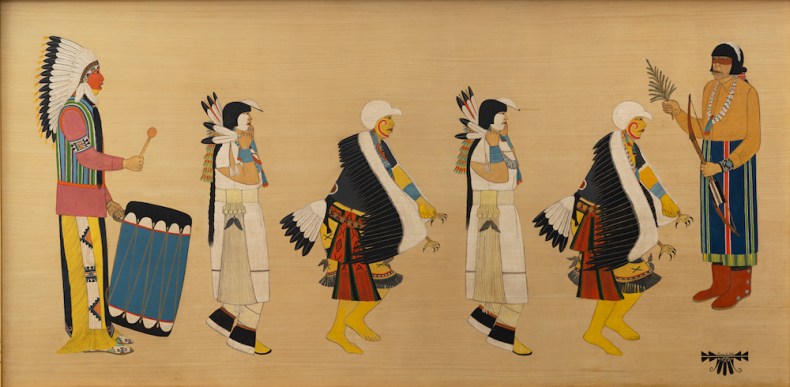
More than 100 works by 20th century Native American artists from the William P. Healey Collection

A gift of more than 100 drawings, paintings and sculptures from William P. Healey’s collection of Native American art has been donated to the Saint Louis Museum. The gift comprises work by some 62 Indigenous artists, 55 of whom were not previously represented in the collection, and features a particular focus on artists based in Oklahoma and New Mexico. A rare panel painting by Tonita Peña titled Eagle Dance (c. 1932–33) is among the earliest pieces to join the collection, while later works include the abstract Ephemeration (1962) by the painter George Morrison.

Eagle Dance (c. 1932–33), Tonita Peña. Photo: courtesy Saint Louis Art Museum; © estate of Tonita Peña

National Museums Scotland, Edinburgh
Silver-gilt ewer and basin, 16th century 

The National Museums Scotland has purchased two related pieces of 16th century silverware: a roughly 437-year old set known as the Panmure ewer and basin, which had previously been held in the collection of the Earls of Dalhousie. As most examples dating prior to 1600 were melted down – fewer than a dozen are still extant – this silver-gilded set decorated with dolphins, fish and assorted sealife is a rare survivor. They will now go on permanent display in the Art of Living gallery at the National Museum of Scotland.

The Panmure basin (16th century). Photo: © National Museums Scotland

Musée d’Orsay, Paris
La Verrerie (1900), Georges de Feure

A decorative panel that once adorned the exterior of a pavilion at the Universal Exhibition in Paris in 1900 has been added to the collection of the Musée d’Orsa. La Verrerie (1900) by the Art Nouveau painter Georges de Feure joins two other panels he created for the L’Art Nouveau Bing pavilion: a showcase organised by the dealer Siegfried Bing, who popularised the name for the then-new art movement. The three are the only such panels known to have survived. 

La Verrerie (1900), Georges de Feure. Photo: © Musée d’Orsay/Sophie Crépy

Acquisitions of the Month: November 2023

Acquisitions of the Month: November 2023

A round-up of the best works of art that have recently entered public collections

Bargello Museum, Florence
Madonna of via Pietrapiana (c. 1450–55), Donatello

After nearly two years of negotiations, the terracotta relief Madonna of via Pietrapiana (c. 1450–55) by Donatello has been acquired by the Italian Ministry of Culture for the Bargello National Museum. It is the only autographed work by the Florentine master to have remained in private hands and shows the expressiveness and detail typical of the artist. The sculpture, which was originally placed in a tabernacle on the facade of a building at 38 via Pietrapiana, will go on permanent display in the Bargello’s Salone di Donatello.

Madonna of via Pietrapiana (c. 1450–55), Donatello. Bargello National Museum, Florence

Van Gogh Museum, Amsterdam
Peasant Spreading Manure (1851), Jean-François Millet

As a young artist, Van Gogh collected reproductions of landscape paintings by Jean-François Millet; in later years, he drew on this collection when seeking inspiration for his own images of rural life. To illustrate how the French artist influenced his practice, the Van Gogh Museum in Amsterdam have purchased Peasant Spreading Manure (1851): the first work by Millet to enter its collection. The work depicts figures labouring in a field at twilight, painted in earthy tones that informed Van Gogh’s own palette in works such as The Potato Eaters (1885).

Peasant Spreading Manure (1851), Jean-François Millet. Van Gogh Museum, Amsterdam

Brooklyn Museum, New York
More than 300 works by Black and Asian American artists

As part of the Brooklyn Museum’s ongoing efforts to expand its holdings of work by Black and Asian American artists, the New York institution has announced the acquisition of some 300 works – many of which were given as gifts to the institution, and span many periods and genres. Highlights include Golden Gate, Yellowstone (1889) by Grafton Tyler Brown, the first Black artist to paint the landscapes of the Pacific Northwest and California, and Satoshi Studying (1945–54) by Hisako Hibi: the first work by a female Asian American painter to enter the American Art section of its permanent collection. The works are set to go on show in the newly rehung American Art galleries, which are due to open in October 2024.

Laro City (Village Scene) (1968), Twins Seven Seven. Brooklyn Museum, New York

National Gallery of Art, Washington D.C.
Gift of 15 artworks by modern and contemporary Haitian artists

The NGA in Washington D.C. has recieved the first works by Haitian artists to join its holdings, courtesy of two collecting couples, Kay and Roderick Heller and Beverly and John Fox Sullivan. The gifts comprise 13 paintings and two textiles, which date from the 1940s through to the early 2000s. Highlights include works by self-taught artists Philomé Obin, Rigaud Benoit and Wilson Bigaud, as well as beaded flags by the textile artist Myrlande Constant. The works will form the centrepiece of the exhibition dedicated to Haitian art currently titled Spirit and Strength, which opens in September 2024.

President Tiresias Sam entering Cap-Haitien (1958), Philomé Obin. Photo: Courtesy the National Gallery of Art, Washington, D.C.

Huntington Library, Art Museum, and Botanical Garden, Los Angeles
Portrait of José Antonio Caballero, Second Marqués de Caballero, Secretary of Grace and Justice (1807), Francisco José de Goya y Lucientes

Goya’s Portrait of José Antonio Caballero, Second Marqués de Caballero, Secretary of Grace and Justice (1807) has been purchased by the Huntington Library, Art Museum and Botanical Garden in Los Angeles with support from the Ahmanson Foundation. The work, which shows the secretary of state decorated with military regalia, exemplifies Goya’s early career as a portraitist in the years prior to the Napoleonic War. It is the first oil painting by the Spanish artist to enter the Huntington’s collections, where it joins a series of Goya’s etchings already within its holdings.

Portrait of José Antonio Caballero, Second Marqués de Caballero, Secretary of Grace and Justice (1807), Francisco José de Goya y Lucientes. Huntington Library, Art Museum, and Botanical Gardens

Saint Louis Art Museum
More than 100 works by 20th century Native American artists from the William P. Healey Collection

A gift of more than 100 drawings, paintings and sculptures from William P. Healey’s collection of Native American art has been donated to the Saint Louis Museum. The gift comprises work by some 62 Indigenous artists, 55 of whom were not previously represented in the collection, and features a particular focus on artists based in Oklahoma and New Mexico. A rare panel painting by Tonita Peña titled Eagle Dance (c. 1932–33) is among the earliest pieces to join the collection, while later works include the abstract Ephemeration (1962) by the painter George Morrison.

Eagle Dance (c. 1932–33), Tonita Peña. Photo: courtesy Saint Louis Art Museum; © estate of Tonita Peña

National Museums Scotland, Edinburgh
Silver-gilt ewer and basin, 16th century 

The National Museums Scotland has purchased two related pieces of 16th century silverware: a roughly 437-year old set known as the Panmure ewer and basin, which had previously been held in the collection of the Earls of Dalhousie. As most examples dating prior to 1600 were melted down – fewer than a dozen are still extant – this silver-gilded set decorated with dolphins, fish and assorted sealife is a rare survivor. They will now go on permanent display in the Art of Living gallery at the National Museum of Scotland.

The Panmure basin (16th century). Photo: © National Museums Scotland

Musée d’Orsay, Paris
La Verrerie (1900), Georges de Feure

A decorative panel that once adorned the exterior of a pavilion at the Universal Exhibition in Paris in 1900 has been added to the collection of the Musée d’Orsa. La Verrerie (1900) by the Art Nouveau painter Georges de Feure joins two other panels he created for the L’Art Nouveau Bing pavilion: a showcase organised by the dealer Siegfried Bing, who popularised the name for the then-new art movement. The three are the only such panels known to have survived. 

La Verrerie (1900), Georges de Feure. Photo: © Musée d’Orsay/Sophie Crépy

A new survey of the Aboriginal artist Emily Kam Kngwarray lets her community tell the story

A new survey of the Aboriginal artist Emily Kam Kngwarray lets her community tell the story

“She just painted her country, and all things that were significant to her,” says Kelli Cole, the co-curator of a major survey of the late Aboriginal artist Emily Kam Kngwarray at the National Gallery of Australia (NGA) in Canberra. “Kama, which is seed, the pencil yam, emu; awelye, the Anmatyerr word for ceremony; and Alhalker, which is her country—those [themes] are in every one of her works.”

The exhibition, which includes textiles, works on paper and paintings, has been assembled by Cole and fellow Indigenous curator Hetti Perkins, and will chart the career of an artist who, with no knowledge of international visual arts practice, managed to create a vast body of work comparable with the likes of Agnes Martin, Sol Lewitt and Ellsworth Kelly.


Kngwarray (1910-96) was from Utopia, an Aboriginal community 250km north-east of Alice Springs in Australia’s Northern Territory. Although she had produced textile designs on fabric since 1977, it was Kngwarray’s first work on canvas, Emu Woman (1988-89), made for a landmark group exhibition organised by Utopia’s art coordinator Rodney Gooch in 1988, that saw her receive widespread attention. Featuring distinctive gestural brushstrokes used in traditional women’s ceremony, and dots in white, yellow and reddish brown representing the underground seedpods of the pencil yam, Emu Woman demonstrated Kngwarray’s propensity to express her rich culture on canvas.

Kngwarray’s Seeds of Abundance (1990) uses a dot painting technique © The artist/Copyright Agency

From 1988 until her death eight years later, Kngwarray produced around 3,000 paintings—roughly one per day. During this period, demand for her work was so high that the gallerist Christopher Hodges regularly chartered a plane to drop off fresh canvases and whisk away finished paintings. Consequently “there wasn’t much story [about each work] that they could get from her”, Cole says. Kngwarray would simply say “untitled” or “awelye [ceremonial]” to Gooch, and “he thought she didn’t want to give much more information”, Cole explains.

When Kngwarray’s works went on show, alongside those of fellow Australian artists Yvonne Koolmatrie and Judy Watson at the Venice Biennale in 1997, many critics assumed she was an anomaly. But as Perkins, who also curated the Venice show, explained at the time: “The possibilities of Aboriginal art practice are infinite and can have relevance and resonance outside their immediate cultural context while maintaining the integrity of speaking from within that context.”

Kngwarray’s meteoric rise resulted in her being singled out from her community, but this show aims to “reposition Emily back into her community”, Cole says. “It was [her] story that she painted, but [the Anmatyerr] people are still painting that same story,” Cole adds. Now, through extensive consultation, Kngwarray’s descendants are telling her story and revealing new details about the artist’s work. The curator gives as an example a “couple of paintings that have this amazing, lush green that no one’s ever identified before” but when it was shown to the Anmatyerr women, the green was immediately recognised as the distinctive colour of emu eggs from a creation story. “Every single photograph, every painting, every quote, everything has been taken back to the community for her family descendants and the artists that we’ve worked with to approve,” Cole says.

Kngwarray’s Untitled (awely) (1994) © Emily Kam Kngwarray/Copyright Agency

Another change, following consultation with the community, has been the NGA’s adoption of the Anmatyerr spelling of Kngwarray’s name, in contrast to the previously widespread use of Emily Kame Kngwarreye.

The exhibition will include several important loans, such as early batiks, two recent NGA acquisitions, and Alhalkere—Old Man Emu with Babies (1989), acquired by the actor Steve Martin at the Sotheby’s New York Aboriginal art auction in May 2022. The show will not only be the most comprehensive survey of one of Australia’s most “significant artists”, Cole says, but it will also position Kngwarray “within her community that she never left—in a sense that was the biggest part of her life.”

Emily Kam Kngwarray, National Gallery of Australia, Canberra, 2 December-28 April 2024; Tate Modern, London, opening 2025

F5: Kristina Lopez Adduci Shares a Favorite Vintage Car, Perfect Cocktail + More

F5: Kristina Lopez Adduci Shares a Favorite Vintage Car, Perfect Cocktail + More

Entrepreneur, speaker, art collector, and curator Kristina Lopez Adduci is the founder and CEO of House of Puff. She created the New York-based cannabis lifestyle brand to offer products that resonated with her own personal preferences. Over time, she’s transformed it, harnessing the power of art to drive social change.

With such a broad range of talents, we were curious as to how Kristina makes it all happen. “You know, it’s funny – the shower’s where the magic happens for me!,” she shared. “Maybe it’s the rhythm of the water or just that quiet moment away from the world… and my twins. But that’s where my brain decides to shift into a diffuse mode of thinking. I used to make a mad dash out of the shower to grab my phone and scribble down those ideas. But now I’ve got this lifesaver – AquaNotes. It’s this cool, waterproof notepad that’s taken up residence right on my shower wall. Pure genius.”

Kristina Lopez Adduci Photo: Rosalind O’Connor

If she wasn’t immersed in House of Puff, Kristina said she would likely pivot to producing. “With House of Puff’s YouTube presence, I’ve delved into the art of storytelling to illuminate our narrative and guide cannabis enthusiasts. Given the chance, I’d love to traverse the globe, weaving and amplifying tales from myriad voices and perspectives.”

And then there’s her flair for crafting delicious cocktails. “Pair that with my love for throwing parties and playing host, and I often find myself musing about opening a cocktail bar in my town, given its stark absence of quality establishments (seriously, no cocktail bars in my town). It’s a passion I’ll likely indulge in one day,” Kristina confessed. We can’t wait to see where all of her ideas take her next!

We’re happy to have Kristina Lopez Adduci joining us for this week’s Friday Five!

silver convertible sports car

Photo: Loic Kernen ©2021 Courtesy RM Sotheby’s

1. 1957 Mercedes-Benz 300 SL Roadster

I’ve always been enamored by vintage Mercedes, their timeless design speaks volumes about a classic era in automobile history. I’m also an avid F1 viewer. So, cheering for the Mercedes team adds another layer of exhilaration. The drama and strategy on the track never fail to captivate me. I think the 300 SL Coupe is one of the most beautiful sports cars of all time.

styled office space

Photo: Kelly Wearstler

2. Kelly Wearstler

One of my favorite American designers, hands down. Kelly’s design approach values history, location, and architectural integrity. But she isn’t afraid to take bold risks. We share a lot of the same design principles, I love a good open-plan concept and creating movement within spaces. She uses her intuition, and I dig that.

vinyl album cover reading EDITH PIAF with her visage and a yellow background

Image courtesy Columbia Records

3. Vinyl Records

I have an old phonograph that I treasure. For me, listening to vinyl records in the age of the digital download evokes memories from a different era. Edith Piaf is on constant rotation, especially when I’m cooking. Also, the large albums give way to beautiful artwork.

dark, moody interior of a high-class bar

Photo courtesy Claridge’s

4. The Perfect Cocktail at Fumoir Bar

I love being transported back in time and a proper cocktail, and Fumoir Bar at Claridge’s Hotel speaks to both of those things. The bar was inspired by The Bright Young Things, that carefree generation of artists, writers, socialites, and performers who lit up interwar London. They were synonymous with parties. Under the watchful gaze of a Lalique panel, a fixture in The Fumoir since 1931, every exquisite cocktail is presented in its uniquely crafted glassware. Their martini is perfection.

long styled dining room table with upholstered dining chairs

Photo: Kristina Lopez

5. Dinner Parties

While the pulsing beats of clubs have their allure, I find genuine joy in the art of hosting. There’s an undeniable charm in gathering an intimate circle of friends around a well-set table, proper cocktails (and cannabis of course), good food, and music. For me, dinner parties are the new flex.

Work by Kristina Lopez Adduci + House of Puff:

a rainbow of minimal one hitter pipes lined up in a row

Le Pipe One Hitter This was our hero product. I wanted a one hitter that I could fit into my purse or leave out on the table. Crafted for those who value discretion, it’s thoughtfully designed by a talented female artist from Massachusetts. The colors are inspired by contemporary art and fashion trends. Photo: Allie Pisarro-Grant

an open package of rolling papers on a styled surface

Sophia Wallace Collection Rolling Papers For Pride 2023, House of Puff teamed up with New York-based artist Sophia Wallace and Housing Works to create on-going support for the LGBTQ+ community. Our newest “queen size” artist series rolling papers feature images from Sophia’s installation, WE ARE HERE FOR THE REPOSSESSION. This artwork is part of an ongoing project she’s been working on for 11 years called CLITERACY. With an unflinching lens and infectious wit, CLITERACY asks us to recognize that everyone – especially those of us with clitorises – have the right to joyful embodiment. In addition to supporting Sophia’s art, proceeds from these rolling papers support Housing Works. Born from ACT UP, this nonprofit has been supporting homeless and low-income New Yorkers affected by HIV/AIDS since 1990. Photo: Allie Pisarro-Grant

pink, yellow, purple, and dark green hemp wicks and ashtrays

Astory Hemp Wick Many are unaware of the chemicals emitted when using standard lighters and matches. To combat this, we’ve introduced our Astor Hemp Wick, designed with the elegance of a French macaron. This holder ensures your hemp wick remains tidy and easily accessible. After use, simply place it back into the designated recess of the accompanying round ashtray. The set is stylish enough to grace any occasional table. To use, ignite the beeswax-coated hemp with your butane lighter or matches, then use the pure, chemical-free wick to light up your preferred blend. Photo: Allie Pisarro-Grant

This post contains affiliate links, so if you make a purchase from an affiliate link, we earn a commission. Thanks for supporting Design Milk!

Kelly Beall is Director of Branded Content at Design Milk. The Pittsburgh-based writer and designer has had a deep love of art and design for as long as she can remember, from Fashion Plates to MoMA and far beyond. When not searching out the visual arts, she’s likely sharing her favorite finds with others. Kelly can also be found tracking down new music, teaching herself to play the ukulele, or on the couch with her three pets – Bebe, Rainey, and Remy. Find her @designcrush on social.

Alumna Monica Buckle explores all paths to discover her true calling

Alumna Monica Buckle explores all paths to discover her true calling
image

“At Lynn, I wasn’t just a number, I had relationships with faculty,” said Buckle. “The personal environment at Lynn made it possible for me to finish my degree on time. The small class sizes and my close relationship with my professors helped me get through those harsh times.”

Buckle moved back home to Connecticut and went to Hospital for Special Surgery in New York City, where she fortunately received life-changing care. It took three additional hip surgeries to correct the issues she encountered in her original operation.

Now came a crucial moment in Buckle’s life. A career in hospitality now seemed impossible—the extent of her injury did not allow her to keep up with the physical demands required by the job. Despite this adversity, Buckle stayed grounded and harked back to the experiences she garnered growing up with her family. She pivoted her focus to her love of art.

“I had always loved art. I took art history classes, I visited museums, galleries and art fairs,” said Buckle. “Even while I was a hospitality student at Lynn, I was doing all these things.”

What began as a hobby turned into a new career path. Buckle pursued her M.A. in art business from Sotheby’s Institute of Art in New York City.

“I now had a real-world approach to art. You must welcome the public into your space; you must anticipate social trends, what people appreciate and what appeals to them,” said Buckle. “That knowledge came from my hospitality background at Lynn.”

2023 Posthumous Dance Magazine Awards

2023 Posthumous Dance Magazine Awards

Founded in 1954, the Dance Magazine Awards have historically only been given to living artists. This year’s new posthumous honors were created to recognize some of the many artists active since 1954 who were not given awards during their lifetimes. The Dance Magazine Awards, which have a theme of education, will be presented at Buttenwieser Hall at The Arnhold Center, 92NY, in New York City on Monday, December 4, 2023.

Syvilla Fort

Later, her name would be associated with the brightest stars of Hollywood, Broadway, and concert dance—Marlon Brando, James Dean, Jane Fonda, Eartha Kitt, Chita Rivera, Geoffrey Holder, Alvin Ailey, Chuck Davis, Yvonne Rainer. Yes, dance educator Syvilla Fort taught them all and more. But her influential teaching career started more modestly while she was still a youth in her native Seattle.

4 dancers holding up their right hand and leaning towards the right
From left: Merce Cunningham, Syvilla Fort, Dorothy Herrmann, and Bonnie Bird in The Three Inventories of Casey Jones. Courtesy Cornish College of the Arts Archives.

Born in 1917, Fort learned early, as a Black girl eager for ballet, that race and class could be impediments to professional training and a career pathway. Local dance schools refused to admit her, and this bitter lesson inspired her to open her own door to marginalized students in her community. She started to teach at age 9, and her commitment to education and access held steady through a lifetime of accomplishments.

Offered a full scholarship to Seattle’s Cornish School of Allied Arts (now Cornish College of the Arts), Fort became its first Black student and created work in collaboration with avant-garde composer John Cage. She also danced for several years in the legendary company of Katherine Dunham, absorbing the breadth of Dunham’s knowledge of African and Afro-Atlantic culture and movement. After a knee injury cut her performing career short, she served as chief administrator and instructor in the Katherine Dunham School of Dance, later opening her own school and teaching at Teachers College, Columbia University.

When we note the lasting contributions of Black artists to ballet and postmodern dance, fields previously dominated by white bodies, we must also remember Syvilla Fort’s pioneering efforts and her outspoken advocacy for inclusion and social justice in dance.

Gregory Hines

A consummate artist and much-loved entertainer, Gregory Hines would have turned 77 this year had he survived the cancer that took him in August 2003.

a man tap dancing in a studio
Hines in the 1985 film White Nights. Photo by Anthony Crickmay, Courtesy DM Archives.

When artists master more than one skill, they are often called “double threats,” even “triple threats.” With Hines, you could lose count. Since toddlerhood, Hines steadily built his career in the arts, growing to light up the worlds of stage, film, and television as dancer, choreographer, actor, singer, musician, director, and teacher. His star blazed as the near-forgotten art of tap enjoyed its first major revival and newfound popularity. With his creative skill, irrepressible zest, and charisma, Hines served as a bridge between two great eras of tap dance—old-school veterans like Charles “Honi” Coles, Bunny Briggs, and Sandman Sims, and crusading innovators like Savion Glover and Jane Goldberg, followed by today’s superstars, like Ayodele Casel and Dormeshia. Hines was there to catch the torch and pass it on just as he said his friend, the multitalented and world-renowned Sammy Davis Jr., had passed it along to him.

Fans of tap thank Hines also for his advocacy in lobbying the U.S. Congress to create the annual National Tap Dance Day (May 25), which launched in 1989 and has since gone international. And, like one of many recent honors awarded to Ms. Casel, in 2019, Hines received the distinction of becoming the face of a United States Postal Service Forever Stamp.

An ambassador of tap, Hines continues to be cited, year after year, as a mentor, friend, and inspiration to many. By giving tap an elevated place among his many talents, Hines assured not only that historic and contemporary Black rhythm tap would get more exposure but that dance, overall, would reach more hearts across the U.S. and beyond.

Pearl Primus

A native of Trinidad, Pearl Primus built her long, distinguished career in choreography and education on immersive research into African and African-diasporic cultures. As she wrote in a 1979 statement, dance became her vehicle and language; her freedom and her world; her medicine and strength; her scream and fist; her teacher.

a black and white photo of a woman jumping up in the air
Primus in the 1946 Broadway revival of Show Boat. Photo by Gerda Peterich, Courtesy DM Archives.

In 1941, discouraged by racism in academia, Primus shifted from biology/premed studies and took up with the artist-activists of New York City’s New Dance Group, becoming its first Black student. The influence of Sierra Leone–born musician and dance artist Asadata Dafora helped this young scholarship recipient define her life’s work. Primus’ later anthropology field studies, choreography, and innovative staging of traditional dances would have significant impact on the world’s appreciation for the dances of Africa and the Caribbean and the experiences of Black people in the American South. Her work reached historic and illustrious concert stages—from her 1943 debut at 92nd Street Y to Carnegie Hall, Broadway, Jacob’s Pillow, and many international venues. Primus earned a doctorate in anthropology from New York University in 1978 and was awarded the National Medal of the Arts in 1991.

An electrifying performer, Primus was also notable for thrilling stagecraft. Rather than approach source cultures and communities in exploitive, extractive ways to merely entertain, Primus opened an intellectual and emotional gateway for audiences, rooting her work in authentic contexts, technical excellence, and political meaning.

Primus was not content to dream up dances in her studio. She sought to move hearts towards compassion and social justice. To develop Hard Time Blues (1945), for example, she labored alongside Southern sharecroppers, gaining direct understanding of their struggles. Some of her most notable works deal forthrightly with racist violence—lynchings (Strange Fruit, 1943) and the bombing of a Black church in Birmingham, Alabama (Michael, Row Your Boat Ashore, 1979). Her profound influence continues in the progressive, community-focused aims and methods of dancemakers today, such as Jawole Willa Jo Zollar, Zollar’s Urban Bush Women lineage of artists, and Orlando Zane Hunter, Jr. and Ricarrdo Valentine of Brother(hood) Dance!

Helen Tamiris

Helen Tamiris lived an exemplary New York story. Daughter of Russian Jewish immigrants on the Lower East Side—different sources give her birth year as 1902, 1903, or 1905—Helen Becker renamed herself Tamiris, aligning with the ancient warrior queen of a nomadic Persian people.

a black and white photo of a woman wearing a dress and gloves
Tamiris in the February 1938 issue of Dance Magazine. Courtesy DM Archives.

A brief, unhappy stint in the corps de ballet of the Metropolitan Opera’s ballet troupe followed early training in Isadora Duncan–inspired modern dance at the historic Henry Street Settlement Playhouse. In the 1930s, she discovered her own voice as a choreographer and educator, eventually partnering with Martha Graham, Doris Humphrey, and Charles Weidman to found and direct Dance Repertory Theatre, an early example of an artist cooperative in dance. She also launched the School of American Dance and her own first ensemble.

During the Great Depression, concerned about widespread unemployment in her field, Tamiris successfully lobbied the Works Progress Administration, part of FDR’s New Deal initiative, to build an employment program for dance artists, comparable to what the WPA offered the theater industry. The Dance Project ran for four years, with Tamiris as its chief dancemaker. In 1939, the WPA fell victim to growing political polarization, similar to what we face today, as fiscal and social conservatives cut further Congressional funding. In the 1940s, Tamiris moved on to Broadway, finding success making dance for musicals like Annie Get Your Gun and Touch and Go, for which she won a Tony.

Her courage in addressing poverty, discrimination, antisemitism, and war in her works and to train and employ Black dancers likely led her to be less celebrated than other giants of modern dance of her time. But we can consider Helen Tamiris a courageous progenitor of today’s dance artists grappling with similar issues of representation, culture, and conscience.