The artist who goes by Sunday Nobody has found millions of viewers with his elaborate, absurdist projects. They are not, he insists, “a waste of a human life.”
394 Hot Dog Ice Sculptures Later, He Quit His Day Job


The author of this article is remaining anonymous for their safety.
RAFAH, Gaza—The Instagram page of Yahia Barzaq, which was once brimming with love, life, and the pure innocence of childhood, has taken a poignant turn in recent months. What was once a collection of heartwarming images capturing the joy of newborn life has transformed into a somber memorial for young lives ended in horrific circumstances.
Barzaq, 33, is a photographer who had a thriving studio in Gaza City specializing in portraits of newborn babies. He and his wife created fantastical scenes to make the infants appear as if they were swimming with clouds, lost in dreams, avid readers, or Formula One racing drivers.
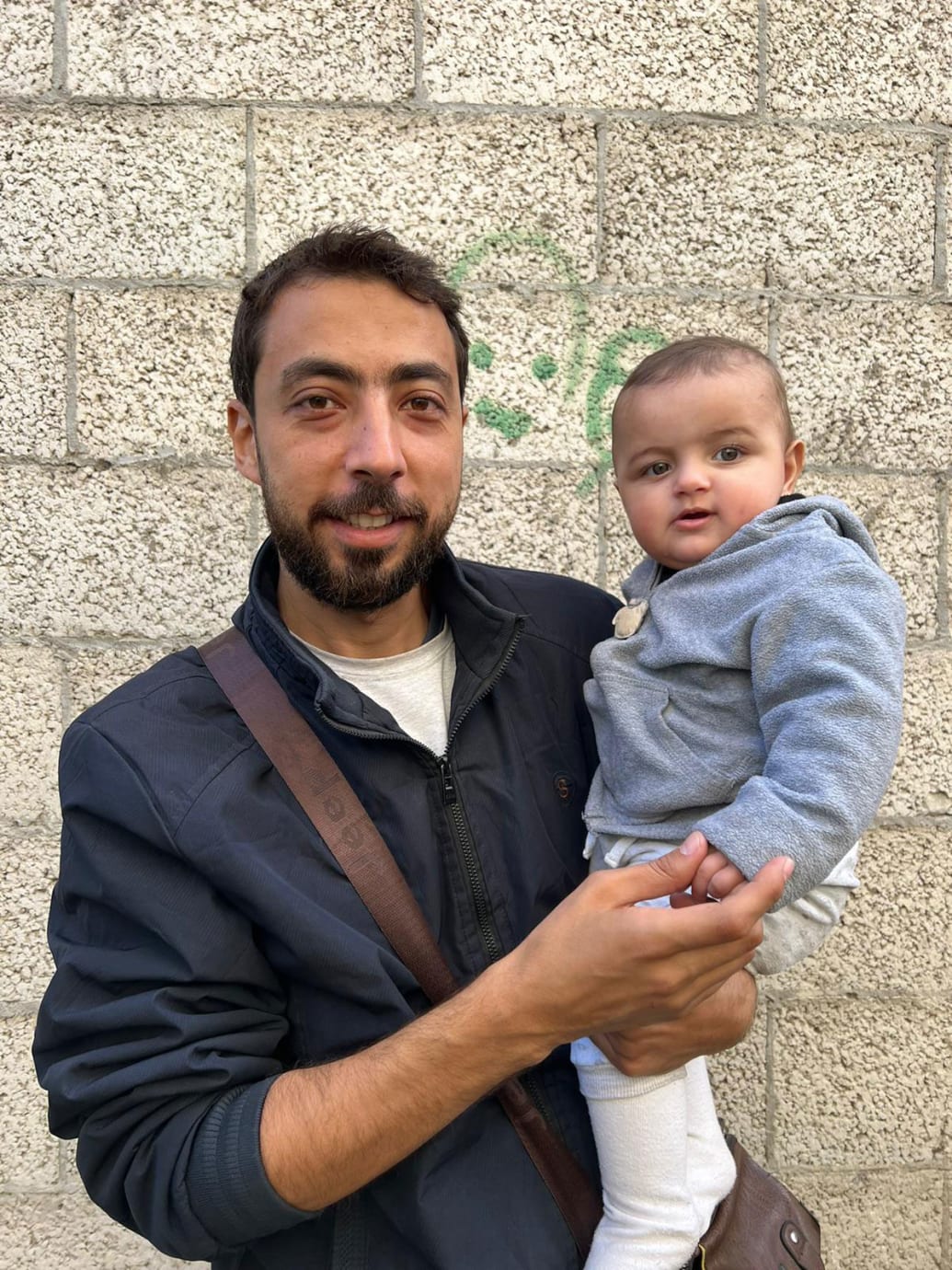
Yahia Barzaq reunited in exile with one of his subjects, Maria.
“The same babies who once peacefully slept in dreamlike poses are now tragically absent, their lives cut short by the very conflict that uprooted us and countless others,” Barzaq told The Daily Beast.
Barzaq, his wife, and their own two children, Mohammed, 8, and Ali, 4, were forced to abandon the studio and their home in Gaza City amid the Israeli bombardment and invasion which followed the Oct. 7 Hamas attack on Israel. From exile in the south of the Gaza Strip, the photographer began to update his Instagram feed as bad news reached him from the families he captured. And so, the photographic journey, which was once a celebration of new life, became a poignant chronicle of loss and displacement. He posted haunting pictures of the deceased babies with a black line through the top left corner.
The brutality of war has rewritten the stories of the infants he once cradled through his lens, leaving him with images of the babies whose prospects were shattered by the relentless violence.
One of them was George As-Souli. He was 7 months old when he was killed with his Christian family who were seeking refuge in the oldest active church in Gaza in the early weeks of the conflict. They were hiding out at the Church of the Greek Orthodox Patriarchate School in Gaza City when a bomb blast killed 18 people including relatives of former Michigan congressman Justin Amash on Oct. 20.
Just two months earlier, Barzaq photographed the young boy. “We heard about a child I had recently photographed. He, along with his parents and entire family, had tragically lost their lives. It was a profound shock. I didn’t just capture his image; I held him, comforted him, and tried to make him smile by gently touching his cheeks,” he said.

George As-Souli
“I was holding him for a long time in my arm so he could sleep and help us to complete the photo session. I can’t forget how innocent he was.
“Why should a child, who I had just photographed less than a month before the war, face the impact of tons of explosives erasing him from existence?”
Viola As-Souli, 61, George’s grandmother who still lives in Gaza City, told The Daily Beast: “This is the worst war ever. We lost our children, grandson, and houses, what more price should we pay?”
A devastating photo of Barzaq’s portraits of George lying tattered in the rubble of the church was captured by Al Araby and became the first tragic update on his Yahia Barzaq Studio Instagram.
Another of the babies memorialized on the page is Adam Dahdouh, who is holding a tiny knitted white heart in the shot. The 11-month-old was the grandson of Al Jazeera’s legendary Gaza bureau chief Wael al-Dahdouh. “We made a very sweet session for him…” Barzaq wrote. “He will never grow up and see how beautiful it was.”
Adam’s father, Hamza, was also killed in January.

Adam Dahdouh
Barzaq, who previously worked in radio engineering and as a cameraman and editor for the Qatari Al-Kass Channel, has done baby photoshoots for a couple of years but only opened his own photography studio a few months before the war began.
It’s no wonder they chose to stay in Gaza City, where they lived and worked, after a brief abortive evacuation to an over-crowded uncle’s house in Deir Al-Balah after the Oct. 7 attacks.
They stayed in their home until Nov. 11 when all hell broke loose. “We experienced a night that was among the most challenging we’ve ever faced. I cannot adequately convey the horror of the ground invasion. Tanks reached our area, unleashing a frenzy of artillery fire accompanied by airstrikes,” he said.
“Suddenly, a thick white gas filled our apartment, making it difficult to breathe, and fear prevented us from opening the windows to ventilate the space. Children began vomiting, and we struggled to catch our breath, especially since our home was already crowded with my in-laws who had sought refuge with us to stay together during these difficult times.
“The bombardment intensified even further, targeting our building with multiple shells. Additionally, the adjacent hospital building, Mehdi Hospital, was completely devastated, resulting in the loss of all lives within it. So once again to Deir Al-Balah.”
Barzaq’s wife, Nahrawan, 30, also worked at the studio—which was destroyed in the bombing—where she prepped the props for the photoshoots and made sure the children were comfortable and ready for the photo sessions.
“We have quickly made a name for ourselves,” she said. “What makes our work unique is our approach to clients. We don’t just see them as customers with a task to complete; instead, our interactions with families are genuine, forming strong connections that often evolve into lasting friendships.”
The photography sessions with parents typically last at least two hours and sometimes extend to five hours in the studio, which allows them to get to know the families.
“As displaced people now we have met numerous children whom we photographed, some in temporary shelters in schools, others in nylon tents in the streets or hospital, and a few with their relatives. Each encounter instantly takes us back to the delightful moments we shared, reminiscing about the times we captured those beautiful memories,” Nahrawan said.
Maria Barghouth was just 5 months old when the war began. Barzaq captured beautiful commemorative shots of her just two days before the start of the conflict. Due to the war erupting, the family hadn’t yet got prints of their baby girl’s photos.
Maria’s mother, a 25-year-old woman, who asked to remain anonymous, told The Daily Beast she had bumped into Yahia and Nahrawan while out shopping in Deir Al-Balah, where they are also refugees.

Baby Maria is now a refugee in southern Gaza.
“Maria is 9 months old now. I never thought we would capture those beautiful photos again after the studio was destroyed and Gaza was ravaged. But when we met Yahia’s family and revisited the pictures, it brought a glimmer of hope. We felt alive again,” she said.
“When the war ends, I won’t just view them on my mobile screen; I will print and place them in our home. I hope our home will be in good condition when the war is over.”


Free camera hand strap with purchase of CCS G3 harness

Cotton Camera Carrying Systems
Camera harnesses come with a free hand strap for a limited time.
UNITED STATES, January 29, 2024 /EINPresswire.com/ — Cotton Camera Carrying Systems has introduced a limited-time promotion offering a complimentary hand strap with each purchase of their renowned G3 harness system. This special offer – recently announced on the Cotton Carrier Instagram page – is designed to enhance the gear carrying experience for photographers by combining the ergonomic benefits of the G3 harness with the added convenience and security of a hand strap.
The CCS G3 camera harness system is celebrated for its ergonomic design that evenly distributes the weight of camera equipment, making it an indispensable tool for photographers. It accommodates various setups, from single-camera users to dual camera or binocular users, ensuring quick access to equipment which is crucial for capturing fleeting moments.
Constructed from durable materials such as rugged Nylon 6 camera mounts, anodized aluminum camera mounting hubs, and premium nylon webbing, the G3 harness is engineered to withstand the demands of outdoor and adventure photography. The system’s functionality and comfort have been lauded by users, highlighting its role in improving the photography experience.
With the latest promotional offer, Cotton aims to make high-quality photography gear more accessible to both new and existing customers by including a complimentary hand strap with each G3 harness system purchase. This initiative reflects Cotton Carrier’s commitment to supporting photographers in their creative endeavors.
Photographers interested in this limited-time offer can find more details on the Cotton Camera Carrying Systems website. The promotion highlights Cotton’s dedication to enhancing their customers’ investments in photography equipment.
For more information about the Cotton Carrier G3 camera harness, visit the company website.
About Cotton Camera Carrying Systems
Cotton specializes in creating ergonomic, secure camera carrying systems for photographers of all levels. With a focus on quality and innovation, CCS products are designed to enhance the photography experience by providing comfort, security, and accessibility.
Brook Parker
Cotton Camera Carrying Systems
+1 778-340-1535
brook@cottoncarrier.com
Visit us on social media:
Facebook
Instagram
YouTube


Since October of last year, Anchorage has been visited by a rare, feathered celebrity — a white raven, who appears to have taken up residence in a neighborhood known as Spenard.
Last summer, the raven was spotted south of Anchorage in the Kenai Peninsula, where biologists confirmed the bird is not an albino but leucistic — which means it has a gene that causes a loss of pigmentation. It also has blue eyes. Biologists believe it’s most likely the same bird that has delighted Anchorage this winter.
Photo by Glen Klinkhart, Anchorage photographer.
Almost every day you can find new photos of White Raven on Facebook on a page called, “Anchorage White Raven Spottings.” There, you can see the bird aloft with its feathers, translucent through the light, or at play with another raven in the snow. Someone recently snapped a shot of White Raven, as it strutted with a slice of pizza in its beak.
There’s also footage on Facebook of White Raven loosening a bolt on a streetlamp and carrying it off in its beak and a guy in conversation with the bird from its perch near McDonald’s.
Photo by Michelle Hanson, owner of mhphotoco.
Among the most recent posts, there are regal photos of White Raven perched on a spruce bough as the moon rises in the backdrop — so many faces of raven captured by an eager Anchorage paparazzi, who don’t seem to compete against one another, but cooperate by sharing tips on how to photograph the bird.
“It’s just so different. It is so out of the norm,” says Glen Klinkhart, a retired Anchorage police detective, who has almost made tracking White Raven a fulltime job.
“We all know what a raven looks like. We all know the shape, how it’s supposed to look,” Klinkhart said, “and then when you see this, this White Raven with this genetic difference, it just kind of stops you.”
Listen to full interview with photographer Glen Klinkhart.
Glen Klinkhart talks about his experiences photographing White Raven and how he uses his skills as a retired police detective to track down White Raven.
Listen • 15:55
Scientists say the white raven is very rare. But how rare? Rick Sinnott, a wildlife biologist, says he knows of only two other white raven sightings in Anchorage. The last one was twenty years ago in the midtown area.
“It wasn’t as white as this one,” said Sinnott, who remembers that its feathers were tipped with a bronze hue. “It was shiny bronze. It was very beautiful”
Sinnott says another white raven was spotted 20 years before that and believes three sightings over the course of four decades meets the definition of rare, especially when you consider the genetic odds. Sinnott says it would take both a male and a female with a recessive leucistic gene to mate – and even then, maybe one of four chicks would be white, if any at all.
Ravens are smart enough to know what they look like and can recognize themselves in mirrors, so Sinnott worried that other ravens would pick on the white raven, because it’s different. But he’s glad that doesn’t appear to be the case.
“When it’s around other ravens, it doesn’t seem to raise feathers around the top of its head, which would suggest it’s not subordinate,” Sinnott says.
In fact, White Raven behaves more like an “alpha” bird. In a recent post, Glen Klinkhart shared pictures of White Raven in a spat with four black ravens over a discarded Häagen Dazs carton of White Raspberry Chocolate Truffle ice cream. In the last photo in the series, White Raven shows off his prize.
Photo by Glen Klinkhart, Anchorage photographer.
It’s one of more than ten-thousand photos Klinkhart has taken of White Raven since October, but there’s one that he’s especially proud of, taken on a day in which he found the bird completely alone. He laid down on the ground to watch, with camera in hand.
“It started getting closer and closer. And I just froze. I’m like don’t move. Don’t affect its behavior. Let it behave,” said Klinkhart, who wondered if the bird was just curious.
“That White Raven came about two feet of me and looked in my camera lens,” he said. “Then it tilted its head. And then it waddled off.”
Klinkhart says he was so close to White Raven, the photo showed his reflection in the bird’s blue eye, a magical moment. Since that first time, White Raven has come close to Klinkhart’s lens a couple of times.
Photo by Glen Klinkhart, Anchorage photographer.
In many Alaska Native stories, the bird is a mystical being.
Meda DeWitt, a Lingít healer who works with medicinal plants, says she first heard about White Raven years ago from another traditional healer, the late Rita Blumenstein, known as Grandma Rita — a Yup’ik from Southwest Alaska, trained by her elders from childhood to ease pain and suffering.
Photo by Rhonda McBride.
“This is one of the stories that she would tell that brought hope,” DeWitt said. “She would say, ‘We will see a White Raven, and that’s when we’ll know that humanity as a whole is shifting towards one of peace.’”
DeWitt says it’s a prophecy Grandma Rita heard from her elders, an example of the white raven’s long history throughout the world as a messenger bird. Even the Greek God Apollo had one, which turned from white to black, after displeasing the God.
Photo by Glen Klinkhart, Anchorage photographer.
In Alaska Native stories, raven also transforms. DeWitt says not to forget that Raven is a trickster who finds trouble. Her uncle tells a story about how Raven wanted to bring mankind fresh water to drink, so he tried to steal a bucket from a chieftain’s house. Soot blackened his feathers as he escaped through a smoke hole. In another version of the Lingit story, Raven turns black after he steals the moon, the sun and the stars to bring light into the world.
DeWitt believes Raven has transformed yet again and has returned to encourage mankind to save the planet, a message especially important to Alaska Natives.
“Our whole job is to steward the earth, and if the earth is sick, that means we’re sick,” DeWitt said. “When I see something like White Raven, it gives me a profound sense of hope. Even beyond hope, knowing that we’re going to be successful.”
Listen to full interview with Meda DeWitt.
Meda DeWitt is a traditional healer, ethno-herbalist and educator. She talks about the spirituality of White Raven in Alaska Native cultures.
Listen • 15:48
Floyd Guthrie, another traditional healer who is Tsimshian, Lingít and Haida, says he has waited a long time for White Raven to appear.
“It makes our hearts feel good, because we connect to the truth of his existence,” said Guthrie, who believes White Raven has always been around to watch over humans but not necessarily visible.
“It’s so wonderful to see White Raven with the blue eyes,” Guthrie said. “In his own way, he just has to tell us, I’m not very far away from you.”
Guthrie and his wife, Dr. Marianne Rolland, specialize in treating trauma. Years ago, when Rolland was searching for a name for their counseling center in Anchorage, she says the words “White Raven” came to her, not in a voice, but from what she calls a place of knowing.
“White Raven is reminding us of our own spirituality and of what we’re here on earth to do,” Rolland said, “that we’re not just physical human beings, but we’re spiritual beings.”
Rolland says she’s not surprised by the hundreds of White Raven photographs that have been posted on Facebook, which include artwork the bird has inspired. From paintings to sculptures, to beaded earrings, there’s almost a cottage industry of White Raven art, not to mention mugs, stickers and keychains.
“White Raven opens hearts, and opening up hearts opens up creativity,” said Rolland.
Listen to full interview with Floyd Guthrie and Dr. Marianne Rolland.
Floyd Guthrie and Dr. Marianne Rolland are traditional healers who specialize in trauma therapy. They’ve been anticipating the return of White Raven, who they believe visits mankind to awaken spirituality and creativity.
Listen • 8:25
After seeing the photos, Jerrod Galanin felt the urge to fashion a Lingít-style, copper armband with the White Raven in silver. Not long afterwards, it was as if the bird sought him out.
“The flight pattern was like sporadic and kind of crazy,” said Galanin. “And so, I looked closer, and it landed on a light post, right on top of us.”
Photo courtesy of Jerrod Galanin.
Some Facebook followers have speculated about whether White Raven is male or female. Biologists say it’s hard to tell for sure. The males are a little larger and can have pouches with a bigger bulge under their throats. Rick Sinnott says males also like to show off during courtship.
“He’ll fly up in the air and drop sticks and fly down and pick them up, catch them as they fall. Or do all kinds of aerobatics, like you see them flipping on their back and doing all kinds of things,” Sinnott said. “When males are trying to impress females, they go into quite a frenzy of that kind of behavior.”
Sinnott says the mating season begins at the end of January and runs through March, so we may soon find out whether White Raven is a “him” or a “her.” Or maybe not. Sinnott says sometimes ravens just like to entertain their buddies.
Photo by Michelle Hanson, mhphotoco.
Sinnott says when ravens take up urban life, you can usually find them hanging out near busy intersections, where there are restaurants and grocery stores. And for White Raven, that means plenty of dumpster dining. Seems the bird has favored those at the Spenard Roadhouse. As one Facebook poster put it, “At least the White Raven has good taste.”
From the progression of photos from October, White Raven appears to have fattened up, but maybe it’s just the bird’s feathers fluffing-up to survive the sub-zero temperatures.
Sinnott says, chances are White Raven will move on come spring and head out into the wilderness. Ravens are known to travel hundreds of miles away. Some, which have been tagged in Anchorage, have been spotted as far away as Juneau, Fairbanks and the North Slope.
But for now, White Raven brings warmth and cheer into the heart of an Anchorage winter.
As Floyd Guthrie says, White Raven here to say, “I see you.”
Photo by Glen Klinkhart, Anchorage Photographer.
Editor’s Note: Audio of White Raven unscrewing a bolt on a street lamp was from a Jennifer Collin’s video. Sound of White Raven preaching to the choir came from a Todd Billingslea video.


Having travelled extensively across the country, often living with his subjects for months at a time, Cañibano provides a window into Cuba, from the small farming communities of his childhood to the exuberance of Havana and the Malecón

A very lucky photographer has captured a rare phenomenon that occurs when light passes through Earth’s atmosphere.
A green flash from Venus captured Peter Rosén
The green flash was captured by photographer Peter Rosén who pointed his camera at one of Earth’s closest neighbors – Venus. The footage was snapped in the early hours on January 8 as Rosén was watching Venus rise above the horizon. So, what is this green flash, as shown above? Firstly, visible light contains many different wavelengths of colored light, and when this light shines through Earth’s atmosphere, these individual wavelengths begin to be refracted through the molecules in Earth’s atmosphere.
The green flash is light bouncing off Venus and making its way through Earth’s atmosphere, specifically Earth’s low atmosphere, where it travels through more of the atmosphere and eventually reaches the observer. As light passes through Earth’s atmosphere, a prism effect takes place, as the light is split into RGB colors, which can also be affected by temperature. When this event is taking place, it’s possible that only green wavelengths of light make it to the observer, with all other wavelengths either being scattered or absorbed by Earth’s molecules.
“On Monday morning I woke up early to get a beautiful view of Venus and the Moon rising over Stockholm’s skyline,” says Rosén. “Because of the extreme cold that still persists over southern Sweden, I also got an unexpected bonus in the form of a rare green flash on Venus.“
However, in the above footage, if you look closely, you will be able to see yellow, orange, red, and even blue. Another simple example of this is how Earth’s atmosphere scatters blue wavelengths of light more than any other color, resulting in the sky appearing blue.
 3
3VIEW GALLERY – 3 IMAGES
This isn’t the first time observers have spotted a green flash on Venus, and the phenomenon is more commonly seen when looking at the Sun, particularly during a sunset or a sunrise above an ocean horizon. There have even been some instances where individuals have seen ice crystals refract the light even more, creating rainbow-colored clouds or halos of light around the Sun or moon.
This effect isn’t exclusive to astronomical objects reflecting light through Earth’s atmosphere, as rainbow rings have been seen around the Sun during an intense pollen swarm. It was only in June 2023 that a photographer in Finland captured an intense pollen swarm, creating an incredible rainbow around the Sun. If you are interested in checking out that story or would like to see the multiple images captured during the event, visit this link here.
3A pollen corona in Turku, Finland
I suppose that was the scenic route of explaining that light from Venus passed through Earth’s atmosphere, and the only wavelengths of light that made it through our planet’s atmosphere were the ones seen in the above gif.

In our Olympus OM-1 review, we labelled the flagship mirrorless camera for photographers “the best Micro Four Thirds camera you can buy”, and said it proved that computational tricks are the future of mirrorless cameras. Almost two years later, it has a successor with a different name etched on its body – the OM System OM-1 II.
Olympus had already been bought by OM Digital Solutions when the OM-1 was launched in March 2022. Since then, there’s been little activity from the fledgling name in cameras besides whacking its OM System brand on updated Olympus models that are mere minor refreshes. Sadly, the same is true here.
We have virtually the same OM-1 hardware in the new OM-1 II; a 20MP back-illuminated stacked sensor with 1053-point AF system, 50fps with continuous autofocus and autoexposure, plus the rugged IP53-rated dustproof, splashproof and freezeproof body. Those specs still read well today, but fans of the MFT system would have been hoping for more.
Still, it’s a system that’s particularly popular with those who don’t want to lug around heavy gear or a tripod, and especially with bird and wildlife photographers, for whom some of the new features in the latest model should only serve to improve the shooting experience. The OM-1 series is also leading the way for computational photography in proper cameras, proving they’re not just restricted to smartphones.
Image 1 of 2

So if little has changed in the OM-1 II hardware (besides its new rubberized and tactile external controls), what exactly is new? In short, improved algorithms. That might not sound sexy, but the overall performance of the camera has been enhanced, plus there are some new computational tricks on offer.
Most noteworthy is the improved buffer performance – the OM-1 II can shoot for twice as long as the OM-1. If you’re maxing the camera out using the 50fps continuous burst mode, you can now shoot sequences up to 256 raw images, with a 5.76m-dot EVF that now has a blackout-free display whatever your shooting rate.
The camera also comes with image stabilization now rated up to 8.5EV, whereas the OM-1 was rated at 7EV. To be clear, the improvement here is algorithm-based and not a newly designed in-body image stabilization system. Nonetheless, we expect class-leading performance, which is exciting especially when pairing the second-gen model with the new M.Zuiko 150-600m F5.0-6.3 IS lens launched on the same day.
There’s also what OM System says is significantly improved autofocus accuracy, through improved AI subject detection algorithms. The OM-1 II can better detect fast-moving birds and keep them in sharp focus. It allows you to select any one of up to eight subjects in crowded scenes, plus human detection AF has now been added to the AI subject detection menu – which is something we asked for in our OM-1 review.

Of any ‘proper’ camera, the OM-1 utilizes computational photography tricks the most – it even has a dedicated menu – and the new OM-1 II adds an entirely new feature; LiveGND. In short, it’s a world-first graduated filter effect, up to 3EV in strength. In practice, you select the horizon in your shot and apply the graduated filter to darken the brighter half of your shot – usually the sky, with soft, medium or hard gradations and GND2, 4 or 8 strength options.
Ultimately, LiveGND balances your exposure when one half of the shot is much brighter, and is a dream for landscape photographers. LiveGND can’t be used in conjunction with LiveND (which by the way now goes up to ND128 – that’s equivalent to a 7-stop ND) or Pro Capture modes, but OM System is going a long way to eliminating the need for physical lens filters altogether.
Elsewhere, the High-Res shot mode that can capture 50MP handheld photos of static subjects can now be used with 14-bit raw capture for what OM System says gives 3x the amount of tones, while focus stacking is much quicker and therefore more usable than before. Until we test the new camera, we won’t know if the ugly halo effect in this mode, reported in our OM-1 review, has been dealt with.
Currently OM System has no plan to roll out these algorithm improvements to the OM-1 via a firmware update, though that could change in the future. Shipping of the OM System OM-1 II is from mid-February, and it costs $2,399 / £2,199 body only (Australia pricing TBC, but that’s around AU$3,640). OM System hasn’t given people much of a reason to upgrade, but those looking for a new, lightweight and versatile system for wildlife and macro photography in particular have a potentially excellent option here.


In the 1950s and ’60s, when Iraq was bursting out of an agrarian past and into the industrial present, the photographer Latif Al Ani was there to record his nation’s seismic shift and aftershocks.
Al Ani shelved his career in the late 1970s, his archive was largely destroyed in 2003, and the Iraq he celebrated has since been pummelled by a succession of calamities and wars. Some of his surviving work was shown at the Venice Biennale in 2015 and he enjoyed a late-life glimmer of renown until his death in 2021.
Now, an invigorating show at NYU’s Institute for the Study of the Ancient World, entitled Through the Lens, makes the case for Al Ani as the peerless photographer of Iraq’s antiquities, not just as emblems of a glorious past but also as witnesses to hurtling but fitful transformations. He documented ruins and their fashionable admirers, and shot unpeopled modern buildings in harsh raking light, making them look like archaic monuments.
He was an artist first and a reporter second. His images are meticulously composed and subtly staged; their messages are never shrill. A handful of pictures of the same desert ruin, Tāq Kasrā, taken over the course of a few hours on the same day in 1964, reveal utterly divergent views of 20th-century Iraq. In one, a shepherd in a white headscarf tends his flock on a rocky field, with the remains of the 1,700-year-old palace rising majestically at his shoulders. The scene is almost timeless; only a pair of automobiles parked in the distance signal that this is not the 18th century, or the 15th.
In other images in that series, though, the same massive brick arch and high colonnaded wall serve as a picturesque backdrop to a tourist masquerade. Two western couples, the men in white button-down shirts and Apollo 13 haircuts, the women in crisp shirt-dresses, costume themselves in Bedouin robes and headscarves. The tableau comes with its own audience (a child looks on at the parents’ dress-up), exotic set, props, even a supporting cast.
One picture, in particular, quivers with psychological overtones and formal complexity. Husband and wife, outfitted for a day at office, drift apart, their gazes pulled in different directions. A blind musician, dressed like the shepherd, sits at their feet, drawing a bow across a homemade rebab’s single string. The asymmetrical composition, the harsh angularity, the air of emotional numbness and alienation, all of it playing out against the looming structure, carry Ozymandian overtones.
Seen as a whole, though, the series is witty and biting, especially in the contrast between the goofy foreigners and their sombre, parched surroundings, between the visitors’ cheery urbanity and the local man’s grizzled impassivity. Creatures of the modern world perform their rites before ancient palaces that make their antics seem comically puny. The people will go; the stones will stay.


Take a step back, and you realise that if the tourists are play-acting, Al Ani must be surreptitiously directing. The same blind musician turns up in another shot taken at the gates of Babylon, more than 100km away, raising the question of whether he should be considered a supporting actor or a prop.
“I wanted to show our heritage against our present,” he recalled in 2015. Those are loaded words. That “our”, for instance. Iraq’s population was considerably more diverse in the 1960s than it is now, and it’s not obvious that today’s Arabic-speaking Muslims bear much direct connection to the ancient Sumerians, Mesopotamians, Assyrians and Persians who swept through the area, leaving their marks on the landscape.
Al Ani seems to have absorbed these uncertainties and used them to dramatic effect. In 1960, he photographed Tāq Kasrā from the air, replicating a shot that Roald Dahl had taken 20 years before, while piloting solo across the desert during the second world war. The exhibition pairs that godlike perspective with an aerial view of 1960s Baghdad, with its broad boulevards, boxy apartment buildings and modern monuments. The de facto diptych almost deserves Gauguin’s weighty philosophical title, “Where do We Come From? What Are We? Where Are We Going?”

A handsome young man with a Clark Gable demeanour, Al Ani was certainly a nationalist, but the meaning of that term kept evolving. Colonial status gave way to an oil-rich Hashemite kingdom in 1932, and it was in that period that Al Ani landed his first job at the Iraq Petroleum Company, which he promoted in its house organ, “Ahl al-Naft” (People Of Oil). When a 1958 coup deposed the king and established a republic, he founded the photography section of the Ministry of Information. Later, he led the photography department of the Iraqi News Agency. He was always a government man, though sometimes a resentful one, until eventually the authorities forced him into premature retirement.
Each political chapter made his task a little harder and more necessary. Starting with the 1958 coup, he once said, the past “has been deleted. I felt there would be no stability. Men were eaten up and newcomers came. Pandora’s box was opened and ignorant people came to rule, who had no culture or understanding of the power they held. Fear was a major motive to document everything as it was. I did all that I could to document, to safeguard that time.”
By his own account, Al Ani’s beef was mostly with the state that employed him. But the show’s curators Pedro Azara and Roberta Casagrande-Kim don’t take him at his word. Having resoundingly established his stature as an artist, they go on to make a more tenuous argument. Al Ani, they claim, set out to chronicle an Iraq whose patrimony was being methodically exploited and despoiled by those pernicious holdovers of empire: archaeology and tourism.
“Like bulls in a shop, archaeologists displaced the Ottoman and Arab populations from their ancestry, sabotaging and erasing their relationship with the finds in their territories,” Azara writes in the catalogue. “Following World War I, this archaeological treasure hunt was facilitated by the colonisation of a large part of the Middle East.”

It’s true that archaeology and colonialism travelled together and nourished each other’s missions. But trying to recruit Al Ani to that critique proves tricky, because the photos are more nuanced and less tendentious than the curators suggest. His portrait of the 9th-century minaret of the Great Mosque in Samarra is a study in texture and line: The rough grain and dune-like hillocks of the ground recede to an eroded brick wall and the spiralling sandstone tower beyond. It’s a view that a 19th-century European explorer might have savoured.
The effort to anoint Al Ani as a cultural freedom fighter leads the curators to distort their subject’s statements. “Most visitors were wealthy foreigners, generally North American tourists,” Azara writes, radically abridging Al Ani’s statement into the much terser: “Newcomers came. Pandora’s Box was opened.” As the full quote makes clear, Azara’s truncated version is deliberately misleading, suggesting that the photographer was inveighing against tourists instead of Iraq’s own government. An excess of rapacious visitors may trouble Azara, but it wasn’t Al Ani’s problem.
The exhibition heralds the arrival of a generation of Iraqi artists — mostly living abroad — who, in paying homage to the man known as “the father of Iraqi photography”, also reclaim their ancestral civilisation. Nadine Hattom, for example, was born in Baghdad, grew up in Australia and Abu Dhabi, and lives in Berlin. She plays a similar game to Al Ani’s, manipulating figures in a landscape, though she does it digitally instead of issuing instructions like “Stand there” and “Look here”. Unable to travel to Anbar Province, she instead sifted through public domain photos of US military operations there, then edited out the soldiers and left only their shadows. She is performing the same trick he did, serenading her homeland through the ghostly traces of yet another foreign invasion.
‘Through the Lens’ runs until February 25, 2024
Find out about our latest stories first — follow @FTWeekend on Instagram and X, and subscribe to our podcast Life & Art wherever you listen








