What Is Bokeh and Why Are So Many Photographers Obsessed With It? |

What Is Bokeh and Why Are So Many Photographers Obsessed With It? |

Bokeh, a term derived from the Japanese word “boke,” meaning “blur,” is central to the aesthetic quality of photography and videography. This phenomenon creates a soft, pleasing effect that can significantly enhance the visual storytelling of a photo or video.

Coming to you from Videomaker, this informative video delves into the intricacies of bokeh, explaining not just what it is, but also how it can be intentionally manipulated to elevate the emotional impact of visual narratives. The video breaks down the five key factors that affect bokeh: aperture, focal length, the distance between the camera and the subject, the subject’s distance from the background or foreground, and the number of aperture blades in the lens. These elements combine to shape the bokeh effect, influencing its strength and form. For instance, a longer focal length and proximity to the subject can intensify bokeh, while the number of aperture blades alters its shape. 

Moreover, the video illustrates how bokeh is more than just a technical feature; it’s a powerful storytelling tool. Filmmakers often use bokeh to convey various emotions and moods, such as romance, loneliness, or alienation. Classic film examples like “La La Land” and “The Grand Budapest Hotel” are referenced to demonstrate how bokeh can create dreamlike atmospheres or whimsical moods. In “The Notebook,” bokeh is used to evoke a sense of rebellion and carefree nature. Understanding and mastering bokeh allows filmmakers and photographers to create more immersive and emotionally resonant scenes. Check out the video above for the full rundown.

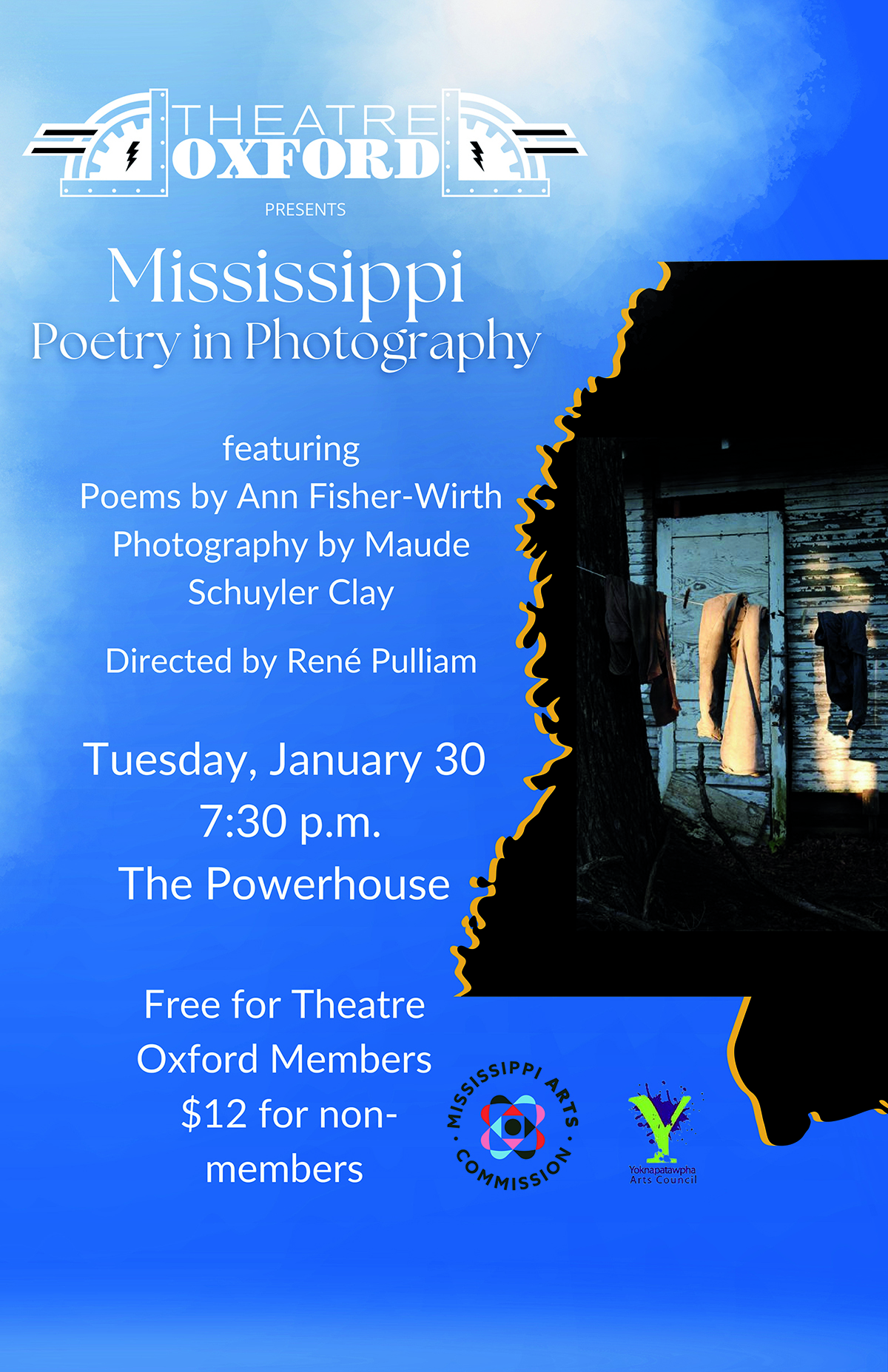
The Poetry in Mississippi’s Haunting Landscape: Theatre Oxford’s Production of “Mississippi: Poetry in Photography” is at the Powerhouse Tuesday, January 30

The Poetry in Mississippi’s Haunting Landscape: Theatre Oxford’s Production of “Mississippi: Poetry in Photography” is at the Powerhouse Tuesday, January 30

Mississippi may bear the scars of a history of poverty and racial oppression, but it is rich with the natural beauty of its landscape and the voices that have risen out of that landscape. Those voices created stories and music that entranced the world.

Award-winning poet Ann Fisher-Wirth, who lives in Oxford, has always had a keen ear for those voices and particularly in the images of Mississippi’s haunting landscape seen in Mississippian Maude Schuyler-Clay’s photography.

The poetry Fisher-Wirth created out of Schuyler-Clay’s images is the centerpiece of Theatre Oxford’s production of Mississippi: Poetry in Photography at the Powerhouse Tuesday, January 30, at 7:30 pm. The production is based on Fisher-Wirth and Schuyler-Clay’s book of poetry and photography, simply titled Mississippi. Books will be available both before and after the production, and Fisher-Wirth and Schuyler-Clay will be signing copies after the show.

“I love the rich orality of Mississippi culture, and I have tried to express it,” Fisher-Wirth writes in the foreword of her and Schuyler-Clay’s compelling book. “To write these poems, I listen to the voices and I listen to Maude’s photography. Out of silence, the poems emerge.”

Directed by René Pulliam, Mississippi: Poetry in Photography will feature cast members performing the poetry that Schuyler-Clay’s photography inspired in Fisher-Wirth. Her words and Schuyler-Clay’s images create a complex tapestry from both historical and modern voices.

The poems and photographs create mini-stories that range from moments in history such as Emmett Till’s fateful encounter with Carolyn Bryant in Money, Mississippi, in 1955 to moments of legend such as bluesman Robert Johnson’s encounter with the devil on the crossroads of Highways 61 and 49.

Some of the poems speak to ageless stories such as a teenager’s crush on a visitor from another country, the tragic death in childbirth of a young mother and her child, the memories embedded in a decaying shack slowly sinking into floodwaters.

Theatre Oxford’s production of Mississippi: Poetry in Photography is made possible in part by the support of the Mississippi Arts Commission and Yoknapatawpha Arts Council.

Tickets are free to Theatre Oxford members and $12 for non-members. Tickets will be available at the door and seats can be reserved at https://oxfordarts.com/theatreoxford.

At MoMA, An-My Lê’s photos show the presence, and continuing power, of the past

At MoMA, An-My Lê’s photos show the presence, and continuing power, of the past

NEW YORK — One of the first photographs in An-My Lê’s retrospective “Between Two Rivers/Giữa hai giòng sông/Entre deux rivières” is of a group of people staring up at the sky. The show runs through March 9 at the Museum of Modern Art.

What the people are looking at is an eclipse. You can figure that out because of the cardboard glasses most of them are using. But knowing that they’re in Vietnam, and seeing a poster of Ho Chi Minh in the background, someone with a sense of history — and pretty much anyone of a certain age — can’t help but wonder at first if they’re looking skyward because of an air raid. Lê took the photograph in 1995. The Vietnam War had ended 20 years before. That doesn’t mean the past had gone away.

An-My Lê. “Manning the Rail, USS Tortuga, Java Sea,” from the series “Events Ashore,” 2010.© 2022 An-My Lê, courtesy of the artist and Marian Goodman Gallery/An-My Lê

Walker Evans said that he wanted his photographs to convey “what any present time will look like as the past.” What he meant was an engagement with time’s passage and the past as change. Among many other things, Lê wants her photographs to convey how any present time looks like shadowed by the past. What that means is an engagement with time’s continuity and the past as presence.

An-My Lê. “Sniper II,” from the series “Small Wars,” 1999-2002.© 2022 An-My Lê, courtesy of the artist and Marian Goodman Gallery

Such a presence is all but explicit in that eclipse photo — and quite overt in what may be Lê’s best-known work, the series “Small Wars” (1999-2002), showing Vietnam War reenactors. Speaking of the presence of the past, those reenactments took place in Virginia and North Carolina, more frequently associated with Civil War reenactments.

(The reenactors granted Lê permission to photograph them on the condition that she participate, alternately as a South Vietnamese soldier and Viet Cong guerrilla. Truly, the mind reels.)

An-My Lê, “Mexican Customs and Border Protection Officer, Presidio-Ojinaga International Bridge, Ojinaga, Mexico,” from the series “Silent General,” 2019.© 2022 An-My Lê, courtesy of the artist and Marian Goodman Gallery/An-My Lê

But whether Lê’s photographing a Rio Grande border crossing, a Hudson Valley quarry, or a Marine training base in the Mojave Desert — the recruits are, in effect, pre-enactors — this alertness to the past as moral climate and ongoing legacy can be felt through the MoMA show. Note the references to the Rio Grande and Hudson. The Mekong and Mississippi figure in the show, too. That mention of “rivers” in the title isn’t just metaphorical.

That title’s being trilingual acknowledges the relationship between Lê’s personal history and larger events. “Collision” might be a more accurate word than “relationship.” Lê was born in 1960 in what was then Saigon and is now Ho Chi Minh City (that’s where she took the eclipse photo). Her mother had grown up in Hanoi and married Lê’s father in Paris, where they were students. The family lived there from 1968-73, before returning to South Vietnam. Four days before Saigon fell, Lê, her parents, and brothers were evacuated to the United States.

An-My Lê, “Parts Depot,” from the series “Trap Rock,” 2006.© 2022 An-My Lê, courtesy of the artist and Marian Goodman Gallery/An-My Lê

To emphasize the impact of Lê’s early years on her work risks scanting the work’s variety and richness. But Lê, who considers herself first and foremost a landscape photographer, invites that emphasis. “My attachment to the idea of landscape is a direct extension of a life in exile,” she said in 2005 interview.

Also, Lê defines her vocation differently, perhaps, from how others might. “Being a landscape photographer means creating a relationship between various categories — the individual within a larger construct such as the military, history, and culture.” Elsewhere she’s spoken of “this enduring search beyond the frame.” It’s that enduring search for multiple contexts that makes her work deceptively challenging and so consistently rewarding.

An-My Lê. “Sailors on Liberty from USS Preble, Bamboo 2 Bar, Da Nang, Vietnam,” from the series “Events Ashore,” 2011.© 2022 An-My Lê, courtesy of the artist and Marian Goodman Gallery/An-My Lê

Lê has a very American sense of space. It’s evident in traditional fashion in three photographs from 2019: of a Lutheran church in rural Montana, of a canyon in the Chinati Mountains, in Texas, and of a cattle drive passing through Marfa, Texas. It’s no less evident, if unconventionally so, in views of a Navy cargo plane at the South Pole, from 2008, and of Dodger Stadium, in Los Angeles, being used as a vaccination site, in 2021. “What makes America America?” Lê asks. “The wilderness, the vastness, our sense of history.” Yes, yes, and no.

Having studied biology at Stanford, Lê planned to go to medical school. A photography course she took changed that. Perhaps this is another example of personal history shaping her photography. Is it too much to see that earlier ambition in the way her work can feel faintly clinical even as it’s always compassionate?

So often in these images Lê maintains a distance from subjects, emotional as well as physical. That’s regardless of whether she’s in sympathy with them or not. Neither embracing nor condemning, she stands apart from those she photographs without ever viewing them as alien.

There’s a sense of calm throughout Lê’s work. It’s not the calm of serenity or acceptance, but of reflection and restraint. The soft light she frequently relies on — especially in her series “Events Ashore” (2005-14), showing US Navy missions abroad — can verge on dreaminess. But that relates to the clarity dreams have, not their capacity for excess or unreality. Dreams exist outside of time; or, at the very least, outside of linear time. That would seem to contradict this idea of the past mattering so much in Lê’s work. But she would argue otherwise. “History doesn’t move through time in a straight line,” she has said.

An-My Lê, “General Robert E. Lee and General P.G.T. Beauregard Monuments, Homeland Security Storage, New Orleans, Louisiana,” from the series “Silent General,” 2017.© 2022 An-My Lê, courtesy of the artist and Marian Goodman Gallery/An-My Lê

Related to those aspects of apartness and calm is an abiding chaste scrutiny. Well, “chaste” doesn’t really apply to the two least characteristic series in the show: “Someone Else’s War (’Gangbang Girl #26′),” which takes scenes from a pornographic movie and renders them as tapestries, and “Gambetto,” consisting of photographs of erotic art from the collection of the National Archaeological Museum, in Naples. Even in these instances, though, chaste does describe Lê’s approach to decidedly not-chaste subject matter.

Only twice does humor peek through in “Rivers.” Once it’s not visual but geographic. Marfa, the site of that cattle drive, is also a pilgrimage site for contemporary art. The other is most definitely visual — and firmly puts us back in the realm of history. Statues of the Confederate generals Robert E. Lee and P.G.T. Beauregard are seen in storage in New Orleans, in 2017. Beauregard’s on horseback. A wooden support in front of the statue resembles a pole on a merry-go-round, which makes Beauregard look as though he’s a rider on a carnival attraction. Appear heroic this general does not.

Installation view of An-My Lê, “Fourteen Views.”Jonathan Dorado/The Museum of Modern Art, New Yo

The show includes two videos, one of the Vietnam reenactors, the other of 29 Palms, the Marine base. Both extend and deepen the impact of the photographs they accompany. There are also two installations. “Fourteen Views,” commissioned for “Rivers,” harkens to 19th-century cycloramas, with the immersive sweep — each panel is 10 feet high and nearly 5 feet wide — of its black-and-white views of Vietnam, New Orleans, Paris, and elsewhere.

The other installation, “đô-mi-nô,” is tucked away in a corner between the Vietnam photos and “Small Wars.” That tucked-away-ness makes coming upon it all the more startling. The title “đô-mi-nô” puns on “domino theory,” the rationale for US involvement in Southeast Asia.

An-My Lê, “đô-mi-nô,” 2021, installation view.Jonathan Dorado/The Museum of Modern Art, New Yo

The installation consists of 181 oversize Zippo-style cigarette lighters arranged on shelves. Zippos were popular among US soldiers and Marines in Vietnam. The shelves might make a viewer think of bookcases — and the jumbo lighters are book size — but what Lê has in mind is something very different: the shelves on which her mother would store canned goods and bags of grain to guard against wartime food shortages. Again the past informs the present, a very direct and personal past.

AN-MY LÊ: Between Two Rivers/Giữa hai giòng sông/Entre deux rivières

At Museum of Modern Art, 11 W. 53d St., New York, through March 9. 212-708-9400, www.moma.org


Mark Feeney can be reached at mark.feeney@globe.com.

See 11 Winning Images From the Close-Up Photographer of the Year Awards

See 11 Winning Images From the Close-Up Photographer of the Year Awards

From a slime mold measuring just one millimeter tall to a moth resting on a window, the images honored in the Close-Up Photographer of the Year contest draw attention to nature’s little details and spotlight tiny animals that most people would probably walk right past.

This year marks the fifth annual competition, which drew almost 12,000 entries from 67 countries. Over the course of 20 hours, a jury of 23 experts parsed through the images to select the winners.

The contest’s photographers allow the public “to see and learn from their work and to recognize how incredible and surprising the world is,” says Tracy Calder, a co-founder of the competition and member of the jury, in a statement.

“It’s often easier for people to get behind conservation stories featuring ‘cute’ or more obvious animals and plants: rhinos, pandas, orchids,” she tells CNN’s Nell Lewis. “But the lesser-known insects and plants we often consider weeds have a huge role to play in keeping everything balanced. Close-up photography often showcases these.”

The photographs honored in this year’s contest zoom in on such animals and plants—sometimes to a microscopic scale. The top 100 impressive entries can be seen on the competition’s website.

Below are the 11 winning images, which demonstrate the understated beauty in Earth’s miniature living things.

The Bird of the Forest by Csaba Daróczi

a bird, seen in silhouette from below, flies through trees above a hole shaped like a mushroom

This image of a Eurasian nuthatch flying over a tree stump won the animals category and secured the title of overall winner.

© Csaba Daróczi | cupoty.com

Hungarian photographer Csaba Daróczi spent much of last winter capturing images in a forest near his home. Each week, he would find a new subject in the trees and visit it repeatedly until he had a satisfying picture.

The idea for this winning photograph, shot with a GoPro 11, was conceived when Daróczi spotted a hollowed-out tree. The stump was just about one and a half feet across, and when he placed his camera inside, it captured a view of the forest’s trees as silhouettes against the sky, framed by the edges of the hole. He took a few initial shots through the opening.

“I was amazed by the results,” Daróczi says in a statement. “After a few days, however, I decided the composition might be improved if I included an animal in the frame.”

So, he put the camera in the stump once again and positioned a sunflower nearby to attract mice and birds. His winning image, capturing a Eurasian nuthatch flying overhead, was the stunning outcome.

The Ice Crown by Barry Webb

a small, bulb-like fungus atop a leaf, with a spot of ice on top of it that has rising spokes like a crown

A regal-looking slime mold won the category for fungi and slime molds.

© Barry Webb | cupoty.com

Though it’s only one millimeter tall, the slime mold in this photograph looks like imposing royalty. The tiny fungus appears to be “wearing an ice crown,” British gardener and photographer Barry Webb writes on Instagram.

Webb found this miniature sight atop leaf litter on the ground in Buckinghamshire, England, on a frigid January day.

“I had to be very careful not to breathe on it,” he says in a statement. “During a previous attempt with another slime mold, my breath had melted the ice when I inadvertently got too close.”

Wood Ants Firing Acid Secretion by René Krekels

on a log, dozens of red-orange ants spray acid, which is seen in streak-like drops in the air above them

Dozens of wood ants spray formic acid in this image, the insects category winner.

© René Krekels | cupoty.com

Wood ants have an unusual protective strategy—when threatened, they can spray formic acid from venom glands in their abdomens.

Usually, this defense would be directed at a predator, such as a bird or another ant. But as Dutch biologist René Krekels studied these creatures in the Netherlands, he became the target of their acidic spray.

“Luckily it wasn’t that destructive, and it provided me with a great opportunity to photograph them defending the nest,” Krekels says in a statement.

Beach Grass by Gerhard Vlcek

a micro image of beach grass dyed in green, yellow and orange; appears to be circular and ovular cells forming rounded shapes, with spikes pointing inward toward the center

The micro category winner features slices of dyed beach grass viewed under a microscope.

© Gerhard Vlcek | cupoty.com

Taken through a microscope, this cross-section of beach grass is only 30 micrometers long. Austrian photographer Gerhard Vlcek sliced the plant into ultra-thin pieces and stained them to produce the colors in the image.

“I had to use the tiniest brush to manipulate the less than one-millimeter parts in different staining and chemical solutions before positioning the stems on the slide,” Vlcek says in a statement. “After that, taking the photograph was the easy part!”

Jumping Stick by Tibor Molnar

a long brown stalk with insect eyes near the top against a black background

A close-up shot of a jumping stick insect’s head took the title of invertebrate portrait winner.

© Tibor Molnar | cupoty.com

American IT manager and photographer Tibor Molnar had imagined this shot in his mind for a while. But when traveling to Ecuador, where these jumping stick insects can be found, he finally had the opportunity to capture it.

Though the creatures look like walking sticks, they’re more closely related to grasshoppers. The insects are known for their elongated faces with eyes on a stalk, but that’s not the only goofy thing about them: “When they jump, they are not particularly graceful,” Molnar says in a statement. “They tend to tumble around completely off-balance.”

The Wedding Guest by Csaba Daróczi

a moth appears to be floating and tinted red, as people behind it dance in a circle holding hands

An oak peacock moth lands on a window behind dancing wedding guests, illuminated in red light. This photograph won the category for butterflies and dragonflies.

© Csaba Daróczi | cupoty.com

Though it looks to be frozen in midair, this oak peacock moth has landed on a window during a wedding. Daróczi, who also won the overall prize, was documenting the event, and he noticed the venue’s lights had lured several insects to the window.

Guests were taking pictures bathed in this red glow, and Daróczi waited his turn to capture the moth’s portrait, with dancers in the background.

Small Wonders by Carlos Pérez Naval

a grayscale photo of a wall with a mineral branching like five trees growing up from the bottom; at the right are a lizard's back foot and tail, curling toward the center of the image

In the category for young photographers under 18 years old, this image of a Moorish gecko and pyrolusite minerals came out on top.

© Carlos Pérez Naval | cupoty.com

On this wall in the Spanish village of Calamocha, a mineral called pyrolusite adorns the surface. “These magnesium minerals create stunning formations, which look just like petrified trees, but they are so small that they’re tricky to spot,” 17-year-old photographer Carlos Pérez Naval says in a statement.

He was able to create this interesting composition when he spotted a Moorish gecko on one of the mineral walls, earning him the title of Young Close-Up Photographer of the Year.

“I wanted to capture a gecko in the ‘petrified forest’ for a long time, but they only recently appeared in my village, probably carried in fruit baskets from hotter areas,” he adds. “Due to climate change, they can now survive here.”

Undertow by Csaba Daróczi

a shot downward at the surface of water, which appears very reflective and not clear, save for one shadowed strip where frilly green plants are visible

Water violets, not in bloom, are visible beneath the shadow of a fallen tree in this winning image from the intimate landscape category.

© Csaba Daróczi | cupoty.com

Each year, Daróczi photographs water violets at this creek near Izsák, Hungary. But on this visit, the violets’ flowering was delayed, so he knew he wouldn’t be able to capture the pale blossoms. At this spot, however, he noticed the plants made for an appealing photograph of greenery in the water.

“I was about to go home when I saw a tree had fallen over the canal, and under its reflection the plants were clearly visible,” he says in a statement. “I found it a very exciting subject and played with it for a while.”

Reflexion by Ria Bloemendaal

a reflection of a pink flowering tree and its branches in the water

Pink reflected flowers in the plants category-winning image appear to be a painting.

© Ria Bloemendaal | cupoty.com

While visiting Trompenburg Botanical Garden in Rotterdam, the Netherlands, Ria Bloemendaal, a retired remedial educationalist and photographer, noticed these reflected blossoms. The blurred flowers and branches look as though they have been painted with watercolors.

“I saw this beautiful reflection in the water and it immediately inspired me to make an ‘impressionist painting,’” says Bloemendaal in a statement.

Asymmetrical Threads by Elizabeth Kazda

colored lines of yellow, blue and green form radial and triangular patterns against a black background

In the human made category, this artistic image depicts colored and metallic thread.

© Elizabeth Kazda | cupoty.com

American artist Elizabeth Kazda wanted to repurpose her many spools of colored thread into an aesthetic photograph. She wrapped them in a pattern around an open picture frame, then put the frame on a rotating platform. As it spun, she captured 64 in-camera exposures of the threads in various positions.

“This is a meticulous process that requires patience,” Kazda says in a statement.

Dreamtime by Simon Theuma

a white shrimp swims over a mosaic of color, which is actually a close-up part of a sea star's body

The underwater category winner displays the relationship between a commensal shrimp and a mosaic sea star.

© Simon Theuma | cupoty.com

This small, commensal shrimp almost appears to be swimming over a tapestry, but in reality, the technicolor backdrop is the body of a mosaic sea star.

Australian photographer Simon Theuma lit up the scene with a strobe light, concentrated into a focused point with a photography tool called a snoot. He named the image “Dreamtime” for its evocation of colorful Aboriginal art.

“The Dreamtime Aboriginal art reminds us of the delicate balance that exists in the grand tapestry of our natural world—this ancient wisdom serves as an important reminder to preserve what we have,” Theuma says in a statement.

Get the latest stories in your inbox every weekday.

The life cycle of tro tro buses: Caleb Kwarteng Prah fuses portraiture with Ghana’s popular transport

The life cycle of tro tro buses: Caleb Kwarteng Prah fuses portraiture with Ghana’s popular transport

For Caleb, one of the most captivating parts of using tro tro doors is in the minibus’ life cycle – often starting as used cars shipped from Europe and North America. “After being used as ambulances and delivery vehicles they make their way to Africa to start their ‘real lives’,” Caleb tells us. “In Ghana they are used, reused, patched and restored several times as they change ownership from driver to driver, until they end up as scraps and are sent back to Europe or China to be recycled,” he adds. Intervening in this life cycle, Caleb collects the doors straight from the mechanic’s yard and brings them back to his studio, before convincing his friends who are also tro tro drivers to sit for him and introduce him to others from the union. In post-production, he then stylises the images in the form of those he’s seen on tro tro buses throughout his town, before taking time for them to be immersed in the culture – “in some cases I even leave the finished works outside in the rain.”

And when creating these compositions, Caleb says that his biggest challenge is in getting the doors because “no matter how damaged they are, they can still be repaired and remodelled to fit into a car”. With the drivers sometimes finding it difficult to hand them over, because when it comes to tro tro, “nothing is truly damaged in their vocabulary,” he adds.

With hopes of turning Portrait of a City – One Minute Instant into a book, and currently creating more work to be included in there, Caleb is still creating, using the doors as his canvas. “I am currently doing research into the labour structure of Ghanaian society in relation to tro tro doors also,” he tells us. Until then, we take in the enthralling quality of his work and his penchant for disrupting the tro tro doors’ life cycle.

Paul Mpagi Sepuya reflects on his cerebral yet erotic photography

Paul Mpagi Sepuya reflects on his cerebral yet erotic photography

Ahead of the opening of Exposure – his upcoming major exhibition – we talk to the artist about his self-reflexive photography practice

25January 2024

Paul Mpagi Sepuya’s camera is pointed at you. For two decades, the California-based artist has been toying with the conventions of portraiture. He uses mirrors and illusion to centre the camera in his photos, which commonly feature himself, his friends, his lovers, his peers; often nude, often intimate. Through Sepuya’s lens, the link between the camera, the subject and viewer becomes uroboric, as he revels in exposing the precise nuts and bolts of his process.

Nottingham Contemporary have worked with Sepuya to host the first institutional presentation of his work on British soil. Titled Exposure, it draws together disparate works by the artist under the banner of identity and visibility. But Sepuya’s work deconstructs the hard and fast categorisations found in contemporary discourse, and his art is by no means didactic; it’s playful, warm, and erotic. 

Before he travelled to the UK, Sepuya spoke to Dazed from his home in Los Angeles about his fascination with the photography studio as a concept, being inspired by trans girls’ influence on the culture, and why he’s a photographer, not an artist. 

You once described yourself as an artist as opposed to a photographer. Do you still feel that distinction?

Paul Mpagi Sepuya: Yeah. I’m an artist and I make photographs. I think it tends to be clarifying; for a long time, I had tried to be a ‘photographer’, meaning someone for hire. I will occasionally agree to do something but I will exclusively only make other images if they make sense with what I’m doing in my own work. It seems a little silly when I think, what’s with the opposition to [being labelled a photographer]? Maybe it just makes me feel old but I feel there’s a whole generation that’s not even calling themselves artists or photographers, it’s a ‘visual something or other’ or ‘narrative storyteller’ or ‘visual activist.’ I’m an artist, I make things to go on a wall. There’s a lot of thought and care and work that goes into making sure there’s depth and intelligence along with something that I hope is a pretty picture. I think I’m firmly an artist who makes things.

That’s something you see a lot, people trying to gussy up what they do to mean something greater. If you’re an artist, it’s okay to just be an artist. 

Paul Mpagi Sepuya: Photography is often a supplement to a lot of other kinds of work and it might just need to illustrate something or make something visible, accompanied by text or media or interview. I’m interested in making photography firmly within an art context, however imperfect that might be.

Recently you’ve become focused on the photography studio itself – specifically in the series Daylight Studio / Dark Room Studio. A lot of photographers try to disguise or obscure their studio but you’re as interested in it as the people who sit for you. Where did that come from?

Paul Mpagi Sepuya: If you come into my studio, it’s not a very photography studio in a funny way. There aren’t strobes and clips and lots of equipment. It’s an artist’s studio in the way early photo studios weren’t much different from a painter’s studio. I moved studios in the building to a larger space and I had the opportunity to start over. I was looking at a lot of historical references and thinking about the objects in them and they were on a little board of things I was interested in. It was one of those Covid moments where I found that so much was on sale, so I started shopping and gathering things. I wasn’t making a historical recreation but I was thinking a lot about these early images and relating to the backdrops of these studios being very indicative of Western European colonialism. All the objects were potted palms or Persian rugs or Indonesian textiles, as backdrops for Western white people to sit. I was like, let’s just have fun with it and throw everything in, but it’s kind of on its way out now. 

“I’m an artist, I make things to go on a wall. There’s a lot of thought and care and work that goes into making sure there’s depth and intelligence along with something that I hope is a pretty picture” – Paul Mpagi Sepuya

Ideas around visibility, identity and representation are prevalent in your work and a lot of contemporary discourse focuses on these ideas but in a black-and-white way. Your work predates these discussions so I’m interested in how you feel about continuing to make art against this background?

Paul Mpagi Sepuya: I’ve never set out to make work where representation or visibility is the endpoint. It’s been interesting to see how the conversations have changed. It’s an ongoing learning process. All of the language that we have today wasn’t available when I was an undergrad. I’m just trying to be honest with where I’m coming from and not trying to inscribe identity on works, especially portraits of friends. For example, with an image of someone dear to me that I may have made five years ago, their gender or their name could have changed since then. People’s understanding of their identity changes – genders change, names change – and I’m not interested in photographs always being held in time, they should always be existing in the present. 

Because of your use of friends, lovers, and peers as subjects, do you view your work as collaborative or communal?

Paul Mpagi Sepuya: Yeah. I think that’s distinct from when there are co-authored works, like with Guadalupe Rosales or Ariel Goldberg, where we’ve constructed an image together. But the making of images – everything that my work is dependent on – is a collaborative community. Suddenly I’m thinking, for example, what if you were the proprietor of a queer bar? You try to facilitate a space that is welcoming where people can come through, and that takes collaboration, but you’re still the caretaker of this space. 

Maybe my practice is more like hosting a dinner party. That also requires a certain set of community collaboration, dialogue, friendship and care, but it’s more carefully orchestrated. Rather than the doors always being open, I’ve only got room for maybe eight people at the table. Still, no one’s going to come to dinner if you’re not taking care of friendships and being a part of the community. Oftentimes people bring interesting conversation or a dish to share so sometimes that dinner party is a potluck. Sometimes you’re like, ‘I’m trying out this recipe’, and sometimes it’s ‘let’s just order in food’. Maybe that’s a good way to put it – like I’m hosting a dinner party. 

“I’ve never set out to make work where representation or visibility is the endpoint… I’m just trying to be honest with where I’m coming from and not trying to inscribe identity on works, especially portraits of friends” – Paul Mpagi Sepuya

It’s very Judy Chicago of you.

Paul Mpagi Sepuya: Yes, but hopefully people don’t need to be dead feminist icons to get their platter.

What culture – be it film, music, art – has inspired you lately?

Paul Mpagi Sepuya: Right now, I would say it’s nightlife. In terms of culture, I think those types of queer spaces, where people come together under the guise of desiring to be in proximity to bodies. You have writers and art historians and artists and designers and theorists and they’re all bringing their amazing minds but the moment everyone meets, you just want to be sweaty together. That is a cultural space, to me. There’s also the amazing, very lived, very intellectual culture that I think the trans girls are bringing to everything. That kind of leadership that is coming from so many trans people is really leading us culturally. 

Part of the process of making portraiture is these moments of bringing everything into the present. That forces conversation and some of them have been about friends who have transitioned over the years. What does a portrait from the past mean? More recently, I had an ex-partner who transitioned while we were together and we maintained that friendship and relationship. I’ve learned so much through her about the definitions within one’s own subjectivity of gayness and queerness. Where does a gay male subjectivity reach its physical boundaries and have to contend with that? I’m wanting to acknowledge that the starting point for [my] work is coming from a very cis, gay, Black male identity, but it’s going to be in community with everyone who comes into that space. 

Paul Mpagi Sepuya’s Exposure is running at Nottingham Contemporary from Jan 27 until May 5, 2024. 

Join Dazed Club and be part of our world! You get exclusive access to events, parties, festivals and our editors, as well as a free subscription to Dazed for a year. Join for £5/month today.