The iconic Skowhegan Indian sculpture could soon have new owners.
Iconic Skowhegan Indian sculpture could be taken down if the town doesn’t take ownership


Eliminating the need for a mirror box, neatly sidestepping a litany of associated drawbacks — from physical depth and weight to shutter shock and lens design compromises — has been a defining feature of the mirrorless revolution. By relying on the sensor readout to monitor what the camera sees we’ve been treated to innovations like 100% focus area, silent shooting, real-time exposure preview and more… but losing an optical path from lens to eye is a sad price to pay for all this power.
Looking through a DSLR’s optical viewfinder is one of the most gratifying experiences in photography. The immediacy, the clarity, the sense of being truly ‘in’ the scene is unmatched by a screen or electronic viewfinder; even as EVF resolution, frame rate, and colour accuracy improve, it will never truly match the real thing — like looking out of a window versus watching a TV feed of the same view.

Bringing an optical viewfinder to one’s eye is immediate. The ambient brightness closely matches the experience through the finder, the view is crystal clear regardless of the light level, and as one’s eye moves toward the finder it’s drawn in seamlessly. Compared to EVF glare, the noisy rendering of low light scenes, and the delay as the EVF activates and attune-able but nonetheless existent lag and limited frame rate, the optical viewfinder is an organic experience that makes a camera feel much more like an extension of our bodies. Mitigating the EVF standby delay with always-on settings may help, but only serves to further reduce the problem of mirrorless camera battery life — getting 800 shots out of even a mid-sized DSLR battery is rarely a problem precisely because of the optical viewfinder design.
The difference becomes more stark at the lower end of the market. Top flight mirrorless solutions like the Canon EOS R3, Sony Alpha 9 III, and the Nikon Z9 may have eye-watering resolution, magnification that exceeds flagship DSLRs, and frame rates so high and latency so low that lifetime sports and wildlife pros are beginning to warm to them, but these cameras are not mass market fodder. It’s still more common to see serviceable but modest resolution, size, and latency even at the high end of the ‘prosumer’ level of the market, where the DSLR sister model’s mirror and pentaprism will outperform them in sheer joy of use.

DSLR isn’t going to be the focus of manufacturers going forward, but it’s not fallen off the face of the Earth — if your first dalliance with cameras was mirrorless and you’ve never had the pleasure of using an optical viewfinder, I urge you to try it. Not only are there current DSLRs from both Canon and Nikon that contain many of the technologies found in their mirrorless products packed into the larger form factor, but yesterday’s flagship DSLRs cost today’s entry to midrange mirrorless offerings — and you might just find that a more direct relationship with your subject injects something intangible into your photography experience.

“Yakemein.” All images © Akea Brionne, shared with permission
Woven into Akea Brionne’s glimmery Afro-surrealist tapestries is an impulse toward sustainability. With a degree in the subject and a practice rooted in research, the Detroit-based artist began considering how to minimize waste while developing photographs. Curbing consumption became a grounding principle that goes beyond material excess, extending to “ideas, conceptions, thoughts, and ways of being,” she tells Colossal.
Working on digital jacquard weavings, Brionne stitches rhinestones to garments, tiled floors, and other details, adding an element of decadence to each tapestry. Many of the portraits shown here were on view recently at Lyles & King in New York for Brionne’s solo show, Roses Grow in Southern Soil, and investigate “her grandfather’s journey between Mississippi and New Mexico in the 1970s at the tail end of The Great Migration.” She is interested in the lingering effects of colonialism and the African Diaspora, particularly as it relates to memory and how stories are passed from one generation to the next.
Whether focused on a single anonymous subject or a small group in front of expansive bodies of water, the works are infused with an eerie sense of the uncanny, subtly unsettling the familiar. “I also think about excess in terms of seeing a large amount of representations of Blackness that felt restrictive, so I strive to combat that and provide some diversity,” the artist adds.
Brionne’s work will be on view with Lyles & King at EXPO CHICAGO this April and in a group exhibition MassArt Art Museum opening in June. Stay updated with her work on Instagram.

“Garden Portrait #1” (2023). Photo by Charles Benton

Detail of “Yakemein”

“Wade in the Water’ (2023). Photo by Charles Benton

Left: “Look Away From It.” Right: “Look Towards It”

Detail of “Always With You” (2023). Photo by Charles Benton

“Open Water” (2024). Photo by Charles Benton

“Always With You” (2023). Photo by Charles Benton
Do stories and artists like this matter to you? Become a Colossal Member today and support independent arts publishing for as little as $5 per month. The article Akea Brionne’s Uncanny Rhinestone Tapestries Unsettle Memory and the Familiar appeared first on Colossal.

I meet Adriano Alia in a little park in Porta Romana. He’s sitting on a bench, waiting for me with a large book next to him and a small analog camera in his hands. I asked Adriano to meet because I was intrigued by his unusual first approach to photography. I was already familiar with his work through social media; in Milan, he’s made a name for himself, especially for shooting some of the most famous rappers, as well as numerous models. Anyone who frequents Milan’s nightlife, especially release parties, will have surely encountered him or at least heard of him. I only find out later that Alia has been in prison and that it was there he first got into photography. Doing some research, I discovered a project he did behind bars, and, most notably, that some of these photographs were exhibited in a show at the PAC in Milan. So, I prepare some questions and meet Adriano. He immediately shows me the large book resting on the bench; it’s the catalog of the PAC exhibition, titled Ri-scatti. Per me si va tra la perduta gente, which represents the beginning of his journey. We talk about his arrest, the numerous transfers before arriving at Bollate prison, which, as he says, changed his life. Until today, his career, and his success. During the conversation, there were moments of strong emotion – especially on my part – which underline the great adaptability and redemption that human beings can demonstrate even in difficult situations. In this sense, by confining this willpower within the walls of a prison, the help must come from above or, as is the case in many situations, from outside, allowing but above all believing in the possible redemption of prisoners.

Without a doubt, the story we are telling today is one of the few with a happy ending. As Adriano is keen to point out, without this course, designed and organized by the Milan PAC and Ri-scatti Onlus – the voluntary association that has been creating events and initiatives for social redemption through photography since 2014 – and promoted by the City of Milan with the support of Tod’s and the contribution of LCA Studio Legale, none of this would have happened. Let’s start with the interview and find out how to become a photographer in prison.
AA: During my time in prison, I had the opportunity to learn how to shoot. One day Amedeo Novelli from Sony and Diego Sileo from PAC in Milan came to Bollate prison and proposed a photography course. The course lasted a couple of months, during which they gave us the opportunity to learn how to use the camera and to use it inside the prison, in the spaces we accessed, so also in the cells, air zones, corridors and common spaces. I had fun, I found my passion, and from that moment I haven’t stopped taking pictures.
AA: Even after the course ended, I was able to continue taking pictures by putting myself forward as a photographer for the prison newspaper, carteBollate. But it was only after the okay of the newspaper director Susanna Ripamonti that I officially continued shooting. I was taking pictures during interviews with family members and during events, when politicians or public figures came inside the prison, as well as continuing to shoot my comrades. Until the day of release-which was August 18, 2023-I took pictures every day, building over time a real reportage of life inside the prison.
AA: In the everyday norm, the main subjects were my friends. I used to propose them to take pictures outdoors during leisure hours or even in the cell. I found the way of life we had fascinating compared to what is outside, because inside there are things that when you are free you see as very normal objects of use and consumption, instead in jail some objects, some ways of doing things, some things we did sounded peculiar to me and in my opinion they were worth photographing. My own friends were saying to me, “Adri will you take a picture of us, will you take a picture of us here? Look, I got these new clothes for the interview,” or “I got a haircut today,” “I want to send a picture to my girlfriend outside.” So taking a picture of them was no longer just a picture, but it was a message that you sent to your loved ones to show how good we could feel inside.

AA: There was always a bit of hostility, especially from some prison officers, because it was so unusual. Whereas on the other hand, thanks to Susanna Ripamonti and Director Giorgio Leggieri who gave me so much space, I had the opportunity to really delve into photography.
AA: Yes, you could say that I also photographed some of the flaws of the prison, maybe even things that I couldn’t have photographed or shouldn’t have even seen.
AA: No, the shots I took during the course have already been published already seen in an exhibition that was held at the PAC in Milan. At the end of the course, photos were selected and these photos went on display at the Pavilion of Contemporary Art in Milan, and so everyone I had photographed during the course had already signed the release. Then the photos I took after the course I always took anyway to my friends.
AA: Yes, it sounds absurd to say, but being in jail was a turning point in my life. Especially the last two and a half years I spent in Bollate were perhaps some of the best years of my life because, after a few years with the same people, unbreakable bonds are formed, your fellow inmates become like brothers. In the end, Bollate is a prison, but it’s not closed off from the outside world. There are many volunteers, many courses, plenty to do. If you’re someone who wants to make the most of it, Bollate prison gives you the opportunity to do so. I did a lot of things, I tried to keep myself busy every day, all day long, with as many things as I could, and the days flew by.
AA: Yes, when I was arrested in 2019, they took me to San Vittore prison. After a few months in San Vittore, I was transferred to Opera, despite it being my first time in prison. I still don’t know why. Opera is a really boring prison; apart from working out and playing cards, there’s not much you can do. After a year, thanks to Covid, I managed to spend a year on probation. Then, due to an investigation initiated by the Prosecutor’s Office, they decided to bring me back to jail, and I stayed there until the end of my sentence. I was lucky because I didn’t return to the original prison; instead, they sent me to Bollate. The photography course I took was actually also held in other prisons in Milan – Opera, San Vittore and the IPM Cesare Beccaria -, however, I think the possibilities Bollate gives you are not so easy to find in other prisons.

AA: As soon as I got out, I had no intention of taking pictures because I thought that my photography was something only about prison and that outside, as a free person, there was too much competition. I was a little demoralized, I thought I was not a photographer and I would be a drop in the ocean. Then, thanks to my friends, especially Andrea Sata and Zano, I found the motivation to continue. I bought a cheap analog and a Kodak Gold 200 ISO film and made my first roll of photographs. It was cool because, by happenstance, at that time I caught a lot of cool people, especially famous people who I’m not going to list here. Then I evolved, I bought a nicer camera, still analog. An Olympus compact, which has now become my must-have item.
AA: Imagine that after my time in prison I no longer knew the night. When I was arrested I was twenty-five years old, I was young and loved going out at night. When I got free I remembered how much I liked the night, going to nice places and making new acquaintances. I was very well received by my friends, who took me to release parties. I had no idea what a release party even was.
AA: Yes, without a doubt. In prison, I learned to photograph those who are not too happy to have their picture taken. Criminals and VIPs don’t want to be taken. In jail I learned to build confidence with my subject and photograph them at the right time. Almost always cool photos come out because they are spontaneous. They are somewhat lurking photos, almost paparazzi-like, the result is never posed but as natural as possible.
AA: Yes, I would like to do an exhibition in Italy, although I’m afraid that by doing it here it will be a bit exploited, because Italy is still a bit of a bigoted country about these things. At least, that’s my fear. In any case, my dream would be to do it in Milan, where the imprisoned boys I photographed can come. It is important to me that people see what can be done inside a prison and that they understand how crucial it is to promote projects like this. It is full of young people in jail who are brilliant, who discover their talents only in jail because maybe outside they were living a life that did not give them the chance to discover them. But there needs to be a focus on that. Because if no one helps them, when they get out of jail they will go back to doing the same things they did before or even worse, because you get even hungrier when you get out of jail.


Credits Adriano Alia


A photography firm has “sincerely” apologised to parents after additional school pictures omitted children with “complex” needs.
Parents expressed their fury after it emerged a photographer working for Tempest Photography took additional images of a P5 class at Aboyne Primary School, in Aberdeenshire, without children with additional support needs.
One of the children removed from the photographs was a wheelchair user whose twin sister was distraught to learn she had been omitted from an image that was offered to parents to purchase.
Now, the Cornwall-based photography firm – which employs local photographers to take school photos across the UK – has said it “deeply regrets” the hurt caused.
Initially, the firm stated it had launched an investigation but it has now sought to reassure customers it “is not standard procedure” and added the company is taking the matter “very seriously”.
The statement, published on X, formerly Twitter, said: “Recently, after capturing a class group photograph, one of our photographers took additional images of the class group which omitted some members of the class from the photograph.
“We deeply regret any upset this has caused and would like to sincerely apologise to the parents and children affected.
“We are a family-run business and photograph at schools across the UK and would like to reassure our customers that this is not standard procedure for our company and we are taking this matter very seriously.
“We are committed to implementing meaningful changes to prevent such an occurrence in the future.”
Aberdeenshire Council also apologised to parents after the issue was flagged, stating the decision was not taken by the school.
The link to purchase the photos was also immediately removed.
Natalie Pinnell, whose daughter Erin was among those excluded from the photographs, told the Press and Journal it felt like her child was “erased from history”.
The “heartbroken” mother told the newspaper: “To give people the option to erase my daughter from history for the sake of optics is frankly inhumane. One of the cruellest things that I’ve ever experienced.”
She said the school was not aware of the actions and immediately took action.
We deeply regret any upset this has caused and would like to sincerely apologise to the parents and children affected
A second parent, Lisa Boyd, also told the newspaper her daughter Lily, a wheelchair user, was removed from an alternative photo, with the nine-year-old’s twin sister devastated.
Aberdeenshire Council said: “We are aware that following Aboyne Primary School’s recent school class photographs, links to purchase the pictures included images with and without complex needs provision pupils.
“Whilst this was not a decision taken by the school, we absolutely appreciate the distress and hurt this has caused some parents and carers and we are sincerely sorry.
“The issue has been taken up with the photography company directly as this is totally unacceptable.”
The council added: “Aboyne is an inclusive school and every single child should be included, engaged and involved in their learning and school experiences.”


There seems to be a thing for tiny cameras recently. And I’m not talking about cameras that are supposed to be tiny, like action cameras and the Insta360 GO 3 (buy here), but regular camera-style cameras. Just… smaller.
There are three that keep popping up in my feeds lately. There’s the new collaboration between Yashica and I’m Back, the Kenko Tokina Pieni M, and a ridiculously tiny 1080p camera from AliExpress.
We’ll start with this one as it seems to be the hottest mini camera at the moment. Or at least, certainly the most talked about. What makes this particular camera special, aside from its size, is that it’s an interchangeable lens mirrorless camera.
It’s currently running on Kickstarter with 36 days left and has already raised over $170,000. This hammers the measly $11,000 goal. It’s a team-up between Yashica – a name with a long history in photography – and I’m Back.
You might remember some of I’m Back’s past products, such as the digital backs for 35mm SLRs launched in 2017. And they’re still launching new film to digital conversion products as recently as just last year.
This time, it’s all digital and the collaboration with Yashica, the Micro Mirrorless, is a very small camera indeed.

It contains a 12-megapixel 1/2.33″ sensor with a 5.8x crop factor. So, an 8.6mm lens provides a similar field of view to a 50mm lens on a full-frame digital or 35mm film camera. It seems designed primarily for video rather than stills, although it does shoot both.
It has a metal shoe on top of the camera. And this is what makes me believe the camera’s aimed more towards video. It’s not a hotshoe. It doesn’t have the universal trigger pin in the middle. So, there’s no flash option when using it for stills. It’s just for holding accessories like small video LED lights or an on-camera microphone.
When it comes to the video specs, it shoots up to 2880×2160 video at 24fps. But it will go up to 60fps when shooting 1080p HD. For photos, it’s 12-megapixel images in RAW, JPG or RAW+JPG – Yup, both at the same time.
It offers a lot of connectivity, including a USB-C socket, HDMI output, and a microphone input. Despite its small stature, it offers a lot of capability in that little box. And don’t forget, you can swap lenses!
Currently, the Micro Mirrorless is currently running on Kickstarter, with pledges currently starting at around $198.

The Pieni M is Kenko Tokina’s attempt at a teeny tiny camera. Unlike the camera above, this one doesn’t have interchangeable lenses. Instead, it has a fixed 3.2mm f/2.8 lens. This produces the equivalent field of view to that of about 85mm telephoto lens on a full-frame camera.
It has a very low 1.3-megapixel resolution, and the company even markets it as a “Toy Camera”. With this in mind, as toys go, it looks like a pretty fun camera. I’m not sure it would be able to replace the phone in my pocket as a daily carry.
It has a microSD card slot with a 16GB capacity limit. These days, it might be tough to get cards, with most manufacturers starting at 32GB capacity. There are a few smaller-capacity ones out there, but they’re about the same price as the larger ones.
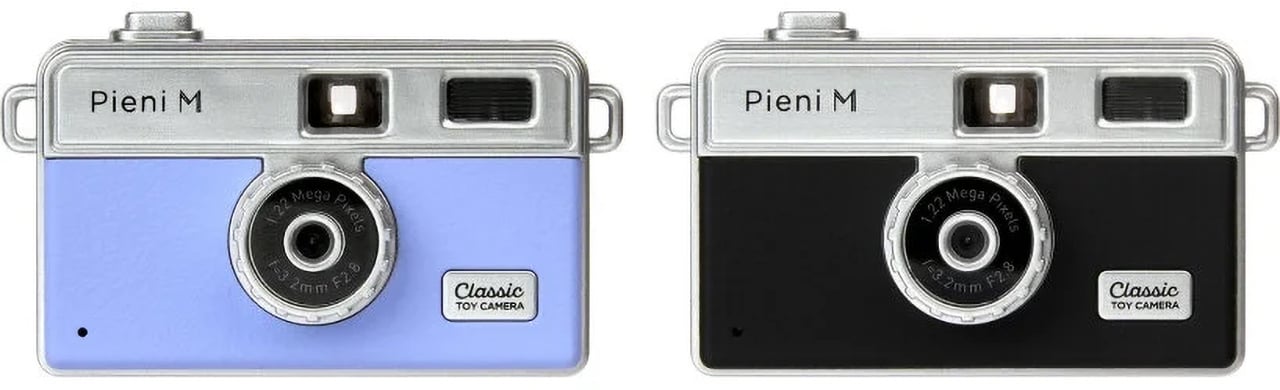
It doesn’t shoot raw stills, just jpg. It shoots MJPEG AVI video and records MP3 audio. It’s pretty basic. It looks like it has a fixed shutter speed of 1/100. So, all of the exposure control is done automatically in-camera, presumably using just ISO.
Given its toy camera moniker, it could be a great first camera for a child. Even if it’s not very advanced and it’s small enough to lose quite easily, it does have strap lugs and only costs around $50. So, as long as they’re not losing one every week, it’s not a massive expense.
Kenko Tokina Pieni M is currently available to buy for $39.85 on Amazon. But it’s imported from Japan, so don’t expect quick delivery.

To give it its full title, this is the “Monoreflexes Shaped Mini Camera CMOS Indoor Home Outdoor 1080p Portable Vintage Very Very Small Mini Camera Video Recorder”. This is just the way with titles on sites like AliExpress.
It’s probably the smallest of the three cameras here, and the description does say it shoots both photos and video. It doesn’t mention the sensor size, resolution, or angle of view of the lens, but it does state that it does 1080p video – although not at what frame rate, let’s assume 30fps.

It claims to offer up to an hour of battery life. The built-in battery is 180mAh. They don’t say how long it takes to charge back up, but I would expect at least an hour. It has a tiny 0.96″ display on the back to let you see what you’re shooting or what you’ve shot
At only 47mm wide and 31mm tall, it is extremely small. It’s less than 2 inches wide by a little more than an inch tall. For comparison, the Insta360 GO 3’s front face dimensions are 54.4×25.6mm. So, it’s pretty close. Of course, the specs differ wildly, and this is reflected in the price.
The standard price for this listing on AliExpress is around $24, but it’s currently reduced to $16.33. This can be reduced even further with coins from the AliExpress app games as well as other coupons. So, it’s very inexpensive. It’s likely also sold under many names by multiple sellers at different prices on AliExpress, so shop around.
Tiny cameras can be a lot of fun as well as very practical. I often use the Insta360 GO 3 – and sometimes still the Insta360 GO 2 (buy here) – when I need a camera in a small space. For me, that’s more on the practical side of things.
When it comes to fun, the Weeview SID is still my favourite tiny camera, and not just because it’s 3D. The image quality still isn’t great, and the 3D effect isn’t always perfect, but it’s still fun. When you can’t see the images until you offload them, it makes you take a lot more care in your shot. And sometimes, it results in a pleasant surprise.
What’s your favourite tiny camera?






