Photographer to give special presentation at Bell County Museum


SUBMITTED PHOTO
“>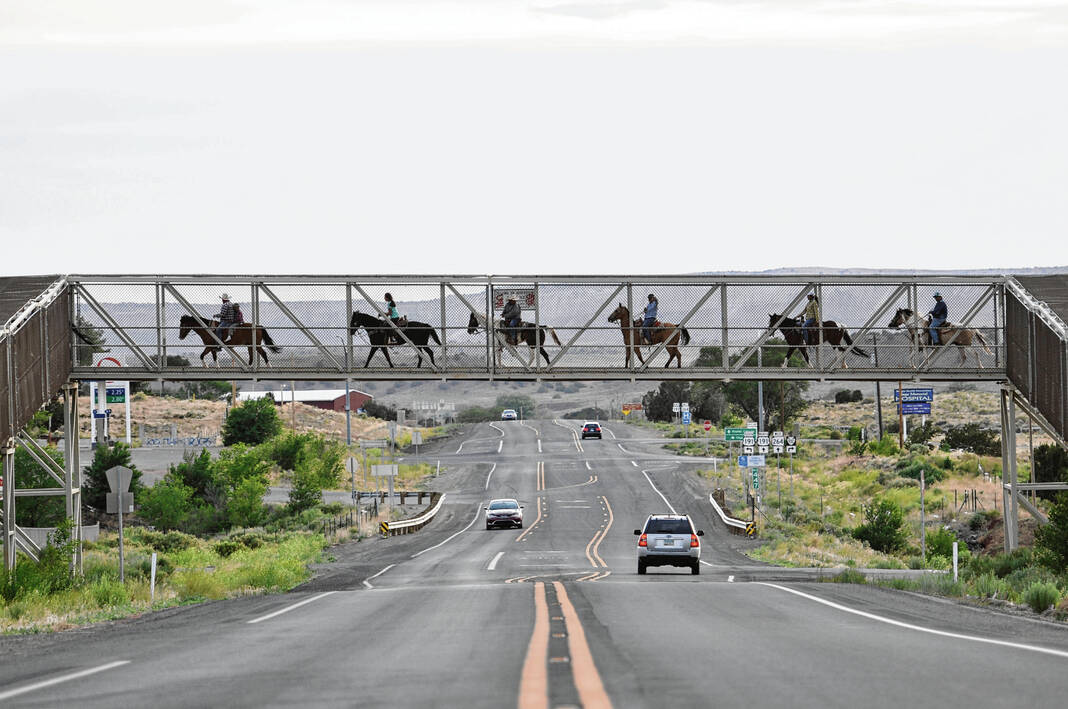
“Diné Family on Horseback” by Donovan Quintero is part of “Developing Stories: Native Photographers in the Field,” which opens at the Eiteljorg Museum in Indianapolis on Saturday. The exhibition features photo essays by three Native American photojournalists showing different perspectives of Native life.
SUBMITTED PHOTO
Unique perspectives of the Native American experience radiates from each image.
A line of horseback riders cross over a bustling Arizona highway using a raised pedestrian bridge. A tiny baby is tucked snugly into a traditional cradleboard.
Code talkers, who used Native language to pass secretive information during wartime, pose for a photograph during World War I. A U.S. Marine Corps veteran and member of the Oglala Lakota tribe address a government panel.
A pair of new exhibitions at the Eiteljorg Museum invites visitors to consider different aspects of Native American life. “Why We Serve: Native Americans in the United States Armed Forces” tells the stories of service the Native American population has contributed to the country’s history for more than 200 years.
“Developing Stories: Native Photographers in the Field” is a set of three photo essays by Native artists focused on issues such as the COVID-19 pandemic, blood quantum requirements and a more than 250-year-old community in New Mexico.
“The purpose is what we do is telling amazing stories and trying to connect with different humanities, and let them see how the stories we’re telling can relate to their lives, backgrounds, livelihoods,” said Bert Beiswanger, director of marketing and communication for the Eiteljorg.
The two exhibitions, which both open Saturday, feature vastly different images from a wide array of perspectives. But taken together, they offer insight into Native American life many people have never had.
“We hope people take away not only a sense of relatability, but to see the Eiteljorg as a place where they can see a part of themselves but also a place where they can learn about current Native art and events and people,” said Dorene Red Cloud (Oglala Lakota), curator of Native American art, history and culture at the Eiteljorg. “To realize Native peoples are still here. They have family in the military. They have complex issues like we all have.”
“Why We Serve” and “Developing Stories” are both traveling exhibitions developed by the Smithsonian Institution National Museum of the American Indian. Through a grant from Lilly Endowment, the Eiteljorg learned of and was able to pursue the opportunity to host two exhibits that were originally developed by the museum.
“Both exhibitions squarely fit with the Eiteljorg’s mission of celebrating Native American arts, histories and cultures, and will be of interest to the Eiteljorg’s visitors,” said Jamie Simek, development director for the Eiteljorg, in an email.
“Why We Serve” examines the service of Native Americans and Native Alaskans in the military, even before the United States was a country. According to the Smithsonian website, the exhibition addresses their service, which some think doesn’t make sense, considering how Indigenous people have been treated throughout history.
“Why would Indians serve a country that overran their homelands, suppressed their cultures and confined them to reservations? Native people have served for the same reasons as anyone else: to demonstrate patriotism or pursue employment, education and adventure,” the Smithsonian website said.
Subjects in the exhibition are varied. Visitors can see a portrait of William Pollock, a Pawnee tribe member who was one of Theodore Roosevelt’s most respected Rough Riders during the Spanish-American War, as well as the Native American Women Warriors group visiting the Vietnam Veterans Memorial in Washington D.C.
“People are going to want to know about why there are so many Native Americans and Native Alaskans who serve in the armed forces, and have been doing so since the country started,” said Dorene Red Cloud (Oglala Lakota), curator of Native American art, history and culture. “I think it’s a very interesting history, a shared history. Everybody has a veteran in the family or a friend, so I think it’s going to be really relatable.”
To go with the Smithsonian’s images, Eiteljorg organizers have added thematic artworks from its own collection to go with the exhibition.
“Developing Stories” takes a different approach to showcase Native life. The exhibition features three photo essays by Native photojournalists.
Tailyr Irvine, a member of Confederated Salish and Kootenia Tribes, presented a photo essay called “Reservation Mathematics: Navigating Love in Native America.” Her work explores the challenges of blood quantum requirements — a system originally created by the United States government to determined the amount of “Indian blood” a person possessed.
Now, the idea is used by Native American tribes to determine membership.
“For instance, with my tribe the Oglala Sioux, you have to be a quarter or more to be a citizen and member. But it really depends on each tribe or nation or village or pueblo,” Red Cloud said. “Nowadays, different tribal members have married different tribal members, so each family has to decide, ‘Should I enroll in your tribe or my tribe?’”
“The Genizaro Pueblo of Abiquiú” by Russel Albert Daniels (Diné descent and Ho-Chunk descent) tells the story of an Indigenous/Hispanic community in New Mexico that has persisted for more than 250 years.
Donovan Quintero, a member of the Diné tribe, focused his essay on the impact of the pandemic in “The COVID-19 Outbreak in the Navajo Nation.” His images show the resilience of the Navajo people as their reservation became a hotspot for the virus.
“Both historically speaking in times past, up until the present day, it’s a very interesting look at different aspects of life,” said Bryan Corbin, public relations manager at the Eiteljorg.
To go with the two exhibitions, the Eiteljorg has planned a series of activities and special programs, also made possible through the Lilly Endowment grant. During the “Why We Serve” opening on Saturday, a presentation on the Navajo code talkers will feature Peter MacDonald Sr., one of the last surviving code talkers from World War II, and Laura Tohe, a Navajo Nation poet laureate and author of “Code Talker Stories.”
“The code talkers are pretty well-known, but a lot of people don’t realize that Code Talkers were used in World War I, and it wasn’t just Navajo language that was used,” said Alisa Nordholt-Dean, director of education and public programs for the Eiteljorg. “Many Native languages played a role in both World War I and World War II, so (Red Cloud) is going to talk about that as well.”
On April 27, a panel of Native American veterans and artists will speak about the influence their service had on their life and work. Throughout the run of “Why We Serve,” visitors can upload a two-minute video focused on personal stories of military service.
“A lot of people have connections to service, either through themselves or through their families. We thought it would be important to give people an opportunity to talk about that service, and let us know why they served or serve,” Nordholt-Dean said.
A panel discussion featuring Quintero, Daniels and Irvine is planned for March 30, as each artist will talk about their works in “Developing Stories.” Area Girl Scouts have the chance to take part in a junior photography workshop led by Roberts Camera on April 14.
“We’re really encouraging that younger generation to use the camera that we all have (on our phones) to document social issues in their lives,” Nordholt-Dean said.
Access to both exhibitions is included with regular museum admission. Veterans and current service members of the U.S. Armed Forces will receive free admission to the museum from Saturday through Aug. 1, in conjunction with “Why We Serve.”
“It’s an opportunity to connect with different audiences and form partnerships, and bring people into the museum through these exhibitions and expose them to the museum’s mission,” Nordholt-Dean said.
IF YOU GO
Eiteljorg Exhibitions
Opening: Saturday
“Why We Serve: Native Americans in the United States Armed Forces” — an exhibition honoring the generations of Native Americans and Alaska Natives who have served in the U.S. military since the American Revolutionary War. The exhibition runs through Aug. 1.
“Developing Stories: Native Photographers in the Field” — the exhibition is composed of three very different photography essays created by Native photojournalists, exploring issues in contemporary Native lives. The show runs through July 7.
Public programs
The Eiteljorg will host public programs related to both shows, some of which have additional fees:
Navajo Code Talker presentation, 11 a.m. Saturday: Peter MacDonald, Sr., a World War II veteran and one of the last surviving Navajo Code Talkers, will discuss his wartime service; the talk is moderated by former Navajo Nation poet laureate and author Laura Tohe. At 1 p.m., Tohe will discuss her book, “Code Talker Stories,” and hold a book signing. The fee for both programs is $30 for non-members, $10 for museum members. Register at: https://eiteljorg.org/eiteljorg-events/navajo-code-talker-presentation/. Veterans and military can attend both programs at no charge.
Photographer Panel, 1 p.m. March 30: Photographers Russel Albert Daniels, Tailyr Irvine and Donovan Quintero will discuss their photographs in “Developing Stories.” It’s included with regular admission; and there’s no charge for
Junior and Ambassador Digital Photography Workshop, 2 p.m. April 14: Girl Scouts can participate in a workshop with Roberts Camera. The fee is $10 per scout and $1 per chaperone. Register at: http://tinyurl.com/ywa9vhz8.
Native American Veterans Panel, 1 p.m. April 27: Hear from Native American veterans about the influence of their military service on their life and work. It’s included with regular admission, with no charge for members, veterans or military.
Information: Eiteljorg.org


Photographer Laurence Ellis on the Transience of Tide Pools | Atmos
03.20.2024
Laurence Ellis explores the teeming biodiversity of tide pools, where the riches of high tide come with crashing waves and the peace of low tide invites heat and predators. In these ephemeral spaces, life finds shelter in shifting conditions.
For a long time I’ve felt drawn to explore ‘in-between’ spaces, a concept which seems to have been shared by ancient cultures since time immemorial. In Celtic mythology, these liminal spaces manifest as an awareness of the unnameable places, not to be found on any map. They can be sites of transition, neither one thing nor the other. A few examples include doorways, shorelines, the forest’s edge, or for this series, tide pools.
Tide pools hold our entire universe and collective consciousness within them. Their transient and chameleon-like nature would not exist if not for the gravity pulling on their delicate waters, a gravity I followed daily while photographing this series in order to chart my visits at high tide. Through capturing life and existence here, this idea of a ‘thin place’ could materialize in a way where the extraordinary was possible, and where the bonds of reality and the everyday could be shed.
A couple of themes emerged while shooting: illusions of land ownership (who can claim space where land stops and sea begins?), as well as the concept of moons and planetary connections to our moving seas. Tides seem to be informed by the simple relationship between ourselves and our moon, a symbiotic embrace defined by orbits immeasurable and our gentle journey within a limitless universe.
We tend to compartmentalize the world into land, sea, and sky; yet, tide pools cannot be constrained to this binary standard of thinking. These photographs speak to the unique life which exists in both land and sea, a balance to be found in one of Earth’s most liminal spaces.

[embedded content]

[embedded content]
[embedded content]


60 Seconds on Earth,Anthropocene,Art & Culture,Climate Migration,Black Liberation,Changemakers,Democracy,Environmental Justice,Photography,Earth Sounds,Deep Ecology,Indigeneity,Queer Ecology,Ethical Fashion,Ocean Life,Climate Solutions,The Frontline,The Overview,Biodiversity,Common Origins,Fabricating Change,Future of Food,Identity & Community,Movement Building,Science & Nature,Well Being,


The Pixel 8 Pro has tons of AI features in its camera – we found out why (Image: Google)
Michael Specht, Pixel camera product manager at Google working on its smartphone camera team, totally understands if you find the rise of artificial intelligence unsettling.
“I can clearly understand someone like my parents saying, you know, I don’t understand this. This is a little bit kind of scary to me,” Specht said.
Whether you have an iPhone or Android phone in your pocket, there is a lot of technology stuffed into the smartphones we carry around. They have meant that we no longer lug around several different devices – now we have a phone, calculator, notebook, and camera all in one.
Phone cameras have practically destroyed the compact camera market. Because every smartphone camera is already so good, phone makers are now using software and artificial intelligence (AI) to boost pictures and improve them beyond what the viewfinder sees – sometimes by erasing people or objects completely.
“Mobile imaging has evolved to the point that it’s becoming difficult to differentiate an image captured on a mobile camera or one from a dedicated camera that costs ten thousand dollars”
One company leading the way on AI in smartphone cameras is Google with its Pixel phones. Express.co.uk spoke to Google’s Specht to find out exactly what it takes for the company to upgrade the Pixel camera every year on its latest flagship phones – and why bringing as many features as possible to its cheaper Pixel A-series devices is so important to the company.
“Mobile imaging has evolved to the point that it’s becoming difficult to differentiate an image captured on a mobile camera or one from a dedicated camera that costs ten thousand dollars,” Specht told us in an exclusive chat.

Specht is a keen photographer who previously worked at Apple (Image: Google)
“For our philosophy, we want to try to mimic authenticity with how our eyes see it, but give you the creative controls … to then go and make changes, even before you capture the image, or after you capture the image, to go down your own path of artistic vision.”
Specht, who worked at Apple on the iPhone camera team for more than a decade, now helps head up the Google Pixel camera team in the US, recently working on the cameras in the Pixel 8 and Pixel 8 Pro, Google’s latest flagship Android devices.
Because phones are so small, we have reached the size limit for cameras in phones, which is forcing companies like Google to get creative with software to improve phone photos.
“From our perspective, spec sheets aren’t everything, right? Like, you can have 50 megapixels, you can have different size sensors, but that’s just one small piece to the puzzle,” Specht said.
“If you look at the evolution of mobile photography, the advancements in software and the imaging pipeline have become a result of the form factor and not being able to put a full 35mm sensor in a mobile camera.”

The Pixel 8 has plenty of advanced AI photo tools (Image: Google)
Google integrates AI into its Pixel camera, and has for many years. Ever since the Pixel 3 introduced Night Sight, Google’s night mode, the phones have been using AI to enhance photos. But now that AI is a big buzzword in tech thanks to the popularity of tools such as ChatGPT that can generate text and images, Google’s use of AI is hotting up.
“Our core principle for Pixel camera and capturing images is really rooting it in authenticity. So whether AI or gen-AI is used, our goal is to really enhance the pixels that exist there today, not to create something entirely new,” Specht said.
Newer Pixel features such as Magic Eraser let you erase people and objects from photos, while Magic Editor allows you to change the sky’s colour or enlarge objects. Specht told us the rise of what is known as generative AI (gen-AI) means Google can run complex computations in the cloud or on the device, turning the Pixel into a mini-Photoshop in your pocket.
“From our perspective, spec sheets aren’t everything, right? Like, you can have 50 megapixels, you can have different size sensors, but that’s just one small piece to the puzzle”
“Photoshop has been around for a very long time,” Specht said. “With something like Magic Editor, we’re just replacing the Photoshop process with something way more accessible all in one place. With the same device you capture, you get to edit and make it accessible to a customer that doesn’t necessarily need to go through 10 hours of YouTube videos [to learn how].”
He said phone cameras are getting close to being able to capture what the human eye can see but that it remains a challenge as Google wants to let people get artistic with blur and other photographic effects that have existed for decades.
“From our philosophy, we want to try to mimic authenticity with how our eyes see it, but give you the creative controls … to then go and and make changes, even before you capture the image, or after you capture the image to go down your own path of artistic vision as well”
But these new AI tools aren’t just limited to the pricey £999 Pixel 8 Pro. Some features are coming to older Pixel phones in software updates known as Pixel Feature Drops.
“Purchasing a phone is not something that everyone does every year, and I think making sure that you take care of all your customers, regardless of how often they upgrade, is super important”
“Purchasing a phone is not something that everyone does every year, and I think making sure that you take care of all your customers, regardless of how often they upgrade, is super important,” Specht said.
“I think that’s quite unique to Google. We really take pride in when you purchase a device from us, we want to take care of you, and as we make advances, we want to bring those advances back to you as much as we can. So part of our philosophy is really as we develop these features, which ones can we bring back [to older phones]? What’s feasible for us to actually do?
“You won’t see many mobile camera companies doing this for their customers.”
But Specht was tight-lipped on what Google might have up its sleeve to blow our minds with AI on the camera of the expected Pixel 9 phones coming later in 2024, or the rumoured Pixel 8a that could be launched at Google I/O in May.
“We have big research teams that are always looking multi-years out and looking at the latest and greatest cutting edge of technology. Sometimes those feature developments take a year, sometimes they take five years.
“One thing that I think the average person will probably find surprising is how deeply we think really far out in advance to develop these cameras. It takes a lot of effort.”

Kate Middleton’s photography is coming under fire once again.
Today, the international wire service Getty Images flagged that a 2023 photograph taken by the Princess of Wales has been “digitally enhanced at source.”
The image was taken of Queen Elizabeth and 10 of her great-grandchildren to mark the monarch’s 97th birthday, and shows several slight distortions, including the blurring of Prince Louis’s neck and some of the other children’s hair. “Getty Images is undertaking a review of handout images and in accordance with its editorial policy is placing an editor’s note on images where the source has suggested they could be digitally enhanced,” a Getty spokesperson told CBS News.

Photo: Courtesy of Kensington Palace
None of the edits are particularly misleading or malicious. However, they do show that the Princess has been manipulating her family photos in a way that violates the policies of most major news outlets on more than one occasion.
It comes at a difficult time for Middleton who, in January, announced she was taking a break from royal duties while recovering from abdominal surgery. Come February, wild conspiracy theories ran rampant on social media speculating about the Princess’s health and the real reason for her absence. To try to quiet the noise, Middleton released a cheerful photo of herself and her three children for the U.K.’s Mother’s Day on March 11. Yet on March 12, AP issued a kill order for the image, which featured several visible editing mistakes. “At closer inspection, it appears that the source has manipulated the image,” the AP said in its advisory. “No replacement photo will be sent.” Suddenly, the wild rumors that existed in a social media silo went mainstream. Many suggested that the Princess was actually missing.
Middleton then issued a personal apology: “Like many amateur photographers, I do occasionally experiment with editing,” she wrote on X and Instagram stories. “I wanted to express my apologies for any confusion the family photograph we shared yesterday caused. I hope everyone celebrating had a very happy Mother’s Day.”

HAGERSTOWN, MD – An old proverb once said, “The goal of the teacher is for the student to surpass the teacher.”
For this year’s Washington County Museum of Fine Arts’ Cumberland Valley Photographers Exhibition, the student did indeed surpass the teacher. Barbara Ingram School for the Arts (BISFA) sophomore Taylor Brown, 16, of Hagerstown, won first place in the juried competition, while her teacher Kristen Green came in second place.
For this year’s competition, 40 photographs by 27 artists were accepted for the exhibition, which runs March 23—June 2, 2024, at the museum.
An opening reception Saturday, March 23, 1 to 3 p.m. includes a panel talk with the winners of the photographers exhibition and jurors Anne Gridley and Gary Graves of Gridley + Graves Photographers. The reception is free, but register in advance for the panel talk by contacting Donna Rastelli at 301-739-5727 or [email protected].
“We’re proud of the museum’s commitment to artists within our region, and our Cumberland Valley exhibitions have a 90-year history,” said Sarah Hall, the museum’s executive director “In fact, we began showing photography as art in the early 1930s, when that was quite progressive—curators and collectors were still arguing about whether photography was an art form, but here at the Washington County Museum of Fine Arts it has had a place on our exhibition schedule from the very earliest days.”
Jurors Anne Gridley and Gary Graves of Gridley + Graves Photographers also reflected on the history of photography as art in their jurors’ statement, referencing a pivotal 1978 exhibition at The Museum of Modern Art curated by the influential John Szarkowski called “Mirrors and Windows.”
They note that today the concept of photographs functioning as either ‘mirror’ or ‘window’ remains true. Photographers can use the medium to either look inward or outward, a fascinating duality that allows photography to be both intensely subjective and objective. They noted,
“Whether constructed in the studio or snapped without premeditation, photographs embody ideas: great ones draw us to them mysteriously as if absorbing our gaze,” read their jurors’ statement. “The photographs chosen for the exhibition are a small survey of contemporary and classic photography aesthetics with personal and universal appeal.”
Taylor will receive $1,000 for her first-place win “Girl in Grass.” Green won $500 for her second-place win for “Looking Back.”
Last year Brown participated in a school project focusing on the work of Dorothea Lange, a groundbreaking photojournalist known for her iconic images, particularly taken during the Great Depression.
“I decided to mimic that with the portraits that I took,” she said, which is why the image is in black and white.
“Girl in the Grass” was a spontaneous photo shoot with a classmate. Taylor said they were in a car and she pulled off to the side of the road, took out her Sony A 6500 camera, and had her subject lay in some tall grass. She took a quick picture before getting back in the car.
“I didn’t think anything of it until my teacher was, ‘Hey, this could be something special’”
At first, Taylor didn’t see how special the photograph was but has come to view it with less critical eyes.
“I think it’s a good portrait,” she said. “That motion in her eyes looks authentic, and all the textures and the grass and the freckles on her face really stand out in the black and white.”
Green said the reason she encouraged Taylor to submit her image was because of a variety of elements.
“We talk about what makes a great portrait often in class and this photograph seemed to fit those criteria in many ways, composition, framing, subject,” she said. “It’s a striking image that sticks with you and when you have that, you know you have something special.”
Green, 34, of Hagerstown. said she’s excited for the one-two win for them both.
“I have been in the show before,” Green said, “but never alongside a student so this makes it even more special.”
Her winning entry, “Looking Back,” is an image of one of her daughters during a family trip to Lancaster, Pennsylvania. She shot it with her camera of choice, a Leica CL.
“It was a rainy and cold day, so we decided to take a train ride,” Green said. “My daughters had never been on a train before. My oldest, Shea, was fascinated and curious about the train. She was looking out the window across from me, trying to see through the fog outside when I took the picture.”
Green said when she heard Taylor took top prize, she said she was extremely proud and excited for her.
“She is a hard worker, reflective, and has a lot of talent,” Green said of her student. “She’s only a sophomore, and I know her future is bright. I love to see her be recognized for her accomplishments.”
Green said she’s humbled that both are a part of such a great exhibition. “Our museum is such a gem, it’s always an honor and experience to have your work hanging inside.”
Green sees Taylor’s win as a way to encourage future photographers.
“I would like to encourage young photographers to keep making images and put their work out there, submit when there is an opportunity to,” she said. “Lastly, I would encourage those same young artists to plan a visit to the exhibition and to become an active participants and advocates for the arts.”
The Cumberland Valley Photographers exhibition is organized by the Washington County Museum of Fine Arts. This exhibition is graciously supported by Hugh and Marty Talton, Delaplaine Foundation, and Washington County Arts Council.
THE WINNERS
CUMBERLAND VALLEY PHOTOGRAPHERS WINNERS






