Rolling Stone cover ‘a dream’ for Manx photographer


Jordi Koalitic is known for his stunning photographs, which captivate viewers with their uniqueness. What sets him apart is the photographer’s willingness to share the secrets behind his creations, allowing others to learn and be inspired by his techniques. Jordi’s backstage videos collect millions of views, but particularly the recent one called Magic Door broke all the records.
The latest campaign featuring the Xiaomi Ultra 13 has been viewed by more than 570 million people, making it one of the most popular videos in recent times! With a follower base exceeding 35 million across multiple platforms, Koalitic’s influence is phenomenal. So, if you are not yet familiar with his artwork, we are happy to keep you up to date.
More info: Instagram | tiktok.com | youtube.com | Facebook
Image credits: jordi.koalitic
Image credits: jordi.koalitic
In a previous interview, Jordi shared that his interest in photography began along with his love for cinema when he was 18. “After two intensive summers of work, I bought my first camera, a Canon 6D, and began experimenting with photography and video. It wasn’t until three years ago, with the launch of my Instagram account, that I started taking photography seriously. My initial interest was to dominate the technique (light, composition, colors…) Over time, the need to consider the concept behind the image and to tell a story became more important,” shared Jordi.
Image credits: jordi.koalitic
Image credits: jordi.koalitic
Image credits: jordi.koalitic
Image credits: jordi.koalitic
Image credits: jordi.koalitic
Image credits: jordi.koalitic
Fast forward to today, after a successful career, Jordi has reached new heights by creating a viral reel. We asked the photographer to explain how he came up with the idea for the Magic Door picture.
“The inspiration came from a previous photo shoot with Xiaomi, which left us wanting more. We decided to delve deeper into this idea, this time exploring the video format to enhance the visual impact. The concept of ‘framing,’ using elements like windows or doors to create a visual composition, was key. We worked to transform this vision into an experience that captured the essence of an emotional moment during a sunset while maintaining focus on depth and visual narrative,” shared Jordi.
Image credits: jordi.koalitic
Image credits: jordi.koalitic
Image credits: jordi.koalitic
Jordi’s work consistently achieves incredible engagement and viral attention. We asked how he approaches the creative process to ensure his content stands out in today’s saturated digital world.
“Our approach to the creative process starts with the everyday, seeking beauty in the ordinary. From the beginning, we began using daily objects (from water bottles to book pages) looking for new perspectives that would bring a touch of visual magic. Simplicity, accessibility, and creativity are our pillars, allowing us to create content that is not only visually impactful but also easy to understand and replicate. This approach ensures our work resonates on social media, thanks to our followers who help us organically viralize this content,” responded Jordi.
Image credits: jordi.koalitic
Image credits: jordi.koalitic
With over 35 million followers across various platforms, Jordi’s influence is undeniable. We were curious how he maintains authenticity and connects with his audience amid such immense popularity.
Jordi replied: “We try to maintain authenticity by staying true to ourselves and ignoring the pressure that can come with popularity. We consider it key not to fear failure, as failure itself allows us to experiment and innovate. This approach helps us authentically connect with our followers, seeing errors as opportunities for growth and maintaining our essence in everything we do.
Additionally, connecting this question with the previous one, our connection with followers is also based on creating accessible and inspiring content. Our strategy involves offering ideas that can be reinterpreted, always maintaining an open line with our community.”
Image credits: jordi.koalitic
Image credits: jordi.koalitic
Image credits: jordi.koalitic
Jordi’s work often blurs the lines between art and advertising. He explained how he balances commercial objectives with the artistic vision to create content that resonates with both brands and viewers.
“A large part of our content on networks are commercial campaigns, yet we strive to integrate the products we work with so naturally into our creative work that the commercial element goes unnoticed. By leveraging the resources provided by brands, we transform each project into a new opportunity for creativity, ensuring that our audience’s focus is always on creativity and artistic innovation.”
Image credits: jordi.koalitic
Image credits: jordi.koalitic
Image credits: jordi.koalitic
Looking towards the future, Jordi shared what excites him the most regarding digital marketing and the evolving role of creators like him in shaping consumer culture.
“The future excites us because of the growing potential of social networks as a platform for limitless creativity. The possibility that creators from any part of the world and social status can share their vision with millions of people seems revolutionary to us.
We look forward to seeing how this trend evolves, offering even more opportunities for innovation and collaboration. The role of creators like us in shaping consumer culture becomes increasingly important, challenging established conventions and opening new pathways for creative expression.”
And lastly, Jordi added: “To all our readers, we encourage you to overcome your fears and unleash your creativity. Don’t be afraid to explore new ideas and challenge the conventional; every attempt and error brings you closer to innovation. Your unique vision has the power to inspire change and open new avenues of expression. Dream, experiment, and share what you create with the world.”

Archaeologists have found new cave paintings in Central Europe that suggest photography may be many thousands of years older than previously realised.
It is well known that the whole concept of the camera obscura is ancient. There is evidence from China and elsewhere that suggests that simple pinhole mechanisms were in use in the 4th century BCE. Indeed, the word ‘camera’ is derived from the Latin for chamber; a reference to the darkened chamber that the camera obscura effect requires to work.
Now, however, archaeologists investigating recently discovered cave paintings in the Prvotravanjska Budala cave system in Croatia have unearthed evidence that actual cameras as we would know them were used in pre-history, circa 15,000 BCE.
Given that photography is previously thought to have been developed in the Victoria era, this is a massive shift in our perceptions of the technology.
The paintings, one of which is shown above (and is the first to be released publicly by the research team), show human figures chasing what look to be deer with a large box like structure that has smaller structures on the front and the back. These, the team led by Dr Goran Živojinović, reckon, are a primitive lens and eyepiece.
“Glass would have been beyond the technology of the time, but these scenes seem to be taking place in winter and it is not impossible that carefully shaped ice was used as a lens at the front of a hide-covered box made of wood and reeds to focus the image in a portable camera obscura,” says Dr Živojinović. “The user would have also wanted to line up the objects in question, and so a small structure poking out the back works as a viewfinder.”
The question is why? What would a portable camera obscura show? Some anthropologists point to a desire to capture ‘the essence’ of an animal, but Dr Živojinović’s team reckon they might have been making actual photographs, or something similar, a mind-boggling 17,000 years ago.
“We have been conducting experiments involving urinating on animal skins, and we have found that if we eat the right food to change the chemical composition of our urine, then at the right temperatures and with a concentrated enough light source we can ‘fix’ the outline of an image on a suitably treated skin. Of course, that involves a long exposure though, so our current theory is that the cave painting represents an idealised scenario and in fact the primitive photographers would have had to rest the apparatus on a rock and point it at a dead deer.”
The team’s findings not only suggest that photography is many thousands of years older than first thought, but also point the way to new, more organic forms of photography that may hold an advantage when it comes to assessing sustainability impacts in future productions.
“We would, of course, use glass instead of ice for the lens, but the main problem at the moment is the urine,” says Dr Živojinović. “Frankly, it smells, and while we have interest from several major camera manufacturers already – and have trademarked the name CaveCam One – until we get hold of a more pleasant smelling liquid, mass production will be difficult.”

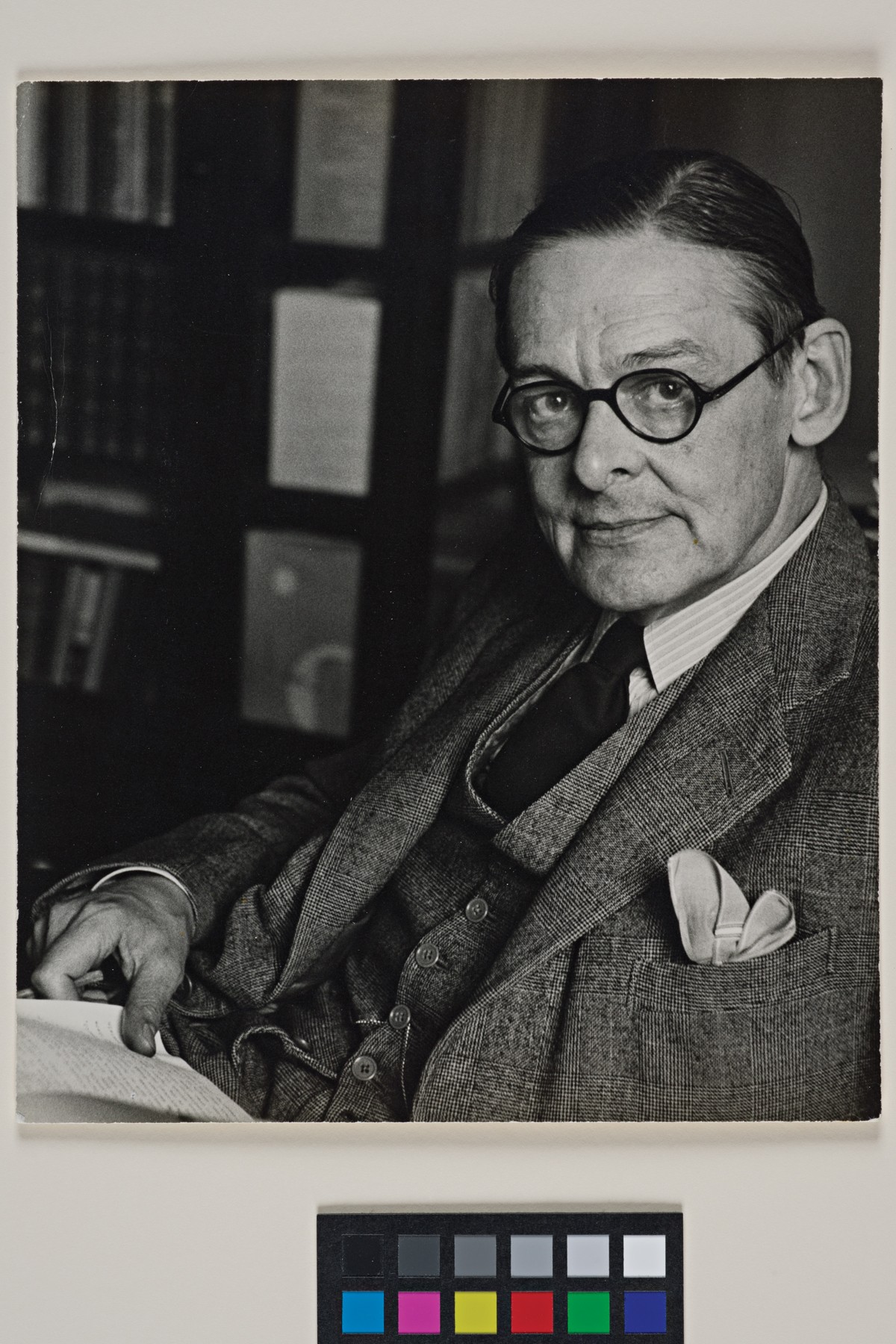
T. S. Eliot, London, 1950, Rollie McKenna, gelatin silver print Frances Lehman Loeb Art Center, Vassar College, gift of the artist, © the Rosalie Thorne McKenna Foundation, courtesy Center for Creative Photography, the University of Arizona Foundation.
April is the cruelest month / breeding lilacs out of the dead land / mixing Memory and Desire / stirring Dull roots with spring rain.” So begins T. S. Eliot’s all-time poetic banger, “The Waste Land,” which was published in 1922. April’s never been the same.
Vassar alum Rosalie (Rollie) Thorne McKenna (1918-2003) made iconic portraits of artists and writers, including W. H. Auden, Dylan Thomas, Elizabeth Bishop, Alexander Calder, and Sylvia Plath. The exhibition “Making a Life in Photography: Rollie McKenna,” on view through June 2 at the Lehman Loeb Art Center on the Vassar Campus, features over 100 gelatin silver prints made during the artist’s lifetime. Exhibition cocurator Jessica D. Brier provides some context for the Eliot photograph:
“Rollie McKenna described her approach to photographing people as a ‘rebellion against studio photography.’ Rejecting the tradition of making portraits in a blank studio, or adopting her own signature style, McKenna preferred to photograph subjects like T.S. Eliot in their own spaces in an effort to capture the spirit of a creative individual. In 1950, she photographed Eliot at his desk, thumbing through the pages of a book and surrounded by his personal library, looking up at the camera as though by chance. This was one among many assignments photographing writers in the 1950s, McKenna’s bread and butter during those years. During a portrait session, she engaged her subjects in conversation, disarming them with her sense of humor and asking questions to get them talking about their work and passions. This approach produced authentic moments, putting people at ease and making her portraits look effortless.”
On April 4 at 5pm, Brier and fellow curator Mary-Kay Lombino will lead an exhibition tour at the Lehman Loeb Art Center. Vassar.edu/theloeb.


China’s art collectors have done their research when it comes to making purchases, and as China became the world’s second-largest art market in 2023, banks are experiencing higher demand for art advisory services, according to family office advisers.
“Art is becoming a key focus in many families, and its ability to solve liquidity needs for tactical investments,” said Bernie Wai, the Asia-Pacific head of the global family office group at Citigroup.
As the market grows, USB is also experiencing higher demand for art advisory services, including impartial expertise on the market, collection governance and legacy planning, said Eric Landolt, the global co-head of family advisory, art and collecting at UBS wealth management.
While art is widely considered a passion investment, it was the best-performing luxury asset class in 2023, with prices rising 11 per cent, according to Knight Frank’s latest luxury investment index. Art was the only one of 10 index constituents to hit double-digit growth last year.

“We support some of China’s wealthiest families and individuals in exploring their personal collecting aspirations and building their own cultural legacy for future generations,” Landolt said.
During his visit to Hong Kong for Art Basel and various events held in the city last week, Landolt observed that Chinese collectors are well-informed art buyers.
“Chinese collectors do their research and ask well-informed questions,” he said. “Collectors are engaging in significant amounts of research before acquiring works.”
In China, while some first-generation families may be very passionate art collectors, they need advice on how to pass their collection to the next generation, which could mean liquidating some of the collection for other investments, said Citigroup’s Wai.
Through art financing, clients can use their artwork as collateral to unlock liquidity for other investments, ideally while continuing to enjoy the benefits of owning the art and the potential long-term appreciation in value.
Dubai prince vows to launch family office in Hong Kong by end of May
“Japan is one example where a family office may want to follow the current momentum in the equity market,” Wai said.
First-generation collectors tend to focus more on old masters and Chinese art such as porcelain, calligraphy, vases and ink painting, while their children and grandchildren grew up with Western contemporary art, according to Wai. It is not uncommon for them to gradually sell off the Chinese art to purchase contemporary pieces, he added.
Sales in the Chinese art market are on the rise amid a post-pandemic boom in spending, according to a joint report by UBS, Art Basel and Art Economics released in March. Sales in China increased by 9 per cent to an estimated US$12.2 billion in 2023, according to the report.
Amid a strong surge of activity in the first half of the year, China moved up to be the second-largest art market in 2023, with its share rising to 19 per cent, surpassing the UK, which fell to third place with a 17 per cent share, the report said.
Meanwhile, the United States’ share dropped 3 per cent year on year, but the nation remained the top global art market, accounting for 42 per cent. High interest rates, inflation and political instability contributed to slowing growth at the top end of the market, the report said.

Enthusiastic buyers capitalised on sales of postponed auction inventories from 2022 in mainland China, while Hong Kong’s major fairs and exhibitions returned to their full-scale programmes in the first half of the year.
Online channels have contributed to the market’s growth by bringing new buyers to both dealers and auctions. The number and value of online-only auctions is rising, with both top-tier and smaller auction houses identifying online channels as the main source of new buyers.
In fact, most online sales that dealers made in 2023 were to new buyers, with digital channels as an important source of new buyers, even though they still rank behind art fairs and gallery visits, according to UBS.
“Significant numbers of new, young and ambitious collectors are entering the market, particularly in China, with events like Art Basel Hong Kong forming a pipeline of business for dealers and gallerists,” Landolt said.
.


Kua bay hawaii hi-res stock photography and images – Alamy

Kua bay hawaii hi-res stock photography and images – Alamy

Kua bay hawaii hi-res stock photography and images – Alamy

Kua bay hawaii hi-res stock photography and images – Alamy
Kua bay hawaii hi-res stock photography and images – Alamy

Kua bay hawaii hi-res stock photography and images – Alamy

Kua bay hawaii hi-res stock photography and images – Alamy
Related products
Manini’owali Beach (Kua Bay) – All You Need to Know BEFORE You Go (2024)
20+ Kua Bay Stock Photos, Pictures & Royalty-Free Images – iStock
Manini’owali Beach (Kua Bay) on the Big Island of Hawaii
Manini Owali at Kua Bay, It’s not the image I was after, bu…


BILLINGS — As artificial intelligence continues to improve within art and photography, it’s getting harder to tell what’s been created by humans and what has not.
It’s a new and exciting kind of medium for Billings photographers like Daniel Kessel, but one that also has its downfalls.
“It’s really fun. There’s still a human element where humans created AI, AI was trained on human creations,” said Kessel at his studio Thursday.
Kessel runs Alienated Productions with his wife Kasandra, a one stop shop for creative media, whether its light painting or commercial production.

“At watershed moments in history, when something changes in the art world, you have to kind of re-adapt and rethink, okay, what is art?” Kessel said.
Though he enjoys using AI, he said it’ll never trump the human experience of taking a photo, which to him, is just as important as the picture itself.
“To me, art or photography is like a verb not a noun. It’s something you experience with your whole body and mind,” Kessel said.
The images spit out by generative AI mediums are now incredibly realistic but they’re made using data from other creators across the internet to compile the photo.

“One of the things then that is happening on the legal front with these AI companies is, did the AI company have right to the data that they used to train their models?” said MSUB City College computer programming instructor John Pannell.
Pannell said the technology is just going to get better, but that means the ethnics around it all might not be so black and white.
“It really can be an amazing tool. It always depends on who’s hand is the tool in, what kind of ethical use is being made of the tool,” Pannell said.

Kessel believes these companies can be infringing on personal data.
“These companies that sample what’s on the internet and this whole data set of artists as well, did it without our permission,” said Kessel.
There’s also a question of ethics when it comes to those who are passing off generative AI work as their own traditional photography.
“People need to be honest about, I created this with AI or I created this with just a camera. I think there needs to be more honesty and transparency in the art world,” Kessel added.

Both photographer and professor agree, when it comes to art, the human touch isn’t going anywhere.
“I think educators,and graphic designers, and photographers can come back and say, yea I see how this is doing that, but if you really want expertise, you’re still going to have to come to an expert,” said Pannell.
We are human so art to us is human rooted. It talks about our experience, and we share with generations to come what our experience was,” Kessel said.








