National Geographic photographer inspires teens to help safeguard the world’s oceans in Santa Barbara

National Geographic photographer inspires teens to help safeguard the world’s oceans in Santa Barbara
image

SANTA BARBARA, Calif. – Hundreds of high school students rushed to their seats to see National Geographic photographer Cristina Mittermeier at the Arlington Theatre in Santa Barbara.

Tristan Santillan, a senior at Dos Pueblos High School, couldn’t wait to see her.

“Cristina Mittermeier is here and we get to watch her … doing a speech about the work she’s done the past few years. Her work is amazing,” said Santillan.

Mittermeier’s mission to safeguard the world’s oceans through her photography has inspired Santillan.

“These animals are getting caught in nets and everything I feel it’s important now to speak up on it,” said Santillan.

“Cristina uses photography and ocean photography in particular to raise awareness of ecology … of the ocean … of nature,” said associate director Meghan Bush of the UCSB Arts & Lectures.

The UCSB Arts and Lectures hopes students will learn how photography can spread knowledge about the environment.

“I think it’s super inspiring I think it’s cool to see these different animals and everywhere she’s been around the world,” said Santillan.

“It Gives them appreciate for why the ocean is important … why ecology is important … and why the beautiful Santa Barbara that they live in … is so important to them,” said Bush.

In the words of Mittermeier, she wants, “people to recognize that the ocean isn’t just a victim of climate change – it is our solution.”

“I feel like Santa Barbara is amazing but some spots are a little dirty .. so I’m glad she said that as well so hopefully we can have a cleaner environment for our future,” said Santillan.

Mittermeier founded the International League of Conservation Photographers to drive conservation efforts through storytelling.

The photographer co-founded nonprofit SeaLegacy focused on the intersection of art, science and conservation to revive the ocean.

Timmins man spreading positivity through photography

Timmins man spreading positivity through photography

A local photographer is using his passion to show off Timmins in its most beautiful light.

Mitch Bolduc, who moved to Timmins in his 20s, has always loved the outdoors. Now retired, he is combining his passion for nature and his hobby in photography to spread positivity about the city. 

“It’s been a dream of mine for a long time and when I got my leg amputated about four years ago, I decided to buy myself a Canon camera and different lenses and started taking pictures,” Bolduc says.

“It ended up being too bulky for me to carry around so I got myself a good phone and started taking pictures on that. I started getting comments on Facebook and that encouraged me, so it’s become a part of my passion, promoting Timmins in a positive way,” he says.

“I’m just a single person. It’s basically me and my cell phone taking pictures and posting them. I’m very basic, it’s nonchalant, but I enjoy it. I get no money out of this. I love the positive comments I get and that’s my gratification. My pictures are always free. I’m not doing it to get rich.”

Bolduc’s photography mostly consists of the outdoors, as well as local landmarks and landscapes. He says his pictures have sometimes turned people’s attention to places they never knew about or have never visited before, including a series of photos he took in the Hersey Lake Conservation Area last summer. 

“A lot of people have lived in Timmins for 30 to 40 years or all their lives and they’ve never experienced that atmosphere of being out on the trails,” he says. 

Another goal of Bolduc’s photography is to promote Timmins. He names Guy Lamarche, former manager of tourism and events with the City of Timmins, as an inspiration for his role in bolstering the city’s tourism economy with events like the Great Canadian Kayak Challenge and Festival and the Summer Concert Series.

“He’s an idol of mine. He really promoted Timmins and got lots of stuff going on here,” he says. 

Bolduc has been encouraged by the response to his photos, particularly from people who may no longer live in Timmins but who really enjoy seeing pictures of the local landmarks they recognize. However, not all the feedback has been positive. 

“I found that on the Facebook pages there was so much negativity, but I think there is so much beauty still to be found here in Timmins,” Bolduc says.

“I get some really good feedback but I get some negative feedback sometimes too. There’s always trolls online trying to put you down, asking what’s beautiful about Timmins. I could go around to all the back alleys and do a whole documentary on the bad stuff, but I choose to look at the positive side and I think we’re losing that. A lot of people are losing that, so I’m trying to give hope and keep things positive. Timmins is still a beautiful, beautiful city and there’s still lots of potential here,” he says.

“I think it’s up to the individual to choose whether you want to be negative or positive. I think that’s a personal thing. If you want to be negative you can be negative and if you want to be positive you can be positive, because there’s lots of beauty. Blueberries are going to come out soon, lots of beautiful flowers will be blooming, and I’ll be taking pictures of them.”

The positive responses to his photos are what keep him sharing them online. 

“Those little comments are my payback. People wonder why I keep doing it, but I keep doing it. It’s almost like an addiction to me.”

Jewish Life Stories: Bob Dylan’s house photographer, and the TV reporter who got under Mel Gibson’s skin

Jewish Life Stories: Bob Dylan’s house photographer, and the TV reporter who got under Mel Gibson’s skin

This article is also available as a weekly newsletter, “Life Stories,” where we remember those who made an outsize impact in the Jewish world — or just left their community a better or more interesting place. Subscribe here to get “Life Stories” in your inbox every Tuesday.

David Kramer, 91, Bob Dylan’s photographer and alter ego

Photographer David Kramer, who served as Bob Dylan’s unofficial staff photographer during a pivotal year in the singer’s evolution from folkie to rock star, died April 29 in Melville, New York. He was 91.

Kramer had unprecedented access to Dylan for a year that included the release of the 1965 album “Bringing It All Back Home,” Dylan’s first to (controversially) incorporate electric instruments. Kramer shot the enigmatic cover photo for the album, as well as thousands of intimate, unposed images of the singer at work and play.

Born in Brooklyn, Kramer apprenticed under legendary photographers Diane Arbus and Philippe Halsman. “Everything about us was the same,” Kramer told the Forward in 2023 about his relationship with Dylan. “Jewish, parents, what your father did for a living, everything. We were like cousins. Working with Dylan was like working with me. That’s why we got along; we were crazy.”

Lesley Hazleton, 78, the agnostic writer who couldn’t forget Jerusalem

Author Lesley Hazelton’s last book was “Agnostic: A Spirited Manifesto.” (Penguin Random House)

Born to an observant Jewish family and educated at a Catholic school, Lesley Hazleton was 20 when she left Britain in 1966 for Jerusalem.

There she earned her master’s degree in psychology from the Hebrew University and worked as a journalist for the Jerusalem Post and Time magazine. She wrote a classic book about feminism in Israel — “Israeli Women: The Reality Behind the Myths,” published in 1977 — before moving to New York in 1979.

“I sold the house when I left Israel, exhausted by the constant high level of tension and drama there,” she wrote in 1986. “After too many wars — and the ecstatic high of one peace — I hungered for normality. Yet I don’t seem to be very good at normality. I wander through it, thinking of Jerusalem.”

At least two more careers were ahead of her: She began driving race cars and writing an automotive column (“Confessions of a Fast Woman,” a memoir, came out in 1992), and she wrote books about faith and spirituality, including biographies of the Virgin Mary, the biblical Jezebel and the prophet Muhammed. She also penned a memoir, “Agnostic.”

Hazleton once described herself as “a Jew who once seriously considered becoming a rabbi, a former convent schoolgirl who daydreamed about being a nun, [and] an agnostic with a deep sense of religious mystery though no affinity for organized religion.”

She died on April 29 at her home, a houseboat in Seattle. She was 78.

Sam Rubin, 64, a Hollywood reporter who got under Mel Gibson’s skin

Sam Rubin.

Sam Rubin reported on the entertainment industry for over thirty years. (KTLA)

In a city of fragile egos and petty rivalries, it seemed everybody loved Sam Rubin, the longtime entertainment journalist for KTLA in Los Angeles known for his celebrity interviews and red-carpet stakeouts. Everybody, that is, except Mel Gibson: In 2006, Gibson grew irritated when Rubin asked the actor about his antisemitic rant during his arrest that year on suspicion of drunk driving. Gibson lashed out at the Jewish reporter, saying, “I gather you have a dog in this fight? Do you have a dog in this fight? Or are you impartial?”

Rubin died May 10 in Los Angeles at age 64. Accolades poured in for the San Diego native. “He made you feel special every single time, and I am not the only person who felt that warmth,” said actor Henry Winkler. “When you were being interviewed by him, there was nobody after you, there was nobody before you at that desk. It was you in that seat, and that was all that mattered.”

David Shapiro, 77, a student activist and poet of the New York School

Poet David Shapiro.

Poet David Shapiro, seen here in 1986, was also a violin prodigy and art historian.(Bill Foley/Getty Images)

Before he became known as a leading poet of the famed New York School, David Shapiro was already notorious for an iconic photo of the 1960s. During the landmark 1968 student uprising at Columbia University, Shapiro was the one wearing sunglasses and puffing on a cigar, sitting behind the desk in the student-occupied office of the university’s president, Grayson Kirk.

In the 1970s, Shapiro returned to Columbia to teach English and comparative literature, having already written (at 18) the first of some 20 volumes of poetry and literary and art criticism.

Born and raised in Newark, New Jersey, Shapiro was the grandson of renowned cantor Berele Chagy. “There are parts of me that have come out of the sanctity of Jewish liturgy,” Shapiro told Tablet in 2017. “This is strange because most of my generation was extremely, extremely secular. In my work, you see this other force, a field of force.”

Shapiro died May 4 in the Bronx. He was 77.

Ivan Wolkind, 56, a Jewish professional who died on the verge of another career milestone

Ivan Wolkind.

Ivan Wolkind was COO and CFO of Jewish Federation Los Angeles, where he worked for 13 years. (Courtesy Magen Am)

Ivan Wolkind, who was recently tapped as the new CEO of the Holocaust Museum Houston, died suddenly in Los Angeles. He was 56.

A native of England, Wolkind spent 13 years at the Jewish Federation of Los Angeles, serving as chief operating and chief financial officer. Since 2023, he had been CEO of Magen Am, a Jewish nonprofit providing armed security services to institutions on the West Coast. He was also a reserve police officer in the LAPD, an avid skier, a practitioner of yoga and a Johnny Cash fan.

In a statement announcing his new position at the museum, Wolkind said he was looking forward to fulfilling its “vision of a society that transforms ignorance into respect for human life, that teaches the lessons of the Holocaust and reaffirms an individual’s responsibility for the collective actions of society.”

He is survived by his wife, Leah Lesch, and their three adult children.

Down to Business: No weddings for this photographer, who prefers natural light and loves shooting in summer

Down to Business: No weddings for this photographer, who prefers natural light and loves shooting in summer

Business: Sheena Magnesen Photography

Address: Naperville

Phone/website: 630-235-2257, www.sheenamagnesenphotography.com

Owner: Sheena Magnesen, 37, of Naperville

Years in business: 14

What does your business do? “I am a natural light, lifestyle, family photographer. I don’t use a flash. I go off whatever the sun is, whatever natural light we have. Lifestyle, I do more of the candid in-between moments in families,” Magnesen said. “I’m not the ‘smile, say cheese, one, two, three person.’ I absolutely hate it.”

What’s your background? “I don’t have a studio. I used to before COVID-19, a studio in my house. COVID-19 happened. We all pivoted in a different way. For me, I liked how things turned out when I was going to my clients’ homes instead of having them come to me. Moms were more relaxed. The children were more relaxed. Dads weren’t complaining. They weren’t checking their phones to make a meeting. … I like it much better. I feel more relaxed too.”

Why did you start this business? “I took photography in (Lyons Township) high school, back when we had a darkroom. I had my uncle’s old Nikon camera. … All through college, I still took pictures for everybody. Carthage College in Kenosha. After graduating, I worked in graphic design. Sometimes, our projects led us to taking photos for clients. … I got married, talked to my husband (and said), ‘I think I can do this on the side.’ … I had baby number one, got pregnant with baby number two. After that, I decided to make this an actual job. … My children are 10 and 12 now.”

Sheena Magnesen, a professional photographer based in Naperville, has been in the business for 14 years. Her interest in photography started when she was in high school, and now she specializes in family photography. (Steve Metsch/Naperville Sun)

What was it like starting out? “I quickly learned I did not like doing weddings. Brides are awful. Their mothers are even worse. Then you have the drunks. The wedding party. … It was not for me. … It’s a very long day and I had two little ones (at home). Why am I doing this when I can be doing things I like during the week?“

How long is a photo session? “Usually an hour. On location or in your home.”

What do you charge? “I’m in the middle. I charge a $250 session fee. You pick your date. … I let my families see their images before they purchase anything. I offer three different collections. Each comes with a certain number of digital images and a different amount of print credit. … It ranges from $500 to $1,000.”

What do you like best about your job? “I have my own schedule. I like relating to the moms. I can do that easily being in this so long and being a mom myself. I become friends with a lot of them, which is kind of cool.”

Do you have a favorite season? “I like photographing in the summer. Spring is too green, like lime green. … Fall is overrated. You don’t need to wait until fall to get the beautiful golden sunset hour.”

How about winter? “In Chicago? I’ve done snow sessions are they’re magical. … But kids don’t want to be out. You’re going to have red noses, red cheeks, watery eyes. Summer’s great.”

What about competition? “It is so oversaturated it’s disgusting. And they’re all like, ‘I’ll do your pictures, $50 an hour, and give you everything.’ Let’s see what those pictures look like.”

How do you set yourself apart? “I think (nearly) 15 years is a lot. A lot of people don’t realize that if you shoot photos of a baby, you need to be very careful. I have expertise with it. … I’ve had some clients who’ve been with me seven, eight years. I have a newsletter I send out. That’s where I get most of my bookings.”

How did the pandemic impact your business? “Those were the best two years I had because everybody was home, nobody was traveling and they were realizing how important family is.”

Is this area good for business? “(Near) South Naperville, we have Plainfield and Romeoville. There are so many beautiful locations outdoors. I like downtown Plainfield, Hinsdale, Downers Grove.”

Any future plans? “I’d like to keep it going as long as I can. Things are picking up as the weather is getting nicer.”

When is your slow time? “From Thanksgiving to January. Unless there’s a newborn or you have family coming in, I usually take (those months) off.”

What’s your advice for someone starting a business? “Make sure you do it the legal way. Go to the bank and get your tax ID. Start an account. Get some good accounting software to keep track of everything. Ask questions (of other business owners).”

Steve Metsch is a freelance reporter for the Naperville Sun. If you know of a business you’d like to see to profiled in Down to Business, contact him at metschmsfl@yahoo.com. 

The Unfiltered Beauty of Intimate Motherhood Photography

The Unfiltered Beauty of Intimate Motherhood Photography

At a time when social media inundates us with highlight reels of seemingly perfect lives, there has never been a greater yearning for authenticity. And I’m not talking about the cliché kind of authenticity that’s been played out in lifestyle photography for years. I’m talking about the kind that truly illuminates what it means to be a real human being in 2024 — the kind of images that intimate motherhood photography produces.

After a seven-year career as a family photographer in the Seattle area, I found myself yearning to create images that resonate on a deeper level — images that go beyond the bright shiny, happy storyline, and instead, tell the complete human story. There simply isn’t enough imagery out there that truly represents and honors mothers in all their complexity. I see plenty of happy moments, but where are the rest of our emotions represented?

© Brooke Holliday

The Complexity of Motherhood

Mother’s face many struggles throughout their motherhood journey. Some struggle with losing their identity in motherhood by giving all of themselves to their children and family, sometimes in part by ending or pausing careers that were significant to their lives. Other struggles I have seen are about the changing of their bodies. One mom said to me “I’ve lost feeling sexy. I need to find the woman-ness, or the essence of my womanhood within my motherhood journey.” And one in eight moms struggle with the heavy weight of child loss. And there are so many more to list. Here are a few more examples:

  • Mom guilt of all kinds
  • Grieving not having more  
  • Sleep deprivation and not being able to rest on your own terms
  • Balancing family and work (feelings of having to do it all)
  • Navigating challenges our older children face alongside them
  • Self-worth and body image
  • Gender roles and expectations
  • Decline in selfcare
  • The compounding stress of raising multiple kids
  • In some cases having little to no support (single parenting)

Despite these hard emotional experiences, there is nothing I love to see more than women embracing themselves. To love and accept every piece of themselves as beautiful, perfectly imperfect humans. This can happen inside the safe container of intimate motherhood photography.

© Brooke Holliday

Intimate Motherhood Photography

Intimate Motherhood Photography is focused around mothers and their children, starting in pregnancy and continuing on throughout their lifetime. These photography sessions aim to create deeply connected imagery of mothers with their babies throughout all stages of life and motherhood. I encourage for these sessions take place in a familiar place, like the home. However, they can also be done in a studio or outdoors. It all really depends on what is comfortable for the family. Some examples of intimate motherhood settings are spending time cuddling in bed, sharing a bath or shower with littles and being together enjoying activities they love.

There are three rules for intimate motherhood sessions that are really important to keep in mind:

  1. NO GUARDS OR WALLS — Mothers don’t have to hide who they really are or whatever invisible struggles they are moving through. This is a zero judgment zone.
  1. NO EXPECTATIONS — As the photographer, there are no expectations placed on the mother or her children. This could be worries like “misbehaving children” or about being photogenic.
  1. NO PRESSURE TO PERFORM — At no time will a mother or her children be asked to do anything that makes them uncomfortable or doesn’t feel natural or authentic. This is a safe space.

Within an intimate motherhood session, you as the photographer really have to hold space for mothers and their children to truly be seen and accepted. We can place them in an environment, but we have to let them unfold naturally, so no over-posing. It’s about capturing moments that feel authentic to each mothers individual experience. To do this you can try the following techniques:

  • Slow down and observe a little more. 
  • See how they naturally interact and encourage more of that behavior. 
  • Speak in a lower and softer tone. 
  • Play music that matches the mood you are going for.
© Brooke Holliday

Facilitating Vulnerability

A pivotal part of creating the space to be open and authentic is vulnerability. Vulnerability often invites the possibility of judgment and can be hard to draw out in someone you don’t know intimately, but our job as photographers is to do just that. 

To help facilitate an open space for vulnerability you can do a few things. 

Before the session you can send a questionnaire that asks each mother to really do some deep thought on their journey, and discuss some of the joys and the struggles they have had. This allows them to reflect and speak their truth. This makes it easier to step into the mindset of being open come session time.

Another way to connect deeper, if you are a mom yourself, is to share your own experiences in session. Being open and honest with your clients about your own experiences can create space to connect on a deeper level and show women that you sympathize with all parts of motherhood. 

Furthermore, showing your clients that they are accepted just as they are and giving them encouraging words and affirmations will really go a long way in making them comfortable. Once their shield falls, it opens the session up for deeply connected photos that tell their unique story.

© Brooke Holliday

Changing the Narrative 

Mothers navigate a world filled with expectations and pressures, where authenticity can feel like a rarity. Yet, it is our job as photographers to tell the honest stories of our clients, and motherhood is one important and incredible story to tell. Through intimate motherhood photography sessions, I’ve witnessed the transformative power of authenticity—the beauty that emerges when the guard comes down and mothers simply allow themselves to be comfortable in their own skin. It is truly an amazing gift to capture and provide to mothers to pass down for their children!

We, as photographers, have the power to change the narrative about motherhood and what it means to be a mom. By helping to change the narrative through intimate motherhood sessions, and the values they hold, we can continue to grow as a society. Photographers have a unique opportunity to do so by capturing images that represent mothers as the real humans they are and not just a perfect exterior image!

So, photographers, I invite you to join me in this pursuit of authenticity—to capture the raw, unfiltered beauty of motherhood and celebrate the strength of the mothers everywhere. Together, let’s redefine the narrative, one frame at a time.

Brooke Holliday serves Seattle-area mothers and families with her photography that aims to capture and celebrate the full-spectrum of the human emotional experience. Learn more about her on her website

As a thank you to our readers, we’re pleased to offer you a Rangefinder exclusive discount code to get 25% off The Portrait Masters course below. Use the code RF25 at checkout to redeem. This code cannot be used in combination with any other sales.

Sarah Sudhoff’s Photographs Move Off the Wall

Sarah Sudhoff’s Photographs Move Off the Wall

Last summer, photographer Sarah Sudhoff spent a month in the small Italian town of Galatina. She had been awarded the Domas Artist Residency, for which the recipient is given a house to live in for a month and, as she came to learn, not much else. 

“I just wandered around the town not knowing anyone and not speaking the language,” Sudhoff said in a talk at Andrew Durham Gallery, where her work is installed. “I was in a house, and that was all I had. What do you do when you travel halfway across the world and only have access to the sun, the water, the town, and yourself?”

The results of that month comprise The Past is Ever Present, some 18 pieces for which Sudhoff used lace from Galatina and cyanotype-prepared fabric to create photographic works of art, as well as a performance and two videos. The word cyanotype derives from the Greek words for “dark blue” and “impression.” It is a printing formulation on various surfaces sensitive to ultraviolet and blue light that renders a blue-toned result. 

Sudhoff had packed a minimum of garments, leaving room in her suitcase for pre-dyed cyanotype cloth in light-sealed packages. As she absorbed the ambiance of Galatina, what struck her initially was the beautiful lace that hung in all the windows. Subsequently, she purchased several pieces of lace to incorporate into her innovative printing process.

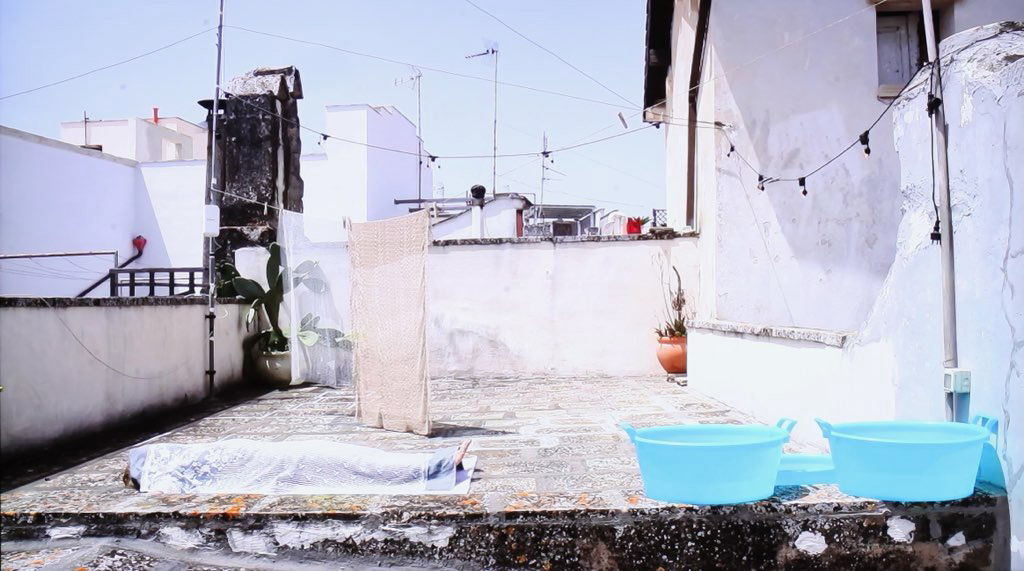
The rooftop of an Italian house on a sunny day.

Sarah Sudhoff, “The Past is Ever Present” 2024, performance

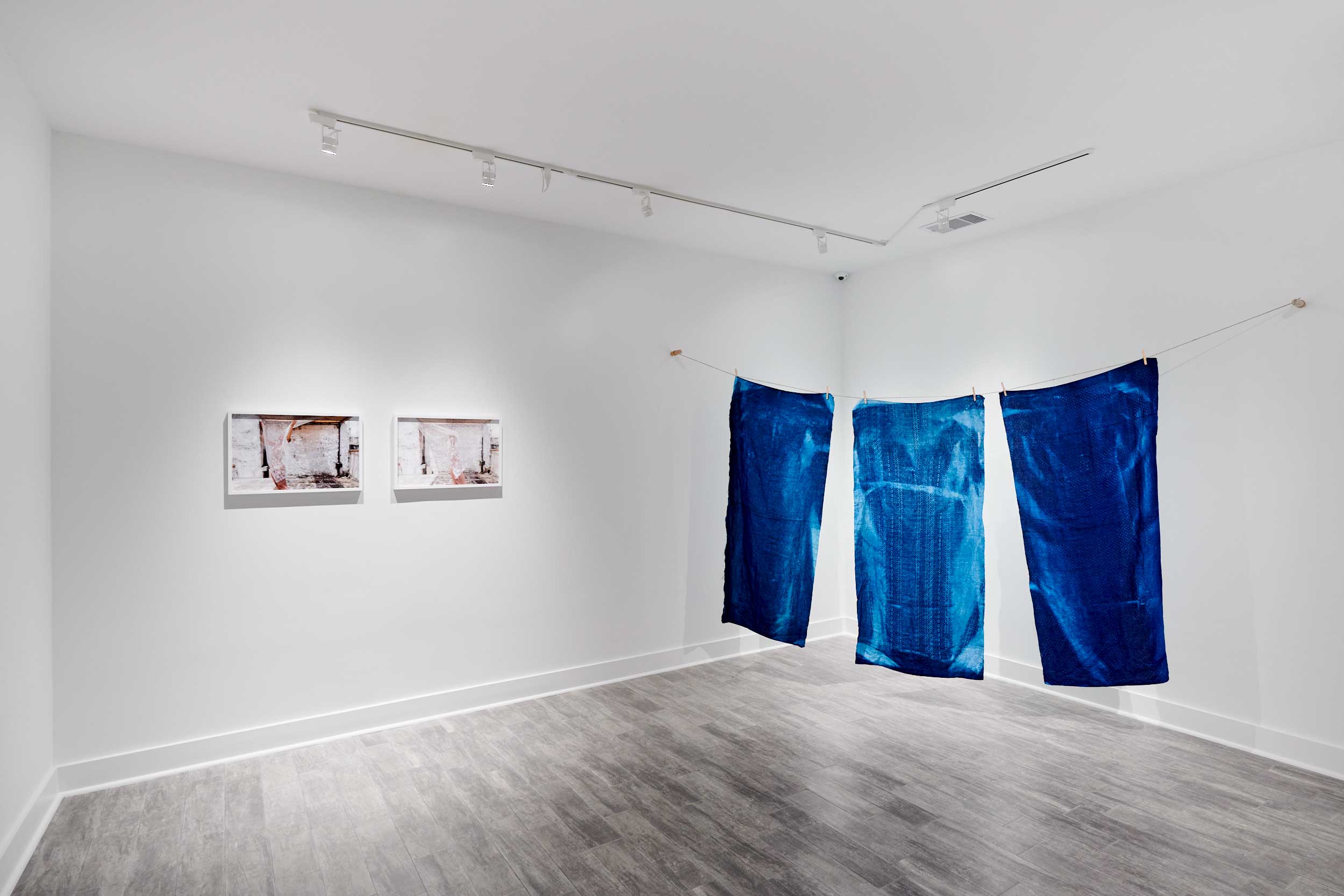
The show’s centerpiece is an eight-minute video documenting Sudhoff’s use of her body, the lace, and the sun to create intriguing patterns on the blue cloth. Working on the roof terrace of her house, she laid on a piece of lace, spread a cyanotype cloth over her body, and yet another piece of lace over that. Sudhoff stopped the processing by washing the fabric in a blue tub and hanging it to dry on the roof’s clothesline. In the gallery, three of these actual printed pieces are suspended adjacent to the video. Visible on the dark blue fabrics are subtle outlines of Sudhoff’s body and patterns created by the various laces. 

Two photographs hang on the wall of a gallery, while three cyanotype textiles hang from the ceiling.

Sarah Sudhoff, “The Past is Ever Present,” 2024, cyanotypes on linen

Sudhoff says of her process, “In processing the cyanotypes, I would count meditatively and silently for eight minutes, allowing each piece to develop in the sun, thus creating a unique record of time, place, and my silhouette. A map, revealing my journey and yet obscuring some of the details, was waiting for me to uncover them.”

A nude woman stands behind a lace textile hung outside on the roof an Italian house on a bright day.

Sarah Sudhoff, “Lace Study, No. 4,” 2024, archival print on paper

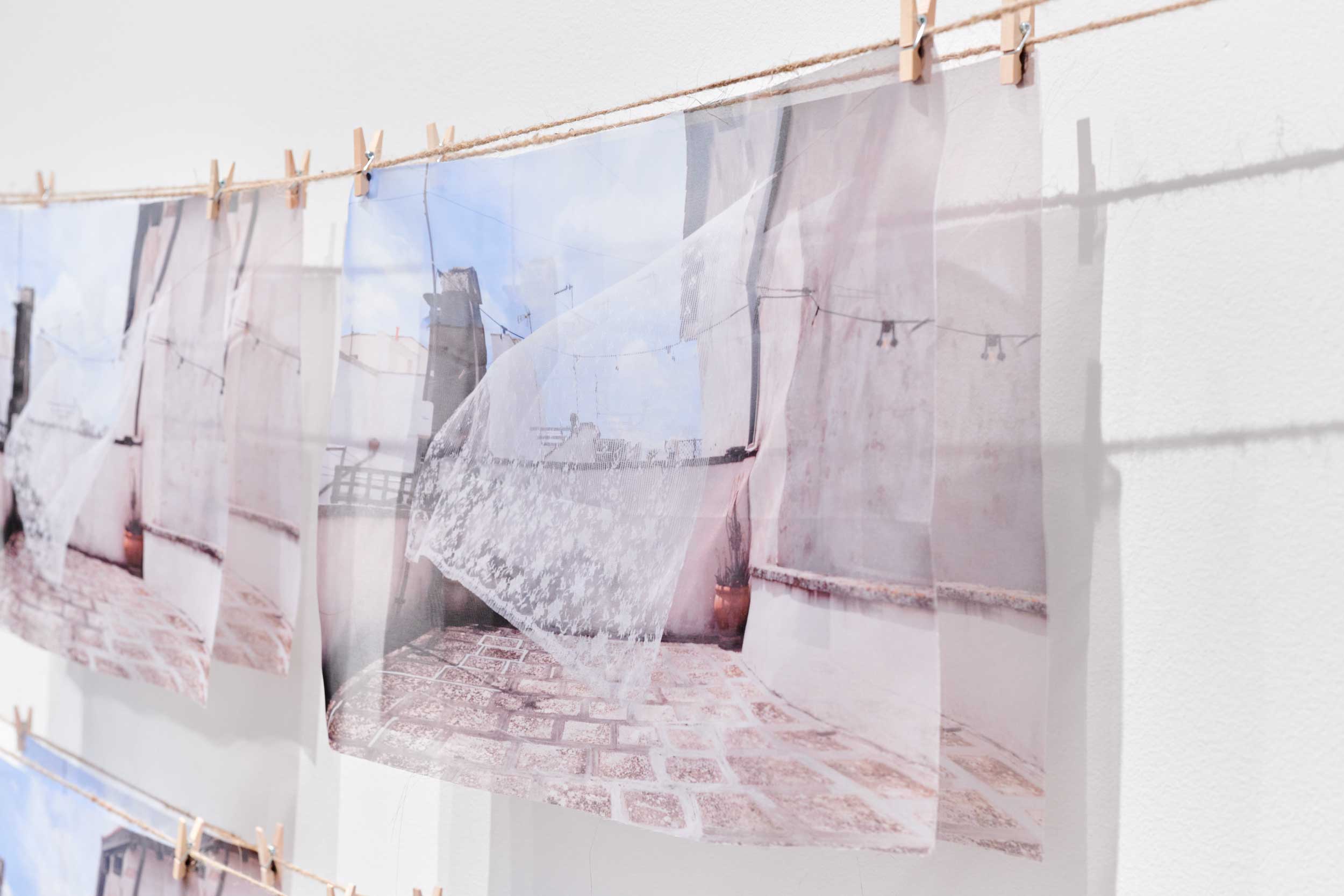
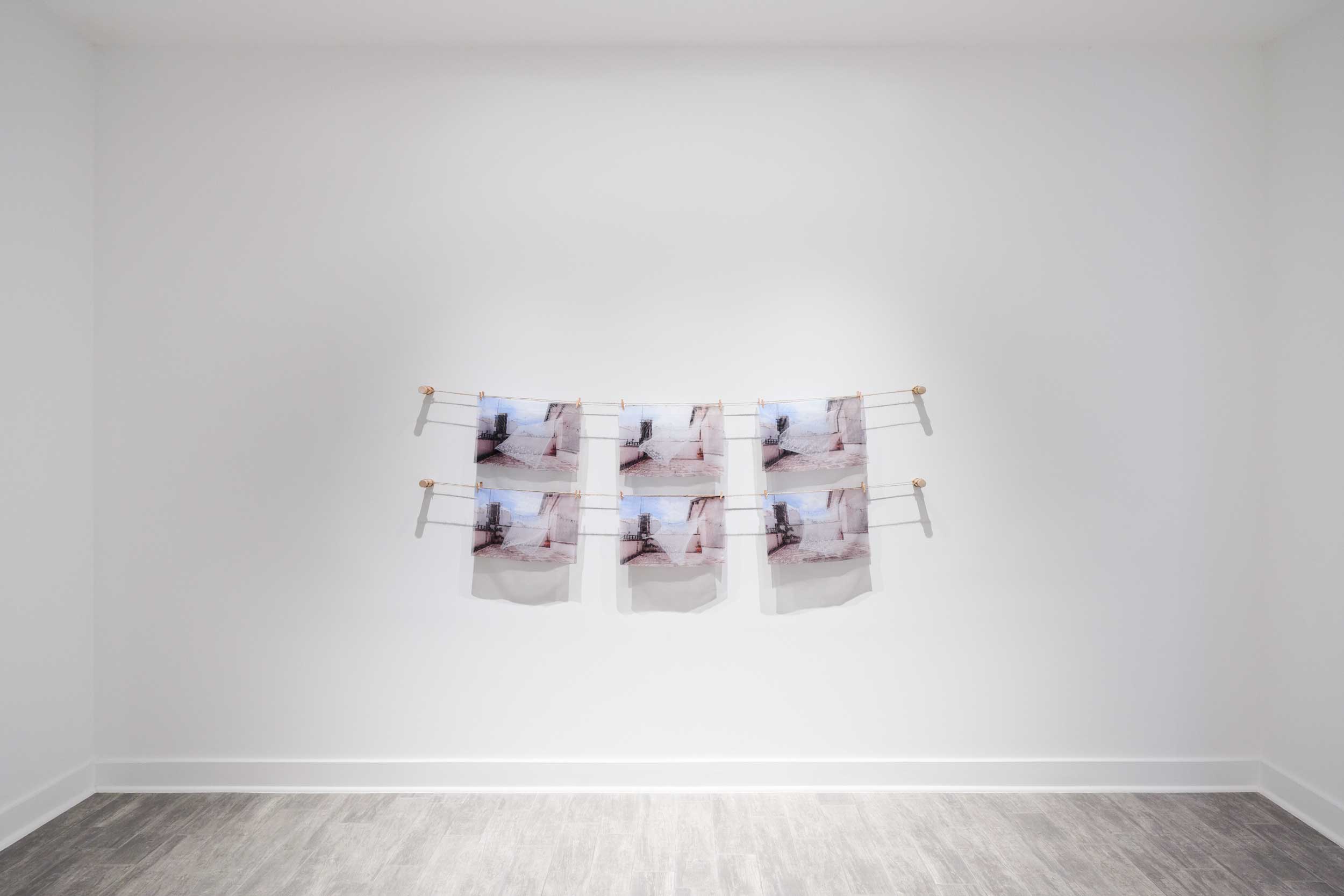
The show also includes four photographs of Sudhoff’s nude body interacting with pieces of lace hanging on the terrace. These are essentially light studies in which the sun shining through the lace creates shadow patterns on the artist’s body, the white-washed wall behind her, and the stone-tiled floor. In another installation, six photographs of the lace undulating in the breeze are printed on feather voile and suspended in two rows. The delicate fabric moves in response to air currents in the gallery, much like the lace in the photographs. 

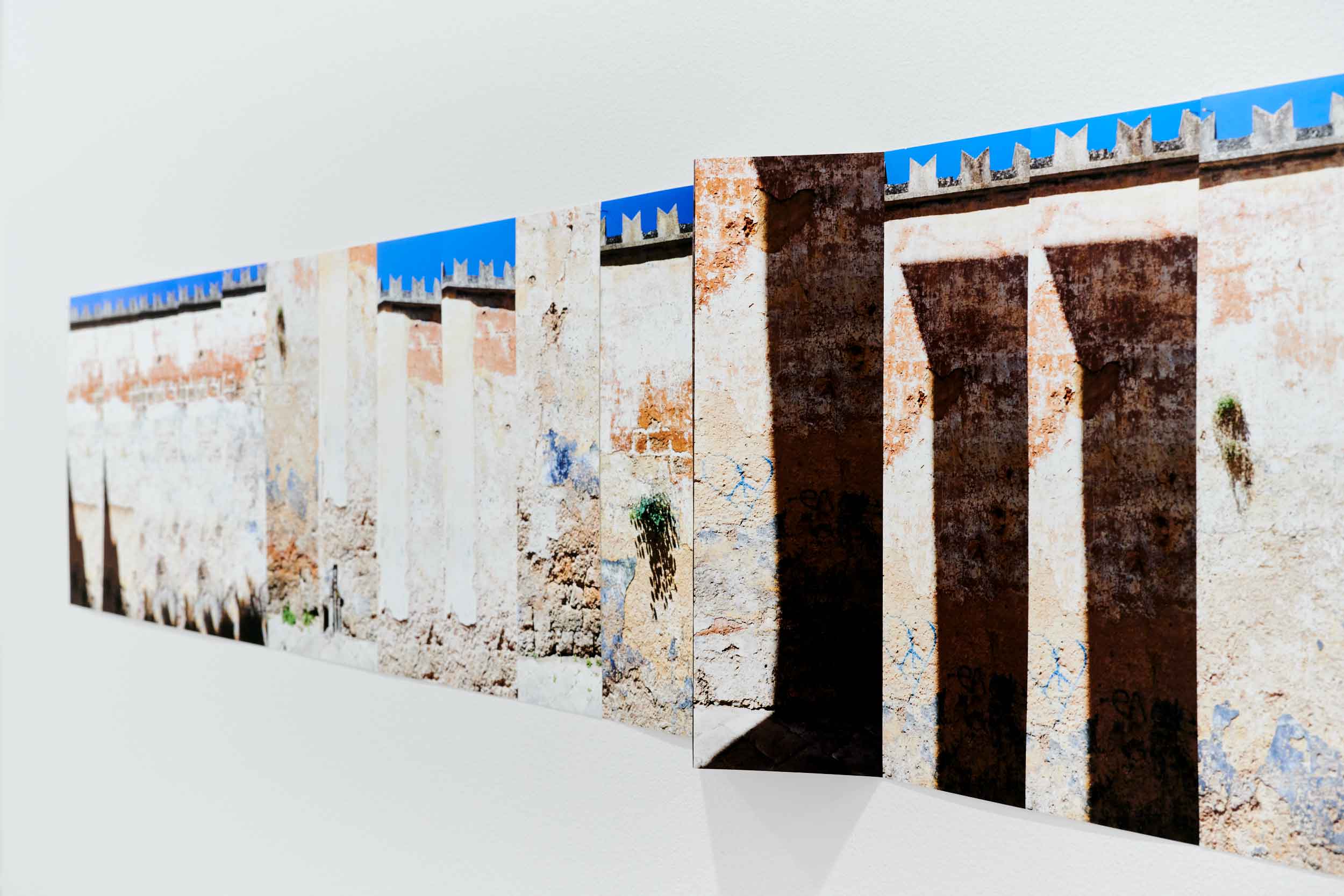
Another series of photographs on view, Via Cavour, depicts the wall of La Basilica di Santa Caterina D’Alessandria, a 14th-century basilica near Sudhoff’s house. Arranged along the gallery’s hallway, more than a dozen photographs of the roughly textured surface recreate Sudhoff’s experience of walking past it every day. “It was my constant and served as my compass to find my way home,” she said. “The old walled city and the slower pace of Galatina served as the inspiration for The Past is Ever Present.”

A long, unframed photograph of an Italian wall along the via Cavour hangs on the wall of a gallery.

Sarah Sudhoff, “Via Cavour, No. 2-11,” 2024, archival print on paper

The basilica, with its layers of history, encouraged her to work with layers of fabric. “I was inspired by the basilica’s gorgeous frescoes, its blue ceiling, and these unrepaired areas where the frescos had broken off, revealing the drawings underneath,” Sudhoff said. “I became interested in the layers of history and the vulnerability of the materials, the space, and thinking about my own vulnerability.” 

The basilica also prompted Sudhoff to investigate patriarchy, eroticism, saints, and the mysteries of religion. Although her body under the fabric and lace did not have any overt religious intent, it did resemble a shroud. She was influenced by the integration of religion and culture in Galatina, where the town celebrated numerous religious holidays while she was there. Sudhoff was struck by how everything came to a standstill during these observances. 

Translucent Prints hang from clothespins on the wall of a gallery.5. Sarah Sudhoff, “Embodied Presence,” 2024, photographic prints on feather voile

Sarah Sudhoff, “Embodied Presence” (detail) 2024, photographic prints on feather voile

These textile-based pieces address themes that have concerned Sudhoff previously. As a single mother, she has explored the domestic roles and invisible labor of parenting, as well as matriarchal lineage. Her grandparents fled Cuba with their daughter, Sudhoff’s mother. In El Recuerdo, an exhibition and performance piece in 2021, Sudhoff paid tribute to her grandmother with a video showing her washing her grave, as well as a performance in which she swung from knotted ropes, referencing her grandmother’s boat journeys across the ocean.

During the pandemic, Sudhoff explored illness and mortality. In Cared For at the Blaffer Art Museum in 2022, her work questioned those who care for the health of women. Sudhoff researched the technologies that examine and penetrate female bodies in the medical field and used her own history of treatment for cancer as source material for the show. “I underwent surgery for cervical cancer the first week of graduate school,” she said. “That set the trajectory of my artistic career.” Sudhoff has been using her body since then to connect with her audience.

Sudhoff allows her personal experiences to dictate her subjects and materials. Her background as a photojournalist is a constant component of her work. She delves deeply into what it means to be a woman and mother in today’s political climate. Prior to the work discussed here, she photographed and performed in hospitals, morgues, medical museums, and her doctors’ offices. In a 2022 interview with Caroline Frost about Focusing Screen for Glasstire, she talked about the numerous examinations she has undergone.

“At times, I’ve felt objectified by specific, repetitive medical and gynecological exams and have become a little numb to the treatment of my body in these spaces,” Sudhoff said. “Performance is another form of communication, similar to writing or speaking. I speak in visuals. My gestures, body position, and images evoke emotions and provide clarity far beyond what I could ever say.”

Sudhoff’s performance and textile-based photographic work continues to explore topics she encounters as she dissects ongoing private and public expressions of self. Her interest in using materials to express her ideas and emotions while still being true to herself as a photographer has resulted in a growing separation from two-dimensional work. She has written that “textiles have the ability to create tangible expressions of ephemeral experiences and encapsulate a specific time and place” and “speak to the feminine or domestic realm.”

Six images printed on translucent fabric hang on clotheslines on the walls of a gallery.

Sarah Sudhoff, “Embodied Presence,” 2024, photographic prints on feather voile

The Past is Ever Present at Andrew Durham Gallery continues Sudhoff’s examination of her past and its impact on her present. The ritual of printing, washing, and hanging the cyanotype textiles has produced compelling documentation of her investigations during the residency. Her body of powerful performances, videos, and photographs reveals Sudhoff’s continuing experimentation with materials and processes, resulting in her work moving away from the aesthetic confines of the gallery wall.

Sarah Sudhoff: The Past is Ever Present is on view at Andrew Durham Gallery through May 18, 2024.