Marvel at the talent of sculptor Marijan Bekic as he creates a new statue for Our Lady of the Rosary parish in Sydney.
Marijan’s prayer in stone will last a thousand years


John E. Dowell’s hauntingly beautiful series, Paths to Freedom, originated from a dream featuring his long-departed grandmother and her tales of cotton fields. The dreams were so powerful that it encouraged him to seek out the cotton fields firsthand. In the deep South, in the dead of night, Dowell envisioned the harrowing journey of his enslaved ancestors. Through his photography, he explores their courage, wisdom, and pursuit of freedom amidst the darkness. His images, currently on view at The Charles H. Wright Museum of African American History in Detroit, evoke portals, spirits, signs in nature, and faith.
The concept for your series originated from a dream. Could you share more about this? Did you wake up with a clear vision of what to create, or did it take time to piece it together?
“It took time to piece it together. When I first began having the dreams, I wasn’t quite sure what was being requested. After consulting with my sisters and brother, I assessed that it was about my grandmother’s stories of cotton.”
In your insightful conversation with Brittany Webb, you talk about your connection with your ancestors, specifically your grandmother. How hard was it to trust (and act on) what was being conveyed to you?
“My grandmother was very clear and matter-of-fact. From there it became a matter of how to get to the cotton—contacting farmers, traveling to farms, et cetera.”

Can you talk more about the idea of portals in nature offering hope and encouragement to
slaves? Was this something that you read about or something that you came by naturally when out in the fields? And in what forms (light, burrows, etc.) do you feel these portals existed?
“That idea of portals first came from my experiences with religions of African origin—Voodoo, Santeria, and Gullah spiritual traditions. In all of these experiences, the individuals
communicated with their ancestors, gaining informative guidance, strength, and the ability to survive. I almost always had emotional experiences photographing cotton. I experienced
hearing and seeing things that were there only on a metaphysical level. At times when I was out photographing, I could hear singing—and many times while I’m looking at cotton, I know nobody is there but I swear I can see slaves picking cotton. At rare times, I felt like I was really experiencing pain as if I had been beaten.”

For this series, you’ve photographed cotton fields in the dark. What did this process look like? Did you scout the location during the day and then go back at night with specific ideas? Or was it more of an organic process?
“A little of both. I started with an idea based on some exploration during the daytime, and then at dusk, I just followed a feeling. I sort of imagined the path and how a group or an individual would run away. Some of this was based on knowledge of the Underground Railroad and seeing or perceiving escape routes when I was within the cotton fields. When I was there at night, I got a certain feeling—it was an awareness of ancestral presence.”

So many of us are living in cities, addicted to screens, and disconnected from nature. I can’t help but think of the concepts of “grounding” or “earthing” when I see your work. Is that something that you think about? What do you think we can learn from nature, and what role does it play in your personal life?
“For me, I have looked for and searched for moments in nature that are very spiritual to me. In my work, I have discovered places and moments that have given that identification. For example, in a banana plantation in Caracas, I photographed an area that felt like I was in the middle of an altar. Not in front of it—I was in it. In South Dakota, I had a similar experience in a corn field where I felt the presence of God. So nature for me becomes a means of discovering my spirituality.
“When I am in nature and have removed all of the distractions of the world, I really feel a presence of God. What’s interesting for me is when I’m in the city, I feel there is a potential awareness of humanity in certain situations, like the park and areas of communication—what I really feel in the city is that disconnecting from screens and enjoying interactions with nature and individuals is possible. So that is to say these connections I experience in the city or outside the city are not formed in spite of a sort of addiction to the screen or an influence by that stuff—I just move through it—it’s not really a part of my life.”

Do you think there is a connection between being connected to nature and feeling connected to one’s ancestors?
“That depends on the experience and background of the individual. I think of experiences I have had in church services, ceremonies within the Gullah culture, Santeria, Voodoo, I could go on and on—all religions of the African diaspora where I’ve felt connected to my ancestors. In a ceremony of this sort there are many individuals who are possessed by spirits of ancestors. For example, in a Voodoo ceremony, one can have experiences with Shango or Ogun, and the same thing in Santeria or Candomblé. In the process of the ceremony, we can see someone who has been taken by the spirit of the particular Orisha or Loa. As I’ve mentioned, I’ve experienced connections to my ancestors in nature, I’ve experienced them alone, and I’ve witnessed others experience it in ceremonial or group environments—so it all depends on the individual.”


MINNEAPOLIS — Waterfowl on lakes and rivers are a common sight. But it’s the not-so-common loon that when seen in person is often the apple of a photographer’s eye, especially for Chris Whitty.
“I’ve been taking pictures of loons and birds on the various lakes for a long time,” he said.
Capturing wildlife on camera is one of his favorite hobbies, usually involving a trek to a remote lake in British Columbia, Canada. Loons frequent this area, some even nesting, but there’s a “white whale” of sorts always on his mind.
Chris Whitty
“If you go out looking for something in my experience, you’re not going to find it. It’s kind of the surprise,” he said. That’s precisely what happened on a spring morning. Whitty did his typical weekend trip to a lake. “I’m like, ‘oh there’s a couple loons’ and then I’m like, ‘oh my god it’s the white one’,” he said.
Four years after first seeing it, the elusive white and gray feathered loon was back at his favorite photo spot.
After hastily getting out of his car to the point where he forgot to put it in park, Whitty grabbed his canoe and glided across the water like the great northern diver in his lens.
“What I like to do is I paddle slowly and quietly and get in the angle for the light and then just stop and then just watch, and they just tolerated me for quite a while,” Whitty said, estimating he took pictures of the white loon among other loons for at least an hour.

Chris Whitty
Dale Gentry, the director of conservation for Audubon Upper Mississippi River, said it’s shocking to see a loon with such a color. “I’ve never seen one in person, and I’ve only seen pictures on the internet,” said Gentry. “Albinism and a leucistic bird, they have some sort of genetic change that influences the genes that code for a pigment in their feathers called melanin.”
When an animal is albino it cannot produce melanin, which gives an animal its color. Therefore, it’s white. Leucism is when an animal lacks some melanin, making it partially white or gray.
“It’s much more common for birds to have little patches of white feathers,” said Gentry. “But for the entire bird to be in sort of leucistic plumage is less common.”
He estimates 1 in 30,000 birds is leucistic. That only adds to the rarity that a loon, known for its strikingly black plumage, would carry the opposite color.
“A number of questions pop for me about the bird,” Gentry said. He wonders if it has a mate and how it is received by the loon community given its different appearance.

Chris Whitty
If the white loon does mate, Gentry said the leucistic trait could be passed down. The trait however could be recessive, meaning the chicks would still have their normal dark color.
Whether it has offspring or not, the chances Minnesotans would learn that in person are slim to none.
“I think something like 97% of North America’s loons nest in Canada so we’re kind of an outlier (in Minnesota),” Gentry said.
Whitty said birders have begged him to keep the lake’s location a secret, that way it doesn’t get flooded with photographers. It’s a request he’s happy to oblige, even if the encounter is truly up to nature to decide.
“It’s funny, you go looking, you won’t find it,” he said.

31 minutes ago
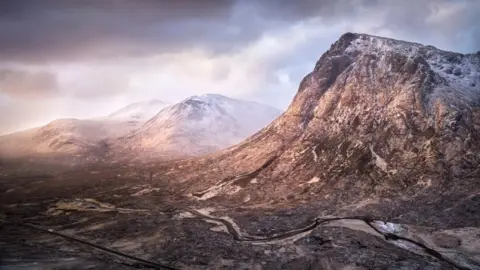 Dylan Nardini
Three Scottish landscape photographers and artists have collaborated for a new exhibition coming to the Highlands.
Dylan Nardini, David Queenan and Grant Bulloch’s That Other Landscape is to open in Kingussie later this month.
All three have been recognised in UK awards, and Nardini and Queenan are former Scottish Landscape Photographers of the Year.
Bulloch is an architect and designer who has travelled extensively throughout Scotland. He often seeks out stormy weather for his images.
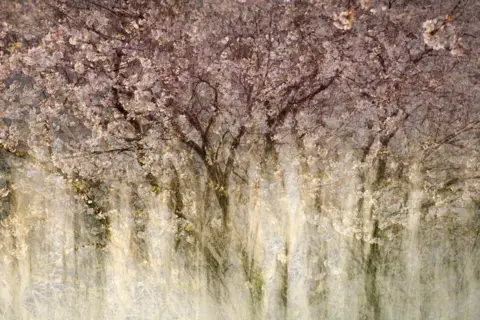 Dylan Nardini
Nardini, whose father and sister are artists, uses digital and traditional film photography in his work.
He also makes images through a technique that involves instant Polaroid pictures and watercolour paper.
The photographer said using this process meant there was some uncertainty how the finished art might look.
He said: “Seeing something develop in front of my eyes as it gets put on paper means the process is far more than just capturing an image.”
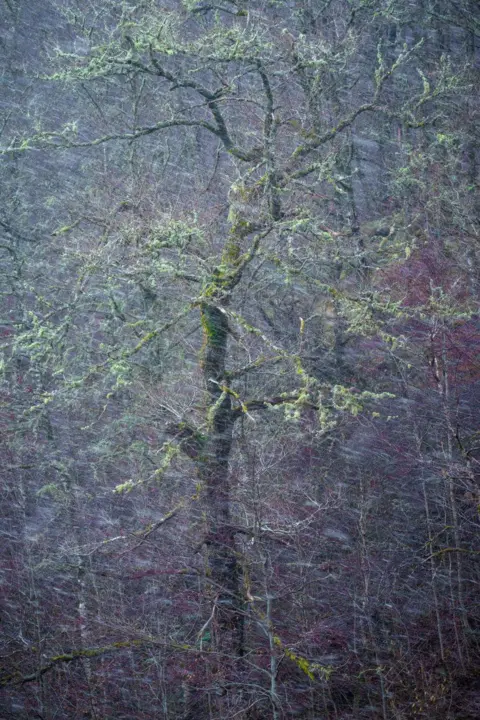 Grant Bulloch
Bulloch’s fondness for bad weather led to an image called Aberfeldy Snowstorm.
He had to wait for a cold front to hit while in the Birks of Aberfeldy woodland in Perthshire.
Bulloch said: “We climbed to the top of the glen hoping to be there to meet the forecasted incoming snow, but it was on our way down that the first flurries appeared.
“I was still able to shoot across the Birks towards the lichen covered trees as they swayed and moved in the snow laden winds.”
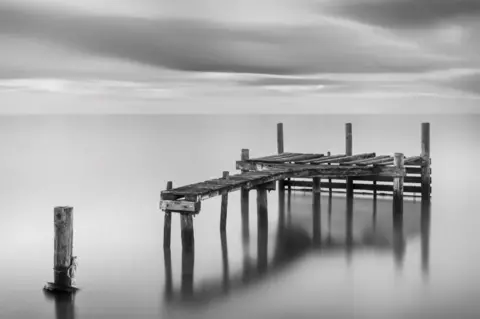 David Queenan
Queenan is based on the south shore of the River Forth.
He said the nearby Forth Bridge and Queensferry Crossing were among his favourite subjects.
But Carriden Pier, less than 10 minutes’ walk from his house, has been his most popular subject since lockdown.
He has been documenting the toil weather has taken on the little wooden structure.
The free two-week exhibition opens at Eleven41 Gallery on 28 June.







