WATERTOWN — The sculpture that will soon be part of Public Square’s Peanut Park is getting packed up in the next day or two and then trucked from a California
Public Square sculpture will soon be trucked from California


Submitted photos
Mineral Ridge native, Jason Lange, working on a set as a director of photography. He’s worked with various networks to create commercials, music videos and documentaries.
MINERAL RIDGE — Despite the precarity of the television and film industry, Jason Lange, who resides in Los Angeles, still finds ways to be creative every day. Lange not only finds joy in his career, but he also doodles to bring positivity to each day.
“It’s been kind of just a hobby, but I still do it,” said Lange. “I think it’s important to stay creative. I think COVID really kind of made that more prominent for me. And then with the strikes too, it’s like, ‘OK, I still need to be creative.’ That’s what makes me tick.”
He graduated from Mineral Ridge High School in 1996, and then from Youngstown State University in 2002 with a bachelor’s degree in telecommunications / TV and radio broadcasting.
Since leaving the Mahoning Valley in 2002, 45-year-old Lange has worked as a director of photography for National Geographic, Discovery, A&E, History Channel, VH1, Bravo, Spike TV, ESPN and more.
Notable works include the second season of “Break A Hip,” the Emmy-winning comedy series and both seasons of the Humanitas Award winning web-series “The Disappointments” among other commercial, narrative, documentary, short film, music video, TV and web series projects.
“Every day is different, but that’s, I think, why I like doing it because it’s never the same thing. The scenarios are always different,” Lange said. “I didn’t think I could ever be in a cubicle.”
In his 20-plus year career, Lange has faced challenges that threatened his creativity, namely the COVID-19 pandemic and industry strikes. In 2020, the television and film industry was shut down due to the pandemic and since then there have been a number of union strikes that have also halted production.
“These last few years have been harder with the strikes and everything,” Lange said.
Although Lange is not a part of the unions that have struck, he has felt the effects as his career led him to work on more unionized projects.
“I definitely was involved in (SAG-AFTRA) projects, and they struck last year too. It was kind of hard to really maintain a lot of that kind of work, but it’s slowly getting better.”
Lange still finds work as a cinematographer and he has now added daily doodles to his plate as another way to make each day unique. Lange has been drawing since he was a kid but started creating his daily doodles about a decade ago.
“My brother passed away like 10 years ago, and I kind of started (doodling) on that day just to kind of make the day different, you know, to create something from that down day and make it a positive thing,” Lange said. “It’s almost like therapy. It’s part of my morning routine.”
Lange decided to put his daily doodles on Instagram and TikTok (@langetoons) about four years ago, but he doesn’t do it for the likes, he posts to preserve his doodles and make people happy.
“I don’t care if no one likes my page. I do it (doodle) to keep it and know that it’s there. If I have one person like it, I’m happy. We’re not trying to get a million followers.”
To suggest a Friday profile, contact Metro Editor Marly Reichert at mreichert@tribtoday.com or Features Editor Ashley Fox at afox@tribtoday.com.

DAVENPORT, Iowa (KWQC) -Quad Cities Live frequently features Figge In Focus where current exhibits, news, and museum programming and events are highlighted.
Figge Art Museum will be premiering a new photography exhibit on June 15 which will continue to be on display through Sept. 8.
Dr. Jeffrey Richmond-Moll, curator of Reckonings and Reconstructions: Southern Photography from the Do Good Fund, will introduce the exhibition and share insights on his curatorial process during a special celebration event to be held on Thursday, June 13 from 6:30 to 8 p.m.
Figge Members are invited to come early for a Member Reception beginning at 5 p.m. where they can mingle with drinks prior to the Curator Talk.
Reckonings and Reconstructions: Southern Photography from The Do Good Fund is a scholarly investigation of southern photography since World War II that highlights a wide-ranging group of photographers – diverse in gender, race, ethnicity, and region – in over one hundred and twenty-photographs by over seventy artists. The collection of photography celebrates the ever-changing American South.
Figge Art Museum is located at 225 West 2nd Street in Davenport. The phone number is 563-345-6647.
Copyright 2024 KWQC. All rights reserved.


A juried photography contest has disqualified one of the images that was originally picked as a top three finisher in its new AI art category. The reason for the disqualification? The photo was actually taken by a human and not generated by an AI model.
The 1839 Awards launched last year as a way to “honor photography as an art form,” with a panel of experienced judges who work with photos at The New York Times, Christie’s, and Getty Images, among others. The contest rules sought to segregate AI images into their own category as a way to separate out the work of increasingly impressive image generators from “those who use the camera as their artistic medium,” as the 1839 Awards site puts it.
For the non-AI categories, the 1839 Awards rules note that they “reserve the right to request proof of the image not being generated by AI as well as for proof of ownership of the original files.” Apparently, though, the awards did not request any corresponding proof that submissions in the AI category were generated by AI.
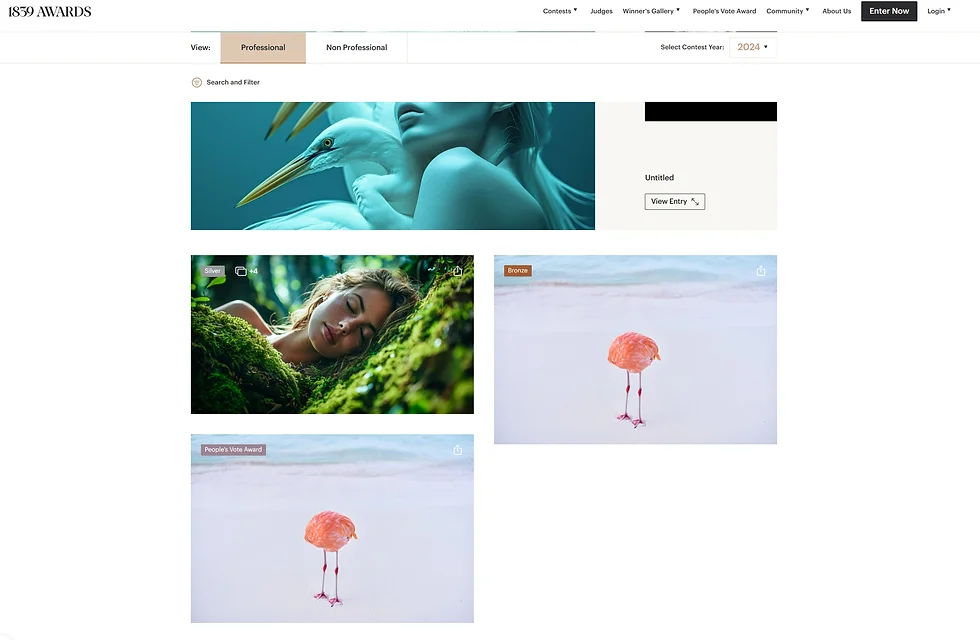
Because of this, photographer Miles Astray was able to enter his photo “F L A M I N G O N E” into that AI-generated category, where it was shortlisted and then picked for third place over plenty of other entries that were not made by a human holding a camera. The photo also won the People’s Choice Award for the AI category after Astray publicly lobbied his social media followers to vote for it multiple times.
On his website, Astray tells the story of a 5 am photo shoot in Aruba where he captured the photo of a flamingo that appears to have lost its head. Astray said he entered the photo in the AI category “to prove that human-made content has not lost its relevance, that Mother Nature and her human interpreters can still beat the machine, and that creativity and emotion are more than just a string of digits.”
That’s not a completely baseless concern. Last year, German artist Boris Eldagsen made headlines after his AI-generated picture “The Electrician” won first prize in the Creative category of the World Photography Organization’s Sony World Photography Award. Eldagsen ended up refusing the prize, writing that he had entered “as a cheeky monkey, to find out if the competitions are prepared for AI images to enter. They are not.”
In a statement provided to press outlets after Astray revealed his deception, the 1839 Awards organizers noted that Astray’s entry was disqualified because it “did not meet the requirements for the AI-generated image category. We understand that was the point, but we don’t want to prevent other artists from their shot at winning in the AI category. We hope this will bring awareness (and a message of hope) to other photographers worried about AI.”
For his part, Astray says his disqualification from the 1839 Awards was “a completely justified and right decision that I expected and support fully.” But he also writes that the work’s initial success at the awards “was not just a win for me but for many creatives out there.”
I’m not sure I buy that interpretation, though. Art isn’t like chess, where the brute force of machine learning efficiency has made even the best human players relatively helpless. Instead, as conceptual artist Danielle Baskin told Ars when talking about the DALL-E image generator, “all modern AI art has converged on kind of looking like a similar style, [so] my optimistic speculation is that people are hiring way more human artists now.”
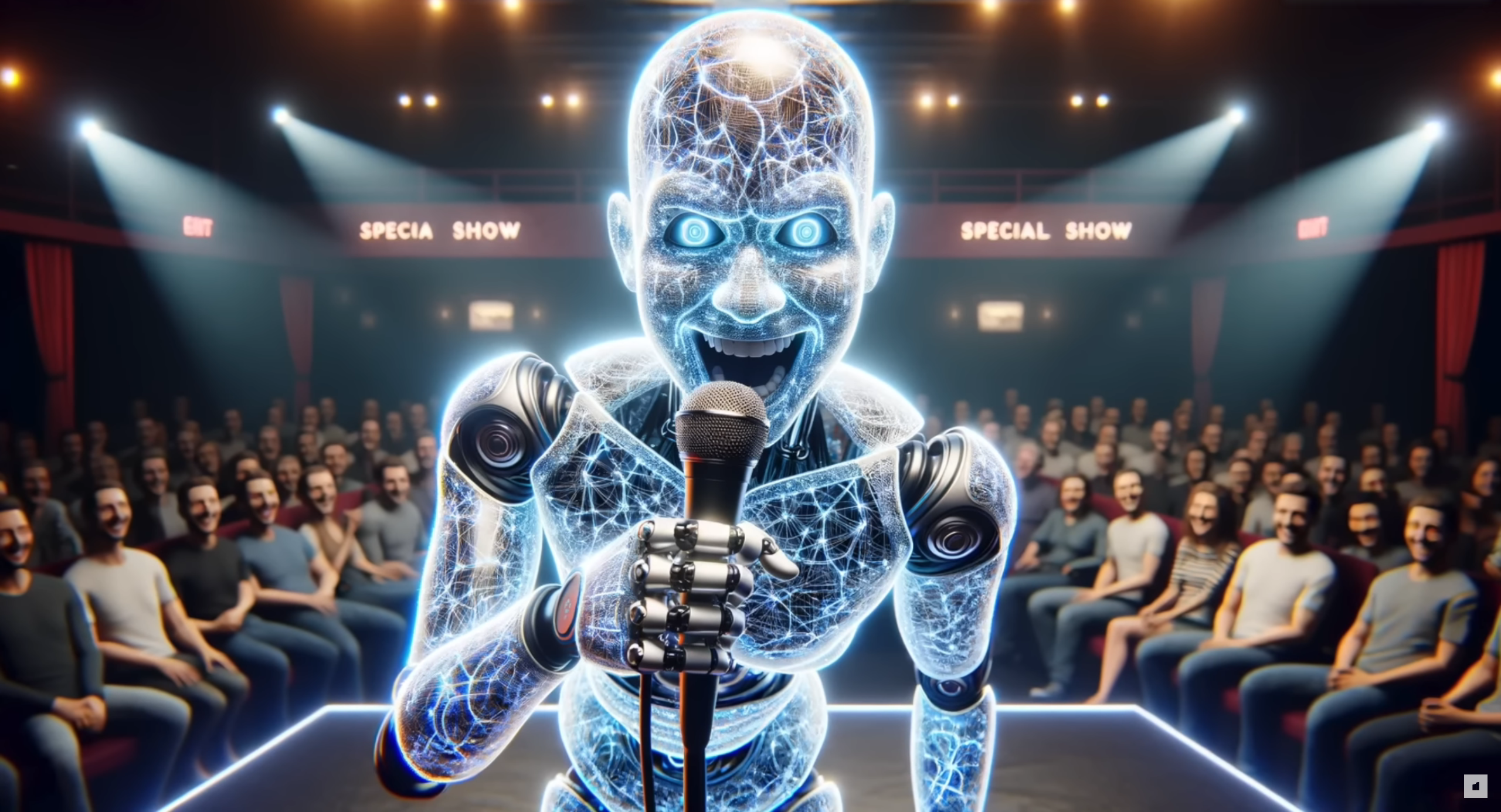
The whole situation brings to mind the ostensibly AI-generated George Carlin-style comedy special released earlier this year, which the creators later admitted was written entirely by a human. At the time, I noted how our views of works of art are immediately colored as soon as the “AI generated” label is applied. Maybe you grade the work on a bit of a curve (“Well, it’s not bad for a machine“), or maybe you judge it more harshly for its artificial creation (“It obviously doesn’t have the human touch“).
In any case, reactions to AI artwork are “a reflection of all the fear and promise inherent in computers continuing to encroach on areas we recently thought were exclusively ‘human,’ as well as the economic and philosophical impacts of that trend,” as I wrote when talking about the fake AI Carlin. And those human-centric biases mean we can’t help but use a different eye to judge works of art presented as AI creations.
Entering a human photograph into an AI-generated photo contest says more about how we can exploit those biases than it does about the inherent superiority of man or machine in a field as subjective as art. This isn’t John Henry bravely standing up to a steam engine, it’s Homer Simpson winning a nuclear plant design contest that was not intended for him.