About

Posts by :

Vertical, casual images and few selfies: Smartphone photography is changing how we see the world

Vertical, casual images and few selfies: Smartphone photography is changing how we see the world

Smartphones are a staple of modern life and are changing how we see the world and show it to others. Almost 90% of Aussies own one, and we spend an average of 5.6 hours using them each day. Smartphones are also responsible for more than 90% of all the photographs made this year.

But compare the camera roll of a 60-year-old with that of a 13-year-old, as we recently did, and you’ll find some surprising differences. In research published in the Journal of Visual Literacy, we looked at how different generations use smartphones for photography as well as broader trends that reveal how these devices change the way we see the world.

Here are five patterns we observed.

1. We make images more casually and with a wider subject matter

Before the first smartphone camera was released in 2007, cameras were used more selectively and for a narrower range of purposes. You might only see them at events like weddings and graduations, or at tourist hotspots on holidays.

Now, they’re ubiquitous in everyday life. We use smartphones to document our meals, our daily gym progress, and our classwork as well as the more “special” moments in our lives.

Many middle-aged people use smartphones most for work-related purposes. One of our participants put it this way:

I often take photos of info I want to save, or of clients’ work when I want to then email it to myself to put on the computer. I feel like I’ve gotten a little slack on socially taking photos of friends … but in the day-to-day, I feel like I use it very practically now for basically work, grabbing a photo to upload it online somewhere.

Email Twitter Facebook42 LinkedIn Print Smartphones are a staple of modern life and are changing how we see the world and show it to others. Almost 90% of Aussies own one, and we spend an average of 5.6 hours using them each day. Smartphones are also responsible for more than 90% of all the photographs made this year. But compare the camera roll of a 60-year-old with that of a 13-year-old, as we recently did, and you’ll find some surprising differences. In research published in the Journal of Visual Literacy, we looked at how different generations use smartphones for photography as well as broader trends that reveal how these devices change the way we see the world. Here are five patterns we observed. 1. We make images more casually and with a wider subject matter Before the first smartphone camera was released in 2007, cameras were used more selectively and for a narrower range of purposes. You might only see them at events like weddings and graduations, or at tourist hotspots on holidays. Get news that’s free, independent and based on evidence. Now, they’re ubiquitous in everyday life. We use smartphones to document our meals, our daily gym progress, and our classwork as well as the more “special” moments in our lives. A triptych of everyday photos showing a meal, a book, and a bottle of medicine. In the old days cameras only came out for special occasions, but we now tend to use our smartphones to document a wider range of subject matter, including our most recent meal, something we see and want to add to our shopping wish list, or an item at the shops that we want to confirm with a family member. Credit: TJ Thomson/The Conversation.

2. We aren’t as selfie-obsessed as some would think

Our participants only used their phone’s front “selfie” camera 14% of the time. They acknowledged the stigma around selfies and didn’t want to be perceived as narcissistic.

3. We’re seeing more vertical compositions

In years past, whether you had a bulky DSLR camera or a lightweight disposable, the “default” grip was to hold it with two hands in a horizontal way. This leads to photos in landscape orientation.

But the vertical design of smartphones and accompanying apps, such as Instagram and Snapchat, are resulting in more photos in portrait orientation. Participants said holding their smartphone cameras this way was more convenient and faster.

The vertical design of smartphones and associated popular social media apps, such as Snapchat, Instagram, and X, influences how people use their smartphone cameras. Credit: Instagram / X / Snapchat .

4. We like to keep our distance

Participants made more images of people from farther away compared to getting close. Intimate “head and face” framing was only present in fewer than 10% of the images.

In one participant’s words:

I feel like my friends and I get frustrated with parents, when they’re zooming in a photo or they walk in really close. My mom would always get one like right in my face, like this is too close! I don’t want to see this. The zoom in, oh, it’s frustrating!

5. We get inspired by what we see online

Teenagers in particular mentioned social media, especially Instagram, as influencing their visual sensibilities. Older adults were more likely to attribute their sense of aesthetics to physical media, such as photography books, magazines and posters.

This aesthetic inspiration impacts what we take photos of, and also how we do it. For example, young people mentioned a centred compositional approach most often. In contrast, older generations invoked the “rule of thirds” approach more often.

One participant contrasted generational differences like this:

There seems to be a real lack of interest [by younger people] in say, composition, or the use of light or that sort of aesthetic side of getting an image. When my partner and I were kids […] our access to different aesthetics and images was actually very limited. You had the four channels on TV, you had magazines, you had the occasional film, you had record covers, and that was it, you know. Whereas, kids these days, they’re saturated with images but the aesthetic aspect doesn’t seem to be that important to them.

Why the way we make images matters

While technology is changing the way people see the world and make photographs, it’s important to reflect on why we do what we do, and with what effects.

For example, the camera angle we use might either give or take away symbolic power from the subject. Photographing an athlete or politician from below makes them look more strong and heroic, while photographing a refugee from above can make them look less powerful.

The vertical camera angle can sometimes be used pragmatically but sometimes connotes symbolic power differences. The low angle of the athlete at left provides more symbolic power than the high angle of the three figures at right. Credit: Vladislav Todorov and Aleksandr Kadykov/ Unsplash.

Sometimes the camera angles we use are harmless or driven by practicality – think photographing a receipt to get reimbursed later – but other times, the angles we use matter and can reinforce existing inequalities.

As the number of images made each year increases and new ways to make images emerge, being thoughtful about how we use our cameras or other image-making technology becomes more important.

TJ Thomson is Senior Lecturer in Visual Communication & Digital Media, RMIT University.

Shehab Uddin is Programme Director, Higher Degree Research, Pathshala South Asian Media Institute.

This article was first published on The Conversation.

Fashion & Culture: Diné artist Naiomi Glasses collaborates with Ralph Lauren on Indigenous-inspired collection

Fashion & Culture: Diné artist Naiomi Glasses collaborates with Ralph Lauren on Indigenous-inspired collection

The Navajo Nation is the backdrop in a new Ralph Lauren campaign which launched Tuesday.

The fashion giant is collaborating with Diné artist Naiomi Glasses, who is known for her Navajo weaving, as well as philanthropy.

This page requires Javascript.

Javascript is required for you to be able to read premium content. Please enable it in your browser settings.

The Lounge Collection Takes a Relaxing Approach to the Daily Grind

The Lounge Collection Takes a Relaxing Approach to the Daily Grind

The ongoing collaboration between Globe and the Eames Office has proved a fruitful venture over the years. Focusing upon the nexus between furniture design and skateboarding, the brands have worked together to interpret the Eames design perspective and creative process into numerous 4-wheeled collector items. Their newest addition to the Eames Office x Globe collection, the Eames Lounge Cruiser, draws inspiration from arguably the most iconic representation of the Eames design legacy, the Eames Lounge Chair.

Situated side-by-side with the Eames Lounge, both the Ash/White and Walnut/Black editions of the Eames Lounge Cruiser collection exhibit a similar bend for emphasizing the warmth and pliable nature of (maple) wood.

Detail shots of the embedded metal badges, deck bolts with the Eames logo, metal truck and wheels across the Eames Lounge cruiserboard.

Close up of Eames Office engraved logo across the Eames Lounge cruiserboard in Ash and White

As an homage, the limited-edition cruiserboards are an uncomplicated interpretation of the bent wood and leather lounger with subtle details, including embedded metal badges and deck bolts with the Eames logo. The simplicity plays into the relaxed and enduring spirit of the design classic, with the cruiserboard style emphasizing a more leisurely, yet playful approach to life.

Eames Lounge cruiserboard thrown into the air against the backdrop of Downtown Los Angeles' City Hall.

The three different color variations also come with varying sizing: the wider Eames Lounge Cruiser 30″ Cruiserboard in Ash and White measuring at 30” x 10” x 17”; the slimmer yet longer Eames Lounge Cruiser 32″ Cruiserboard in Walnut and Black edition measuring 32.2” x 8.6” x 14.5”; and lastly, the all-black Eames Lounge Longboard 38″ in Black Oak and Black stretches out even further at 37.5” x 10” x 28.25″.

Eames Lounge cruiserboard in Ash and White finish.

Of the three, our favorite is the lightest hued combination in Ash and White, a wide-sized reminder of our own youth spent cruising supermarket backlots, bombing downhills, and carving up embankments. But indicative of our grown-up aspirations, its the actual Eames Lounge and Ottoman in the same ash and off-white leather combination staged by Eames Office and Globe to advertise the limited edition release that now tops our wishlist.

Eames printed Dot Pattern tote with black nylon handle being held up by arm with tattoo

The boards also include an Eames printed Dot Pattern tote, further emphasizing while all three skateboards are very ride worthy, they’re more likely to be desired as a collectible rather than a means to tackle the daily grind.

Eames Lounge cruiserboard in Ash and White finish displayed from the top, side, and bottom.

The Eames Lounge 30″ Cruiser Ash/White retails for $260, the Eames Lounge 32″ Cruiser Walnut/Black for $250, and get ready to pony up $340 for the largest Eames Lounge 38″ Longboard Black Oak/Black. All three Eames Lounge skateboards are available via Globebrand.com.

Gregory Han is a Senior Editor at Design Milk. A Los Angeles native with a profound love and curiosity for design, hiking, tide pools, and road trips, a selection of his adventures and musings can be found at gregoryhan.com.

NWT designers featured at Vancouver Indigenous Fashion Week

NWT designers featured at Vancouver Indigenous Fashion Week

From a sealskin puffer jacket to a colourful atikluk dress, designs from Northwest Territories artists stunned attendees at the fourth edition of Vancouver Indigenous Fashion Week.

This year’s event, which ran from November 20 to 25 at the Queen Elizabeth Theatre in Vancouver, featured 15 Indigenous artisans and designers from the NWT.

Cheryl Fennell, who said she is Yellowknives Dene, showcased her collection “Drums in my Heart,” with designs incorporating hide, beads, fish skin and fur.

“My concept for all my designs is really nature and the natural world, which I really believe is what grounds us all,” she told Cabin Radio.

Fennell said this collection was inspired by the drum.

Advertisement.

Advertisement.
image

imageA model walks the runway wearing one of Cheryl Fennell’s designs. Photo: Kelly William
” data-medium-file=”https://i0.wp.com/cabinradio.ca/wp-content/uploads/2023/11/370316632_1625027988353474_3604846807595092312_n.jpg?fit=225%2C300&ssl=1″ data-large-file=”https://i0.wp.com/cabinradio.ca/wp-content/uploads/2023/11/370316632_1625027988353474_3604846807595092312_n.jpg?fit=720%2C960&ssl=1″ loading=”lazy” src=”https://i0.wp.com/cabinradio.ca/wp-content/uploads/2023/11/370316632_1625027988353474_3604846807595092312_n.jpg?resize=720%2C960&ssl=1″ alt class=”wp-image-163402″ srcset=”https://i0.wp.com/cabinradio.ca/wp-content/uploads/2023/11/370316632_1625027988353474_3604846807595092312_n.jpg?resize=720%2C960&ssl=1 720w, https://i0.wp.com/cabinradio.ca/wp-content/uploads/2023/11/370316632_1625027988353474_3604846807595092312_n.jpg?resize=225%2C300&ssl=1 225w, https://i0.wp.com/cabinradio.ca/wp-content/uploads/2023/11/370316632_1625027988353474_3604846807595092312_n.jpg?resize=770%2C1027&ssl=1 770w, https://i0.wp.com/cabinradio.ca/wp-content/uploads/2023/11/370316632_1625027988353474_3604846807595092312_n.jpg?resize=300%2C400&ssl=1 300w, https://i0.wp.com/cabinradio.ca/wp-content/uploads/2023/11/370316632_1625027988353474_3604846807595092312_n.jpg?resize=600%2C800&ssl=1 600w, https://i0.wp.com/cabinradio.ca/wp-content/uploads/2023/11/370316632_1625027988353474_3604846807595092312_n.jpg?resize=450%2C600&ssl=1 450w, https://i0.wp.com/cabinradio.ca/wp-content/uploads/2023/11/370316632_1625027988353474_3604846807595092312_n.jpg?resize=150%2C200&ssl=1 150w, https://i0.wp.com/cabinradio.ca/wp-content/uploads/2023/11/370316632_1625027988353474_3604846807595092312_n.jpg?resize=293%2C391&ssl=1 293w, https://i0.wp.com/cabinradio.ca/wp-content/uploads/2023/11/370316632_1625027988353474_3604846807595092312_n.jpg?w=843&ssl=1 843w” sizes=”(max-width: 720px) 100vw, 720px” data-recalc-dims=”1″>imageA model walks the runway wearing one of Cheryl Fennell’s designs. Photo: Kelly William
” data-medium-file=”https://i0.wp.com/cabinradio.ca/wp-content/uploads/2023/11/370316632_1625027988353474_3604846807595092312_n.jpg?fit=225%2C300&ssl=1″ data-large-file=”https://i0.wp.com/cabinradio.ca/wp-content/uploads/2023/11/370316632_1625027988353474_3604846807595092312_n.jpg?fit=720%2C960&ssl=1″ src=”https://i0.wp.com/cabinradio.ca/wp-content/uploads/2023/11/370316632_1625027988353474_3604846807595092312_n.jpg?resize=720%2C960&ssl=1″ alt class=”wp-image-163402″ srcset=”https://i0.wp.com/cabinradio.ca/wp-content/uploads/2023/11/370316632_1625027988353474_3604846807595092312_n.jpg?resize=720%2C960&ssl=1 720w, https://i0.wp.com/cabinradio.ca/wp-content/uploads/2023/11/370316632_1625027988353474_3604846807595092312_n.jpg?resize=225%2C300&ssl=1 225w, https://i0.wp.com/cabinradio.ca/wp-content/uploads/2023/11/370316632_1625027988353474_3604846807595092312_n.jpg?resize=770%2C1027&ssl=1 770w, https://i0.wp.com/cabinradio.ca/wp-content/uploads/2023/11/370316632_1625027988353474_3604846807595092312_n.jpg?resize=300%2C400&ssl=1 300w, https://i0.wp.com/cabinradio.ca/wp-content/uploads/2023/11/370316632_1625027988353474_3604846807595092312_n.jpg?resize=600%2C800&ssl=1 600w, https://i0.wp.com/cabinradio.ca/wp-content/uploads/2023/11/370316632_1625027988353474_3604846807595092312_n.jpg?resize=450%2C600&ssl=1 450w, https://i0.wp.com/cabinradio.ca/wp-content/uploads/2023/11/370316632_1625027988353474_3604846807595092312_n.jpg?resize=150%2C200&ssl=1 150w, https://i0.wp.com/cabinradio.ca/wp-content/uploads/2023/11/370316632_1625027988353474_3604846807595092312_n.jpg?resize=293%2C391&ssl=1 293w, https://i0.wp.com/cabinradio.ca/wp-content/uploads/2023/11/370316632_1625027988353474_3604846807595092312_n.jpg?w=843&ssl=1 843w” sizes=”(max-width: 720px) 100vw, 720px” data-recalc-dims=”1″>
A model walks the runway wearing one of Cheryl Fennell’s designs. Photo: Kelly William

“The drum was really meant to provide teachings to people,” she said. “It was all about love and unity and how people can work together in order to survive.”

Items in the collection included a sealskin bathing suit, an igloo dress, and a mermaid dress with a long water train and fish skin. Fennell said people particularly “went wild” over a sealskin puffer jacket she made, with rappers, musicians and artists all wanting to try it on.

Fennell said some of her earliest memories are of her mother attending Dene drum dances or asking her to make a dress for her doll.

She described the fashion event in Vancouver as “an extraordinary celebration of Indigenous creativity and culture.”

Advertisement.
image

Advertisement.
image

imageCree artist Aerial Sunday-Cardinal wears Cheryl Fennel’s sealskin puffer jacket. Photo: Cheryl Fennell
” data-medium-file=”https://i0.wp.com/cabinradio.ca/wp-content/uploads/2023/11/399898183_852249463573190_5772611556897203933_n.png?fit=221%2C300&ssl=1″ data-large-file=”https://i0.wp.com/cabinradio.ca/wp-content/uploads/2023/11/399898183_852249463573190_5772611556897203933_n.png?fit=707%2C960&ssl=1″ loading=”lazy” src=”https://i0.wp.com/cabinradio.ca/wp-content/uploads/2023/11/399898183_852249463573190_5772611556897203933_n.png?resize=707%2C960&ssl=1″ alt class=”wp-image-163454″ srcset=”https://i0.wp.com/cabinradio.ca/wp-content/uploads/2023/11/399898183_852249463573190_5772611556897203933_n.png?resize=707%2C960&ssl=1 707w, https://i0.wp.com/cabinradio.ca/wp-content/uploads/2023/11/399898183_852249463573190_5772611556897203933_n.png?resize=221%2C300&ssl=1 221w, https://i0.wp.com/cabinradio.ca/wp-content/uploads/2023/11/399898183_852249463573190_5772611556897203933_n.png?resize=770%2C1046&ssl=1 770w, https://i0.wp.com/cabinradio.ca/wp-content/uploads/2023/11/399898183_852249463573190_5772611556897203933_n.png?resize=1131%2C1536&ssl=1 1131w, https://i0.wp.com/cabinradio.ca/wp-content/uploads/2023/11/399898183_852249463573190_5772611556897203933_n.png?resize=293%2C398&ssl=1 293w, https://i0.wp.com/cabinradio.ca/wp-content/uploads/2023/11/399898183_852249463573190_5772611556897203933_n.png?w=1175&ssl=1 1175w” sizes=”(max-width: 707px) 100vw, 707px” data-recalc-dims=”1″>imageCree artist Aerial Sunday-Cardinal wears Cheryl Fennel’s sealskin puffer jacket. Photo: Cheryl Fennell
” data-medium-file=”https://i0.wp.com/cabinradio.ca/wp-content/uploads/2023/11/399898183_852249463573190_5772611556897203933_n.png?fit=221%2C300&ssl=1″ data-large-file=”https://i0.wp.com/cabinradio.ca/wp-content/uploads/2023/11/399898183_852249463573190_5772611556897203933_n.png?fit=707%2C960&ssl=1″ src=”https://i0.wp.com/cabinradio.ca/wp-content/uploads/2023/11/399898183_852249463573190_5772611556897203933_n.png?resize=707%2C960&ssl=1″ alt class=”wp-image-163454″ srcset=”https://i0.wp.com/cabinradio.ca/wp-content/uploads/2023/11/399898183_852249463573190_5772611556897203933_n.png?resize=707%2C960&ssl=1 707w, https://i0.wp.com/cabinradio.ca/wp-content/uploads/2023/11/399898183_852249463573190_5772611556897203933_n.png?resize=221%2C300&ssl=1 221w, https://i0.wp.com/cabinradio.ca/wp-content/uploads/2023/11/399898183_852249463573190_5772611556897203933_n.png?resize=770%2C1046&ssl=1 770w, https://i0.wp.com/cabinradio.ca/wp-content/uploads/2023/11/399898183_852249463573190_5772611556897203933_n.png?resize=1131%2C1536&ssl=1 1131w, https://i0.wp.com/cabinradio.ca/wp-content/uploads/2023/11/399898183_852249463573190_5772611556897203933_n.png?resize=293%2C398&ssl=1 293w, https://i0.wp.com/cabinradio.ca/wp-content/uploads/2023/11/399898183_852249463573190_5772611556897203933_n.png?w=1175&ssl=1 1175w” sizes=”(max-width: 707px) 100vw, 707px” data-recalc-dims=”1″>
Cree artist Aerial Sunday-Cardinal wears Cheryl Fennel’s sealskin puffer jacket. Photo: Cheryl Fennell

“The importance of the event is to celebrate the diversity among Indigenous peoples but also the creativity, the oneness, to make connections – which we really did – and to build understanding between Indigenous and non-Indigenous peoples,” she said.

Taalrumiq, who grew up in Tuktoyaktuk and is Inuvialuit and Gwich’in, shared her collection Anuuraat, which means “clothing” in Inuvialuktun. She said it began with more traditional designs and ended with pieces showing her more modern bold and colourful style.

“It was a reflection of Inuvialuit Gwich’in identity across time,” she said. “My intention was thinking of Inuvialuit and Gwich’in, all Indigenous youth, to see my clothing on the runway, to recognize their culture and to really feel proud of who they are and to know that they can do all this stuff too.”

imageA model walks the runway in one of Taalrumiq’s designs. Photo: Kelly William
” data-medium-file=”https://i0.wp.com/cabinradio.ca/wp-content/uploads/2023/11/FB_IMG_1700643818782.jpg?fit=259%2C300&ssl=1″ data-large-file=”https://i0.wp.com/cabinradio.ca/wp-content/uploads/2023/11/FB_IMG_1700643818782.jpg?fit=828%2C960&ssl=1″ loading=”lazy” src=”https://i0.wp.com/cabinradio.ca/wp-content/uploads/2023/11/FB_IMG_1700643818782.jpg?resize=828%2C960&ssl=1″ alt class=”wp-image-163323″ srcset=”https://i0.wp.com/cabinradio.ca/wp-content/uploads/2023/11/FB_IMG_1700643818782.jpg?resize=828%2C960&ssl=1 828w, https://i0.wp.com/cabinradio.ca/wp-content/uploads/2023/11/FB_IMG_1700643818782.jpg?resize=259%2C300&ssl=1 259w, https://i0.wp.com/cabinradio.ca/wp-content/uploads/2023/11/FB_IMG_1700643818782.jpg?resize=770%2C893&ssl=1 770w, https://i0.wp.com/cabinradio.ca/wp-content/uploads/2023/11/FB_IMG_1700643818782.jpg?resize=293%2C340&ssl=1 293w, https://i0.wp.com/cabinradio.ca/wp-content/uploads/2023/11/FB_IMG_1700643818782.jpg?w=1080&ssl=1 1080w” sizes=”(max-width: 828px) 100vw, 828px” data-recalc-dims=”1″>imageA model walks the runway in one of Taalrumiq’s designs. Photo: Kelly William
” data-medium-file=”https://i0.wp.com/cabinradio.ca/wp-content/uploads/2023/11/FB_IMG_1700643818782.jpg?fit=259%2C300&ssl=1″ data-large-file=”https://i0.wp.com/cabinradio.ca/wp-content/uploads/2023/11/FB_IMG_1700643818782.jpg?fit=828%2C960&ssl=1″ src=”https://i0.wp.com/cabinradio.ca/wp-content/uploads/2023/11/FB_IMG_1700643818782.jpg?resize=828%2C960&ssl=1″ alt class=”wp-image-163323″ srcset=”https://i0.wp.com/cabinradio.ca/wp-content/uploads/2023/11/FB_IMG_1700643818782.jpg?resize=828%2C960&ssl=1 828w, https://i0.wp.com/cabinradio.ca/wp-content/uploads/2023/11/FB_IMG_1700643818782.jpg?resize=259%2C300&ssl=1 259w, https://i0.wp.com/cabinradio.ca/wp-content/uploads/2023/11/FB_IMG_1700643818782.jpg?resize=770%2C893&ssl=1 770w, https://i0.wp.com/cabinradio.ca/wp-content/uploads/2023/11/FB_IMG_1700643818782.jpg?resize=293%2C340&ssl=1 293w, https://i0.wp.com/cabinradio.ca/wp-content/uploads/2023/11/FB_IMG_1700643818782.jpg?w=1080&ssl=1 1080w” sizes=”(max-width: 828px) 100vw, 828px” data-recalc-dims=”1″>
A model walks the runway in one of Taalrumiq’s designs. Photo: Kelly William

Taalrumiq said she has always loved fashion and being creative. One of her earliest memories is of her mother making her a sewing kit. As a toddler, she said, an Elder rubbed her hand in a tray of beads and said told her she would become a good beader.

“It’s just following in the footsteps of my mom and all my Inuit grandmothers who are expert seamstresses. My Gwich’in Juju was a master beadwork artist like my Gw’ichin auntie as well,” she said. “So just carrying on the family tradition and talent in my blood memory as well as incorporating my western education and training in art and fashion.”

Taalrumiq said her experience at Vancouver Indigenous Fashion Week was “a dream come true.”

She was among several designers featured in an article in Vogue about the Red Dress showcase. She said it was important for her to share the story of Frank Gruben, her relative from Aklavik who has been missing since May.

“I can use my work not only to promote myself or my brand, but to uplift my community and to highlight issues that are important to us.”

Advertisement.
image

Advertisement.
image

imageA model walks the runway in one of Taalrumiq’s designs. Photo: Kelly William
” data-medium-file=”https://i0.wp.com/cabinradio.ca/wp-content/uploads/2023/11/FB_IMG_1700643837405.jpg?fit=198%2C300&ssl=1″ data-large-file=”https://i0.wp.com/cabinradio.ca/wp-content/uploads/2023/11/FB_IMG_1700643837405.jpg?fit=634%2C960&ssl=1″ loading=”lazy” src=”https://i0.wp.com/cabinradio.ca/wp-content/uploads/2023/11/FB_IMG_1700643837405.jpg?resize=634%2C960&ssl=1″ alt class=”wp-image-163328″ srcset=”https://i0.wp.com/cabinradio.ca/wp-content/uploads/2023/11/FB_IMG_1700643837405.jpg?resize=634%2C960&ssl=1 634w, https://i0.wp.com/cabinradio.ca/wp-content/uploads/2023/11/FB_IMG_1700643837405.jpg?resize=198%2C300&ssl=1 198w, https://i0.wp.com/cabinradio.ca/wp-content/uploads/2023/11/FB_IMG_1700643837405.jpg?resize=770%2C1166&ssl=1 770w, https://i0.wp.com/cabinradio.ca/wp-content/uploads/2023/11/FB_IMG_1700643837405.jpg?resize=1015%2C1536&ssl=1 1015w, https://i0.wp.com/cabinradio.ca/wp-content/uploads/2023/11/FB_IMG_1700643837405.jpg?resize=293%2C444&ssl=1 293w, https://i0.wp.com/cabinradio.ca/wp-content/uploads/2023/11/FB_IMG_1700643837405.jpg?w=1080&ssl=1 1080w” sizes=”(max-width: 634px) 100vw, 634px” data-recalc-dims=”1″>imageA model walks the runway in one of Taalrumiq’s designs. Photo: Kelly William
” data-medium-file=”https://i0.wp.com/cabinradio.ca/wp-content/uploads/2023/11/FB_IMG_1700643837405.jpg?fit=198%2C300&ssl=1″ data-large-file=”https://i0.wp.com/cabinradio.ca/wp-content/uploads/2023/11/FB_IMG_1700643837405.jpg?fit=634%2C960&ssl=1″ src=”https://i0.wp.com/cabinradio.ca/wp-content/uploads/2023/11/FB_IMG_1700643837405.jpg?resize=634%2C960&ssl=1″ alt class=”wp-image-163328″ srcset=”https://i0.wp.com/cabinradio.ca/wp-content/uploads/2023/11/FB_IMG_1700643837405.jpg?resize=634%2C960&ssl=1 634w, https://i0.wp.com/cabinradio.ca/wp-content/uploads/2023/11/FB_IMG_1700643837405.jpg?resize=198%2C300&ssl=1 198w, https://i0.wp.com/cabinradio.ca/wp-content/uploads/2023/11/FB_IMG_1700643837405.jpg?resize=770%2C1166&ssl=1 770w, https://i0.wp.com/cabinradio.ca/wp-content/uploads/2023/11/FB_IMG_1700643837405.jpg?resize=1015%2C1536&ssl=1 1015w, https://i0.wp.com/cabinradio.ca/wp-content/uploads/2023/11/FB_IMG_1700643837405.jpg?resize=293%2C444&ssl=1 293w, https://i0.wp.com/cabinradio.ca/wp-content/uploads/2023/11/FB_IMG_1700643837405.jpg?w=1080&ssl=1 1080w” sizes=”(max-width: 634px) 100vw, 634px” data-recalc-dims=”1″>
A model walks the runway in one of Taalrumiq’s designs. Photo: Kelly William

Tishna Marlowe, who is a member of the Łútsël K’é Dene First Nation, showed her line Dene Couture – Heirloom Collection. She said the collection is about her past, present and future, and inspired by her grandmother and other women in Łútsël K’é.

Marlowe said she began creating fashion that showcased her Indigenous culture because she wasn’t seeing it anywhere else.

“When I was 23, I moved to Vancouver and it was quite a culture shock,” she said. “I just felt like I could never self-identify.”

Marlowe said getting to showcase her work at Vancouver Indigenous Fashion Week felt “like going home” and she left feeling inspired.

“It’s 100 percent pure celebration of fashion, Indigenous culture, diversity, inclusiveness,” she said.

Marlowe said events like this are important because Indigenous people were forbidden from wearing their fashions for many years. Until 1951, Canada’s Indian Act banned Indigenous people from wearing traditional and ceremonial clothing, and traditional dress was also forbidden in residential schools.

“Now that we’re in such a safe space, people are just wanting their culture back and wanting to self-identify,” Marlowe said. “This is just the tip of the iceberg, we are just beginning.”

Airport exhibit spotlights Indigenous heritage

Airport exhibit spotlights Indigenous heritage

Key Points:

  • A new exhibit sponsored by the United Methodist Board of Global Ministries spotlights 26 contemporary Native American artists.
  • Some of the art subtly refers to issues such as missing and murdered Native American women, abuse at Indian boarding schools and climate change.
  • The show, “This Land Calls Us Home: Indigenous Relationships with Southeastern Homelands,” features more than 60 paintings and objects that will be on display until November 2024.

While traveling several years back, the Rev. Chebon Kernell came across something interesting at Hartsfield-Jackson Atlanta International Airport.

It was “A Walk Through Atlanta History,” a permanent exhibit tracing the city’s story up to the 1996 Centennial Olympic Games.

“They included Indigenous peoples there, but it was on just one little panel of this massive display,” said Kernell, executive director of the Native American Comprehensive Plan of The United Methodist Church. “I noticed that one panel was about 13,000 years of (Native American) history. And the entire rest of the exhibit was 200 years.

“That didn’t sit well with me, and so I began to use that example as a teaching moment, to talk about how we have silenced histories, especially in this country.”

Visitors view the newly installed works of “This Land Calls Us Home,” on view at Concourse T North, near gates T12-15 at Hartsfield-Jackson Atlanta International Airport in Atlanta. Photo by Dan Curran for Global Ministries.

Visitors view the newly installed works of “This Land Calls Us Home,” on view at Concourse T North, near gates T12-15 at Hartsfield-Jackson Atlanta International Airport in Atlanta. Photo by Dan Curran for Global Ministries.

The Rev. Chebon Kernell (Seminole/Muscogee), executive director of the Native American Comprehensive Plan of The United Methodist Church, speaks with a reporter at the opening of “This Land Calls Us Home,” held at Hartsfield-Jackson Atlanta International Airport in Atlanta on Nov. 6. Photo by Susan Clark, courtesy of Global Ministries.

The Rev. Chebon Kernell (Seminole/Muscogee), executive director of the Native American Comprehensive Plan of The United Methodist Church, speaks with a reporter at the opening of “This Land Calls Us Home,” held at Hartsfield-Jackson Atlanta International Airport in Atlanta on Nov. 6. Photo by Susan Clark, courtesy of Global Ministries.

Glenn Kellum, a colleague at the United Methodist Board of Global Ministries, where Kernell worked at the time, suggested he meet with airport officials to talk it over. They were amenable.

“So fast-forward five years later, we have developed an art exhibit that gives contemporary examples of Native American culture, identity and even our hopes and dreams for this area that we still consider our homelands in Georgia,” Kernell said.

“Double Woven River Cane Basket” (left) and “United First Nations River Cane Basket” (right) were created by Vivian Garner Cottrell, who is of Cherokee and Irish descent and a fourth-generation basket maker. Cherokee patterns are woven into each basket with natural dyed material using black walnut, bloodroot, berries and bois d’arc shavings. Photo courtesy of Global Ministries.

Double Woven River Cane Basket” (left) and “United First Nations River Cane Basket” (right) were created by Vivian Garner Cottrell, who is of Cherokee and Irish descent and a fourth-generation basket maker. Cherokee patterns are woven into each basket with natural dyed material using black walnut, bloodroot, berries and bois d’arc shavings. Photo courtesy of Global Ministries.

Artist Vivian Garner Cottrell (Cherokee) stands near a display case that features one of her baskets at the opening of “This Land Calls Us Home” held at Hartsfield-Jackson Atlanta International Airport in Atlanta on Nov. 6. Photo courtesy of Global Ministries.

Artist Vivian Garner Cottrell (Cherokee) stands near a display case that features one of her baskets at the opening of “This Land Calls Us Home” held at Hartsfield-Jackson Atlanta International Airport in Atlanta on Nov. 6. Photo courtesy of Global Ministries.

He curated the exhibit with the help of museum professionals and other Native American Methodists and scholars. It is sponsored by Global Ministries.

The show, “This Land Calls Us Home: Indigenous Relationships with Southeastern Homelands,” features more than 60 paintings and objects by 26 artists and will be on display in the T North Concourse until November 2024. It’s free to travelers in the airport.

Artists discuss their work

“Warhol Sequoyah” by Jeff Edwards portrays Sequoyah, creater of the Cherokee syllabary, in a style popularized by the late artist Andy Wahol. Edwards often uses the famous Sequoyah portrait in the styles of other artists. Photo courtesy of Global Ministries.

“Warhol Sequoyah” by Jeff Edwards portrays Sequoyah in a style popularized by the late artist Andy Warhol. Photo courtesy of Global Ministries.

Artists Jeff Edwards and Tony A. Tiger talk about some of their art in related story, including Edward’s “Warhol Sequoyah” and Tiger’s “Influence of Ancestors,” seen at the top of this story.

“Global Ministries is pleased to partner with representatives from our denomination’s Native American community to present this exhibit for display at Atlanta’s airport,” said Roland Fernandes, the top executive of Global Ministries and the United Methodist Committee on Relief, in a statement. “The installation offers a unique opportunity to help facilitate a greater understanding of Native American and Indigenous peoples of the Southeast. Many of the artists have close ties to specific ancestral sites now in the greater Atlanta and Georgia region, which may also be of special interest to travelers visiting the Atlanta area.”

Jeff Edwards, who has three pieces of art in the exhibit, said it was the first time his artwork was featured in an airport.

“I think it’s pretty neat,” he said.

One of Edwards’ pieces is an Andy Warhol-inspired piece about Sequoyah, whose creation of the Cherokee syllabary made reading and writing in Cherokee possible.

“I thought it was kind of cool that you actually have to be a traveler (to see the exhibit),” Edwards said. “If you get a six-hour layover, it’d be kind of cool to have an art show to go to.”

Some of the exhibits tackle Native American issues such as missing and murdered Indigenous women, abuse at Indian boarding schools and climate change, albeit subtly.

“You’ll see little bits and pieces in some of the expressions that we’ve selected,” said Kernell, a Native American scholar and educator. “Sometimes they might take a little bit, maybe an explanation from the artist or different things, to kind of bring it to the forefront.”

“Spearfinger’s Deception” was created by Luzene Hill of the Eastern Band of Cherokee Indians. Her work is informed by pre-contact culture of the Americas and advocates for Indigenous linguistic, cultural and individual sovereignty. In Native American lore, Sprearfinger could transform herself from the ugly, old woman she was into a beautiful young female. Her deadliest weapon was her sharp finger that resembled a spear or awl, which she used to cut her victims. Photo courtesy of Global Ministries.

“Spearfinger’s Deception” was created by Luzene Hill of the Eastern Band of Cherokee Indians. Her work is informed by pre-contact culture of the Americas and advocates for Indigenous linguistic, cultural and individual sovereignty. In Native American lore, Sprearfinger could transform herself from the ugly, old woman she was into a beautiful young female. Her deadliest weapon was her sharp finger that resembled a spear or awl, which she used to cut her victims. Photo courtesy of Global Ministries.

The Rev. Chebon Kernell (second from left), executive director of the Native American Comprehensive Plan, leads a stomp dance demonstration at the opening of “This Land Calls Us Home” held at Hartsfield-Jackson Atlanta International Airport in Atlanta on Nov. 6. Photo by Susan Clark, courtesy of Global Ministries.

The Rev. Chebon Kernell (second from left), executive director of the Native American Comprehensive Plan, leads a stomp dance demonstration at the opening of “This Land Calls Us Home” held at Hartsfield-Jackson Atlanta International Airport in Atlanta on Nov. 6. Photo by Susan Clark, courtesy of Global Ministries.

For example, there is a painting by Jody Bradley Lipscomb of a young girl clutching a tree. Titled “The Crying Tree,” it alludes to abusive Indian boarding schools — a few operated by Methodists — intended to separate Native Americans from their culture. “The Crying Tree” refers to an oak grove where children sought refuge from Cherokee Indian Boarding School in North Carolina.

Tony A. Tiger, another artist featured in the airport show, believes exposure to Native American art could do the opposite of the boarding schools by sharing Native culture with people of other races.

“We have a narrative to share with America,” Tiger said. “I think it’s important that people understand that we weren’t savages; we did have civilization here with many different languages and we had large villages.

“With more knowledge … possibly we can treat each other better.”

An exhibit at Hartsfield-Jackson Atlanta International Airport in Atlanta, “This Land Calls Us Home: Indigenous Relationships with Southeastern Homelands,” showcases 60 works of art by 26 Native American artists. It will be on display in the T North Concourse until November 2024. Photo by Jim Patterson, UM News.

An exhibit at Hartsfield-Jackson Atlanta International Airport in Atlanta, “This Land Calls Us Home: Indigenous Relationships with Southeastern Homelands,” showcases 60 works of art by 26 Native American artists. It will be on display in the T North Concourse until November 2024. Photo by Jim Patterson, UM News.

“Know Your Enemy” by Jeff Edwards portrays a Cherokee Native American. The spider held by the subject’s left hand originally was the head of Oklahoma Gov. Kevin Stitt. It was changed to a spider because of concerns the reference would be missed by non-Oklahomans. Photo courtesy of Global Ministries.

“Know Your Enemy” by Jeff Edwards portrays a Cherokee Native American. The spider held by the subject’s left hand originally was the head of Oklahoma Gov. Kevin Stitt. It was changed to a spider because of concerns the reference would be missed by non-Oklahomans. Photo courtesy of Global Ministries.

But Edwards said there’s a line he won’t cross between honoring his Cherokee heritage and doing what he called “pity pieces,” or art that reflects stereotypes.

“Oh, look at what has happened to us Cherokee. We’ve had such a horrible history.” Edwards said. “Yes, of course we have. But … we’re still here, you know, so we survived that history.”

Having the exhibit at the airport means it may reach people who don’t go to museums very often.

“One advantage … is to counteract the historical silencing that I feel the other exhibit does in the tunnel area of the airport,” Kernell said. “To have something more in depth that provides the community with a deeper understanding of Native American people.”

Patterson is a UM News reporter in Nashville, Tennessee. Contact him at 615-742-5470 or [email protected].

To read more United Methodist news, subscribe to the free Daily or Weekly Digests.


About the Native American Comprehensive Plan

The Native American Comprehensive Plan serves as the United Methodist entity that resources, strengthens and advocates for the local church in Native American communities and contexts for all generations. 

“Post-COVID … the focus that we’ve taken is (to cultivate) relationships with the entities that surround us and do a lot of education to the non-Native American world about the things that we’re going through,” said the Rev. Chebon Kernell, executive director of the plan.

“We have relationships with universities. We have relationships with museums … and we’ve tried to reach what they’re teaching so that a good message about Native American people today can be taught that can be a good pedagogy there.”

Read more


Watch video: Stomp Dance

“This Land Calls Us Home” is an artistic multidimensional exhibit highlighting the contemporary expressions of Indigenous peoples and their relationship with their ancestral domains and homelands. Representing primarily Mvskoke and Cherokee indigenous communities, “This Land Calls Us Home,” tells a story of the eternal connection that modern Native American people have with their respective homelands. Sixty works of art by 26 Native American artists will be on display in the Hartsfield-Jackson Atlanta International Airport in Atlanta, Ga., until November 2024. Video courtesy of Global Ministries. Click here to watch video

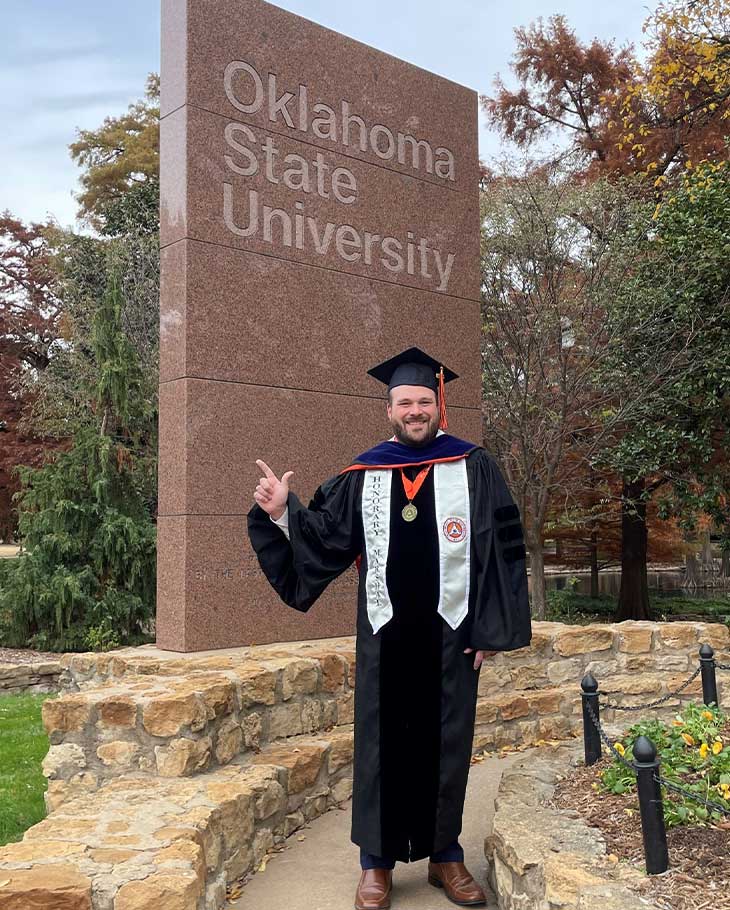
Physics Ph.D. student named Honorary Commencement Marshal

Physics Ph.D. student named Honorary Commencement Marshal

Tuesday, December 5, 2023

Media Contact:
Elizabeth Gosney | CAS Marketing and Communications Manager | 405-744-7497 | egosney@okstate.edu

Jared Austin-Harris, an Oklahoma State University Department of Physics Ph.D. candidate, has been named an Honorary Commencement Marshal for OSU’s fall 2023
graduate commencement ceremony. Austin-Harris is one of four graduate students selected for the role.  

This honor tops off Austin-Harris’ time at OSU and adds another distinction to his
academic career; he has earned two bachelor’s degrees in physics and mathematics,
master’s degrees in physics and teaching, learning and leadership and he will receive
his Ph.D. on Dec. 15.
 

I am excited to be recognized for my hard work and achievements during my graduate
career by being named as a graduation marshal,” Austin-Harris said. “As a first-generation
college student, I am humbled to be honored as such.”
 

As a student, Austin-Harris spent countless hours working in physics professor Dr.
Yingmei Liu’s lab, dating back to working on his undergraduate degree. The work he
did as an undergrad is still impacting the lab today.
 

Since joining our program in 2018, Jared has demonstrated outstanding research ability and potential,” Liu said. “He has successfully
implemented the first state-of-the-art highly programmable ultracold quantum simulator
in Oklahoma. T
his project combines modern developments in cold atom physics with important application-driven
precise sensor research in a completely unique way.”
 

His dedication to physics research and advancement has helped him build a resume stacked
with notable accomplishments and awards. Austin-Harris is listed as the first author
of four papers published in physics journals and won the 2023 Robberson Summer Dissertation
Fellowship, 2021-23 OSU Distinguished Graduate Fellowship, the 2022 and 2019 American
Physical Society Travel Award, the 2021-22 Walt Kolb Graduate Studies Scholarship,
the Niblack Research Scholarship, and the 2022 Joel Martin Endowed Scholarship.
 

Jared is a highly motivated student and has been an excellent mentor to several undergraduate students in the physics
program,” Liu said. “Jared’s work 
enabled my research group to win major research funds totaling more than $2 million. 

After graduating with his undergraduate degrees, Austin-Harris pursued a career in
education, teaching high school students for two years. Following graduation, Austin-Harris
will continue his work in Liu’s lab in a post-doctoral position that blends his passions
as an educator and a researcher. 
 

“This role will allow me to train and guide the next generation of Ph.D. students
to begin their work in the lab,” Austin-Harris said. “My long-term goals include the
opportunity to use my skills and love for both education and physics in a tenure-track
position within academia.”
 

Story By:
Erin Weaver, CAS Communications Coordinator | erin.weaver@okstate.edu

Want to Start Getting Paid for Your Photography? Follow This Formula

Want to Start Getting Paid for Your Photography? Follow This Formula

Aspiring photographers often hit a wall when trying to transition from hobbyist to professional work. It’s one thing to take nice photos for fun, but landing those first paid gigs requires a strategic approach and understanding of what a client needs, not just what you like to shoot. The fantastic video tutorial boils down a simple yet effective formula any beginner can follow to start photographing local small businesses and getting paid.

Coming to you from PJ Pantelis, this excellent video tutorial discusses how new professional photographers can get started photographing small businesses. Notice that Pantelis focuses on the client experience just as much as the final images. Clients are trusting you with the public representation of their image, and that’s a heavy responsibility. He walks through best practices like scouting locations, finding interesting angles, posing subjects, flattering lighting, and effective framing. But the nuts and bolts of running a shoot go beyond aperture and shutter speed. Making a genuine connection and delivering a great experience builds the trust and relationships necessary to get rebooked and referred for future work. Small touches like learning the client’s name, working efficiently, and sharing sample edited images soon after the shoot leave a positive, lasting impression.

For any photographer hoping to make that leap, applying Pantelis’ straightforward tips will simplify what can feel like an overwhelming process, and that’s important when you’re just starting out. With some solid fundamental techniques, intentional client care, and consistent delivery, the transition from amateur to paid professional photographer can be smooth.

If you’re looking to turn your photography talents into a money-making endeavor, be sure to check out the full video above and take notes on Pantelis’ invaluable advice. 

‘It’s been a grim year—but the importance of art cannot be overlooked’

‘It’s been a grim year—but the importance of art cannot be overlooked’

As the year ends, our thoughts are with the victims caught up in the war in Gaza. Our readers will be universally distressed at the suffering of innocent people, Palestinian and Israeli. Gaza has rightfully had saturation media coverage during the past few weeks. But at The Art Newspaper our remit is very much narrower: to focus on the impact of armed conflict on art, museums, archaeological and historical sites, religious buildings and heritage.

Gaza must be rebuilt and every society depends on its culture to help bind its people together

Needless to say, losses to culture pale into insignificance compared with the deaths, the injuries and the suffering caused by the displacement of millions of people—and the terrible fate of hostages. But in the long run, Gaza must be rebuilt and every society depends on its culture to help bind its people together.

Determining what damage has been caused to Gaza’s heritage is at present a very challenging task. The Art Newspaper has no correspondent in Gaza and, even if we did, reporters there operate under either Israeli or Hamas control. As all journalists know only too well, truth is the first casualty of war. But using a wide spread of media sources, we have done our best to assemble data on damage to Gaza’s culture.

Sadly, art has hardly flourished in Gaza because of the territory’s tragic late-20th century history. In 1948, the year the state of Israel was created, Gaza had a population of less than 50,000. Now it has 2.4 million inhabitants, making it among the most densely populated territories on earth. Half its people are registered refugees. Art must seem a luxury for people in these circumstances, although it can provide inspiration.

Quandary for museums and artists

The Gaza conflict creates a dilemma for museums and artists outside the region: should they express their views on the rights and wrongs of the Israeli and Hamas sides? Most museums have no special expertise in international relations and arguably should avoid getting entangled in political issues, although they should rightfully be concerned about threats to culture. Artists, as individuals, make their own decisions.

Looking back over this year, the situation in Ukraine since the Russian invasion of February 2022 is highly distressing. Assembling reliable information on damage to Ukrainian heritage has been difficult, although more feasible than for Gaza. Hardly a month has gone by since last year when The Art Newspaper has not carried a report on Ukraine. Our articles have covered damage to historic sites, Russian looting of Ukrainian museums, sanctioned Russian collectors and sponsors, leadership changes at Russian museums and Western support for Ukrainian artists. Sadly, the invasion has meant that cultural links between Russia and the West have become even more difficult than at the height of the Cold War.

Apart from these two terrible conflicts, what other major issues faced the art world in 2023? Restitution of African and Oceanic art seized during the colonial period, as well as the return of Native American and Canadian First Nations artefacts, is now very much on the agenda, particularly over items looted in the late 19th century by British troops during battles at Maqdala (Ethiopia), Benin (present-day Nigeria) and the Asante empire (present-day Ghana). Museums in Europe and North America will face even greater pressures for restitution in the coming year.

One can hardly avoid mentioning the crisis which hit the British Museum this summer, its most damaging since the Second World War. Revelations that one of its senior curators had allegedly stolen 2,000 antiquities from the museum over a 25-year period seemed almost unbelievable.

Hartwig Fischer rightly resigned as director, to be replaced by the steady hand of Mark Jones (formerly at the Victoria and Albert Museum) as the interim head. The search is now on for a new permanent director, who should take over by next summer. Their main challenges will be to restore the British Museum’s reputation, ensure security, and launch the ambitious masterplan to refurbish the building and redisplay the collection.

Looking back on 2023, one of the brightest spots was the Vermeer exhibition at Amsterdam’s Rijksmuseum. It deserves the highest praise for several reasons: reassembling so much of the master’s oeuvre (28 out of the 37 paintings), its elegant presentation, the number of visitors (650,000) and what it added to our scholarly knowledge of the artist. Vermeer was a triumph, a bright spot amid this year’s man-made disasters.

• Martin Bailey is special correspondent for The Art Newspaper