About

Posts by :

The Japanese photographer celebrating community in rural America

The Japanese photographer celebrating community in rural America


CNN
 — 

“I never really paid attention to politics before the 2016 election,” confided Japanese photographer Fumi Nagasaka over video call. Nagasaka moved to New York in 2002, witnessing two Obama wins before Trump’s divisive election victory seven years ago. “When it happened I just thought, ‘Okay, this country is falling apart’. Everybody started to be angry.”

Nagasaka’s concern then was about her practice: Leaving Japan for the United States had provided her with a sense of freedom to explore creative pathways she felt were otherwise limited. “In the US, it didn’t seem to matter what kind of education you had, as long you had talent and knowledge you had opportunities,” she said. In the aughts she began shooting American street style photography for a Japanese magazine, which would ultimately shape her more personal, culture-focused work. “I wasn’t confident with my English, but photography became a tool for me to meet people,” she explained.

Harnessing this sentiment, Nagasaka subsequently undertook a series of long-term projects examining adolescence across America, Japan, Canada and Europe, publishing the books “Untitled Youth” in 2016, “Teenage Riot” two years later, and in 2022, “Marching Wolves”. In 2017, incentivised by the election result and curious to rectify her unfamiliarity with the American South, she made the first of many trips that would become her new monograph, “Dora, Yerkwood, Walker County, Alabama.”

Travelling to Dora, a town of approximately 2,300 people, with her New York neighbor Tanya Rouse (a native of Alabama, her daughter had been one of Nagasaka’s earlier subjects), the photographer quickly became privy to the contrasts between New York City and the social and physical characteristics of the wider country. “I’d been to Los Angeles and San Francisco, but I’d never really been to a small rural town,” she recalled.

“I met some great people,” she continued. “It was Halloween and homecoming, so there were football games, a parade, a dance — it was the biggest event in town, so I photographed it.” She and Rouse decided then to return every year around the same time, and the new book is a rich and intimate document of their six years moving around the county.

Using a heavy duty, medium format camera however, Nagasaka’s presence initially garnered skepticism. While teens loosened when she shared her Instagram handle and they could trace her portfolio, others were harder to reassure. To remedy this, she contacted the local newspaper. “Everybody reads it, so we reached out about my project and an article came out. People started to understand what I did then, and I expanded the project.”

While working on the series in 2020, Nagasaka took on a separate commission to document the presidential election, an experience that further highlighted a gulf in the attitudes of the friends she had made and those back in New York, as well as compelling her to confront the disparities between the racial groups she encountered.

“Trump supporters were easy to find in Dora, they wore Trump hats and had Trump flags, but the Biden supporters were difficult. Nobody was putting signs up,” she remembered. “It was during Covid and in Yerkwood (a predominantly Black area south of Dora), nobody was outside. We knocked on doors, because I had photographed some people the year before, and were told that if they put signs outside, people would steal them.”

In the book itself, there are no images of flags or explicit references to politics, despite its role in the book’s genesis, having spurred Nagasaka’s initial intrigue in the South and the way politics reverberates in communities. As the photographer acknowledges in the book’s afterward, “Many people, including those who live there, sometimes associate the South with poverty and rural blight, and while it is undeniable that those things exist, what I found in Walker County was beautiful, charming and full of love.”

Instead, “Dora, Yerkwood, Walker County, Alabama” examines the human condition, employing the camera as a device to witness moments of joy and celebration, as well as quiet and tenderness. “This project changed my life and the way I see things, and this book is my love letter to the community,” asserted Nagasaka, whose care and warmth for the people she met is plain throughout.

“I didn’t want to bring politics into the project,” she continued, alluding to the book’s final form and the comfort she subsequently found in Walker County. “Even though that was happening in the town, I left it outside. I’m not a photojournalist, I’m an artist, and I was focused on celebrating this beautiful town.” Any political noise then, the viewer brings themselves, but what ultimately reads most prominently in the images is a sense of intimacy, extended from the community to Nagasaka and reciprocated in the work.

“Dora, Yerkwood, Walker County, Alabama” by Fumi Nagasaka is published by GOST Books and out now.

Inside the Archives: A Commitment to Indigenous Artists and Storytelling

Inside the Archives: A Commitment to Indigenous Artists and Storytelling
image

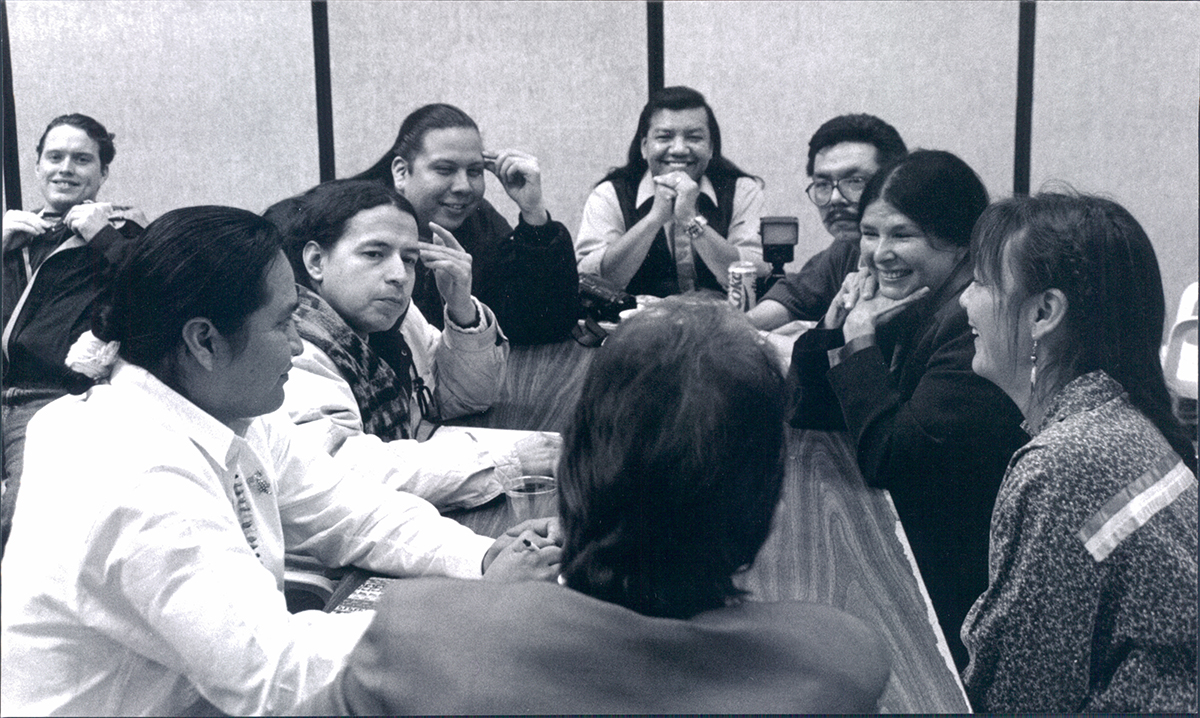
In addition to the films showcased, the In the Tradition: New Dimensions in Native American Film panel (moderated by writer, activist, and curator Paul Chaat Smith) brought together emerging and veteran artists, who discussed appropriation of Native stories, Native representation in the film industry, production opportunities, and the possibilities for change.

Panelists included Tantoo Cardinal, Alanis Obomsawin, Norman Patrick Brown, David Poisey, and Suzan Shown Harjo. Cardinal, who served as a Dramatic Competition Juror and starred in the Festival film Where the Rivers Flow North, also starred in seven other films at the Festival including award winner, Smoke Signals, and most recently, she acted in Martin Scorsese’s Killers of the Flower Moon. Obomsawin’s documentary Kanehsatake: 270 Years of Resistance was part of the 1994 program and she screened six other films at the Festival over the years. Brown and Poisey screened their films Awakening and Starting Fire with Gunpowder, respectively, during the Festival. And though Harjo did not have a film in the Festival, she shared insights from her career in journalism, policy advocacy, media, and film.

The Native Cinema section, later known as Native Forum, continued highlighting Native and Indigenous work during the Festival until 2004, screening over 160 films from artists around the world. The Festival retired the section in 2005, choosing to incorporate a steady stream of selected Native and Indigenous films into other Festival categories. In turn, the Indigenous Program, which formally began nearly 30 years ago, continues to support and elevate Indigenous artists and their stories. Recently the director of the Program highlighted accomplishments over the last year in his blog post An Indigenous Infinity: A Dispatch from Adam Piron.

Art shows to leave the house for this month

Art shows to leave the house for this month
image
Courtesy of @suneil_sanzgiri

HERE THE EARTH GROWS GOLD, SUNEIL SANZGIRI, BROOKLYN MUSEUM

In Here the Earth Grows Gold, NYC-based artist Suneil Sanzgiri uses 16mm film projection spliced with archival footage, animation, and interviews, alongside new sculptural assemblages comprised of bamboo, family photos, 3D renderings, anti-colonial publications, and nature imagery to examine the complexities of anti-colonialism, nationalism, and diasporic identity.

The work is deeply inspired by his family’s resistance while living in Goa, India, under Portuguese occupation. Through this debut solo exhibition, Sanzgiri links this legacy with that of African countries like Angola, South Africa, Morocco, etc, during the 1960s and 70s. Despite this personal anchor, the exhibition could stretch to any anti-colonial struggles raging today and inconsistencies of what’s regarded as official history versus one’s own lived history.

Until May 5, 2024

Summer of the Arts’ Holiday Thieves Market returns with new artists and returning favorite

Summer of the Arts’ Holiday Thieves Market returns with new artists and returning favorite

The Holiday Thieves Market fine art show is back this year with free admission.

The event will be held at the Hyatt Regency Coralville Hotel, Saturday, December 9 from 10a.m.– 6p.m. and Sunday, December 10 from 10a.m. – 4 p.m.

Visitor can buy from 84 fine artists (22 of which are new to the event) sharing their work in a wide variety of mediums including: ceramics, drawing, fiber, jewelry, mixed media, painting, photography, printmaking and wood.

Many of the artists will feature specific holiday items in addition to their usual work.

Stacie’s Greenhouse will also be at the event selling poinsettias and various other holiday plants for sale.

In addition to the fine art show, the Holiday Thieves Market Silent Auction returns.

It features over 20 items donated by businesses and individuals throughout eastern Iowa, including the return of a couple of last year’s most popular items. The silent auction takes place on Saturday and Sunday and closes at 3:30p.m. on Sunday.

You can learn more about this year’s participating artists and some of the silent auction items available this year, here.

First Americans Museum will host a Winter Holiday Art Market in Oklahoma City

First Americans Museum will host a Winter Holiday Art Market in Oklahoma City
image

The holiday season is starting early at the First Americans Museum of Oklahoma with the annual Winter Holiday Art Market this weekend.

Each December, the First Americans Museum holds the Winter Holiday Art Market. The exhibit showcases over 50 artists and vendors, selected as the best First American artists in the country.

From handmade jewelry, authentic food and remarkable art, the Winter Holiday Art Market has something for any and all visitors to enjoy.

The event will be held Friday through Sunday.

First Americans Museum (FAM) shares the histories of Oklahoma’s 39 tribal nations. The museum honors the indigenous people who inhabited what is now the state of Oklahoma.

A full schedule of the event is below:

Friday

  • 6 p.m. Doors open to Hall of the People
  • 9 p.m. – Close

Saturday

  • 11 a.m. to 4 p.m. Artist Market – Hall of The People

Artist Demonstrations & Story Time in Five Moons Theater

  • 1 p.m. Story Time with Sarah Brown, Choctaw
  • 2 p.m. Metalsmithing with JJ Otero, Master Silversmith
  • 3 p.m. Story Time with Sarah Brown + (Indigenous Santa Visit)
  • 4 p.m. – Close

Sunday

  • 11 a.m. to 4 p.m. Artist Market – Hall of The People

Artist Demonstrations & Story Time in Five Moons Theater

  • 1 p.m. Story Time with Sarah Brown, Choctaw
  • 2 p.m. Metalsmithing with JJ Otero, Master Silversmith
  • 3 p.m. Story Time with Sarah Brown + (Indigenous Santa Visit)
  • 4 p.m. – Close