About

Posts by :

Local woman takes top prize at arts center members’ show

Local woman takes top prize at arts center members’ show
Josy Wright alongside her best-in-show winner, “Fog Lifting,” at the Jamestown Arts Center annual members’ exhibition. She won from a field of 98 artworks. A local printmaker was awarded best in show for her etching at the annual members’ exhibition at the Jamestown Arts Center. Josy Wright’s submission, “Fog Lifting” was chosen from 98 works

Updated designs released for National Aboriginal Art Gallery

Updated designs released for National Aboriginal Art Gallery

The Northern Territory government has unveiled new designs for the National Aboriginal Art Gallery in Mparntwe (Alice Springs), with updates made to the interior atrium and facade.

In March 2022, the territory government appointed BVN and Susan Dugdale and Associates to design the gallery with landscape architecture to be completed by Aspect Studios and Clarsen and Clarsen. The project has been co-designed with the local Arrernte community as well as with input from First Nations peoples from across Australia through the National Reference Group, which comprises 11 members, nine of whom identify as First Nations people and three as Traditional Owners of the local estate group of Mparntwe.

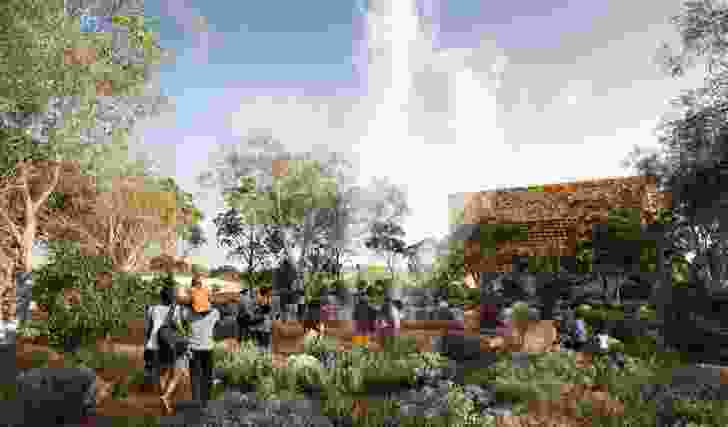
Gallery amenities and features remain relatively the same with a First Nations-led and governed gallery, a cultural welcoming circle, a four-storey atrium, a top-floor event and function space, a ground-floor cafe, an outdoor public area, healing gardens to protect and preserve sacred sites, and a Kwatye (water) play park still planned for the site.

The pinkish, earthy shade of the atrium and stairwell area has been updated to a more neutral, creamy colour palette with the skylights above the stairwell redesigned.

The pinkish, earthy shade of the atrium and stairwell area has been updated to a more neutral, creamy colour palette with the skylights above the stairwell redesigned.

Image:

Northern Territory Government

The atrium and stairwell has been redesigned with two oval-shaped skylights above the stairwell replacing three geometric triangular apertures. A walkway originally depicted as being suspended above the stairs and wrapping around to the right of the atrium has also been removed and substituted with a more subtle walkway to the left of the stairs.

Render of the cultural welcome space.

Render of the cultural welcome space.

Image:

Northern Territory Government

Plans state the vision for the gallery is to celebrate and display First Nations artwork, share stories and interpretations of the world’s oldest continuous culture, encourage local participation in arts programs and events, generate employment opportunities during the construction phase and upon completion of the gallery, as well as “create a high-quality cultural facility that stands as an iconic architectural statement, driving tourism, enhancing liveability, and promoting social and economic objectives.”

A tender for the construction of the project is now open until 14 December 2023. Construction is expected to commence in late 2027, with the gallery anticipated to open in early 2028.

Elon University digital art showcase displays importance of recognizing Indigenous artists, history

Elon University digital art showcase displays importance of recognizing Indigenous artists, history

Elon University’s Center for Race, Ethnicity and Diversity Education hosted a beading workshop, as well as an Indigenous digital art showcase, as part of its Native American and Indigenous Heritage Month celebration.

The workshop was led by Vickie Jeffries, a tribal administrator for the Occaneechi Band of the Saponi Nation, and took place in the CREDE office Nov. 13. 

“Inventive Minds: An Indigenous Art Showcase” displayed a variety of artworks from different time periods. Set up in the CREDE office on the second floor of Moseley, viewers walked around and looked at art from museums, caves and more. 

Sitting beside the art pieces were explanations of the meanings behind the works, such as the importance of the colors, symbols and history of the pieces. Attendees could also scan QR codes on the descriptions to learn more. 

The showcase on Nov. 8 featured photographs of rock paintings found inside a cave in Alabama  displayed as a group of works on one screen. According to the description, the paintings were discovered in an unnamed cave in 1999. While only a few of the paintings were pictured in the display, there were thousands of images found within the cave.

According to Jan Simek, an archeologist and professor at the University of Tennessee, the paintings are thought to have held spiritual importance because the region’s indigenous groups believed that caves were “portals to the underworld.” 

image
Charlotte Pfabe | Elon News Network

Paintings from an unknown cave in Alabama on display in Elon’s Center for Race, Ethnicity and Diversity Education on the second floor of Moseley on Nov. 8. The creators of the paintings are unknown, as the art dates back to 660 and 949 C.E. 

Many students involved in the CREDE’s African-American, Black, Latinx, Hispanic, Asian, Pacific Islander, Native American, Alaskan Native and Multiracial initiatives — or ALANAM — coordinated and attended the event as well. 

Sophomore Maylee Clerici works in ALANAM initiatives as a student coordinator and member of the organization’s marketing team. She said that she played a role in choosing to display the rock paintings because they “reveal a little bit about the mystery of the past and how Native American communities thrived in those earlier years.” 

According to Clerici, the artists are unknown.

“It’s a little bit unknown who the artists are but the artists date back to 660 and 949 C.E. during the woodland period,” Clerici said. 

Another piece of artwork displayed was a painting featuring symbolism of turquoise. The piece, titled “Turquoise Water and Sky: The Stone and its Meaning,” comes from the Museum of Indian Arts and Culture in Santa Fe, New Mexico.

According to the painting’s description, turquoise represents the sky and the water in Native American culture, and is said to have healing and protective powers. It’s commonly used in Pueblo and Navajo ceremonies and gatherings, according to the MIAC

Native American and Indigenous Heritage month continues through the entire month of November. The CREDE started its Heritage month celebrations with a kick-off event featuring indigenous artists, food and prizes on Nov. 1 and plans to continue the celebrations by supporting local Indigenous artists. 

Junior Jorah Midgette is a member of ALANAM initiatives as well and said that the best way to get involved with NAHM activities and ALANAM events is to keep in touch with the CREDE. She also said that the goal of these events is to “prioritize space for native and indigenous students here on campus.”


Festival spotlights Indigenous artists

Festival spotlights Indigenous artists

When Gabriel Ayala — an internationally recognized guitarist and painter — noticed the lack of Native American cultural events in Tucson, he created his own.

The first Native American Arts and Music Festival is Friday, Nov. 24, at the Plaza at Hotel Congress.

The theme, “All My Relations,” encourages the exchange of cultures.

A member of the Yaqui people of Southern Arizona, Ayala said the city had Tucson Indian Days 20 years ago.

“It was a full week of cultural events that led up to a giant powwow at the convention center,” Ayala said.

“It unfortunately just fizzled out and never happened again. I was always disappointed and wishing that something like this would happen again. I took it upon myself to reach out to the people at Hotel Congress and pitched them the idea. They loved it, and I’m very thankful that they are hosting the event for us.”

Ayala participated in “Tucson Indian Days,”

“It was seven full days,” he said.

“Every night, there were concerts or some type of cultural event happening at various locations throughout all of Tucson. Now, it’s just vanished. I remember being a part of these events. I remember going to watch these concerts. I remember as a powwow dancer going to the powwow and dancing all weekend long. It was at the hockey rink, and they would have to put mats over the ice. What a great memory. It’s too bad it’s just a memory, and this generation doesn’t know it. Hopefully in the years to come, we will make this a weeklong festival.”

He hopes to see his event continue to grow, highlighting different Native American cultures.

“I want to start bringing something back,” Ayala said.

“Here, it’s Native American Heritage Month, and there’s not a lot going on. So, I thought if I can bring it back, we’ll start with a one-night event, go into two days next year and start slowly adding a day or two here and there. I would love to be responsible for bringing back ‘Tucson Indian Days.”

The upcoming event will honor Native American contributions in the Southwest by highlighting local Indigenous musicians, artisans and dancers.

Ayala said it was important to him to showcase traditional and contemporary performers. Among this year’s performers are world champion hoop dancers Sampson and Scott Sinquah.

The show’s headliner is One Way Sky, an alternative rock group of youth from the Tohono O’odham Nation and Gila River Indian Community.

Ayala said he wanted to spotlight this up-and-coming group.

“As an older musician, someone who has been at it for my whole life, I felt it is important to showcase them, these artists that don’t always have the opportunity to be a headlining band,” Ayala said.

Many performers are also visual artists. Along with playing the Native American flute, Randy Kemp is a storyteller, painter and printmaker. He is a member of the Choctaw, Muscogee-Creek and Euchee tribal nations.

Adrian Wall is a renowned sculptor, Native American flute player and singer-songwriter from the Acoma Pueblo in New Mexico.

Ayala chose artists from a range of mediums, who will bring clothing, wall art, jewelry and other types of artwork.

“Everything is going to be really diverse and multimedia, so it’s not the same things at every booth. Everybody is going to be unique to themselves,” Ayala said.

During the event, Ayala will act as emcee. He wanted to spotlight others.

“For me, I didn’t want it to be just about me,” Ayala said.

“I didn’t want to run an event so I could just showcase myself and blast myself the whole night. In our culture, it’s never about that. It’s about giving back. For me, this festival is really about giving back and letting everyone else shine.”

Sebastião Salgado to receive outstanding contribution to photography award

Sebastião Salgado to receive outstanding contribution to photography award

15 November 2023

Iconic documentary photographer Sebastião Salgado is set to receive the Outstanding Contribution to Photography Award from the Sony World Photography Awards 2024.

The fight against burning oil wells, Kuwait oil fields, 1991. © Sebastião Salgado

The Brazilian photographer is known for his powerful black-and-white imagery incorporating themes of poverty, war, displacement, and the environment captured over a career spanning more than 50 years.

The Outstanding Contribution to Photography Award recognizes a person or a group of people who have made a significant contribution to photography. Salgado is the 17th recipient of the award, and joins the likes of William Egglestone (2013), Elliot Erwitt (2015), Martin Parr (2017), and Rinko Kawauchi (2023).

Draped in blankets to keep out the cold morning wind, refugees wait outside Korem camp. Ethiopia, 1984. © Sebastião Salgado

“I am honoured to receive this award, and to know that my work is reaching audiences,” Salgado says.

“Photography is my way of life, it is my language, and throughout my career I have always been interested in capturing the historical moment in which we are living, and telling the stories of our species and our planet.

“A photographer photographs with his heritage, and in my work I seek to explore our shared human experience.”

A marine iguana. March 2004 © Sebastião Salgado

Dozens of photographs by Salgado will be on view as part of the Sony World Photography Awards 2024 exhibition, which will be on show at Somerset House, London from 19 April – 6 May 2024.

The selections feature works from his early projects such as Gold (1986) and Workers (1993), and more recent series like Genesis (2011) and Amazônia (2019).

Born in 1944 in Aimorés, Brazil, Sebastião Salgado trained and practised as an economist before embarking on a full-time career in photography in 1973, going on to work with leading photographic agencies Sygma, Gamma and Magnum.

According to Salgado, his childhood in rural Brazil, surrounded by the great expanse of nature and the open skies, was an important aesthetic touchpoint, guiding his lens and informing his approach to light, contrast and proportionality.

In the 1980s and 1990s, he travelled around the world to pursue many photography projects, producing a number of acclaimed series, which continue to influence visual culture today.