
A descendant of the Irish-born inventor of the modern-day submarine has created a sculpture in his honour, made from recycled airliner parts.
Irish-born submarine inventor honoured with sculpture


“I think over time you get better at spotting emotions, as well as gestures, compositions, and more because these are the things that you’re constantly looking for; The ingredients of a photo,” says Willie Velazquez, arguably one of NY’s best street photographers, to the Phoblographer in an interview. “I think you may even begin to take in the world in a different way compared to the people around you who don’t shoot.” He continues to state that sometimes, even he doesn’t know what he sees — but it’s a gut reflex to just shoot. Overall, he attributed some of his work to just pure luck.
All images by Willie Velazquez. Used with permission. Please visit his website and his Instagram for more.
Willie first started out in sales, and that kept things running for him into the end of his 20s when he was finally making good money. But for him, life became really monotonous and rigorous. “Days melted into each other, and sleep was minimal due to the 5+ coffees I had daily,” he describes to us. “When the coffee lost its effects, I began supplementing. That led to barely sleeping at all during the work week, which I made up for by sleeping in all day on weekends, waking only to eat, and sometimes socialize.” That’s when he realized he was burning out and it was time to try something else.
Growing up, Willie had a lot of cameras but wanted something more professional. So in 2019, he bought a Canon Rebel. “Afterwards I sat outside on a nearby bench, unboxed the camera, turned it on and almost immediately realized I had no idea what or who to shoot,” he tells us.


Willie was a rapper in a past life, and grew up with Hip Hop cover albums as a prime example of photography. He didn’t live that life anymore though, so he went to parks to photography. From there, he shot streets, buildings, and eventually started photographing people. “After a short while, I just started walking around with the camera everywhere I went,” Willie shares. “It could’ve been a 5-minute trip to the store and back; I’d have the camera on me, finger on the shutter at all times. I was in the beginning stages and didn’t even realize street photography was an actual thing yet.” Needless to say, he was hooked.
For a while, Willie shot film: specifically a Leica M6 and an Olympus Mju II. And these days, he’s been using a Leica M10p and a Ricoh GR III. “So far, it’s the longest I’ve gone without feeling the urge to buy another camera, so I’m feeling great about that,” he shares with us. “Depending on the day I’m either shooting 28, 35 or both. I’m really at home with those two focal lengths.” Besides this, he carries a flash.
Somebody once told me they didn’t shoot the homeless, the disabled, children nor senior citizens. His work was unremarkable to me, as I’d expect. No life in it. Mostly hip shots and side profiles of people just walking in the street, and a considerable amount of shots from behind a person; portraits of the back of heads. But seldom did he shoot head on. He was dabbling, beginning. We all go through it.
Willie Velazquez
Willie’s thought process and creative vision are fascinating. While many street photographers shy away from photographing the homeless and disabled, Willie tends to embrace it in a way that tells a much larger story than what we tend to see from more green photographers. Part of this perhaps comes from his upbringing.
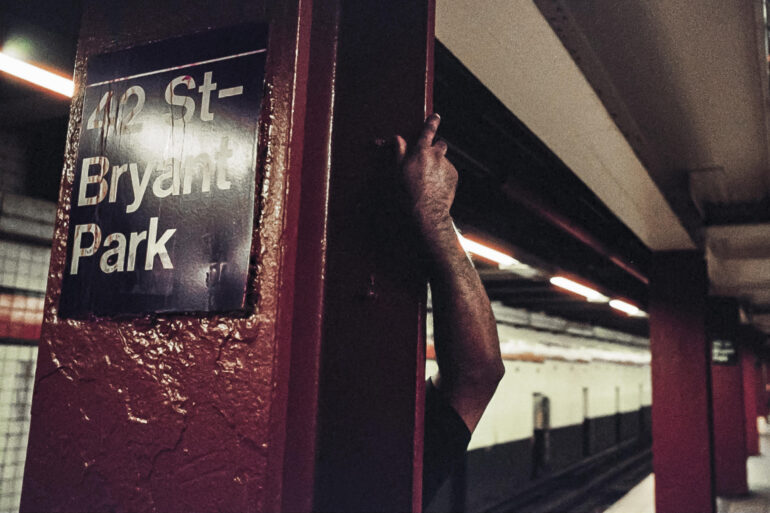


Instead, Willie tells us that he shoots without restrictions. And in many ways, his images tell a story of NY that isn’t being told. It’s one with economic disparity at the root. “…if there’s any consideration to be made, it’s in the curation of my work and what it is I choose to share,” Willie explains. “But when I’m outside and shooting, it’s mostly a reflex to what I see and the feeling it evokes, whatever that feeling may be. To put a restriction on that is not being true to the soul of the work.” In the long run, Willie thinks that it more or less just became a reflex.
Can’t speak on the professional implications since photography is yet to be my main source of income. But as far as AI itself I’d be more curious to know once it’s got a uniform, hive-minded opinion on the human race. But when it gets to that, photos will probably be the last thing to worry about.
“And morally speaking; is it really any better to treat any demographic like they don’t exist and make the effort to not include them in an art form I put my heart and sweat into?”
Of course, Willie’s work is also quite raw, and not the type of stuff that you’d ever see an AI duplicate. To that end, Willie thinks that AI is fun and that people are making some remarkable visuals with it. “There’s a series of Steve Harvey running from monsters in the woods that looks like they shot it on a Polaroid I think,” he says. “I can’t get enough of it.”

 Hannah O’Hara
The seaside towns of England’s North West are places steeped in nostalgia for many, filled with echoes of childhood trips, ice creams and bracing walks along the prom.
Photographer Hannah O’Hara was no different when she was commissioned to create work that reflected Fleetwood’s “people, places and heritage”.
However, she says spending a year “immersing” herself in the Lancashire fishing port has also given her a new perspective.
And the driving force for that was, she says, a simple one.
“People are much more talkative than in the South.”


O’Hara is based in Sussex, but her father lived in Blackpool when she was a child and she has “fond memories” of trips to Fleetwood.
So she jumped at the chance to return there for a year, thanks to a commission from photography charity Photoworks and Fleetwood High Street Heritage Action Zone‘s cultural programme.
And while she admits that immersing herself in the culture of the town, which included taking photography walks with residents and visiting care homes to speak to residents, “triggered nostalgic memories”, it also allowed her to embrace Fleetwood’s “amazing community”.


“People are so friendly,” she says.
“I have met and worked with so many kind individuals who have helped me develop this project and given their time freely and told their stories openly.
“It has been a privilege as an artist to hear their memories.”
The resulting exhibition, From Nothing to Now, shares the stories and images she has gathered and explores the themes that run through all her work – temporality, place and memory.
It includes both her own images and some of those taken by residents on their photography walks and is being shown across the town, in its museum, library and bustling market.


The wider cultural programme’s arts engagement co-ordinator Angelica Vanasse says O’Hara’s “dedication” to the work and “getting to know the people in Fleetwood has helped to create opportunities for connection to shape the stories… in ways that are meaningful to people in the present”.
“Hannah has gotten to know people… across the high street and its businesses, in cultural organisations, care homes and in community environments,” she says.
“The exhibition… reflects their heritage, stories, memories and connection to place in ways that are rooted deeply in the present and being proud of the place they call home.”
Photoworks curator Julia Bunnemann says the strength of it is the result of the “strong connections” O’Hara has made with people “across all ages and backgrounds… from a diverse range of local communities”
“It has been brilliant to witness the genuine connections that have emerged as a result of her artistic exploration,” she adds.
From Nothing to Now is at Fleetwood Museum, Fleetwood Library and Fleetwood Market until 28 November.


In “Louisiana Lens: Photographs from The Historic New Orleans Collection,” John H. Lawrence skillfully weaves a captivating visual narrative of New Orleans, Louisiana and the Gulf South.
Lawrence traces the evolution of photography from daguerreotypes to digital, contextualizing each image within the social and cultural fabric of the city. He explores themes of architecture, music, race and more. Accompanied by 131 black-and-white and 44 color photographs, the hardcover volume is a testament to Lawrence’s encyclopedic knowledge for visual culture.
Its price is $49.95 and may be purchased online and in person at The Shop at The Collection, THNOC’s museum store.
– The Historic New Orleans Collection

Please join us for a free, family-friendly, indoor & outdoor holiday makers market featuring handmade gifts by local artistsans from DC, Maryland, and Virginia.
While you shop, you can enjoy:
Free hot chocolate and coffee
A free holiday ornament-making activity
There will be vendors in the main parking lot as well as inside the church on the lower level. The indoor portion of the market is wheelchair-accessible through the elevator on the main floor.
There is free parking along Nelly Custis Drive, though the parking lot will be closed for the event.
Founded by a local artist and native Arlingtonian


From the Cochiti Pueblo to traveling the world, one artist has followed his dream but has never forgotten his roots.Virgil Ortiz found a niche for art by the time he was 6 years old. To have an exhibit to portray his Native American history is something he never thought would happen.”It’s such a contemporary art space and gives an artist a voice, a pillar, to educate everybody on what we want to talk about,” Ortiz said.Ortiz welcomed the opportunity to have his work featured at Meow Wolf in Santa Fe. From flashing lights to giant sculptures, Ortiz is highlighting the importance of preserving Native American history. “Our history, which is really not taught in our schools, it’s not our history books. It’s been basically been swept under the carpets,” Ortiz said.Through his exhibit, he shows a group from the future on a mission to preserve his people’s history.”Their purpose is to come from the year 2180 to the present time and historic times and what they’re doing is collecting our songs, our traditions, our ceremonies, our artwork, our designs, storing them and protecting them,” Ortiz said.The focus of the exhibit is not only to preserve the traditions of the Pueblo people, but to display the impact of the 1680 Pueblo Revolt — what he calls the first American revolution.Coming from a family he would say is familiar with creativity and art, he learned early to find his passion for it. As a kid from rural Cochiti Pueblo, Ortiz said his Native American background paved the way for him to become the artist he is today.
From the Cochiti Pueblo to traveling the world, one artist has followed his dream but has never forgotten his roots.
Virgil Ortiz found a niche for art by the time he was 6 years old. To have an exhibit to portray his Native American history is something he never thought would happen.
Advertisement
“It’s such a contemporary art space and gives an artist a voice, a pillar, to educate everybody on what we want to talk about,” Ortiz said.
Ortiz welcomed the opportunity to have his work featured at Meow Wolf in Santa Fe. From flashing lights to giant sculptures, Ortiz is highlighting the importance of preserving Native American history.
“Our history, which is really not taught in our schools, it’s not our history books. It’s been basically been swept under the carpets,” Ortiz said.
Through his exhibit, he shows a group from the future on a mission to preserve his people’s history.
“Their purpose is to come from the year 2180 to the present time and historic times and what they’re doing is collecting our songs, our traditions, our ceremonies, our artwork, our designs, storing them and protecting them,” Ortiz said.
The focus of the exhibit is not only to preserve the traditions of the Pueblo people, but to display the impact of the 1680 Pueblo Revolt — what he calls the first American revolution.
Coming from a family he would say is familiar with creativity and art, he learned early to find his passion for it. As a kid from rural Cochiti Pueblo, Ortiz said his Native American background paved the way for him to become the artist he is today.







