
Exploring campus art with the Haggerty Museum of Art’s Emilia Layden and art club president Will Eikenbary.
Surrounded by art: highlighting Marquette’s colorful campus palette


ONEONTA — Ten students at the State University of New York at Oneonta recently exhibited a collection of photographs from a faculty-led documentary photography course in Portugal. Two area residents were among those to participate in the course:

EAST GREENSBORO, N.C. (Oct. 25, 2023) – The University Galleries at North Carolina Agricultural and Technical State University will host the 2023 Alumni Art Exhibition during its homecoming celebration. Set to present a diverse range of styles, subjects and mediums, the group exhibition will showcase alumni artists from the university’s Visual Arts Program.
The exhibition’s opening reception is Thursday, Nov. 2, at 5:30 p.m., and will be on display through Dec. 13.
“Over 100 works of art are being exhibited from more than 50 A&T visual arts alumni,” said Roy Carter, A&T associate professor and director of the Visual Arts Program. “This is a massive collection of work from our visual arts graduates who are recognized artists across the nation and the globe.”
The exhibition will spotlight the work of numerous outstanding alumni, including Durham, North Carolina native Jalen Jackson ‘21, the featured artist for the show. He has been highlighted in Walter Magazine and various group exhibitions across North Carolina, including 311 Art Gallery, Anchorlight Studios, Wake Tech, The Fruit and Artspace, where he’s the 2023 Artspace HBCU Artist-in-Residence in downtown Raleigh, North Carolina.
For this exhibition, Jackson captures his childhood memories in oil paintings that resonate with cultural experiences, especially growing up as a son of a single mother. He said his paintings are the best way to show his appreciation toward his mother and his motivation throughout his journey as an artist.
“The woman who raised me has been the best mother, teacher, role model and muse I could ever ask for,” said Jackson. “My goal is to create a sense of nostalgia while giving a representation of Black soul for whoever interacts with my work.”
Other highlighted artists in the alumni exhibit include Charles Joyner, a North Carolinian who portrays images that document various genres of African American and African culture. His artwork is a transparency of his life growing up in rural North Carolina that has been strongly influenced by his travels in West Africa. A retired professor of design at North Carolina State University, Joyner has been creating, exhibiting and teaching art for more than thirty years. His works have won numerous awards in national exhibitions and are exhibited in museums and galleries throughout the southeast. Joyner earned a B.A. in art and design from A&T and an MFA from the University of North Carolina at Greensboro.
“These artists and others that have come through this program are why we have been able to be successful as a historically Black college/university art program,” said Carter. “Our job is to mentor, guide and develop them as professionals.”
Another well-known artist showcased in the exhibition is Vandorn Hinnant, a visual artist, poet and educator based in Durham. He received a B.A. in art and design from A&T. His works of art are in private collections in Africa, North America and Europe, and public collections across North America. Hinnant leads hands-on workshops on “The Geometry of Art and Life” for learners of all ages. He is co-author with Robert Powell Sr. and Robert Powell Jr. of the book: “The Rest of Euclid: An Ancient Architecture of Arithmetic and the Modern Theory of Number.”
The exhibit will be open to the public during normal University Galleries hours, Monday through Friday, 10 a.m. to 5 p.m. and Saturday by appointment. Exhibitions are free. Group tours are welcome. For more information, call Carter at 336-334-3209.
Nov. 2
Alumni Panel Discussion, 11 a.m.-noon
Opening Reception, 5:30 -7:30 p.m. (Greetings begin at 6 p.m.)
North Carolina Agricultural and Technical State University
Henry Clinton Taylor Gallery, Dudley Building
202 University Circle
Greensboro, NC 27411
Student Workshops
Alumni artists will hold workshops and portfolio presentations throughout the exhibition.
In addition, the University Galleries feature virtual exhibitions, which include:
“Black Art Matters,” https://www.ncat.edu/cahss/gallery/black-art-matters.php
“Rosa: The Works of Bryan Collier,” https://www.ncat.edu/cahss/gallery/collier/index.php
“Songs from the Motherland: Musical Instruments from the Permanent Collection,” https://www.ncat.edu/cahss/gallery/songs-from-the-motherland/index.php
To learn more, visit the University Galleries website.

The route to Benjamin Rinenbach’s career was not direct, even though photography has been a lifelong passion.
“I’ve always been fascinated by photography,” said Rinenbach, 46, an award-winning Rancho Bernardo photographer. “Since I was a kid, before I could read, I was looking at ‘National Geographic’ magazines, fascinated by the pictures.”
Throughout his life, in the military, working in construction and as a firefighter/paramedic, Rinenbach said he always took photos with whatever camera he had, be it a point-and-shoot or smartphone. But it was not until six years ago that on a whim he decided to pursue photography seriously.
“A spinal fusion and a drunken late night camera purchase on eBay changed his path forever,” he wrote on his website, rinenbachphotography.com.

This photo by Benjamin Rinenbach is called “4 minutes at Sunset Cliffs.”
(Benjamin Rinenbach)
That path is taking him to the San Diego Convention Center, where Rinenbach will be among the 95 exhibitors representing hundreds of artists from across the country and around the world displaying their works Nov. 3-5 at the 15th annual Art San Diego.
Rinenbach plans to exhibit around 20 photos, ranging from 12-inch squares to 30-inch by 40-inch.
Last year, he won Art San Diego’s “Best Solo Exhibitor” award during his debut at the event.
“It was a nice shot in the arm, overwhelming,” Rinenbach said about his award. “I am extremely humbled and appreciative of it.”
Art San Diego is organized by the Redwood Art Group, which holds contemporary art and design fairs across the United States. In addition to the exhibits, the event will feature art labs that provide interactive experiences. The fair has also partnered with Monarch School, Humble Design and Arts District Liberty Station. Artwork purchased through this partnership will benefit downtown San Diego’s Monarch School, which educates elementary through high school students who are homeless.
Rinenbach’s self-taught photography is primarily in black and white. His inspirations are photographers Edward Curtis and Ansel Adams, along with film directors John Ford and Sergio Leone.
The Chicago native said during the early parts of his life he lived “a predominately left-brain existence.” This included being a skateboarder, gymnast and “secretly” writing poems while serving as an Army infantryman and working in construction. A back injury six years ago while firefighting in Chicago ended his 12-year career as a firefighter/paramedic.
During his recovery he started pursuing his right-brain creative side.
“I wanted to explore and experiment with the artistic side of myself,” Rinenbach said. “I have fallen in love with it.”
His preference is for black-and-white photography.
“I find color to be distracting,” he said. “I like shadows, shapes, contours and contrasts. I find no benefit of those in color. I love looking at black-and-white. It is emotive and suiting to my eyes. It is interesting to my eyes.”

Benjamin Rinenbach took this photo at Joshua Tree National Park. He calls it “Josh at Dusk.”
(Benjamin Rinenbach)
Three years ago Rinenbach, his wife Christa, who grew up in Scripps Ranch, and their now 15-year-old son, Ben, and 13-year-old daughter, Cam, moved to Rancho Bernardo. Leaving Chicago, where the couple met, and moving to San Diego to be closer to his wife’s family was something they had wanted to do for a long time, he said.
Since moving here, Rinenbach said he has found lots of creative inspiration. He calls most of his photos “desert and coastal noir,” so he has many options within a short drive. Taking photos of the Pacific Ocean and San Diego’s coastal areas is a given for local photographers, he said, but some of his favorite spots are in San Diego’s desert.
“For me, to have the ability to be in a place where I can look at the horizon in any direction and there is nobody between in that chunk of the world, but yourself, the critters and clouds … there is great peace. It is humbling. There is nothing man-made. It is just mother nature in any direction.”
His favorite lighting is overcast. He said he often does long exposures, letting the lens stay open from two to eight minutes.
“The cloud cover or water collaborates with you … with the clouds you do not have any blown-out highlights from the sun, which is too harsh,” he said. “It is just natural filtered light that provides great photo opportunities.”
Rinenbach said he enjoys the process, which requires him to be patient and slow down. “I can’t wander away, so I am forced to be patient and enjoy the scene before me. It is about more than a cool snapshot, but the process for me.”
Cam sometimes accompanies him on his photography road trips that may have no set destination. He stops when inspiration strikes.
“My daughter is very invested in it, has a decent camera and gear, and explores with me,” he said. “Not long from now she will be a far superior photographer than I am.”

This photo by Benjamin Rinenbach is “4 minutes at Cabrillo.”
(Benjamin Rinenbach)
He did not start out doing landscape photography. Initially, he took whatever jobs he could get, which is why he has several photos of ballet dancers on his website. He started working with a ballet company in Chicago, which led to him not only photographing the dancers, but their families who liked his experimental and artistic style.
“I loved it,” Rinenbach said about working with the dancers. “I figured that work was not too far astray, very emotive and high contrast … it was a good fit for my style.”
Even now, when creating some of his visual arts pieces that often incorporate multiple levels of glass with his photography, he will overlay a photo of a dancer with a landscape scene to create a new image.
“It is other worldly,” Rinenbach said of the final image.
Rinenbach said he enjoyed exhibiting his work at last year’s Art San Diego and that it led to several commissions for him. For example, he was hired by San Diego biotech company Illumina to help decorate its building. He contributed work that incorporated acrylic and wood with his photography and was involved in the installation’s coordination so all the artwork complements the building’s design.
Some of his mixed-media is 3D photography sculptures that weigh 50 to 100 pounds due to the multiple layers of glass.

Benjamin Rinenbach took this 4-minute long exposure of the Ocean Beach pier. He calls it “Oceanic Shavasana.”
(Benjamin Rinenbach)
Art San Diego is open noon to 5 p.m. Friday, Nov. 3; 11 a.m. to 7 p.m. Saturday, Nov. 4 and 11 a.m. to 5 p.m. Sunday, Nov. 5. It is in the San Diego Convention Center, Hall E, 111 W. Harbor Drive. Tickets in advance are $30 for a three-day pass, $20 for general admission and $10 for students, seniors and military. Prices are higher at the door. Buy at redwoodartgroup.com/art-san-diego.
A special offer has been extended to Pomerado News readers, who can access free tickets at bit.ly/ASD23-COLLECTOR-NE.
Tickets — paid or free — do not include parking at the San Diego Convention Center, which is an additional fee.

A Free Workshop Series for Families at the WaterFire Arts Center
WaterFire Providence announces the launch of ArtLab@WaterFire: Creative Labs, a new and free workshop series for families of all ages to ignite their creativity and make art together. Hosted on weekends at the WaterFire Arts Center (WFAC), these workshops are available to kids and families of all ages

Local photographer Dwan Miller, 47, found inspiration to do photography from his daughter. Because of her, he said he has found the passion that has filled his free time and helped him connect with his daughter on a deeper level.
“It’s a valuable connection,” Miller said. “I got separated from them at an early age from their mom. Having a connection with her this strong means the world as a father. Every day we talk and every day we are teaching each other more. And it’s more than just photography, it’s about life.”
Dwan Miller stands next to a 1931 Hupmobile Century Six Series S at Midwest Dream Car Collection in Manhattan, while attending the Black Entrepreneurs of the Flint Hills’ Circle of Community Black Business Gala and Awards on Feb. 25. Miller, 47, a North Carolina native, joined the military when he was 20 and served until 2017.

Valle de los Vientos Wind Farm, Atacama Desert, Chile (2017). All images © Jamey Stillings, courtesy of Steidl, shared with permission
An arid region with uncanny similarities to Mars, the Atacama Desert is sparsely inhabited by animal life but rich in mineral deposits. Located west of the Andes Mountains in northern Chile, the area is home to massive mines harvesting a third of the world’s copper and lithium supplies. These extractions date back to at least the 19th century, having scarred and damaged the landscape in the process.
The same dry, sun-soaked qualities that make the Atacama inhospitable uniquely position it as a lucrative site for generating wind and solar power, two forms of renewable energy that stand in opposition to the region’s history of fossil-fuel dependence. Santa Fe-based photographer Jamey Stillings spent part of 2017 flying over the region documenting the shift toward sustainable sources, now compiled in a recent book published by Steidl.
Dozens of aerial images fill the 160 pages of Atacama: Renewable Energy and Mining in the High Desert of Chile, juxtaposing the older mines with the newer solar and wind plants. Stillings not only captures the beautiful and saddening sights most humans will never witness firsthand but also illuminates our current crossroads: as we collectively consider how to live in ways that are less ecologically destructive, we also need to plan for realistic, and even obvious, alternatives like those available in Atacama and clearly identify how we’ll transition from one system to the next.
Atacama is available on Bookshop, and you can find more from the series, along with Stillings’ other projects, on Instagram.

Cerro Dominador Concentrated Solar Plant under construction, Chile (2017)

El Romero Solar Photovoltaic Plant, Chile (2017)

Mina SQM Lithium Mine, Salar de Atacama, Chile (2017)

Aerial landscape, Atacama region, Chile (2017)

Pampa Elvira Solar Thermal Plant located at Minera Gaby Copper Mine, Chile (2017). ‘Atacama’ book cover
Do stories and artists like this matter to you? Become a Colossal Member today and support independent arts publishing for as little as $5 per month. The article In ‘Atacama,’ Renewable Energy and Mining Converge in a Stunning Bird’s-Eye View of Human Impact appeared first on Colossal.


CATHY WURZER: A new art exhibition at MIA in Minneapolis is breaking some boundaries. It’s the museum’s first show featuring photography of exclusively Native people by exclusively Native photographers. In Our Hands, Native Photography 1890 to Now opened Sunday, runs through January 14. Jaida Grey Eagle is a Saint Paul-based documentary and editorial photographer and cocurator of the exhibit. Jill Yohe is MIA’s associate director of Native American Art. And Jaida and Jill are both on the line. Glad to have you both here.
JILL YOHE: Thank you.
JAIDA GREY EAGLE: Thank you so much for having us.
CATHY WURZER: Oh, I’m excited that you’re both here. Jaida, what’s the story behind this exhibit?
JAIDA GREY EAGLE: Yeah. So in 2019 after graduating from the Institute of American Indian Arts, I came on at the Minneapolis Institute of Arts as a curatorial fellow under the Shakopee Mdewakanton Fellowship Program. And Jill, who’s on the line, and Cassie Riley, we all came together and were interested in talking about having a Native photography show.
And so that was kind of the first, I believe, it– I started around March, 2020. And then COVID happened, and so these conversations moved to Zoom. And Jill correct me, but I believe it was that October we had our first meeting with our curatorial council.
JILL YOHE: Yes.
JAIDA GREY EAGLE: And yeah, it’s been on the go since. [LAUGHS]
CATHY WURZER: Jill.
JILL YOHE: Yeah. I think that Jaida coming was a wonderful experience. Shakopee Mdewakanton Fellowship has been extraordinary offering these opportunities. And Jaida has been thinking about photography for a long time, as Cassie Riley, our curator of photography. And we have a great collection of photography at MIA. But we have had little representation of Native photography. And so we thought, let’s do an exhibition.
We pitched the show during the beginning of COVID. And we knew what was required to do a show of this breadth and scope was to understand that we need to draw upon the experience of those who have dedicated their lives. So we created a council of 14 curatorial council members from all over, what is now US and Canada. And they helped create this exhibition from the very onset to the culmination of the exhibition that you can come and see now.
CATHY WURZER: Say, let me ask you a little bit about the history of photography of Native Americans. I mean, if I’m thinking back to some of my art classes, it dates back to what the 1850s, some of the earliest photos of Native Americans. And some photographers became quite famous for their depictions of Native Americans. What’s your view of the body of work of those photographers? And are they included in this exhibit? Jill, I’ll start with you.
JILL YOHE: Those photographers, including Edward Curtis, they’ve had many exhibitions. And our council decided this is a time for us to see what Native photographers of that contemporaries with people like Edward Curtis, the weight and beauty and power of that kind of photography. We placed this show in the hands of our curatorial council. And we asked the question, what happens when a camera is placed in the hands of Native artists and community members?
CATHY WURZER: So let me get this right. Jaida, there are more than 150 images over more than 100 years in this exhibition. And I was a little surprised to hear that this is the museum’s first show featuring exclusively Native photography, right? So what did you make of some of the images that you’ve seen so far?
JAIDA GREY EAGLE: Oh, I think that they’re so incredibly inspiring. For myself, as an emerging photographer, to see the work of people who have dedicated their lives to this medium in conversation with people that are my age or even younger in this exhibition, it’s so special. And I think it’s just– I mean, I keep saying it over and over again, but it’s incredibly inspiring.
CATHY WURZER: Jill, going back to maybe some of the earlier photos in the exhibit that were taken decades and decades ago, at the turn of the century, the 20th century, Native American photographers kind of took the representation of their people into their own hands, right? So is that clear in this exhibit?
JILL YOHE: Absolutely. Some of the photographs that you see are historic photographs show Native photographers beautifully using the medium in different ways and focusing on that which is important for those photographers at the time, family, working with the medium itself, understanding self-representation like Benjamin Haldane who has a great self portrait of him in his studio in the late 19th century. Just an extraordinary glimpse into Native life from Native eyes.
CATHY WURZER: And how different is that versus what many of us saw, as they say in our art classes, with photos taken from, say, predominantly white photographers? Can you explain that to people?
JILL YOHE: I feel when you enter the galleries, you’re going to feel something special. You’re going to see Native presence, you’re going to feel Native presence, you’re going to understand Native presence in an entirely different way. You’re going to see the ingenuity of Native photographers stretching the medium, indigenizing the medium, staking claim to issues that are important for all people like social justice, environmental justice. And that was created as long as photography has been in the hands of all people.
CATHY WURZER: Jaida, do you want to make a comment on that?
JAIDA GREY EAGLE: Yeah. I hope that when people enter that they spend time with it. They spend time with each theme. They spend time with our media. They listen to our guides. Because this was a process created in community for the community. And I think that that’s really represented and reflective with not only the work but with the scholarship that was created during this.
CATHY WURZER: Say, Jaida, do you have a favorite photo from the exhibition? I suppose that’s really hard, but I’m going to ask you that anyway. I know. I know.
[LAUGHTER]JAIDA GREY EAGLE: I say something different every time because they are all my favorite. I am stunned by the opening image that we have from Ryan RedCorn, which is from a series that he did called Osage Cooks. And it is of a woman named Selena White and she– as soon as you come down that main hallway at the MIA, you see her image.
And I believe it’s 10 foot tall. And it just takes up space and you just see her. And for myself, I’m just drawn to her. She is wrapped in several blankets, several shawls, and just the color of the portrait is so striking. And yeah, that’s probably my favorite image at the– today. Today, that is my favorite image.
CATHY WURZER: It can always change, and that’s OK. Jill, how about you? Just curious.
JILL YOHE: Oh, yeah. I will say, I have favorites like Jaida every single day. I was just giving a gallery talk upstairs and I found a new favorite. But I think the thing that is the most favorite for me is seeing in many times for the first time ever, these works in conversation with each other over decades, over centuries. And something special happens, they’re together. And they’re bringing life to each other, and they’re dialoguing and talking with each other. That’s my favorite part.
CATHY WURZER: It sounds beautiful. I’m so glad that you both took time to talk with us about it. Thank you so much.
JILL YOHE: Thank you so much.
JAIDA GREY EAGLE: Thank you for having us.
CATHY WURZER: Jaida Grey Eagle has been with us. Jaida is a Saint Paul-based documentary and editorial photographer. Jill Yohe is MIA’s associate curator of Native American art. Both are curators behind the new exhibit In Our Hands, Native photography 1890 to Now, opened Sunday at MIA, runs through January the 14th.
![Banner [Virtual] Art Gallery – The Bay State Banner](https://www.mecreates.com/story/news/wp-content/uploads/2023/10/Larry-Pierce_Jazz-Trio_watermark.jpg)
![Banner [Virtual] Art Gallery](https://www.mecreates.com/story/news/wp-content/uploads/2023/10/Larry-Pierce_Jazz-Trio_watermark-768x1024-1.jpg "Banner [Virtual] Art Gallery")
“Jazz Trio” by Larry Pierce
This is the third in a weekly series presenting highlights of conversations between Boston artist Paul Goodnight and leading Black visual artists in New England. In this week’s podcast, Goodnight interviews Larry Pierce. The interview has been condensed and lightly edited.
A Bronx native, Navy veteran and graduate of the School of Visual Arts in New York, Pierce is a painter and sculptor who believes art is a record of and testimony to every aspect of the human condition and should be accessible to all. In 2005, he created the AfricanWinter Gallery in Dorchester.
Paul Goodnight: There’s a piece that I can’t keep out of my mind, this sculpture that you were doing in memory of Art Tatum. Tell us a little bit about that.
Larry Pierce: He was one of the most phenomenal pianists ever. He was praised by classical musicians. Arthur Fiedler said when he first heard him on the radio, he thought there were three people playing the piano at the same time. That’s how good and how fast he was.
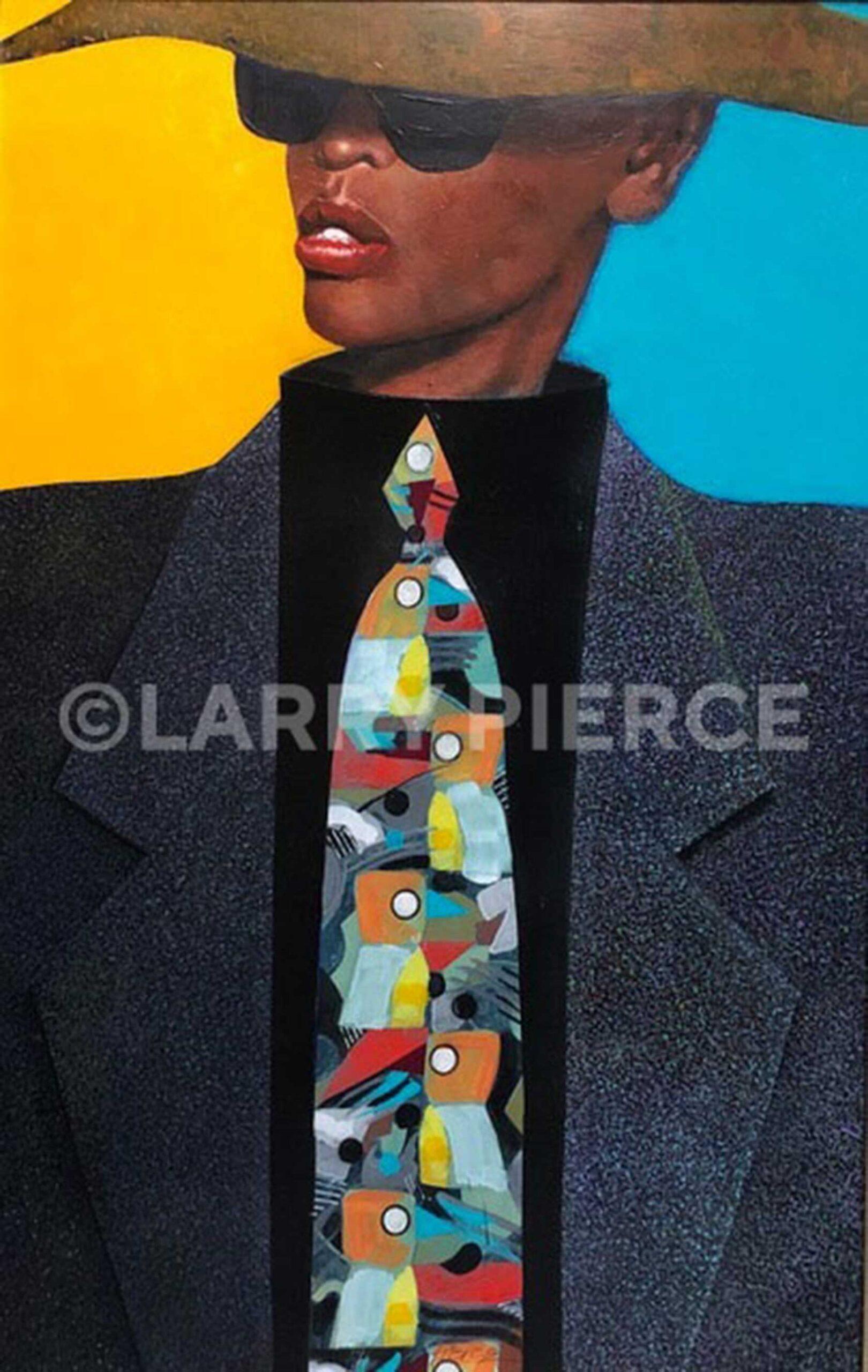
“Woman with Loud Tie” by Larry Pierce
There was a series of paintings that you did called “When They Were Young” — I think you’ve done Dizzy Gillespie, Melnea Cass and some others?
I’m kind of a time traveler. And when you see Melnea as a young woman, people are shocked that she was so beautiful, but she was more than beautiful. She was a firecracker. She was the mayor of Roxbury. Just like Rosa Parks. Everybody thinks Rosa was a tired old lady who didn’t want to give up her seat. Rosa was a revolutionary as a young woman. I like for young people to know that these are people in their senior years and they’re successful at whatever they do, but everybody had a starting point. Everybody looked like you when you were 12, 14, 15 years old.
How many pieces did you do in that series?
It’s still ongoing. I’m looking for a really good reference for Billie Holiday. But I did Count Basie. I did Nelson Mandela.
That’s basically documenting our history, too.
Yes. It appalls me how poorly young people are educated, and now there’s an attempt by the powers that be to make them even less (familiar with) our history. I think that it’s incumbent upon artists of color, not just Black artists, to make sure that our history is alive and kicking.
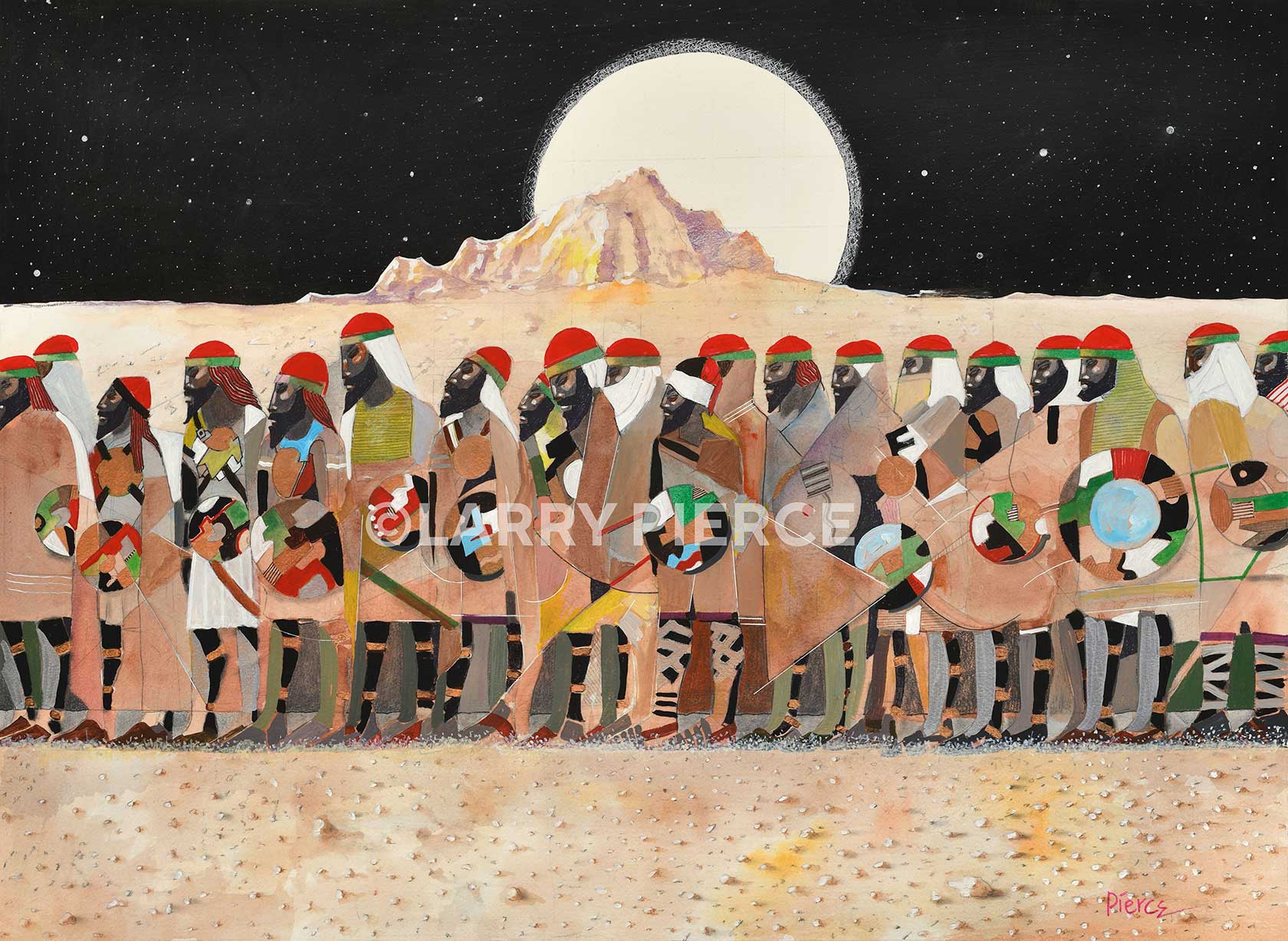
“The Meii” by Larry Pierce
I remember the one piece with Vladimir Putin and Donald Trump.
I did a piece called “Bedbugs.” It has a double meaning because I have Trump and Vladimir Putin in the same bed together. Putin has on earphones, and they’re looking at each other, and at the bottom of the blanket it says Doral — (Trump’s hotel) in Florida. Remember, they were closed down because they had a bedbug problem. There’s a lot of meaning in that piece. It’s one of the most powerful pieces I’ve ever done, and it got kicked out of the show at Northeastern (University).
Don’t you think there should be artistic freedom — that whatever we hang, we shouldn’t have to apologize for our commentary?
You have to put it out there no matter what. If the powers that be can’t deal with it, OK. But at least I did my part.
Do you feel as though you don’t have to worry about what you say when you’re creating it?
Not yet. The Chinese have a curse: “May you live in interesting times.” These are very interesting times, because they’re trying to move closer to fascism. The orange man almost got us there. They go after the intellectuals and artists, and it’s our job to hold back that tide.
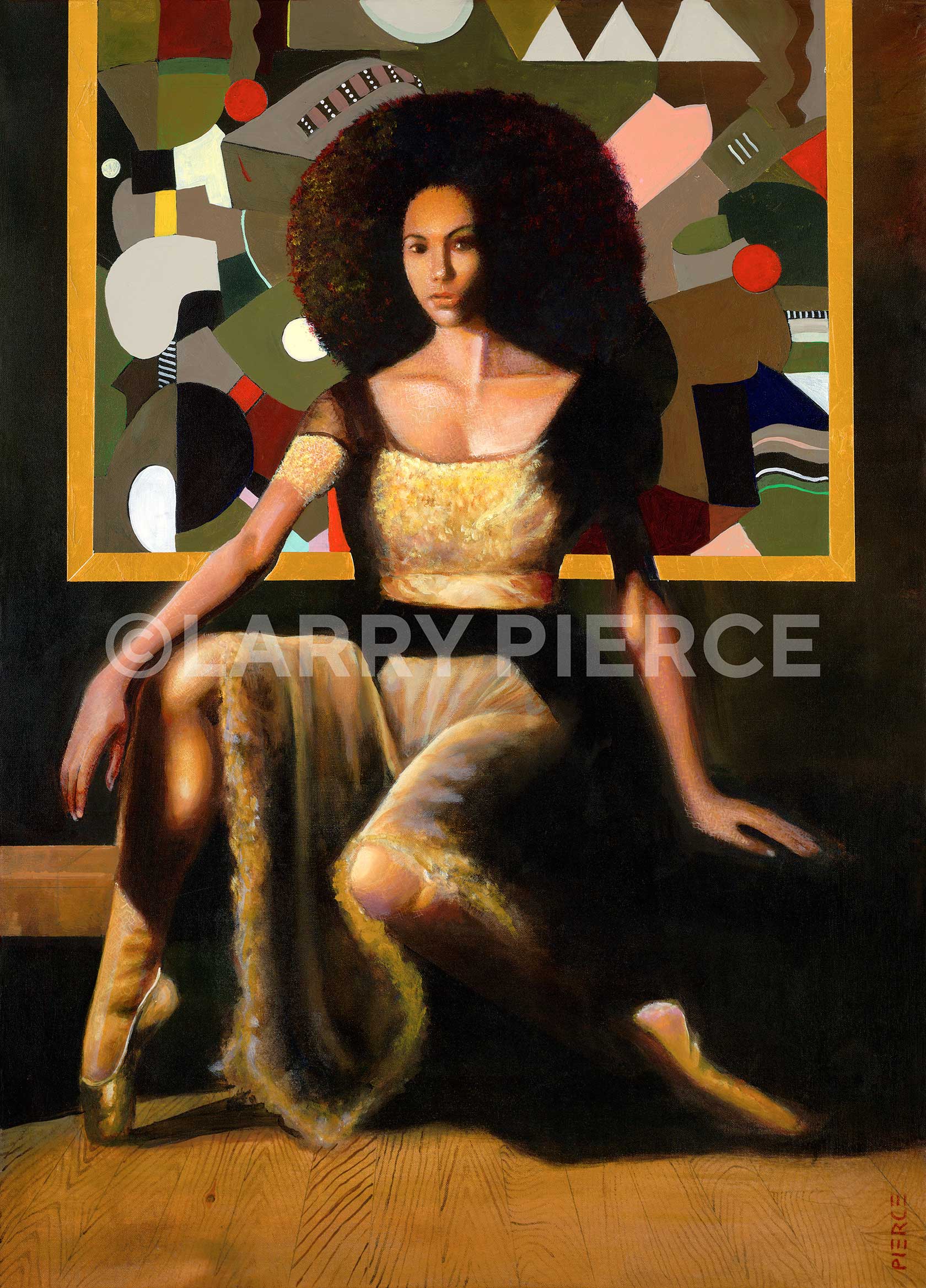
“Reena” by Larry Pierce
Do you have any preparation rituals?
What I do is dream very lucidly. I have had dreams where the image was so powerful that I would jump right up — I keep a sketchpad by my bed — and I would just do a quick sketch before that curtain of forgetfulness closes. That’s one of my processes.
Were your parents supportive of you growing up in the arts?
Absolutely. It didn’t really dawn on me until later that I come from a family of artists. My mother was a beautician. My father was a master upholsterer. My sister’s a fantastic interior designer, and my late brother Mike was a drummer.
What’s it like when you see your imagination played out on the canvas?
I hit the usual brick wall that a lot of artists do. I pull myself out of it through dream time and visual stimulation. For instance, I did a painting of a sister who was in the waiting room at Whittier (Street Health Center). She was in hijab, so you could only see her eyes. But she was talking on her cellphone. And I’m like, wow, this is the juxtaposition of that old culture and the future. I took a picture before she knew I was doing it.
Did you paint it?
Yes, I did. It’s one of my favorite paintings.





