About

Posts by :

Google Pixel 8 Pro Review for Photographers: Android’s Best Camera

Google Pixel 8 Pro Review for Photographers: Android’s Best Camera
[embedded content]

The Google Pixel smartphones enjoy a well-earned reputation as photographic tools. With the release of the Pixel 8 and 8 Pro, Google took the photo game one step further by substantially increasing the amount of light the Pixel cameras can collect. As a photographer, this excites me.

Pixel 8 Idaho golden light
We chased the autumn colors down to Idaho and they did not disappoint.

The focus of this review is going to be on the $1,000 Pixel 8 Pro model exclusively because the first thing that’s obvious about the Pixel 8 phones is that photographers will want the model with the best camera system, and that’s the Pro. The standard Pixel 8 does get the same benefits in regards to an improved ultra-wide and main camera but it’s the 8 Pro that also gains an updated 112mm f/2.8 telephoto lens.

Pixel 8 Pro camera bar
The camera bar may be obtrusive but it allows for larger sensors and brighter apertures across all three cameras.

You also need the 8 Pro to unlock the “pro” camera tools which give you access to things like white balance, shutter speed control, ISO adjustments, and more. Perhaps most importantly though, the Pro model gives you the ability to shoot RAW and JPEG files that maintain the maximum 48 megapixels of its cameras.

Google Pixel 8 Pro Long exposure
Long exposures are easy using either the “Pro” camera controls on the 8 Pro alongside a tripod and filters, or the built-in Long Exposure function handheld as seen here.

This does mean that you’re carrying around a phone with a 6.7″ screen, albeit a very nice-looking one. Featuring a 1344×2992 dot display with a variable frame rate from one to 120hz, the Pixel 8 Pro screen is bright and sharp with its peak brightness capable of 2400 nits. I found the touch controls to be responsive and rarely had to repeat an action or button press.

Google Pixel 8 Pro screen size
Getting the Pro features means dealing with the larger 6.7″ screen. However, the extra brightness is worth it.

Google Pixel 8 Pro: The Cameras

Compared to the last model, everything about the three cameras on the 8 Pro has gotten either brighter or larger — or both. The ultra-wide camera has a dramatic-looking 11mm equivalent focal length. Couple that with a brighter f/1.95 maximum aperture and you get a camera that can even tackle astral photos. Compared to the Pixel 7 Pro, this ultra-wide lens is brighter, wider, and with four times the megapixels. Quite the upgrade indeed.

Google Pixel 8 Pro 5X camera
The new 5X camera is a big improvement over the Pixel 7 Pro and iPhone 15 Pro Max, and the highest quality smartphone tele I’ve used so far.

The Pixel 8 main camera is similar to its predecessor, featuring the same 50-megapixel count, and 25mm field of view, but it adds more light with a brighter f/1.68. A slightly shallower depth of field is possible and the image quality in low-light situations is improved.

Google Pixel 8 Pro landscapes
The brighter 25mm f/1.68 main camera delivers excellent dynamic range and detail.

Lastly, the telephoto lens is improved with a brighter f/2.8 aperture that still pushes out excellent 48-megapixel images. I found the optical image stabilizer to be very effective while composing shots, and the image quality is substantially better than the iPhone 15 Pro Max telephoto lens.

Google Pixel 8 Pro ultra-wide lens
It might not seem like much on paper but the new ultra-wide camera is even wider and has a faster f/1.95 aperture.

Google Pixel 8 Pro: Ultra HDR

Google has finally entered into the HDR photo fray but does so with a new proprietary format. Files can now be shot in a P3 color space and when viewed on an appropriate display can show more dynamic range and brighter highlights than before. This couples very nicely with the improved and much brighter screen on the 8 Pro.

Google Pixel 8 Pro parade
We ended our epic journey in Sun Valley, Idaho, to attend the trailing of the sheep festival.

However, because we have another new HDR format that needs to be supported by the display community, it’s going to take time to fully appreciate the Pixel 8 photos on various computer and TV platforms — if that ever happens. Regardless, it’s time for Google to integrate HDR photography into its phones and this is a step in the right direction.

Google Pixel 8 Pro: Portrait Mode and Night Sight

Although we have faster apertures across the board, the depth of field is still going to be fairly deep regardless of which lens you use. Modern smartphones rely heavily on detecting your intended subject and then artificially blurring the background with depth maps. The level of realism has steadily improved over the years and the Pixel 8 Pro delivers the best results I’ve seen on a Google phone so far. Unfortunately, the portrait mode does not work with the longer 5x.

Google Pixel 8 Pro portrait mode
The subject detection and depth masks do a pretty good job of blurring the background around people. However, make note that the grass stem has vanished into thin air.
Google Pixel 8 Pro portrait mode
Unfortunately, the portrait mode doesn’t do as good a job with pets. The results look a generation behind.

It does its best work with human portraits and delivers similar results to the latest iPhone. However, there are often some strange artifacts or parts of an image that are unrealistically cut out from the scene. In time, these bugs can be addressed but for now, the results are tainted with strange occurrences. The iPhone 15 Pro series phones do a great job with family pets but unfortunately, the Pixel 8 Pro portrait mode doesn’t quite mask out the subject as nicely or as seamlessly when it comes to animals. I’d say that Google still has some work to do getting its portrait mode to meet the competition.

Google Pixel 8 pro night sight
Night Sight returns and is as excellent as ever. Color accuracy and detail are preserved without giving up any megapixels.

Night Sight is the answer to any of your low-light photo challenges. I’ve always found the Night Sight mode to be very effective at tackling darker conditions whilst still maintaining detail and good color accuracy. I love that Night Sight can be used even in bright, contrasty situations where a little more shadow detail might be desirable.

Google Pixel 8 Pro sunset hills
In general, the Pixel 8 Pro handles contrast and dark shadows well. Dynamic range is excellent and gives even interchangeable cameras some competition.

The Pixel 8 Pro in Night Sight mode can maintain the full 48 megapixels of its cameras when many other competitors’ phones would drop down to 12. Night Sight shots have more detail and a more realistic look to their rendering than the competition, too.

Google Pixel 8 Pro: Video Capability

The Pixel 8 cameras have switched to a new way of recording high-quality video by recording at two different sensitivities simultaneously. This is a technology we’ve seen employed on high-end cinema cameras like the Panasonic GH6 and Arri cameras and provides a substantial improvement to the detail recorded in shadows and highlights. There is also HDR capture now with HLG output and the Pixel 8 Pro can now handle more dynamic range than we’ve seen before from Google.

Google Pixel 8 Pro Sheep trail
We stumbled upon an actual sheep herd drive days before we would see more at the festival.

Although the video results still have that classic over-sharpened look that all phones are guilty of, the excellent skin tones and color accuracy really push the Pixel 8 phones higher. Low-light video quality also benefits from the brighter apertures now found on the Pixel cameras. Smartphones are still quite poor when it comes to low-light video quality but the Pixel 8 improvements are enough to give them a slight edge over Apple.

Google Pixel 8 Pro 5X zoom
I avoided the 5X lens on the iPhone 15 Pro Max due to its middling performance, but I used the telephoto on the Pixel 8 Pro all the time.

The Pixel 8 Pro can also help filter out annoying noises in your audio like machines running, or traffic noises while enhancing the vocals of whoever is talking to the camera. This is a very handy feature for situations like recording friends inside a busy restaurant or someone talking next to running water and it works very effectively.

Google Pixel 8 Pro: AI is the Future

Google is heavily pushing its AI tools as a standout feature to set itself apart from the competition. We’ve tested things like Magic Eraser before and although the results are pretty rough looking, it takes no skill at all and usually looks fine for social media output. But now Google is offering Magic Editor which allows you to more heavily edit images thanks to the computing power in the cloud.

Google versus iPhone 15 tele lenses
Here you can see the extra detail captured by the Pixel 8 Pro telephoto lens.

You can draw around almost any object and the Magic Editor will let you move it, resize it, or delete it completely. Skies can be replaced and even people’s facial expressions can be swapped for other images taken in the same burst. The results are far from instantaneous, however, and there will still be many digital artifacts remaining.

Google Pixel 8 Pro mirror lake
Idaho has some of the most beautiful waters. When they are not raging, they lie still like a mirror.

For example, backgrounds that are redrawn behind moved or deleted objects tend more towards impressionism than they do realism. People that are removed will leave their shadows behind and sometimes things like hands will remain after the processing is done. In situations where you have simple backgrounds with clearly separated subjects, the results can be pretty impressive though.

Google Pixel 8 Pro edited picture
I’ve moved Diane to the left and resized her smaller with the Google Magic Editor. Easy enough to do except her shadow is incomplete, her hat is cropped, and her hand is still attached to her husband. The potential is there but the results need work.

As I’ve said before, even if the results are not convincing upon very close inspection they are absolutely effective in the context of social media and the like. Removing an offending street sign in the background or adding more drama to a dull sky is easy to do and the results are effective. This is a powerful tool for Google because even if the results aren’t perfect now, they will only improve over time.

Google Pixel 8 Pro: A Powerful Tool for Pro and Amateur Alike

The Pixel 8 Pro is a strange device in that it caters to both the photographer who wants to edit RAW files and squeeze out maximum image quality as well as the influencer who wants to easily edit and alter their images before posting to social media — true to life or not.

The new cameras and brighter lenses make a difference and as a result, the 8 Pro is the most powerful photo and video camera Google has ever made. But it doesn’t stop there: the new AI tools and Magic Editor are also a useful addition to anyone’s repertoire, especially if they don’t have the time or the necessary Photoshop skills to go further. The image quality is the best we’ve seen from the Pixel line and competes favorably against the Apple iPhone 15 Pro phones in many regards. As a result, the Pixel 8 Pro is worth taking a look at if you want the best images possible from a smartphone.

Alternatives:

The iPhone 15 Pro Max will provide comparable video capabilities and a similar setup of cameras. The iPhone has excellent portrait mode results and beautiful image quality overall but the Pixel 8 cameras deliver better results. Very few users would consider changing over ecosystems, though.

For those who like to stick with Google’s Android operating system, then the Samsung Galaxy S23 Ultra is probably the best bet. It didn’t do a lot to separate itself from the S22 Ultra, but some well-played upgrades and additions make the Galaxy S23 Ultra hard to pass up for those who like life away from the Cupertino-based giant. Another worthwhile option is the Xioami 13 Pro, but given its lack of North American support, it’s probably not on many people’s radar.

Should You Buy It?

Yes. If you are an Android user and want to prioritize photographic results, the Pixel 8 Pro is the way to go.

Ferndale Artist Káasháyee Kéet’Aakw’s Designs Are Part of a Continuing Visual Language

Ferndale Artist Káasháyee Kéet’Aakw’s Designs Are Part of a Continuing Visual Language

KáaSháyee Kéet’aakw was raised in Ketchikan, Alaska, right in the middle of his historical Tlingit Alaska Native homeland. When he was 14 years old, his family moved to Ferndale, likely to enjoy a lower cost of living and a lifestyle that wasn’t so dependent on the boom-and-bust economy of the trades and tourism industries. He arrived just in time to enter his freshman year of high school and has more or less made his life in Ferndale ever since.

He began a career in graphic design in 2009 and has worked in marketing specialties like sign layout and logo design, as well as print layout and business cards. When the pandemic arrived in 2020, his ground job to a standstill. This gave him the opportunity to take stock where he was in life and what he wanted for his future. He also took an inventory of any deficits he felt and found his connection to culture was lacking.

“Being that I was in Washington, dislocated from Alaska, I thought one place I could start would be to enroll at Northwest Indian College,” he says. “They had quite a few classes on Cultural Sovereignty at the core of their Native Studies Leadership Program, and it really sounded like I would be diving into who I was as a Native person.” He enrolled and found the classes did exactly what he hoped they would; he is now set to graduate in 2024.

Already a successful graphic designer, KáaSháyee Kéet’aakw’s desire to connect to his history has taken him down some remarkable roads. Photo courtesy KáaSháyee Kéet’aakw

Learning the Forms

Online learning spread like wildfire during the pandemic. KáaSháyee had already taken one online workshop in 2019, offered by Sealaska, a corporation established by the Alaska Native Claims Settlement Act. It taught Formline, a very distinctive aspect of the visual art produced by Indigenous groups of the Northern Northwest Coast of the North American continent. Its flowing lines and use of strong positive and negative space can be found in paintings and carvings by Tlingit and Haida Tribes, along with many others.

As more and more artists took to the internet to stay connected, KáaSháyee found himself working with five different teachers. He learned about art, design, and his own history — but he was also absorbing how different people teach and started to himself feel a call to teach others. “There are quite a few Alaska Natives that live outside of Alaska, and many of us would like to connect with the culture,” he says. “Even in Alaska, plenty of people would love to learn, but if there isn’t somebody on the other end to help, that makes it difficult.”

Greeting visitors as they enter downtown Ferndale, this orca design incorporates KáaSháyee’s signature question mark. Photo credit: Steven Arbuckle

A Journey via Paddle

As the world began to open up again, KáaSháyee traveled to the Port Townsend School of Woodworking to take classes in carving masks and paddles. Because the Tlinglit are largely coastal, the canoe is central to their way of life and paddles have always been some of their most valuable tools. As a result, they’ve also become a symbol of heritage.

After tracking down the most true-to-form paddle possible, KáaSháyee was able to map its dimensions and recreate it in the present day. Courtesy KáaSháyee Kéet’aakw

“When I finished my paddle, I found that it was a nice piece of artwork, in its shape and design,” KáaSháyee says. “But it wasn’t a functional paddle you would use to pull, in a canoe.” He began to compare this current artwork to what would have existed prior to European colonization.

This led to an application to visit the Burke Museum of Natural History and Culture in Seattle. More than just an art museum, the Burke traces its roots to 1879, and holds more than 16 million artifacts. KáaSháyee was selected to make a three-day visit and was granted an assistant to assemble a selection of pieces from as far back as the 1870s. He was able to handle them and make drawings, trace outlines, and use calipers so he could make replicas. As he examined 21 different paddles, KáaSháyee found that only one had the form of a true, traditional paddle. Although some examples dated back to the 1870s, because of the presence of European settlers “even then they had changed,” he says.

imageAn eye emblazoned with a question mark roots the artist in the stream of time, even if not all of his questions have been answered. Photo courtesy KáaSháyee Kéet’aakw
” data-medium-file=”https://www.whatcomtalk.com/wp-content/uploads/2023/10/43ef8394f3c201cc2cbc32d7b29e403a-fcs-paddle-300×300.jpg” data-large-file=”https://www.whatcomtalk.com/wp-content/uploads/2023/10/43ef8394f3c201cc2cbc32d7b29e403a-fcs-paddle-1024×1024.jpg” decoding=”async” loading=”lazy” src=”https://www.whatcomtalk.com/wp-content/uploads/2023/10/43ef8394f3c201cc2cbc32d7b29e403a-fcs-paddle-1024×1024.jpg” alt class=”wp-image-76640″ width=”512″ height=”512″ srcset=”https://www.whatcomtalk.com/wp-content/uploads/2023/10/43ef8394f3c201cc2cbc32d7b29e403a-fcs-paddle-1024×1024.jpg 1024w, https://www.whatcomtalk.com/wp-content/uploads/2023/10/43ef8394f3c201cc2cbc32d7b29e403a-fcs-paddle-300×300.jpg 300w, https://www.whatcomtalk.com/wp-content/uploads/2023/10/43ef8394f3c201cc2cbc32d7b29e403a-fcs-paddle-150×150.jpg 150w, https://www.whatcomtalk.com/wp-content/uploads/2023/10/43ef8394f3c201cc2cbc32d7b29e403a-fcs-paddle-768×768.jpg 768w, https://www.whatcomtalk.com/wp-content/uploads/2023/10/43ef8394f3c201cc2cbc32d7b29e403a-fcs-paddle-1536×1536.jpg 1536w, https://www.whatcomtalk.com/wp-content/uploads/2023/10/43ef8394f3c201cc2cbc32d7b29e403a-fcs-paddle-2048×2048.jpg 2048w, https://www.whatcomtalk.com/wp-content/uploads/2023/10/43ef8394f3c201cc2cbc32d7b29e403a-fcs-paddle-696×696.jpg 696w, https://www.whatcomtalk.com/wp-content/uploads/2023/10/43ef8394f3c201cc2cbc32d7b29e403a-fcs-paddle-1068×1068.jpg 1068w, https://www.whatcomtalk.com/wp-content/uploads/2023/10/43ef8394f3c201cc2cbc32d7b29e403a-fcs-paddle-420×420.jpg 420w” sizes=”(max-width: 512px) 100vw, 512px”>
An eye emblazoned with a question mark roots the artist in the stream of time, even if not all of his questions have been answered. Photo courtesy KáaSháyee Kéet’aakw

His goal was to find the differences between the old objects and today’s artwork, and to be able to close that gap. As he carved a number of paddles, he discovered an interesting glimpse into the past: even with the best possible planning, he would arrive at a part of the carving and realize there was a better way to do it. Saying to himself, ‘This probably isn’t the way it was done,’ over and over again seemed to only strengthen the link to the past.

Identifying a Language

This year, KáaSháyee returned to the Burke to study again, this time focusing on two-dimensional art. “I looked at many orca designs that were done in the Formline style, and I started seeing patterns where certain elements were placed,” he says. “There are stories attached to these different designs, and this artwork accompanies stories.”

“Whether it be a mask that somebody would dance with during storytelling and song, or engraved onto a box, there might be a raven holding a sun in his beak,” KáaSháyee says. “That ties it to the story of ‘The Raven Brings the Light,’ an origin story we tell. What we’re talking about is a visual language.”

Formline is immediately recognizable as a single style, but to the trained eye, no two practitioners do it the same way. Photo courtesy KáaSháyee Kéet’aakw

Along the coasts of Alaska and Canada, he says, the artwork produced by different Tribes looks similar. But by looking closer, the viewer can notice differences. Sometimes it’s as obvious as a clan’s crest, but other times it’s much more subtle. While they all may speak the same visual language, you can detect differences in regional visual dialects. Here in Southern Canada, Washington, and Oregon, people use a Coast Salish way of assembling designs — a different language — but there are still more different dialects.

Sharing His Story

As an Alaskan in Washington and a trained designer who practices art, KáaSháyee is careful in how he approaches his work. He was recently commissioned to create a logo for a Native Education Conference that brings together teachers from Washington, Oregon, and Alaska. He wanted an image that spoke to all three areas, but didn’t want to copy any styles, so he blended a wave to represent Oregon, an evergreen for Washington, and an Alaskan mountain. He is currently brainstorming along similar lines to create a logo for the WWU Native American Student Union.

A respect for the visual languages of others made KáaSháyee move carefully while putting together a logo to represent people from Alaska, Washington and Oregon. Courtesy KáaSháyee Kéet’aakw

His work is visible in Bellingham’s Waypoint Park, on a 150-foot-long wall found close to the intersection of Granary Avenue and West Chestnut Street. The piece is a collaboration by seven artists representing Lhaq’temish, Nooksack, Tlingit, Haida, Tsimshian, Nimiipuu, Dineh, Apache and Port Gamble S’Klallam Tribes.

KáaSháyee also recently completed a 600-square-foot mural that welcomes people into downtown Ferndale, on the east-facing wall of Kevin’s Car Wash. “The design is the orca, and it’s my first iteration of those elements that I examined at the Burke Museum,” he says. A close look at the components that make up the design reveals that one of them is the question mark in the orca’s eye.

Question Marks, Past and Future

As KáaSháyee investigated his past, he discovered a story about his own grandfather. Since the Tlingit are matrilineal, family names follow the lines of their mother figures. But the Europeans are patrilineal, and when they made their written records, they tried to follow the lines of the fathers. So, when his grandfather tried to trace his family tree, he was left with more questions than answers. When KáaSháyee’s grandfather carved himself a paddle, in the place where he might have carved his family’s crest, he instead decided to paint a question mark.

KáaSháyee’s grandfather, after trying to use the written records of Europeans to trace his family line, opted to make the mystery part of his image. Photo courtesy KáaSháyee Kéet’aakw

KáaSháyee has taken this cue and decided to continue placing that question mark within his own work. In this way, it also becomes a statement, a part of a story that is being told by visual artwork. As a result, it makes his designs more than ‘just art,’ and allows them to also become part of a continuing visual language.

As he moves forward with his own projects and pursues more collaborations, KáaSháyee also plans to share what he has learned, so other artists can carry their languages into the future.

“I think about all the people who can connect and engage with their culture, and it would be life-changing to them, to their identity,” he says. “I feel that my future is going to be making resources available to people to learn the Tlingit visual language.”

Print Friendly, PDF & Email

‘Unusual Geometries’ blends math and art at OSU Museum of Art

‘Unusual Geometries’ blends math and art at OSU Museum of Art
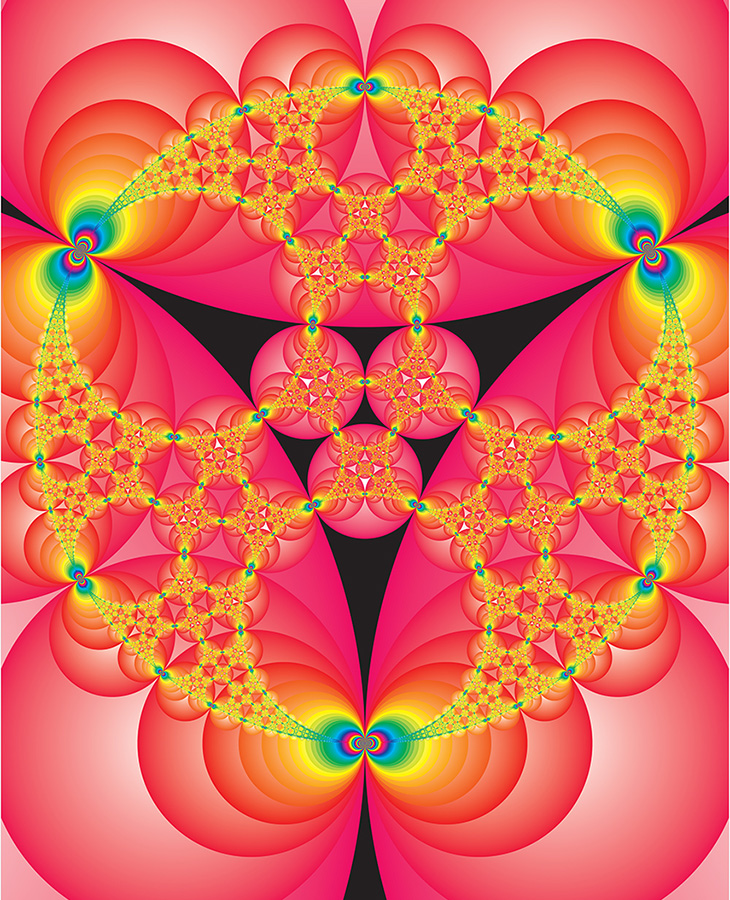
David J. Wright (American, b. 1955), Glowing Gasket, 2002, color reproduction on paper
from a digital original.
Courtesy of the artist.

Tuesday, October 17, 2023

Media Contact:
Casey Ihde | OSU Museum of Art Marketing and Communications | 405-744-2783 | casey.pankey@okstate.edu

Get ready to explore the visual side of math in “Unusual Geometries,” Oklahoma State
University Museum of Art’s newest exhibition. 

Running from Oct. 17 to Dec. 16, 2023, “Unusual Geometries” invites guests to rediscover
the hidden beauty and playfulness found within the world of geometry.

“The full breadth of geometry encompasses everything from the shape of coral to the
behavior of fractals and tells us not just how to measure objects and their spatial
relationships, but how to view them,” said Dr. Jay Schweig, department head and associate
professor of mathematics.

Schweig, in partnership with fellow OSU faculty including Drs. Henry Segerman, David
J. Wright and Lisa Mantini, contributed artworks exploring such topics as geometry,
fractals, optical illusions, hyperbolic planes, stereographic projections and more.

Complimenting the faculty’s artistic research are works from the museum’s collection. 

“Blending art from the museum’s collection with projects from mathematics professors
and their students provides an interesting opportunity to experience the many dimensions
of artistic expression,” said Vicky Berry, director of OSUMA.

Brightly colored paper strips fold and intertwine in origami structures by Mantini.
A man’s profile spins around a central axis, translating a two-dimensional shape into
three-dimensional form in Renato Giuseppe Bertelli’s “Profilo continuo di Mussolini”
(Continuous Profile of Mussolini). This work inspired Segerman’s students to experiment
with positive and negative space, modeling and 3D printing. Mesmerizing circles expand
and repeat in never-ending patterns in Wright’s explorations into the work of Felix
Klein. Crocheted frills twist and curl into a hyperbolic plane, a concept modeled
after mathematician Daina Taimina’s creations.

Left: David Bachman (American, b. 1969), Saul Schleimer (American, 1973), and Henry
Segerman (British, American, b. 1979), Cohomology fractal for the SnapPy manifold
s227, digital reproduction. Courtesy of the artist. Right: Renato Giuseppe Bertelli
(Italian, 1900-1974), Profilo Contiuno di Musssolini, 1933, glazed earthenware, 11
1/2 x 8 1/2 x 8 1/2 inches. OSU Museum of Art, Gift of George R. Kravis II. 2018.012.479

Viewing math in such a way offers the intellectually curious opportunities to strengthen
observational skills and foster creative problem-solving.

“Coming at a problem from different perspectives can often be helpful,” said Segerman,
associate professor. “It might be a rare mathematical problem that benefits from an
artistic perspective, and a rare artistic problem that benefits from a mathematical
perspective. However, if you do know about both fields then you might be able to spot
the crossovers that do exist. … If you know about other, apparently distant fields,
more possibilities are open to you.”

Guests are invited to continue their cross-curricular curiosity in the artLAB by learning
basic origami techniques and contributing a paper cube to a growing community art
installation. ArtLAB activities are drop-in and available throughout the exhibition
run.

“Unusual Geometries” is on view Oct. 17–Dec. 16, 2023, at the OSU Museum of Art in
downtown Stillwater. A reception will be held from 5–7 p.m. on Nov. 8. Learn more
at
https://museum.okstate.edu/art/unusual-geometries.html.

Vorja Sánchez Brings the Past to Life in a Series of Uncanny ‘Ancient Pottery’ Illustrations

Vorja Sánchez Brings the Past to Life in a Series of Uncanny ‘Ancient Pottery’ Illustrations

All images © Vorja Sánchez, shared with permission

Beastly jugs and vessels with legs comprise the latest in illustrator Vorja Sánchez’s eclectic and uncanny menagerie (previously). A new print titled “Ancient Pottery” draws inspiration from a wide variety of stoneware urns, bowls, and statuettes from prehistoric cultures around the world, imbuing each of them with the lively features of animals or mythological beings. Produced from an original piece made with pencil, ink, and watercolor on cotton paper, the artist emphasizes the appearance of age, as if a patina has formed over time across the entire composition.

“I am fascinated by the simple and imperfect but pure and free forms of ancient ceramics,” Sánchez tells Colossal. He continues:

When I started to study them—my cousin is an archaeologist specialized in ceramics and gave me a lot of information—I realized that they shared a common essence regardless of their origin. The older they are, the more universal the language is. I found that very interesting. That’s why I decided, sharing the same space, to make an accumulation.

Sánchez is currently working on new pieces that focus on individual pots. You can purchase prints in the artist’s shop, and find more on his website and Instagram.


A print of a watercolor and pencil illustration of ancient pots given uncanny lifelike qualities.

A print of a watercolor and pencil illustration of ancient pots given uncanny lifelike qualities, photographed as it is held by someone.

A detail of a print of a watercolor and pencil illustration of ancient pots given uncanny lifelike qualities.

A detail of a print of a watercolor and pencil illustration of ancient pots given uncanny lifelike features like eyes and noses.

A detail of a print of a watercolor and pencil illustration of ancient pots given uncanny lifelike qualities.

A detail of a print of a watercolor and pencil illustration of ancient pots given uncanny lifelike qualities.

A print of an illustrated pot that has a monstrous, colorful face.

Do stories and artists like this matter to you? Become a Colossal Member today and support independent arts publishing for as little as $5 per month. The article Vorja Sánchez Brings the Past to Life in a Series of Uncanny ‘Ancient Pottery’ Illustrations appeared first on Colossal.

SunChips® Showcases Artwork from Underrepresented Artists in “Art Seen” Honors

SunChips® Showcases Artwork from Underrepresented Artists in “Art Seen” Honors

The brand will display art on SunChips bags in stores this month and champion artists through a $100,000 donation and partnership with nonprofit arts organization YoungArts

PLANO, Texas, Oct. 17, 2023 /PRNewswire/ — SunChips celebrates individuality and believes different perspectives fuel a one-of-a-kind world. As part of that mission, its “Art Seen” program has put a spotlight on originality among artists to help more art be seen. Today, the brand has unveiled the “Art Seen” 2023 winning artists and their original artwork which will take over millions of SunChips bags at retailers across the country.

“Since 2021, the SunChips ‘Art Seen’ program has shined a light on artists whose diverse viewpoints make the world a brighter place,” said Rhasheda Boyd, vice president of marketing at Frito-Lay. “With less than 15% of art in permanent collections in the U.S. created by women and people of color, SunChips was inspired to drive a greater impact in the art community. Featuring these artists’ work on our packaging in retailers nationwide allows us to do our part to offer more exposure for these talented individuals in unexpected ways.”

The work of three selected artists will be featured on millions of SunChips bags across the country as well as local mural installations in the artists’ hometowns and on SunChips social media channels.

These artists include:

  • Maruja Panti, Catanduanes, Philippines: Maruja is a self-made artist. She believes, “No one colors the world and reflects the light exactly the way you can,” and that her art goes beyond its form. Her work explores topics of feminism, beauty and contemporary struggles of peoples, especially women, today. Her commissioned artwork for the SunChips Original flavor tells a story of embracing individuality by following your passions.
  • Darnell “Solo” Kirkwood, Los Angeles, California: Darnell believes art has empowered his appreciation to creatively shift narratives, allowing him to be more present and one with the universe. The energy of each piece, including his commissioned artwork for the SunChips Garden Salsa flavor, derives from and is dedicated to the journeys traveled through the perseverance of both dreamers and visionaries – against all odds.
  • Megan Lewis, Baltimore, Maryland: Megan’s work allows her to communicate meaningfully and think outside the intellectual and artistic “holding” patterns. Her paintings depict Black men and women usually existing in a resting position, focusing on their facial features and accented by swings of color and thick paint strokes. Her commissioned artwork for the SunChips Harvest Cheddar flavor celebrates a season of harvest with vibrant plants and colors.

To further champion the next generation of emerging artists, SunChips is donating $100,000 to YoungArts, an organization that identifies exceptional young artists, amplifies their potential and invests in their lifelong creative freedom. The donation will fund artistic needs such as studio space and art supplies, as well as professional development, impacting more than 30 artists.

“At YoungArts, we value the creative expression that comes from a multitude of lived experiences,” said Angela Goding, senior director, strategic partnerships at YoungArts. “We’re grateful to join SunChips in celebrating how artists connect us through their uniquely personal work.”

Fans can also get involved in the support of underrepresented artists through an interactive branded lens experience on SnapChat that will feature the work of artist Glenn Espinosa from YoungArts. To access the interactive lens and amplify the work, fans can scan the code on the back of specially-marked “Art Seen” SunChips packaging, snap and share with their friends. Fans can also access the interactive lens on www.SunChipsArtSeen.com or by exploring the SnapChat app.

SunChips will donate an additional $1 to YoungArts for each Snap shared between 10/9/23 and 11/5/23, up to $40,000. To learn more about the program, head to www.SunChipsArtSeen.com.

About Frito-Lay North America
Frito-Lay North America is the $23 billion convenient foods division of PepsiCo, Inc. (NASDAQ: PEP), which is headquartered in Purchase, NY. Frito-Lay snacks include Lay’s and Ruffles potato chips, Doritos and Tostitos tortilla chips and branded dips, Cheetos snacks, Stacy’s pita chips, PopCorners popped-corn snacks, SunChips multigrain snacks and Fritos corn chips. The company operates 30+ manufacturing facilities across the U.S. and Canada, more than 200 distribution centers and services 315,000 retail customers per week through its direct-store-delivery model. Learn more about Frito-Lay at the corporate website, www.fritolay.com, on Twitter (@fritolay), on Instagram (@fritolay) and on Facebook (Frito-Lay).

About PepsiCo 
PepsiCo products are enjoyed by consumers more than one billion times a day in more than 200 countries and territories around the world. PepsiCo generated more than $86 billion in net revenue in 2022, driven by a complementary beverage and convenient foods portfolio that includes Lay’s®, Doritos®, Cheetos®, Gatorade®, Pepsi-Cola®, Mountain Dew®, Quaker®, and SodaStream®. PepsiCo’s product portfolio includes a wide range of enjoyable foods and beverages, including many iconic brands that generate more than $1 billion each in estimated annual retail sales. 

Guiding PepsiCo is our vision to Be the Global Leader in Beverages and Convenient Foods by Winning with pep+ (PepsiCo Positive). pep+ is our strategic end-to-end transformation that puts sustainability and human capital at the center of how we will create value and growth by operating within planetary boundaries and inspiring positive change for planet and people. For more information, visit www.pepsico.com, and follow on Twitter, Instagram, Facebook, and LinkedIn @PepsiCo.   

About YoungArts
Established in 1981 by Lin and Ted Arison, YoungArts identifies exceptional young artists, amplifies their potential, and invests in their lifelong creative freedom. YoungArts provides space, funding, mentorship, professional development and community throughout artists’ careers. Entrance into this prestigious organization starts with a highly competitive application for talented artists ages 15–18, or grades 10– 12, in the United States that is judged by esteemed discipline-specific panels of artists through a rigorous blind adjudication process. For more information, visit youngarts.org, Instagram, YouTube, Facebook or Twitter.

SOURCE Frito-Lay North America

Create Your Own Abyss With These Interchangeable Wall Tiles

Create Your Own Abyss With These Interchangeable Wall Tiles

Expanding upon its now iconic Abyss collection, Duffy London has introduced a new element: the limited-edition Abyss Wall Tile. The interchangeable 3D-printed design allows users to create their own vertical Abyss within any space they wish. Originally launched in 2012, Abyss explores depth and our own perception of it through layers of glass and wood in a turquoise display of color. It’s likely that images of oceanic topography come to mind when you see any one of its pieces.

The Abyss Wall Tile was developed from the concept of deconstructing Abyss into smaller sections that could then be rearranged into a totally new pattern. Three individual tiles, based on Truchet Tiling – a mathematical tiling system – can be rotated three different ways to create a seamless, unique design every time. The bespoke pattern can then be scaled up or down to suit different sized spaces and environments.

[embedded content]

Crafted using plexiglass, recycled plastic, and brushed stainless steel, each Abyss Wall Tile is handcrafted in Duffy London’s East London studio. Choose between a brushed stainless steel or mirror-polished gold finish.

3D printed hexagonal shaped tiles with topography

installation of 3D printed hexagonal shaped tiles with topography

3D printed hexagonal shaped tiles with topography

installation of 3D printed hexagonal shaped tiles with topography

To learn more about Duffy London’s Abyss Wall Tiles, visit duffylondon.com.

Kelly Beall is Director of Branded Content at Design Milk. The Pittsburgh-based writer and designer has had a deep love of art and design for as long as she can remember, from Fashion Plates to MoMA and far beyond. When not searching out the visual arts, she’s likely sharing her favorite finds with others. Kelly can also be found tracking down new music, teaching herself to play the ukulele, or on the couch with her three pets – Bebe, Rainey, and Remy. Find her @designcrush on social.

What would Mark Rothko make of the world today? His son discusses his legacy and market at launch of major Fondation Louis Vuitton show

What would Mark Rothko make of the world today? His son discusses his legacy and market at launch of major Fondation Louis Vuitton show

Christopher Rothko, Mark Rothko’s son, says that his late father would have been “upset” by the astronomical market value of his works today and unsettled by the tumultuous state of the world. Christopher Rothko was speaking at the launch of a vast show of works opening at the Fondation Louis Vuitton in Paris this week (Mark Rothko, 18 October-2 April 2024).

The Paris show is co-curated by the younger Rothko and includes more than 115 works drawn from collections such as the National Gallery of Art in Washington DC, the Menil Collection in Houston, Texas, and the Fondation Beyeler in Basel. The exhibition is “displayed chronologically across all of the Fondation’s spaces”, tracing “the artist’s entire career from his earliest figurative paintings to the abstract works that he is most known for today”, a gallery statement says.

The market value of Mark Rothko is in the spotlight after Artnet News reported that Pace gallery is offering Olive over Red (1956) at the Paris + par Art Basel fair this week for $40m. “The primary way that it’s [the prices for Mark Rothko’s works] important to me is that it makes organising exhibitions very difficult—the cost of insurance and transport is astronomical. I’m grateful to do this show which is really on an enormous scale; not many institutions can afford to do this,” Christopher Rothko says.

Mark Rothko’s No. 10 (1957)

© 1998 Kate Rothko Prizel & Christopher Rothko – Adagp, Paris, 2023

So how would Mark Rothko have responded to his stratospheric market prices today? “He would be very upset because it’s a major distraction; they become a commodity and trophy, they become something other than the experiential relationship [for the viewer sparked by his works],” Christopher Rothko says.

Today’s difficult global political climate would also have left an impression on him, the younger Rothko says. “He certainly was born into a socialist family on the brink of the Russian revolution. They left in 1913…he lived through the Great Depression in New York. He was very concerned with his fellow common man. I cannot imagine he would be pleased with what he would see today.”

Asked how many works he had loaned to the show, Christopher Rothko said: “I’m always talking about my sister [Kate Rothko Prizel] and I; we always coordinate. Technically we’re two private collections but do everything together. We’ve loaned nearly 30 works. I wanted to bring paintings that Europeans would not have seen for the most part before and refresh [the selection].”

Mark Rothko’s Red on Maroon (1959) from the Tate’s Rothko Room

Credit: © 1998 Kate Rothko Prizel & Christopher Rothko – Adagp, Paris, 2023 / Photo: Tate

Crucially, Tate in London has loaned nine Seagram Murals by Mark Rothko—the gallery’s entire Rothko Room—to the exhibition. “It is powerful in the UK but certainly not lacking anything [by being] here,” Christopher Rothko says. Another important ensemble of four paintings (The Rothko Room) is on loan from the Phillips Collection in Washington DC.

Rothko committed suicide in 1970. The press statement says: “Even in the case of the 1969-1970 Black and Grey series, a simplistic interpretation of the work, associating grey and black with depression and suicide, is best avoided.” Christopher Rothko says that “this has been a reality of my life for 55 years. I try to cut out this direct connection of dark colours means depression and light colours don’t… there was no question he was very depressed at the end of his life but at that moment, he launches into a new style which was subtly different but a major step; he painted more paintings in those last two years than any other time in his life. It is never an easy formula… it’s always complicated.”

Suzanne Pagé, the artistic director of the Louis Vuitton Foundation, tells The Art Newspaper: “Rothko is completely apart [from other artists] and absolutely necessary for each of us today. He speaks about our fundamental emotions. It is paradoxical in a way—achieving profundity through abstract art.” Pagé adds in a statement: “At the heart of the exhibition are abstract works from the so-called ‘Classic’ period, from the late 1940s onwards, in which a unique colourist asserts himself in the radiant, mysterious brilliance of colour raised to incandescence.”

Mark Rothko’s Untitled (The Subway) (1937)

© 1998 Kate Rothko Prizel & Christopher Rothko – Adagp, Paris, 2023

The artist’s only self-portrait dating from 1936, drawn from the collection of Christopher Rothko, opens the show. It is subsequently followed by paintings made in the 1930s depicting urban landscapes such as the New York subway. Later works from the 1940s reflect Rothko’s progression towards abstraction via his Multiform works.

“In his classic format, he is creating infinite possibilities. Each painting starts as a new experiment with a new set of feelings and ideas; at first blush, it might seem like there’s nothing there. He is completely suffused in the painting; he is bringing his beliefs at that moment to the painting. If you engage with the painting, you are essentially completing that process because the meaning for you is personal; you bring you own feelings and it’s an interaction,” Christopher Rothko says.

Rothko was especially reluctant to speak of his technique. “He did not want you thinking about him or the specifics of how he made the painting. If you’re preoccupied with those details, you’re taking yourself two steps away from the full impact of that interaction,” says Christopher Rothko. Dispensing with frames is also part of the experiential viewing process. “The painting through their borders have their own frames and the rectangles are moving as if they want to cross those borders; you don’t want to box them in,” he adds.

“Suzanne reminded me that it had been nearly 25 years since the last Rothko show in Paris [at the Musée d’Art Moderne de la Ville de Paris in 1999]. France has only two works in public collections [at the Centre Pompidou],” Christopher Rothko says, adding he is collaborating on a major paintings on paper show due to open at the National Gallery of Art in Washington DC next month (19 November-31 March 2024). The show is scheduled to travel to the National Museum in Oslo next summer.

A Photographer’s Guide to Hidden Downtown Los Angeles

A Photographer’s Guide to Hidden Downtown Los Angeles

The beauty of photography lies in the art of discovery, capturing images that are uniquely your own, and avoiding the cliché “downtown Los Angeles” stamp on your work.

Today, we’re embarking on a photographic journey through downtown Los Angeles, exploring some of my favorite, lesser-known spots, all within a five-minute walk of each other. This DIY photo tour will equip you with tips on how to get there, what to steer clear of, and what to keep an eye out for. But, before we delve into the picturesque wonders of this vibrant city, there’s one crucial element to remember: safety first.

The Best Downtown LA Photo Spots

Downtown Los Angeles is a great place where each street may add a different backdrop to your photographs. You have old, new, rundown, and in-between. No matter what area you choose, put safety at the top of your concerns. 

1. Embrace the Unconventional Exploration

One of the most exhilarating ways to unearth a new location is to embrace unconventional exploration. Forget sticking to the main streets and obvious landmarks. Dive into every building, venture through side doors and winding alleys. If you stumble upon a parking structure, don’t opt for the elevator; instead, take the stairs and see what hidden perspectives await. I found two of the locations in this video by wandering aimlessly. 

2. Opt for Walking Over Driving

Walking forces you to experience the location at a slower pace, enabling you to absorb the intricacies and nuances that might otherwise be missed. The simple act of wandering the streets of downtown Los Angeles can lead to chance encounters and serendipitous discoveries. When I walk around, I’m not only looking forward. I’m looking to see for any unique angles, places to get lost in, etc.

3. The Magic of Different Times of Day

To truly understand a location and its photographic potential, visit it at various times of the day. Each moment brings with it a unique play of light, shadows, and ambiance. The early morning sun casts a beautiful glow on the city’s architecture, while the twilight hours infuse the streets with a captivating, cinematic quality. By capturing the same spot at different times, you can find multiple uses for the same scene.

The essence of a great photograph lies not only in the subject but also in the photographer’s unique perspective. As you follow this video guide to downtown Los Angeles, remember, the charm of photography resides in the art of discovery.