
The memories of loved ones who have sadly died at sea will be honoured at Town Beach Reserve north following the successful unveiling of the new Heard at Sea sculpture.
Memories of loved ones remembered through beachside sculpture


2023 World Press Photo global winners show the cost of war and of peace.
This year’s World Press Photo Contest global winners, chosen from thousands of entrants, highlight the climate crisis, community, war’s impact on civilians, and the importance of press photography around the world.
The four World Press Photo Contest global winners are:
With Russia’s war in Ukraine constantly in the news, the Photo of the Year goes to Evgeniy Maloletka for his confronting image from the siege of Mariupol for perfectly capturing the human suffering caused by Russia’s invasion of Ukraine in a single image.
The Story of the Year, nine haunting but beautiful photos by Mads Nissen, refuses to let us forget the people of Afghanistan living now under the Taliban and with a lack of international aid.
The Long-Term Project Award goes to Anush Babajanyan, for her work spanning years to highlight a story not often covered outside Central Asia about water management impacts after the end of the Soviet Union made worse by the climate crisis – but most importantly, showing the powerful spirit of people forced to adapt to new realities.
The Open Format Award goes to Mohamed Mahdy, who is collaborating with neighborhood residents of Al Max, in Alexandria, Egypt, to preserve the memory of their fast-disappearing fishing village and has invited the whole world to participate through an interactive website.
The four global winners were selected from 24 regional winners, which were chosen from more than 60,000 entries (still images and multimedia) submitted by 3,752 entrants from 127 countries. The entries were judged first by six regional juries and all winners chosen by a global jury consisting of the regional jury chairs plus the global jury chair.
Global jury chair, The New York Times photo editor and co-founder of Diversify Photo, Brent Lewis said:
“Our four global winners represent the best photos and stories from the most important and urgent topics of 2022. They also help to continue the tradition of what it is possible to do with photography, and how photography helps us to see the universality of the human condition.
The haunting image from the siege of Mariupol was unanimously chosen as the winner of the World Press Photo of the Year. With the vote being decided on the first anniversary of the beginning of the war in Ukraine, the jury mentioned the power of the image and the story behind it, as well as the atrocities it shows. The death of both the pregnant woman and her child summarized so much of the war, as well as the possible intent of Russia. As one juror put it: “It’s like they are trying to kill the future of Ukraine.”
Executive Director of the World Press Photo Foundation, Joumana El Zein Khoury, said:
“Millions of people around the world will look at these photos and see death, despair, loss, and crisis. My wish is that they also see what I see. The hope that through documentation there is a chance of justice and a better future, through remembering we honor what is lost, and through the courage and dedication of these photographers we are inspired.
By highlighting these global winners, we hope to help people understand the world we all share a little bit more. I find myself thinking about how the people in these photos are not so much different from myself, bringing me to care more about what is happening to them. That is the indispensable benefit of photojournalism and documentary photography that I hope everyone who views these stories will also appreciate.”
These stories, alongside the other winners, will be shown to millions of people as part of our annual exhibition in over 60 cities around the world – including Amsterdam, Rome, Berlin, Barcelona, Zurich, Tel Aviv, Taipei, Singapore, Mexico City, Jakarta, Sydney, and Toronto, and will be seen by millions more online.
About the World Press Photo Foundation
Connecting the world to the stories that matter.
We are a global platform connecting photojournalists, documentary photographers and our worldwide audiences through trustworthy storytelling.
World Press Photo was founded in 1955 when a group of Dutch photographers organized a contest (“World Press Photo”) to expose their work to an international audience. Since then, our mission has expanded. Our contest has grown into one of the world’s most prestigious competitions, rewarding the best in photojournalism and documentary photography from around the world. Through our successful worldwide exhibition program, we present to millions of people the stories that matter.
The World Press Photo Foundation is a creative, independent, nonprofit organization, based in Amsterdam, The Netherlands. We appreciate the support of our strategic partners, the Dutch Postcode Lottery and PwC.
https://www.worldpressphoto.org/

Architecture has always been a recurring subject in photography since the first appearance of this medium: starting from the large-scale views of cities and monuments captured by daguerreotypes in the 1840s, architecture has gradually become the object of a perspective, more attentive to details and formal implications of composition. Even though documentation is still one of the main purposes of contemporary architecture photography, the subject keeps transforming itself not only through photographers’ gaze, but also thanks to the context it interacts with. What Mad Pursuit, the exhibition curated by Francesco Zanot, currently on view at the Teatro dell’architettura in the Swiss city of Mendrisio, reflects on the evolution of this subject through a selection of around 50 works by three internationally renowned photographers: Aglaia Konrad, Armin Linke and Bas Princen.
 What Mad Pursuit brings together the works of Aglaia Konrad, Armin Linke, Bas Princen at the Teatro dell’architettura in Mendrisio, Switzerland | ʹWHAT MAD PURSUIT. Aglaia Konrad, Armin Linke, Bas Princenʹ | Aglaia Konrad, Armin Linke, Bas Princen| STIRworld” class=”full-width-image”>
The originality of What Mad Pursuit lies in the constant process of negotiation between the places captured by the photographs on display and the architecture that welcomes them. Considering the venue chosen for this exhibition, we are far away from the “white cube” stereotype: inaugurated in 2018, Teatro dell’architettura was originally projected by the Swiss architect Mario Botta—whose life and work have always been deeply rooted in Mendrisio—and is now a multi-functional space and core of USI Academy of Architecture. Characterised by an alternation of curved and squared lines that wrap within a circular floor plan to the large domed roof, Teatro dell’architettura is crossed by two red and grey floors unfolding around the void of the central atrium.

The title of this exhibition takes inspiration from an essay of the same name by the British neuroscientist Francis Crick (1988), where he wrote that “hybrid subjects are often astonishingly fertile,” highlighting how exchange is often more beneficial than isolation. Moving back from science to architecture, the mutual relation between the internal space of the frame and the external space is the main focus of the exhibition. In the photographic series Shaping Stones, Aglaia Konrad (Salzburg, 1960) chooses to investigate buildings that share the same material and mode of representation (black and white photography) and end up looking like a homogenous ensemble, even though they were designed by architects who were completely different in recognition and historical era. Instead of proposing a specific series of works, Armin Linke (Milan, 1966) reveals a more heterogeneous selection of photographs from his archive, without following any chronologic or linear order and going beyond their original context. Last but not the least, Bas Princen (Zeeland, the Netherlands 1975) reflects on one of the most frequent objects of debate in modern visual culture—the value of duplication and further layers of meaning this process adds—while photographing other representations of architecture (not necessarily made by resorting to the same medium).

These photographs, whose palette is mostly neutral and often turns into black and white, re-emerge from the space of the Teatro almost like inorganic concretions, in a continuous play of resignification. Revealing not only their presence but also their materiality, they challenge another recurring stereotype: photography as a purely bi-dimensional kind of representation. This materiality is more evident in Princen’s photographs, which are printed on rice paper, while Konrad’s images adapt to the surface of the wall and, on the other side, Linke prefers to transform his works into installations with more properly architectural and, at times, choreographic characteristics.


Despite the structure of Teatro dell’architettura is mostly based on the model of anatomical theatres (buildings specifically projected to teach anatomy in early modern universities), the name of this venue contains multiple meanings dialoguing with the exhibition’s topic in a particularly effective way. According to the Western tradition, a “theatre” is a kind of building whose architecture is designed not only depending on the aim of showing something or someone but also depending on the act of watching itself. Especially between the 18th and the 19th century, social conventions shaped European theatres devoted to performing arts as public places that were built not only to make people see but also to give them the chance to be seen. While visiting What Mad Pursuit, the visitor becomes involved in a mutual relationship with the photographs on display by constantly exchanging the roles of observer and object of the gaze itself. For this reason, the places primarily chosen by the photographers’ gaze should not be conceived as eye-catching views that open before us like imaginary windows, but rather as actual characters that make this space their dwelling.

‘What Mad Pursuit’ is on view at the Teatro dell’architettura in Mendrisio, Switzerland, until October 22, 2023.



For Peterborough-based photographer Jordan Lyall, taking photos has always been about anticipating and capturing the feeling of a moment in time.
Lyall practises what is called documentary-style photography. She snaps photos of families as they live their lives — no posing, no directing, no carefully curated outfits, no altered lighting, and no “Say cheese!”.
The photographer, who says she’s always been drawn to capturing relationships, waits for those mundane and unique moments that celebrate life, and those are the moments she documents.
Advertisement – content continues below
Tweet this quote
“I get super excited every time I get to see how a family lives their lives, how they love each other, the things they do, and the little quirky, weird things that are unique to them,” explains Lyall, assuring that she says “weird” and “quirky” in the best possible ways. “I love that every family is just so awesomely different.”
After holding a camera her whole life, a friend’s wedding first kicked off the self-taught photographer’s professional career 20 years ago. Though she always did documentary-style photography for weddings, Lyall says it was “creatively invigorating” when she discovered she could also bring that authenticity and rawness to family photography.
“I always kept the posing to a minimum [at the weddings] and focused on capturing the day as it happens. I always told the couples, ‘I want you to remember how the day felt, not just how it looked.’ Realizing I could have this same approach with my family work was just this great revelation. I haven’t looked back since.”
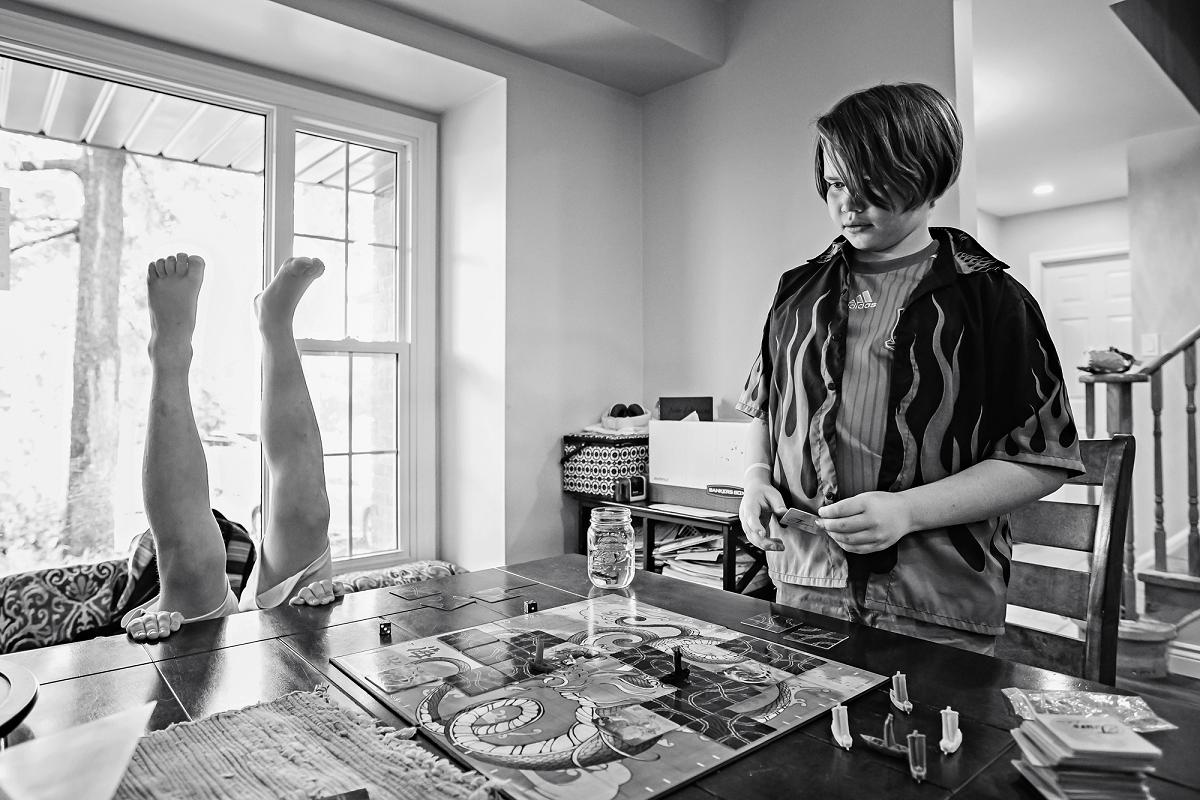
Now, Lyall’s documentary-style photography is what makes her brand and drives her passion. It also wins awards, including her recent Fearless Family Awards, and a This is Reportage: Family Award. Her work has also been featured in select exhibits, chosen as “Kodak Moments,” and shortlisted for Made for Documentary’s Documenting 2022.
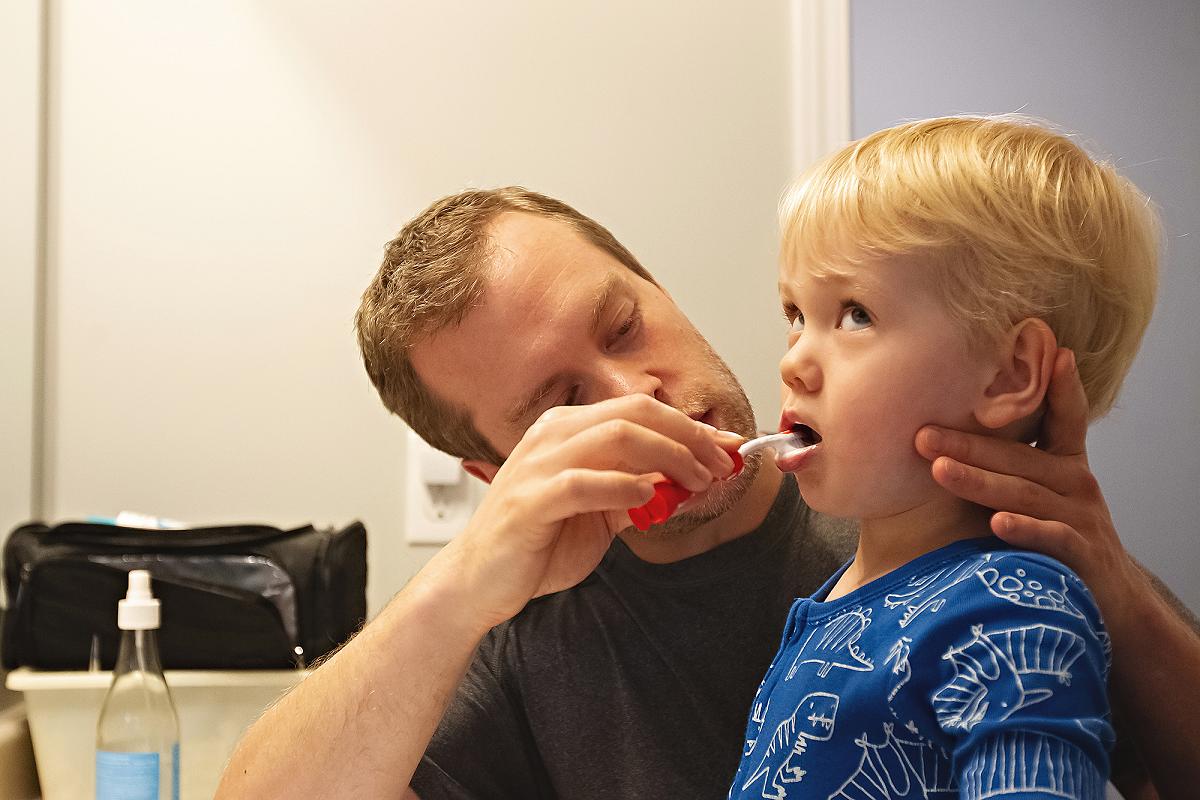
More important to Lyall that her awards is that her photography captures family memories — even the ones you don’t think you want to remember, like the everyday moments of your daily routine.
“It’s about bringing you back to how that time with your kids felt in that moment and the relationships you had with them at that age, because it’ll never be the same,” says Lyall. As the mother of a 10 and 13 year old, she knows first-hand just how fleeting these moments are.
Advertisement – content continues below
Tweet this quote
“Your kids will grow and there’s more wonderful stuff to come, but you’ll miss those little things that you did with them and those rituals and boring, mundane moments,” Lyall adds. “It’s not about the boring stuff. It’s about what’s behind those actions, and what it says about your relationships with your kids.”
During her “Day in the Life” family photography sessions, Lyall spends either a half or full day with a family, joining them on their chosen daily activities and adventures. She explains that this is where her style “really shines” because the family can just go about their ordinary day while Lyall documents it.
Alternatively, twice per year Lyall offers limited “Slice of Life” sessions where she spends just one hour with the family, usually documenting a specific activity. She only offers 25 “Slice of Life” sessions in the summer and fall and 25 sessions in the winter/spring.
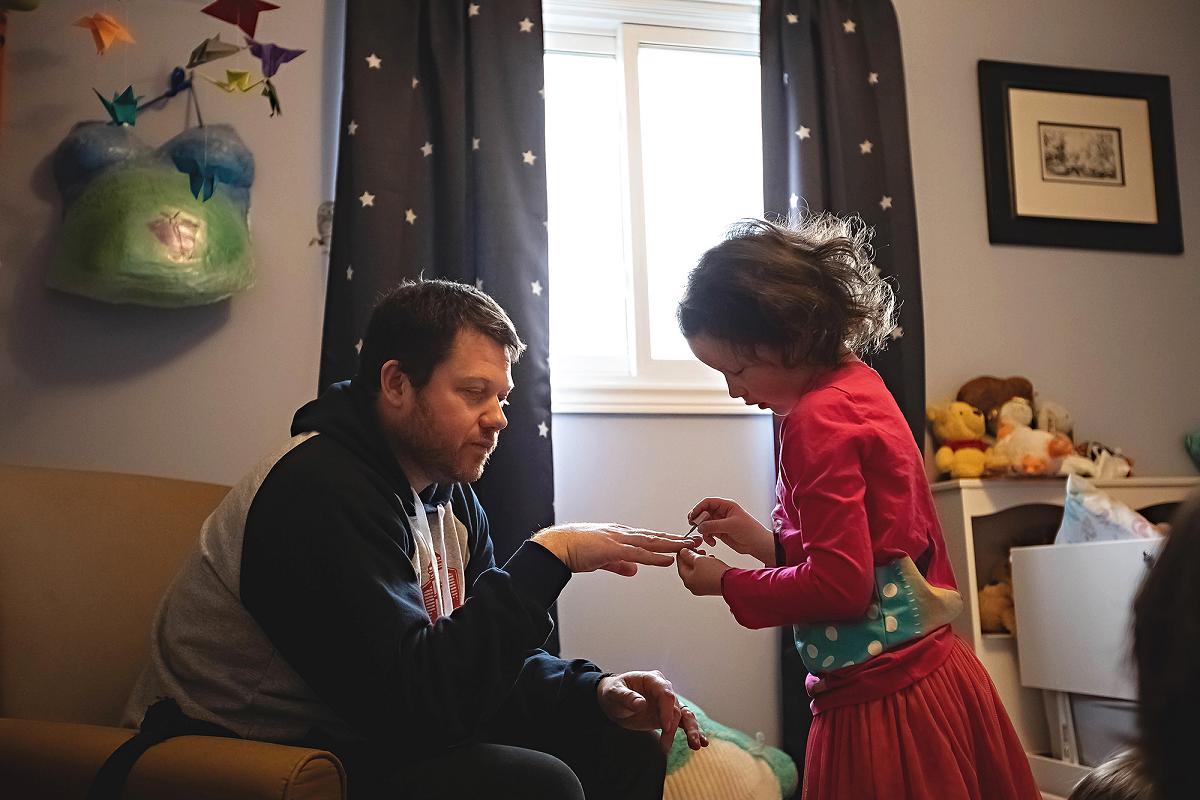
Lyall also continues to do wedding and event photography.
No matter the event you book her for, Lyall does not do any directing or stage-setting. Instead, she acts like the “family friend who happens to have a camera,” tagging along for the day. Since she does practice such an intimate type of photography, Lyall explains it’s very important to get families and children feeling comfortable around her.
“I always encourage parents to tell their kids that they don’t have to say ‘cheese’ and they don’t have to do the things they might associate with being around a camera, like making eye contact or being performative,” says the photographer. “They can just do their thing and I’m just there to hang out, have fun, and take pictures.”
Advertisement – content continues below
Tweet this quote
While Lyall points out she’s always respectful of a family’s wishes and limitations to what they want photographed, she encourages them to allow her to capture the messy moments along with the good.
“If your kid has a meltdown, that’s part of life, and that’s okay,” she says, adding that she’s not there to judge your family or messy house. “Capturing how you help your kids through that is a huge part of your family and your life and your relationships. And that’s the stuff you’re going to want to remember. The things that people think they don’t want to have in their family photos is exactly what they should be capturing.”
She notes those meltdown moments are a rare occurrence because she aims to provide a comfortable and stress-free environment, where children are willing participants because they aren’t being forced to look and act in a certain way.
Lyall recalls a time when, as a young mother, she took photos of her newborn in a tutu and put the images on Facebook. Though she was bombarded with comments of how cute her child was, now when she looks at those photos, all she sees is the reality behind it: it took 30 minutes to take the photo because the outfit was scratching her toddler’s skin and they kept pulling it off.
“Social media teaches us that we must only show the best parts of ourselves,” says Lyall, adding that she believes it stems from the age of film when there were limited chances to snap those perfect shots. “I don’t think it helps anybody. I think it creates a situation where we all feel alone, disconnected, and less than [other people]. I think we should be sharing more of our real selves and be talking more about the real things that we deal with day-to-day, especially as a parent.”
To fight against this social construct, Lyall explains her photography is instead a reminder to young children that they’re worthy of having their picture taken even when they don’t have their hair styled, aren’t wearing matching clothing, and aren’t smiling.
Advertisement – content continues below
Tweet this quote
“I want a kid to feel like they have a record of themselves doing all the things and being gloriously themselves, no matter what that is — weird, wonderful, crazy, chaotic,” Lyall says. “All of it is amazing, so we want to remember you exactly as you are. That’s the energy I want to bring to all my sessions, because you are worthy of being captured no matter what’s going on and no matter what you’re doing.”
To help people capture their everyday moments, Lyall has started a how-to series on improving cell phone photos, which can be found in her Instagram story highlights. All the tips and pointers are “quick and easy” and require no extra equipment, technical knowledge, or directing.
“I wanted to encourage people to capture the real moments of their day-to-day lives with their family more often, and one of the easiest ways to do that is to feel more confident taking images with your own cell phone,” she explains, adding that in the fall, she will continue the series with advice on seeing and using light to improve cell phone photo quality, and on editing photos.
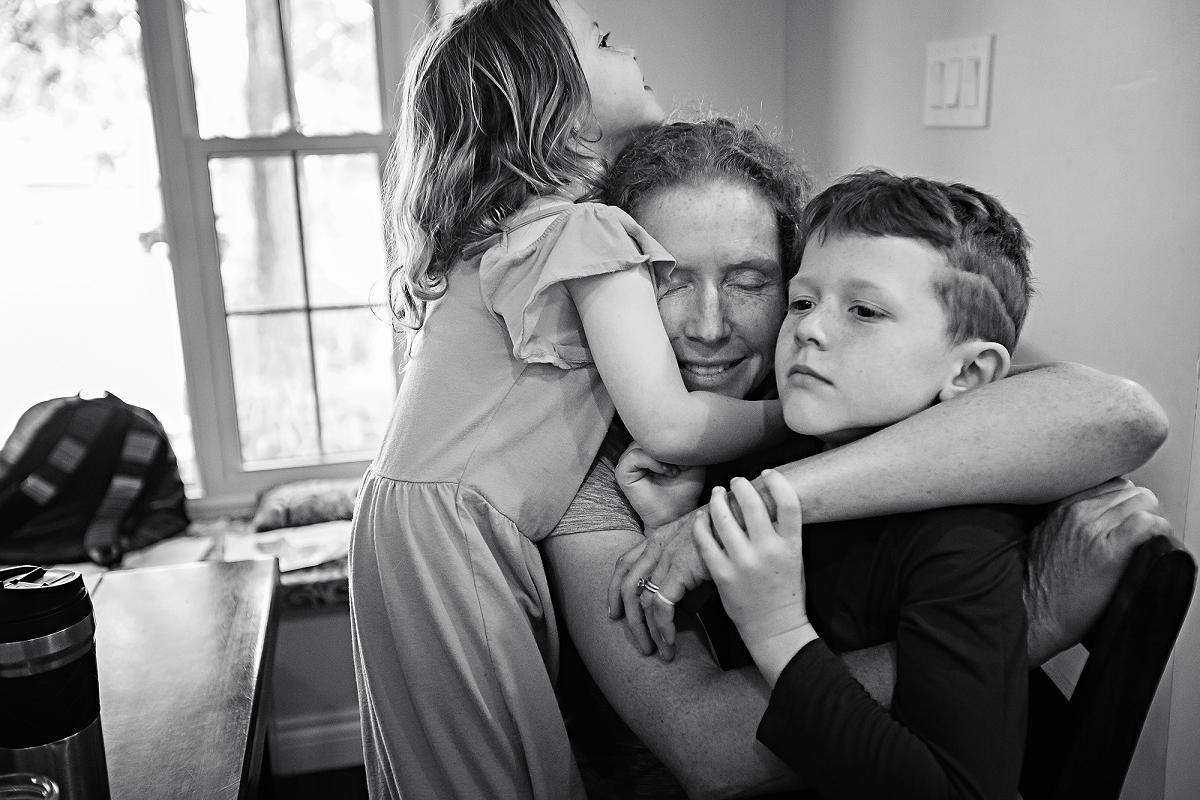
She says she hopes these tips will help parents capture photos of their children exactly as they are — something she has learned to do while watching her own children grow up.
“As I’ve gotten older and realized how fleeting these moments are, it only increased my drive to catch the real stuff over stylized stuff,” she explains. “I really wanted to preserve who they were as people as they grew and capture that over anything else.”
“It pushed me that much more to offer this style of photography to people as an alternative, because I think it’s so incredibly important to celebrate who you are, and not what you think people should be.”
Visit jordanlyallphotography.com to schedule a Day in the Life or Slice of Life photo session, and follow Jordan Lyall Photography on Instagram and Facebook for the how-to series on using your own cell phone for photos.


While it is generally not illegal to take videos or photographs of someone in public, some people believe that it is morally wrong to do so and that it is an invasion of privacy. Similarly, others feel it is alright to take videos and photographs of someone else in public as long as the content is not obscene or harmful.
Even if these videos or photographs are not obscene or harmful, one should still be conscious of the possible implications on the persons in those videos or photographs, especially if negative behaviour is captured.
This includes how it may affect them at work or in school, and how it may affect their friends and family members. Ultimately, it is a personal choice whether or not to take a video or photograph of someone else in public but one needs to be aware of the moral and legal implications. If the situation permits, it would only be right to seek consent before any videos or photographs are taken, particularly if it involves a child.
What then can you do if you find yourself the unwilling subject of a non-obscene video or photograph?
Approach the situation calmly and politely request that the other party stop taking pictures or videos of you. You may also ask them to delete any footage and/or photographs they have already taken. It is important to avoid shouting, being argumentative, intimidating, or aggressive.
Likewise, refrain from engaging in any physical altercation, such as trying to take their devices from them or pushing them forcibly. If the person persists in filming or photographing you, you may wish to call the police for assistance or to file a report.
While you might need certain information from the person to file your report, it is important to understand that you do not have the right to demand their personal identification documents or prevent them from leaving. If you have made a police report for a crime but your case is not taken up for further investigation or prosecution, you can choose to file a Magistrate’s Complaint to give directions for further action. Additionally, you may also consider taking legal action against the person for any emotional distress or financial losses suffered.


As I stood at the edge of the tranquil beach, a sense of both calm and disappointment washed over me. Having checked the weather forecasts closely, I was once again feeling let down as instead of crisp morning light, I instead had low clouds and very little light.
All around, the beach appeared to be draped in a thick blanket of low clouds, creating an almost surreal atmosphere. The waves lazily lapped against the shore, instead of what I would have liked them to be doing and were barely disrupting the stillness. I felt like giving up on the shoot, but after surveying the scene, I figured this was the perfect setting for a journey into the realm of fine art photography, where I intended to experiment with long exposures to capture the essence of this moment.


Despite the subdued lighting and the gentle monotony of the waves, I felt some excitement building within me as I took and reviewed my first image. There was an inherent beauty in the subdued tones and the lack of immediate drama in the scene. I knew that I wanted to encapsulate this feeling and who know, translate it into a visual masterpiece perhaps?
Having already grabbed my filters, I started on my quest. The decision to use these filters wasn’t just technical; it was a creative choice. I wanted to extend the exposure time beyond what I would normally do, thus allowing the subtle movements of the waves to blur into an almost dreamlike state. The intention was to blur the lines between the sea and the sky, creating a seamless transition between the two elements. With this intentional blurring, I aimed to evoke a sense of timelessness, a moment frozen but also flowing.
As I set up my camera, I pondered the exposure time that would best convey the tranquility of the scene. While shorter exposures might have captured the details more crisply, I was drawn to the idea of extended exposures that could emphasize the delicate movements in the water and clouds. The length of the exposures was crucial; it had to be long enough to create the desired effect, yet not so long that the scene lost its connection to reality entirely.
I settled on two-minute exposures as the sweet spot. This duration allowed enough time for the waves to create a beautiful misty effect as they interacted with the shore, blurring their distinct edges. What I need to be 100% sure of here was getting my focus right. Using focus peaking, I was able to see exactly where the plane of focus was before then putting on my 10-stop filter.

While the idea of intentionally “blowing the highlights” might sound counterintuitive, it was my deliberate choice to amplify the ethereal quality of the scene. With the thick clouds diffusing the light, there was a soft light that wrapped around the scene. By allowing the highlights to blend into this soft radiance, I aimed to create a high-key aesthetic that would enhance the dreamy atmosphere.
The challenge here was to balance the blown highlights with retaining some detail in the minimalistic rock formations that were to be the focal points of the composition. I wanted the rocks to stand as stoic witnesses to the passage of time, almost as if they were guardians of this tranquil space. After a few attempts, I was on the right track and off now on my new adventure.

With my settings dialed in, I turned my attention to the composition. I wanted to create an image that was both visually engaging and potentially emotionally evocative to the viewer. The rule of thirds felt too rigid for this scene; instead, I opted for a more fluid approach. Placing the rock formations closer to the edge of the frame allowed the viewer’s eye to wander through the negative space, getting lost in the expanse of the beach and the soft merging of sea and sky. I have said before that the rules of composition shouldn’t be rules, but more so tools, and this was a perfect opportunity to practice what I preach as such.

As the first two-minute exposure began, time seemed to stand still as I waited to see what the result would be. I watched as the waves danced and mingled with the shoreline, before retreating once again back out to sea. The clouds could have painted soft streaks across the sky; however, I was intentionally overexposing my shots, so these wouldn’t be a factor I would have to consider.
Reviewing the images on my camera’s LCD screen was in some way a revelation. The intentional blown highlights didn’t detract from the photograph’s impact; instead, they added to the otherworldly aura of the scene. The rocks, rendered in subtle detail, anchored the composition, and with the negative space that the blown highlights had created, I felt it added to the overall scene.
The experiment with fine art photography was a journey of creativity and contemplation. The textbook definition of fine art photography is: “fine art photography is artistic expression through photographs, transcending reality to evoke emotions and narratives.” Even as I was hitting that shutter, I was unsure if it would work out, and even after I got home and processed the images, I was still unsure. Through intentional choices in exposure time, composition, and embracing the elements, I was able to capture the delicate balance between reality and dreaminess.
This experience reminded me that landscape photography isn’t solely about technical prowess; it’s about storytelling, emotion, and the artist’s unique perspective. It’s about pushing boundaries, embracing imperfections, and seeking beauty in the subtlest of details, from my point of view anyway.
Do you have additional thoughts on this topic? Are you a fine art photographer? I’d love to see your views on my experiment and see what is fine art photography?

Modern cameras are absolutely ridiculous machines, capable of performing tasks and producing images that would not have been imaginable even a decade ago. And let’s be honest: most cameras are far more capable than necessary, meaning if our images are not what we want them to be, the problem is probably with us. This important video essay discusses the issue.
Coming to you from Mitchell Kanashkevich, this insightful video essay discusses the idea that modern cameras have surpassed the needs of the majority of photographers. This sort of message should not be discouraging; rather, it is a great reminder that we do not have to spend money every time we want to improve as photographers, and really, considering how expensive a new camera or lens can be, that is a really important thing to keep near the front of our minds. And besides wasting money on gear we do not need, that sort of approach can lead to a vicious cycle, and that sort of back and forth rarely leads to much satisfaction, at least not in the long-term. Often, a bit of education or creative exploration is a much better solution. Check out the video above for the full rundown from Kanashkevich.





