
About

Posts by :

Water is Life: A Deep Dive Interview with Carole Lindstrom On Her Upcoming Dual Biography

Water is Life: A Deep Dive Interview with Carole Lindstrom On Her Upcoming Dual Biography

I grew up not far from Lake Michigan, so it did not seem strange to me that a lake could stretch so far that it resembled an ocean. Now I live close beside it at a time when abundant fresh water is much on the minds of people everywhere. And I think that no picture book author has done more to talk of water, Water Rights, and the Indigenous activists fighting for it, more than author Carole Lindstrom. No doubt you remember her work on the Caldecott Award winning title We Are Water Protectors. That book took much of its inspiration from the members of the Standing Rock Sioux Tribe who fought against the Dakota Access Pipeline. Now she returns to us with the true story of Grandma Josephine and her great-niece, Autumn Peltier. If you’re unfamiliar with them, Josephine Mandamin or “Grandma Josephine” was a respected Anishinaabe elder from Canada who was an internationally recognized Water Rights and Indigenous activist. Her niece Autumn would go on to become the youngest Chief Water Commissioner for the Anishinabek Nation.

Today, Carole herself joins us to discuss Autumn Peltier, Water Warrior (out everywhere September 19th):


Betsy Bird: Carole! It’s so lovely to get a chance to talk to you about AUTUMN PELTIER, WATER WARRIOR. So let’s just start at the very beginning. First and foremost, how did you personally first hear about the work of Josephine Mandamin and Autumn Peltier?

SCROLL TO KEEP READING THIS POST

ADVERTISEMENT

ADVERTISEMENT
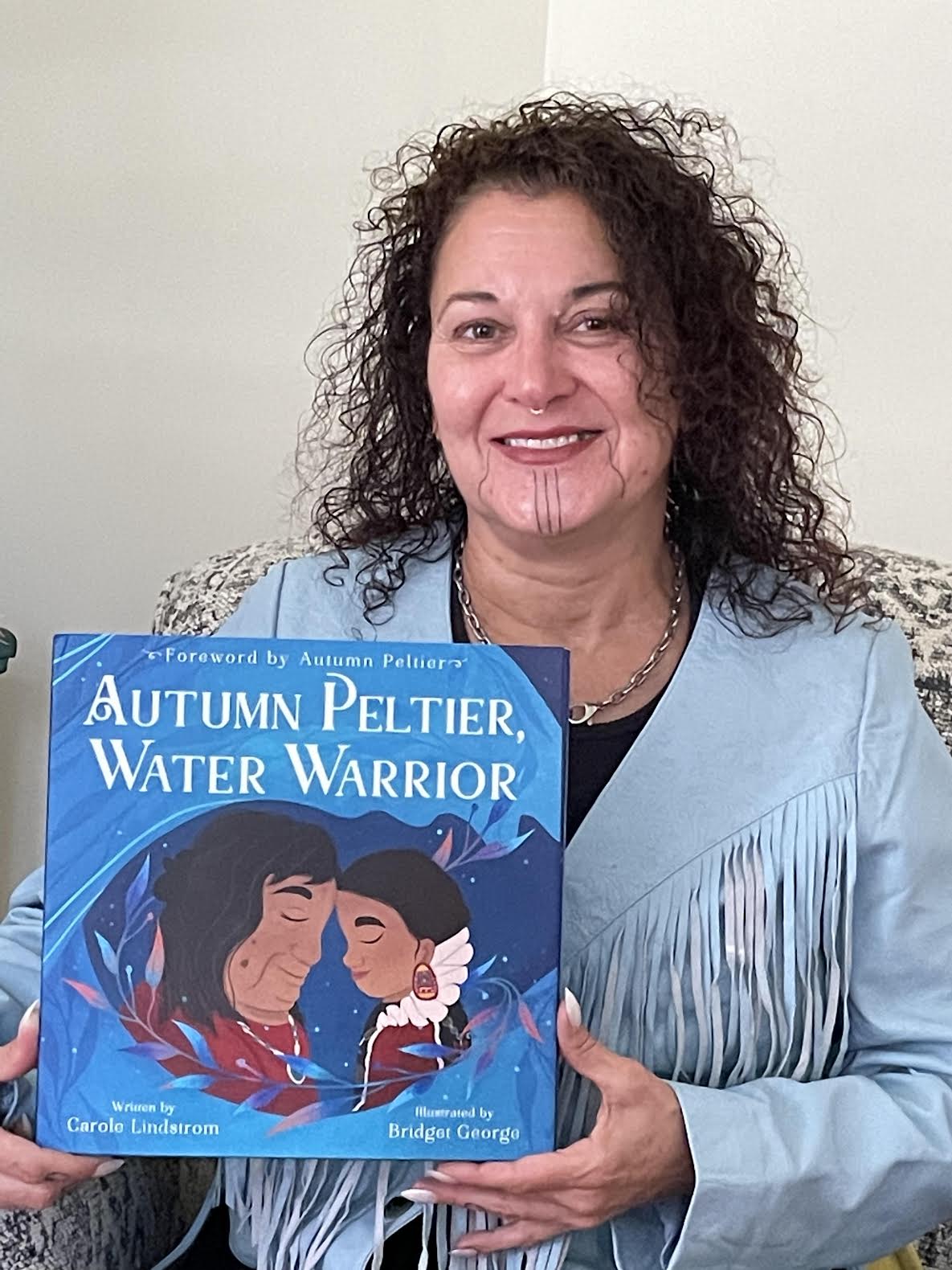
Carole Lindstrom

Carole Lindstrom: When I was doing research for WE ARE WATER PROTECTORS I learned about Grandmother Josephine and her great niece, Autumn Peltier and all they were doing to protect the water. I knew after learning about these important Anishinaabekweg that I had to write a story about them.

BB: I’m always interested in that point where vague notions circulating in an author’s brain coalesce into a comprehensible story. Where did that moment happen for you? When did merely knowing about Josephine and Autumn turn into a real book?

CL: I just know that when I read about people and things that are doing big things and aren’t recognized for it – that there’s a story there. I also knew as I began to think about the story arc and what the actual story would be, when I realized that it must be told through the viewpoint of nibi (water) that it was a story.

BB: There are so many different ways to write a biography for kids. You can take just a slice of a subject’s life or encompass it entirely. You had the extra added challenge of having two different biographical subjects. How did you prefer to tackle the material? And was it hard working two people’s stories into a single book?

CL: I knew that Grandmother Josephine and Autumn’s story were intertwined so that necessitated a story that intertwined their lives When I came upon the idea of telling it through nibi’s viewpoint, that’s when the story began to flow, so to speak.

BB: The theme of protecting water comes up time and time again in your books for children. Could you speak a little to why this topic interests you so specifically? Why do you return to the theme of water repeatedly?

CL: For many reasons, but I feel from a spiritual place that as Anishinaabekweg we are considered the keepers of the water. It feels important to my heart and myself as a person to honor that place and I do that by telling these stories. Water is life. It is essential to us all. It is neglected and taken for granted, we can see that today in the lakes drying up in 2023. These are all warning signs and nibi could not be any louder in it’s cries for needing care and nurturance.

BB: Tell us about some of the choices you made in writing this book. Were there things you initially hoped to include but that had to be cut?

SCROLL TO KEEP READING THIS POST

ADVERTISEMENT

ADVERTISEMENT

CL: No, there was not anything that I cut when writing the story of Autumn. My writing style is to keep words to a minimum and let the illustrators work shine through the details. Children are also brilliant with inferences, so I find making the best word choices to pack the most punch also to be very helpful.

BB: This book is illustrated by Bridget George. Were you aware of Bridget’s work before this book? What are your thoughts on the final product?

Bridget George

CL: Yes, I was aware of Bridget’s brilliance before the book. I am very fortunate that I have a large say in the illustrators of the stories that I write. I am extremely grateful for this privilege and do not take it lightly. It’s very important to me, as Native woman, to uplift and bring up new voices in illustrating books for young people. Graphic design and the like would not have been something that a lot of Native students would study in school because it was not awfully long ago that these types of books were not looked at as “to the trade.” They were viewed at as more niche markets; therefore, many Native artists would have done just that with their creative talents. They would have been painters, sculptors, bead workers and the like. It is only in the last few years that Native books have found themselves on bookshelves everywhere, YAY!!!

So the publishers I work with are all very kind and gracious in offering to work with new artists to help them develop their skillset for illustrating children’s books. I have been so very honored to work with some amazing publishers which has allowed me to work with some INCREDIBLE illustrators, like Bridget.

I am blown away by the final artwork. I just love it so much and think the words and art go perfect together.

BB: Finally, what else do you have coming up next? What can we hope to see from you?

CL: I am working on a middle grade historical fiction book with Bloomsbury. I’m excited about this story. It’s based on my Metis ancestry and the Northwest Resistance.

I am also working on a YA graphic novel and several picture books in various stages of revisions.

Miigwech for having me, Betsy.

BB: Thank YOU for talking with us today!


image

A great deal of gratitude to Carole for answering my questions today, as well as Chantal Gersch and the folks at Macmillan for setting this up. Autumn Peltier, Water Warrior is on shelves everywhere September 19th. Look for it soon!

Filed under: Interviews

Rio’s Greer Museum to host photography exhibition

Rio’s Greer Museum to host photography exhibition
image

RIO GRANDE, Ohio (WV News) — The Greer Museum is hosting an exhibit of the photography work of Ohio Poet Laureate Kari Gunter-Seymour.

Not only celebrated for her poetic prowess, she demonstrates remarkable skill as a photographer, officials said.

WEB EXCLUSIVE VIDEO: Kenosha Art Market artist mini feature

WEB EXCLUSIVE VIDEO: Kenosha Art Market artist mini feature

(PILOT) Web exclusive video mini feature with Pleasant Prairie artist Sandy Obertin on the firing process used to create her unique wind chimes on display at Kenosha Art Market Sunday, Aug. 20, 2023.


Reporter

GALLERY: KENOSHA ART MARKET 2023

GALLERY: KENOSHA ART MARKET 2023
image

Scenes from Kenosha Art Market on Sunday, Aug. 20, 2023. The Art Market takes place the third Sunday of each month from June through October in Union Park, 4500 Seventh Ave., and features original fine art, jewelry, pottery, paintings and more for sale by area artists.

Dipp uses AI to fix bottlenecks between marketing and design teams

Dipp uses AI to fix bottlenecks between marketing and design teams

Before founding dipp, Jennifer Chen and Mikhail Abramov spent 15 years working as art directors in New York City. During that time, Chen says they realized that the marketing, sales and design process have stayed the same, despite new technology and tools being introduced to the market, and is often riddled with bottlenecks.

“Salespeople have sales needs, they communicate with the marketing team and then once the marketing team has a direction they brief a designer, then the designer goes back to the marketer, and then the marketer goes back to the designer,” she said. “There’s that vicious cycle that slows down the entire process because nobody understands the needs and workflow of the other department.”

Dipp was launched three years ago to automate much of that workflow, and allow marketing and design teams to collaborate more effectively, while focusing on their own performance metrics. For example, if a marketing team wants to update a price on their ad, all they need to do is enter it into a spreadsheet instead of asking a designer. The Taipei-based startup recently raised $1.5 million in seed funding from investors including SparkLabs Taiwan, Palm Drive Capital and content-tech unicorn Tezign, and will launch generative AI-powered features soon.

To use dipp, brands first set up a brand guideline with information including fonts, colors and layout (or they can upload an Adobe Photoshop file). That data is then turned into a dipp file with everything remaining editable. Then prices and other information for ads are uploaded into a spreadsheet, with each row representing a product, so visual assets can be edited in batches. This helps marketing and design teams keep up with the massive amount of visual content that is needed to sell online—Chen said brands typically generate 300 to 500 images at a time, which dipp can help them do in minutes.

dipp's team

dipp’s team

The brands dipp works with are typically Fortune 500 companies in apparel and beauty selling a large number of products, or upwards of 500 SKUs. They have high product rotation rates, often with weekly launches of 20 or more products, and sell on three or more marketplaces, alongside social media advertising campaigns. Chen says most have large sales and marketing teams, but a shortage of designers. Its customers include Levi’s, Estée Lauder and Rakuten. Dipp also works with e-commerce enablers, or agencies that help brands distribute products across multiple channels.

Since its launch, dipp has primarily focused on Taiwan, but is expanding into Southeast Asia, with new clients in Singapore, the Philippines and Thailand. Dipp started in New York, but the team decided to move to Taiwan after getting into Taipei-based accelerator Appworks because of the market potential it saw in Asia.

For example, brands here hold a high number of sales promotions. “Throughout the year, it’s not just Black Friday or Christmas, there’s a sale every month,” Chen said. “There’s a busy season starting in June that goes all the way to Chinese New Year.”

In terms of competition, Chen says potential customers often ask how dipp is different from Rocketium, which helps creative teams build very large marketing campaigns. Chen says dipp differentiates by focusing on e-commerce because brands in Asia often sell through multiple online channels at the same time, including PC Home, Momo, Shopee and Lazada. Each marketplace has its own unique guidelines for visual content, including file sizes and dimensions. That information is embedded into dipp’s platform, so brands can automate their ads to fit different requirements.

Dipp is now working on integrating generative AI into its platform to help address gaps between marketing and design departments. For example, it will allow marketers to use prompts to generate images as a first draft of ideas to present to designers. It also automates the process of reviewing designs, or checking details like character limit and formatting to meet the requirements of different marketplaces and social media platforms.

Dipp’s new funding will be used for team expansion, especially in its R&D and business departments.

In a statement, Palm Drive Capital founding partner Seamon Chan said, “With global venture capital investments in generative AI reaching US$1.7 billion in the first quarter of this year, we are thrilled to support dipp in enhancing their e-commerce solution with AI capabilities. As the company has validated its value proposition in Taiwan by offering a much-needed solution to the multichannel e-commerce operation of global brands, we are optimistic that this solution will bring disruptive impact on e-commerce operating workflows through the APAC region.”

Robert Capa Contemporary Photography Center Budapest : Robert Capa, the Photojournalist – The Eye of Photography Magazine

Robert Capa Contemporary Photography Center Budapest : Robert Capa, the Photojournalist – The Eye of Photography Magazine

Robert Capa, the Photojournalist, the world’s first permanent exhibition of Robert Capa’s life’s work, has opened in the new exhibition space of the Robert Capa Contemporary Photography Center in Budapest.

2008

In 2008, the Hungarian State purchased the Master Collection III series of 937 images, making Budapest, alongside New York and Tokyo, the most important custodian of the Capa legacy. The agreement on the purchase of the Robert Capa Collection in Hungary stated that the collection should be housed in its “permanent home”, a photographic center to be established for its research and exhibition.

2013

The Robert Capa Center for Contemporary Photography (Capa Center for short) was established in 2013, with the main task of promoting the purchased collection through exhibitions, events, and publications, as the trustee of the Robert Capa photographs. In addition, in the exhibition space on the first floor, a permanent exhibition of the André Kertész collection from Szigetbecse is on display and in addition regularly changing contemporary photography exhibitions present the artists and trends in Hungarian and international photography. In the event hall, a variety of photographic events (lectures, workshops, portfolio consultations) take place.

2023

On 13 June 2023, the world’s first permanent exhibition of Robert Capa’s life’s work, Robert Capa the photojournalist, opened in the new exhibition space of the 10th anniversary Robert Capa Contemporary Photography Center.

The unique exhibition presents about 138 photographs from the series, including many that have become iconic, and explores the major stages of the photographer’s life, arranged according to the themes defined by the oeuvre. Robert Capa’s work is important because of the profound impact his images and attitude have had on the public, forever changing the norms of photojournalism, and contributing to the understanding and remembrance of history.

Robert Capa lived only 41 years. Born Endre Friedmann in Budapest on October 22nd 1913, he died on a landmine in the Indochina War 1954 on May 25th.

His name is among the first and best in the history of photography. The war correspondent, who had seen five battlefields, made his mark in his tragically short life: his photographs of the front and the rear created a school and renewed photojournalism. He photographed the war, the fighting, the soldiers in the trenches and the everyday life of the hinterland from the position of a participant observer, with boundless compassion. He was there with the soldiers; he was in the middle of the action and he documented the events in the immediate vicinity of death. It was this proximity, this participation, that recreated the genre of war photography. As his famous quote goes: “If your pictures are not good enough, you were not close enough”.

Robert Capa had a major impact on the photojournalism profession and war photography. His images and work have inspired and continue to inspire generations. The ethical principles and dedication that Capa embodied have remained important pillars of the photojournalism profession ever since.

Robert Capa Contemporary Photography Center
Budapest, Nagymező u. 8,
1065 Hungary
https://robertcapaexhibition.capacenter.hu/en/

A Gallery for Fine Photography : Joshua Mann Pailet – The Eye of Photography Magazine

A Gallery for Fine Photography : Joshua Mann Pailet  – The Eye of Photography Magazine

Joshua Mann Pailet was born in the middle of the year, the middle of the day in the middle of the century on June 30,1950.
Joshua’s mother, Charlotte Mannova was born in Brno, Czechoslovokia and survived the Holocaust via Kindertransport.
The rest of her immediate family did not survive.
She met Joshua’s father in England when he was a Lieutenant in the US Army and moved to New Orleans, USA.
Joshua attended Rice University in 1968-1972-1973 where he studied Engineering, Economics and obtained in Masters in Accounting.
He took a photography course with Eve Sonneman to satisfy his fine Art credit.
He fell in love with the medium and began shooting his Nikon FE2 everyday.
His photography class exhibited their photographs at the Rice Gallery and Dominique and John de Menil of the Menil foundation purchased 19 of his photographs.
Joshua attributes Mrs. de Menil‘s continued collecting of his work to allowing him complete artistic freedom.
Joshua opened A Gallery for Fine Photography in New Orleans in 1975 to represent other artists.
With more good luck, Pailet met Harry Lunn, who assisted him with access to his first Ansel Adams Show.
Joshua closed A Gallery to live on the American Freedom Train for a year as their official Photographer.
The American Freedom Train was a red, white and blue steam engine that  traveled across the country and was one of the last steam engines in the US.
He reopened his gallery in 1977 and began showing artists including Brassaï, Diane Arbus, Ansel Adams and all the major Photographers.
Joshua is a founding member of AIPAD and was in the group of original photography dealers at Art Basel in Switzerland in 1989.
He procured a booth at both photo fairs for 15 years.
He continues to operate his gallery in New Orleans and work on his own photographs.
Joshua represents Henri Cartier-Bresson, Helmut Newton, Elliott Erwitt, Herman Leonard, Peter Beard and many many more.
A Gallery is the longest surviving photography gallery in the World and is located at 241 Chartres St, New Orleans, USA.
Joshua has over 350,000 black and white negatives and 150,000 color slides.
His work includes rock and roll, New Orleans culture, major American history events, Hurricane Katrina and many European images showcasing Paris, Prague and Switzerland.
His love of photography, honesty of the human condition, range of work and his ability to capture  moments at their truthful speed allows viewers to see and feel life all around.
His work resides in the Bibliothèque Nationale in France, the New Orleans Museum of Art, the Ogden Museum of Southern Art, the Polk Museum of Art, the Smithsonian Instituion and the Library of Congress.

A Gallery for Fine Photography
241 Chartres St
New Orleans, LA 70130
www.agallery.com

Art Sandwiched In: Photography as Visual Storytelling and Community Memory | Orlando, FL

Art Sandwiched In: Photography as Visual Storytelling and Community Memory | Orlando, FL

An informal lunchtime program with engaging speakers or films held on selected Wednesdays from noon-1pm with coffee and cookies provided. Bring your own bag lunch and feed your hunger for art! Sponsored by Caroline and Jeffrey Blydenburgh. Additional support provided by The Joe & Sarah Galloway Foundation.

November 1: Photography as Visual Storytelling and Community Memory
presented by Peter Schreyer, Director of Crealdé School of Art

Peter Schreyer will share observations and invite discussion about his favorite images from Bearing Witness: Early 20th-Century Photography from the Karen and Frederick Dawson Collection. As a working film-based photographer, he will also show important period cameras used in the creation of the historic images from the collection. Schreyer is a Swiss-born internationally exhibited, award-winning documentary photographer and the long-time director of Crealdé School of Art in Winter Park.





