About

Posts by :

NASA’s James Webb Telescope Captures the Fiery Remains of a Dying Star in Unprecedented Detail

NASA’s James Webb Telescope Captures the Fiery Remains of a Dying Star in Unprecedented Detail

Image courtesy of ESA/Webb, NASA, CSA, M. Barlow (University College London), N. Cox (ACRI-ST), R. Wesson (Cardiff University)

More than a year after NASA’s James Webb Space Telescope brought us images of the Southern Ring Nebula, the world’s most powerful observer captured the remains of another celestial body with stunning clarity.

Nebulae are massive clouds of dust and gas that sometimes emerge from dying stars. Both the Southern Ring Nebula and the Ring Nebula, which is the subject of the newly released images, were born from a star discarding its outer layers as its fuel reserves dwindle. Located about 2,000 light-years away, the latter is bright and often discernible from Earth with the use of simple binoculars.

Documented with the telescope’s Near-Infrared Camera, the Ring Nebula is now visible in unprecedented detail. The bright red outer ring is comprised of approximately 20,000 enormous globules of molecular hydrogen gas about the size of Earth. Inside, astronomers explain, “is a narrow band of emission from polycyclic aromatic hydrocarbons, or PAHs–complex carbon-bearing molecules that we would not expect to form in the Ring Nebula. Outside the bright ring, we see curious ‘spikes’ pointing directly away from the central star.” These prongs were barely visible in earlier images captured by the Hubble Space Telescope and were largely only seen through infrared.

The most intriguing discovery, though, is the ten evenly spaced features nestled inside the halo surrounding the bright outer ring. Astronomers explain:

These arcs must have formed about every 280 years as the central star was shedding its outer layers. When a single star evolves into a planetary nebula, there is no process that we know of that has that kind of time period. Instead, these rings suggest that there must be a companion star in the system, orbiting about as far away from the central star as Pluto does from our Sun. As the dying star was throwing off its atmosphere, the companion star shaped the outflow and sculpted it. No previous telescope had the sensitivity and the spatial resolution to uncover this subtle effect.

According to a statement, research into the Ring Nebula is ongoing, so expect more information in the coming months. Until then, head to NASA  to see the images up close.


A celestial body with bright red center and blue outer rings

Image courtesy of ESA/Webb, NASA, CSA, M. Barlow (University College London), N. Cox (ACRI-ST), R. Wesson (Cardiff University)

Do stories and artists like this matter to you? Become a Colossal Member today and support independent arts publishing for as little as $5 per month. The article NASA’s James Webb Telescope Captures the Fiery Remains of a Dying Star in Unprecedented Detail appeared first on Colossal.

Sordoni Art Gallery at Wilkes University Celebrates 50 Years with The One Rose: The Life and Legacy of Rose O’Neill

Sordoni Art Gallery at Wilkes University Celebrates 50 Years with The One Rose: The Life and Legacy of Rose O’Neill

In recognition of 50 years of arts, culture and community, the Sordoni Art Gallery at Wilkes University will open the 2023-24 season by featuring the life and work of Wilkes-Barre native Rose O’Neill. The One Rose: Celebrating The Life and Legacy of Rose O’Neill will be displayed from Aug. 25 to Oct. 8

About Rose O’Neill

O’Neill (1874–1944), an American illustrator of the early 20th century, was a woman of many accomplishments — published poet, novelist and activist for women’s suffrage. She is considered the first female comic artist and was the first woman illustrator for Puck magazine, the leading men’s magazine of the late-19th century, entertaining its readers with considerable satire and political commentary.

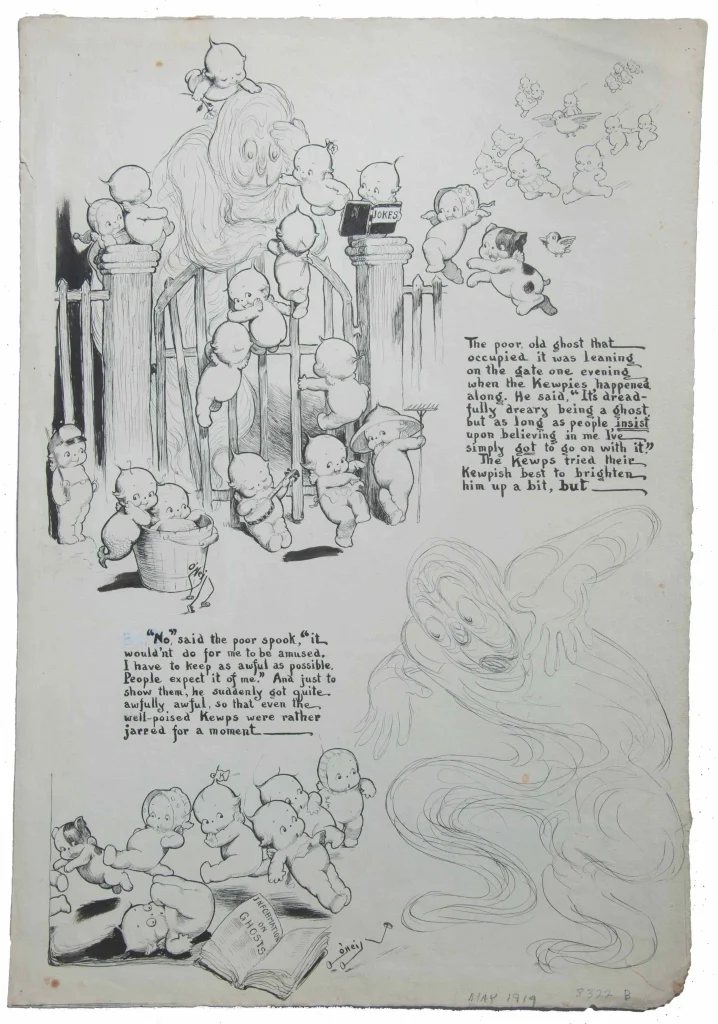
Kewpie dolls, based on comic strip characters O’Neill created, gained international popularity, served as the face of major advertising campaigns and appeared on a variety of household goods. O’Neill became the first woman to earn over a million dollars, and her $1.4 million fortune would be equivalent to more than $36 million today.

An accomplished artist and sculptor of Sweet Monsters, her work was featured in exhibitions in Paris and New York. O’Neill was inducted into the National Women’s Hall of Fame in 2019. The One Rose celebrates the life and career of this Wilkes-Barre artist who was born just streets away from where the gallery is today. 

The Ghost-Kewps, 1919, pen and ink on paper, 22 1/2 × 17 1/4 inches, collection of the Ralph Foster Museum, College of the Ozarks

Exhibition and Anniversary Events

A celebratory cocktail party will kick off a series of anniversary and exhibition events.

Cocktails & Culture will be held from 5:30 to 7:30 p.m. on Thursday, Sept. 7. Attendees will enjoy an evening of live music, specialty cocktails, local cuisine and an inside look at the exhibition. This event is held in collaboration with Diamond City Partnership and tickets are $25. Advance registration is required.

For more information, visit wilkes.edu/sordoniartgallery.

Additional events include:

Second Saturday Family Hour, Noon to 2 p.m. on Sept. 9: Participants will create their own comic strip and suffragette rosette. Coloring sheets featuring downtown Wilkes-Barre landmarks will be provided by the Wilkes-Barre Riverfront Parks Committee. Storytime with the Osterhout Free Library begins at 1 p.m. This event is free and open to the public.

Cartooning Workshop with Kevin O’Neill, Noon to 3 p.m. on Sept. 23: This special Art in Your Hands: Kid’s Edition workshop is hosted by Kevin O’Neill, who will lead the creation of a dinosaur mural while teaching the basics of illustration. This workshop is for children ages seven to 10. Space is limited and registration is required by emailing melissa.carestia@wilkes.edu.

Art in Context Lecture: The O’Neills in Wilkes-Barre, 5 p.m. on Sept. 27: Learn about Wilkes-Barre history through the lens of the O’Neill Family. They lived on Meade Street in the Emerald Cottage dedicated to “friendship, love, truth, and liberty.” This discussion is led by Diane Wenger, Wilkes professor emeritus of history. This event is free and open to the public.

Rose O’Neill: Facts & Fancies at 5 p.m. on Wednesday, Oct. 4: A lecture featuring one of the foremost scholars on Rose O’Neill will close the exhibition. Sarah Buhr, curator of the Springfield Art Museum, will discuss the accomplishments of this singular woman. From her artwork to writing to becoming the first woman to make over a million dollars from her craft, Buhr will share the magnificent life and career of O’Neill. This event is free and open to the public.

50 Years of the Sordoni Art Gallery

The Sordoni Art Gallery has been a constant in the ever-changing landscape of downtown Wilkes-Barre. After the devastating flood that impacted the Wyoming Valley in June 1972, Margaret “Barney” Sordoni (1915-1989) and her son, Andrew J. Sordoni III, worked alongside Eugene Farley, the first president of Wilkes College, to create a unique resource for the college and community.

Since 1973, the Sordoni Art Gallery has continuously played an integral role in bringing high-caliber art and artists to the Wilkes campus and greater northeastern Pennsylvania region. The gallery opened its doors in Stark Learning Center on River Street with an exhibition featuring works by Wilkes-Barre native George Catlin. To unveil its current South Main Street home, shared with the Karambelas Media and Communication Center, in 2017, the gallery celebrated its new 7,000-square-foot space with a landmark exhibition featuring works by Andy Warhol.

“The Sordoni has always been more than just an art gallery to Wilkes University. A non-traditional classroom, the Sordoni Art Gallery encourages students to ask questions, test boundaries and think critically about the world around them,” says President Greg Cant. “For some Wilkes students — many of whom are the first in their families to attend a four-year college — the Sordoni Art Gallery offers the completely new experience of being immersed in the visual arts. This is a life-changing moment for these students, and we take great pride in having such a valuable resource on our campus.”

The gallery is open from 10 a.m. to 5 p.m., Tuesdays through Fridays and Noon to 5 p.m. on Saturdays. It follows the operating schedule of Wilkes and is closed on University holidays, breaks or due to inclement weather. For more information, visit wilkes.edu/sordoniartgallery.

Brides Urged Not to Ask for Refunds From Maui Wedding Photographers

Brides Urged Not to Ask for Refunds From Maui Wedding Photographers
Maui Fires
Reyna Edmonds, left, aftermath of the Maui fires, right.

A wedding photographer has urged brides not to ask for refunds from wedding photographers on the island of Maui after it was hit with devastating wildfires.

Reyna Edmonds has a sister who is a wedding photographer on Maui and has been receiving “tone-deaf” messages from brides who are more concerned about their weddings than the catastrophic fires on the island.

“First off, I just want to say that my heart goes out to the people of Maui, I don’t think that anybody on the mainland has any idea of how horrific things actually are or were over there,” she says on TikTok.

“My sister’s told me that her and a bunch of other vendors on the island are getting messages from their brides on the mainland requesting their deposits back,” she continues.

“Emails asking silly, frivolous questions like ‘Do you think my wedding’s going to be okay five months from now?’ Or brides asking their opinion if their wedding should go ahead. While I realize to brides it is the most important day of their life, it is extremely tone-deaf for what is going on on the island of Maui.”

@reynarobyn If you would like to donate, need help with your wedding or are a vendor who wants to help please DM me or see my website www.reynarobynphotography.com #maui #mauifires #mauifire2023 #helpmaui #mauidonations @Maui Wedding Films ♬ original sound – Reyna Edmonds

“Unless you are sending your vendors words of positivity, love, and encouragement and asking how you can help them and donate, please do not reach out and email them,” she says.

“They are trying to find out how to keep themselves together, many of them have lost their homes, they’ve lost friends, they’ve lost family. Some of them have lost their gear, people have lost their lives, so please be patient, please give them the time that they need to figure out what is going on and only reach out if you’re actually willing to help.”

Edmonds is offering her own services in lieu of the affected photographers on the island of Maui while also encouraging other wedding photographers who would be willing to give their services for free to contact her.

“I know people having to cancel and reschedule their weddings is nothing compared to what the people on the island of Maui are going through right now, what they have seen and what they have endured, but I am hoping that by offering my services and by getting a group of vendors together who can offer their services will alleviate the pressure of the vendors there and allow them to at least keep some of the money that is their income so they can continue to feed their families, keep their homes, and do anything they need to do to keep their business afloat.”

The death toll in Maui has reached 114 victims and the local mayor says that 850 people are still missing. President Biden is traveling to Hawaii today to survey the damage.

Edmonds can be contacted via her website.


Image credits: Photo of Maui courtesy of Adam Gray.

Remembering Ron Slowinski (1942-2023)

Remembering Ron Slowinski (1942-2023)

Ronald Slowinski (legacy.com)

The widely exhibited artist and longtime Kansas City Art Institute professor balanced earthly delights with the mysterious and mystical

Born in Chicago, Ron Slowinski never lost the friendly, blustery and direct persona native to the Polish Catholic neighborhood where he grew up. Slowinski credited Chicago’s glories — its architecture, its diverse population, the museums and especially the Chicago Art Institute’s collection — for many of his aesthetic inspirations. His love for what he called “the almighty grid,” which underlies all his paintings, came from the Frank Lloyd Wright buildings he saw as a kid in Chicago. But the richness and mysteriousness of his art evolved as he moved, lived and drank in the cultures of New York, Japan, Kansas City and especially the Southwest.

Slowinski graduated from the School of the Art Institute of Chicago in 1954. He was then drafted into the army, where he was stationed at Fort Bliss, Texas, for two years as a guided missiles technician. He helped fire missiles in the Alamogordo region, and it was there that he encountered nearby New Mexico and hiked through what he called its “non-compromised nature.” He fell in love with the Indigenous cultures there and devoured books on the Hopi and Navajo, all of which later factored in his most prominent artworks.

In 1956 Slowinski returned to Chicago. In a 1979 essay he wrote: “The years 1956-59 I spent painting and ‘starving’ in Chicago were, in some ways, the most exciting . . . a group of artists started a co-op gallery — the Wells Street Gallery, where I had my first one-man show.” He was in numerous exhibits after that, along with other Chicago artists such as Robert Natkin, sculptor John Chamberlain, Richard Bogart and photographer Aaron Siskind. Slowinski wrote that we “were for the most part young, without reputation.” They were also all abstract artists. “The group saw itself as a kind of reaction-alternative to the Allen Frumkin Gallery (which showed only representational art), the dominant aesthetic force in Chicago at that time,” he stated.

In 1959, along with many of his artist friends, Slowinski moved to New York City and set up a loft/studio in what is now known as SoHo but was then called “Hell’s Hundred Acres.”

“The years I lived in New York City were exciting but difficult,” he wrote. “I married (Martha Crowe) and had two children (Joseph and Rachel) — not an easy or comfortable life raising children in a fifth-floor loft in a commercial neighborhood (Canal and Broadway).”

Slowinski had his first one-man show in New York at the prestigious Poindexter Gallery, run by one of New York’s few female directors, Nellie Poindexter. Along with Slowinski and other Chicago artists, Poindexter exhibited art by Richard Diebenkorn, Al Held, Nell Blaine, Robert DeNiro, Sr. and Jack Tworkov.

Because of his admiration for Frank Lloyd Wright — he visited Taliesin several times — Slowinski took a job as a preparator (a “basement rat,” he called himself) at the Guggenheim Museum, where his prankster humor occasionally took over. An expert copyist, Slowinski loved to tell the story about reproducing an important Kandinsky artwork from the Guggenheim’s collection and trotting it up to a curator’s office, where he proceeded to stomp on it while yelling, “Kandinsky, Kandinsky, Kandinsky! I’m sick of Kandinsky!” He also dumpster-dived into the Guggenheim’s trash bins to secure some of Wright’s painting materials. Eventually he was given part of Wright’s easel by the Guggenheim.

During his years in New York Slowinski largely created systematic and gridded paintings. The eminent designer Ivan Chermayoff commissioned him to paint an 11 x 22-foot geometric work for Westinghouse Electric’s corporate lobby in Pittsburgh, which was installed in 1971, among other commissioned works.
Slowinski took a job teaching art at the University of Indiana in Bloomington in 1965. The next year, he moved to Kansas City to teach at the Kansas City Art Institute, where for 39 years he taught painting and drawing. Slowinski cared about his students and was genuinely excited about their work. He regularly took them to his home and showed them his one-of-a-kind collection of Southwestern Indian art, and he kept in contact with them for years.

James Woodfill, chair and professor of KCAI’s painting department, was one of Slowinski’s students. In a recent interview he recalled that Slowinski “was so generous as a mentor, opening his studio and home for visits and spending long blocks of time in our studios talking not only about our work but about our lives as artists . . . The work in our senior studio was wide-ranging, experimental, and personal. Ron emphasized the development of our individual voices and helped us navigate our explorations in both traditional and multi-disciplinary dialogs.”

Slowinski also curated several exhibitions at the Kansas City Art Institute’s former Charlotte Crosby Kemper Gallery, including shows of Japanese prints, New Mexico Santos figures and American Indian art from the Larry Frank collection. Director Sherry Cromwell-Lacy remembers how carefully he dealt with art objects. “He made me promise,” she recalled in a recent interview, “that I would ‘feed’ (with cornmeal) the Hopi masks every day before going home.”

Ronald J. Slowinski, “La Baugh Woods”(1977), from the Pollen Series, acrylic on canvas, 50 x 56” (The Nelson-Atkins Museum of Art. Gift of Dr. and Mrs. John Arnold and Dr. and Mrs. Burnell Landers)

In 1974 Slowinski approached my husband, Douglas Drake, who had just opened the Douglas Drake Gallery in Kansas City, about exhibiting his art. Drake’s first exhibition at his gallery included a drawing by Henri Matisse. “Ron told me he wanted to be in my gallery,” Drake remembers, “because the Matisse I showed was a really good one. So I passed the test!“I was so surprised by the freshness and uniqueness of his work that I included him in a show of abstract art I had already planned that included canvases by Gottlieb, Motherwell, Stella, Olitski, Frankenthaler, Noland, and others.” Drake continued to represent Slowinski until his death.

At that point, Slowinski’s hard-edged geometric grids had morphed into more intuitive and flowing fields of atmospheric color. Two major lifestyle changes played into these changes. In 1968-69, after receiving a Fulbright Advanced Research Grant, he lived with his family in Kyoto, where he consumed the culture. “The gardens,” he once exclaimed. “I can still see those gardens!” He also began spending every summer in Taos, often with his family, attending the various Pueblo summer dances and studying the Indigenous art and religions with the intensity of a scholar.

The paintings and watercolors he exhibited at the Douglas Drake Gallery were titled the “Wyoming Series,” “Genji Series,” “Hopi Flower and Corn Dance” paintings and the “Pollen” pictures.

As minimalist and etheric as these paintings appeared, Slowinski still incorporated the grid. Drake recalls that he used hake brushes from Japan, first covering his canvases with gesso, leaving the surface intentionally uneven. He then carefully built up 10 layers of horizontal and vertical strokes with the thinnest of paint. These brushstrokes were administered “ritualistically,” Slowinski said, “with a kind of mantric sensibility, like saying the rosary.” He often sprinkled marble dust on the canvas before adding the final layer of paint, the combination of effects resulting in the specific luminosity of his paintings.

The wet-on-wet painting technique was meant to emulate the way a 19th-century Hopi woman potter might have worked, and in essence, Slowinski said, he wanted to embody the spirit of anonymous women potters from centuries past.

As diaphanous as his paintings look initially, due to the subtle layering, after just a few seconds the paintings seem to vibrate as if they are alive.

Gaylord Torrence, curator emeritus of American Indian art at The Nelson-Atkins Museum of Art, met Ron in 1977. In a statement he wrote, “Over the years, Ron assembled a collection of historical Native American art from the cultures of New Mexico and Arizona. In keeping with his interest in all Indigenous art, he was drawn most to those objects that embodied world view, philosophy, and mythology — works that reflected the heart of the cultures. I recall two old Hopi basketry trays hanging in his home that many collectors would have dismissed as unimportant, yet for Ron they reflected the ancient continuity of the Hopi people; they were a type made before EuroAmerican encounter and continue to be produced today.”

A 2004 exhibit of Slowinski’s paintings at the Canfield Gallery in Santa Fe was well reviewed in both ArtNews and Art in America.

As he became older Slowinski began making figurative work. He had always admired the mystics Thomas Merton and St. John of the Cross and had studied Tibetan Buddhism. In 2001 he had an exhibit at the Leedy-Voulkos Art Center called “God: Recent Works,” in which the deity was represented by various men and women, in what one reviewer labeled “a hermetic compendium of personal passions and concerns.”

But by 2013, for the exhibition “Unexpected Joy” at the John Molloy Gallery in New York City, Slowinski had found yet another way to invigorate his abstract artwork. The abrupt shifts of color bands in these works were derived from his longstanding study of Russian icons, where the titles of the narratives are often placed at the bottom of the picture plane. “Formally,” Slowinski said of these works, “the different sections have nothing to do with another, but I like the conceptual aspects of these works. It’s hellishly difficult to get the right proportions, and it’s self-defeating and an almost impossible goal to get it right.”

But as in all Slowinski’s best artworks, as he balanced structure with color and light, and earthly delights with the mysterious and mystical, he got it right.

Wedding photographer criticises brides asking for refunds after Maui wildfires

Wedding photographer criticises brides asking for refunds after Maui wildfires

A wedding videographer has candidly criticised brides for worrying about their big days and asking for refunds amid relief efforts for the Maui wildfires.

Shayna Kiesler couldn’t believe how many requests she’d received from individuals looking to get their non-refundable deposits back from her company, Portola Wedding Films in Maui, because they would no longer be able to host their nuptials on the island. The community is being forced to not only deal with the loss of loved ones, landmarks, homes, businesses, and crops, but as she noted, brides-to-be are also worried about their personal fortunes too.

According to Hawaii Governor Josh Green, as of 16 August, more than 110 lives have been lost due to the devastating and unexpected fires that engulfed Lahaina last week. Governor Green also speculated that there are “probably still over 1,000” unaccounted for.

Kiesler’s sister, Reyna Edmonds, posted a TikTok on 14 August urging brides to stop making these monetary demands, as she noted conditions on the island are “horrific”. The Seattle-based wedding photographer attempted to appeal to the frustrated individuals, while also opening their eyes to the realities of Maui residents right now.

“While I realise to brides this is the most important day of their life, it is extremely tone-deaf for what is going on on the island of Maui,” she said. “Please be patient, please give them their time that they need to figure out what is going on, and only reach out if you’re actually willing to help.”

Edmonds also spoke to People, where she suggested that tourists don’t seem to have “empathy” for individuals like her sister. “From a vendor’s perspective, it’s frustrating. These people have no empathy for what the island is going through and what these [wedding] vendors are going through,” she proclaimed. “Like, yeah, my sister didn’t lose her home, but she knows people who have and her friends still have family that are missing.”

She continued: “I think that… everyone wants their beautiful wedding day, and [brides] can sometimes be a little bit selfish without realising they are and in this case, I felt like it was really happening and I just felt like I needed to say something on behalf of my sister.”

To assist struggling wedding vendors on the island, Edmonds is connecting them with other photographers and planners willing to service their customers for free so that the money they’ve paid to Maui business owners can stay with them.

“Obviously, I couldn’t imagine planning your dream wedding and then having this happen but I think that like everyone just needs to have a little bit of empathy,” Edmonds confessed.

In her video caption, she asked interested viewers to visit her website if they would like to donate, need help with their own wedding, or can provide services for those who do.

The Independent has contacted Edmonds to request comment from her and her sister.

SLC bookstore’s pop up market helps promote queer inclusivity

SLC bookstore’s pop up market helps promote queer inclusivity

By Mythili Gubbi

Click here for updates on this story

    SALT LAKE CITY, Utah (KSTU) — One bookstore in Salt Lake City is showcasing unique art through a pop up market, to help promote queer inclusivity.

“It creates a safe space for a lot of us, where we can express ourselves and express our own identities,” explained Erica Jursic, who owns ‘I am an Ocelot.’ She is an artist and illustrator, and one of about a dozen artists who brought their creations to ‘Under the Umbrella’ on Saturday. “I create all of the artwork that you see at my booth, which include originals, prints, stickers, upcycled goods.”

They use art to showcase what they believe in. “It allows me to kind of highlight some of the issues, like the motifs in my work, including like ocean conservation, bipoc solidarity, queer identity, my own Taiwanese tropical islander identity as well.”

Under the Umbrella is a book store where everything in the store in queer in some way. “It’s just a big old gay time in here,” said Kaitlyn Mahoney, owner, of Under the Umbrella. The point was to create a safe space for anyone who identifies under the LGBTQ umbrella, so that’s where under the umbrella came from.”

The bookstore hosts a queer pop up art market the third Saturday of every month. The booths ranged from art, taro reading, candies, shirts, prints, scrunchies, stickers and more. “Owning a small business is really hard, and owning a physical space, it is out of reach for a lot of people, so I wanted to share. I have the space, you’ve got the patio out back, let’s spread the joy and bring more queer people together,” said Mahoney.

It’s Brooklyn Troutman’s first time selling at a market like this. “I’m meeting lots of really fantastic local artists by doing this, I’m meeting lots of awesome Utah locals, which I really appreciate, so we’ll see where this goes.”

Hoping to continue to celebrate spaces like these. “We don’t have many spaces in general that are like dedicated queer spaces that are good for everybody who comes in.”

Please note: This content carries a strict local market embargo. If you share the same market as the contributor of this article, you may not use it on any platform.

SLC bookstore’s pop up market helps promote queer inclusivity

SLC bookstore’s pop up market helps promote queer inclusivity

By Mythili Gubbi

Click here for updates on this story

    SALT LAKE CITY, Utah (KSTU) — One bookstore in Salt Lake City is showcasing unique art through a pop up market, to help promote queer inclusivity.

“It creates a safe space for a lot of us, where we can express ourselves and express our own identities,” explained Erica Jursic, who owns ‘I am an Ocelot.’ She is an artist and illustrator, and one of about a dozen artists who brought their creations to ‘Under the Umbrella’ on Saturday. “I create all of the artwork that you see at my booth, which include originals, prints, stickers, upcycled goods.”

They use art to showcase what they believe in. “It allows me to kind of highlight some of the issues, like the motifs in my work, including like ocean conservation, bipoc solidarity, queer identity, my own Taiwanese tropical islander identity as well.”

Under the Umbrella is a book store where everything in the store in queer in some way. “It’s just a big old gay time in here,” said Kaitlyn Mahoney, owner, of Under the Umbrella. The point was to create a safe space for anyone who identifies under the LGBTQ umbrella, so that’s where under the umbrella came from.”

The bookstore hosts a queer pop up art market the third Saturday of every month. The booths ranged from art, taro reading, candies, shirts, prints, scrunchies, stickers and more. “Owning a small business is really hard, and owning a physical space, it is out of reach for a lot of people, so I wanted to share. I have the space, you’ve got the patio out back, let’s spread the joy and bring more queer people together,” said Mahoney.

It’s Brooklyn Troutman’s first time selling at a market like this. “I’m meeting lots of really fantastic local artists by doing this, I’m meeting lots of awesome Utah locals, which I really appreciate, so we’ll see where this goes.”

Hoping to continue to celebrate spaces like these. “We don’t have many spaces in general that are like dedicated queer spaces that are good for everybody who comes in.”

Please note: This content carries a strict local market embargo. If you share the same market as the contributor of this article, you may not use it on any platform.





