About

Posts by :

How to Master the Art of Digital Marketing in 2023

How to Master the Art of Digital Marketing in 2023

Opinions expressed by Entrepreneur contributors are their own.

Digital marketing in 2023 is like navigating through uncharted waters. With global digital ad spending projected to reach $626 billion by year’s end, cutting through the noise and making an impact is more crucial than ever.

The catch? It’s not about what you spend but how well you blend the art and science in your marketing strategy. So, if you’re all set to master the art of creativity and the science of data in digital marketing, let’s delve into this exhilarating journey of marketing success.

The creative heart of digital marketing

Creativity is the cornerstone of any exceptional digital marketing campaign. Remember the viral success of Spotify’s “Wrapped” campaign? Users eagerly awaited their personalized, end-of-year music stats, transforming Spotify from just another streaming service into a music curator that understood their unique taste.

The takeaway here? The campaign was successful because it touched the heart. It connected with users emotionally, striking a chord with their identity. This brings us to the art of audience understanding, the soul of any successful digital marketing strategy.

Related: Avoid These 5 Pitfalls In Your Digital Marketing

Understanding the audience

A profound understanding of your audience is at the heart of successful digital marketing. Building customer personas isn’t a ‘nice-to-have’ — it’s an absolute ‘must-have.’ A customer persona is a semi-fictional representation of your ideal customer based on market research and real data about your existing customers.

They help you understand your customers better, making it easier for you to tailor your content, messaging, product development and services to meet their specific needs. Developing a deep understanding of your customer personas, interests, behaviors and pain points helps refine your content to resonate better. It’s about offering value that speaks directly to them, in a language they understand, through a medium they prefer.

This personalization is the key to unlocking engagement and conversion. A study by Accenture revealed that a staggering 91% of consumers prefer brands that offer personalized recommendations and offers.

That makes sense, right?

People crave recognition, understanding and brands that tailor their experience to their unique needs and wants. So, remember, digital marketing isn’t just about flashy ads and catchy slogans. It’s about understanding your audience, engaging them personally, and, ultimately, converting that engagement into action. Personalization isn’t just a trend—it’s the backbone of effective digital marketing in 2023.

Related: How ChatGPT Is Changing Digital Marketing (for Better or Worse)

The analytical brain of digital marketing

For all the creative flair we can muster, the undeniable reality is that digital marketing has a formidable analytical core. It thrives on data — numbers and metrics that drive crucial decisions. But why is data so critical?

In 2023, data-driven marketing has taken the spotlight, acting as a GPS for marketers to navigate the complex digital landscape. By leveraging data analytics, companies can understand consumer behavior, predict trends, and make informed decisions.

For instance, Netflix, known for its intelligent use of data, customizes its content based on users’ viewing habits, significantly increasing user engagement.

Underlying this data-driven approach is the dynamic trio of Artificial Intelligence (AI), Machine Learning (ML), and Big Data. These aren’t just buzzwords; they’re game-changers. AI and ML help analyze copious amounts of data in real-time, helping businesses personalize experiences at scale.

An excellent example is Amazon. Using AI to understand customer behavior, Amazon offers personalized product recommendations, improving customer experience and increasing sales. Big Data is the fuel that powers these intelligent machines. By analyzing vast datasets, companies can glean insights about customer preferences, habits, and behaviors, in turn guiding marketing strategies.

But all this tech talk is meaningless without the right tools.

In 2023, tools like SEO and competitive analysis, HubSpot for CRM and content management and Hootsuite for social media management are vital assets in any digital marketer’s arsenal. There’s also Google Analytics, a fan-favorite for website analytics, and MailChimp for email marketing. In summary, understanding this fusion of technology and data is key to mastering digital marketing in 2023.

Related: Why data is the world’s most valuable resource today

Mastering the 2023 digital marketing landscape

Mobile marketing — If there’s one thing digital marketers can’t afford to ignore in 2023, it’s mobile marketing. With over 5 billion people using mobile devices worldwide, a mobile-first approach isn’t just smart; it’s essential. Statista reports that 73% of all retail e-commerce is expected to be generated via mobile commerce by the end of 2021.

Successful mobile strategies are aplenty, but Starbucks stands out. Their mobile app, incorporating a loyalty program, mobile payments, and personalized offers, is a masterclass leading to a 12% rise in revenue.

Influencer and social media marketing — In a world where influencers influence 49% of consumers they follow on social media, influencers have undeniably changed the marketing game.

Today, social media platforms are the new marketplace; each platform offers unique ways to reach audiences. With its visual appeal, Instagram is perfect for lifestyle and fashion brands. LinkedIn, with its professional network, is ideal for B2B marketing.

Understanding the changing digital marketing landscape in 2023, marketers can strategically use mobile, influencers and social media platforms to reach their audience in more personal, authentic, and effective ways.

Conclusion

In the 2023 digital marketing landscape, the interplay of art and science is more significant than ever. It’s not just about crafting creative campaigns but understanding your audience deeply and making data-driven decisions catering to their needs. Starbucks’ mobile strategy and Glossier’s influencer campaign are examples of this blend at work.

So, as we navigate this exciting terrain, I’ll leave you with this: Are you leveraging the right data to fuel your creative efforts? How can you better combine the science of data with the art of understanding your audience to drive success in digital marketing?

Manifesting Evanescence: Ming Smith’s Photography in Houston

Manifesting Evanescence: Ming Smith’s Photography in Houston
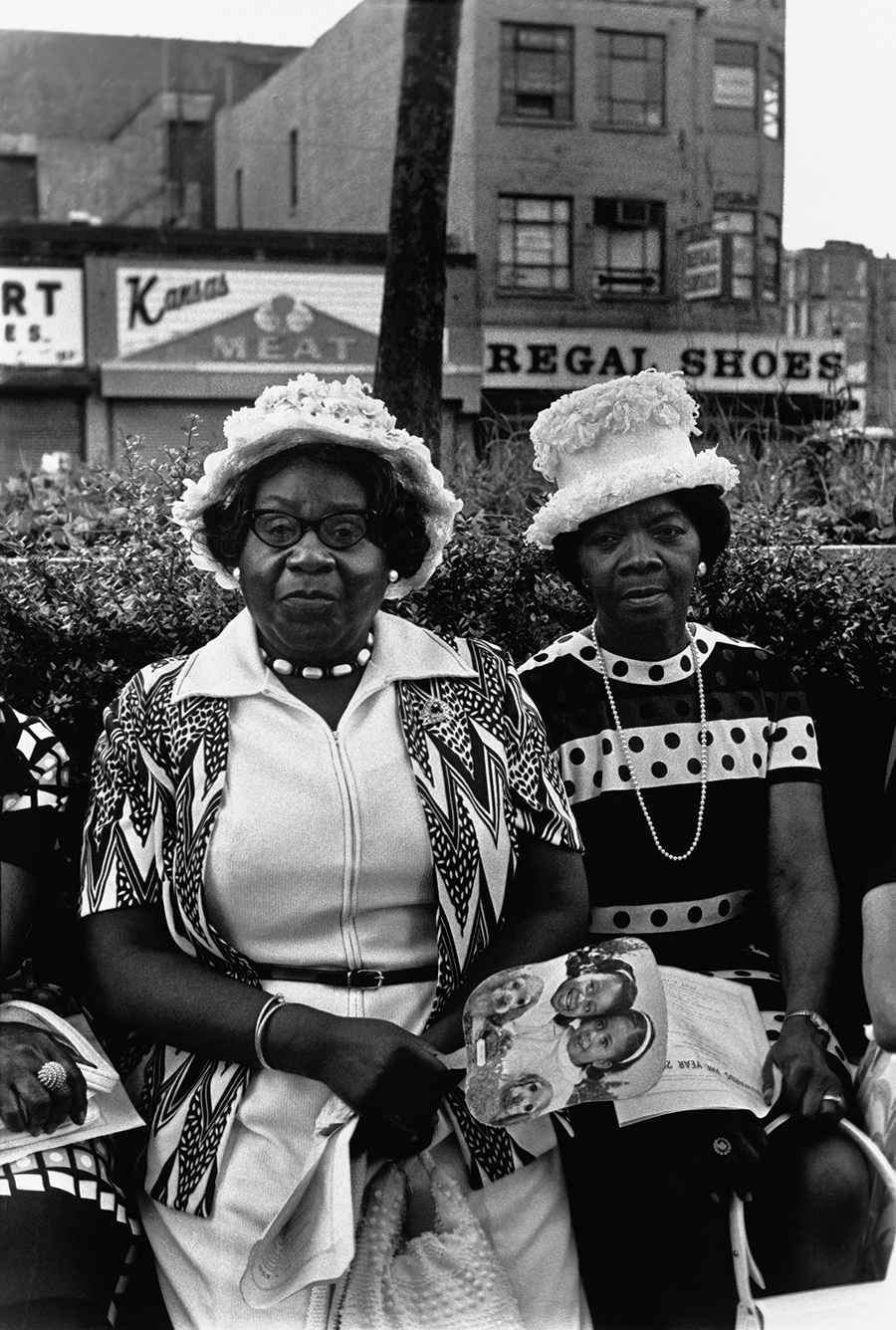
Black and white photo of two women sitting outside dressed in sunday best

Ming Smith, “Amen Corner Sisters (Harlem, New York), 1977, archival pigment print, 24 x 36 inches. Image and work courtesy Ming Smith Studio.

Janice Bond first met Ming Smith ten years ago. In 2020, when Bond became deputy director at the Contemporary Arts Museum Houston, she started talking to Smith about a museum retrospective that has finally come to fruition now, after Bond has left CAMH to open her own space, Art Is Bond. Not content with “conceiving” a retrospective — as noted on the museum’s website — Bond organized a synergetic outpouring of Smith’s work. Thus, there are three Ming Smith shows currently on view in Houston: one in “a cruise ship,” as Bond calls the CAMH (the museum’s acute angles do resemble some kind of naval transport), and two in “boats”: her gallery and Barbara Davis Gallery. Bond wants to create “a critical mass around this historic moment” of different generations and economic brackets, even though the shows exhibit similar, or in some cases, the same work, albeit in different sizes. 

By “historic moment,” Bond means Smith’s largest museum show to date. But the moment is years in the making, and the context of the photographer’s rise to the museum level bears some scrutiny. It started through another artist’s sustained attention. In 2017 Arthur Jafa had a show at the zenith of art world visibility, the Serpentine Galleries in London. Jafa decided to share the podium with Norwegian collage artist Frida Orupabo, YouTube creator Missylanyus, and Ming Smith, who he championed as “the greatest Afro-American photographer ever.” Since then, she’s received a lot of attention in the gallery and the U.S. museum world, culminating in a recent lifetime achievement award from the International Center for Photography. Reaching this peak took time, and the institutional biases of race and gender are not entirely to blame, even though they are ever-present. Rather, it’s her curiosity towards all the disparate corners of the visible world a camera can capture that has made her an unlikely subject for museum attention, which oftentimes favors a sense of closure in a given artist’s trajectory. 

Smith started taking photos with her mother’s camera when she was five. Supporting herself with a modeling career, she gained recognition early on when Black Photographers Annual, a showcase book published by Ebony magazine, published her portfolio in the very first issue of 1973 and continued to print her photos in all subsequent editions. That same year, Smith had a solo show at Cinandre, a hairdresser salon doubling as a social club a couple of blocks from Central Park in New York. In 1975, she became the first and only female member of a Harlem photographer collective Kamoinge, alongside Anthony Barboza, Louis Draper, Alger Cowans, and others. 

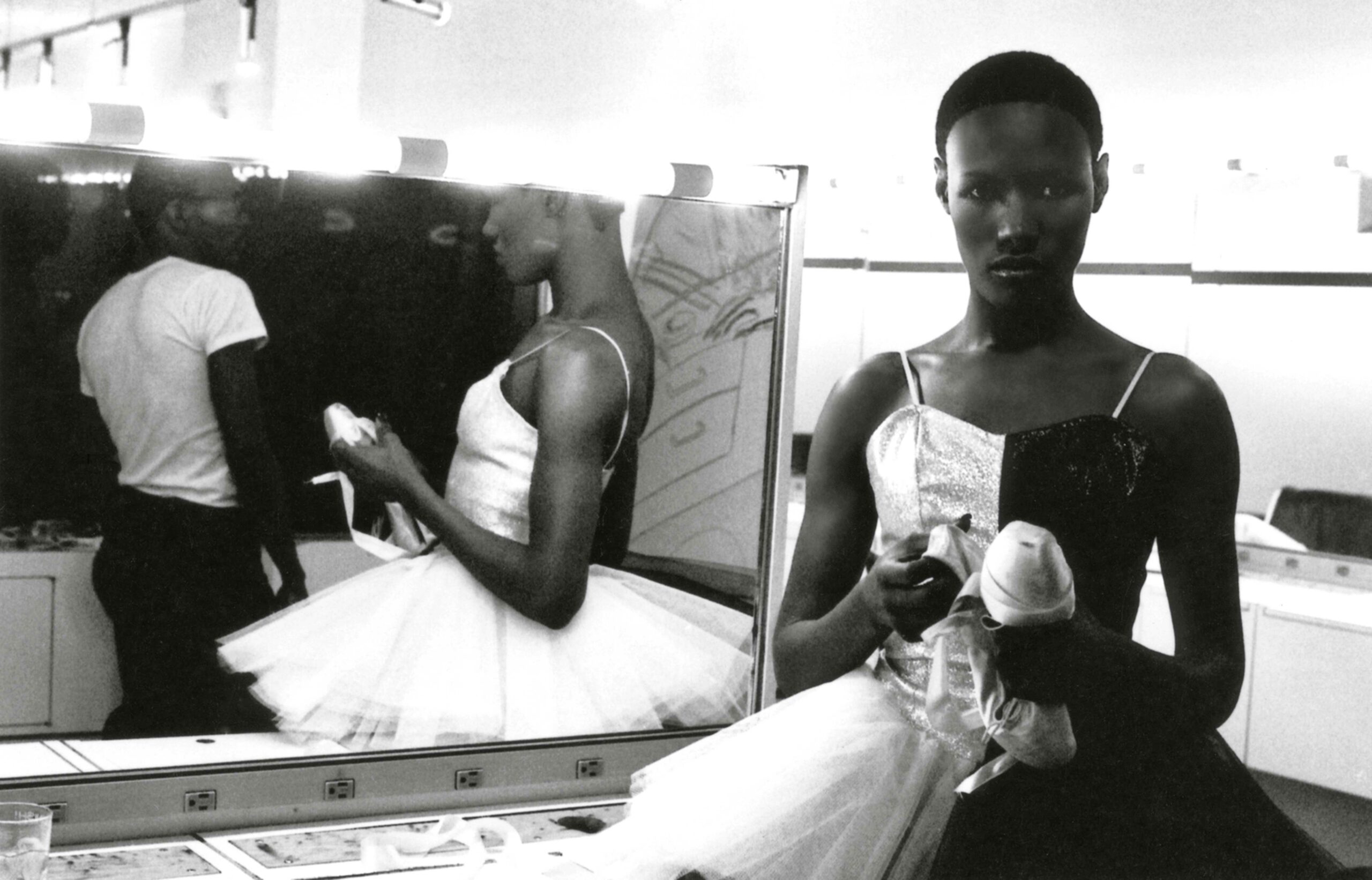
Black and white photo of a young Grace Jones in a tutu

Ming Smith, “Grace Jones at Cinandre,” 1974, archival pigment print, 24 x 36 inches. Image and work courtesy Ming Smith Studio.

In an introduction to the Annual’s first edition, Toni Morrison saw the photography book as hovering “over the matrix of black life.” That phrase can describe Ming Smith’s unique position, too: she could be formal, going after urban texture in one moment and social the next, never stopping to box her intuitive orientation through geographies and scenes of Black life in a restrictive bottled message. The CAMH exhibition relays this lack of stilted logic perfectly, mixing iconic images from different eras and series with a recent video work in collaboration with her son, Mingus Murray, and a sound box with music from her ex-husband David Murray, which includes “Ming,” a title composition from his 1980 album that features her on the cover. “Ming is a dreamer,” Bond says, and the show is supposed to be “reflective not only of her work, but of the energetic process.” 

Smith’s moment in Houston may be historic, but the lightness of touch betrays no gravity, even when the subjects clearly “have something very heavy on their minds … sometimes so heavy as to be timeless, as in Ming Smith’s ancestral — and yet absolutely present — confrontation,” as James Baldwin noted in his introduction to the 3rd issue of Black Photographers Annual. Both as a model and Murray’s touring companion, Smith traveled through the States, Europe, Japan, and several African countries.

Unsurprisingly, she often gravitated towards music and photographed a lot of avant-garde jazz’s prominent players. These photos are unusual in that Smith allows for a lot of negative space around the figure(s), leaving room for random background ambience. This way a portrait becomes pictorial, not commemorative. Even when a figure is foregrounded, as in the case of Smith’s famous shots of Sun Ra, it dissolves into the air, making the legendary bandleader a cross between a Christmas tree and an alien pilot. Smith also befriended young Grace Jones and took playful pictures of her that could be placed among the very best in the performer’s vast visual biography. Smith’s interest in fiction has also led her to inhabit the world of playwright August Wilson’s characters for a series made in Pittsburg. 

Installation view of photos on white walls and a cube painted black with color photos

Installation view of “Ming Smith: Feeling the Future” at the Contemporary Arts Museum Houston, 2023. Photo by Sean Fleming.

A seemingly endless variety of subjects and topics makes Smith’s shows feel pleasantly observational. Photographers often have a fixed viewpoint, print size, and skew the horizon just so, but Smith follows no set recipe. This makes her hard to categorize. Photography is often evaluated through its weaponizing by controlling institutions. There exists a venerable tradition of understanding the medium through its use by the power in locations that need surveillance — the colonies, the cities, the market. Individual artistic choices in photography are seen, therefore, as fugitive from the types of profiling that the state or the corporation does. An artist who unveils the surveillance tactics in a gesture of Brechtian estrangement is also much more visible to the cultural systems of talent registration. That is why fellow female photographers Carrie Mae Weems or Lorna Simpson — while younger than Smith — have already had solo shows in multiple museums, including CAMH, in the 1990s, on the strength of their efforts to clarify the mechanics of racial profiling. This type of conceptual criticality finds exhibition opportunities much more often than anything elusive or painterly. 

Smith does not do estrangement, so to position her advantageously in the alternative bureaucracies of high art she needed a translation. Jafa’s involvement in Ming Smith’s career makes sense. He’s a quintessentially topical artist, and his politics is very visibly stitched into the images he makes or uses. Jafa volunteered to put her in the right context, and his reading of Smith in a 2020 interview for her Aperture monograph remains among the most incisive. “Black people get tight around photos,” Jafa tells Greg Tate, “because… there’s always a danger that the photograph can be used as evidence against you in some fashion.” In many of Ming’s shots, he posits, “you can’t identify anybody.” 

According to an Artforum review by Chloe Wyma, Smith’s work displays a “purported rejection of the medium’s probative burden,” but it also addresses the invisibility of its subjects. This is a topic that is central for much of Black photography, either conceptual or straight. Carrie Mae Weems notes in an interview that “black folks operate under a cloud of invisibility.” “Lorna Simpson,” writes Marta Gili, “analyzes the way in which we imagine the invisible through the visible, while unmasking the prejudices that accompany us when it comes to reconstructing what is not shown.”

Smith’s first art break came in 1979 with the sale of two photographs to MoMA after the museum hosted an open call. When asked by a MoMA curator to choose the shots herself, she decided on a portrait of David Murray, because she did not see a lot of black men on the museum walls. Later, Smith made a series called Invisible Man (1988-1991) in honor of the Ralph Ellison 1952 classic book, and took on societal blind spots, capturing people in motion, folding into darkness, or resembling ink smudges. The titular image of the series has become the centerpiece of a small MoMA monograph published in 2020. It shows a tall hunched figure plodding through the night snow. We presume the figure is Black, but it could be anyone lost in severe weather. 

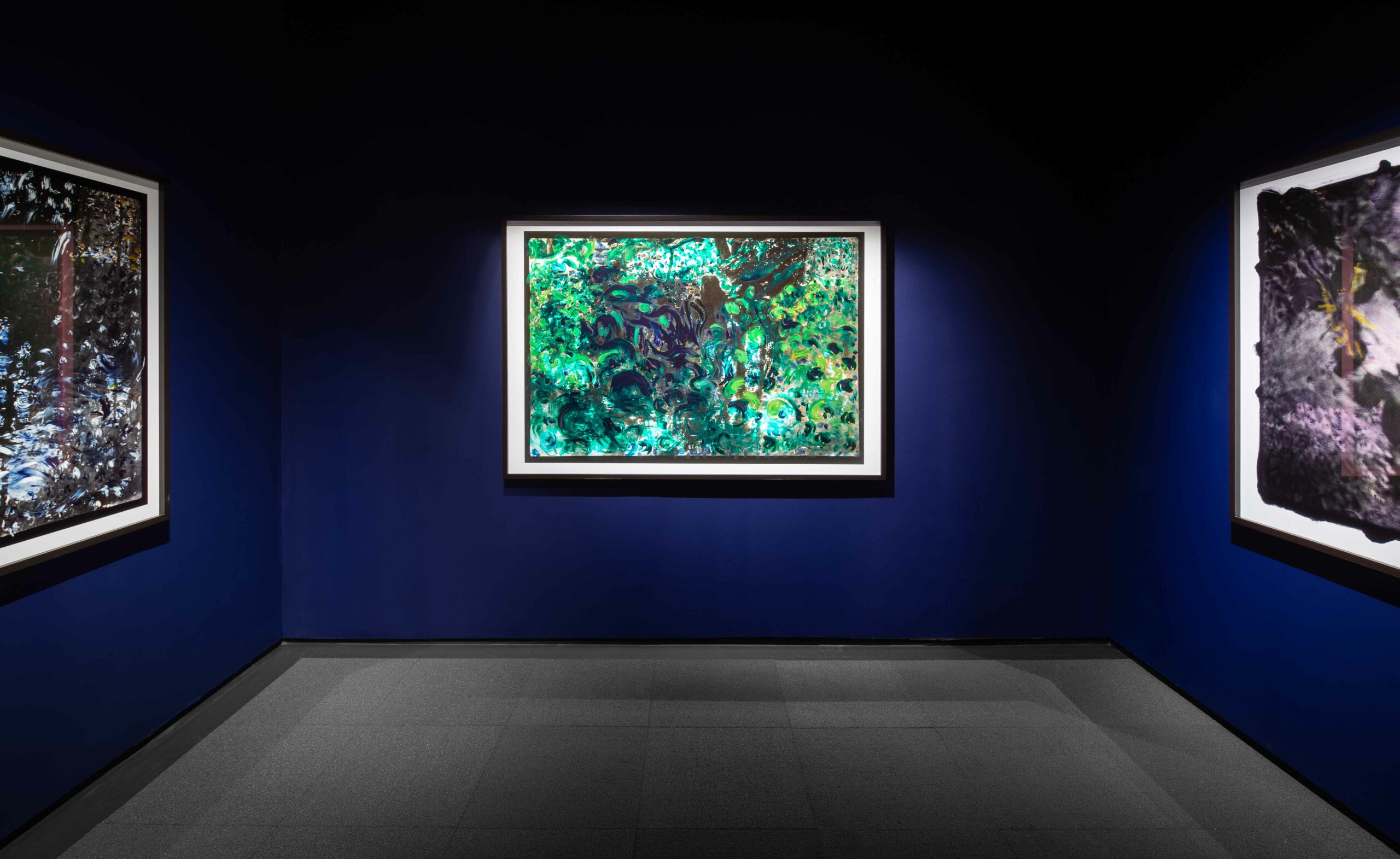
Installation view of colorful photos on a dark blue wall

Installation view of “Ming Smith: Feeling the Future” at Contemporary Arts Museum Houston, 2023. Photo by Sean Fleming.

Surveillance and invisibility are concepts, though, and Ming Smith chooses movement over mind. One of the reasons she went to New York was to take dance lessons, as Ohio ballet schools did not allow Black kids. She’s been interested in Katherine Dunham’s modern dance system since the 1970s. Smith frequently compares photography to dance, saying both are states of extreme mental acuity. In an interview with Greg Tate, she said that her dark and textured nude studies were influenced by the dynamics of Auguste Rodin’s The Kiss. Movement makes itself present through the impressionistic ripple effect that she’s often after. Be it iridescent snowflakes or Sun Ra’s gleaming cloak, Harlem night scenes or strokes of paint that she often uses to enhance the image, Smith presses the shutter not to capture the fleeting moment, but to manifest its evanescence. 

Ming Smith: Feeling the Future is on view in the Arts Museum Houston through October 1, 2023. Ming Smith: Catching the Light is on view at Art is Bond and Barbara Davis Gallery through September 2, 2023.  

10 Reasons Why Flickr is the Best Site on the Internet for Photographers

10 Reasons Why Flickr is the Best Site on the Internet for Photographers

Founded back in 2004, Flickr has changed owners several times through the years as the social media and photo-sharing landscape evolved. Here are 10 reasons why I believe Flickr is still the best site on the Web for photographers.

#1. Photo URLs

Each photo you upload gets its own unique URL page, chock full of information about the photo including all metadata embedded with your photo on upload. Also included are links to different size versions of your photos including your full high res original image. These unique url pages include tags and geo-locational data, and they elegantly showcase the photograph, including the ability to magnify the photo and look at details from this page.

#2. Unlimited Storage

Flickr allows unlimited storage. You will never run out of space or be charged more money as your photo library grows.

#3. Ad Free

Flickr offers an ad-free browsing experience for both you as well as any visitors to your photos/stream.

#4. Open API

Flickr has an open API that allows developers to develop functionality on top of the site. I’m able to use SuprSetr to organize all of my photos by keywords into albums automatically. At present, I have almost 5,000 albums. SuprSetr makes managing them a breeze.

#5. Social Metadata

Flickr allows others the ability to interact with your photos generating rich new information that I call “social metadata” around photos.

I upload found vernacular photographs and a robust community frequently is able to identify locations and even families and people in my collections and share this information with me and others on the photo’s page.

#6. Good Owners

Flickr is run and managed by the MacAskills, who also own SmugMug. Don and Ben MacAskill are trusted friends of photographers who have decades of experience managing online photo websites and communities. They have a deep respect for photography and photographers and have expressed a desire to help preserve the Flickr archive as long as possible into the future. They recently helped establish the @flickrfoundation which is focusing on preserving important work for all time. They are thoughtful, good, decent people who you can trust with your photos.

#7. Flexible Licenses

Flickr allows a variety of licenses for you to use with your photos. You can use the default “all rights reserved” license if you want or you can use a variety of Creative Commons licenses which allow more generous ways for you to share your photos with the world if you so choose. I personally use Creative Commons Non-Commercial for my photos.

#8. Wonderful Community

There is a wonderful community of photographers at Flickr. Perhaps not as robust as it was in years past, Flickr still has a wonderful group of photographers that I interact with daily. I have met many of my best friends over the years first on Flickr. Flickr is a very social place where you can get to know other people and photographers and engage and interact and make lots of interesting new friends who share a love of photography both through their individual photo pages and Flickr groups.

#9. Longevity

Flickr has been around for over 19 years. It will celebrate its 20th birthday next year. They are the OG photo-sharing site. Other sites have come and gone but Flickr persists. This also means that Flickr is one of the most important highly organized searchable databases of photographs in the world having been a place where photos have lived for that long. It’s impossible to underestimate the importance of this large body of work for humankind. It’s an amazing collection of some of the most important images in the world.

#10. Profile Pages

Flickr offers each user their own profile page. This page includes photos you choose to highlight as well as your most favorited photos on Flickr. It’s a great place for other photographers and people to learn more about you.

While Flickr is a paid service (good things are worth paying for) it does also offer a free version which allows you to try the service out with up to 1,000 photos. It has a mobile app as well but I prefer the web experience myself and that’s how I use it mostly.

Bonus: Fantastic Support

The support on Flickr is first-rate. Not only do they have a help forum where users can help each other and where staff can assist as well, but you can also reach out directly when needed. The support team is friendly, professional, helpful, and knowledgeable.


About the author: Thomas Hawk is a photographer and blogger based in San Francisco. The opinions expressed in this article are solely those of the author. Visit his website here and his Flickr photostream here.

Exploring the Intersection of Art and Real-World Experience: Clemson University BFA Internships

Exploring the Intersection of Art and Real-World Experience: Clemson University BFA Internships

As the Fall semester approaches, the anticipation for new beginnings fills the air at Clemson University. With the start of classes just around the corner, we take a moment to reflect on the enriching experiences of two Bachelor of Fine Arts (BFA) students who embarked on transformative summer internships. Kailey Nelms ’26 and Julia Shuler ’25, both BFA students, ventured into the world of art beyond the classroom, gaining insights into contemporary art and interior design. Their journeys not only honed their skills but also highlighted the profound impact of art on various aspects of human life.

Kailey Nelms, a talented BFA student, spent her summer in an exhilarating internship alongside the renowned contemporary artist, Dorothy Shain. This opportunity provided Kailey with a firsthand look into the world of a successful artist and the intricacies of managing an art-based business. Immersed in Dorothy Shain’s artistic universe, Kailey contributed to the artist’s marketing efforts through social media initiatives, fostering connections with potential clients. Beyond the studio, Kailey’s experience illuminated how art seamlessly intertwines with the realm of ‘for the home’ design and collaborates with national magazines and businesses. This exposure expanded Kailey’s artistic horizons, transforming her perception of the creative field.

Reflecting on her journey, Kailey shared, “I’ve been able to help Dorothy design some Mother’s Day cards to assist mothers in need in Greenville. I pitched a collaborative idea to a company now in the pipeline.” Kailey’s internship refined her technical skills and instilled in her a deeper understanding of art’s broader impact on communities.

Another promising BFA student, Julia Shuler undertook an exciting summer internship with the esteemed Michele Johnson Interior Design Firm. Drawing inspiration from travel, fashion, and art, Michele Johnson Interior Design Firm is renowned for its harmonious blend of contemporary style and timeless design. This internship offered Julia an invaluable opportunity to create interiors that resonate with individual client styles. This real-world experience enhanced Julia’s journey as an evolving artist within the Clemson University community.

At the heart of these internships lies a realization of the profound role of art in promoting holistic well-being. Both Kailey and Julia discovered how art can enhance mental health, enrich sensory experiences, and foster connections within society. Through their journeys, they recognized that art extends beyond aesthetics, touching lives on a deeper level.

As the Fall semester commences, the experiences of Kailey Nelms and Julia Shuler stand as a testament to the power of internships in shaping the educational journey of BFA students. Their exposure to the world beyond campus walls has refined their artistic skills and illuminated how art can touch and transform lives. The Clemson University community eagerly anticipates the ripples of inspiration and creativity that Kailey, Julia, and their peers will undoubtedly bring into their classrooms, studios, and beyond.

Want to Discuss?

Get in touch and we will connect you with the author or another expert.

Or email us at news@clemson.edu

The 37-year-old who won the iPhone Photography Awards says he’s not a professional and only started taking photos as a hobby 5 years ago

The 37-year-old who won the iPhone Photography Awards says he’s not a professional and only started taking photos as a hobby 5 years ago
  • Iván Silva won the grand prize at the 2023 iPhone Photography Awards.
  • Silva, from Mexico City, said he used YouTube tutorials to teach himself photography.
  • He says he prefers using a phone to a traditional camera as it is easy to travel with.

Iván Silva may be an award-winning photographer, but he says he’s not a professional. 

Silva, 37, was announced as the Grand Prize Winner of the 16th annual iPhone Photography Awards earlier this month.

Silva, from Mexico City, beat thousands of entries from around the world with an image of his young nephew celebrating Argentina’s 2o22 World Cup victory, according to a post on the iPhone Photography Awards’ Instagram account. 

Speaking to Insider, Silva said the photo of his nephew standing on a truck was taken a couple of days after the World Cup in December 2022 while his family was vacationing in Arandas, Jalisco, in Mexico. Some of the family were collecting wood for a bonfire when Silva’s nephew, wearing a Messi jersey, stood on top of the truck in celebration, he said.

Silva says he started photography 5 years ago as a hobby

Speaking to Insider, Silva said he began taking photos as a “hobby” five years ago and is self-taught; he used YouTube tutorials and movies, and studied professional photographers to help hone his craft. 

These days, Silva said he only has time to photograph on the weekends or while on vacation as he has a demanding job. He works within the judicial system in Mexico and also recently welcomed a newborn son, he said.

And while he initially used a traditional camera, Silva says he now mostly prefers his phone camera as it is more “comfortable” and “easy” to travel with.

“This is the first time I have participated in an international photography contest,” Silva said. He added that he previously applied to contests in Mexico but with “no results.”

“When I found out I was a winner by email, my wife was taking a bath while I was taking care of baby. I was so excited that I didn’t read the whole message. I shouted and told my wife I won — she was very scared and thought something happened to the baby,” Silva said. 

“She said she’ll never forget that day because of the scare she had because of my screams,” he added.

Silva said he initially thought he had won the childhood category, and it took around an hour for him to realize he had won the grand prize.

In addition to the grand prize and the three runners-up, the competition also shortlists winners from numerous categories including abstract, animals, architecture, and children, as shown on the contest’s website. Most entries are amateurs since the contest is open to all iPhone users, a spokesperson for the iPhone Photography Awards told Insider. 

Silva’s photo was chosen because it captures the inspiration, hope, and dreams of childhood, the spokesperson said. 

“His hero, Lionel Messi, came from very difficult circumstances but became the best and so many kids resonate with this,” they added. “The hope he embodies is the biggest gift one human can give another.”