About

Posts by :

Today’s Photo from Ted Grussing Photography: Risk … Reward

Today’s Photo from Ted Grussing Photography: Risk … Reward

… risk … reward, is as old as life on earth … whether it be the simple act of committing yourself to the purpose of gathering food for the day or achievements in sports or business, always there is the necessity of putting yourself out there and being committed to achieving a goal … our daily gift!

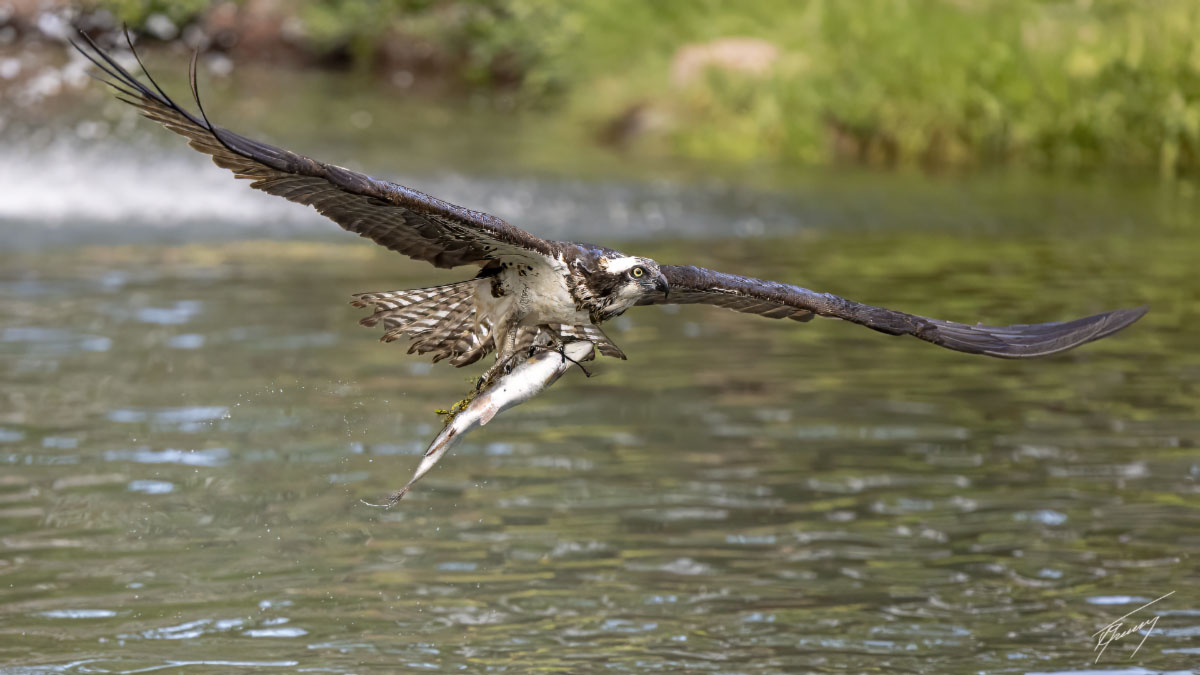
In the shot above our Osprey has set his sights on a trout swimming in the pond and his total focus is having his talons and the trout being in the same place at the same time!

Below, our Osprey has met all expectations and is making off with his reward … one of the finest trout dinners it is possible to get. Thanks to The Sedona Rainbow Trout Farm for providing me the opportunity to get these wonderful shots … check it out yourself … trout raised in and only kept in pure spring water! Doesn’t get any better than that and you do not have to make the high dive to get them.
Have a wonderful day … let a few smiles make their way across your face today and pass on a few compliments as you can … in the evening you will have a warm smile and feeling after a day well lived.

Cheers,

Ted

I lie down in slumber, and the peace of the world is
upon me. Though poverty abide with me, I pray that
courage and and gentleness forsake me not. And with
all living things out of the earth and out of other worlds
I believe I shall grow in the fields of God forever.

excerpt from A Psalm by Max Ehrmann

###

photo_tedgrussingThe easiest way to reach Mr. Grussing is by email: ted@tedgrussing.com

In addition to sales of photographs already taken Ted does special shoots for patrons on request and also does air-to-air photography for those who want photographs of their airplanes in flight. All special photographic sessions are billed on an hourly basis.

Ted also does one-on-one workshops for those interested in learning the techniques he uses.  By special arrangement Ted will do one-on-one aerial photography workshops which will include actual photo sessions in the air.

More about Ted Grussing


Healing Paws

Healing Paws

This is an advertisement

Artwork on display at the farmers market

Artwork on display at the farmers market

Sitting among her pieces of art on display at the Waxahachie Farmers Market, Victoria Garcia is completing a portrait of a cat while her mother, Alma Villarreal, is working on a landscape.

“This is very relaxing, and I really enjoy the many art crafts that I work on,” said Garcia, a sixth-year art education teacher at Walnut Grove Middle School in Midlothian. Her artwork includes handmade bead necklaces, different pottery items, paintings, and drawings.

This page requires Javascript.

Javascript is required for you to be able to read premium content. Please enable it in your browser settings.

6 NFT Artists And Experimental Studios To Watch In 2023

6 NFT Artists And Experimental Studios To Watch In 2023

When it comes to digital art, we have seen spectacular growth in the nonfungible token space over the past three years, and even more spectacular crashes with regards to the market value of collectible NFTs. While the collectibles category allowed collectors to gain decent investment returns at first, lately it feels like the overproduction of PFP collectibles (NFTs that can be used as social media profile pictures) led to a downward spiral of NFT price volatility. And yet, according to the data aggregator CryptoSlam, people are still making millions of dollars worth of NFT trades every day, roughly $118 million in the last week of June.

Clearly, the NFT art scene is far from over. The question is what digital art aficionados will value most in 2023.

NFTs are still a fantastic way to create global communities around artists and genres. NFTs are not only certificates of authenticity to certify a particular PFP belongs to someone. They are also a fantastic artistic medium, extremely versatile by design, and allowing for ambitious concepts and narratives. While there are many innovative artists creating NFTs, here are a few that have been experimenting with cutting edge technology to create unique styles that push the envelope:

Sara Ludy

The California-born Sara Ludy explores nature in uncanny ways that highlight its mysticism. Featured in exhibitions at leading institutions such as the Whitney Museum of American Art, Ludy combines a wide range of media like painting, AI, VR, video and websites to create her work. Her latest work Daance Dange Daice, a collaboration with Refraction, a DAO
DAO
focused on cultural production, and for the benefit of non-profit organization Rhizome, that has been at the forefront of digital art for almost three decades, is Sara’s first foray with AI.

Entangled Others Studio

The Argentinian artist Sofia Crespo and the Norwegian artist Feileacan McCormick form Entangled Others, a duo that uses cutting edge technology such as neural networks, AI image generation, 3D modeling and quantum computing to bring their ideas to life. Entangled Others explores different forms of life and makes poetry with technology. The duo’s work took center stage during a fundraiser for the Buffalo AKG Art Museum in 2022, resulting in a museum acquisition that bridged the NFT world to this more traditional artistic space.

Stevie P

Brooklyn-based Stevie P has a background in economics, and his artwork explores common internet scams and imaginary investment schemes, immersing his audience into a hilarious performance like no other. An extremely savvy coder, Stevie builds his projects from start to finish, investigating and utilizing smart contracts (blockchain native immutable programs) as part of the artwork. This prolific artist releases work on almost a monthly basis, keeping his audience (who he calls “his business associates”) asking for more. His latest project with the generative art powerhouse Art Blocks is Dopamine Machines (2023) and explores the language of internet advertising.

Keiken

Everyone admires the beauty in the worlds proposed by video games, but very few people know that some artists utilize them as artistic mediums. Keiken (Japanese for “experience”) is a collective based between Berlin and London that works across performance, video games, digital art and is famed for spending most of its time “working inside a gaming engine” where they make most of their artworks. Keiken creates speculative worlds that invite us to immerse ourselves in thinking about better futures. Their latest NFT work, Wisdoms for Neknel, which I had the pleasure to help lureleased alongside digital art publishers Daata and aided by AI, proposes people to experience a world where wisdom is a currency.

Jonas Lund

The Swedish born, Berlin-based artist Jonas Lund has been experimenting with blockchain technology for at least half a decade. A relentless innovator, Lund works across different media like sculpture, painting, AI, smart contracts and even tapestry-making. Always injecting a very healthy dose of humor into his work, the artist allows the audience to explore emerging technologies together with him. Lund launched a token, called JLT, in 2018 that allows its token holders to vote on decisions that affect his personal artistic practice. Currently, Jonas is set to launch the first Signature project of the up and coming platform Wild.xyz, called Most Accidents Happen at Home (2023).

Disclosure: I am part of the curation board at wild.xyz.

Felt Zine

This artist collective from New York City and Brooklyn have been portraying internet counter-culture since 2011. From music and parties, to digital art, and even launching their own marketplace, the always-in-motion iconoclasts are constantly innovating and creating new ways to perceive reality. Founded by Mark Sabb, and led by Dev Moore and Jawn Reyes, Felt Zine is a well-oiled machine. Most notably, their latest collaboration was with none other than Givenchy. Matthew Williams, the Creative Director at the luxury powerhouse, in conversation with Complex, said that the collaboration was strategic to create streetwear akin to contemporary art in web3.


NFTs have allowed for better pricing and discoverability of digital art as a whole, and created a flourishing market over the past five years. The above-mentioned artists and collectives show that there’s much more to NFTs than goofy jpegs. And they show that, in the metaverse, experimentation holds real value.

What Have I Learned About the Art Market Since January 2018? A Look Back and a Farewell

What Have I Learned About the Art Market Since January 2018? A Look Back and a Farewell

Every week, Artnet News brings you The Gray Market. The column decodes important stories from the previous week—and offers unparalleled insight into the inner workings of the art industry in the process.

This week, a sense of an ending…

Closing Time

If I’ve learned the wisdom of one journalistic adage since I joined the Artnet News staff full-time in January 2018, it’s not to bury the lede. So, in that spirit, this will be the final edition of the Gray Market in this space, as I say farewell to my friends and colleagues here to move onto something new (to be discussed in another place and time). 

For context, I first started the Gray Market as a freelancer in Los Angeles in December 2013. That means I’ve been writing under this name for about nine and a half years (technically 9.6, but who besides me is enough of a maniac about specificity to count?). For about five and a half of those years, meaning the majority of the column’s lifespan, its adopted home has been here at Artnet News. 

That stretch of time has involved a lot of personal change for me: relocating from the west coast to Brooklyn, watching both my parents retire, making it through the pandemic in good health (without leaving New York), congratulating at least a dozen new friends on becoming parents (y’all have been busy), and meeting my wife (and being smart enough to marry her, obviously), to name just a few milestones. “Bittersweet” is the word I’ve tended to fall back on to describe how leaving feels, but I hope it’s a mark of my development as a writer that I also feel like that word alone is woefully insufficient. 

But no one reads this column for extended personal reflections. What you come here for is reflections on the art business! And based on some of the stories this column addressed during my first few weeks on the job, five and a half years turns out to be an eye-opening span of time to look back on the news in this curious, one-of-a-kind industry. Besides just being downright eerie in the trajectory it reveals, this review also cements that even the most expected changes sometimes play out on an unexpectedly long timeline—and not always for the reasons we anticipate, either.

Case in point, my first Gray Market as an Artnet News employee focused on what was felt at the time as a tectonic shift in the business of American institutions: the Metropolitan Museum of Art’s announcement that it would begin charging a mandatory admission fee to non-residents of New York effective March 1, 2018. At that point, the cost for one typical out-of-state adult became $25, a figure that cultural commentators almost universally blasted for its perceived exclusionary effect. 

Fast forward to August 1, 2023the day that I filed the column you’re now readingand perhaps the biggest art story was the Guggenheim’s announcement that it will raise the price of its adult general admission ticket from $25 to $30. The new price matches the one implemented by the Met in July 2022, as well as by the Whitney Museum of American Art last month. (The Philadelphia Museum of Art also charges $30, while the Art Institute of Chicago charges $32.)

While it’s true that these latest price hikes prove that the financial struggles of even the U.S.’s most renowned museums have only worsened over the past half-decade, the reasons have shifted, too. Yes, running a top-flight institution continues to get more expensive because of inflation, upkeep, and the pressure to physically expand or renovate the premises in a sector where the bar is always being raised for the appearance of success. Museum leadership nationwide has found few, if any, new levers to pull to try to generate meaningful revenue to cover all of these escalating costs, too. 

Wu Tsang Anthem (2021). © Wu Tsang. Installation view, Wu Tsang: Anthem, Solomon R. Guggenheim Museum, New York, July 23–September 6, 2021. Photo: David Heald © Solomon R. Guggenheim Museum, 2021.

Wu Tsang Anthem (2021). © Wu Tsang. Installation view, Wu Tsang: Anthem, Solomon R. Guggenheim Museum, New York, July 23–September 6, 2021. Photo: David Heald © Solomon R. Guggenheim Museum, 2021.

Yet the shortfalls at major American museums have been exacerbated by two factors that were largely, if not totally, unforeseeable in January of 2018: the unionization wave that has walloped a sector historically content to pay staff less-than-subsistence wages, and Covid’s lasting legacy of reduced attendance at museums. For instance, Zachary Small of the Times relayed that annual visitor tallies at the Art Institute of Chicago are still down roughly 25 percent from pre-pandemic levels, while the Art Newspaper reported earlier this year that the Met’s 2022 attendance total had declined 34 percent relative to 2019. So while the underlying trend has been consistent throughout my time at Artnet News, the forces driving it have only multiplied.

What other telling stories were on the Gray Market docket in my opening weeks here? Well, in early January of 2018, David Zwirner announced plans to build a new $50 million, five-story gallery in Chelsea designed by Pritzker Prize-winning architect Renzo Piano. Zwirner targeted autumn of 2020 as a tentative opening date for the project. My take focused on the fact that it would also be Piano’s first ever commercial gallery, a natural next step for the museum-ification of the sector.

However, on July 26less than a week before the publication of the column you’re now reading, and nearly three years past Zwirner’s original ETA—the mega-gallery announced that the collaboration with Piano was no more. Zwirner has instead redirected the $50 million budget into two separate projects in Chelsea: a new 18,000-square-foot gallery on West 19th Street designed by longtime collaborator Annabelle Selldorf, and a 36,000-square-foot office space on West 20th Street that opened last month.

If you’re eager to label this news a turning point in the gallery business’s winners-take-all era, however, I’d recommend pumping the brakes. Zwirner isn’t spending any less money than he planned to; he basically just broke a dollar into two 50-cent pieces. The conversion also apparently netted him an extra 4,000 square feet of space. I do think the state of the market has a serious right hook in store for many galleries that expanded unnecessarily using the artificial sustenance of pandemic-era loans, but David Zwirner is not the place to look for evidence of the friction.

Yet the original project’s collapse does show how the über-professionalized, big-money art market is more exposed to external complications than ever before. Robin Pogrebin of the Times noted that the canceled, Piano-designed gallery “was part of a larger development by the investor Uri Chaitchik of Casco Development that encountered financial trouble during the pandemic.” Headwinds in the real-estate market can only fragment this kind of alliance if big-money developers see big-money galleries as viable partners in the first place. So even in its kiboshing, the Zwirner headquarters-not-to-be proves that these two adjacent industries see each other as equals to an extent they haven’t previously.

Rounding out the month of January 2018, In Other Words, the Charlotte Burns-helmed media wing of the now-defunct, Sotheby’s-owned advisory firm Art Agency, Partners, relayed rumors that Frieze was planning to augment its London and New York fairs with a new annual expo in Los Angeles in January 2019. While a representative from the fair brand neither confirmed nor denied the reporting at the time, it took only four more weeks for Frieze to officially announce the move (although the new fair’s dates would be in February 2019, not January 2019).

Visitors streaming into Frieze Los Angeles, 2023. Photo: Casey Kelbaugh. Courtesy of Casey Kelbaugh and Frieze.

Visitors streaming into Frieze Los Angeles, 2023. Photo: Casey Kelbaugh. Courtesy of Casey Kelbaugh and Frieze.

Now zoom ahead to July 13, 2023—three weeks prior to the publication of the column you’re now reading—when Frieze announced a different kind of stateside expansion: the acquisition of the Armory Show and the pending acquisition of Expo Chicago, two of the U.S.’s longest-running regional fairs. (The latter deal is slated to close later this year.) Although the Armory and Expo will continue operating under their own names with their existing directors now working alongside Frieze’s other fair brass, per a company statement, the transactions mean that four of Frieze’s seven annual events will now take place in the U.S., the world’s most robust art market. 

This creates a sharp contrast to the closest analogue we have, MCH Group’s short-lived campaign to acquire significant equity stakes in regional art fairs scattered across multiple countries between mid-2016 and late 2018. Which makes Frieze’s expansion-by-acquisition less a revolutionary development than a new strain of the same consolidation trend that has been playing out in the art business for most of this century, including the last five and a half years.

Even some of the smaller stories I touched on during the opening weeks of my Artnet News tenure have boomeranged back in strange ways in recent weeks. Also in late January 2018, Sotheby’s (then still under the leadership of CEO Tad Smith) announced that it had acquired Thread Genius, a startup described by Tech Crunch as offering “a set of algorithms that can both instantly identify objects and then recommend images of similar objects to the viewer.” In other words, its killer app was machine learning, an important stepping stone on the pathway to the more advanced artificial intelligence that is now an inescapable part of the art-business discourse in the summer of 2023. 

Yet almost no one cared about the acquisition at the time. Instead, the central art-tech story of 2018 was the blockchain, mostly as a means of creating either title registries for physical artworks or fractionalized investment opportunities for people who, frankly, I would advise to find better uses for their money. More than four years elapsed between Sotheby’s investment in Thread Genius and the public imagination’s takeover by ChatGPT, DALL-E, and their A.I.-driven competitors in mid-2022. As of my writing, another year has passed since that storming, and it’s an understatement to say we’re still short on clarity about the technology’s likely impact on the arts. This simple math underscores that even allegedly world-changing innovations need more time to take root than it often sounds like in the moment.  

Last but not least, in early February of 2018, I called a little attention to a talk at the 92nd Street Y between then-72-year-old mega-dealer Larry Gagosian and longtime associate Glenn Fuhrman, the financier and collector behind the FLAG Art Foundation. To me, the most newsworthy aspect of the chat was this brief exchange: 

Fuhrman: I can’t think of any other billion-dollar business in the world that theoretically could disappear because it’s so reliant on a leader. Is your business something that could survive you?

Gagosian: We are working on that… I don’t have children and that’s usually how these legacies are established… But this is something that is really important to me.

There can’t be more than about six people reading this column right now who don’t already know that its publication is only a week removed from that of New Yorker staff writer Patrick Radden Keefe’s endlessly discussed profile of a now-78-year-old Gagosian. Based on Keefe’s reporting, however, it almost sounds as if Gagosian’s thinking about his gallery’s long-term future (or at least his willingness to discuss it frankly) has regressed in the five-plus years since he spent a few words on it onstage with Furhman. 

Young buck Larry Gagosian cozying up to Leo Castelli in 1996. (Photo by Ron Galella, Ltd./Ron Galella Collection via Getty Images)

Young buck Larry Gagosian cozying up to Leo Castelli in 1996. (Photo by Ron Galella, Ltd./Ron Galella Collection via Getty Images)

In the piece, Gagosian distances the gallery’s recently formed advisory board from succession planning “per se,” and multiple episodes recounted by others (most notably Issy Wood, who he tried to recruit to the gallery) hinge on Gagosian’s unwillingness to even acknowledge that he’ll one day have to retire, let alone die. In other words, it’s not just that we’re still speculating about the same mega-dealer’s succession plan five and a half years later; it’s that we’ve arguably moved backwards even as the subject has become more relevant.

Fold these early 2018 stories and their 2023 sequels together, and you’re left with something that only time can make plain: namely, that for all the talk about seismic shifts, unprecedented developments, disruptive technology, and other factors, the art business is still largely riding the same trends captained by the same entities as it was when I started this job five and a half years ago. But the motives for these trends’ persistence haven’t necessarily been predictable. More importantly, they haven’t even necessarily been within the control of the people and businesses that have benefited from them the most.

Whether the impetus was a global pandemic, a cross-industry partnership gone awry, or a strategic pivot perhaps informed by a more ambitious rival’s earlier mistakes, there has been no surer way to play yourself in the art industry than to believe that the business is still small enough to give you and your partners even relative autonomy. At the same time, success still often demands an unshakable belief in yourself and your product, whether that means a new tech or the old standby of hard-charging salesmanship in an eternally subjective trade. It’s a paradox that no one should envy trying to manifest.

Sure, things in the art industry have changed since January 2018. They just haven’t done so at any uniform pace, or for uniformly foreseeable reasons. And even after accounting for the differences, most of the landscape looks similar to when I first started at Artnet News. 

In light of all that, my advice is to be skeptical anytime someone tells you they’re going to change anything structural in the medium term. But also keep in mind that the choice to change yourself and your circumstances is still often yours. 

‘Til next time, remember: no one’s here for a long time, so at least try to make it a good time while it lasts.

Follow Artnet News on Facebook:
Want to stay ahead of the art world? Subscribe to our newsletter to get the breaking news, eye-opening interviews, and incisive critical takes that drive the conversation forward.

Celebrate Native arts and culture at the IN THE SPIRIT

Celebrate Native arts and culture at the IN THE SPIRIT

Celebrate Native arts and culture at the IN THE SPIRIT

A wide range of performances will take place throughout the day in the Washington State History Museum amphitheater.

The free IN THE SPIRIT Arts Market & Northwest Native Festival is returning to the Washington State History Museum on Aug. 12 from 10 a.m. to 5 p.m. This highly anticipated event, in correlation with the IN THE SPIRIT Contemporary Native Arts Exhibition, is a vibrant celebration of Native arts and culture, offering visitors a unique opportunity to experience the richness of contemporary Native creativity and directly support talented artists.


“Washington’s cultural history begins with the Indigenous people of this land,” said Washington State Historical Society Director, Jennifer Kilmer. “IN THE SPIRIT is an event that celebrates the presence, and continuation of Native art and culture today.”


Visitors are invited to view the IN THE SPIRIT exhibition, which showcases the work of 26 Native artists from across the country. The exhibition highlights a juried selection of Native art that ranges from traditional craftsmanship to cutting-edge contemporary styles.


The Arts Market will feature selected Native artisan vendors, offering an array of crafts, jewelry, and artworks for visitors to purchase. Many of the artists featured in the exhibition will be in attendance as vendors. Additionally, there will be art-making opportunities for attendees to create something of their own.


A wide range of performances will take place throughout the day in the Washington State History Museum amphitheater. The festivities will kick off at noon with a special blessing by Puyallup Cultural Director Connie McCloud (Puyallup). At 12:30 p.m., the renowned 2014 & 2016 Native American Flute Player of the Year, Rona Yellow Robe (Chippewa Cree Tribe), will share traditional songs. At 2 p.m., the Alaska Kuteeyaa Dancers (Tlingit, Haida, Tsimshian, Aleut, Muckleshoot, and Quielute) will take the audience on a journey through time, sharing songs and dances passed down for generations. Closing out the festival with a bang will be celebrated heavy-rock duo, Lozen (Puyallup and Indigenous Mexican), playing their first show in five years at IN THE SPIRIT. 


The Tacoma Art Museum and Museum of Glass will also be offering complimentary admission and programming for IN THE SPIRIT on Aug. 12. The Tacoma Art Museum will feature works from talented Native artists, including Paige Pettibon (Confederated Salish and Kootenai). 


Pettibon’s art spans across various mediums, and her pieces are deeply influenced by her Indigenous and multicultural heritage. Visitors can meet Paige Pettibon and witness her creative process firsthand from 1-4 p.m. at the Tacoma Art Museum.


Over at the Museum of Glass, Glass Fest Northwest will take center-stage, celebrating glass art by bringing together local artists and artisans, food, drinks, music, and interactive activities on the plaza. Inside the Museum, visitors will have the opportunity to witness renowned weaver Nancy Burgess (Umpqua) as she creates new works inspired by hat and basket forms from her weaving practice.


The IN THE SPIRIT Arts Market & Northwest Native Festival is a result of the collaborative efforts between the Washington State History Museum and the Native Advisory Committee. Together, they aim to foster cultural appreciation, support Native artists, and celebrate the diversity of Native arts.


We wish to acknowledge that this festival takes place on the traditional lands of the Puyallup People who have stewarded this land throughout the generations. We pay respect to their people past and present.


For more information about the festival and other related events, please visit the Washington State History Museum’s website at www.washingtonhistory.org.


Opportunities for Artists, Writers, and Art Workers in August 2023

Opportunities for Artists, Writers, and Art Workers in August 2023

Hyperallergic’s monthly Opportunities Listings provide a resource to artists and creatives looking for grants and paid gigs to further their work.

Subscribe to receive this list of opportunities in your inbox each month. Sign up here!


Residencies, Workshops, & Fellowships

Featured
Erie Canal Museum & New York State Canal Corporation – 2024 Artists in Residence
Seeking photographic projects that reflect upon the Erie Canal’s physical, environmental, and social condition; materiality; history; and context. Three artists will be selected, one for each geographic section of the canal system. Each will receive a $10,000 stipend.
Deadline: September 10, 2023 | eriecanalmuseum.org

Featured
The Image Centre – Photography Research Fellowships
In 2024, six fellowships ranging from $2,500 to $10,000 will be offered for research related to The Image Centre’s photography collections. A variety of scholars and independent artists may apply.
Deadline: September 30, 2023 (5pm EDT) | theimagecentre.ca

Breck Create – 2024 Artists-in-Residence
Artists spend two to four months in a live/work studio in downtown Breckenridge, Colorado, receiving a biweekly $600 stipend for expenses. They may also take classes and participate in open studios at no cost.
Deadline: September 1, 2023 | breckcreate.org

Center for Performance Research – 2024 Artist-in-Residence
This yearlong, Brooklyn-based program seeks to support 10 artists working within various perspectives of contemporary dance, performance, and time-based forms. Each artist will receive a $1,500 stipend and more.
Deadline: August 16, 2023 (5pm EDT) | cprnyc.org

Corning Museum of Glass – BIPOC Residency
Artists who identify as Black, Indigenous, or people of color can spend a month in Western New York exploring new directions in glassmaking or expanding on their current work. Transportation, room and board, and a supply budget are provided.
Deadline: August 31, 2023 | glassmaking.cmog.org

First Peoples Fund – 2024 Cultural Capital Fellowship
Meant for Native American culture bearers and artists, this yearlong fellowship includes a $7,500–$10,000 project grant plus technical support to further their work of passing on ancestral knowledge and cultural practices within their tribal communities.
Deadline: August 15, 2023 (2am EDT) | firstpeoplesfund.org

Frame Contemporary Art Finland – Frame Curatorial Research Fellowship
Two contemporary art curators will explore new forms of research that renew curatorial and institutional working habits. Organized in collaboration with the Queens Museum in NYC and Van Abbemuseum in Eindhoven, the Netherlands, the fellowships include €12,000 and more.
Deadline: August 13, 2023 | queensmuseum.org

Guggenheim Fellowships
Approximately 175 fellowships will be awarded to mid-career individuals who have demonstrated exceptional capacity for productive scholarship or creative ability in the arts and show promise for the future.
Application Period: August 18–September 16, 2023 | gf.org

Laundromat Project – 2024 Create Change Residency
This program supports the development of participatory, community-attuned projects by artists of color in NYC. It includes a $15,000 honorarium and up to $10,000 for production. Applications are also open for the Create Change Fellowship and the Create Change Bed-Stuy Residency.
Deadline: August 19, 2023 | laundromatproject.org

Lower East Side Printshop – Keyholder Residencies
Eight emerging artists will receive one year of free 24-hour access to the Lower East Side Printshop’s printmaking facilities, plus a $1,000 stipend, to develop new work and foster their careers.
Deadline: September 1, 2023 | printshop.org

Harvard Radcliffe Institute Fellowship Program
Fellows are in residence for a period of nine months, from September 2024 through May 2025, and receive a stipend of $78,000 plus an additional $5,000 to cover project expenses.
Deadline: September 14, 2023 | radcliffe.harvard.edu

Oolite Arts – Studio Residency + Knight Artist Housing Stipend
Residents get free studio space on Miami Beach, access to digital media equipment, exhibition opportunities, and more. Those who have lived in Miami-Dade County for at least two years will also receive a $12,000 yearly housing stipend.
Deadline: August 16, 2023 | oolitearts.org

Polar STEAM – Antarctic Artists & Writers Program
Creative practitioners working in a variety of genres (from traditional to experimental formats) can apply to travel to Antarctica to collaborate with researchers in a unique polar environment.
Deadline: August 31, 2023 | polarsteam.info

Princeton Arts Fellowships
Fellows spend two consecutive academic years at Princeton University; formal teaching is expected. A $90,000 yearly stipend is provided. Now accepting applications for programs in Creative Writing, Theater, and Visual Arts.
Deadline: September 12, 2023 | arts.princeton.edu

Print Center New York – New Voices 2024
A curator-selected cohort of six to eight artists will present their work and develop their practices through a group exhibition, artist-led public programming, and more. Each will receive $2,500.
Deadline: September 8, 2023 | printcenternewyork.org


Open Calls for Art & Writing

Featured
Bernheim Arboretum and Research Forest – L+A+N+D Request for Proposals
L+A+N+D (Landscape + Art + Nature + Design) celebrates innovative design concepts for immersive outdoor installations on a grand scale to spark imaginations, conversations, and a deeper appreciation of the natural world.
Deadline: September 4, 2023 | bernheim.org

Arts Center of the Capital Region – Troy Art Block
This new public art program aims to animate alleys with temporary murals in downtown Troy, New York. Artists must be available to paint and participate in the October 2023 festival. Stipends are included.
Deadline: August 28, 2023 | forms.gle

Kennedy Center – VSA Emerging Young Artists Program
Fifteen US visual artists with disabilities who are between the ages of 16 and 25 will each receive a $5,000 award, have an artwork featured in an exhibition, and attend professional development activities.
Deadline: August 18, 2023 | kennedy-center.org

Rehearsal Art Book Fair – Open Call for Exhibitors
Coming to NYC in September, this new art book fair seeks to explore and present the essence of independent art and literary publishing within highly capitalized and/or censored contexts. Table space costs between $30 and $70.
Deadline: August 16, 2023 | rehearsalartbookfair.org

Women’s Studies QuarterlyUnbearable Being(s) Call for Papers
The peer-reviewed interdisciplinary journal invites submissions that explore the literary, theoretical, and cultural lifeworlds created by and about unbearable being(s) for a special issue to be published in the fall of 2024.
Deadline: September 15, 2023 | feministpress.org


Grants & Awards

Featured
Foundwork – 2023 Foundwork Artist Prize
The honoree will receive an unrestricted $10,000 grant and studio visits with distinguished jurors: Alex Gartenfeld, Davida Nemeroff, Shinique Smith, Emiliano Valdés, and Nicola Vassell. Artists must be Foundwork members to be considered ($4/month with the option to cancel after the three-month prize selection period).
Deadline: September 26, 2023 (4:59pm PDT) | foundwork.art

Featured
Joyce Foundation – 2024 Joyce Awards
Organizations in the Great Lakes region of the US partnering with artists of color can receive $100,000 (including a $30,000 artist stipend) to commission a new work in collaboration with local communities. New applicants must register by September 6.
Deadline: September 11, 2023 (11:59pm CDT) | joycefdn.org

Featured
Lower Manhattan Cultural Council (LMCC) – Manhattan Arts Grants
Calling Manhattan-based artists and cultural organizations! Lower Manhattan Cultural Council’s grant opportunities provide awards of up to $16,000 for public projects and presentations in 2024.
Deadline: September 12, 2023 (5pm EDT) | lmcc.net

CAA-Getty International Program – Support & Travel Grants
To help art historians, museum curators, and art history educators attend CAA’s Annual Conferences, this program covers travel expenses, hotel accommodations, per diems, conference registrations, and one-year CAA memberships.
Deadline: August 15, 2023 | collegeart.org

Foundation for Contemporary Arts – Emergency Grants
Distributed on a monthly basis, grants ranging from $500 to $3,000 are intended to support project-based needs. Visual and performing artists with a US tax ID whose work is of a contemporary, experimental nature can apply.
foundationforcontemporaryarts.org

Nest Heritage Craft Prize
Texas-based artists and makers can enter an original handmade work representative of heritage craft in the region. One winner will receive a $25,000 grant while four semi-finalists will get $2,500 each.
Deadline: August 21, 2023 | buildanest.org

Pollock-Krasner Foundation Grant
Visual artists practicing painting, sculpture, and works on paper (including printmaking) can apply for funding of up to $50,000. The grant amount is determined by the artist’s individual circumstances.
pkf.org


Other opportunities closing soon:


Check out more opportunities at hyperallergic.com/tag/opportunities.

To feature an opportunity from your organization on Hyperallergic, get in touch at nectarads.com.




