
charles ray’s new public sculpture in manhattan imagines adam and eve in their old age


June 11, 2023

Neighbour’s Dispute.
Image credit: Ofer Levy
Here are some of the shortlisted images for the Australian Geographic Nature Photographer of the Year awards for 2023, showcasing the year’s best wildlife and landscape photos.
Welcome to the Australian Geographic Nature Photographer of the Year collection for 2023.
Our involvement with this competition is very much part of our mission to encourage photography of our region’s landscapes and wildlife. Our region offers so much for any would-be photographer, and not just in our wild and remote areas.The flora and fauna in our backyards and city parks are all worthy subjects too. Photography encourages you to look carefully at the world around you. It increases knowledge and understanding, and raises awareness. Nature photographers are active conservationists, and that is the real power of this competition. Some of us will be looking carefully at the f-stop number or the lens type, but for most, it’s a chance to be inspired by the beauty of nature.
We commend all those who entered (550 amazing photographers) and extend our gratitude to this year’s judges, Mike Langford, Adjunct Professor Wayne Quilliam and Jackie Ranken, who faced an epic task evaluating more than 2000 entries.
And this year it was even harder, with a new category attracting awe-inspiring images.
“This year we introduced the well-received macro category, with photographers submitting incredible larger-than-life-sized images of nature’s smallest scenes,” says the Museum’s acting director Justine van Mourik.
That meant there were 10 categories this year:
The South Australian Museum will announce the overall winner, category winners, runners-up and the Portfolio Prize in August.
Until then, here’s a look at the shortlisted images in the Animals in Nature, Macro and Urban Animals categories.


Celebrity photographer Munna Thaakur has worked with almost all the A-listers from Amitabh Bachchan to Salman Khan in his 25-year-long career after starting from almost nothing. Munna used to earn a living as a newspaper hawker by delivering the daily newspaper to houses of film celebrities in Mumbai and eventually went on to capturing them in his lens. He also used to be a cart puller for quite some time in the city of dreams where he now is a prominent name in the world of photography and has all from Tiger Shroff to Taapsee Pannu among his followers on Instagram. “Rotigrapher to photographer” is how he describes his journey as a photographer. Also read: Jaya Bachchan gets shy as Amitabh Bachchan leans on her in throwback pic, Abhishek Bachchan shares post

In an interview with Hindustan Times, Munna opened up about how he learnt the ropes of photography as a part time job and all those who met and helped him in his remarkable journey. Munna is 48, unmarried, and a look at his Instagram account is enough to confirm his love for cycling in tough terrains with his camera for company. He was just 15 when he came to Mumbai from Akola, Maharashtra and worked as a newspaper hawker in Lokhandwala.
Opening up about how Arjun Rampal was his first celebrity, he said, “In my initial days, I also worked as a cart puller for some time. As a newspaper hawker later, I used to do a part time job at a photo studio. I used to bring and deliver pictures and would click passport size pictures. A man named Bilal Khan taught me how to operate the camera. I used to deliver newspapers at Arjun Rampal’s house as well. There, I told his servants that I wanted to shoot and they conveyed it to him. Arjun asked me to show him my previous work but I had none. I told him if the pictures didn’t come out well, I would delete the roll. He gave me a chance and I finally started out in the industry. Having a supermodel in my profile was definitely a boost for me.”
Some are left but I am sure I will get them.
“In my initial days, money was never on my mind, I just wanted to make my profile. My pictures would go to magazines as well which was enough for my requirements. And I continued to get one project after another. I used to visit celebrities and show them my work,” he added.
Sharing the long list of people he has captured through the camera, Munna said, “My first photo shoot with Mukul Dev was my first work which was printed in Zee magazine. I also worked with Mayuri Kango whose pictures were published in Stardust. After Arjun, I approached John Abraham and kept getting one link after another. John’s pictures were put on hoardings and then I shot Bipasha Basu as well. I went on to work with Priyanka Chopra, Lara Dutta, Dia Mirza, Shraddha Kapoor, Sonakshi Sinha. Some are left but I am sure I will get them.”
However, there is still a question about how a class 7 dropout could learn the technicalities of photography without getting any formal knowledge. Ask him and pat comes the reply, “Marta kya na karta (it was a do or die for me). I had to make it work. I kept on learning while doing it and it’s not that hard. Once you decide to do something, things start falling in place automatically. I kept on getting good guidance at every step. You learn from your mistakes and don’t repeat them and that’s how I have learnt. I have learnt about lighting by seeing others’ work.”
“In my case, I have been lucky that whenever I did a photo shoot with a celebrity, I got more opportunities to work with them. Everyone has his comfort zone and you get that vibe at work. And when the pictures are good, everyone likes it. I never faced trouble during any photo shoot. I never had to kill a photo shoot after clicking pictures,” he added.
On being asked about working with Amitabh Bachchan, Munna says, “He is a legend, you can’t even speak in front of him as words don’t come out of your mouth in his presence. He is so experienced that no matter how you click him, the pictures always come out good. I had shot with him for an ad film and a film’s look test.”
Munna also has several celebrities who have extensively worked with him like Salman Khan, Suniel Shetty, Sonakshi Sinha, Shilpa Shetty and Taapsee Pannu to count a few. “From where I started my career, every person has only helped me in my endeavour. I have come from rock bottom, climbed one step after another. Those who helped me in the beginning, I wouldn’t have been here. My entire life is an incident in itself. Every shoot was an incident for me but thankfully, all of them were good. After every single shoot, I tried to be better in my next,” he says. The photographer says that he just had around ₹25 in his pocket when he first came to the city and he now makes around ₹20-25 lakh a year.
Munna however, refuses to focus on anything other than his profession and continues to remain close to his roots. “I try to be in touch with anyone who helped me in my initial days and throughout my journey. Even those whom I used to deliver the newspaper to, I meet them even today. Only my sense of photography has undergone a change, not me. Mere ko hawa nahi lagi (I haven’t acquired ego). I am very close to my roots, if that is changed, nothing would make sense. Our performance should change for the better, not us as people,” he signs off.


 It’s A Good Trip / YouTube
The eastern Ukrainian town of Bakhmut is now known across the world as the site of the longest and possibly bloodiest battle in Russia’s war on Ukraine.
It is now almost completely destroyed, and almost all of its ruins are controlled by Russian forces.
Nearly every single resident has now left, and those the BBC has been able to contact describe Bakhmut before the war as extremely well looked-after, cosy and leafy.
They also speak fondly of the two things which had made the town famous: sparkling wine and salt.
The city was known far beyond Ukraine’s borders for its sparkling wine. The local winery, set up in a huge abandoned gypsum mine in the 1950s, was among the biggest and best producers of the fizzy drink in the USSR and then in independent Ukraine. Its location, about 70 metres below ground, made it easier to achieve the right temperature for the drink to ferment.
It is now owned by a company called ArtWinery, and its marketing director Oleksandra Cherednychenko told the BBC about the first time she visited the vast caves.
“It was an amazing feeling. It is an underground city so vast that they used proper vehicles to get about within it – lorries to transport goods, and people used buggies. There were endless rows of bottles, and you couldn’t see where they ended.

“It was very nice inside, with classical music playing, and walls painted yellow, green and red. It was mesmerising. Nothing beats wine-testing underground.
“It is one of the main symbols of Bakhmut, and it had a soul. Company workers planted a vineyard right next to the main office, and there was a nice garden with peacocks,” Oleksandra said.
For decades, sparkling wine from Bakhmut was highly sought after in the Soviet Union, and it was popular during celebrations such as weddings or New Year’s Eve.
The winery’s operations were suspended the day Russia invaded Ukraine on 24 February 2022, and most of its employees were evacuated out of Bakhmut.
In May 2023, Yevgeny Prigozhin, the head of the Wagner mercenary group, said all of the winery’s buildings had been destroyed. Wagner has been at the forefront of Russian forces fighting Ukrainian troops in Bakhmut.

Salt is another product which has made Bakhmut well-known in Ukraine and beyond. Before the war, the salt-mining company Artemsil produced more than 7 million tonnes of salt a year, exporting it to 22 countries from Armenia to Denmark.
“It was a prestigious company to work for. When I got a job there, people were surprised I got hired without powerful friends in high places,” said Anzhelika, who spent almost 20 years working for Artemsil. “It was the best time of my life, we felt secure.”
War changed everything.
Anzhelika told the story of two former colleagues who worked in a lab next door to her office. “One was killed when a missile hit her house in January. It happened on her birthday, actually. The other one has started drinking herself to death. It could be the feeling of helplessness, or the stress of it all,” she said.
Anzhelika remembers Bakhmut as a beautiful, well looked-after city.
“Our government had decided to make a showcase out of such frontline cities – to show those who left Ukraine what they were missing. A lot of money was spent on Bakhmut over the past years,” she said.
Natalya Putrya, a piano teacher at Bakhmut’s Culture and Arts College, has similar memories of the city.
“It was stunningly beautiful. The local authorities took good care of roads and pavements – this may not be such a big deal for Europe, but for us it was unusual. They had built a marvellous stadium and refurbished our college, lavishly. New, very good musical instruments were bought,” she said.
Her college hosted piano competitions for all of Ukraine and held frequent public concerts to mark occasions such as St Valentine’s Day or New Year’s Eve. “There is no life without culture and art. Bakhmut was always interested in culture,” Natalya said.

One of her students, Oleksandra, has fond memories of the college in Bakhmut.
“We went there at dawn and went home at sunset. The night guard would tell us to get out of college at nine in the evening, and I remember that on the way home everything felt just right. It was the right time and place to be. It was our home.”
Oleksandra has vivid memories of the night before Russia’s full-scale invasion last year.
“On 23 February we held a massive concert, and I remember the beautiful sunset that evening. I was walking home, looking at the sky and the stars. And I wondered: ‘How long will the sky above stay peaceful?’ The stars were absolutely amazing that night. The next morning, we were woken up by people shouting that war had started and our cities were being bombed.”

Oleksandra told me how devastated she was to see her college being damaged by fighting.
“I had tears in my eyes when I saw photos of our concert hall after it had been hit – right where our beloved grand piano was. It was every pianist’s dream to take to that stage and play it. When we learnt that all the windows got smashed we knew that was the end of our pianos. All the strings will go rusty because of the damp,” she says.
After the start of the war, the college moved to Kamyanets-Podilsky, a city in western Ukraine.
“This changed the dynamic of our relationship with teachers completely,” says Oleksandra. “We are one big family now, because we’ve all lost our homes. We’ve been through all this together. The support we’re getting from each other is priceless.”
Her teacher Natalya agrees: “Yes, we’re family. We meet after work and we stay in touch, we go out all the time – for a cup of coffee or just for a chat in a cafe. This must be the warmth we’ve brought from Bakhmut. We’re trying hard to preserve it, because it’s tough living without a home.”
But despite the tragedy of Bakhmut’s destruction, Natalya has one dream: to return to her native eastern Ukraine, even if it won’t be Bakhmut.


“All maps state an argument…”
—J. B. Harley, 1989
There’s a popular poster of the world composed of satellite images, with continents arrayed horizontally like the Mercator wall map we knew in grade school. While in a store once, I laughed at a sign that touted this poster as “The Most Accurate Map of Earth.” Putting aside the distortions of a flat map, surveyors know that claims of accuracy depend on context and purpose. This is not the map you’d want in your glove compartment to find a route to Decatur.

Woodcut map of Tenochtitlán, Second Letter of Cortés. Nuremberg: 1524. NEWBERRY LIBRARY
That sign in the store seemed almost reverential that photos from space promise something true and unbiased. But the poster plainly perpetuates our traditional frame of East and West since the Americas could just as accurately be on the right-hand side or the entire thing upside down. As for truth, consider the choice to view the world from such a distance, without borders or place names, where green, brown, deep blue and icy white surely obscure all traces of civilization, along with the harm humans have done.
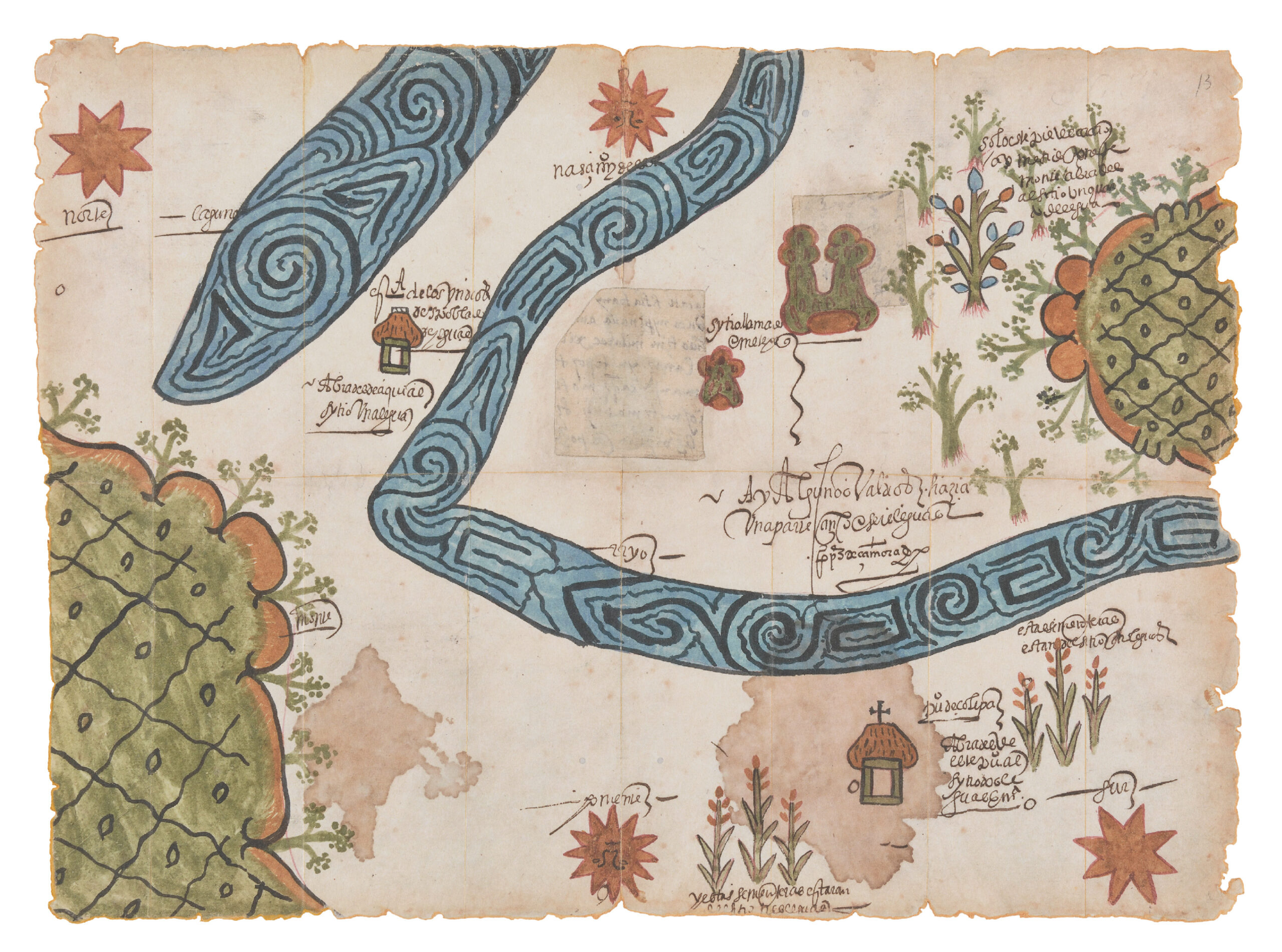
Facsimile by Tlaoli Ramírez Téllez, 2021, of Map of Zolipa Misantla, Veracruz, 1573. Original at Archivo General de la Nación (AGN) Mapoteca no. 1535. COURTESY LACMA
The nonverbal messages enfolded in maps figured prominently in three compelling Los Angeles art exhibitions in 2022. Broadly, they dealt with colonial rule following the Spanish conquest of Mexico and its lasting reverberations, and they expanded the usual narrative of that often violent clash of worldviews. Through selections of historic and contemporary maps, the exhibitions highlighted Indigenous perspectives, revealing a surprising interplay of cultures and a resilient people who never ceased expressing themselves through art.
The ancient fire god of the Mexica (pronounced mə·shee·ka)—the nation we know as the Aztecs—stood watch over a gallery of colonial-era maps at the Los Angeles County Museum of Art (LACMA). The basalt statue was carved perhaps 700 years ago by Nahua artists, members of the Indigenous people of Mexico, and was among artifacts that provided a pre-Columbian lead-in for the exhibition, Mixpantli: Space, Time, and the Indigenous Origins of Mexico. The word Mixpantli describes a celestial comet, a portent of the 1519 Spanish invasion as set down by Nahua scribes.

Detail from Map of San Juan Cuauhtinchan, Puebla, 1704. AGN Mapoteca no. 655. ARCHIVO GENERAL DE LA NACIÓN
More than works of art, the maps in the exhibition tell a legal story that is part and parcel of colonial history. They belong to a corpus of Spanish land grants and court documents called the Ramo de Mercedes, housed in Mexico’s Archivo General de la Nación (National Archives). Spanish for mercy, merced refers to grants considered to have been graciously given “at the sovereign’s mercy” (Tyler, N.M. Hist. Rev., 1991). The king established the colony of New Spain across the subjugated Aztec empire and empowered his viceroy to grant title to land, predominantly for farming and ranching (Taylor, N.M. Hist. Rev., 2021).

Map of Santiago Atapan, Michoacán, 1728. AGN Mapoteca no. 687. Sun denotes east and star denotes north. Roads with mojoneras (milestones) topped with crosses give distances in leagues to nearby pueblos. ARCHIVO GENERAL DE LA NACIÓN
Because the original maps remain in Mexico, Mexico City-based artist and designer Tlaoli Ramírez Téllez recreated them for LACMA. They are called facsimiles, but that label doesn’t do them justice. Meticulously drawn with acrylic, ink, and watercolor on paper, they replicate the originals’ signs of age in every detail, from water and wine stains to frayed edges, crumbling creases, and revealing palimpsests. These are skillful forgeries of official maps, authenticated with signatures and annotations scrawled by colonial functionaries.
Indigenous communities could and did use the land grant legal system to protect their own interests, sometimes to fight encroachments and dispute water rights with colonial estate holders, as was the purpose behind the map of Santiago Atapan (gorgeously fringed with golden fields), and to secure grants for preexistent pueblos (Museo Amparo). But more often, piece by piece, land grants were the means of transferring Indigenous-held territory into Spanish hands (Rull, 2020, pp. 14, 192).
The mapas de mercedes de tierras (land grant maps) were presented as key evidence in land cases before the viceroyalty courts. Although the legal system was imported, a rich tradition of mapmaking was local. We know from Spanish sources that conquistadors had been given Nahua maps to help them choose where to drop anchor and find their way in unfamiliar territory (Alva, Historia Chichimeca; Mundy, 1998).

Map of Ahuehuetitlán, Oaxaca, 1616. AGN Mapoteca no. 2056. At the pointing hand symbol it reads: “Here is the site …” ARCHIVO GENERAL DE LA NACIÓN (AGN)
The parties requesting and opposing land grants commissioned Indigenous artists to paint maps, whose great variation in style is attributable in part to the meeting of cultures. Artists raised in Mesoamerican traditions became trained in European techniques, and they integrated these different approaches with unique results (Hidalgo, 2019, Ch. 2; Rull, p. 50).
Indeed, the exhibition highlighted the “hybrid nature” of these artistic legal documents that emerged in a time of transformation. As artist Mariana Castillo Deball explains, although land grant maps were meant to serve the Spanish system, “we can still recognize the voice and ways of representing things by the Indigenous painters.”
For example, a 1704 map of San Juan Cuauhtinchan is characterized by rectilinear, church-centered blocks that conformed to the king’s decree to his land surveyors: “Let the city lots be regular from the start, so that once they are marked out the town will appear well ordered; … otherwise order will never be introduced” (A.E.J. Morris, 1994).
Even then, nearly two centuries after the Aztec defeat, the Nahua mapmaker incorporated an expression of defiance in his drawing: overlooking the village, atop a green hill of the Sierra de Amozoc, we see a raptor clutching a fawn in its talons and a snake in its beak. In Nahua iconography eagles symbolize elite warriors, and the captive snake recalls a legend of the founding of Tenochtitlán, the Aztec-Mexica capital—a scene that lives on at the heart of the Mexican flag.
Mexico’s hybrid culture is especially evident in the sixteenth-century Florentine Codex (the exhibition included UCLA’s reproduction). This monumental, illustrated, bilingual (Spanish and Náhuatl) primary source for Mexica history and culture represents the collaboration between a Franciscan friar and a team of Indigenous writers and artists. It is poignant that their work to preserve Nahua collective knowledge was pursued during a horrific epidemic that decimated the native population.
The second exhibition was LACMA’s companion show, Mixpantli: Contemporary Echoes, where the artworks connected past to present. Dominating the gallery floor was a map by artist Deball that visitors could physically walk upon. Its title, Vista de Ojos (lit., view from eyes), is a term borrowed from a land grant procedure that required visual confirmation by colonial officials of those locally drawn maps discussed above. This government review of the artist’s view of the land—placing in relationship the subduer and subdued—Deball poetically calls a “gaze on top of a gaze.”
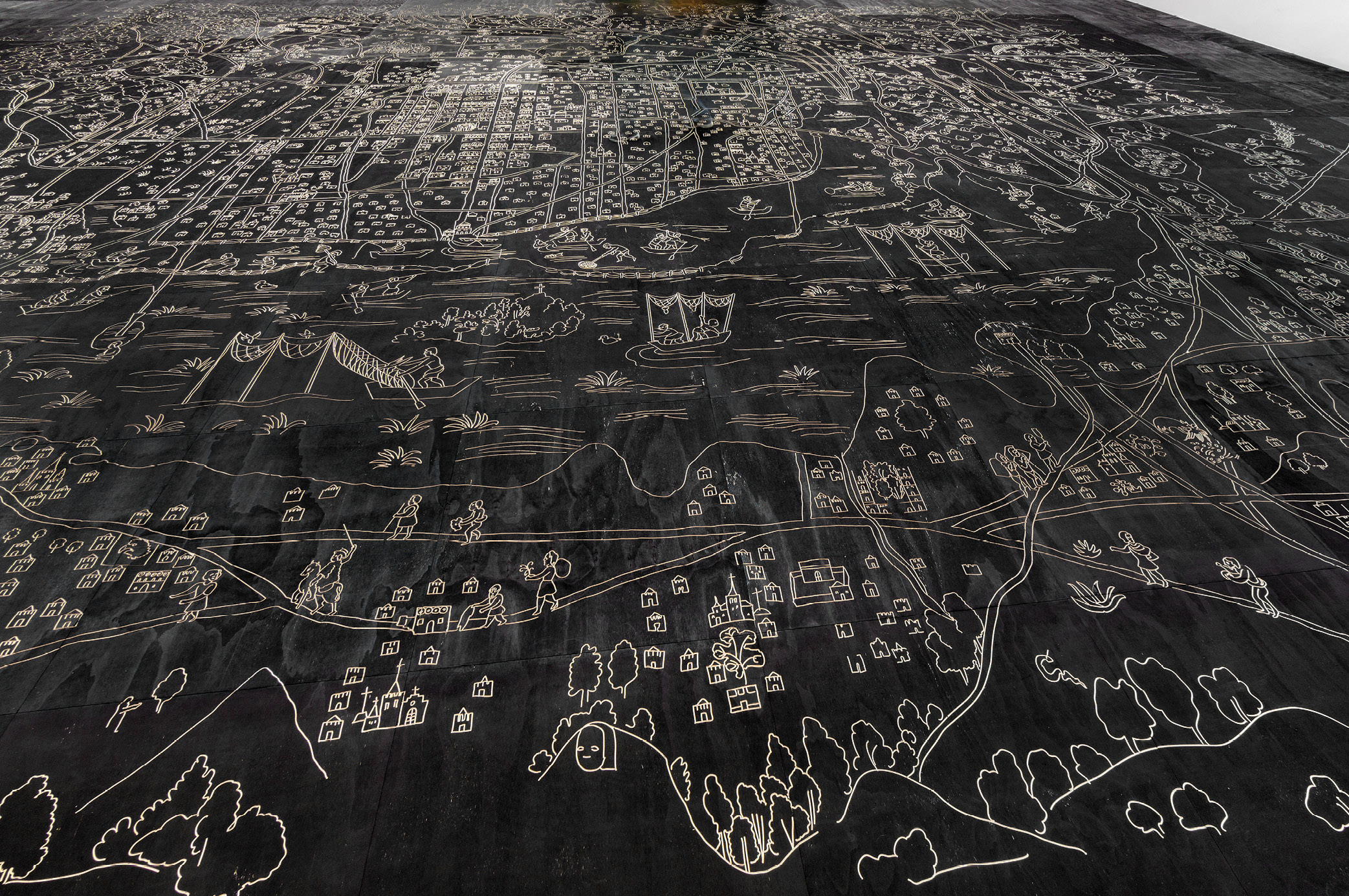
Mariana Castillo Deball. Installation view of Vista de Ojos, 2014. CNC engraved plywood floor. Kurimanzutto, Mexico City. PHOTO BY ESTUDIO MICHEL ZABÉ. Courtesy the artist
Measuring 19 by 13 meters (2,659 square feet), Deball’s incised plywood panel flooring is an enlarged rendition of the historic Santa Cruz Map of Tenochtitlán, by then renamed Mexico City. Produced only three decades after the Conquest, that map shows European-style buildings in place of Aztec temples, and uses animals, stars, and other symbols to identify Mexica place names. Based on what suggests an insider’s familiarity with the city, the mapmaker was likely “an Aztec with European schooling” (Lib. of Congress, CN 2021668313).
Deball, born in Mexico City, writes of the Santa Cruz Map, “On the outskirts one can see the Indigenous settlements and their inhabitants engaging in everyday activities,” such as fishing, canoeing, and bowhunting. She sees in these traditional lifeways a contrast between Indigenous and European maps in outlook and approach, which the other exhibition’s title, “Space, Time,” references. Whereas European maps focus on spatial information frozen in time, Indigenous maps are populated with people and stories, actions we imagine projecting into the past and future. Deball’s walkable installation (in LACMA’s permanent collection) invites visitors to set foot on the map and experience it with more than just a gaze.
Both the Santa Cruz Map and its modern rendering testify to Indigenous continuity, countering the misconception that Conquest meant obliteration. The “myth of native desolation” is what historian Matthew Restall terms the notion that those not readily destroyed through battle or disease soon surrendered their ethnic identities under the weight of Spanish colonizers, culture, and control. On the contrary, Restall elaborates on the resourcefulness of those Indigenous people to survive and adapt, as the maps in these exhibitions bear out.
Contemporary Echoes also showcased paintings by Southern California artist Sandy Rodriguez that uncomfortably challenge us to see the through-line from the Spanish invasion to today’s news. Rodriguez describes herself as a Chicana who, owing to her family and proximity to the border, grew up in two worlds. Using amate paper and natural pigments (e.g. indigo leaf extract and clay to form Maya Blue), she draws from the palette and vocabulary of historic maps to link colonialism with national immigration policy.
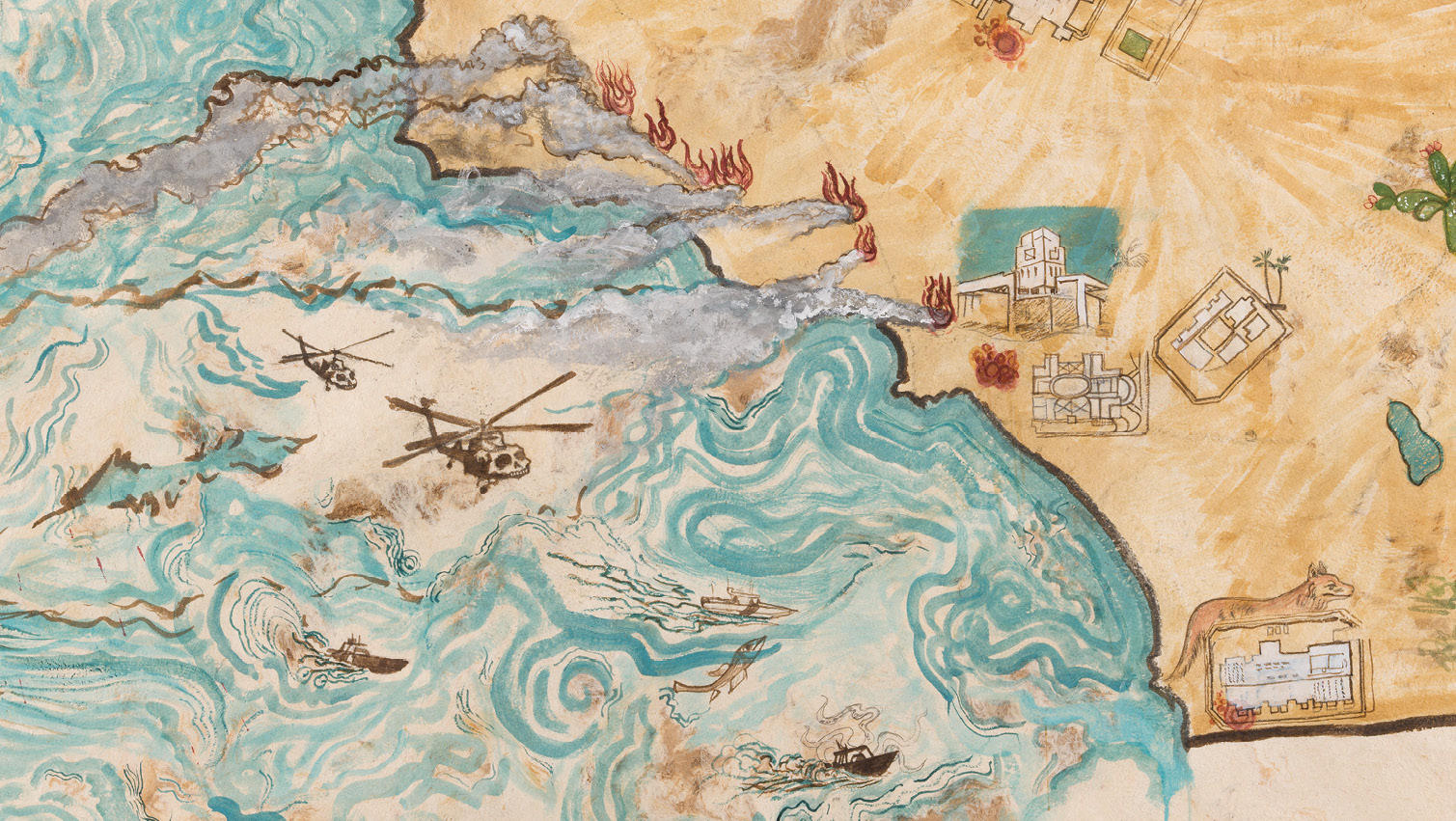
Sandy Rodriguez. Detail from De las Señales y Pronósticos & I.C.E. Raids de Califas, 2018. Hand processed watercolor on amate paper. Crystal Bridges Museum of American Art, Bentonville, AR. COURTESY THE ARTIST
Filled with Mesoamerican iconography, Rodriguez’s works confront the viewer with police violence and the incarceration of Latino immigrants. Her painting, De las Señales y Pronósticos and I.C.E. Raids de Califas (Of the Signs and Prophecies and I.C.E. Raids in California [slang]), presents a map of the state, with satellite views of detention centers plotted onto the desert borderlands. Rodriguez explains that her colors and style reference images of the Conquest in the Florentine Codex, in which Spanish galleons are upgraded to immigration enforcement helicopters sporting the menacing visages of calevaras (skulls).
Although it’s not a map, the ancient Códice Maya is relevant to the topic of Indigenous culture, and its showing at the hilltop Getty Museum coincided with the third exhibition we will cover. This manuscript on bark paper tracks the movements of the planet Venus—the Morning Star—as recorded by Maya priests around the peak of Maya civilization, 400 years before Spanish contact and centuries before Tenochtitlán existed. On loan from Mexico, the codex employs pictorial symbols and imagery, like a graphic novel, and documents the sophistication of ancient astronomy and the Maya calendar.
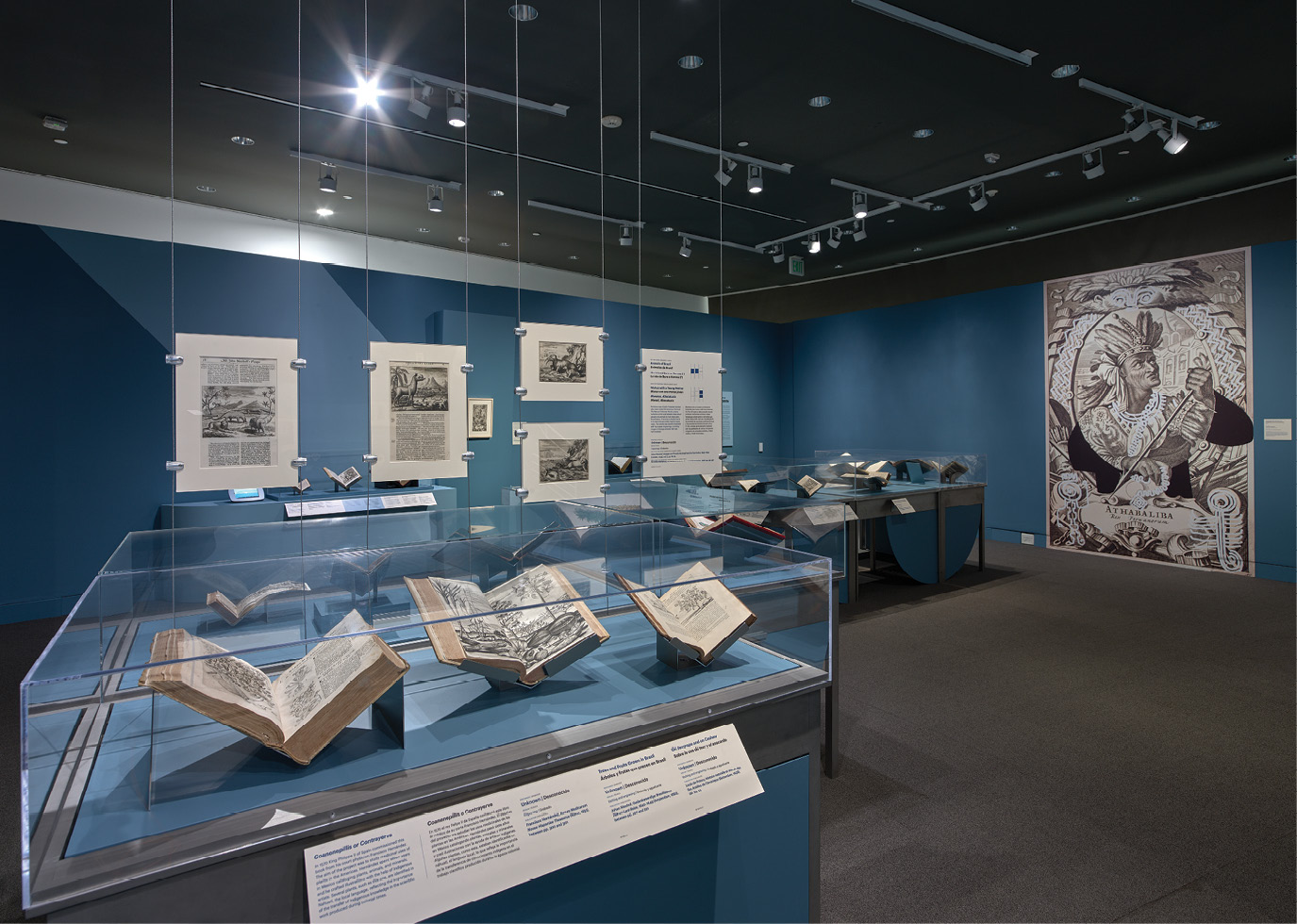
Installation view of Reinventing the Americas: Construct. Erase. Repeat. 2022, at Getty Research Institute. PHOTO BY JOHN KIFFE, © J. PAUL GETTY TRUST
We conclude with Reinventing the Américas: Construct. Erase. Repeat., at the Getty. There, a fine woodcut map of Tenochtitlán from 1524 displays the mix of styles seen in the Mixpantli exhibition. (See this magazine’s cover image.) Its label pointed out a motif that resembles the Aztec Náhuatl glyph, tepetl, representing a hill or mountain, while, markedly less subtle, this “map of conquest” flaunts the triumphal coat of arms of Charles V, then Holy Roman Emperor and King of Spain.
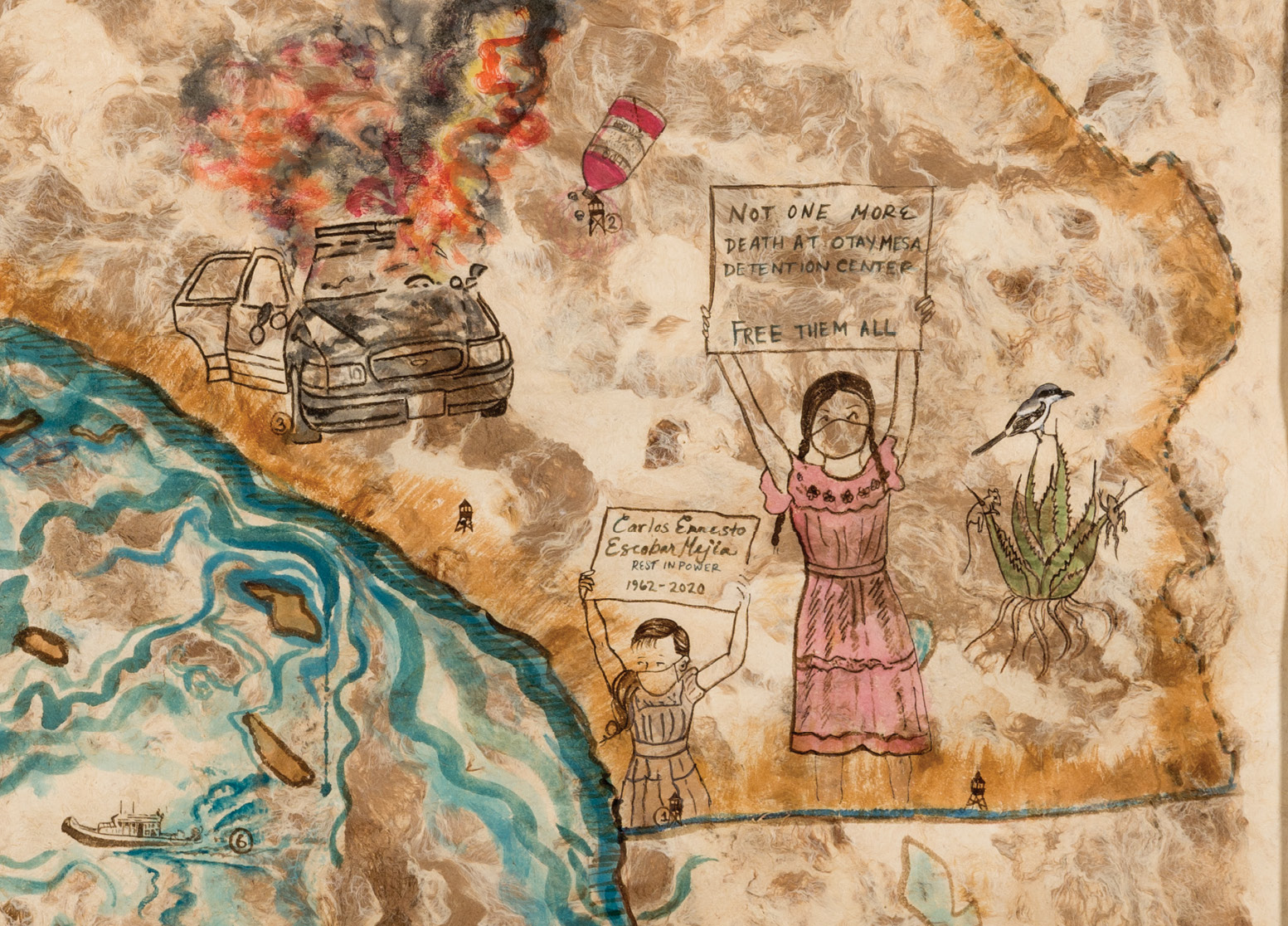
Sandy Rodriguez. Detail from Mapa de Califas—Atrocities, Isolation and Uprisings, 2021. Hand processed watercolor on amate paper. COURTESY THE ARTIST
This exhibition began with the premise that America is more than a place on a map; it is an idea that, since Columbus, was defined by Europeans. To illustrate, a 1619 map of the Straits of Magellan by Flemish engraver Theodor de Bry features naked native figures as Adam and Eve, representing the New World as Eden, a blank slate waiting to be graced with knowledge and civilization. Such Eurocentric portrayals persisted for centuries, “fueling stereotypes and prejudices” against Indigenous peoples (Getty.edu). The purveyors of this view, it seems, were unacquainted with Maya astronomy.
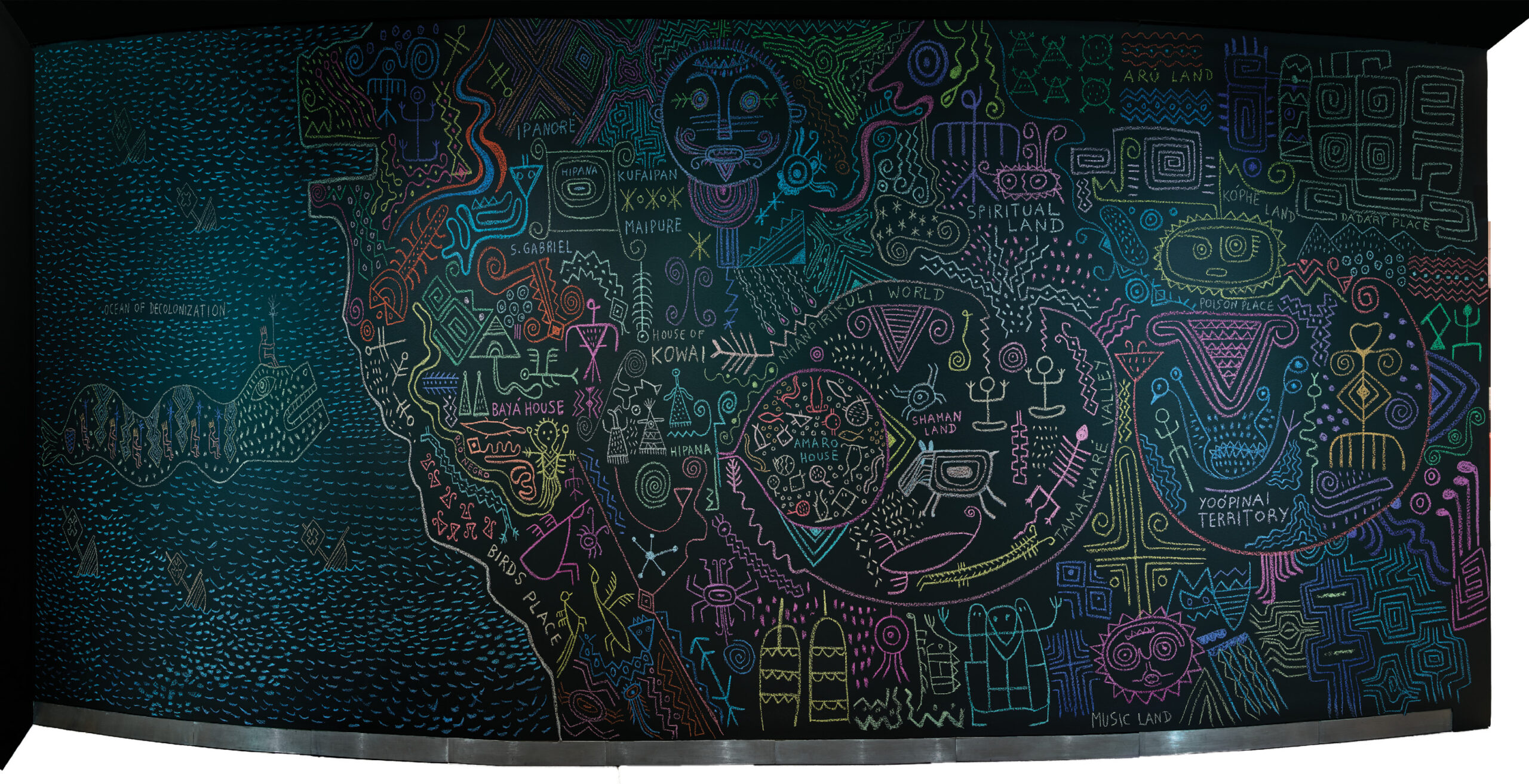
Denilson Baniwa. Untitled, 2022. Chalk mural, at Getty Research Institute. PHOTO BY JOHN KIFFE, © J. PAUL GETTY TRUST
In keeping with the theme of reinvention were contemporary works in a variety of mediums by Indigenous artist Denilson Baniwa. Originally from the Brazilian state of Amazonas, Baniwa describes his work as reflecting on both his home village and the outside world where he now lives and the “frictions that occur when these worlds collide,” including those caused by differing “understandings of the world,” its origins, and our place in it.
The exhibition included his videos, paintings, and “digital interventions”—in which copies of historic depictions of the New World appear altered or defaced. In a piece titled History of Violations, Baniwa blacked out, as if by Sharpie, the European-assigned place names on a renowned 1579 map of the Americas by Abraham Ortelius. And in a wall mural in chalk, Baniwa offered his own map, reclaiming history from an Indigenous point of view, if somewhat cryptically, in the style of ancient petroglyphs.
Sandy Rodriguez refers to the subject of her map paintings as “contested lands.” One might say that all the maps in these exhibitions, from colonial to modern, in various ways pose the challenge: who belongs here? And just as land is often contested, so is history. Those elegant Spanish land grant maps are inescapably tied to a history of Indigenous communities dispossessed by way of an avaricious legal system. At the same time, because the mapmakers’ skills were highly valued by the conquerors, the maps impart to us a cultural legacy and the human spirit to survive.

Xiuhtecuhtli, ca. 1250-1521, Mexica. Basalt stone (Ht. 80 cm). Museo Nacional de Antropología, Mexico City. INAH DIGITAL ARCHIVE
Survival was a recurring theme in these exhibitions, culminating in the vibrant expression of Indigenous experience in contemporary art. This theme is palpable in the Florentine Codex: amid staggering death and destruction, its Nahua authors and artists resisted their plight and affirmed their presence on the land. Five hundred years after the Conquest, their prefatory words still hold the power to move us: “We people here ….”
Alex Hidalgo, Trail of Footprints: A History of Indigenous Maps from Viceregal Mexico (Univ. of Texas Press, 2019).
Matthew Restall, Seven Myths of the Spanish Conquest (Oxford Univ. Press, 2021).
Ana Pulido Rull, Mapping Indigenous Land: Native Land Grants in Colonial New Spain (Univ. of Oklahoma Press, 2020).
See related maps, art, and artifacts at these museums:
Latin American and Pre-Hispanic Art Collections at the Getty Center in Los Angeles.
Art of the Ancient Americas Collection at the Los Angeles County Museum of Art. Works by Mariana Castillo Deball and Sandy Rodriguez are in the museum’s permanent collection.
Paintings by Sandy Rodriguez are part of the installation, Borderlands, at the Huntington Library Art Museum in San Marino, CA. Her solo exhibition, Unfolding Histories: 200 Years of Resistance, is at University of California, Santa Barbara until March 3, 2024.
Colonial maps from the 2018 exhibition, In Tlilli, In Tlapalli. Images of the New Land: Indigenous Identity After the Conquest, at Museo Amparo in Puebla, Mexico, can be viewed on the museum’s website.

Finalists for Australian Geographic Nature Photographer of the Year 2023 have been revealed.
The stunning photographers have been entered into ten categories including animals in nature, astrophotography, junior, landscape, macro, monochrme, our impact, threatened species and urban animals.
Click through to see some of our favourites.

Photography has become an everyday part of our lives, moving from the realm of professionals to the hands of amateurs and enthusiasts. With the continual evolution of smartphone technology, mobile photography has significantly transformed, delivering professional-level results that rival traditional DSLRs. This year, 2023, showcases some extraordinary smartphone cameras, pushing the boundaries of what mobile devices can achieve in photography.
Apple’s iPhone 14 Pro Max is more than just a smartphone; it’s a versatile photographic tool. The phone showcases a triple-lens rear camera setup: a 48-megapixel wide sensor, a 12-megapixel ultra-wide sensor, and a 12-megapixel telephoto sensor. This configuration allows photographers to capture a wide range of shots, from panoramic landscapes to detailed close-ups, all while maintaining high resolution and rich color reproduction.
The phone’s Night Mode is particularly impressive. Now available for all three lenses, it intelligently adapts to different light conditions, enabling photographers to capture vibrant, detailed images even in low light. This opens up a world of creative possibilities, from capturing cityscapes under neon lights to shooting wildlife at dawn or dusk.
Apple’s ProRAW feature should not be overlooked either. This provides photographers with comprehensive control over editing while maintaining the high image quality. This feature can be a game-changer for photographers interested in post-processing, allowing for a level of detail and dynamic range usually associated with DSLR cameras.
The Google Pixel 7 Pro is another standout in mobile photography. Its camera setup includes a 50-megapixel main sensor, a 12-megapixel ultra-wide sensor, and a 48-megapixel telephoto lens. This powerful hardware is complemented by Google’s advanced computational photography capabilities.
The Pixel’s software uses AI and machine learning to enhance image quality and make automatic adjustments. This leads to better low-light performance, enhanced digital zoom, and improved portrait mode effects. Google’s Night Sight and Super Res Zoom take these enhancements even further, providing remarkable low-light shots and impressive zooming capabilities. For travel photography or impromptu street shots, these features make the Pixel 7 Pro a powerful companion.
The Samsung Galaxy S23 Ultra comes equipped with a comprehensive camera system, housing a 108-megapixel wide sensor, a 12-megapixel ultra-wide lens, and two 10-megapixel telephoto lenses. This setup offers great versatility, accommodating a variety of shooting situations and styles.
The phone’s Space Zoom feature is particularly impressive, offering up to 100x digital zoom. This feature can capture distant subjects with an impressive level of detail, which could be particularly useful in situations like wildlife photography or sporting events. Furthermore, the Single Take feature allows users to capture a series of photos and videos with one shutter press, perfect for fast-paced events or dynamic scenes.
The Sony Xperia 1 IV, with its triple 12-megapixel lens setup (wide, ultra-wide, and telephoto), offers professional-grade capabilities. The Photography Pro feature emulates the manual controls found in DSLR cameras, providing full control over parameters like shutter speed, ISO, and focus. This makes it an ideal choice for photographers who prefer hands-on control and precision.
To fully capture the potential of these phones, let’s explore a few more tips that can elevate your smartphone photography skills:
The beauty of smartphone photography lies in its accessibility and spontaneity. With your phone always in your pocket, you’re ready to capture any moment. Take advantage of this convenience, keep these tips in mind, and you’ll soon notice a significant improvement in your photos. Remember, the best camera is the one you have with you. Now, armed with one of these top smartphones of 2023 and the knowledge to harness its full power, you’re well equipped to take your mobile photography to the next level.
In 2023, the line between traditional and mobile photography continues to blur. Thanks to the combination of powerful hardware and innovative software, today’s smartphones offer a level of photographic quality and versatility that was unthinkable just a few years ago.
With devices like the iPhone 14 Pro Max, Google Pixel 7 Pro, Samsung Galaxy S23 Ultra, and Sony Xperia 1 IV, photographers have high-quality tools right at their fingertips. Whether you’re capturing the fleeting moments of street photography, the grandeur of a landscape, or the intricate details of a close-up shot, mastering mobile photography is now more achievable than ever.
So, embrace the capabilities of your smartphone camera. Practice, experiment, and never stop learning. The world of photography is vast and rewarding, and with your smartphone, you’re well equipped to explore it.








