
Zinta Aistars speaks with Kalamazoo woodblock print artist Mary Brodbeck.
Art Beat: East meets West


June 9-10
1245 N. Spring St., Los Angeles, CA 90012
The largest pride music event in the country — LA Pride in the Park will expand this year to a two-day extravaganza, taking place at Los Angeles Historic Park this Friday and Saturday. Global superstars and GRAMMY Award-winning queens Megan Thee Stallion and Mariah Carey will slay the stage as your festival headliners.
The festival also will feature an array of local vendors and LGBTQ+ exhibitors, a large sober space, sponsor giveaways, and so much more.
Get single or weekend passes online.
June 9-11
277 N. Avenida Caballeros, Palm Springs, CA 92262
Head over to sunny Palm Springs for the 10th annual Splash House festival.
This summer festival series grants you admission to a house and disco escape with great people and tons of fun in our favorite desert playground.
The party takes place across three hotel resorts, and each resort is a full takeover hosting poolside stages, rooms and balconies that are all part of the fun. Desert days continue into the night for their After Hours series, where you’ll dance aside the planes and under the stars at the Palm Springs Air Museum.
Get your tickets online.
June 10 at the Hollywood Bowl
2301 N. Highland Ave., Los Angeles, CA 90068
On Saturday at The Hollywood Bowl, the one and only Janet Jackson is back.
The celebrated music icon behind “All for You,” “Rhythm Nation,” “Nasty,” “That’s the Way Love Goes,” and so many more hits — headlines opening night at The Hollywood Bowl.
Plus, GRAMMY-Award winning rapper Ludacris kicks off a night not to be missed! All proceeds from opening night benefit the LA Philharmonic and its learning and community programs.
June 10 at Castaic Lake
32132 Castaic Lake Drive, Castaic, CA 91384
Also on Saturday is the fourth annual Castaic Lake Dragon Boat Festival. Last year’s festival had about 500 paddlers in attendance from both youth and adults. Come out and enjoy beautiful Castaic Lake and watch teams from different cities, states and countries compete in dragon boat racing.
There will be different stage performances, including lion dance, live music and more dancing.
And guess what? The event is free for the public.
June 10 to June 11 at the Autry Museum of the American West (Griffith Park)
4700 Western Heritage Way, Los Angeles, CA 90027
This Saturday and Sunday, join the Autry Museum of the American West for a fun-filled weekend perfect for the whole family. Celebrate contemporary and traditional Native art forms for the 32nd annual American Indian Arts Marketplace, where you can purchase one-of-a-kind artwork, jewelry and fashion.
The festival brings together dozens of Native American artists and tribes for the annual showcase, as well as Native playwrights as they regale us with their stories of being Native today.
Watch “The SoCal Scene” at 9 p.m. every Thursday on Spectrum News 1 and the Spectrum News app.

… a large cup of pure Kona Coffee, a Canon R5 with a 100/500 lens and a 1.4 extender giving me a reach of 700mm and a wood plank to rest the camera on when not shooting and at about 6:45AM it was time to take the tram up to nest level about 150′ above the ground … a stop and then checking the nest out which is in a niche in the cliff about two football fields away.
The top photo is of my camera resting on the plank pointed at the nest … I drew a red circle around the nest … a beautiful morning and a few minutes to enjoy my coffee before the action started.
The next photo shows mom bringing a bit of breakfast into the nest for the kids … a tip for you if you want to shoot raptors in and around their nests, they will almost always fly into the nest from below it, as they can fly upwards into the nest area whilst dropping airspeed and kind of stall into the nest. Good to dissipate speed when flying into a cliff wall. When shooting the incoming bird, do not try to get a shot of it alone, rather when you see it coming in, get a focus on the nest and begin shooting and you will get it as it swoops upwards and into the nest.
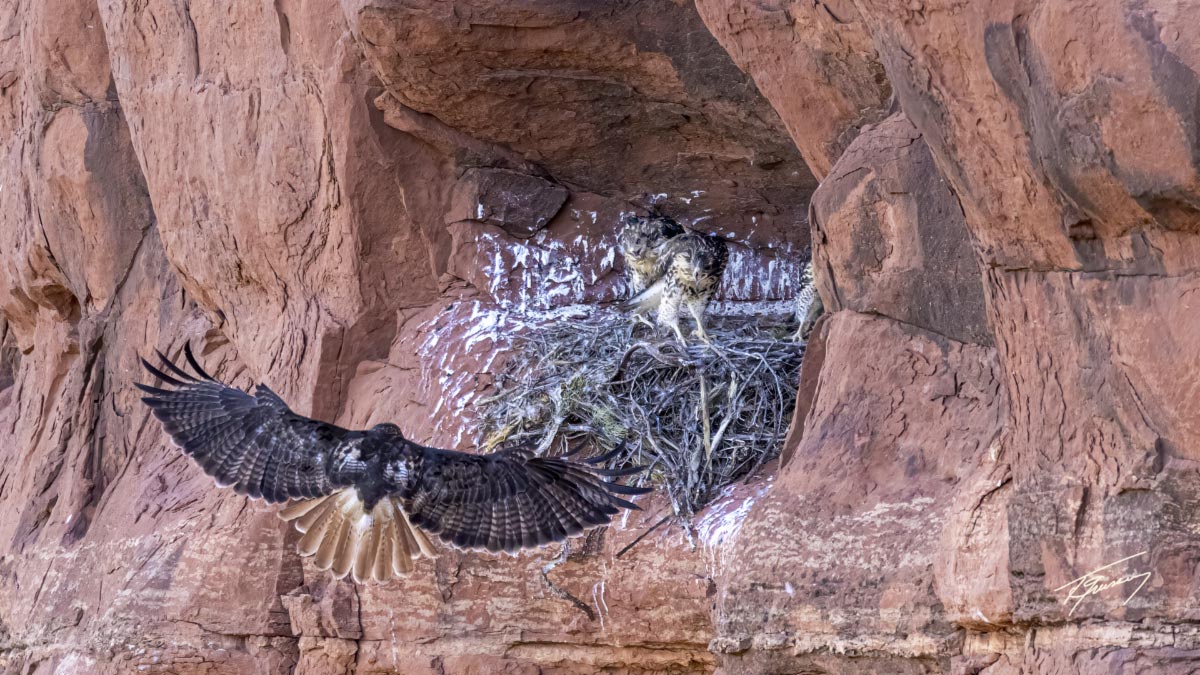

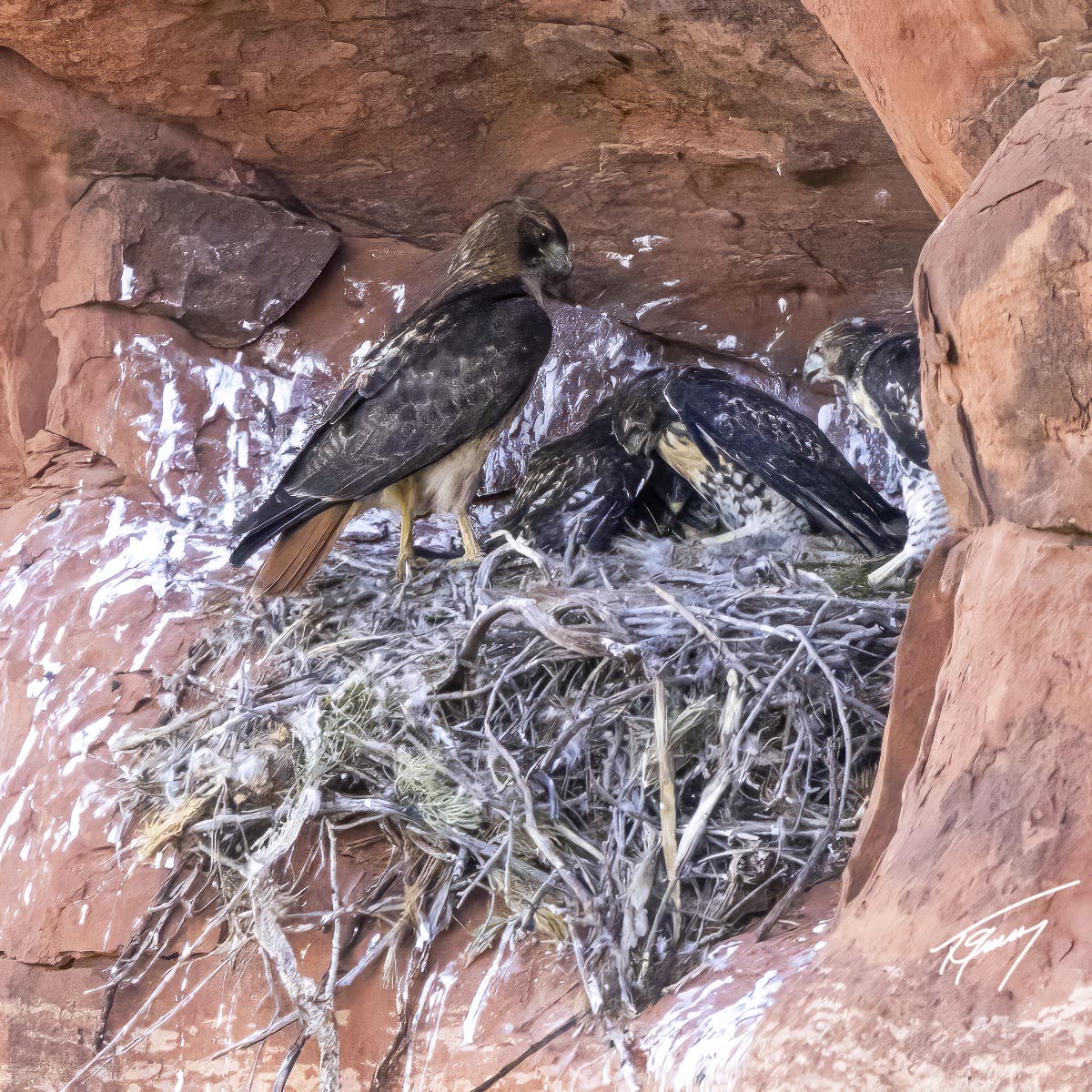

The next shot below that is of one the kids mantling breakfast (covering it up with his wings) this is done to keep others from seeing the food … taking a meal away from another bird is pretty common, but if others cannot see it, perhaps they will get to keep their food. Shortly after this mom left the nest to go find more food for the family.
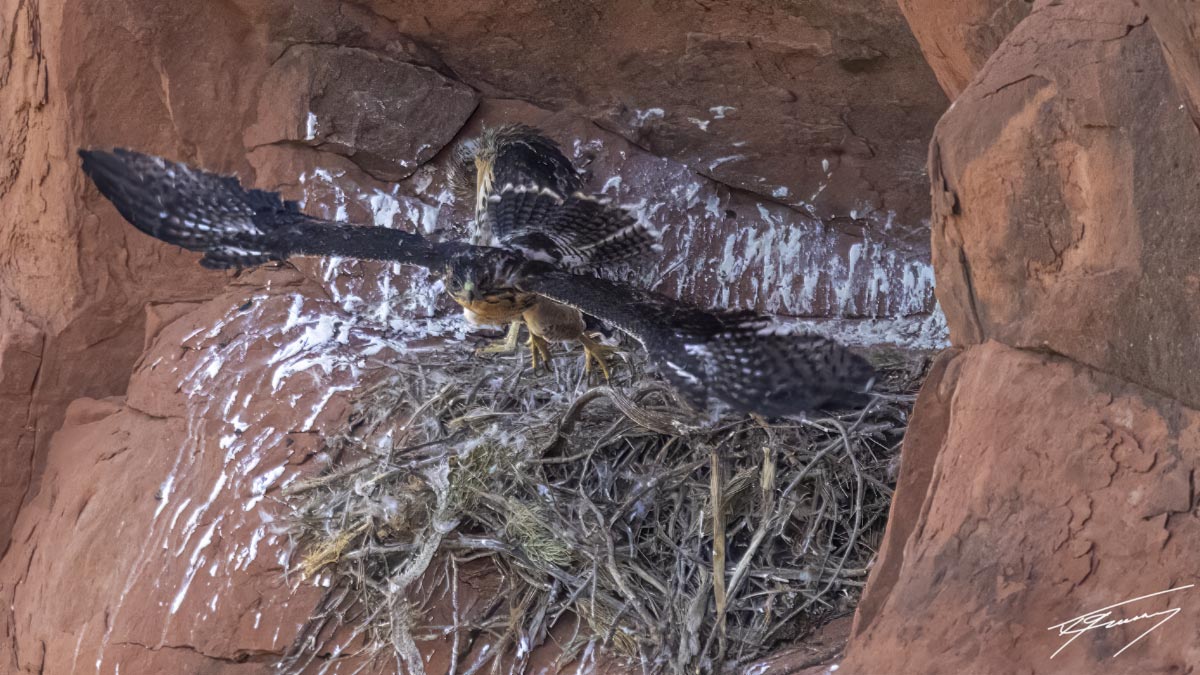
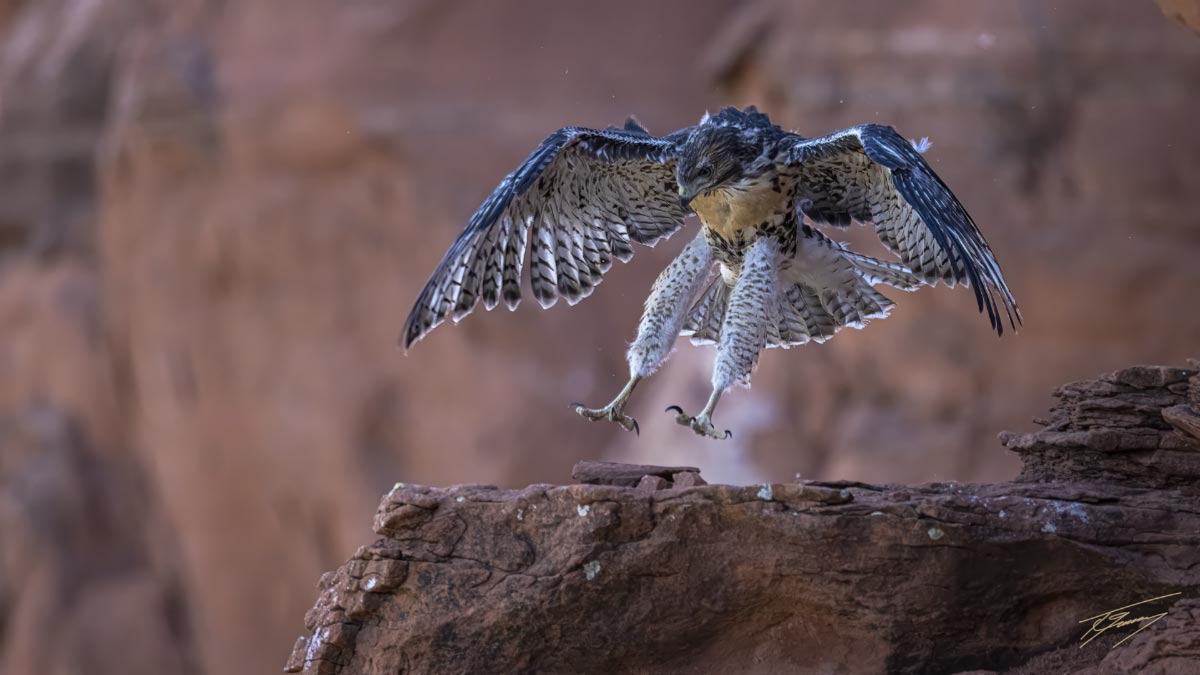
About ten minutes later, one of the kids made a couple of runs with wings flapping to the edge of the nest, but stopped short of going airborne … on the third try, he steeped into the abyss and went airborne … he ended up coming into an outcropping from the cliff about 40 feet from me and stuck a perfect landing. He played around on this outcropping for about fifteen minutes before making the flight back to the nest. I spoke with Michele at International Raptor and Falconry Center and she told me that it is common when making a first flight that there there will be a few false starts … after that it is a push off and go! Only deleted half of the photos … so many good ones.

Check the last photo out carefully and you will see remnants of his baby feathers on his head and wings … they will likely hang out around the nest for a couple of more weeks and the adults will still provide food as the young learn the skill of providing for themselves. Life is so terrific!

Into the weekend for me and the plan is to be back Monday morning … keep breathing, smile and make someones day a little better because you are here..

Cheers,
Ted
Whatever else you do or forebear,
impose upon yourself the task of happiness,
and now and then abandon yourself
to the joy of laughter.
excerpt from Whatever Else You Do by Max Ehrmann
###
 The easiest way to reach Mr. Grussing is by email: ted@tedgrussing.com
In addition to sales of photographs already taken Ted does special shoots for patrons on request and also does air-to-air photography for those who want photographs of their airplanes in flight. All special photographic sessions are billed on an hourly basis.
Ted also does one-on-one workshops for those interested in learning the techniques he uses. By special arrangement Ted will do one-on-one aerial photography workshops which will include actual photo sessions in the air.
More about Ted Grussing …

This is an advertisement

Lucas Zwirner faces to the side in a swirl of pigment washes of orange and brown. When Elizabeth Peyton’s painting of her friend, the heir-apparent to the Zwirner gallery empire, debuted at Art Basel Hong Kong, art-world forums lit up.
But the tittering online was not because the work was particularly stylish or even because, according to rumors, it may have been spurred into being by a romance. It was because Peyton was using her art to signal something about her social network. As some journalists pointed out, the director and the artist are professionally intertwined now. Officially, just a few weeks before the painting popped up on the fair floor, Peyton had left Gladstone Gallery behind when signing with David Zwirner.
This subtext was like a hyperlink hidden within what was, on the surface, a sentimental painting of a friend. We’ve been seeing a lot of paintings in this vein lately: works that play on intimate depicted relationships which are coded, like a video-game Easter egg, in a way that is discernible ideally for those who are also members of a specific in-crowd, or who aspire to be.
Examples that jump to mind include Gagosian gallery star Anna Weyant’s Two Eileens (2022), which got people talking via its doubled image of Eileen Kelley, “sexpert,” host of the Going Mental podcast, and niche celebrity. (Kelley returned the favor by having Weyant on the podcast to talk about art-world sexism.)
Or think of something like Constance Tenvik’s Kenny On The Day When I Exchanged A Mind Map For Plastic Gloves, Printed Out Official Documents & A Cab To The Airport (2020), depicting art dealer, writer, and gadfly Kenny Schachter, recognizable by his glasses and signature track pants, but identified knowingly only by his first name.
Such scene-y figurative portraiture combines an awareness about access to a scene with a tenderness for it. If the viewer gets the fine print (as more than a few did when it came to that Peyton-Zwirner link), then they too gain some level of membership.

Elizabeth Peyton, Lucas Zwirner (2022). Courtesy of David Zwirner.
This trend—let’s call it hypersentimental painting—can be seen from a few angles. The clique-based realism that you have been seeing more and more of late is surely a by-product of our algorithmic drifts into social clusters. Social bubbles have become so pronounced over the last years that it can be hard to reconcile with anyone who sits beyond them.
Such digital fragmentation was further aggravated by the pandemic, which shrunk down these already siloed groups. With such tightened virtual micro-communities, to paint what one intimately knows and what their peer group will have a special appreciation for seems only natural.
At the same time, many of us feel more exposed than ever before. Though people have been proudly and loudly moving into smaller forums via “Close Friends” lists, Discord channels, Mastodon platforms, and Telegram or WhatsApp groups, that mass migration still comes against the background of a lot of angst about living life in public online.
Most of our attention and time remains captured the big platforms. The marketing tactics and hyper-scrutiny within these places have become so unavoidable that if you want to preserve any sense of subcultural cachet in these arenas, interacting necessitates a certain kind of deliberate encryption.
Against this background, the proliferation of this strain of subjective painted scenarios focused on members of an artist’s personal world—be they lovers, family, or friends—is a smartly positioned move. This kind of painting champions micro-community as content but also, crucially, as sensibility. It’s all about painting in a way that speaks to those who get it while still catching the eye of those who don’t. That pair of outcomes, when they work out, provides a double reward.
 Emma, (2022). © Anna Weyant. Photo: Robert McKeever. Courtesy Gagosian” width=”822″ height=”1024″ srcset=”https://www.mecreates.com/story/news/wp-content/uploads/2023/06/WEYAN_2022.0008-1-1-822×1024.jpg 822w, https://news.artnet.com/app/news-upload/2023/06/WEYAN_2022.0008-1-1-241×300.jpg 241w, https://news.artnet.com/app/news-upload/2023/06/WEYAN_2022.0008-1-1-40×50.jpg 40w, https://news.artnet.com/app/news-upload/2023/06/WEYAN_2022.0008-1-1.jpg 963w” sizes=”(max-width: 822px) 100vw, 822px”>
Anna Weyant Emma, (2022). © Anna Weyant. Photo: Robert McKeever. Courtesy Gagosian
What I am calling hypersentimentalism has gestated in the long tail of figuration that blossomed in tandem with the Age of the Influencer around 2014. Figurative painting circulated well within the Instagram economy: Easily consumed images of stylized figures resonated with social media as a platform for performing and curating identity. (In 2020, Tamara de Lempicka, an artist whose stylish Art Deco portraits were long considered kitsch, was even given an attempted rebrand as a “Queen of Instagram” before her time.)
By the second decade of the millennium, figuration was still booming, but frustration with the major forms of it was building alongside frustration with the fakeness and hyper-performativity of this era of social media.
In 2020, critic Alex Greenberger dubbed a lot of the whimsical new nouveau Surrealist and nouveau Pop painting, which had enchanted the market, as “zombie figuration.” By 2021, art historian Darby English cautioned that the astonishing vogue for figuration by Black painters was limiting: “To me, the worrisome thing about a flood of figuration is the time and resources we aren’t spending on the part of us we can’t image.” In New York, the most recent Whitney Biennial took a sharp turn towards abstraction and a language of opacity, making deliberate demands of the audience to invest in artists’ backstories.
Hypersentimentalism’s laser-focus on niche knowledge and micro-communities offers a way to keep faith with the strengths of figuration, while still positioning oneself against some of these frustrations. It follows an “IYKYK” logic, playing up a layer of insider opacity. (For those who don’t know, IKYKY stands for “if you know, you know.”)
Tellingly, a parallel development has happened in marketing, where old-fashioned influencers are no longer the hot commodity. Instead, brands are turning to micro-influencers—or even nano-influencers.
In fashion, Lauren Cochrane notes the rise of the “IYKYK model.” Casting niche personalities over professional models “adds a layer of authenticity… Rather than choosing someone solely for their beauty and ability to look great in clothes, they are bringing the actual people they would like to wear their labels into the campaign. And if they share their love of the brand with their influential friends and followers? Even better.”
Indeed, that fashion phenomenon has itself notably synthesized with the art world. Take collector Karen Boros walking the Balenciaga runway for Spring/Summer 2020, an event that caused a small flurry of excitement in the German art world. The micro-celebrity may not have been noticed by the many thousands more who watched and reposted the show, but the right (high-net-worth) people likely did.
More recently, art critic Dean Kissick was among those modeling in a Marc Jacob’s Heaven spring 2023 campaign, a lookbook that was a horizontally scrolling eye-spy of various New York micro-celebrities. (The White Lotus star Michael Imperioli, clad in a skull-print hoodie‚ was perhaps the most famous among them—though he still feels like a niche pick).

Installation view of Amalia Ulman’s show “Jenny’s” at Jenny’s. Courtesy of the artist and Jenny’s. Photo by Joerg Lohse
In recent art, examples of this guessing-game, who’s-who style are percolating everywhere.
Chloe Wise’s rise was spurred on in part by her paintings of New York friends going viral. In Wise’s vibrant canvasses, you aren’t told you are supposed to recognize, say, model and artist Richie Shazam among the three embracing figures in 2019’s Polysemic Primavera (a hypersentimentalist tic: titles never dare belie the names of the muses in the painting). Spotting Shazam’s half-face again peering out of another Wise work, Some pleasant lies would be nice (2021), feels as if you are being given membership to the in-crowd—even if it is a low-tier level of access.
 Some pleasant lies would be nice (2021) © Chloe Wise – Courtesy of the Artist and Almine Rech. Photo: Dan Bradica” width=”881″ height=”1024″ srcset=”https://www.mecreates.com/story/news/wp-content/uploads/2023/06/CWI0165-CHLOE-WISE-2021_47126-881×1024.jpg 881w, https://news.artnet.com/app/news-upload/2023/06/CWI0165-CHLOE-WISE-2021_47126-258×300.jpg 258w, https://news.artnet.com/app/news-upload/2023/06/CWI0165-CHLOE-WISE-2021_47126-1322×1536.jpg 1322w, https://news.artnet.com/app/news-upload/2023/06/CWI0165-CHLOE-WISE-2021_47126-43×50.jpg 43w, https://news.artnet.com/app/news-upload/2023/06/CWI0165-CHLOE-WISE-2021_47126-1652×1920.jpg 1652w, https://news.artnet.com/app/news-upload/2023/06/CWI0165-CHLOE-WISE-2021_47126.jpg 1762w” sizes=”(max-width: 881px) 100vw, 881px”>
Chloe Wise, Some pleasant lies would be nice (2021) © Chloe Wise. Courtesy of the Artist and Almine Rech. Photo: Dan Bradica
You could follow that thread downtown to Amalia Ulman’s exhibition “Jenny’s” at the trendy gallery Jenny’s, featuring a dense, salon-style gallery of portraits of friends and scene-makers. Though working as much in the tradition of conceptual installation as figurative painting (I do not think these artists follow any formal rules), Ulman sounds some of the familiar notes.
The show was an homage to the Theater District restaurant Sardi’s, whose walls are adorned with caricature sketches of New York theater folk. Ulman replicated the caricature salon hang, only with figures who either exist in or orbit around the downtown cultural scene in New York.
Tagged are artists Anna-Sophie Berger, Seth Price, Heji Shin, and Jordan Wolfson, among others. There are also the prestigious Stadelschule professors Josef Strau and Michael Krebber, as well as art critics and authors, such as Natasha Stagg, Stephanie LaCava, and Dean Kissick (again).
In February, Swiss artist Tobias Spichtig debuted a whole family of paintings at a sleek show of figurative works (alongside abstract paintings and sculptures) at O-Town House in Los Angeles. Though Spichtig has incorporated the quotidian or social into his work before—clothes left by friends have worked their way into his sculptures, and there are several paintings of his partner—there was always a degree of remove from the overtly sentimental.
 Dear Friends on view at O-Town House, Los Angeles Install views. Photo: Tobias Spichtig” width=”1024″ height=”683″ srcset=”https://www.mecreates.com/story/news/wp-content/uploads/2023/06/Tobias-Spichtig_2023_dear-friends_o-townhouse_los-angeles_install_4_DP2M0627-1024×683.jpg 1024w, https://news.artnet.com/app/news-upload/2023/06/Tobias-Spichtig_2023_dear-friends_o-townhouse_los-angeles_install_4_DP2M0627-300×200.jpg 300w, https://news.artnet.com/app/news-upload/2023/06/Tobias-Spichtig_2023_dear-friends_o-townhouse_los-angeles_install_4_DP2M0627-1536×1024.jpg 1536w, https://news.artnet.com/app/news-upload/2023/06/Tobias-Spichtig_2023_dear-friends_o-townhouse_los-angeles_install_4_DP2M0627-2048×1365.jpg 2048w, https://news.artnet.com/app/news-upload/2023/06/Tobias-Spichtig_2023_dear-friends_o-townhouse_los-angeles_install_4_DP2M0627-50×33.jpg 50w, https://news.artnet.com/app/news-upload/2023/06/Tobias-Spichtig_2023_dear-friends_o-townhouse_los-angeles_install_4_DP2M0627-1920×1280.jpg 1920w” sizes=”(max-width: 1024px) 100vw, 1024px”>
Tobias Spichtig Dear Friends on view at O-Town House, Los Angeles. Photo: Tobias Spichtig
His O-Town House show, “Dear Friends,” foregrounds feelings—its title seems to play on a party invitation or a social media post, but also, refreshingly, just says what the show is about. It featured a series of identically scaled paintings: of his partner, but also friends.
And so, you might pick out artists like Klara Linden or Xiangyu He. Each one gazes out, their skin and eyes bright against black backgrounds as slightly tall portraits that recall iPhone screens. The images, which have a gothic quality, are not realistic exactly, but rather look to capture an essence of each sitter. The exhibition text described the “uncomfortable desire for unlimited intimacy,” manifesting in Spichtig’s “emotional headshots.”
That same candidness echoes in a recent show at Deborah Schamoni in Munich. The names of painter Elizabeth Ravn’s sitters are listed off in the press release (first names only: “Alizée, Athanasios, August, Claude…”). The sense of sentimental communion is front and center, but also a sense of protective remove: “I won’t say whom, but I rang in 2022 with one of these figures, who, after cutting my hair like a young Jean-Michel Basquiat at my request, made out with me on their rooftop underneath the new year’s fireworks, as friends.”

Elizabeth Ravn, Magdo and Lucci (Neukölln Bed) II, 2022. Courtesy the artist and Deborah Schamoni. Photo: Ulrich Gebert
This turn to local and intimate subject matter does seem to fit naturally with the recent idea of a “vibe shift” away from the moral and activist rhetoric of the last years. Yet, while in certain instances of this “cool-kids” style, the sentimental seems to repudiate the political, the latter is actually importantly present in some paintings that might be seen as adjacent to hypersentimentalism.
I would be remiss not to mention artists like Doron Langberg and Salman Toor, who respectively depict intimate portraits and social scenarios, turning to close circles from their queer communities, and even painting each other.
Hypersentimentalism is about world-building but also, and maybe more so, about world-preserving. A 2022 exhibition at the ICA in Boston called “A Place for Me” offered a smart survey of that kind of gesture of empowerment as well, showing artists “depicting what they love—their friends, lovers, and family; studio spaces and homes; and the scenes that make up their everyday.” Among others, it included figurative works by Ambera Wellman and Louis Fratino (the latter whose tender portraits of everyday queer intimacies have been soaring at auction.)
The fact that hypersentimental painting relies on there being insiders and outsiders doesn’t mean it should be discredited automatically. The desire to showcase quotidian moments is powerful, as is the urge to paint those we care for. Both are an antidote, even if just in an ephemeral sense, for the fatigue we all feel after the last decade of targeted marketing and online polemics. What do we really want? What do we actually desire? The answer is beautiful quaint, maybe: each other.
Follow Artnet News on Facebook:
Want to stay ahead of the art world? Subscribe to our newsletter to get the breaking news, eye-opening interviews, and incisive critical takes that drive the conversation forward.

Ten years after Pablo Garcia released the NeoLucida, a modern iteration of a centuries-old drawing tool, the Chicago-based artist and designer has a new model. The NeoLucida Plus works similarly to the original tabletop device: simply peer into the small eyepiece, and see a shadow image superimposed onto the surface below.
Camera lucidas emerged in the early 19th century, and today, most vintage models come with large price tags. To use the device, artists look through a small prism of glass or mirror tilted at 45 degrees, which creates an inverted reflection of the scene directly in front of them. Rather than relying on freehand sketching, the aid allowed users to trace an image and easily create accurate and proportionate drawings.
Garcia’s new model includes a redesigned prism that produces a brighter image, with an optional shade lens and aperture control to adjust the light. The NeoLucida Plus is currently funding on Kickstarter, and rewards are going quickly.
All images © Pablo Garcia, shared with permission


Do stories and artists like this matter to you? Become a Colossal Member today and support independent arts publishing for as little as $5 per month. The article A New Camera Lucida Redesigns a Centuries-Old Artist’s Secret that Lets Users Draw What They See appeared first on Colossal.

The Board of Directors for the Business Council for the Arts (BCA) has named Stacie Wheelock Adams as its new CEO effective June 1, 2023. Adams is succeeding Katherine Wagner who is retiring after more than 14 years of dedicated service.
“We are thrilled to announce Stacie Adams’ selection as the BCA’s new CEO,” said the Founder’s Chair Nancy A. Nasher. “Stacie is a leader who has an excellent reputation in the arts community, deep relationships in the business sector, and an enthusiasm and commitment to helping the BCA continue its important mission.”
Adams has joined the BCA after a distinguished career in arts leadership in Dallas. During her tenure at the Crow Museum of Asian Art, she served as the deputy director for a respected six-year period. Before joining the museum, Adams held the position of director of public relations and communications at the Dallas Symphony Orchestra for over five years. Adams holds a Bachelor of Business Administration degree in marketing and management from Texas A&M University.
Adams joins the BCA after holding her previous position as the senior vice president of external affairs at Axxess, a technology innovator for in-home care in the United States. Adams was responsible for creating and executing the company’s comprehensive philanthropy and community engagement strategy. Additionally, she acted as a liaison with essential stakeholders, including community and nonprofit organizations across North Texas.
“When I met Stacie more than eight year ago, I knew her deep connections in the Dallas community were exactly what Axxess needed at the time as we worked to build our philanthropic and community engagement footprint in Dallas,” said Axxess Founder and CEO John Olajide. “I couldn’t imagine a better leader for a role representing the convergence of the arts and business communities than Stacie. I know she will bring the same level of commitment and rigor to the BCA that she has done for Axxess over the last five and half years.”
For over 35 years, the Business Council for the Arts has been actively encouraging municipalities, businesses, and individuals to support the arts within the workplace, education, and the broader community of North Texas.
“I am honored to have been chosen to lead the BCA,” said Adams. “I intend to work alongside our board and our staff to continue to build upon the BCA’s business-facing strategy, providing programs that positively impact engagement and retention, health and wellness, equity, inclusion and diversity, while continuing to grow community connections through arts and culture.”

In a territory of wide-open sky, the earth is dark. A police cruiser sits ominously still on the side of the road. For Indigenous people, this image, titled, “Starlight Tours”, brings a wave of emotions over them, and a certain knowingness.
That’s the feeling Anishinaabe artist Mike Alexander hopes to capture by telling the full truth of Indigenous history with police.
A starlight tour is a practice of the Saskatoon Police Service in which Indigenous men were picked up in the city and driven to the outskirts to be dropped off. It had deadly consequences for Neil Stonechild (Saulteaux), who in 1990 died after being abandoned in a field by police on a winter’s night when he was 17 years old. He was left partially clothed, wearing only one shoe, when temperatures dipped to minus-28 degrees.
Stonechild was last seen by a friend handcuffed in the back of a police cruiser “gushing blood” from a cut on his face, and Stonechild’s last words to the friend were “Jay, help me. They’re going to kill me.”
Stonechild was one of many Indigenous men who fell victim to freezing deaths resulting from the starlight tour police practice.
Alexander is originally from Swan Lake First Nation in Treaty 1 territory. He grew up in Winnipeg.
“I grew up in the city away from the things that were ultimately the most important to me, which is that connection and bonding with family,” he said.
A few years ago, he learned he was part of the Sixties Scoop, a child welfare practice supported by Canadian policy that allowed authorities to remove Indigenous children from their families and place them in foster homes to be adopted by white families.
Alexander has been working to reconnect with family. His mother was Diane Weseen of Swan Lake First Nation, and his father was Norman Courchene of Sagkeeng First Nation.
“It’s probably one of the more important things on my sort of healing journey that I’ve been able to accomplish.”
The “StarLight Tours” painting was just completed at the start of June, Indigenous History month, and Alexander said “I do think that there’s plenty of Canadians that don’t know what a starlight tour is, and that becomes a gift that I get to share with them,” he said.
Now living in Vancouver, Alexander has been a practicing artist for the past six years, working in acrylics. He’s an artist in residence at Skwachàys Lodge, where he enjoys living among a creative group of Indigenous artists.
“My real calling in life is to create,” Alexander said. As a boy, he was always the one doodling during class, writing and drawing. When he was older, music was his creative tool in death metal bands. In the mid-1990’s he was in his mid-twenties and hanging out at the Aboriginal Centre in Winnipeg.
“I was part of the Native Youth Movement. Wab Kinew was one of us, and it was a very educational time for me in the mid-nineties.” Kinew is currently serving as the NDP Opposition leader in the Manitoba legislature and is being touted in political circles of having a very good chance of becoming premier in the next provincial election.
Alexander had already been aware of and interested in social issues, “so to be able to kind of place myself with a group of people that were really concerned about Indigenous rights was really critical for me at the time.”
That was when he learned about the starlight tours.
“If you ever wanted to get away with something as a cop, that’s a great idea. You know you’re never going to get caught. You’re never going to be held to account for that.”
Though never criminally charged in Stonechild’s death, Constables Brad Senger and Larry Hartwig did lose their jobs after an inquiry.
“The insidious part is that it happened—or happens, under the table I feel like in a lot of cases it’s really hard to prove,” said Alexander.
He contrasts the starlight tours practice with a shooting. “With a shooting, there is a legal mechanism that comes into play.”
“And even if [a starlight tour] can be proven, it then becomes ‘well, does anyone believe that it happened?’ And then on top of that, ‘does anyone care’?”
Because of “the attitudes towards us Indigenous men, there’s so many forces working against the person who’s a victim of that type of police brutality,” Alexander said.
“I think it shapes a lot of people’s view of the police, that they can’t be trusted. They’re not there for us. They’re not there to protect us.”
A land of open skies
During a visit home to Winnipeg, after living in Vancouver, a place surrounded by mountains, he was struck by the contrast of vast horizons and open skies.
“I wanted to try to capture what life is like back home. If we’re talking about land, then I want to talk about the land that I know, where Anishinaabe people have been for time immemorial.”
The sweeping sense of space became a main element of the “Starlight Tours” painting.
“I thought that if I could turn it into something that was really stormy and dark and foreboding of an atmosphere, that would really help tell the story of what is actually happening in the painting.”
Finishing the painting at the beginning of Indigenous History Month wasn’t intentional timing, but a good coincidence, said Alexander. “In a creative lens, every painting I’ve ever done has spoken to Indigenous history.”
It’s a dark theme and history, and it is a dark painting. Darkness is something Alexander is familiar with.
“I have lived in darkness. It’s a lonely, sad, angry and sometimes beautiful place to be, and I’m lucky that it didn’t take me.”

Alexander said he feels fortunate to have come out of that darkness, “and able to articulate that darkness, but in a way that hopefully comes across as beautiful.”
He hopes to articulate “some of the nuances” of how “people come out of cultural genocide in a good way, and how is that possible?”
Alexander said many of the stories shared are the positive and uplifting ones, and “sometimes the stories are an awful lot darker, and I think those are overlooked sometimes, because people don’t want to live in that darkness.”
If that makes Alexander the person to tell darker stories of what it is to be Indigenous in this country, he is ok with that. While his other, more traditional Ojibwe Woodland style paintings are at Science World, the Skwachàys Gallery, and upcoming this fall at the Bill Reid Gallery, he’s not certain where these paintings of darker truths would be shown.
“Honestly, I don’t know what to do with them, other than to just make them and hopefully they will get to be seen by a lot of people.”

Art as medicine
Alexander feels his art making is “110 per cent spiritual,” he said.
“For me, it’s a way of connecting with my ancestors. You know, when I paint, I believe that my parents are with me.”
Daphne Odjig is a strong influence for Alexander, and most of his paintings are in the Woodland style.
“Odjig left those paintings for me to discover. That means those paintings are medicine,” he said.
They were painted with the next generation in mind, and “those are gifts talked about in our stories and our ways. I think that they really touch on the psyche in such a positive and important way.”
“I have a sense of loss that gets dealt with and resolved through painting. To me that seems like a fundamentally spiritual activity, a way to connect with people who I will never see again in this life.”
Mike Alexander’s art can be found at Skwachàys Gallery, and online at www.thunderclouddesigns.org

Never miss a Windspeaker article. Subscribe Today to our new Windspeaker Newsletter!
Local Journalism Initiative Reporters are supported by a financial contribution made by the Government of Canada.


Hayes, LA (KPLC) – The Hayes Library invites all teens to enter their nature photography contest.
The contest aims to encourage young adults to explore and show off the beauty of Louisiana through photography.
To participate, teens can use a camera or their cell phone to take a photo and submit them to the Hayes Library, located at 7709 Perier Street. Staff at the library will print the photos for free.
The deadline to submit photos is June 13 at 5 p.m.
The photos will be displayed in the library for visitors to vote on.
Winners will be announced at a party on Tuesday, June 27.
Copyright 2023 KPLC. All rights reserved.


Anyone at home can now view the vast and varied beauty of Colorado through the eyes of the state’s most celebrated landscape photographer.
History Colorado on Tuesday announced it had finished digitizing, cataloging and organizing a repository of more than 6,500 images of John Fielder’s illustrious career spanning close to 50 years. History Colorado had previously announced Fielder donating his life’s work in hopes of inspiring an appreciation of nature and climate action.
The photos found on the John Fielder’s Colorado Collection webpage can be pulled for private and commercial use. The site includes curated lists for viewers to explore the mountains and plains of every county in the state just as Fielder did.
For decades, the photos have been seen in coffee table books and across walls of homes and offices everywhere. That includes the office of Gov. Jared Polis.
“This photograph is a constant reminder of the natural wonders found in our state, which generations of conservationists, lawmakers and everyday people have fought to protect for the enjoyment of future generations,” Polis said in a news release. “This collection, and the exhibitions that will come from it, are a chance for us to celebrate John and all he has accomplished, but more importantly, to honor the legacy he has created and the gift he is giving to the people of Colorado.”
Later this summer, History Colorado expects to open an exhibit at its downtown Denver center affording a more intimate journey through Fielder’s career. Much of that career has been dedicated to conservation; Fielder has always sought lands and waters to photograph and show to lawmakers in charge of protection.
The collection “is a profound opportunity for Coloradans to see the breathtaking vistas that define the Centennial State,” History Colorado Executive Director Dawn DiPrince said in the news release, “and evaluate if the relationship we have with the land will allow for our grandchildren to experience the same wonders.”
Upon the announcement of his donation, Fielder in an interview explained how he had seen landscapes change since he started photographing in the 1970s. In a life that saw him lose his wife to illness and son to suicide, Fielder described the loss of nature as heartbreaking as well.
“It’s like losing a wife and son, you think about them every day,” he said. “So too do I think about the impact humans have on Earth and what it’s going to be like here.”
In preparation for the donation, sifting through tens of thousands of files from his pre- and post-digital camera days gave him that reflection. It has been a deep time of reflection for Fielder, 72.
After months of quietly battling pancreatic cancer, he recently went public with the diagnosis.
One “incredible asset to (organizing the collection) is I revisited all these places that have defined my life, the most sublime places in Colorado,” Fielder said in a previous Gazette interview. “That was an incredible treat.”
He thought back to his father from his North Carolina childhood. He remembered the man for volunteering and raising money for charitable causes.
“He was a man who believed you have to give back to your community,” Fielder said. “I’ve been able to give back to my community, and I feel like no matter what happens to me, I’ve achieved all of my goals.”





