About

Posts by :

Looking Back: Aerial photography aids in land management in 1973

Looking Back: Aerial photography aids in land management in 1973
image

100 Years Ago – May 31, 1923

The Oregon Editorial Association will participate this year in one of the most unique conventions in the history of the state’s organization of newspaper men. Plans are complete for the participation of the editors in the third annual Mount Hood Climb of the Mount Hood Post, American legion, which, according to interest shown in various northwestern communities, will attract an estimated 750 visitors. The combined editorial and Legion party are expected to set a record in Northwestern Mountain Climbing. The number gathered at the highland forest camp, on the banks of the sparkling Tilly Jane Creek and at the very edge of Mount Hood’s perpetual snow, will far exceed that of any former recreational party ever held in the state, and the legionnaires, whose guides last year escorted 111 to the summit of the peak, expect the “Over the Top” party this year to be doubled.

This page requires Javascript.

Javascript is required for you to be able to read premium content. Please enable it in your browser settings.

Exhibit spotlights photography students

Exhibit spotlights photography students

The Simi Valley Cultural Arts Center is sponsoring a pop-up art exhibit featuring current and recently graduated students from the Moorpark College Photography Department.

The exhibit, titled “Finding Our Voices,” will be on display through July 31 inside the Simi Valley Public Library, 2969 Tapo Canyon Road.

An opening reception and artist talk will be held from 5 to 7 p.m. Thurs., June 29 at the Simi Valley Library. The public can come and meet the featured artists who will be in attendance at the reception. Light refreshments will be available.

Admission to the library and the opening reception is free.

Library hours are from 10 a.m. to 8 p.m. Monday through Thursday, 10 a.m. to 5 p.m. Friday and Saturday, and from 1 to 5 p.m. Sunday.

“Finding Our Voices” showcases the artwork of the following artists: Brooke Andraus, Felipe Araneda, Gabrielle Biasi, Kat DeGuzman, Gerardo Delgado, Blake Fagan, Richard Gonzalez, Karissa Haff, Cameron Han, Ryan Interrrante, Jesus Isabeles,

Mary Maki, Victoria Mc- Laughlin, Joseph Mercado, Joseph Moche, Rolla Parks, Chistopher Pineda, Olivia Ricketts, Ruth Salazar, Madeleine Salvay, Becky Savell, Cristina Serrano and Kaela Watso.

Students are using the medium of photography to find their voice as they navigate private and public life in this exploration of self, time and place, event curators say.

The Moorpark College photography program teaches the technical and aesthetic principles of fine art and commercial photography as students learn to work in a traditional black-and-white laboratory as well as with new digital software and equipment.

The art displayed in “Finding Our Voices” showcase the skills and techniques that are being explored within the photography department.

For more information, call (805) 583-7905 or go online to simi-arts.org.

What is Spirit Photography: Fraud or Phenomenon?

What is Spirit Photography: Fraud or Phenomenon?
what is ghost spirit photography


Is it possible to see your loved ones after they pass away? Spirit photographers have an answer for you. The mysterious images of ghostly figures awed people for decades, and even today keep intriguing audiences who are well aware of photographers’ tricks. But how exactly did they do it, and were there any real ghosts involved? Read on to learn more about spirit photography.

What is Spirit Photography?

unknown woman photo 1865unknown woman photo 1865
A seated woman with a man in the background by an unidentified photographer, , 1865, via Wikimedia

To label the invention of photography as simply yet another discovery within the history of humanity would be an understatement. Not only did this groundbreaking event radically change the ways of recording and transmitting information, but it also significantly thinned out the barriers of distance and time. For the first time in human history, it became possible to witness an event without actually attending it or to look at the face of someone who might not be alive anymore. The impression of it was so intense that the possibilities of the new technology seemed limitless to many people. Some believed photography could break the barrier between the living and the dead, not metaphorically but physically.  In that moment of confusion, the cultural phenomenon of spirit photography came into existence.

By the 1860s, several photography techniques were already familiar to the public. The most popular one used in the United States involved a so-called glass negative (a glass plate covered in a light-sensitive emulsion). The emulsion darkened the parts of a photograph that were the lightest in reality, creating a reverse yet accurate image. Then, a photographer developed the negative and printed the final image.

spirit photography hope couple 1900spirit photography hope couple 1900
An elderly couple with a female spirit by William Hope, via NPR

The new technology called for endless experiments, so the history of photo manipulation is almost as long as the history of photography itself. Although there were numerous ways to create an illusion of a floating spirit, historians did not recover all of them, leaving an element of mystery still. The most popular proven methods featured overlaying several negatives during the printing process so that the images would appear on the same picture.

Get the latest articles delivered to your inbox

Sign up to our Free Weekly Newsletter

Another technique was simply using a plate uncleaned after the previous use. As a result, the new photograph was developed along with the contours of another one. Of course, different techniques produced different results. For that reason, spirit photographs had a variety of ghosts present: some appeared as semi-transparent figures, some as strange balls of light, and some as floating heads similar in density to those of the living.

Spirit photography should not be confused with another phenomenon of the era, the post-mortem photography. Post-mortem photographs featured the physical bodies of someone’s deceased relatives, most likely children or mothers who died in childbirth. Although the pictures themselves were morbid, the desire to capture a dead loved one next to their living family at least once is quite understandable. Before the advent of photography, artists sometimes painted portraits post-mortem as well. Spirit photography had essentially the same purpose, yet never used actual bodies, utilizing photo manipulation of various kinds.

William Mumler: The Alleged Pioneer of Spirit Photography

mumler tinkham photo 1862mumler tinkham photo 1862
Mrs. Tinkham by William Mumler, c. 1862-1875, via Google Arts & Culture

The first person to ever take a photo of a spirit was William Mumler, an engraver and amateur photographer from Boston. In 1861, Mumler was working on a self-portrait. But Mumler was not the only person in the picture. Behind him appeared a figure of a woman, which Mumler identified as his long-dead cousin. This story told by Mumler was the beginning of a long-lasting craze over spirit photography.

Mumler’s discovery happened just at the beginning of the American Civil War. Feeling the air saturated with death and grief, Mumler saw a perfect business opportunity, opening a photography workshop in Boston. He was not working alone. his wife, Hannah Mumler, was involved in the process. While Mumler was busy with the technical part, Hannah acted as a medium, reaching the deceased relatives of a client and asking them to reveal themselves in the photograph. Another curious fact was that Hannah was a trained photographer, unlike Mumler. They met in a photography studio which was Hannah’s workplace that Mumler rented for his experiments. Some historians believe that it was Hannah Mumler and the owner of the studio Helen F. Stuart who invented the technique and designed the business scheme that followed.

mumler lincoln photo 1872mumler lincoln photo 1872
Mary Todd Lincoln with the ghost of Abraham Lincoln, photo by William Mumler, 1872, via History

Mumler’s most recognizable and sensational work was the 1872 portrait of Mary Todd Lincoln with her deceased husband, the 16th President of the United States, Abraham Lincoln. A semi-transparent figure of Lincoln is standing behind the seated Mary Todd, touching her shoulder. The president’s widow was an avid believer in spiritualism and mediumship. Crushed by her husband’s murder and the deaths of their three sons, Mary Todd Lincoln tried to find comfort in the possibility of connecting to her dead loved ones as if they were still there.

Mumler VS P.T. Barnum

spirit photography rochas 1909spirit photography rochas 1909
Spirit photograph by Albert de Rochas, 1909, via Wikimedia

Although spirit photography was a huge trend at the time, it had its fair share of skeptics as well. The history of spirit photography is also a history of remarkable court cases. Fraud charges were common occurrences for photographers who claimed to make the dead appear in pictures. The jury tried to unveil their technical secrets, but they rarely succeeded.

William Mumler was put on trial by none other than P.T. Barnum. Although Barnum was rather far from being an honest entrepreneur, he insisted that Mumler’s activity was essentially nothing but preying upon the grief-stricken relatives of the deceased. During the trial, Barnum presented his version of the Lincoln photograph showing an image with the face of the dead president floating beside him. That accusation was followed by another, even more striking. Some witnesses claimed that Mumler was breaking into their clients’ houses to steal photographs of their dead relatives and use them for his works.

lincoln barnum photo 1869lincoln barnum photo 1869
P.T. Barnum and the ‘ghost’ of Abraham Lincoln, 1869, via Widok

The trial initiated by Barnum did not bring any result since Mumler was cleared of all charges. However, this was not entirely Mumler’s victory or that of his lawyer. Mumler’s main line of defense was shifting the responsibility from himself to the spirits. The photographer insisted that he was not responsible for the figures appearing, and if someone was unhappy with the result, it must have been the spirits playing tricks on them. The main reason for Mumler’s acquittal was that the judge and the jury had no idea how a manipulation like that could become possible. In fact, we still cannot be entirely sure how Mumler did it, although there are numerous possible explanations and techniques, there is no definitive proof of his method.

Frederick Hudson and Georgiana Houghton

hudson album photo 1872hudson album photo 1872
Album of spirit photographs by Frederick Hudson, 1872, via The Metropolitan Museum of Art, New York

Across the ocean, the first (and the most famous) British spirit photographer was Frederick Hudson.  Like Mumler, Hudson was working with an assistant. Along with the photographer, a medium and artist named Georgiana Houghton was present. Houghton made sure that the dead relatives would connect to the world of the living. Unlike the pale silhouettes captured by Mumler, Hudson’s spirits look more solid and physically present, as if another person was standing right next to the sitter. Although Hudson was proclaimed a fraud several times during his lifetime, he never went to jail. The will to believe overweighed any logic for some people. For example, one of Hudson’s sitters claimed to see his dead mother in a photograph next to him, even though, in his own words, the ghost looked nothing like her.

houghton eye of the lord watercolor 1864houghton eye of the lord watercolor 1864
The Eye of the Lord by Georgiana Houghton, 1864, via AWARE

Houghton herself was a trained artist and claimed to channel her artworks from the world of spirits and higher beings way earlier than Hilma af Klint. However, her association with Hudson did not help her career in the long term. Even though neither of them ever faced any criminal charges for their photographic experiments, Houghton would hardly be taken seriously as an artist for decades. The only exhibition of Houghton’s work during her lifetime was organized and paid for by the artist personally. Although Houghton died in 1884, her artworks would be on display for the next time only in the twenty-first century.

Why Did People Believe in Spirit Photography?

spirit photography robin ghost 1863spirit photography robin ghost 1863
French illusionist Henry Robin with a ghost, 1863, via Wikimedia

Despite the rightful accusations by P.T. Barnum and many others, it would not be entirely correct to dismiss spirit photography as merely an instrument for capitalizing on someone’s pain. In a way, photographs of dead loved ones helped people navigate grief and sorrow, providing them with one more chance to see their loved ones before letting go. Just like the practice of mediumship, spirit photography was also a way to cope with the fear of death. While skeptics labeled both practices as frauds, believers in spirits received their proof that death is not final. Like Mary Todd Lincoln grieving over her husband and sons, many others were trying to find comfort in the idea that there was something to hope for beyond the grave.

However, not all believers in spirit photography were grief-stricken relatives in need of comfort. Many other proponents of spiritualism were more rational in their beliefs. The rapid technological advances of the nineteenth century created a stir in public minds. The world suddenly became unfamiliar, forcing many people to actively search for answers. The discoveries of invisible waves and particles, new means of travel, and new ways of transmitting information raised further questions: if these forces were unknown until the present moment, what else could humanity be missing?  What if photography, as a new way of seeing, can capture something invisible to the human eye? What if it can be a bridge between our world and others? Thus, even though spirit photography may now seem like a weird occult craze, it nevertheless had at least some logical reasoning behind it.

4 Habits You Should Practice to Grow as a Photographer

4 Habits You Should Practice to Grow as a Photographer

Photography is as much a learned skill as it is a natural talent for some. Whether you fall into the former or the latter category, there are a few practices that you can practice every day that can help you become a better photographer.

Travel photographer and blogger Pat Kay shares four tips he uses to keep his photography game at its peak. In the above video, he goes into detail about habits he’s formed to keep his shooting and editing sharp.

The first two are geared towards seeing with your eyes. Kay talks about recognizing what does it for you as far as photographs go and making sure you photograph it. For Kay, it’s hard light situations that play between light and shadows. For others, it’s reflections. For me, I always like to make long exposures out of water and the ocean, quite possibly a byproduct of living near water for so long.

Kay talks about visualizing compositions. He talks about “scouting” a location through Google Earth or Instagram images that people have already taken, but he also talks about seeing some concepts and looking for them in everyday life, such as frames or leading lines.

The third tip is the one that is most obvious for photographers: carry a camera. Yes, a cell phone is a camera, but many times, I’m also carrying a small mirrorless camera, such as my Canon EOS M50 Mark II and a small pancake lens, such as the Canon EF-M 22mm f/2 STM. There’s just much more freedom and ability to make the images I really want to make with a mirrorless camera as opposed to what’s just on my phone. That said, the best camera is, as they say, the one you have with you.

Finally, the last tip is about putting some space between you and your work. This was an old trick I used to do as a newspaper reporter. I’d write a story, and if time allowed, I’d let it sit for a day before reading it over and editing it, or if that wasn’t possible, I’d do a few laps around the outside of the building before coming back to it. In photography, your emotions are always running high after a shoot, and coming back and editing photos right away might mean you don’t make the best choices or edits because of it. Letting the photos sit for a bit before looking at them just might be the emotional distance you need to make the best work.

Kay goes into a lot more details on these habits, and you can check them out in the video above.

Do you have good photography habits to share? Leave them in the comments below.

An Inside Look at Frank Ocean’s New Photography Book, ‘Mutations’

An Inside Look at Frank Ocean’s New Photography Book, ‘Mutations’

Less than two months after performing a much talked-about set at Coachella, the enigmatic artist Frank Ocean has released his latest project: a book of photography.

Titled Mutations, the 48-page booklet is being published and sold through the musician’s independent luxury company, Homer, and features original photography taken by Ocean himself. In fact, the brand describes Mutations as a “retrospective of artwork from October 19 to December 22, 2022”—making the sticker price of $75 feel all the more worth it. Who wouldn’t want to own an OG Frank Ocean piece, especially since it’s “offset printed on tissue-weight paper,” as Homer states on its website? Sounds intriguing.

Ocean launched Homer in 2021, with a debut collection that included printed silk scarves and blingy-meets-DIY fine jewelry cast in 18-karat gold or hand-painted enamel. The artist designed and photographed the first Homer catalog himself, which put chunky pieces done in diamond-studded barbell shapes and neon beaded chains on brilliant display. That aesthetic motif continues in Mutations, which features images of Frank Ocean’s friends and family draped in Homer jewelry, their portraits set against blurred multicolored backgrounds not unlike aura photography.

Courtesy of Frank Ocean

a look inside frank ocean's book mutations

Courtesy of Frank Ocean

a look inside frank ocean's book mutations

Courtesy of Frank Ocean

frank ocean in mutations

Courtesy of Frank Ocean

a look inside frank ocean's book mutations

Courtesy of Frank Ocean

a look inside frank ocean's book mutations

Courtesy of Frank Ocean

a look inside frank ocean's mutations book

Courtesy of Frank Ocean

a look inside frank ocean's book mutations

Of course, the lime-green mask of a child’s braces-studded face makes a comeback in Mutations, but no word on whether or not Homer’s $25,000 penis ring gets a page in the book.

Homer’s products are designed in New York and made in Italy before returning to Manhattan’s Chinatown, where the label has opened a brick-and-mortar jewelry shop on Bowery.

“Hand on my heart, this project has kept my mind moving and my imagination turning throughout it all,” Ocean wrote in an Instagram story after launching Homer in 2021. “All of my work now is dedicated to my family. Everything. My hope is to make things that last, that are hard to destroy, set it in stone.”

Painting in the Age of Photography

Painting in the Age of Photography

Gerhard Richter’s photorealistic painting ‘Two Candles’ (1982).

Photo: Gerhard Richter

The growing prevalence of photographic images in the first half of the 20th century persuaded many painters to shift away from representing reality and to focus instead on expressing their own emotional reactions to the world. That shift is dramatized in “Capturing the Moment: A Journey Through Painting and Photography,” opening June 13 at Tate Modern in London, which explores the myriad ways contemporary painting and photography have influenced each other.

The exhibition includes about 60 paintings and photographs, including landmark works by painters such as Pablo Picasso, Francis Bacon and Gerhard Richter, as well as photographers like Dorothea Lange, Jeff Wall and Hiroshi Sugimoto. Lead curator Gregor Muir describes the show as a “poetic wandering” that demonstrates how “both art forms attempt to capture fleeting points in time or moments in history.”

The first room surrounds Lange’s iconic portrait of the downtrodden “Migrant Mother, Nipomo, California” (1936) with paintings by Picasso, Bacon, Lucian Freud and Alice Neel. “It’s allowed to be on its own in that room to sort of defy painting,” Muir says, “and to show that we’re now dealing with a medium which is becoming ever more knowing, ever more able to challenge painting on its own terms.”

Pablo Picasso, ‘Weeping Woman’ (1937).

Photo: PicassoDACS, London 2023/Tate

Picasso’s Cubist painting “Weeping Woman” (1937), which he based on a photograph of a woman holding her dead child during the Spanish Civil War, is accompanied by a quotation pointing to the Spanish painter’s preoccupation with photography. The new medium, Picasso said, was “at a point where it is capable of liberating painting from all literature, from the anecdote, and even from the subject… So shouldn’t painters profit from their newly acquired liberty to do other things?”

Bacon, who often held Picasso up as an exemplar, used photographic material as the source for most of his work. The exhibition includes his 1965 triptych “Three Studies of Lucian Freud,” which he based on photographs of his friend and rival painter.

As the 20th century continued, painters moved away from photography to explore abstraction and the material qualities of paint. But a sort of reconciliation between the two art forms emerges in the photorealistic paintings of the German artist Gerhard Richter. Richter has said that he developed his style in the 1960s by projecting copies of photographs onto canvas, tracing them in pencil and finally filling them out in paint. The Tate Modern show includes “Aunt Marianne” (1965), Richter’s haunting, slightly blurred painting based on photograph of himself as a four-month-old boy sitting in the lap of his 14-year-old aunt.

As painters like Richter drew inspiration from photography, photographers such as Jeff Wall and Hiroshi Sugimoto began to manipulate their images to make them seem increasingly painterly. Wall’s photograph “A Sudden Gust of Wind (after Hokusai)” (1993) depicts four figures caught in a sudden gust of wind that has swept across the open landscape. The meticulously staged composition, based on a woodcut by the Japanese artist Katsushika Hokusai, took Wall over a year and a hundred separate shots to complete.

Francis Bacon, ‘Study for a Pope VI’ (1961).

Photo: The Estate of Francis Bacon/Yageo Foundation Collection, Taiwan

The exhibition also includes four of Sugimoto’s black-and-white seascape photographs from the early 1990s. Sugimoto has referred to these works as “time exposed” on account of his technique of long exposure, whereby light slowly burns into the prints to produce an image. “They are very beautiful, almost wistful and traditional seascape images that we might be used to through sublime pictorial painters who preceded Sugimoto by many decades, if not hundreds of years,” Muir says.

The last two rooms of the exhibition consider how contemporary figurative artists like Michael Armitage, Salman Toor and Miriam Cahn draw inspiration for their topical paintings from the prevalence of digital media images, both photographic and televisual. Toor’s 2015 painting “9PM, The News” depicts a family sitting around the dining table watching the television. “It’s a wonderful painting, which shows the ubiquitousness of news media and how we are suspended in a world of imagery that has become infectious for today’s painters,” Muir says. “More and more we are seeing contemporary painters and photographers striving to be specific about a clear moment in time which has impacted on them.”

POD: Jasmine Williams, Curator and Creative Producer

POD: Jasmine Williams, Curator and Creative Producer

Jasmine Williams moved from Mississippi to Austin, Texas on a whim. She had just lost her job in housing, which provided her a home. While some of her friends were visiting, they brought up the idea of her moving to Austin. With no job prospects that she could find at the time in her field of marketing and corporate relations, she took the chance and left the Magnolia State in 2018.

She was happy in Austin, where she learned she could make a living from creativity and entrepreneurship. She began delving more into her family lineage as well as Mississippian culture and history. Eventually, she ended up creating ’SippTalk, an online forum that highlights Mississippi creatives and culture through various multimedia forms.

“I found myself gravitating to the same work of creating community safe spaces, documentation, and I wanted to do it in a community that was closer to home,” Williams told the Mississippi Free Press.

Staying in Austin began to make less sense, so at the end of 2019, she moved to Jackson, Miss., a city with a large creative community and a place where many of her connections were based.

“I wanted to learn more about oral history and archives and really tell the stories of the people that are here because there’s so much I didn’t know,” Williams said.

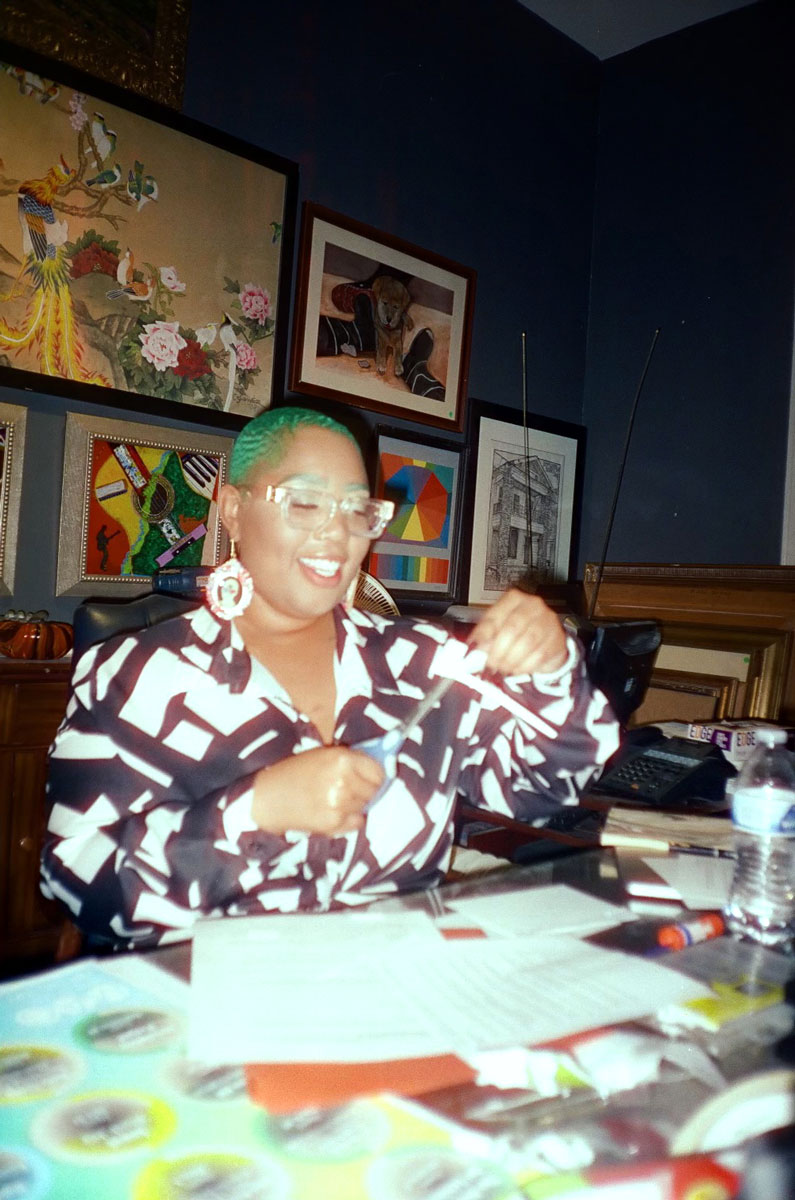
Jasmine Williams sitting at a cluttered desk, cutting something with scissors
While living in Austin, Texas, Jasmine Williams began to learn more about her home state of Mississippi and her family lineage, which inspired her to create ’SippTalk, an online forum that highlights Mississippi culture and creatives through various multimedia forms. Photo courtesy DeJarius Evans

A few weeks following her return to Mississippi, Williams met artist Nick Cave. After telling him how much she enjoyed his work, he hired her to organize a call-and-response to his “Beyond the Cave” exhibit at the Mississippi Museum of Art in downtown Jackson.

The event brought together more than 42 local creators from Jackson and across the state who created responses to Cave’s work through visual art, music, photography, dance and other forms of creative expression. Williams curated the event with friends Meredith Williams, Miranda Hicks and Charity Hicks, also known as rapper Vitamin Cea.

“We didn’t really know the journey that we were embarking on or like what we were really building, but we trusted the people that were around us,” Williams said. “To see the reactions from kids to elders who felt seen, felt special and were excited, that really did it for me. I knew that I wanted to continue to create safe spaces for Black folks to feel seen, regardless of what that looks like.”

This event helped her build a relationship with the art museum and ultimately acquire a position as associate curator of public programs and community engagement. In this role, she has organized events such as “Art and Voice as Healing,” Museum After Hours with The Mashup, the Food Truck Festival with Magnolia Market, and Art Night.

“I never saw myself working in a museum because I love the grassroots aspect; I love being able to create something that’s fresh and new,” Williams said. “I felt like it had to happen outside the walls of an institution, and I felt like I would have to sacrifice my creativity in order to fit into an institution. I think building that relationship did help them to think more about what community and including people really looks like.”

The associate curator said that transitioning into having an institutional mindset has been a challenge but that her experience has come with its own set of advantages like stability, resources and a set location and space that is always present for people to connect to.

The Columbus, Miss., native said she loves that people can see reflections of themselves and can affirm that they belong through the programs and events she organizes. The more opportunities she finds to provide people with a sense of community, the more she feels inspired to keep creating.

“There’s a narrative about Jackson not being safe … so having these programs and they happen safely, people are enjoying themselves, (and) we get to a real representation of what Jackson looks like,” the curator said.

Jasmine Williams headshot, seen with green hair and clear glasses
Jasmine Williams is a creative producer, which encompasses not only writing, film and storytelling, but also captures the experiences of southern Black folks. Photo courtesy Justin Hardiman

Williams also serves as an artist-in-residence for the Mississippi Museum of Art. On Saturday, June 3, from 1 p.m. to 3 p.m., she and Sarah Jené will be on-site to premiere their outdoor installation “How We Get Over: We Grow On” in the Art Garden. The project, which will be open to the public during the museum’s hours of operation until Sept. 3, 2023, is an exploration of Black grief and Black southern traditions around grief.

Jené curated an opening ceremony that pays homage to the Black church and the tradition of testifying.

“We both lost family members to COVID, and it was just bringing up a lot of emotions that were bigger than just losing someone,” Williams said. “We were trying to create a space that just holds space for folks to deal with the plethora of what grief is, expanding on what we think about grief, and even talking more about what perpetual grief looks like and why Black folks experience grief differently.”

In the future, Williams wants to organize an arts and music festival and find opportunities for creatives to learn more about what it means to sustain oneself through art. Jackson’s creative ecosystem has always been there with artists doing the work to keep it going, the curator explained, emphasizing that the main thing that is still largely missing in her view are the eyes and resources to take it to the next level.

“Everybody is creating their own universe and doing things to push themselves forward,” she said. “We are going to look up (one day), and we are going to be at the place that we dreamed about because we’ve just been doing the work and people feel motivated.”

“How We Get Over: We Grow On” premieres outside the Mississippi Museum of Art (380 S. Lamar St., Jackson) on Saturday, June 3, 2023, with a launch event from the participating artists taking place from 1 p.m. to 3 p.m. The installation will remain on display until Sept. 3, 2023. For more information on the art museum, visit msmuseumart.org

Marketing, Not The City, Is Saving Architecturally Significant Homes

Marketing, Not The City, Is Saving Architecturally Significant Homes

If renowned modernist painter Gordon Smith hadn’t lived to 101 years of age, it’s highly probable that his Arthur Erickson designed house — probably the most famous Erickson residence in the country — wouldn’t have survived.

The small house, built in 1964, with extensive glazing and cantilevered beams, sits nestled within a forest setting near the ocean in West Vancouver, on a lot worth millions. Considering the land value, a lot of buyers would have knocked the house down, cleared the trees and built a mansion. But Smith, who commissioned Erickson to build the house for him and his artist wife Marion, who died in 2009, lived in the house until his death in 2020. The couple didn’t have children, and Smith wisely left the house in the hands of Equinox Galleries owner Andy Sylvester and curator Daina Augaitis, who’ve spent the last two years restoring it.

As a fundraising drive for the Arthur Erickson Foundation, they are showing off the results with group tours on June 24. It is the first public viewing of the famous modernist house, which includes a new display of contemporary art on the walls (Smith donated much of his own stellar collection when he was alive). The $500 ticket also includes an optional tour of artist-writer Douglas Coupland’s house nearby, hosted by Coupland himself. (Coupland was a dear friend of Smith’s). 

Architecturally Significant Homes
Gordon Smith’s 1964-built house. (Arthur Erickson Foundation)

And tickets are being snapped up — which tells you something about the level of interest in Erickson’s work. It tells you something else, too, says heritage expert and consultant Don Luxton

“It tells you something about marketing,” he says. “The Smith House is the greatest house that Erickson did, arguably, and the fact it’s preserved is a triumph. You never keep everything, but it shows that it’s possible to find the right owners for these buildings. And that that house had an audience.”

Not all midcentury modern houses are so lucky. Back in the 1950s and 1960s architects who favoured modern designs had free rein on Vancouver’s North Shore, particularly in West Vancouver, with its ocean views and rugged forested slopes. Land was relatively cheap and the geography a welcome challenge to the new generation of designers who were keen on integrating the lush surroundings. They built a lot of modern houses with a particular West Coast style. 

But with land now at a premium, and real estate investment a key market driver, it’s difficult to justify a small house on a large lot, says Luxton. That makes marketing of the houses key to their survival — especially without crucial government policies in place to save them, including incentives, such as tax breaks for those owners that do preserve them, he says.

“Nobody is trying to help these [home owners], so the fact that any of these buildings survive is remarkable,” he says. “The hope for them is you’ve got to increase the value of the building in terms of how you market them, and you have to make it a prestige thing. That works in other jurisdictions, in Palm Springs especially. People are mad to buy these midcentury modern houses, especially if a star lived there. But it’s a different market in Palm Springs.

“So there is a lot that’s working against the buildings in Vancouver, and mainly it’s just sheer land value.”

The latest Real Estate Board of Greater Vancouver statistics show that despite interest rates doubling, home prices have increased about 5% year to date. Near record-low inventory has created a competitive price environment despite the increased cost of borrowing, according to the board. Buyers are looking, which puts pressure on vulnerable West Coast Modern homes that are relatively small in relation to their lot size. 

Architecturally Significant Homes
5791 Telegraph Trail (LeHomes Realty Premier)

That’s the problem for the house designed and lived in by architect Robert Hassell, at 5791 Telegraph Trail, in West Vancouver, which is listed for $1.99M. The tall cedar-clad structure called Hassell House is being marketed as a teardown with no regard for its provenance. On the other hand, there is also the Bowker House, a Fred Hollingsworth and Barry Downs collaboration that is on the market for the first time in more than 50 years that is being marketed for its midcentury prestige and splendor, with 20-foot-high cathedral ceilings, exposed wood expanse and considerable glazing and views of Howe Sound. The 2,794-sq.-ft house, built on a large lot at 6850 Hycroft Rd. in West Vancouver, is listed for $3.198M.

Luxton says it’s difficult to tell what percentage of the houses have been lost and how many have been saved because so many are undocumented. 

The Bowker House (Royal LePage Sussex)

West Vancouver has identified 124 houses built between 1945 and 1975 as having architectural importance. Only six are municipally designated heritage buildings from that time period. But their preservation depends on the property owners who appreciate them, and little else. 

Maintenance of the homes is up to the owner, and if a house falls into disrepair there’s little that can protect it, says Luxton. 

 “It’s hard to say what percentage are disappearing but certainly there is an erosion of the building stock, and except for some prominent buildings, not everything is going to be saved. 

“At least [realtor] Trent Rodney and some others are trying to market these things. At least there is more awareness.”

Rodney made a splash last summer when his firm sold a 2,434-sq.-ft Erickson house on Eagleridge Drive, known by architects as Catton House and re-named Starship House by Rodney because of its angular shape. That house sold for $4.3M and made it clear that West Coast Modern houses have an audience that is willing to shell out. Critics complained about the re-naming of significant homes for marketing purposes, but Luxton says the names don’t matter as much as the fact that the houses are surviving.

Architecturally Significant Homes
Catton House, AKA Starship House (West Coast Modern)

Rodney is currently marketing another Erickson house, this one in the seven-acre Monteverdi Estates that Erickson designed beginning in 1979. The community consists of 20 homes, most of them on a hillside, with landscaping by legendary landscape architect Cornelia Oberlander. But house No. 8 is on a flat lot, and it’s the first time it’s been on the market in a decade, according to Rodney.  

“A lot of people think it is a strata community because of the extra community space, but it’s not,” says Rodney. 

Not one house in Montiverdi Estates has been torn down. And Rodney — who has carved out a successful niche selling the general West Coast Modern style — says he hasn’t sold a house that got demolished yet. Instead, he has buyers, mostly creative types, patiently waiting for exceptional examples of midcentury or West Coast Modern houses to come up for sale. His strategy is that he prices the houses for their value, not just the cost of the land. 

“The reason we haven’t had one demolition is we charge a premium for the architecture as a work of art. So when we market a piece of architecture, people understand there is a premium attached to the building and the architectural significance there.”

Luxton took the same approach years ago as founding director of Heritage Vancouver. By telling the story behind a house, he says they gave the building cachet. Suddenly people would want to own a home by Samuel Maclure, a West Coast architect from a much earlier period. 

Again, it comes back to the marketing. 

“You have to see them as having a pedigree, like collecting fine old cars,” says Luxton. “It’s a prestige thing. Erickson houses are being bought by people who treasure them. They have real value to people. But those are the exceptions.

“Your average run-of-the-mill midcentury modern building might not hit that level.”

As the market heats up, those houses will just become demo bait.