
Some think the truly tasteless artwork attached to the prow of the yacht is an ode to Bezos’s new fiancée, Lauren Sánchez.
What’s That Grotesque Sculpture on Jeff Bezos’s Megayacht?


The World Health Organization (WHO) is delighted to announce the appointment of internationally acclaimed artists Renée Fleming and Pretty Yende as Goodwill Ambassadors for Arts and Health. This prestigious announcement was made as part of WHO’s 75th Anniversary commemoration during the 76th World Health Assembly on 22 May 2023.
Renée Fleming, one of the most celebrated singers of our time, and Pretty Yende, an extraordinary soprano known for her dazzling performances, have been selected for their artistic achievement and advocacy for improved health outcomes through creative means. On 8 April 2023, Fleming and Yende performed for a special concert titled Healing Arts, dedicated to WHO’s 75th anniversary in Geneva, Switzerland.
Dr Tedros Adhanom Ghebreyesus, WHO Director-General, said, “WHO is honoured to have Renée Fleming and Pretty Yende join as Goodwill Ambassadors for Arts and Health. Their unparalleled talent, dedication to the arts, and commitment to advancing health and well-being make them ideal ambassadors for this important cause. Their involvement will inspire individuals, communities and policy-makers to recognize and harness the transformative power of the arts in the pursuit of better health for all.”
Fleming brings a wealth of expertise to her new role. She has captivated audiences worldwide with her luminous soprano voice and compelling artistry. Beyond her remarkable vocal talent, Fleming has been a fervent advocate for research at the intersection of the arts and health. Her presentations worldwide with scientists and practitioners, her leading role in major initiatives, and her association with WHO demonstrate her commitment to harnessing the transformative power of the arts to better society.
“I am elated that the preeminent global health agency is recognizing the powerful impact of the arts in health, and I am deeply honoured to be entrusted to share this message,” said Fleming. “Every day, advances in neuroscience and clinical research reveal more about the benefits of arts therapies, experiences, and education, with implications for well-being throughout the human life span. However, we have only just begun to realize the amazing potential of this work, and I look forward to expanding awareness and access as a WHO Goodwill Ambassador.”
Pretty Yende has mesmerized audiences with her exquisite voice and stunning performances. As a soprano with a deep understanding of the power of music, she has demonstrated her commitment to using her talent to improve society. Yende’s passion for sharing the healing aspects of music and her dedication to social causes align perfectly with WHO’s Arts and Health agenda.
Yende said, “I am delighted to be appointed a WHO Goodwill Ambassador for Arts and Health. I hope to help establish a foundation for continued investigation into the arts being a fundamental ingredient in improving our physical, mental, and social well-being. I am grateful to WHO for paving the way for new research and providing their global platform to spread the word and generate research on the connection of arts and health.”
I look forward to all the possibilities to do essential work in my native South Africa and globally for a better and healthier tomorrow,” added Yende.
The appointments of Fleming and Yende underscore the profound link between arts and health. Engagement in creative activities, such as music, art, and dance, positively impacts physical, mental health, social well-being, and overall quality of life. Through their roles as Goodwill Ambassadors, Fleming and Yende will promote the integration of arts into health-care systems, advocate for access to creative arts therapies, and champion the importance of artistic expression in improving health outcomes globally.
Fleming and Yende join other distinguished WHO Goodwill Ambassadors such as Alisson and Natalia Becker, Brazilian professional footballer and his physician wife; Ivorian retired professional footballer Didier Drogba; Michael Bloomberg, entrepreneur and three-term Mayor of the City of New York; Cynthia Germanotta, President of Born This Way Foundation; former UK Prime Minister Gordon Brown; and broadcaster and writer James Chau, among others.

When I started out in photography, I started learning on film. While it was very much in the digital era, I still shot film. The reason being it was what was available to me at the time, and buying film stock was not as expensive as it is now. Shooting on film has taught me a ton and has helped me be a better digital photographer. Here is why beginners should consider film photography as their first step in the journey.
We are living in the postmodern digital era where AI is the new frontier of image-making, and everyone carries a camera in their pocket. Why would anyone want to shoot film in this modern environment? After all, the stereotype now is that film is mostly for the millennial hipsters who shoot whacky still-life images and street portraits. At the same time, film can be a great tool for many photographers, especially beginners, as it allows you to slow down, focus on getting it right in-camera, and, lastly, forget about postproduction. Below are these and more reasons explaining why film photography is a great way to start.
The greatest thing about film photography for me is that it allows you to focus on balancing the number of frames you take per scene. There is only a limited number of pictures you can take, which means that every shot has to count. It is very easy to just spray and pray with a digital workflow, which can be detrimental to our creativity. Each picture on a film camera is a carefully considered decision. When shooting film, you are forced to slow down, observe what’s around you, and ultimately, think about the reason you’re taking this picture. All of this results in you being more attentive to the environment around you and more sensitive to mistakes. The outcome of this sensitivity is that you are able to take better images on a digital camera and miss fewer shots.
Another thing that film helped me nurture is a sense of anticipation and excitement. Waiting for the lab to develop my rolls was the most exciting feeling in the whole process as you can only guess how the images will turn out. The developing process itself can be full of unexpected results and surprises, both bad and good. All this creates a very unique result in the end, which would be quite hard to think of and achieve in post-production. This teaches beginner photographers that happy accidents are something to be excited about and not upset about. Anticipation and delayed gratification are something that is missing from the modern photography environment. This showed me that photography is about the journey and not necessarily about the result at the end.
If you want the full film experience, get a camera from the 70s without a built-in meter. This would not be my recommendation, but you can go for this option if so inclined. My first camera was a Canon EOS 300, which had a meter built-in, and the film would rewind automatically. This made the process easier while also keeping it pure. I could learn to expose with the meter suggestion, shoot both in auto and manual mode and learn how to work a professional camera. The important thing was to make sure to get it right, which was hard without immediate feedback. The only thing that kept me in check was the meter. I quickly learned to meter by eye, and now I can easily walk into a room and say exactly what settings I need to expose a picture. Another important factor is that if you mess up exposure, you don’t have as much room to play with unless you know how to push and pull film stocks. It’s a whole art, and it really is not for beginners.
Additionally, the absence of post-production makes the process a lot easier than the digital one. When starting out, there is a lot to learn, and arguably the most important thing to learn is how to use a camera, and now how to retouch pictures in Photoshop. Each film stock has a distinct look that helps create that authentic film color grade. This makes the picture ready as soon as the film is developed. Film stocks are hard to replicate on a digital camera, so why try to fake it when you can make it? My favorite film stocks are the classic Kodak Portra 400. It is ISO 400, which lets you shoot in lower light conditions while producing very muted and smooth tones that complement portraits very well. Another one I like a lot is Kodak Tmax 100. This is a black-and-white film that is great for capturing contrast and rich black-and-white scenes. If I were to go back to shooting film, these are the stocks that I would mostly use.
Film is tangible; you can literally pick up your pictures and see them come alive in real life. The sensation of making film prints the authentic way is hard to compare to anything else. The physical nature of film—loading, winding, hearing the shutter, advancing, and developing—all add up to give a more pure experience. This is an experience that you must have when becoming a photographer to understand the value behind your work. It is easy to simply shoot a bunch of digitals without thinking too much. The experience is more authentic on film, which makes it that much better. Having to slow down and think about each frame makes photography intentional and pure. I had a similar experience only when shooting on medium-format cameras. Being forced to slow down made me create better images. Now I try to create such things with a digital full-frame system.
As for suggestions for film cameras, I would recommend anything from the 90s that has a built-in meter. For example, the Canon EOS 300 is a great, cheap way to get into photography, and you can add any EF lenses to this camera, making it a great future-proof investment. Such a camera often costs anywhere between $20 and $50 and sometimes even comes with a kit lens. It’s a rubbish lens, but it will take pictures.


The Forge Project, a regional Native-led organization focused on decolonial education and Indigenous art, recently announced the winners of its 2023 Forge Fellowship. WAMC’s Capital Region Bureau Chief Dave Lucas spoke with two of six winners.
Brent Michael Davids is a member of the Stockbridge Munsee Community. He’s a flutist, composer, and designer of musical instruments, who for five decades has written and performed different varieties of music of nearly every genre.
“Orchestral, concert band, theater, ballet, jazz, folk music, American Indian music, modern dance, films and film scoring. And TV and radio,” said Davids.
Davids, who founded a recording studio on the Stockbridge-Munsee Reservation in Wisconsin, says he is happy to have connected with the Forge Project.
“One obvious connection for me is in the arts, you know, for music and working on music,” Davids said. “The other is that the Forge is located in my tribal homelands, our territory.”
The Forge Project started in 2021 in the Hudson Valley. The group’s executive director Candice Hopkins spoke with WAMC in October 2022, outlining its goals.
“We’re a Native women-led organization that focuses on fellowships for Native cultural workers in the United States and Canada, working on things like decolonial governance, or even experimental music, seed savings, for example. And we host six fellows a year, at the residences at Forge. We do programs in decolonial education and Indigenous-led education. And we have founded a journal as well called Forging. And so we’re working in publication, too. Forge was created, not only because in this area, in the Mahicanituck Valley, another word for the Hudson Valley, there’s a great absence of Native folks, because a lot of people were displaced, and they were displaced to even as far away as Wisconsin. The Stockbridge-Munsee Community, for example. And so with Forge what we’re dedicated to is increasing Indigenous presence in this area,” said Hopkins.
Dr. Suzanne Kite is a visual artist and composer, one of the first American Indian artists to utilize artificial intelligence and machine learning in art practice.
“I moved to Ancram in January of this year,” Kite said. “And I moved there, basically, to be closer to this booming indigenous art world that is kind of rooted in the work of the Forge Project. And so also I could teach at Bard College, and I think my work is very much indebted to the artists who have come before me and really pushed boundaries. So I’m able to make experimental sound work, video work and artificial intelligence work, because of all the amazing people that are in collections, like the Forge collection.”
Kite sees her art as a reflection of the philosophy and spirit of the Lakota people. She praises Forge and hopes it will encourage other collections throughout New York state to attract contemporary indigenous work.
“Currently I’m making a lot of embroidery work,” said Kite. “And so usually it’s on large deer hides that are dyed black, and I use silver embroidery thread and beads. And I also work with conductive thread, and I embroider different designs in the Lakota visual language, because I’m Oglála Lakȟóta. And I try to make designs that I’ve had dreams about trying to combine like hand beadwork and machine learning experiments and digital embroidery.”
Davids says the Forge Project giving direct support to artists is a move in the right direction.
“In this day, and age artists, you know, working artists who are, you know, working on commission are working project by project by project, we’re constantly searching for money,” said Davids. And we spend a lot of time jumping through hoops and writing big research papers and things when we should be working on our art and working on projects. So we live dual lives, we spend our times as administrators searching for funding, funding agents, looking for funds, and then at the same time trying to do our work as well. And we’ve kind of split our lives in half.”
Each Forge Project Fellow receives a $25,000 grant toward their practice. They also have full access to the Forge Project site, libraries, and collection of contemporary art by Indigenous artists during three-week rotating fellowships on-site at Forge. There’s more about Forge and the six fellows here.


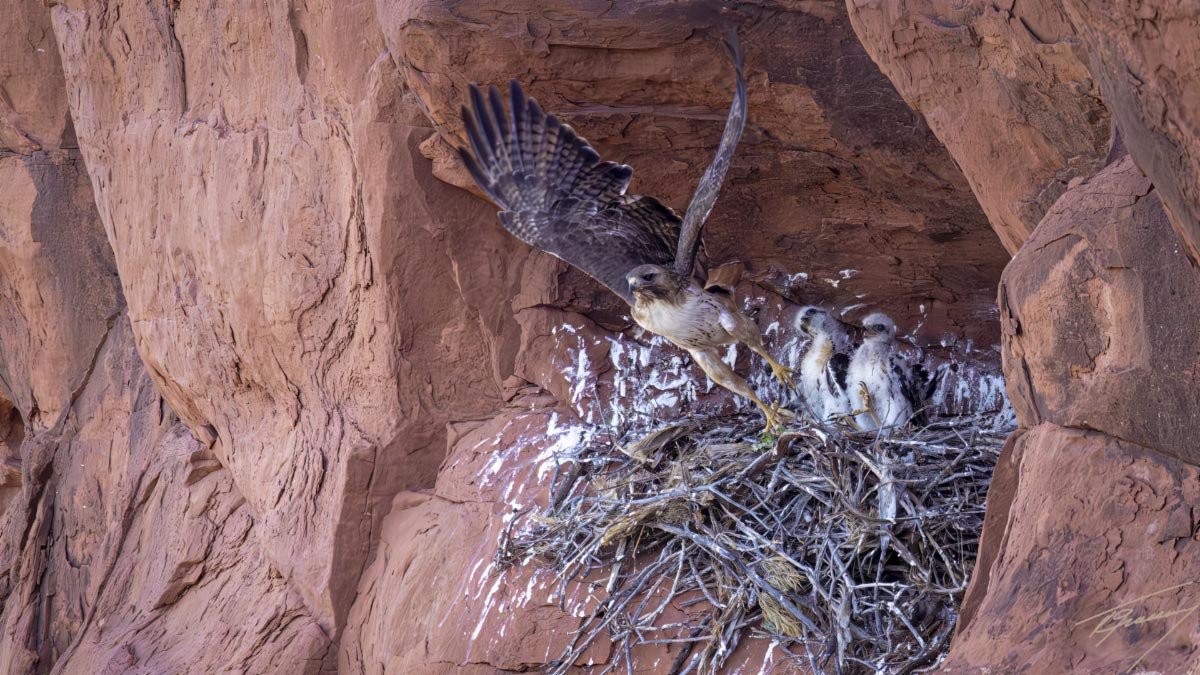
… I spent a couple of hours early this morning (yesterday) and like last week I was in the open gondola about 150′ above ground. The nest is about 400 to 500 feet to the NNW down the cliff face from me and the perch rock is about 150 feet from me in the opposite direction. I’ll send a couple of photos tomorrow to give you context for where I am … I was shooting with a Canon R5 and the 100-500mm lens with the 1.4 extender on it giving me a 700mm lens.
The first shot above is one of the adult Red Tail Hawks just after he nailed a lizard on a cliff top about 600 feet from me … the shot just below that he has taken to flight and bringing the tasty morsel back to the nest to feed the chicks; technically they are called “eyass” until they “fledge” which means taking their first flight and thereafter they are called “juveniles” and will hang around the nest for a couple of weeks or so and after that, they are out there on their own.


The first photo below shows the adult and the three chicks in the nest after breakfast was brought in and the chick on the far right has the lizard and is in the process of downing it and the photo below it shows the adult on the way out of the nest to continue the quest for more food to feed the kids … they need a lot of food at this stage and both adults provide it!



Have a beautiful day … keep breathing and flash a smile whenever you get the chance … you might make someone’s day!
Cheers,
Ted
I ask no odds of any man,
I am not one that follies sway.
I am the source of my rewards,
I do my work each day.
The fruit of trees, the grain of fields,
Wherever use and beauty lurk—
The good of all the world belongs
To him who does his work.

It matters not if rich or poor.
This is the future’s great command,
Who does not work shall cease to eat;
Upon this rock I stand.
Though work bring naught of power
nor wealth
Spare me from want of common needs,
And give a share of manly health,
A few good friends of honest deeds;
And till death’s peaceful slumber nears
A life of undishonored years.
Work by Max Ehrmann
###
 The easiest way to reach Mr. Grussing is by email: ted@tedgrussing.com
In addition to sales of photographs already taken Ted does special shoots for patrons on request and also does air-to-air photography for those who want photographs of their airplanes in flight. All special photographic sessions are billed on an hourly basis.
Ted also does one-on-one workshops for those interested in learning the techniques he uses. By special arrangement Ted will do one-on-one aerial photography workshops which will include actual photo sessions in the air.
More about Ted Grussing …


Bowling Green native and internationally-acclaimed sculptor Russ Faxon has been commissioned for an art project at the Southern Kentucky Performing Arts Center.
The new work will be located at Burr Plaza, a public common area in front of SKyPAC.
Folllowing a news conference on Tuesday, Faxon declined to give details about the sculpture, other than it will be figurative.
“I’ll just say it’s full of energy and movement,” Faxon told WKU Public Radio. “Everybody will have a different impression of what that story is, what it means to them. Art means different things to different people.”
Faxon is a graduate of Western Kentucky University who also studied art in Italy.
He’s best known for creating Tennessee’s Korean War Memorial and sculptures of Roy Acuff and Minnie Pearl at the historic Ryman Auditorium in Nashville.
At WKU, Faxon created campus statues of Coach E.A. Diddle, as well as Sergeant First Class Robert Guthrie, who died fighting in the Korean War. The art outside SkyPAC, which is about year-and-a-half away from unveiling, will be free for public viewing.
“So many more people are able to appreciate it and be inspired by it,” Faxon said. “We’re affecting other people’s lives by the stories we wind up telling, and we have to continue to grow as people, and the way we do that is through thinking, creative thinking.”
The SKyPAC sculpture is being funded through a $100,000 gift from local businessman Joe Davis, the current chair of Arts of Southern Kentucky. It’s the first project to come from the group’s Public Art Committee. That group’s goal is to tap regional artists to provide free exposure to the arts.





