About

Posts by :

Tucson International Airport amplifies indigenous voices with gallery dedicated to native artists

Tucson International Airport amplifies indigenous voices with gallery dedicated to native artists

TUCSON, Ariz. (13 News) – The Tucson Airport Authority (TAA) welcomed Pascua Yaqui representatives and members of the Tohono O’odham’s San Xavier District to Tucson International Airport (TUS) to amplify indigenous voices through dedicated art exhibitions in the terminal’s International Arrivals Gallery. The artwork was installed before the inaugural air service between TUS and five Canadian airports.

The International Arrivals Gallery provides a first impression for travelers who have been cleared by U.S. Customs and Border Protection in the terminal’s Federal Inspection Services (FIS) facility. The gallery is located pre-security, near the Concourse A exit, so all visitors are welcome to enjoy the space.

TAA Board Chair Keri Silvyn joined Bewley in making remarks to those in attendance on Thursday, May 18. Both Pascua Yaqui and Tohono O’odham representatives shared a blessing in the gallery as well.

“As you look around this gallery, you see the exceptional work of many indigenous artists,” said TAA President and CEO Danette Bewley. “It is important to us that this airport provide a sense of place to everyone who comes through the terminal, including these artists. We want travelers to feel like they are in Southern Arizona, and we want locals to feel like they are home.”

Many of the paintings featuring Tohono O’odham artists represent the annual baihidaj or saguaro fruit harvest. The Hasan, or saguaro, is revered and used to produce a ceremonial wine that is used during an annual rain ceremony.

The ceremony celebrates the start of the summer rainy season, which signifies a new year for the Tohono O’odham. Pottery depicts Kehina social dances, and maze designs illustrate challenges overcome and returning home to the Creator.

“Our Wak Community (San Xavier District of the Tohono O’odham Nation) is honored to have these items on display for passengers to view as the arrive in our homeland Tohono O’odham Jewed (Desert People’s Land),” said San Xavier District Chairman Austin Nunez.

While the art has been on display for months, the May 18 event was the first time that everyone involved in the gallery’s development had been in the space together.

Be sure to subscribe to the 13 News YouTube channel: www.youtube.com/@13newskold

Two local artists to be featured at upcoming HeART of Marshall art event

Two local artists to be featured at upcoming HeART of Marshall art event
image

The Starr Family Home State historical site will once again host the HeART of Marshall art exhibit event this Saturday, featuring a wide range of art from local artists of all ages, including two featured artists.

Mileah Lorenz and Patty Lovelace will have a joint art display during the event in the Blake House, where the building will be broken into four sections with art representing the four seasons on display in each room.

Rachel Driskill with the Starr Home organized the event, stating that she was thrilled to bring Lorenz and Lovelace together for the show.

“They use multiple mediums to create their one-of-a-kind works of art, bringing their unique perspectives to life through stunning pieces that will mesmerize you with their use of color, texture and depth,” Driskill said.

Both Lorenz and Lovelace credited Driskill with bringing the two together, and creating and organizing the art work and the entire event.

“Rachel truly has an eye for it, she is so talented, she see’s all of the little details and really brings everything together,” Lovelace said.

Driskill said that along with Lovelace and Lorenz’s display in the Blake House, the exhibit will also feature a range of work from other artists in the area.

She said that historical art and photography by local artist Barbara Tyler will be displayed in the Maplecroft mansion itself, along with work from Trinity Episcopal School students, which will be displayed on the North Lawn.

“In addition to showcasing the incredible talent of East artists, the HeART of Marshall art exhibit at Starr Family Home State Historic Site will also feature a unique and personal aspect — art of family history,” Driskill said, “Using multiple mediums, and stunning artifacts, the Starr Family Home paints narrative art that tell the stories of their own families and ancestors. These pieces are both visually stunning and emotionally powerful, offering a glimpse into the lives and histories of the people who have shaped our community.”

Featured Artists

One of the motivations for bringing the two artists Lovelace and Lorenz together for the featured art showcase this weekend was how their art and experience compare and contract with each other, according to Driskill.

Lorenz is a self taught artist who began sketching for her job in marketing about a year ago. She said that a request to draw a portrait for a client lead her to trying more and more complicated sketches until she reached her hyper realistic style of art on display this weekend.

“I just wanted to try to do different types of drawings, and I really feel satisfied when I am able to get a sketch to look so realistic people are unsure if it’s a photo or not,” Lorenz said.

Lovelace began her artistic journey six years ago, taking every opportunity in that time to learn more about different artistic mediums and honing her skills.

“When I first got back into painting I went all in, I attended every art class I could, every work shop, and I joined every group I could,” Lovelace said.

This is Lorenz’s first time having her artwork on display in a showcase, with Lovelace working in a number of arts organizations across the Marshall and Harrison County areas for the last few years and participating in a number of shows.

“She is almost exactly where I was just a few years ago, so it’s great to see her grow and to get to see all of the things that she (Lorenz) is going to accomplish,” Lovelace said.

The two also work in very different mediums, with Lovelace’s work focused on pastels and oil paint, with some work also done in water colors and mixed medium combining the three. In contrast, Lorenz does a lot of work with pencil and colored pencil sketching, while also working in embroidery and graphite.

The event is planned for Saturday, from 4 to 7 p.m. at the Starr Family Home state historical site. The event is free and open to the public to attend.

“This is a can’t-miss event for anyone who appreciates creativity, culture, and the rich history of our community,” Driskill said, “Come experience the HeART of Marshall and the artists who have brought their unique perspectives to life through their work, both as a celebration of their talent and a tribute to the enduring legacy of East Texas.”

Conference looks at how Florida public art connects communities

Conference looks at how Florida public art connects communities

On May 11th, people from around the state convened in Orlando for the 25th annual conference of the Florida Association of Public Art Professionals. Formed in 1998, this organization, which goes by the acronym FAPAP, has been working to elevate the character and quality of public art in cities, towns and communities across Florida. FAPAP President Oaklianna Caraballo explains.

“The FAPAP organization is a wonderful resource for public art administrators, for public artists, for periphery fields – our conservators, our fabricators, our elected officials. In part, our mission is education. So we come together in our annual conference. We share ideas. We help each other. We have the same concerns, the same values, we’re doing the same jobs, but our colleagues happen to be a city over, a town over, a county over. So coming together to really elevate the quality of art and administration is really important.”

In 2001, host city Orlando did not even have a public art program. Today it’s a model that other cities aspire to emulate. According to Orange County Arts & Cultural Affairs Administrator Terry Olson, FAPAP played an instrumental role in giving him the tools he needed to build his program from scratch.

“When I started my position in 2001 with Orange County Arts & Cultural Affairs – I was hired to create that office – I didn’t know that much about public art,” Terry recounts. “So the first thing I wanted to do was go to the statewide association conference, where I met other people. I could ask questions. I learned a lot. And that helped me shape our program, which was just being developed, since it hadn’t existed before, into one that used best practices as opposed to whatever process we could figure out.”

While many locals take the sculptures and murals they see for granted, public artworks are typically the first thing that travelers, notice when they arrive in airports or at downtown destinations. It is no coincidence that the biggest and most impressive public art collections in Florida are maintained by tourist meccas like Miami, Jacksonville, Tampa-St. Pete and Orlando. That realization motivates Executive Director of the Florida Keys Council of the Arts Elizabeth Young in her tenacious effort to build her program into a statewide leader.

“Now that I’ve been coming to conferences for 15 years and working with my other colleagues from around the state, I look at public art differently no matter where I am in the United States or out of the country,” says Liz. “In Florida I think about our public art projects that are seen by people from all over the world because so many people visit Florida.”

thumbnail_Chloe the Flamingo at Tampa International.jpg

Submitted

/

Special to WGCU

Just as “The Bean” has become synonymous with Chicago, many tourists associate Tampa with “Chloe,” the 21-foot flamingo sculpture at Tampa International Airport (shown above) and Miami with Michele Oka Doner’s mile-and-a-quarter long bronze and terrazzo concourse, A Walk on the Beach, at Miami International Airport. But residents have also come to adopt the artwork in their communities as their brand, such as John Henry’s sculptural installation, Alachua, on the campus of the University of Florida. When it was installed, that piece was actually ridiculed by students and faculty alike. Today it is revered.

Just as “The Bean” has become synonymous with Chicago, many tourists associate Tampa with the 21-foot flamingo sculpture at Tampa International Airport and Miami with Michele Oka Doner’s mile-and-a-quarter long bronze and terrazzo concourse, A Walk on the Beach, at Miami International Airport.

But residents have also come to adopt the artwork in their communities as their brand, such as John Henry’s sculptural installation, Alachua, on the campus of the University of Florida. When it was installed, that piece was actually ridiculed by students and faculty alike. Today it is revered, as FAPAP President Oaklianna Caraballo notes.

“It really is iconic. It’s a symbol of our university. It shows up on websites, in fliers, and it really is beloved by the community now despite its rocky beginnings.”

Going forward, expect to see larger and more whimsical pieces. According to a survey taken by FAPAP, that’s what the general public tends to favor most.

Second, expect to find more art in local neighborhoods and communities. Here’s Liz Young with the rationale:

“I think the trend is accessibility and I think the trend is diversity in our art world, and that we are moving more into communities than we ever have. That art is, like we heard actually today, one of our speakers talked about museums without walls. Art is not just for someone who can pay the entrance fee and go into a museum and view art. Our art is on our streets and in our squares and in our parks and in our government buildings more and more.”

Finally, expect to see much more technology built into public art in the future. Oaklianna Caraballo makes this observation:

“It’s an exciting moment when we see technologies really delving into the digital world. It’s a way to connect with our younger generation. We learned about Web3 and NFTs and most importantly ways that institutions are incorporating these new technologies into art.”

A Walk on the Beach by Michele Oka Doner at Miami International Airport.jpg

Submitted

/

Special to WGCU

Just as “The Bean” has become synonymous with Chicago, many tourists associate Tampa with the 21-foot flamingo sculpture at Tampa International Airport and Miami with Michele Oka Doner’s mile-and-a-quarter long bronze and terrazzo concourse, A Walk on the Beach, (shown above) at Miami International Airport. But residents have also come to adopt the artwork in their communities as their brand, such as John Henry’s sculptural installation, Alachua, on the campus of the University of Florida. When it was installed, that piece was actually ridiculed by students and faculty alike. Today it is revered.

Whatever its size, color, shape or location, public art is most about improving our overall enjoyment of, and connection, to our lived-in environment. On this topic, Terry Olson gets the last word:

“Public art adds quality to our lives. It gives variety, brings beauty. These are things that are necessary for the human soul.

MORE INFORMATION:

  • In addition to serving as President of the Florida Association of Public Art Professionals, Oaklianna Caraballo is the Art in State Buildings Specialist for the University of Florida in Gainesville. House in the College of Arts, the administration of the Art in State Buildings Program at UF focuses on the mission of being part of a transformative community, responding to and generating paradigmatic shifts in the arts and beyond. 
  • The public art program at the University of Florida seeks to participate in the ever-evolving field of contemporary public art discourse with a focus on advancing the field for both artists and institutions. 
  • Oaklianna Caraballo received her bachelor’s degree from Florida State University and her masters degree in Museology from the University of Florida. She has been a member of the Florida Association of Public Art Professionals since 2006 and has been a FAPAP Board member since 2009. 
  • With a background in theatre and the visual arts, Terry Olson has headed the Orange County Arts & Cultural Affairs office since 2001 and has overseen the development of its public art program. In that capacity, he has developed several audience awareness campaigns such as the “Public Art Treasure Cache” program. He created and is known as the “Chief Instigator” for FusionFest, an annual celebration of Central Florida’s many diverse global cultures. Terry brought the National Arts Program to Orange County and several venues in Florida, is one of the founders of the Orlando Theatre Project, the Dr. Phillips Center for Performing Arts, the Orlando International Fringe Festival, the Creative Gift Foundation and the Central Florida Performing Arts Alliance. 
  • Elizabeth S. Young is the Executive Director of the Florida Keys Council of the Arts and Past President of the Florida Association of Public Art Professionals. Liz has an extensive background in both the performing and visual arts. Her experience working with non-profit organizations spans program development, board relations, fund development and marketing. She earned her B.A. in Art History and Theater from Wheaton College in Norton, Massachusetts.  
  • After spending nearly a decade in New York City as a casting director for film, television and theater, Ms. Young moved to the Florida Keys in 1987. Her professional life in the Keys includes being the business manager of Island Wellness and working in all aspects of the business of the fine art and photography gallery of Alan S. Maltz. 
  • As Executive Director of the Florida Keys Council of the Arts since 2008, Liz serves all the arts, all the Keys, all the time. Recently, she was a grant panelist for the State’s Division of Cultural Affairs and the John S. and James L. Knight Foundation, presented at the City of Key West’s Ambassador and Leadership Monroe programs and for the Board of the Tourist Development Council. She has served as the Public Art Administrator of the City of Key West’s 1%-for-public-art program since 2017, and the County’s program since 2008.  
  • Liz also co-curated the Florida Keys Sculpture Trail with Susann D’Antonio on behalf of benefactors John Padget and the late Jacob Dekker. 
  • The actual name for “The Bean” in Chicago is Cloud Gate. The 100-ton sculpture’s seamless aluminum body reflects and distorts the skyline and lake in unimaginable ways.  
  • Tampa International Airport’s 21-foot floor-to-ceiling flamingo was created by public artist Matthew Mazzotta as a meeting point and photo destination for tourists and locals alike. His design was chosen from more than 700 proposals. Until just a few months ago, she had no actual name. But after 37,000 votes cast in Tampa International’s “Name the Flamingo” contest, she was named Phoebe, a contraction of the flamingo’s scientific name of Phoenicopterus Roseus.    
  • Michele Oka Doner’s A Walk on the Beach (1995, 1999) and its extension, A Walk on the Beach: Tropical Gardens (1996-2010) is composed of more than 9,000 bronzes embedded in terrazzo with mother-of-pearl. Oka Doner told attendees at the FAPAP annual conference that workers in the Philippines stripped the one ton of the mother-of-pearl she needed for the artwork from old buttons. 
  • You can view a 7-minute film about Michele Oka Donner’s 1.25 mile-long concourse at Miami International here.  
  • During the first day of the 3-day FAPAP conference, attendees viewed a survey of the most popular and best known public artworks in Florida. While no pieces from Southwest Florida were included, some of this area’s best artworks include the Jim Sanborn light sculpture known as Caloosahatchee Manuscripts that sits on the sidewalk outside the Sidney and Berne Davis Art Center, David Black’s Fire Dance in Fort Myers’ Centennial Park West, two sculptures by Rochester, New York monumental artist Albert Paley (one at the Riviera-St. Tropez Condominiums in Fort Myers and the other on the campus of Florida Gulf Coast University) and Mark Fuller’s Cambier Quilt in downtown Naples. 
  • While Orange County Arts & Cultural Affairs Director Terry Olson finds cityscapes to be all-too-often “dehumanizing,” especially when they are huge and out-of-scale, even the smallest artworks can transform such places into creative oases. That’s precisely what happened when Orange County added a sculpture garden outside the Administration Center building. “I’ll see somebody looking at a sculpture, taking a picture of it, pointing it out to their child, reading the sign, in some way stopping and engaging. Before we put sculptures on the lawn there, it was a blank space and people just walked to get to the building like zombies. The art has caused people to stop and go ‘Oh, look at that’ or ‘Hey, did you see that’ or ‘I didn’t know that’ or ‘Look there.’” 
  • Even if you’re not an art lover, public artworks engage a community, make public spaces seem more welcoming, create a deeper interaction with a place and improve the overall quality of life of both residents and workers. These are important factors to companies, talented young workers, professionals and retirees when they are looking for a place to relocate or settle. This was the conclusion of a survey conducted between 2008 and 2011 by the Knight Foundation and Gallup of 43,000 people in 26 cities about what they wanted most from their communities. To the surveyors’ surprise, the respondents stated that “the aesthetics of a place – its art, parks and green spaces” ranked higher than education, safety and the local economy as “drivers of attachment.” 

Interrelated benefits

Urban planners, economists and public art professionals have identified thirty-eight (38) interrelated benefits that are derived by the people who live, work in and visit a community from a vibrant public art program. According to these and other sources, public art: 

  • boosts/strengthens civic pride; 
  • enhances and defines a city’s identity; 
  • reflects the unique character and history of the city; 
  • burnishes the city’s image to the outside world; 
  • creates an important positive impression for visitors; 
  • encourages/increases tourism; 
  •  enables the community to attain recognition as a regional and national leader in the visual arts; 
  • symbolizes a community’s maturity; 
  • expresses the vision of community leaders; 
  • makes a statement about the community’s values and culture; 
  • elevates the image of proximately-located corporate enterprises; 
  • spurs economic development in the community; 
  • creates visual and aesthetic landmarks; 
  • creates positive mental images; 
  • imparts a more aesthetic, cohesive visual and physical appearance; 
  • enriches the public environment visually; 
  •  makes the beautification of the city a matter of the highest priority; 
  • enhances the climate for artistic creativity in the community; 
  • brings art and art education to the entire community; 
  • creates public art community partnerships linking individuals of all  races, ethnicities, age, genders, professions, and economic levels; 
  • stimulates our imagination; 
  • promotes excellence and diversity through a variety of artists and media; 
  •  provides tangible outlets for creative ingenuity; 
  • increases property values; 
  • enriches the cultural climate of the city; 
  • reflects and enhances the city’s  diversity, character and heritage through the integration of artworks and designs  in the architecture, infrastructure and landscape on public and private property; 
  • makes a space seem more welcoming; 
  • creates a deeper interaction with the place one is visiting or working in; 
  • increases awareness of how surroundings impact experience; 
  •  expresses shared ideals and concepts; 
  • enhances the quality of life for residents and property owners; 
  • adds to the visual quality of life; 
  • engages the community; 
  • draws people together and induces strangers to talk to each other; 
  • raises the level of citizen awareness to the importance of aesthetic and intellectual experiences in everyday life; 
  • promotes understanding and awareness of visual arts in the public realm; 
  •  makes a commitment to future generations; and creates “human scaling” of open areas by framing the space with various forms of public art structures. 

To read more stories about the arts in Southwest Florida visit Tom Hall’s website: SWFL Art in the News.

This photographer is sharing his passion with community through monthly night walks

This photographer is sharing his passion with community through monthly night walks

Around a dozen photographers looked through their viewfinders as the sun began to set around Norse Way on May 10. Their lenses pointed toward flowers, shops and interesting architecture along the way.

During the monthly meetup, Long Beach Night Walks, photographers ranging in experience from first-time amateurs to professionals gather in different areas of Long Beach to take photos together.

“One of my favorite things is just going out and doing something that I love, and being around people that love the same thing that I do,” said Sirley Ramirez. “It’s really exciting.” 

Sirley Ramirez lines up a shot through a window of a shop on Norse Way during a photo walk on May 10, 2023. Ramirez previously won last month’s contest for the photo walk for her photo matching the pastel theme. (Richard H. Grant | Signal Tribune)

Long Beach Night Walks is the brainchild of local photographer Travis Stock-Tucker. After living in Long Beach for 13 years, Stock-Tucker set a goal to meet other creatives while giving back to the community.

“I’ve never really connected with the other photographers and what I wanted to do,” Stock-Tucker said.

Rigel Gutierrez takes a selfie in a convexed alley mirror during a photo walk on May 10, 2023. (Richard H. Grant | Signal Tribune)

Stock-Tucker inherited his love of photography from his grandmother, who bought him his first 35mm camera when he was 7 years old, and captured the moment he unwrapped it on her own camera. 

His grandmother could always be seen on the periphery of family events clicking away on her camera. Throughout her life, she amassed a personal collection of thousands of photos.

Inspired by his grandmother’s passion, Stock-Tucker has continued taking photos and building his unique style for over 20 years, and is now sharing the art form with others. Stock-Tucker said his photos are typically darker night shots using long exposure.

Travis Stock-Tucker (hat) gives the members of his photo walk some safety tips before they navigate around the various business on Norse Way in Long Beach on May 10, 2023. (Richard H. Grant | Signal Tribune)

During the last Long Beach Night Walk on May 10, participants formed a loose circle as Stock-Tucker explained the guidelines for the evening, which included announcing the monthly theme, “service,” and instructions to respect local business owners who may not want their establishments photographed. In line with the theme, some photographers focused on tables where people could be served, with others peeking through shop windows to take photos of the services offered within.

At each Long Beach Night Walk, photographers are invited to take photos based on the theme and submit them to Stock-Tucker, and the best one is recognized. Last month, Ramirez took the best photo for the theme “pastels,” with her photo of the Aquarium of the Pacific during sunset.

Stock-Tucker said Ramirez is a new photographer using her first camera, and has become a regular fixture at Long Beach Night Walks.

9-year-old Julien Del Solar poses for a picture that his father Alex takes of him along a wall of a business on Norse Way in Long Beach on May 10, 2023. Julien recently picked up photography as a hobby and this is his first time attending a group photo walk. (Richard H. Grant | Signal Tribune)

Among the other burgeoning photographers at May’s Long Beach Night Walks was 9-year-old Julien Del Solar, who was still wearing his elementary school uniform as he walked along Norse Village Way taking photos with his father.

“For me to help somebody that’s brand new, that’s probably my favorite part,” Stock-Tucker said.

Long Beach Night Walks take place on the second Wednesday of each month from 6 p.m. to 8 p.m. To learn the location of each meet-up, visit @happilybeardedafter on Instagram.

Today’s Photo from Ted Grussing Photography: A Closer Look

Today’s Photo from Ted Grussing Photography: A Closer Look

… rummaging through folders tonight trying t find an image or two that talked to me … and finally I came up with these two. Above is beautiful piece of wood at Sunset Crater National Park. I have not been there hiking since the Museum Fire, but prior to that they boasted wonderful stands of tree trunks, standing and fallen that take on life in other forms as you look at them … and they are fun to work with.

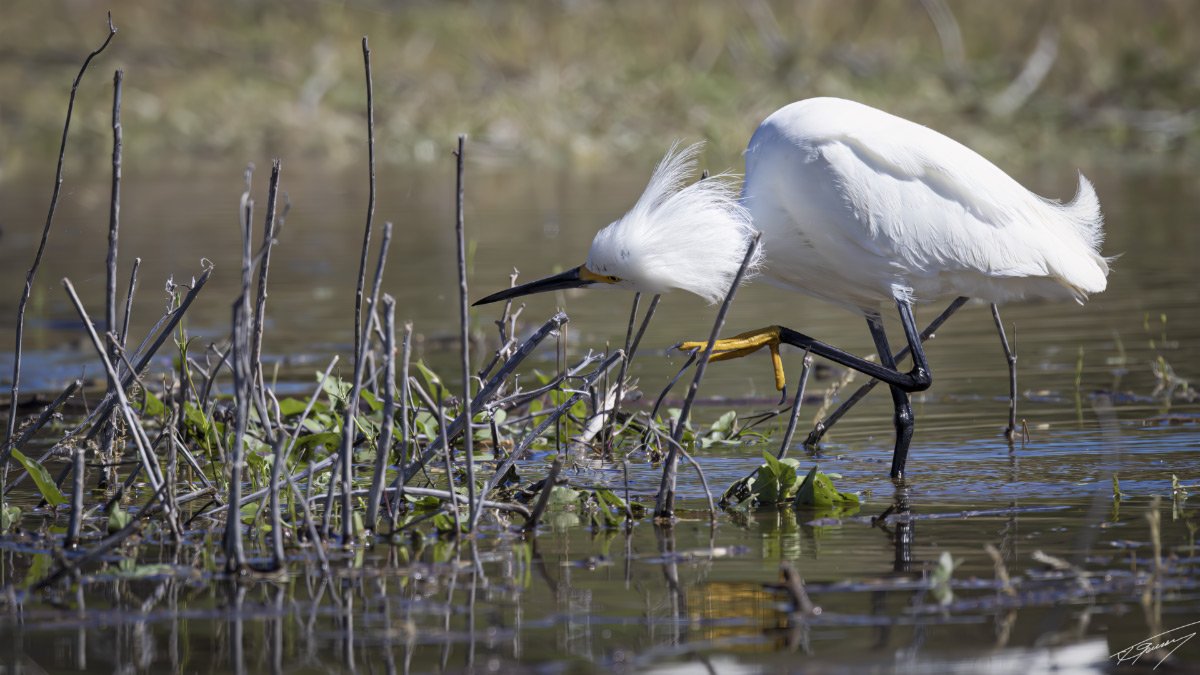
Below is a photo of a Snowy Egret taking a closer look in the shallow water … perhaps tracking a small fish preparatory to spearing it with his beak? The water level at Lake Pleasant is up another two feet since Monday … another trip soon.

Into the weekend for me … keep breathing, smiling and making it a better world to live in. Always your choice!

Cheers,

Ted

I bring but this one common thought
My life has wrought;
That from the dregs of drear despair
Still everywhere
There is a joy I yet may sip—
‘Tis comradeship
With all mankind, the high and low
I know.

excerpt from I Know by Max Ehrmann

###

photo_tedgrussingThe easiest way to reach Mr. Grussing is by email: ted@tedgrussing.com

In addition to sales of photographs already taken Ted does special shoots for patrons on request and also does air-to-air photography for those who want photographs of their airplanes in flight. All special photographic sessions are billed on an hourly basis.

Ted also does one-on-one workshops for those interested in learning the techniques he uses.  By special arrangement Ted will do one-on-one aerial photography workshops which will include actual photo sessions in the air.

More about Ted Grussing

Lifestyle Photography Tips For Capturing Authentic Images

Lifestyle Photography Tips For Capturing Authentic Images

SLR Lounge helps over 1.5 million photographers master their craft. Real world education & resources from the most successful wedding photography studios in the world.


Watch anywhere
Learn online, anywhere, anytime.


Access Tutorials & Resources
Exclusive content and more!


Submit to awards
Have your work recognized.


Join the Conversation
Ask questions, seek inspiration
and contribute to our community.

How to Take a Creative Low-light Bride Portrait

How to Take a Creative Low-light Bride Portrait

One of the hardest parts of a wedding day to take portraits is after dark. But it’s also the time of day with the most potential. 

While today’s image is part of a bridal session, this is absolutely something I do on a real wedding day. When it comes to doing these on a wedding day, what I normally do is wait for all the traditional parts of the wedding reception to be over, and I simply leave for a few songs to try to find an idea or find a place that works for an idea I might already have in mind. Then, I get everything set up as much as I can and go back to the reception to let the couple know I’m ready wherever they are. Sometimes, they are ready right that second. Other times, it takes a few songs. The idea here is to get them a super cool and epic image without them feeling like I’m pulling them away from the fun. So, it’s just a matter of waiting until they are ready to take a break from dancing.

As for the gear, for this image I’m shooting on the Sony a9 paired with my 24mm f/1.4 GM lens. For lighting, I’m using two Stella Pro Reflex S lights on top of C8 automatic light stands from Cheetah Stand. The reason I love using the Reflex S is that it is a constant light that can also act like a flash with its digital burst mode. This is really important for this image because we are actually going to be using one light in constant mode and the second light in burst mode. 

The idea here is to use a slow shutter speed in order to get some blurry motion through the frame. But with that, I don’t want the bride’s face to also be a blurry mess. So, I have one light set to burst mode with a spot optic attached in order to just light the bride’s face. Because the light is in burst mode, the quick pop of light freezes the bride’s face, even if she is moving or if the camera is moving. 

The second Reflex S is going to be set to constant mode with a medium optic attached. This optic allows me to get enough spread of light in order to cover the dress. But I still have enough control so that I’m not lighting the floor or walls or letting this light spill onto the bride’s face. And because I’m in constant mode, my camera’s sensor will gather this light for as long as the shutter is open. So, to recap, one light is a quick pop that freezes her face. The second light is constantly on, so it gets seen the entire time the shutter is open. 

From here, I have my camera set to a .6-second shutter speed, ISO 100 and f/6.3 on the aperture. The reason I’m at f/6.3 is that I want my shutter speed to be long. And even in this pretty dark room, with this low of a shutter speed, I needed f/6.3 to fully remove any ambient light. Then, I set the power of my lights to match my camera settings. From here, I asked the bride to simply wave her dress around as I took photos. This waving motion paired with the constant lights shows a blur through the frame. But the pop of light from the other reflex S freezes the bride’s face. 

And that’s it. Hopefully, you found this walkthrough useful and have a few ideas for your next session. If you have any questions, make sure to drop them in the comments. 
 

Twin Cities events: Art-A-Whirl, rooftop mini-golf and more

Twin Cities events: Art-A-Whirl, rooftop mini-golf and more

Skyline Mini Golf in 2022. Photo: Carina Lofgren/Walker Art Center

More than 1,000 artists will take over 70 Northeast Minneapolis galleries, businesses and breweries Friday-Sunday for Art-A-Whirl, the self-proclaimed largest open studio tour in the country.

  • The annual celebration of local art is free and open to the public. Visitors can explore studios, shop and meet artists, listen to live music and check out local restaurants.
  • Indeed Brewing’s music festival Whirlygig also runs all weekend, or you can watch live car crushing at 4pm Saturday at auto repair shop Turbo Tim’s.

🚋 Tip: Avoid a parking battle by taking the free Art-A-Whirl trolley, which loops through the Northeast Minneapolis Arts District every 30 minutes.

  • Metro Transit is also offering free rides all weekend.

More weekend fun:

⛳️ Putt across the Walker Art Center‘s rooftop Skyline Mini Golf course this weekend. The 10-hole, artist-designed course reopens for the season Thursday. $12

😋 Eat your way through the Asian Street Food Night Market in Maplewood on Friday and Saturday. The all-day event also features live music, local artists, a talent show and beer garden. Free entry

🧒 Minnesota Children’s Museum‘s new exhibit “Emotions at Play with Pixar’s ‘Inside Out‘” opens Saturday. Expect interactive activities that teach kids about the film’s five featured emotions: joy, sadness, anger, disgust and fear. $15+

🗣 Celebrate and learn more about Dakota culture at Dakhóta Omníčiye at Fort Snelling on Saturday, hosted by the Minnesota Historical Society.

  • The all-day event includes hands-on workshops, speakers, book readings and a community dinner. $12, free for Native community members

😱 Shop taxidermy, funeral collectibles, haunted antiques and more at the Oddities & Curiosities Expo at the Minneapolis Convention Center on Saturday. $10 advance, $15 day-of

💕 Autism, mental health and disability nonprofit Fraser has organized a sensory-friendly festival in St. Paul on Saturday with inclusive activities for those with sensory processing difficulties. Free

🧶 Stillwater Flea & Crafter Market returns for the season Saturday–Sunday with about 200 vendors at the Washington County Fairgrounds. Free entry