Half-a-Century-Old Sculpture to Make Renovated Return to Astor Place
By Admin in Photography
Invented in Europe, in 1839, photography was quickly embraced in the United States. This should come as no surprise. Photography was a democratic medium for a democratic society: accessible, unpretentious, utilitarian, inexpensive. “The smallest town now has its Daguerrian gallery,” Frederick Douglass declared in an 1861 lecture. “The farmer boy gets an iron shoe for his horse. And a metallic picture for himself at the same time. And at the same price.”
“Daguerrian” refers to daguerreotypes, one of the two originating formats for photography. Paper prints was the other. Daguerreotypes were more popular in America. Like them, tintypes were printed on metal (iron, actually, not tin). The process was patented in 1856. Less expensive than daguerreotypes, tintypes soon surpassed them in popularity. They were at their most popular in the 1860s and ‘70s, though “Painted Tintypes: Photography for the People” includes examples from the late 19th century and into the early 20th, as well as one from 2007.
There are 50 tintypes in the show, which runs at the Museum of Fine Arts through Oct. 15. The MFA’s Anne Havinga and Michael J. Bramwell curated. In a winning touch, the show also features a tintype ticket. It entitles the bearer to 10 tintypes for $2.50. No date is given, but let’s assume it’s from 1865. In that case, the ticket would cost $46 today. Less than $5 per image? That’s a bargain.
As its title indicates, a particular version of tintype is the show’s focus: ones that had been tinted by hand. Tintypes were black and white. Coloring was a way to make them look more natural. Coloring also allowed whoever did the tinting a degree of creativity in the process that the camera’s objectivity did not allow for.
Most of the tintypes are portraits, whether of individuals, families, or some other grouping. A few of the images stand out because of their atypical subjects: a baseball player, firemen, a Dalmatian, a pair of boxers, a group of soldiers from a Union regiment. The Civil War gave an enormous boost to the popularity of the tintype. It was an inexpensive and readily available way to record a loved one heading into harm’s way — or, conversely, for soldiers, a keepsake of home.
To give a sense of how much tintypes cut across society, there are many images of women and people of color. That emphasis on the social aspect of the images makes sense, though the wall text does tend to belabor this, keyed more to uplift than specific insight.
One example: “As an invaluable collective force, women from all walks of society raised whole generations, fought for political and racial equality, made major scientific breakthroughs, and nourished and kept families together.”
It’s hard to imagine now, but color in photography didn’t become respectable in “serious” photography until the 1970s. One of the chief agents of that change was the photographer Joel Meyerowitz. “It describes more things,” Meyerowitz said of why he switched from black and white to color.
Paradoxically, with painted tintypes this greater descriptiveness, instead of making the images appear more lifelike, has a distancing effect. They seem slightly unreal. That is, any photograph is unreal. It’s two dimensions doing the work of three (four, if you include time). But here that unreality gets exaggerated. The addition of color doesn’t so much heighten reality as deflect it. The miracle of photography is how it arrests time. These painted tintypes seem to be outside of time. They summon up neither the sitter’s then nor the viewer’s now.
You can almost feel the painted surface come between you and the subject. Applying color counters the lustrousness, precision, and sense of immediacy that are among the tintype’s chief characteristics. The color is like candy-coating. Many of the tintypes look like pastels or lithographs. Weirdly, there’s a stylistic resemblance in several to the tintypes to the painting of Douanier Rousseau. This is rather beguiling. It’s even more disorienting.
The few tintypes in the show that haven’t been tinted have far more force — they look more “real, or far less “unreal” — than the tinted ones. They’re so much more direct and affecting. It’s especially true of the late David Prifti’s “Shawna.” That’s the tintype from 2007. The image could hardly be simpler in appearance. A young Black woman with a marvelous sweep of hair behind her is seen in profile in front of a grayish corrugated wall. That’s it. Yet the tintype has a vividness and emotional heft unlike anything else in the show.
In part, that’s a tribute to Prifti. In part, it’s a reminder of the aptness of a remark the great French film critic André Bazin once made: “photography does not create eternity, as art does, it embalms time.” Here the embalmer’s skills, rouged cheeks and all, come to the fore.
PAINTED TINTYPES: Photography for the People
At Museum of Fine Arts, 465 Huntington Ave., through Oct. 15. 617-267-9300, www.mfa.org
Mark Feeney can be reached at mark.feeney@globe.com.
By Admin in Photography
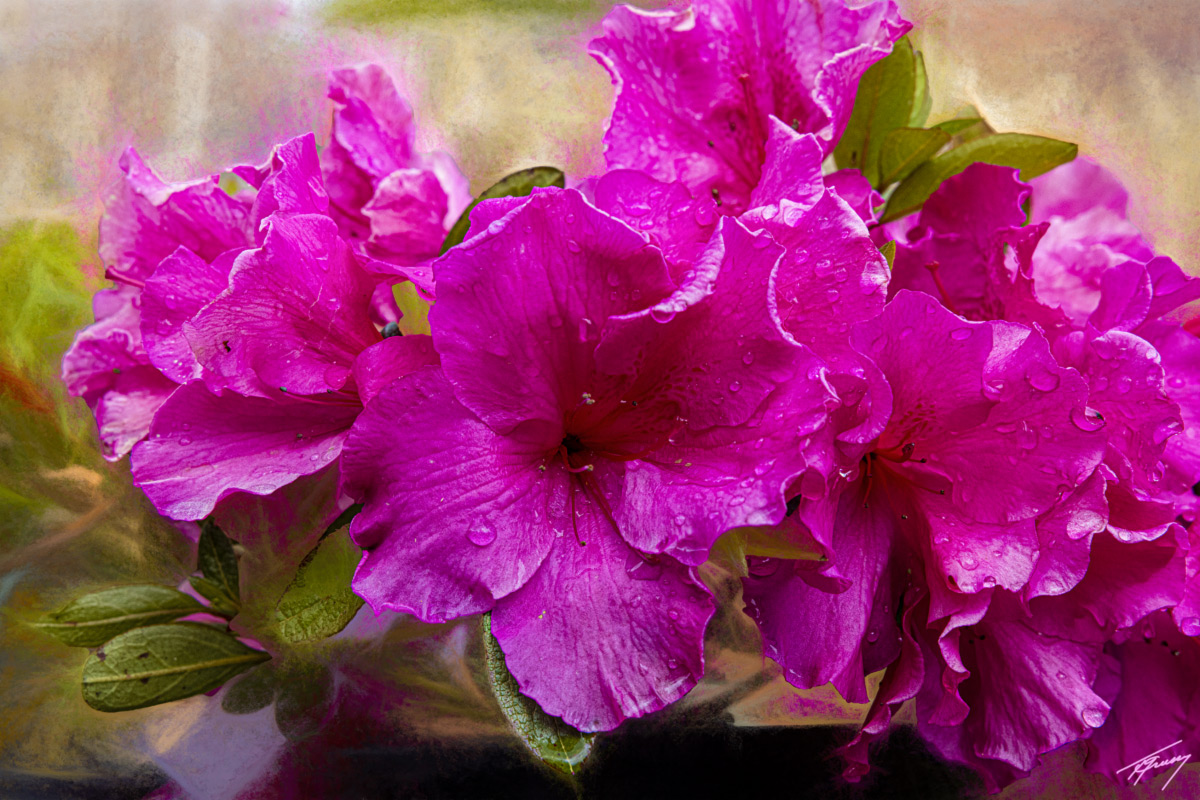
… flowers are fun and looking into the depths of them is a passion of mine … you are transported into a very special world where beauty is without limit and so are the universes you can create whilst drawn into these micro worlds of attraction.
In my emails when I use the color magenta as above, they are active links that you can click on to go to the websites of the company or organization and learn more about them including locations, directions and anything else they are sharing.
Another beautiful and productive day has been lived … it is really nice being here and waking in the morning with the chance to live another day and maybe get it more right than the day before … keep breathing and smiling … you are here!
Cheers,
Ted
I bring but this one common thought
My life has wrought;
That from the dregs of drear despair
Still everywhere
There is a joy I yet may sip—
‘Tis comradeship
With all mankind, the high and low
I know.
excerpt from I Know by Max Ehrmann
###
The easiest way to reach Mr. Grussing is by email: ted@tedgrussing.com
In addition to sales of photographs already taken Ted does special shoots for patrons on request and also does air-to-air photography for those who want photographs of their airplanes in flight. All special photographic sessions are billed on an hourly basis.
Ted also does one-on-one workshops for those interested in learning the techniques he uses. By special arrangement Ted will do one-on-one aerial photography workshops which will include actual photo sessions in the air.
More about Ted Grussing …
By Admin in Art World News
From a pawesome rendition of Gustav Klimt’s “The Kiss” (1907–1908) to a purrfect remix of Egon Scheiele’s “Self-Portrait with Chinese Lantern Plant,” (1912) the Vienna Tourist Board is using artificial intelligence to generate feline spinoffs of classic Austrian artworks. The delightful images are part of a new marketing campaign meant to encourage tourists to visit Vienna and “see the art behind AI art.”
The AI-generated cat versions of the famous works come at a time when programs like DALL-E and MidJourney face criticism from artists for potential plagiarism and stolen intellectual property. But rather than avoid AI, the board has instead decided to lean into the controversial technology and explore the ways it can be a fun, educational tool — see, for example, a version of Pieter Bruegel’s “Tower of Babel” (c. 1563) that features a seven-tiered edifice covered in cats.

Alongside the AI artworks, the tourism board also released a cheeky video featuring art historian Markus Hübl. In the video, Hübl takes viewers through a few of Vienna’s fine art museums to ponder some of the masterpieces (and their AI-cat counterparts) that visitors can see in real life in the Austrian capital.
In the Belvedere Museum, Hübl explains the meaning behind the intricate detailing in Klimt’s “The Kiss.”
“A man and a woman at the top of a little part of rock. These very strict hard forms symbolizing the male system and the very soft circles symbolizing the female system,” he says, explaining the juxtaposition of the square and circular patterns in the iconic painting.
Then he turns his attention towards the AI version on a tablet. Like the original work, the cat rendition features two figures, each emanating opposite energies while entangled in a passionate embrace. Except instead of a human couple, this painting consists of two kittens.
“Cats are an ambiguous symbol. On the one hand for wildness. On the other hand, most of them are castrated and living in our flats. We are searching for both phenomena: softness and sweetness, and untamed wildness. Aren’t those both not driving forces for creativity and art? What a metaphor,” he jokes.

In the Leopold Museum, Hübl gives some backstory behind Scheiele’s “Self-Portrait with Chinese Lantern Plant,” pointing out the power in Schiele’s direct eye contact and the cultural subcontext behind the self-portrait. He then turns to the AI rendition, which shows an angsty cat dressed in a black blazer.
“A mangy disheveled cat is going into direct contact with us — face to face. It is also a little bit morbid, one ear seems to be cut and the fur is muddy. The cat is looking not really happy, but can we really understand what’s going on in his soul?” he asks.
“Maybe this cat, like all the other cats on the internet, wants to tell us: Look at me.”

By Admin in Photography
Postpartum. The period of your life that begins the moment you welcome your child into the world. The period of your life that isn’t really just a period, but in actuality is the rest of your life—the aftermath of becoming a mother. It is perhaps one of the most complex trials that mothers go through.
I was unwary enough to believe that the journey would be all joy and bliss, but as I progressed into my motherhood experience, the naivety began to shed—and the realities began to trickle, or rather flood, in. Once I entered motherhood, there was an eclipse. Everything went dark. I felt alone. In despair. A foreigner in my own skin. And during what was one of the hardest times of my life, my saving grace was found in a creative outlet: portraiture.


Over a year and a half into postpartum, I found myself still grappling with emotions of grief. I felt at my lowest time and time again. I knew there was a possibility that I was suffering from postpartum depression, but, at the time, I believed I lacked the guidance necessary to get me the help that I needed.
But in such a vulnerable moment, I felt a tug to pick up my camera and start documenting. I wanted to capture every aspect of motherhood—the beautiful, the gritty, the raw, the intimate, the all-consuming. I wanted to still the moments and use these photographs as a means of reflection. And I wanted to share my story. Because as isolated as I felt, I knew that in reality I was far from alone. I needed to share not only what motherhood looks like, but what it feels like to go through such a substantial shift.
And so I did. My motherhood portrait study was brought to fruition from a need to embrace vulnerability and also to create dialogue around the universal experience and hardships of mothering. Motherhood: The Thread That Holds Us Together is a visual synopsis into not only my own motherhood experience, but also the narratives of six other moms who willingly allowed me into their lives and into their homes to capture their stories.


I began capturing my motherhood narrative, largely on film. I dove into exploring the shift within my emotions. I captured the intimate and painful moments of breastfeeding. I journeyed through the ache of my grief. By all means, I used portraiture to lay to rest the woman that I once was, and to welcome with open arms the new being that I was becoming: a mother.
Capturing my motherhood journey through photos allows me to honor and fall in love with my changes. It allows me to lend grace to this new territory that I am trying to gracefully navigate. And I had no idea how opening myself up to my brokenness could be the very thing that began to mend those fragmented pieces. I truly believe that portraiture helped to pull me out of a dark place. It allows me to see myself, to see my motherhood experience, from the outside in. And that, in part, led me to finally seeking the help that I needed.
I called a postpartum support line. I got a therapist who specializes in postpartum. And I was diagnosed with Adjustment disorder with symptoms of high-functioning postpartum depression and anxiety. As I said, I knew that I’d likely been suffering since childbirth, but I never gave myself room to say that I needed help. I never gave myself grace to admit that I needed help.


I think a lot of us mothers do that sometimes. We carry the weight of our silence because we believe that we can’t share our hardships. We believe that having a tough time adjusting to motherhood equates to us being a bad mom. But it doesn’t.
Through turning to portraiture in one of my darkest moments, the reality of the motherhood experience was revealed to me. Motherhood is both up and down. Easy one moment and hard the next. Full of good days and full of bad ones. Beautiful and very hard. But that’s what makes it.
My camera became a tool of healing, weaving, and redeeming. It became a means of storytelling and encouraging conversation. It became a way of exploring the physical, mental and emotional shift that motherhood brought upon me. And it became the thing that helped to pull me out of the throes of grief.
This story is a part of The Motherly Collective contributor network where we showcase the stories, experiences and advice from brands, writers and experts who want to share their perspective with our community. We believe that there is no single story of motherhood, and that every mother’s journey is unique. By amplifying each mother’s experience and offering expert-driven content, we can support, inform and inspire each other on this incredible journey. If you’re interested in contributing to The Motherly Collective please click here.
By Admin in Photography
Portrait photography is one of the most popular genres, but it can be a particularly tricky one, as you have to have not only solid camera technique, but the ability to work with people well. If you are new to portrait photography and looking to improve your images, check out this fantastic video tutorial that features a seasoned shooter sharing five useful tips.
Coming to Miguel Quiles, this great video tutorial discusses five portrait photography tips for beginners. If I had to give one tip to newer portrait photographers, it would be when it comes to the editing stage, err on the side of doing less. Today’s editing tools are tremendously powerful, and while that can make our work easier, the downside is that they make it very easy to go overboard. An overly processed portrait can look artificial and can even be insulting to the client. Aiming for a natural, mildly processed look is a great way to start building your skills. Check out the video above for the full rundown from Quiles.
If you would like to continue learning about the art of portraiture, be sure to check out our range of tutorials on the subject in the Fstoppers store.
By Admin in Art World News
Ten UMass Amherst students and recent graduates will share $65,000 in equity-free funding to pursue their entrepreneurial endeavors, thanks to the 2023 Innovation Challenge hosted by the Berthiaume Center for Entrepreneurship in the Isenberg School of Management. The center’s premiere pitch event aims to launch novel ideas into scalable, impactful ventures.
The students and Graduates of the Last Decade (GOLD) represented five teams in the finals of the two-part competition, held in Old Chapel and remotely via livestream from the Mount Ida Campus in Newton, May 3. Friends and alumni cheered on the teams in the competition hosted by Gregory Thomas, the Berthiaume Center’s executive director and a lecturer at the Isenberg School of Management.
Computer science and marketing dual major Juliano Wahab ‘23 and computer science major Alex Rohrberg ‘23 earned $41,000 in equity-free funding for developing Monet. The online platform, which connects artists with art lovers worldwide, was inspired by the mission to support artists by providing a platform to collaborate and connect with potential buyers and monetize their art.
IRON garnered $21,000 in equity-free funding. The brainchild of marketing majors Elijah Mishkind ‘21 and Kyle Collins ‘19, IRON is an app for the gym, empowering users with frictionless workout tracking and discovery though an addictive user interface.
Noah Martinez and Aaron Xu, who will be graduating this month with degrees in sport management and computer science respectively, devised the venture that earned the People’s Choice Award by the viewing party at the Mount Ida Campus and $1,000 in equity-free funding. Drafted is an all-inclusive app that aims to streamline the athlete recruiting process by creating a more casual and social experience intended to boost athlete exposure.
The two remaining teams also earned $1,000 in equity-free funding for their entrepreneurial creations. Finance major Emily Shal ‘23 developed Food Near Me, a mobile app designed to simplify the restaurant search process for food lovers, allowing users to filter search results based on distance, food type and price range. CardVerse, from computer engineering majors Ritik Shah ‘23, Jatan Pandya ‘23 and Shubham Shah ‘23, seeks to revolutionize the multibillion-dollar collectable card authentication industry by introducing an automated solution.
“My favorite part of the event was to see the emphasis on the Berthiaume ecosystem,” says Vice Chancellor for Research and Engagement Michael Malone. “The Innovation Challenge has been going for 18 years strong, and it’s been a pleasure to watch it grow to include participants and spectators from all over the UMass community.”
The Berthiaume Center for Entrepreneurship is central in promoting entrepreneurship and innovation across the UMass Amherst campus, region and state. Headquartered in the Isenberg School of Management, the center has become the central hub of a cross-campus network of scholars, innovators and entrepreneurs, with a three-fold mission of supporting research, education and practice, all targeted at facilitating the transformation of ideas into business realities.
The judging panel for the Innovation Challenge included Tara Brewster, director of philanthropy and vice president of business development at Greenfield Savings Bank; Hisao Kushi, co-founder and chief legal officer of Ernesta Home Inc. and co-founder and past chief legal officer of Peloton Interactive Inc.; Bud Robertson, former chief financial officer of Progress Software Corporation, member of Launchpad Venture Group and board member at OpenExchange Inc.; and Erica Swallow, co-founder, co-lead and Realtor at the Turnberg & Swallow Team of Coldwell Banker.

One of the largest civic exhibitions in the United States challenges artists to help invigorate neighborhoods.
ST. LOUIS — Counterpublic, the innovative public art exhibition in this city that is holding its second edition this spring, cultivates its distinctiveness.
Its first iteration, in 2019, was a hyperlocal concept: a triennial at storefront scale, bringing projects by St. Louis and national artists to parks, bakeries and taquerias on Cherokee Street, on the city’s south side.
This year it follows again a geographic method. But its footprint is much bigger, with 37 commissions along a six-mile axis. They range from monumental to barely-there.
Some are made to stay. Damon Davis, who earned notice for his art around the 2014 Ferguson protests, has built a tribute to Mill Creek Valley, the bustling hub of Black St. Louis that the city abruptly razed in 1959. It is a major public sculpture with eight pillars that embed names and memories of residents. They stand on the plaza of a new soccer stadium, with more pillars planned for other sites along a one-mile route.
In long-neglected North St. Louis, the British Ghanaian architect David Adjaye is erecting a sculpture of rammed-earth walls in a pattern that recalls the symbology of Ghana’s Akan people on the grounds of the Griot Museum of Black History, a gift to this strapped community institution. And Jordan Weber, a regenerative land sculptor from Des Moines, is building a permanent rainwater garden for a community land trust.
Other projects are more abstract. A performance video by the choreographer Will Rawls, for instance, offers a mood map of the intersection of Jefferson Avenue, the thoroughfare that the show follows, and Interstate 44. It features the dancer Heather Himes Beal and screens in locations where it was filmed, including a library and a McDonald’s. (It’s also online.)
In a riverfront industrial zone, a sound-and-video work by the artist X (previously Santiago X) is projected after dark onto a bluff; it evokes how damming and channeling the Mississippi broke human connection to the river. A newspaper box in front of the city sewer agency holds a publication by Virgil B/G Taylor, a Berlin-based artist who has embarked on a kind of technical-poetic study of the sewer system, also yielding an Instagram chatbot.
In a more participatory register, the local artist Simiya Sudduth has created a mural on Jefferson but also welcomes visitors in her vintage travel trailer turned healing space. Juan William Chávez, also based in St. Louis, has opened up his native bee garden.
Woven through Counterpublic is some pointed urban sociology. The Jefferson Avenue axis is not arbitrary. With downtown to one side and the wealthier western areas to the other, it traverses the city’s core. Some stretches bear marks of chronic disinvestment, others of creeping gentrification, still others of brutal “urban renewal” clearance.
This isn’t just context for the show: It’s also the creative stakes. Every project seeks to restore erased histories, uphold people or institutions that were or might be displaced, or bolster those who live in the wake. The methods deployed are wildly diverse. This is a program of experiments, pushing the public-art envelope in many directions.
Counterpublic has lofty aims. Its title — drawn from social and feminist theory — refers to parts of the public excluded from official narratives and resources. For public art, this translates to a challenge: Who is really being served? In a time when cities use biennials and other festivals to promote themselves as creative hothouses and destinations, this show seeks to revolutionize the form.
The goal, James McAnally, its executive and artistic director, writes in the catalog, was to create “a triennial that allied itself with generational, cultural, economic and civic change; a post-pandemic, post-uprising exhibition demanding that we, as arts workers and artists, do more to repair our broken world.”
Put that way, it’s a tall order. According to the organizers, over half the $4.5 million budget will “remain in the community” through local assets or commissions. But the commitment is also to method. The show consulted extensively with residents to shape its priorities. It takes pride in collaborations with local cultural activists. It asserts an explicit stand for the return, or “re-matriation,” of Indigenous land.
Study St. Louis a little, and the heightened stakes that Counterpublic declares make some sense — bolstering the implicit argument that this city is particularly well suited to incubate a new exhibition model, responsible and responsive.
In developing the show, the “curatorial ensemble” — McAnally, Allison Glenn, Risa Puleo, Katherine Simóne Reynolds, Diya Vij and New Red Order — read “The Broken Heart of America,” a 2020 book by the Harvard historian Walter Johnson that presents St. Louis as the country’s epicenter of violent racial capitalism and imperial expansion. The counterpoint, Johnson argues, is the city’s strong radical tradition, from cross-racial labor activism in the 19th century to the Ferguson protests.
Move along the route, and there’s little denying how blunt power shaped the landscape. Sugarloaf Mound, at the show’s southern tip, is the last remaining Indigenous mound in a city once known for them. (St. Louis is part of the greater Cahokia area, seat of a major pre-Columbian civilization.) You reach it by a side road in the shadow of Interstate 55.
In 2009, the Osage Nation purchased back the tallest section of the mound and removed the house that stood on it. It is now fenced off, and not part of the show, but the pivot for several projects. Above the highway, billboards by New Red Order and Anna Tsouhlarakis urge motorists to question their relation to the land. At its foot, the mother-son duo Anita and Nokosee Fields have placed 40 wood platforms marked with Osage patterns, adorned with ribbons, accompanied by an audio work.
After the show, these platforms will be distributed in the Osage Nation in Oklahoma — reinscribing the ties between ancestral land and places where people were sent. As for the mound, Counterpublic has pledged its support to Osage efforts to purchase its remaining sections, on which two private houses still stand.
Moving north, you pass a neighborhood where avenues named for U.S. states cross streets named for Native nations, the grid itself a metaphor for order and conquest. At corners like Cherokee and Tennessee — an association that brings up the Trail of Tears — Counterpublic has installed “Erased History Markers” that retell these facts.
Mill Creek Valley too was made to vanish, so much that Davis, the sculptor of the pillars, had not heard of it until recently. The New York-based artist Steffani Jemison tackles this erasure in another vein: Her sound work, a collaboration with the storytellers Jackie and Papa Wright, plays in several gondolas of the Ferris wheel at Union Station. Soaring high, you hear a kind of elegy: names and locations of Black theaters lost in the demolition.
Entering North St. Louis, Jefferson Avenue passes the location of the infamous Pruitt-Igoe housing projects — where many Mill Creek residents landed until those buildings too were torn down in the 1970s. That site remains vacant today. Just beyond it, a military geospatial intelligence campus is under construction.
That facility’s growth at the edge of the once elegant, now rundown St. Louis Place neighborhood has spurred fears of yet another wave of displacement. (Boosters argue that it will benefit the area and spur Black wealth creation.) Counterpublic’s northern cluster here includes Adjaye’s work (to be inaugurated in June) and a massive black sculpture by Torkwase Dyson that looks like a vessel crossed with a giant sundial; enter and you hear sound based on Scott Joplin’s ragtime, a St. Louis invention.
Does it all work? There’s no disputing the seriousness. This is a deeply thought exhibition that has set itself a high degree of difficulty. It aims to create tangible effects while treading lightly; to amplify grass-roots activism without overwhelming it; to model a practice nationally while committed to one city.
It is not entirely an insurgent act. Counterpublic’s co-founder with McAnally is Lee Broughton, who is married to Chrissy Taylor, the president and chief executive of Enterprise Holdings and a scion of one of the city’s most prominent business families. The couple are principal backers of the exhibition overall and have funded the $1 million Adjaye project.
Involved too is St. Louis City SC, the Major League Soccer franchise whose stadium hosts the first set of Davis’s memorial pillars. (Broughton is part of its ownership group, and its chief brand architect.) The pillars themselves are commissioned by Great Rivers Greenway, a public agency developing amenities across three counties.
The point here is that Counterpublic, for all its radical aspirations, remains enfolded in the kind of public-private-philanthropic architecture typical for biennials and public art in the United States. It’s fair to wonder whether curatorial, political and funding interests will stay aligned in future editions.
For now, the exhibition is particularly affecting when its touch is lightest. Take three sculptures by the Detroit artist Matthew Angelo Harrison, installed for the show’s duration at the George B. Vashon Museum of African American History — another community treasure, in a former mansion and funeral home.
Made by encasing African statuettes in polyurethane resin to compelling visual effect, the works are remarkable. But even more so is the museum’s vast collection of Black St. Louis memorabilia, amassed by its owner, Calvin Riley. That Harrison’s works do not deflect from this trove is part of their success.
In the loveliest project, the New Jersey-based sound artists Mendi and Keith Obadike worked with the St. Louis producer Mvstermind and local car clubs to hold a parade on the opening weekend. Two dozen Jeeps decked in colorful flags led a procession on long loops on the north side, stereos playing an original ballad remixed by 10 local producers.
It was a moment when this ambitious exhibition relinquished control to local culture keepers rarely found in biennials or museums. It was also ephemeral by intention. The aim, the artists said, was to wrap the neighborhood in love. Public art often aims for permanence or impact. The truest trace, it felt as the Jeeps pulled in, is the vibe.
Milwaukee Art Museum announces new Herzfeld Center for Photography show
Wondering what’s the importance of PDF editing software for photographers? Hop inside this guide to find out!
The loon traveled from Los Angeles to its permanent home in the Twin Cities.
A new beetle species has been named to honor a fellow Husker, bridging the worlds of academia and wildlife conservation.
Silversea, a premier brand in experiential luxury and expedition travel, recently concluded the inaugural season of its first Nova-class ship, Silver Nova,
The Desert Foothills Land Trust (DFLT) is proud to announce a special presentation event featuring acclaimed botanical photographer Jimmy Fike on Saturday, Oct. 12 at 6:30 p.m. at the Sanderson