About

Posts by :

Art Collective Chto Delat’s Members Fled Their Native Russia—But Kept Making Subversive Work

Art Collective Chto Delat’s Members Fled Their Native Russia—But Kept Making Subversive Work
Oxana Timofeeva, Dmitry Vilensky, and Tsaplya Olga Egorova in Berlin.

For 20 years, Chto Delat (“What is to be done?”) has been a leading voice in leftist activism in their home country of Russia, making work about art’s revolutionary potential to galvanize the public and activate political change amid persistent threats to freedom of expression. The collective was founded in 2003 by a working group of artists, writers, philosophers, and organizers from St. Petersburg and Moscow, and its work has been exhibited at institutions across the world, including the New Museum, the Centre Pompidou, and the Museo Universitario Arte Contemporáneo in Mexico City.

Chto Delat’s members—choreographer Nina Gasteva, artist and filmmaker Tsaplya Olga Egorova, writer and musician Nikolay Oleynikov, and artist and activist Dmitry Vilensky—produce video works, radio programs, publications, and public performance actions that center democracy, workers’ rights, and anti-fascism with the intention of suturing together art, activism, and theory. While the organization’s name references a 1902 political text by Vladimir Ilyich Lenin, it was primarily inspired by Nikolay Chernyshevsky’s 1863 novel of the same name, which Vilensky cites as a guide “for how to construct emancipatory collectives and make them sustainable within a hostile society.”

chto-delat-collective-russia

Stalled revolution is a recurring theme for the group—Chto Delat draws on Situationist theory to emphasize the ongoing possibility of self-actualization amid Russia’s tumultuous political shifts. In Chto Delat’s vision, art cannot be divorced from history or politics—rather, it is a tool to rectify narratives of oppression and give a voice to the marginalized. Its art-actions combine realist, surrealist, and absurdist elements with public spaces—city streets, university buildings—insisting that art’s role in society should not be confined to the gate-kept halls of the museum.

Its 2022 film installation, Canary Archives, expands on the metaphor of a canary in the coal mine (a warning sign to alert miners of danger) to underscore its members’ resistance to the military invasion of Ukraine. Among its nods to the Russian avant-garde, a modernist art movement that flourished after the Russian Revolutions of 1917, the collective publishes an English-Russian newspaper on issues central to Russian activist culture. The independent press uses manifestos, leaflets, and communiqués as tactics of democratic communication in an otherwise choked media environment.

In 2013, Chto Delat opened the School of Engaged Art in St. Petersburg, an incubator that invites newcomers to train in its philosophy through seminars and group work. The school became a flashpoint for Chto Delat in 2022, when accusations began to swirl that the collective was, in Vilensky’s words, “a training ground for young activists engaged in subversive anti-state activities.” Soon after, police searched the home he shared with Egorova, and confiscated computers, hard drives, and literature in anticipation of a criminal trial. Vilensky, Egorova, and Gasteva sought asylum in Germany, and now reside in Berlin.

For Vilensky, a key member of Chto Delat, groupwork is a way to resist “individualistic and selfish ideas of artistic genius.” Operating with a Creative Commons license, which allows for the free distribution and use of the group’s work, is a vital tenet of Chto Delat’s commitment to freely transmitting and sharing its message. “We advocate strongly for free access to our artistic production,” Egorova asserts.

Making socially engaged art requires Chto Delat to function as a “democracy of initiatives.” Any three members can act under the collective’s name so long as the project is presented to the wider group first. “Everything happens through collective discussion and is based on trust,” Gasteva says. Together, members edit and revise their ideas, accepting disagreement as a part of the process. “Of course, we have conflicts,” says Vilensky, “and whoever has the most passion is the one that wins.”

Sign Up for the Cultured Newsletter

Sure, we can be close friends. Unfiltered access awaits.

UMD Smith Launching Doctor of Business Administration Program

UMD Smith Launching Doctor of Business Administration Program

Newswise — Applications are open for the new Doctor of Business Administration Program at the University of Maryland’s Robert H. Smith School of Business.

The program is designed for working professionals to elevate their careers as leaders in business organizations and government agencies that utilize cutting-edge technologies and business analytics to drive growth and innovation.  

The practitioner-oriented curriculum covers business strategies, research methodologies, analytics, legal and ethical issues in digital economy, and big data management – all within a 3-year program designed with flexibility.

“Emerging and rapidly advancing technologies along with the proliferation of data has redefined how leaders approach and solve operational problems,” says Assistant Dean of Doctoral Programs and Dean’s Professor of Accounting for the Smith School Rebecca Hann. “Senior executives and researchers increasingly are challenged to expand their expertise and skill sets to keep current with a rapidly changing business landscape.”

The 54-credit-program’s areas of specialization are Information Systems and Marketing.

The information systems track will engage students with state-of-the-art research tools and techniques in AI, machine learning, and predictive analytics and causal Inference from large-scale data – all toward developing:

  • A deep understanding of digital business models, digital platforms and emerging technologies and their implications for business strategy and policy;
  • A solid foundation in behavioral and economic theories for nuanced insights into the role, impact, and potential of digital technologies; and
  • Rigorous research skills and advanced critical reasoning applied to real-world decision making in business and government.

The marketing track curriculum covers topics including marketing analytics, digital-marketing, e-commerce and retail management, social media strategies, customer relationship management, brand and product management, advertising and marketing communications, new product development and innovations. Students will develop skill sets and comprehensive knowledge in:

  • Social media and web analytics, market segmentation, marketing mix models, personalization and recommendations, and attribution modeling;
  • Using behavioral theories to understand users’ as well as customers’ motivation, attitudes and behaviors and make behavioral predictions; and
  • Understanding of foundational theory and practical application of marketing behavioral and quantitative topics.

Smith’s DBA program further accommodates working professionals with flexible course offerings during weekday evenings and weekends.

For more information go to Smith’s Doctor of Business Administration homepage.

What is Baton Rouge airport’s smoking lounge turned art gallery now selling?

What is Baton Rouge airport’s smoking lounge turned art gallery now selling?

Question: What does a former smoking lounge in the Baton Rouge airport need?

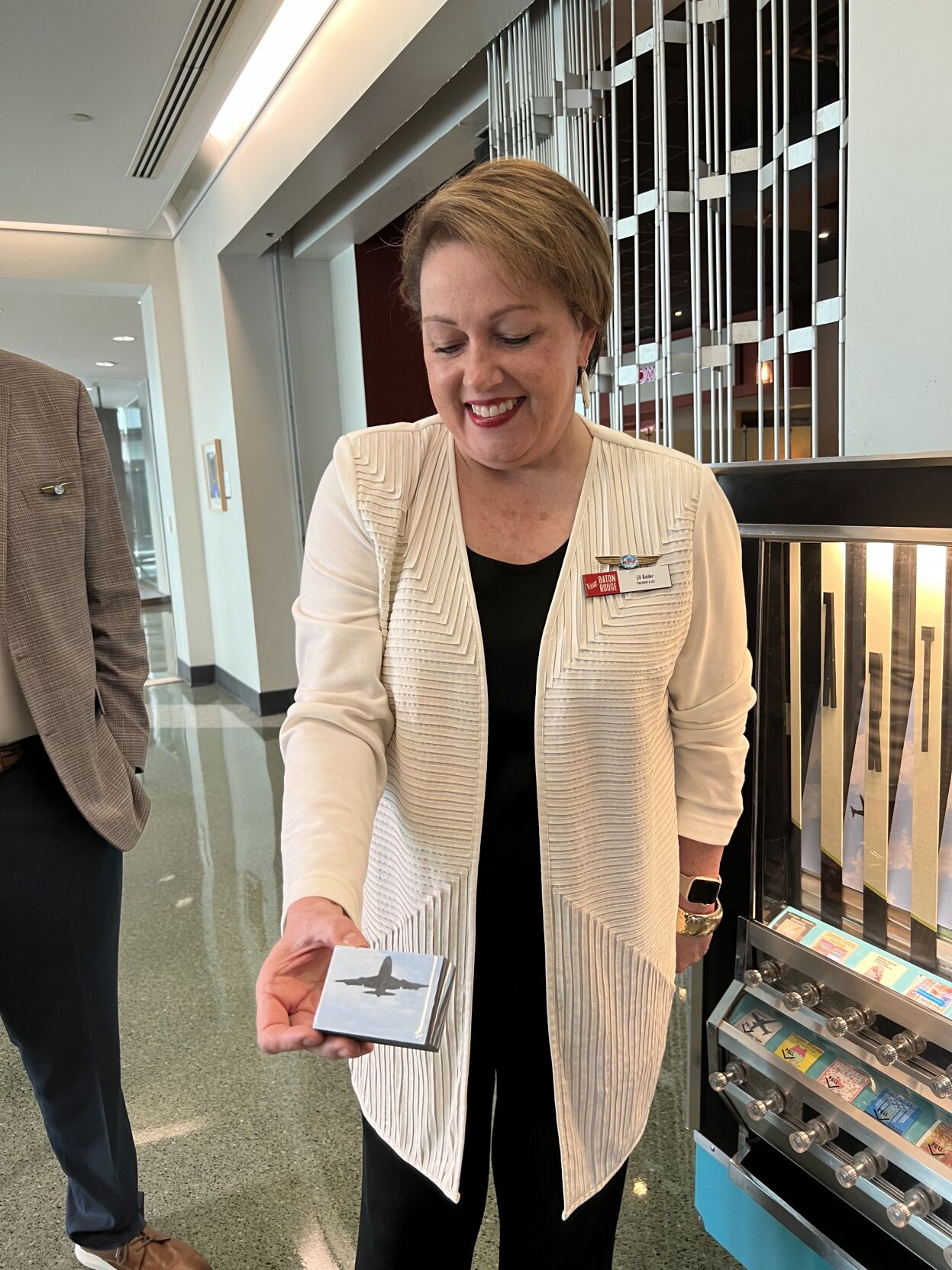
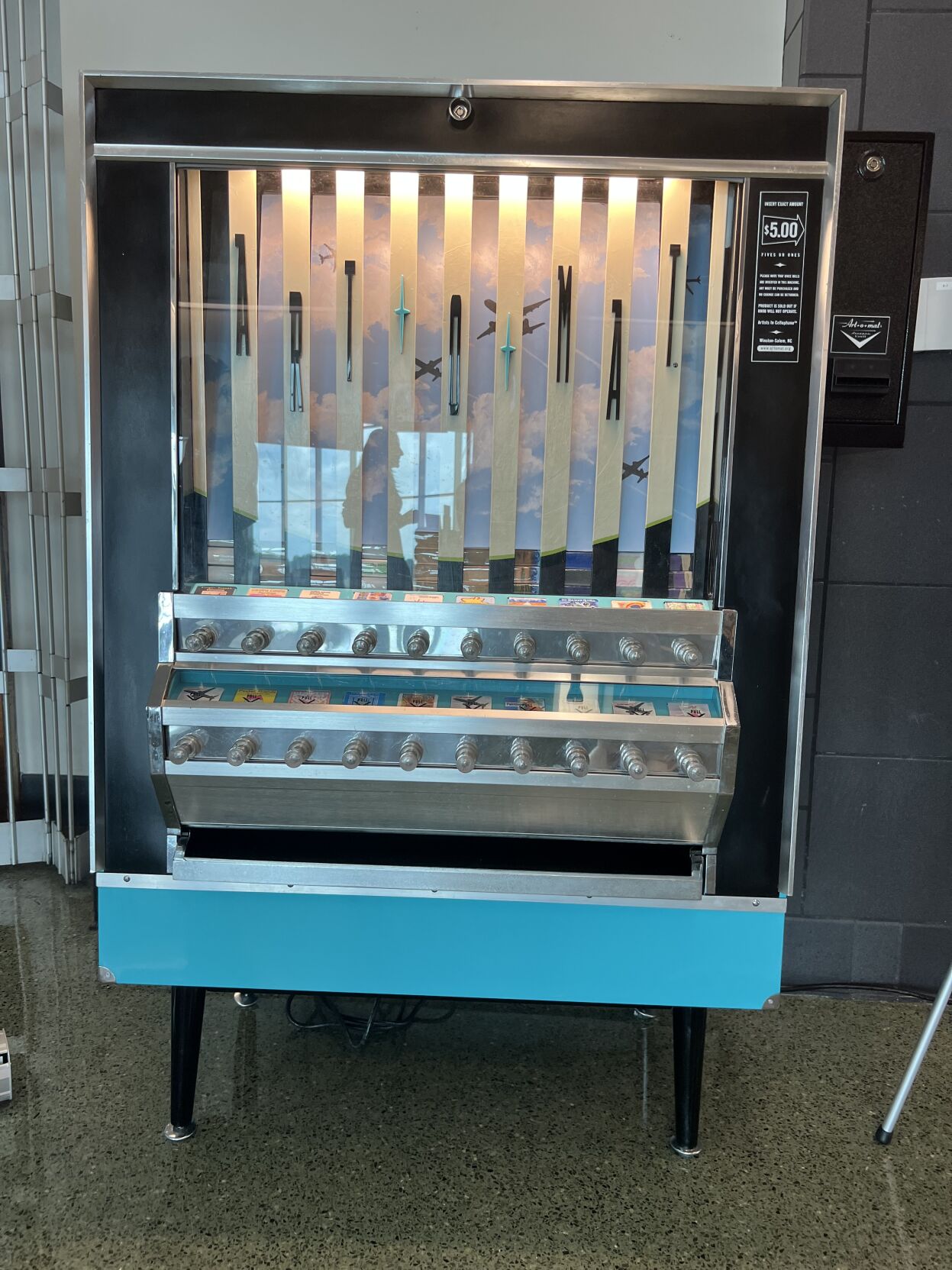
Answer: Clearly, it needs an Art-o-mat, a former cigarette vending machine turned into an art dispenser, which is exactly what the Baton Rouge Gallery at the Baton Rouge Metropolitan Airport helped to unveil Tuesday morning. 


IMG_7332.jpg

Jill Kidder, president/CEO of Visit Baton Rouge, purchased the first piece of art from the new Art-o-mat vending machine located by the Baton Rogue Gallery in the Baton Rouge Metropolitan Airport. 


The first-ever airport art vending machine opened for business at a time when the airport’s director of aviation, Mike Edwards, said the airport is up to 91% of its pre-pandemic volume and touted American Airlines’ June 1 launch of Baton Rouge-direct-to-Washington, D.C.’s Reagan National daily flights, with a 5:42 a.m. departure and an evening return. 

Edwards and other area officials, including Jill Kidder, president/CEO of Visit Baton Rouge, were on hand for the Art-o-matic’s unveiling, in a nod to National Travel and Tourism Week, May 7-13. Kidder said new data shows that in 2022, 7.2 million visitors to Baton Rouge spent $450 million, providing savings of about $1,000 in tax dollars per household.


IMG_7341.jpg

This aviation-themed Art-o-mat vending machine was unveiled at the Baton Rouge Metropolitan Airport May 9, 2023. 


“Tourism makes us better,” Kidder said. 

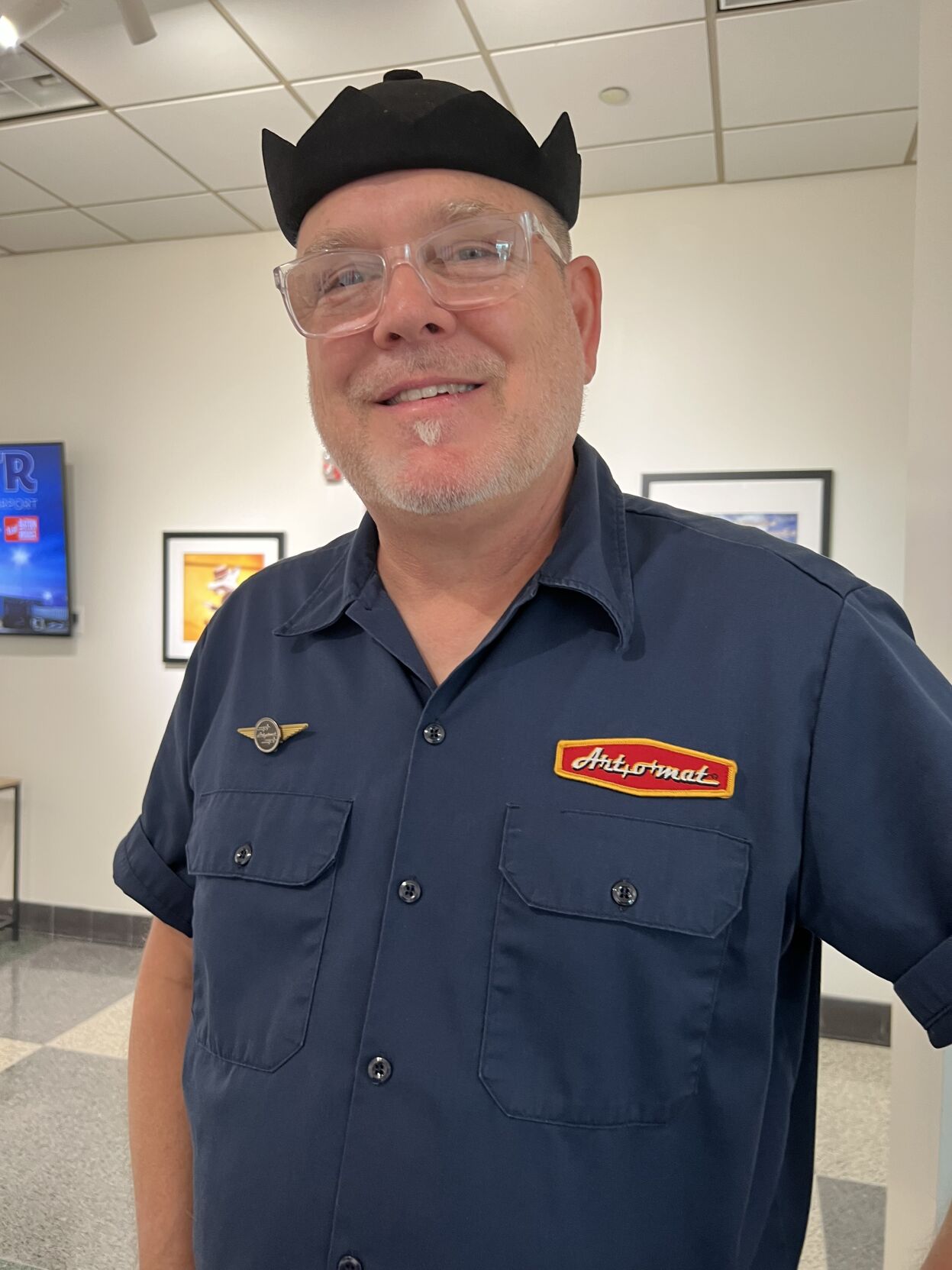
Clark Whittington, creator of the Art-o-mat in 1997, assisted in the art vending machine’s reveal.

Jason Andreasen, president/CEO of the Baton Rouge Gallery, said Whittington contacted him within hours of the news back that the gallery was opening a location in BTR airport, saying an Art-o-mat had never been in an airport and he hoped they could make it happen.

“It’s a retired cigarette machine placed outside a retired smokers’ lounge,” Andreasen said. “The art could be equally addictive.”

The art, which sells for $5 a piece, comes in a small box, about the size of a cigarette box. The airport’s Art-o-mat is about the 200th one placed across the country, according to Whittington, of Winston-Salem, North Carolina. Two Baton Rouge-area artists provide art for Art-o-mat vending machines around the country.

[embedded content]

Andreasen said the machines cost between $4,000 and $5,000 to place. Another Art-o-mat is at the Baton Rouge Gallery in City Park. Artists receive half the proceeds of the pieces they sell. 

The art available at the newest Art-o-mat appears to be all flight-related — from small paintings of hot air balloons, planes or birds to miniature papier-mâché bird sculptures. 

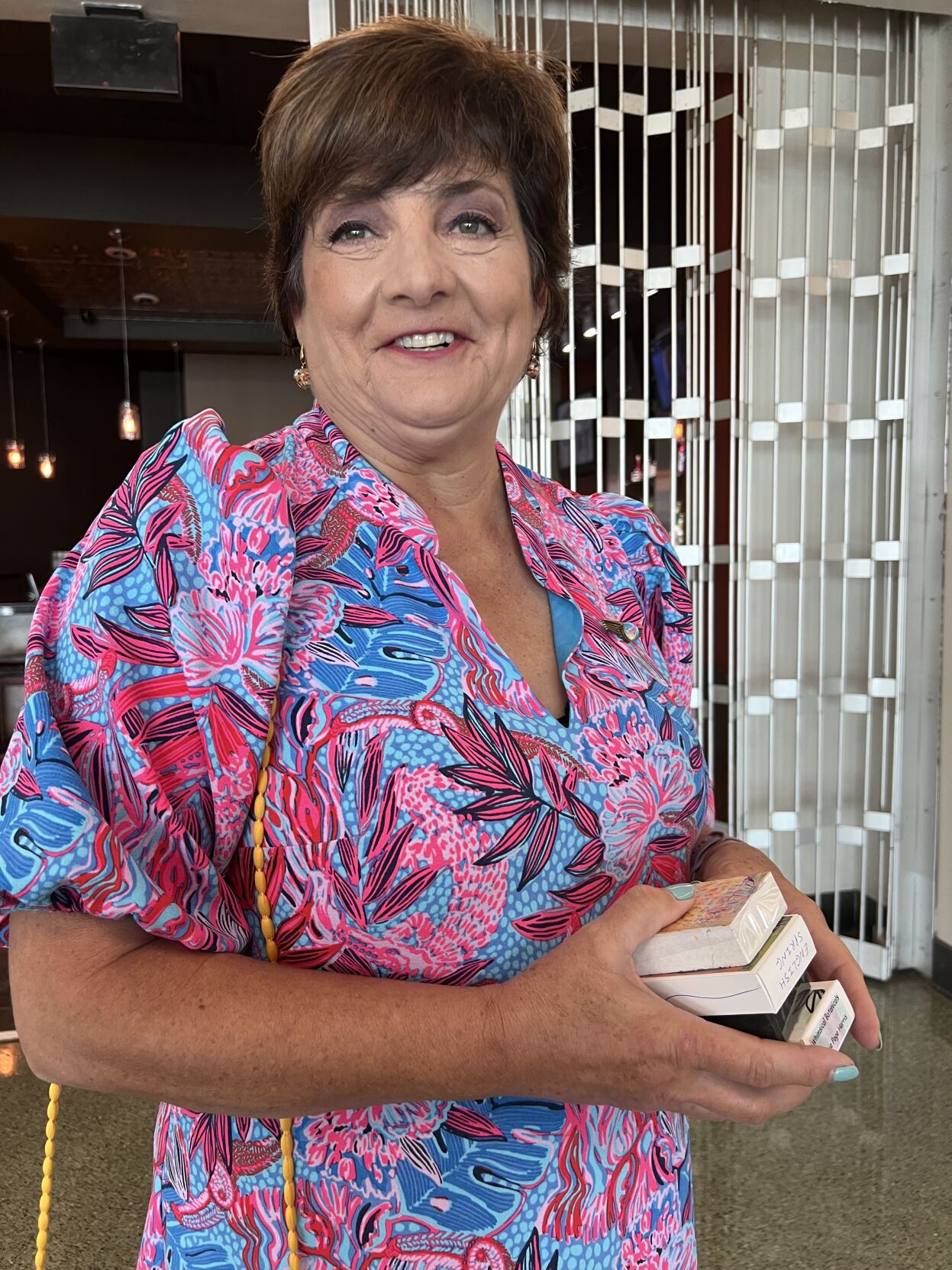
Debbie Daniel, of Baton Rouge, considers herself “a lover of all things Art-o-mat.” She has collected more than 100 of the diminutive works of art, which are on display in her home.


IMG_7340.jpg

Debbie Daniel, of Baton Rouge, considers herself “a lover of all things Art-o-mat.” She has collected more than 100 of the diminutive works of art, which are on display in her home.


“I have them in my windows. I buy them for my grandchildren,” she said. “I can’t get enough of them. I need to go to AA — Art-o-mat Anonymous.”

Daniel said one of her favorite aspects of buying the pieces is after she opens the small box, takes in the artwork and then sends a note to the artist who created it to let them know where their piece of art ended up. Each piece of art comes with information about how to contact the artist. 

Andreasen said he and his staff will stock the machine at least once a month. 


IMG_7325.jpg

Clark Whittington, founder of Art-o-mat, from Winston-Salem, N.C. assisted in unveiling the Art-o-mat located just outside the Baton Rouge Gallery in the Baton Rouge Metropolitan Airport on May 9, 2023. It is the first Art-o-mat located in an airport.


“Once we get a handle on how much activity it gets, we’ll determine how often we refill it,” he said. “Hopefully, we’ll have to refill it all the time.”

Jim Caldwell, the airport’s marketing and public relations manager, said all indications show potential for great sales for the wee works of art, as he anticipates a busy summer of travel.

First Ascent marketing firm grows in Wilmington

First Ascent marketing firm grows in Wilmington

WILMINGTON – First Ascent Design, the homegrown digital marketing agency, has expanded its headcount in downtown Wilmington and moved into a larger office space – one that is familiar to its founders.

First Ascent Design, a homegrown marketing firm, recently leased the former coIN Loft and CompassRed office in the Crosby and Hill Building at 605 N. Market St. | PHOTO COURTESY OF WIKIPEDIA

Led by husband-and-wife co-founders John and Pauline Himics, First Ascent was launched eight years ago in the now-defunct coIN Loft coworking space. Established through a state-supported public-private partnership known as Start It Up Delaware under then-Gov. Jack Markell, the coIN Loft was Delaware’s first coworking space and the entrepreneurial ecosystem helped to grow First Ascent’s clientele.

By 2019, the agency had outgrown the coworking space and moved into its own offices on North King Street. During the pandemic, the firm saw a rush of new business as clients sought to transition their marketing efforts online.

“A lot of folks that had leaned on a lot of traditional methods just couldn’t lean on them anymore. They had to do digital things for the first time, and we were a great partner to get that done,” Himics told Delaware Business Times.  “We doubled our headcount in both 2020 and 2021 and added 50% last year. It’s been an interesting sprint for us.”

Now totaling 20 employees, First Ascent was in need of bigger office space once again.

That led First Ascent to 605 N. Market St., the home of the former coin Loft, where John Himics said it felt like “an opportunity to bring the story full circle.” They signed a lease for about 4,400 square feet with landlord Buccini/Pollin Group that will keep them in their hometown city for the foreseeable future, Himics said. It fills the space left after former tenant CompassRed was acquired by LabWare.

“We’ve got beautiful, exposed brick in the front. In the back, we’ve got three skylights to let a lot of natural light in. Everything that made it attractive as a coworking space is still here and is very attractive for an agency vibe as well,” he said.

While some firms have given up office space in favor of coworking space or remote work, Himics said he felt that it was important for First Ascent’s culture to have space of its own. The firm works a hybrid schedule of three days in the office and two at home, but when leaders discussed the future of office space during the pandemic, the employees were emphatic.

“I had multiple folks on the team tell me, ‘I don’t care if there’s still paint drying or exposed wires or walls are drying. I want to get off my kitchen table and get back in and be with the people that I enjoy working with,’” Himics recalled.

In finding new office space, Himics said the firm did consider its options, but it didn’t think long about whether to stay in the First State. He said it was the encouragement of a coIN Loft colleague that convinced the couple to start the firm, and since then the network of professionals in Delaware has helped the firm grow. First Ascent counts Delaware State University, Goodwill of Delaware and Delaware County, the Delaware Alliance for Nonprofit Advancement, Buccini/Pollin Group, Delaware College of Art & Design, The Mill, and Delaware Innovation Space among its clients.

“That community here in Delaware has been the reason why we won’t go anywhere else,” he said.

For now, First Ascent continues to focus on quality service, offering branding and identity, graphic design, web development and digital marketing. It’s also been branching further north, taking on more projects in the Philadelphia suburbs, but also taking select projects up and down the East Coast.

“I’ve answered RFPs anywhere that Amtrak will take us. I don’t feel that we’ll be moving out of Wilmington anytime soon because I can do work in Baltimore, Boston, New York, etc., just by hopping on the train,” Himics said.

Metro Art commissioned artist Francesco Simeti leads a sketch and collage workshop at the West LA Veterans’ Garden

Metro Art commissioned artist Francesco Simeti leads a sketch and collage workshop at the West LA Veterans’ Garden

Detail of Francesco Simeti’s station artwork design in progress

Learn about artwork in progress for the under-construction Westwood/VA Hospital Station and participate in an art making workshop with artist Francesco Simeti on Tuesday, May 23 in the West LA Veterans’ Garden at the West Los Angeles Veterans Administration (VA) Medical Center. Simeti, one of four artists commissioned to create site-specific, integrated artwork for the station, will lead workshop participants in creating sketches and collages inspired by the Veterans’ Garden. Participants may choose to have their work considered for inclusion in the artist’s final design for the station.

Tuesday, May 23, 2023 
11am-2pm

West LA Veterans’ Garden 
100–138 Davis Ave
Los Angeles, CA 90049

(located behind the Jackie Robinson Stadium on Davis Ave, note: map apps call it the “Grow Native Veterans’ Garden”)

RSVP by Friday, May 19 by email MetroArt@metro.net or call (213) 922-4278 

Art supplies and lunch will be provided to attendees who RSVP by the deadline.


Plan your trip using Transit app. To get there, take Metro E Line (Expo) to Expo/Bundy Station to ride Metro Bus 14 to Montana/Barrington.

For more information, visit metro.net/art


Click here to read more about the artists selected to create artwork for the Purple (D Line) Extension Transit Project.


About Metro Art  

Metro Art enhances the customer experience with innovative, award-winning visual and performing arts programming that encourages ridership and connects people, sites and neighborhoods throughout LA County. A diverse range of site-specific artworks are integrated into the growing Metro system, improving the quality of transit environments and creating a sense of place.  

Click here for more information about the Metro Art program. Follow Metro Art on  Facebook and Instagram, and subscribe for email updates on upcoming meet-the-artist events.