
A sculpture honoring the relationship between the Choctaw Nation and the people of Ireland will soon be erected on the Choctaw Capitol grounds in Tuskahoma, OK.
Eternal Heart Sculpture To Be Unveiled


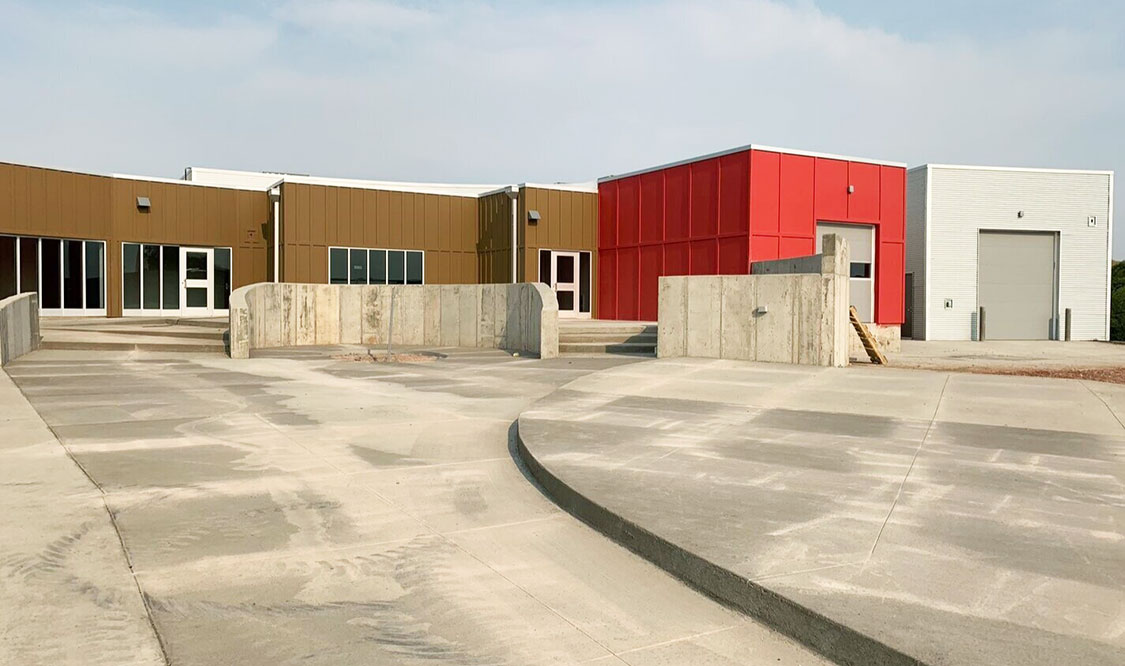
KYLE, SD – The Oglala Lakota Artspace (OLA) will hold its grand opening on Saturday, May 20, 2023, from 10:00am to 5:00pm. The arts center supports Indigenous artists and culture bearers in and around the Pine Ridge reservation. The grand opening celebration will feature, music, poetry, art workshops, and cultural events and food trucks will be onsite.
“The foundation of FPF’s work is in my home community on the Pine Ridge reservation and where our work began over two decades ago”, said Lori Pourier, President/CEO of First Peoples Fund. “We believe Indigenous arts and culture are vital to solving the systemic, generational, social, and economic challenges faced by Native nations across the country. When we launched the Rolling Rez Arts bus in 2016, we had yet to realize the possibility of the Oglala Lakota Artspace. Today, OLA is the first-ever arts center, classroom space, studios, and credit union dedicated to artists and culture bearers on the Pine Ridge reservation. I am elated to see the building come to life with artists and community members. It is truly the Indigenous Arts Ecology in action – a relationship-based, collective arts ecosystem that is grounded in ancestral knowledge that integrates space, spirit, people and lifeways.”
The grand opening will highlight the local Indigenous community’s rich traditions and creative expressions. Visitors can expect a vibrant and inspiring atmosphere, with opportunities to learn, engage, and connect with community members.
“Artspace is thrilled to celebrate the grand opening of the Oglala Lakota Artspace,” said Kelley Lindquist, President of Artspace. “This creative hub will provide essential resources and connections to help build a more sustainable and vibrant future for the people of the Pine Ridge reservation and beyond. We are proud to be a part of this collaborative effort and look forward to the arts center’s impact on the community.”
The Oglala Lakota Artspace grand opening is open to the public and free of charge.


Sarah Piantadosi was just 16 when she put together her first photography project. Having found little inspiration in her isolated home town of Winnipeg, she decided to document the high school culture around her, from people partying and taking drugs to queer couples making out. But when she submitted the photos for an assignment, her tutors refused to mark it. “I wrote an article in my school newspaper about it,” she says. “I was like, ‘This is ridiculous. You can’t take a photo of two guys or girls kissing?’”
Piantadosi, now 39, has been drawn to transgressive photography ever since, from the crude explorations of gender and family by Diana Thorneycroft to the erotic depictions of New York’s underground gay community by Robert Mapplethorpe (who she acknowledges is problematic). “I realised you could make strong subversive statements with photography,” she says. “I found it exciting and appealing.”
After moving to London in 2007, Piantadosi began to pursue photography as a career, building up a formidable portfolio with clients including Dior, Calvin Klein and Alexander McQueen. Yet, despite her extensive CV and her interest in bold pictures, the prospect of shooting nude portraits made her feel uncomfortable.
“There’s this cliche,” she says, “of the male photographer and the young female model and the, ‘Oh, let’s go over to my house and we’ll take pictures’ where all sorts of gross shit goes down.” In the early days, she worked as a lighting assistant and remembers seeing condoms falling out of photographers’ camera bags. “And then when #MeToo came along and all the stories started coming out, you just know there’s a mountain of them. It’s so disturbing. I didn’t want to start in that place.”

But how could she take a more sensitive approach, respecting consent and boundaries? “I’d looked at other photographers’ nudes and thought there was a real intimacy there,” she says. “I was like: ‘Gosh, how do you achieve that?’”
Inspired by what she calls a “generational shift” at the start of the pandemic, she set out to photograph more than 50 twentysomethings in London and Paris over a year and a half, using the nude as a way to explore ideas of agency and empowerment. “I just felt that the generation younger than me were taking a stand in a way I hadn’t seen before,” she says. “They don’t want to be silenced. They want to be seen. They want to be heard. They want more autonomy. That’s super powerful.”
Bone, her first book, brings together the results in a full-frontal display of how young people engage with their bodies and boundaries. Some portraits are intimate and stripped back, with the subject curled up in a bed sheet or reclining on a rug; others have a more mystical quality, owing to Piantadosi’s experiments with lighting. The use of overexposure evokes auras and obscures body parts, allowing her to also play with concepts of self, gender and androgyny.

A black and white shot of Lilith, who is non-binary, is particularly striking: the stark contrast renders them featureless, save for their dark pubic hair, instead illuminating the outline of their figure as it locks into an exaggerated power pose. Elsewhere, an androgynous subject leans back Renaissance-style, but bathed in an iridescent sheen.
“When I started messing around with these techniques,” she says, “it was almost like capturing a different version of reality. I wanted to reveal the character within – or the aspirational fantasy of oneself. I questioned how I could make something that is meaningful to the subject as well.”
The portraits represent a broad cross-section of this younger generation, bringing together different genders, races and sizes, many of which have been shunned by mainstream media. Foregrounding these demographics is a rare luxury Piantadosi attributes to her working independently. “You’re making work on your own terms,” she says. “You’re able to express things that maybe you can’t in commercial and editorial photography.”

Most of the subjects – a term she insists on instead of “models” – are working musicians, writers and artists. “I didn’t want to just photograph a bunch of models from an agency or from the runway. I was more interested in street casting and capturing this generation working within culture. As a society, we really need that. We need to see variety to feel normal and healthy in ourselves.”
In an attempt to confront photography’s history of exploitation, Piantadosi worked with a casting director and preceded each sitting with a 30-minute chat over a cup of tea. “I think these extra steps are so important,” she says, “because there is a power dynamic when you’re a photographer, especially if you’re photographing somebody young and inexperienced. They might want to make you happy and give you what you’re asking for. It’s important that the boundaries be discussed beforehand.”
Piantadosi’s slow and considered approach also carved space for experimentation and collaboration. Sometimes, she worked on a set with a team of stylists and designers. Other times, the shoots took place one-on-one in her home. Often, she encouraged the subjects to bring along a personal item, a piece of jewellery, say, or a pair of gloves, to add a new dynamic.
In one especially cinematic portrait, a subject stands against a sleazy backdrop of car headlights, wearing just a pair of fishnet tights. Elsewhere, another poses with their hands on their hips as they glance steadily down at the camera, one cowboy boot suspended in the air.

Shooting in digital meant Piantadosi could tether her camera to a screen that she and her subjects could see, allowing them to exchange ideas or concerns. In some cases, she organised reshoots to try out new concepts or track an “evolving story”. She laughs. “I’m making it sound like the photos are saccharine or corny, but I don’t think they are. Just because you have this approach of empathy doesn’t mean you can’t still take a real sexy, devilish and subversive photograph.”
It felt exciting, Piantadosi says, to capture the cultural shift she had witnessed. “We’ve never had these conversations so intensely, or had such a demand for these conversations to be in the mainstream. I think now people are angry, they want to speak out and they should. Why should all the power be in the hands of rich white guys?”
But with so much political uncertainty, she’s intrigued to see how the book will age. “Will the conversation have progressed further and the book will seem like a relic?” she muses. “Or will things have regressed and we’ll look back to a time when we were freer?”
Producing Bone meant a lot to Piantadosi, professionally and personally. But what she really values is the responses from her subjects. “I just hope they can look at the book and be proud of their picture. I hope they can look back at it when they’re 80 and be like, ‘Oh my God, I had the guts to do that.’”
Bone is out now via Sarah Piantadosi’s website.

William Casby, who had been enslaved, was 106 when a famous photographer asked him to sit for a photo.
Good morning. Today we’ll look at a Richard Avedon photograph that traced a shameful arc in the nation’s history in a very personal way.

Sandra Jones remembers the day “the guy came to do the picture.”
It was March 24, 1963. She was a teenager. “The guy” was one of the world’s most famous photographers, Richard Avedon.
Avedon had seen a short article in a newspaper that said that her great-grandfather, William Casby, had been born enslaved in Virginia. The article said that Casby had just turned 106. Avedon decided he wanted to photograph Casby, who lived in the Algiers neighborhood of New Orleans.
The portrait Avedon took was stark and startling. It went into “Nothing Personal,” a book published the following year with an essay by James Baldwin, a friend of Avedon’s from their days at DeWitt Clinton High School in the Bronx.
Avedon considered the portraits in “Nothing Personal” to be “some of my very best work.” As the photography historian Philip Gefter wrote in 2017, they stand as “a stark yet authentic counterpoint to the American image of eternal youth and anodyne good cheer” — the relentlessly upbeat tone that Madison Avenue, in particular, served up in the 1950s and 1960s.
Besides Casby, “Nothing Personal” included photographs of the celebrated wit Dorothy Parker, by then in her 60s and looking more sad than sardonic; the Beat poet Allen Ginsberg; and Maj. Claude Eatherly, the pilot who had decided that the weather over Hiroshima was right for dropping the atomic bomb in 1945.
Now the Casby portrait is going into another book, to be published for the 100th anniversary of Avedon’s birth. The Casby image is one of 150 Avedon photographs accompanied by brief essays.
It is also in “Avedon 100,” an exhibition at Gagosian, the gallery on West 21st Street, that also features family portraits that Avedon took at the same time — Casby flanked by several generations of descendants. More than a dozen of descendants of those descendants gathered for the opening of “Avedon 100” last week.
Jones, at 74, was the oldest. The youngest was Aiyanna Casby, who at 4 months of age was about the same age that Cherri Stamps-McCray was when she sat on Casby’s lap for the photograph in 1963.
Sandra Jones said that Casby had been a shoe repairman. “I used to go by there,” she said, and to her delight, “he’d put taps on our tennis shoes.”
He would talk about the Civil War era — the Emancipation Proclamation was issued in 1863, the year he turned 6 — and the aftermath, “saying it was a bad time,” Jones said. “My grandfather wanted for us things that he did not have because he grew up in that era when he was on the plantation.”
“He would talk about how hard the work was and how hard they worked,” she said, “but his hands were soft as cotton” — the crop on the plantation where he had been born. “That was the thing I could never get,” she said. “My grandfather’s hands were soft. I don’t know whether he was privileged to not pick as much as somebody else or something.”
His goal “for all of us was to do better than before,” she said. “The avenues were open more than when he came along. Even now, my grandchildren, they’ve got more opportunities than I had.”
Jones pointed out her mother and sisters in the photograph on the gallery wall. It is a few feet from another family portrait, Avedon’s photograph of Dr. Martin Luther King Jr. with his father and his son. On the same wall is a portrait of Malcolm X, the former Nation of Islam leader.
Nearby is a portrait of Donyale Luna, the first African American model pictured in Harper’s Bazaar. Avedon took flak from William Randolph Hearst Jr., after advertisers pulled out of the magazine and, for what Avedon called “reasons of racial prejudice and the economics of the fashion business,” never photographed Luna for a fashion magazine again.
Renitta Sweet, a cousin of Sandra Jones and a great-great-granddaughter of Casby, said she had heard about him “since I was a child.” She said she had contacted the Avedon Foundation in 2020 to ask if there were other photographs besides the portrait in “Nothing Personal.” “I knew they took more than one,” she said.
Gagosian asked 150 well-known artists, curators, musicians and writers to select an Avedon photograph for “Avedon 150” and write a paragraph about why it was important. The art dealer Peter MacGill chose the portrait of Casby. The family chose the two group photos, and Sweet, her brother Roderick Mitchell and their uncle Tyrone Casby drafted the paragraph that will go into the new book.
It says that Casby witnessed “the lies of Reconstruction, the injustices of the Jim Crow era and the infinite shortcomings of this blatantly racist country.”
“This history is not distant,” it says.
Weather
Expect a mostly cloudy start to a sunny day, with temperatures near the mid-70s. At night, it’s partly cloudy. Temps will drop to the mid-50s.
ALTERNATE-SIDE PARKING
In effect until May 18 (Solemnity of the Ascension).
Trump case: A New York Times analysis of about 30 false business records cases brought by Alvin Bragg and his predecessor shows that in this respect, the case against Donald Trump stands apart. In all but two of the indictments reviewed by The Times, the defendant was charged with an additional crime on top of the false records charge.
Two men’s disparate paths and a killing on the F train: Jordan Neely’s mental health decline played out in public after his mother was strangled. Daniel Penny said he was protecting himself and others when he choked Neely. Their encounter has once again revealed the deep fault lines in the ways New Yorkers, and Americans beyond, view race, homelessness, crime and how some people seem to be treated differently by the police.
A reporter makes “the invisible visible”: Andy Newman, a Metro reporter, shadowed Intensive Mobile Treatment teams that serve adults suffering from mental illness. Two of the stories he heard have stayed with him.
A new High Line bridge: A new foot bridge will allow pedestrians to reach the High Line from Moynihan Train Hall without having to cross several streets. Our reporter Winnie Hu watched its installation.
Vanished art, rediscovered: Towering remnants of tropical décor from the Empire State Building, which were believed to have vanished decades ago, will return to public view at the Park Avenue Armory.
METROPOLITAN diary
Dear Diary:
While much of the city was watching the World Cup final, I wandered the streets of SoHo in search of the perfect winter footwear.
Standing in a small boutique, my gaze locked onto a pair of black combat-style boots. I asked the sales clerk if she had them in my size.
“Good choice,” she said. (No wonder. When she walked out from behind the register, I saw that she was wearing the same pair.)
Later, I headed back to my apartment in Bed-Stuy. When I got to my apartment door I had the uncomfortable realization that I had the bag from my shopping, but I was missing my tote — and, with it, my wallet and keys.
I mentally retraced my steps, recalling the different stores I had stopped at that afternoon. I couldn’t figure out where I might have left the bag.
I was tired, and it was getting dark out, but I headed back into Manhattan on what I was convinced would be a fool’s errand. Soccer fans were emptying out of bars, and the afternoon’s calm had been replaced by a more frenetic energy.
I went back to every store I had gone to earlier and scoured the subway station. No sign of the bag. Eventually, I abandoned the search and headed home again.
When I got there, a group of about a half-dozen young people was gathered outside the building. My first thought was that someone was having a party.
They continued to stand there as I got closer. No one had let them in.
“Are you Michelle?” one asked when they saw me. “We found your bag at the Canal Street station, and thought we’d try to return it in person.”
The perfect black boots were no longer the highlight of my weekend.
— Michelle Berry
Illustrated by Agnes Lee. Send submissions here and read more Metropolitan Diary here.
Glad we could get together here. See you tomorrow. — J.B.
P.S. Here’s today’s Mini Crossword and Spelling Bee. You can find all our puzzles here.
Melissa Guerrero and Ed Shanahan contributed to New York Today. You can reach the team at nytoday@nytimes.com.

London’s art-fair scene has suffered some high-profile casualties this year, but Nazy Vassegh, founder of the up-and-coming Eye of the Collector event, believes she has a recipe for reinvention. While the fallout from Brexit and reduced global travel during the pandemic prompted both Masterpiece and the summer Olympia Art & Antiques Fair to call it a day, Vassegh, a former chief executive of Masterpiece, believes there is still plenty of appetite for a more intimate event in the city.
“I started with the concept of enjoyment, discovery and rediscovery, but it was time to move away from aisles, booths and tents,” she says, revealing a flair for the soft sell. Her event — which she has never called a fair but seems comfortable that everyone else does — instead puts the art directly on the wood-panelled walls and floors of the 19th-century Two Temple Place in central London. “It is an imagined collector’s house. Art collectors don’t have an Old Masters room and a contemporary room. They mix it up. They have some serious works and they have some eclectic pieces,” she says. Among the established and emerging artists on view in this year’s Eye of the Collector, whose third edition runs May 18-20, are Barbara Hepworth (Alan Wheatley Art), Henri Cartier-Bresson (Peter Fetterman Gallery) and Antony Micallef (Dellasposa Gallery).
Vassegh works with a relatively small number of galleries who supply their art for her to hang — just 21 bringing about 160 works this year. The smaller size protects Vassegh from some of the variables that the larger fairs face, especially now that exhibitors are less committed to doing the same events every year. “Brexit is a problem for all of us involved in art. There’s more red tape, it’s complicated and costly to ship things. We have fewer international galleries this year, but we have a waiting list because we’re small. We are very nimble. I don’t need 150 galleries to sustain this model,” she says.

The size of the event makes choosing its works more manageable for Vassegh, an experienced adviser who personally picks each artist, supported by a curatorial committee. When it comes to vetting works for authenticity and origin, “We work closely with our select galleries to ensure all works are accompanied with full provenance and cataloguing from an early stage.”
Vassegh still champions the bigger fairs. “They are incredibly important in educating, especially in new markets,” she says. But she adds, “London isn’t a new market. The days when locals would go to a fair to learn a bit about art and have fun are gone.”
A determined self-starter, Tehran-born Vassegh attributes her focus and adaptability to her upbringing. “I left Iran when I was nine, the year before the [1979] revolution. My father could see that the country was changing and also thought I should have more exposure than just him and my grandmother [she lived with them]. So he took me to Los Angeles — we called it Tehrangeles — to live with my uncle and his family for a year.”
Vassegh then went to boarding school in the UK, at which point her father gave her the choice of going back to Iran or moving to London to live with her mother. “Not many 10-year old girls with Iranian fathers get to make that sort of decision. And once I did decide to stay in the UK, I was 100 per cent into it because it was my choice. That taught me a lot.”
Before setting up as an art adviser in 2010, Vassegh was at Sotheby’s for 19 years, latterly as managing director of its Impressionist and Modern art department. The idea for Eye of the Collector came to her when visiting the Venice Biennale in 2019, she says, and reflects her ambitious instincts. “I knew that collectors were suffering from fair fatigue and had been thinking about how to do something different. Then I went into a palazzo and realised, ‘I want this.’”
The gallerist Tanya Baxter says that Vassegh has hit the spot. “Some art fairs can be too overwhelming to focus, but I saw some serious collectors there last year, with the intention of buying something extraordinary. Nazy’s curation allows them to have a closer relationship with the art.” Baxter brings work by several established artists, including Bridget Riley, William Scott and Antony Gormley, to Eye of the Collector this year.
The event has faced some criticism — that it is too light, too easy on the eye for the high-minded art crowd. Vassegh’s marketing style, which makes good use of Instagram and her own glamorous appearance, adds to a sense of superficiality among some.
She counters with conviction. “I don’t need to apologise for presenting art in a beautiful setting,” she says. “It’s not fluff. There is still connoisseurship. Collectors and art lovers enjoy Eye and the most important thing is that it is a commercial success [for the galleries].”
Another measure of success, she says, is that about 60 works are being made especially for the fair this year, including by the textile artist Anya Paintsil (Ed Cross gallery), the painter Pippa Young (Arusha Gallery) and several pieces of contemporary design through Sarah Myerscough Gallery.

Gallerists appreciate her vision. Kristin Hjellegjerde joins the fair for the first time this year with work by six artists, including rising stars Sara Berman and Richard Stone. She says, “It was Nazy who won me over.” Vassegh’s event has also won praise for being an enjoyable experience. “It’s not a circus, like so many other fairs. I find it a refreshingly gentle way to see works,” says the art adviser Helen Macintyre, who recently joined the fair’s 18-person strong advisory council.
Having the fair in London is, Vassegh says, a no-brainer: “It had to be here, my whole career has been in London.” The city, she says, “is core to the concept and will continue to be part of the journey”, though she hints that Eye of the Collector could have a future elsewhere too. “I wouldn’t have dared to say so before now, but the platform could go anywhere.” Mindful of her forthcoming fair, though, she quickly stops this line of questioning and instead delivers a characteristically determined imperative: “Let’s make this edition as successful as possible first.”







