About

Posts by :

‘Native America: In Translation’ shows Indigenous people as contemporaries versus historic figures

‘Native America: In Translation’ shows Indigenous people as contemporaries versus historic figures

An exhibition at the Milwaukee Art Museum features the works of international Indigenous artists who explore Indigenous history, culture and representation through a contemporary lens.

It’s called Native America: In Translation, which took three years to make.

The exhibition highlights 10 featured artists’ perspectives on community, identity, heritage and the legacy of colonialism on the American continents.

“The exhibition in my mind starts with this work by Marianne Nicolson. It’s a really large photograph; it’s on the wall at the bottom of the stairs as you come into the gallery space,” says Ariel Pate, the assistant curator of photography.

Paul Smith with the museum’s Native Initiatives Advisory Group for a tour.

Pate continued, “And it shows a cliff in sort of beautiful natural area, and there’s a really prominent painting on the face of the cliff.”

IMG_1494.jpg

Teran Powell

/

‘Cliff Painting’ painting by Marianne Nicolson.

The image is 30-feet wide and 28-feet-tall and was originally painted in 1998.

“It’s located in Kingcome Inlet, which is in what we call British Columbia, but which is actually the ancestral homeland of the Dzawada’enuxw Nation. Marianne Nicolson is of that nation and this work really welcomes people into that territory of the Dzawada’enuxw people and lets them know that the Dzawada’enuxw people are there today,” says Pate.

Native America: In Translation is on display in the Herzfeld Center for Photography and Media Arts, on the lower level of the Milwaukee Art Museum.

I followed Pate and Smith’s lead wherever they wanted to take me along the tour.

Next was a series of six photos by Alan Michelson. Paul Smith, with the museum’s Native Initiatives Advisory Group for a tour, has a personal connection to the images. He says they struck him.

IMG_1453.jpg

Teran Powell

/

Alan Michelson’s work titled, ‘Hanödaga:yas (Town Destroyer),’ is a projection onto an iconic bust of George Washington by the French sculptor JeanAntoine Houdon.

“Being from the Oneida Nation, we are not sovereign to Wisconsin; we’re from New York and people don’t know our story a lot of times and how we ended up here in Wisconsin,” he says.

“People often don’t know that the Iroquois Nation, which the Oneida nation is a part of the Haudenosaunee Confederacy, that we [Oneida] were the United States’ first military ally. And that allyship between the Oneida and the United States broke up our confederacy. The other nations in the confederacy sided with the British,” Smith explains. “The Oneida were the only one of the confederacy to side with the Americans. After the Revolutionary War, the Oneida helped with the victory over the British quite decisively over in upstate New York area, and you can see how that relationship devolved in these pictures.”

Smith says the images show in sequence, “From being Upstate New York, to signs celebrating the Army destroying our villages, and the movement, and the fire, the treaties broken and then our Wampum belt.”

Pate describes the painting at its significance. “So, it’s a work that’s six panels, and each of them a different image is projected onto a bust of George Washington,” Pate says. “Sort of taking this, you know, figure from American history and projecting historical documents on it that reflect this really tortured relationship between the Iroquois Nation and America.”

Both Pate and Smith say not enough people in Wisconsin know this history.

Further inside the gallery there is a room full of photos by Martine Gutierrez.

The images are from a fashion magazine she created in 2018 called Indigenous Woman.

IMG_1433.jpg

Teran Powell

/

A portrait of Martine Gutierrez from her 2018 project, ‘Indigenous Woman.’

“It’s big. It’s really colorful. The cover looks just like Andy Warhol’s interview. There’s a lot of like really glamorous images in it and Martine made this because she felt that as a trans Latinx woman no one was going to put her on the cover of a Paris fashion magazine, so she needed to make her own,” says Pate.

Pate says in each of the photos, Gutierrez is the model, the stylist, the photographer and the editor.

“And also a woman of Indigenous descent and sort of thinking about how we think about Indigeneity as authenticity. And you know as a trans woman she really works hard to have people acknowledge her as who her identity is and have people take her for who she is,” says Pate.

Pate and Smith agree that this exhibit is historic.

It showcases Indigenous people in media in a contemporary fashion from Indigenous perspectives, versus as just historic figures. And they hope Native audiences who see the show feel welcome to the museum.

Native America: In Translation is on display until June 25.

Eighth annual Highland Village Art Festival to be held Saturday – Cross Timbers Gazette | Southern Denton County | Flower Mound

Eighth annual Highland Village Art Festival to be held Saturday – Cross Timbers Gazette | Southern Denton County | Flower Mound

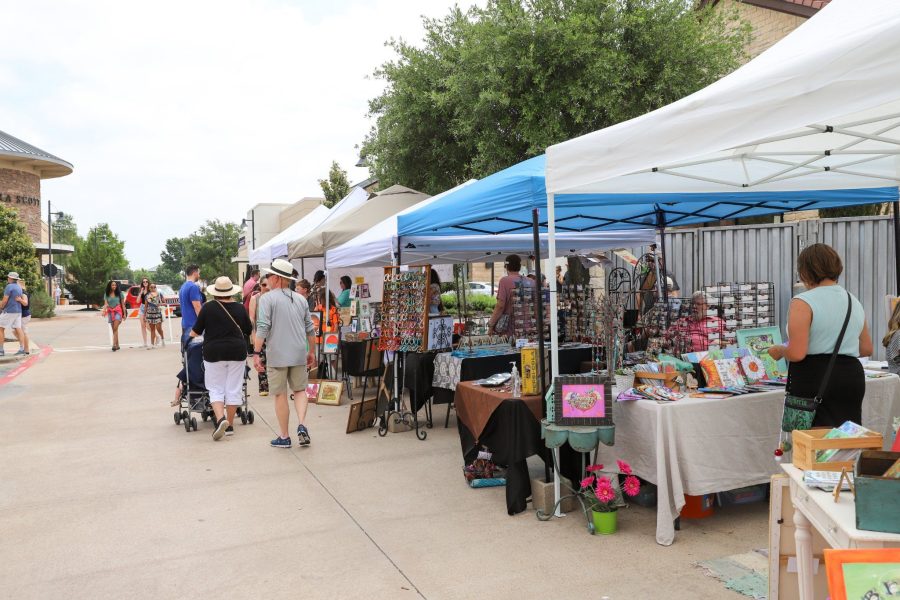
The Shops at Highland Village, in partnership with the city of Highland Village, will host the eighth annual Highland Village Art Festival on Saturday.

“We are thrilled to be partnering with the city once again to host the Highland Village Art Festival for our community,” said Ginny Tirey, marketing manager at The Shops at Highland Village. “We look forward to welcoming a myriad of artists to the center and giving them a platform to put their creative skill and talent on display.”

A beloved community event, the festival will feature displays, including exhibits, demonstrations and more from over 45 outstanding artists, according to a news release from The Shops. Families can see stilt walkers, watch a chalk artist at work and get their faces painted during the event, which will run form 10 a.m. to 6 p.m. The Whitney James Quartet will grace the south courtyard stage from 4-6 p.m. to perform a special jazz concert for guests to enjoy.

This year’s festival will benefit Kids Kastle, the wooden playground near the pond in Unity Park that originally opened in 1994. For more information, visit theshopsathighlandvillage.com.

Larissa Fasthorse Becomes First Native American Woman Playwright on Broadway

Larissa Fasthorse Becomes First Native American Woman Playwright on Broadway

Larrisa Fasthorse found her voice and her superpower through being a playwright. 

On April 20, Fasthorse (Sicangu Lakota) became the first Native American woman playwright produced on Broadway with the debut of her original work, “The Thanksgiving Play.”

The play — starring D’Arcy Carden, Katie Finneran, Scott Foley and Chris Sullivan— tells the story of four white presenting people attempting to devise a culturally sensitive first Thanksgiving play for Native American Heritage Month. The characters try so hard to do everything right that they do everything wrong, Fasthorse said. 

Never miss Indian Country’s biggest stories and breaking news. Sign up to get our reporting sent straight to your inbox every weekday morning. 


Fasthorse says she wanted to challenge herself to write a play about contemporary Indigenous issues through white presenting characters. 

This play is also an opportunity for people to come together and enjoy being in a space where they can share laughter, happiness, joy, and truth, she said. 

“I’m really happy with it and how it came out and the things it deals with,” Fasthorse said. “As Native people, a lot of the history that I’m talking about in this play, we know it. It’s not news to us. It’s news to everybody else.”

When Fasthorse started working in film and television 15 years ago, she was frustrated with the inaccurate representation of Indigenous people. 

Shows like Rutherford Falls and Reservation Dogs that depict contemporary Native life with Indigenous-specific humor with Native actors weren’t around back then. 

“I sold a couple of shows, but they were just getting watered down the way they’re portraying Indigenous people, and I didn’t have the power to change that,” Fasthorse said. “In film and TV, the studios own your work — you don’t. So, they can change whatever they want.” 

But then Fasthorse was commissioned to do her first play in 2012 and everything took a positive turn. 

“I was really excited because the theater was willing to do things right, to hire Indigenous consults, to hire language consultants, hire other Indigenous artists to work around the show,” she said.  

Fasthorse grew up in South Dakota, where at a year old, she was adopted by a white family. Her adoptive parents worked to help her keep a connection to her Lakota culture and people.  

“But growing up, that’s hard — you are separate, and I always worried about not being enough of anything,” Fasthorse said. “Not being enough white, not being enough Lakota, all the things.”

Not feeling enough and being stuck in between was reinforced when a casting director in California told her it was a problem that she wasn’t quite white — and they could tell. 

“Now I realize how much that’s my superpower,” she said. “I’m a bridge. I’m a bridge that can translate between cultures,” she said, adding she can take contemporary and historical issues and translate them for a white audience and weave in Lakota storytelling.

“I was really fortunate as a Native playwright around the country to be working quite a bit, getting commissions and having them produced,” she said. “But then I couldn’t get second and third productions; my plays would just kind of be once and be done.”

The process grew increasingly frustrating, and the fight to hire Indigenous actors also became an issue. But eventually, she says, she cracked the formula, and “The Thanksgiving Play” opened doors. 

Fasthorse describes “The Thanksgiving Play” as a dark satirical comedy that depicts historical events accurately. 

She added the Indigenous crew found the truth and humor in the story to be a relief. 

Although her plays tell historical truths, Fasthorse emphasizes that her primary aim is to create art. 

“A lot of my art does educate, but it’s first and foremost art,” she said. “It is not education.” 

Her first writing mentor, Merata Mita, a Māori filmmaker, producer and writer from New Zealand who passed away in 2010, told her that she could either be an artist or an educator, Fasthorse said. 

“Now, some art educates, and some education is artistic,” Fasthorse said. “But you have to choose which one you are. So, I’m very much an artist.”

Fasthorse encourages Indigenous artists to stay true to who they are/

“Everybody has to find their people and if you aren’t being true to who you are and your voice, your people can’t find you,” Fasthorse said. “Your voice is something they don’t have and if you don’t stay true to that, the people who love what you have can’t find you. If you try to please everyone, you will please no one, including yourself, most importantly yourself.”  

More Stories Like This

Tens of Thousands Attend Gathering of Nations, World’s Largest Powwow
Sundance Institute Announces Fellows for 2023 Native Lab
Blue Mountain Tribe’s Path to the Playing the World’s Largest Powwow
Indigenous Sportscaster Takes Diné Language to the Big Leagues

12 years of Native News

This month, we celebrate our 12th year of delivering Native News to readers throughout Indian Country and beyond. For the past dozen years, we’ve covered the most important news stories that are usually overlooked by other media. From the protests at Standing Rock and the rise of the American Indian Movement (AIM), to the ongoing epidemic of Murdered and Missing Indigenous People (MMIP) and the past-due reckoning related to assimilation, cultural genocide and Indian Boarding Schools.

Our news is free for everyone to read, but it is not free to produce. That’s why we’re asking you to make a donation this month to help support our efforts. Any contribution — big or small — helps. If you’re in a position to do so, we ask you to consider making a recurring donation of $12 per month to help us remain a force for change in Indian Country and to tell the stories that are so often ignored, erased or overlooked.

Donate to Native News Online today and support independent Indigenous journalism. Thank you. 

About The Author
Author: Stacy ThackerEmail: This email address is being protected from spambots. You need JavaScript enabled to view it.


Honorable Mention, Pam Dorner American Kestrel surrounded by shimmering leaves of gold bokeh at Bosque del Apache NWR. M…

Honorable Mention, Pam Dorner American Kestrel surrounded by shimmering leaves of gold bokeh at Bosque del Apache NWR. M…

Honorable Mention, Pam Dorner
American Kestrel surrounded by shimmering leaves of gold bokeh at Bosque del Apache NWR. Many people know Bosque del Apache for sandhill cranes, snow geese, eagles and beautiful landscapes. The refuge also has many amazing smaller birds that call the refuge home such as the American Kestrel. The American Kestrel is the smallest falcon in North America. Many times it will hunt by sitting on a perch and scanning the ground for prey. What caught my eye was the way the fall leaves in the background formed a golden bokeh around this colorful raptor.

An Animated Swimmer Dives into the Exhausting Experience of Working Under Pressure

An Animated Swimmer Dives into the Exhausting Experience of Working Under Pressure


A relatable animated short from the Ukrainian artist and director Iulia Voitova captures the total collapse and immobility of burnout and exhaustion. “La Plongeuese,” or “The Diver,” follows a professional swimmer so affected by a rigorous training schedule and the incessant noise of her coach’s whistle that she decides to give up her career entirely. When she visits a talented masseuse, though, she finds that her nerves and anxiety, which Voitova brilliantly depicts with tightly crimped paper, finally get some reprieve.

“La Plongeusese” was the director’s graduation project for La Poudrière, an animation film school in Valence, France, and you can find more of her works on Vimeo and Instagram.


A swimmer with crimped paper legs stands at the edge of a diving board while a coach blows his whistle

A hand pulls at the middle finger of another hand, with two fingers in crimped paper

A large man stretches out a swimmer in exaggerated fashion

Do stories and artists like this matter to you? Become a Colossal Member today and support independent arts publishing for as little as $5 per month. The article An Animated Swimmer Dives into the Exhausting Experience of Working Under Pressure appeared first on Colossal.

In Portland, looking back at a continent on the cusp of change

In Portland, looking back at a continent on the cusp of change
Todd Webb. “Untitled (44UN-7776-038), Ghana,” 1958.Todd Webb Archive (dba Lucille Webb Trust)

PORTLAND, Maine — “Outside the Frame: Todd Webb in Africa” is, in effect, three shows. One is largely visual, comprising nearly 60 photographs taken by Webb in 1958 during five months he spent in Africa on assignment for the United Nations, as well as some related ephemera and a few images by other photographers. That show is mostly in color.

Another is verbal, consisting of a notably didactic and hectoring wall text. That show is resolutely in black and white. The third is intellectual and implicit, encompassing the complexities of historical incomprehension that characterize the other two.

“Outside the Frame,” which was organized by the Minneapolis Institute of Art, runs through June 18 at the Portland Museum of Art.

Todd Webb, “Untitled (44UN-7990-212), Southern Rhodesia (Zimbabwe),” 1958.Todd Webb Archive (dba Lucille Webb Trust)

Webb (1905-2000) lived a bracingly varied life before coming to photography. He worked in a bank in his native Detroit; as a gold prospector, then fire ranger, out West; then, back in Detroit, for Chrysler. A fellow worker for the auto manufacturer was another future photographer, Harry Callahan. The two became friends.

Webb’s best work is about the interplay of persons and place: New York, Paris, but also a particular person, Georgia O’Keeffe, in a less-populated place, New Mexico. An assignment from the United Nations in 1957 to photograph the General Assembly led to his being sent to Africa a year later.

This was a momentous period. The European colonization of Africa was ending or would soon do so. Two years later, the British Prime Minister Harold Macmillan would deliver his “Wind of Change” speech. The idea was for Webb to record this transformation as it was taking place. He visited no fewer than nine countries — present-day Ghana, Togo, Sudan, Somalia, Zambia, Zimbabwe, Malawi, Tanzania, and Kenya — with an implicit brief of being forward-looking and positive. The title of the UN-produced brochure in which Webb’s photographs would appear (only 22, out of nearly 2,000 negatives exposed) was ‘’A Continent Awakes.”

Such an upbeat view of a post-colonial future assumed not just the existence of a colonial past but its acceptance. This is one meaning of “Outside the Frame,” how these photographs, their frequent beauty and distinctiveness notwithstanding, fail to offer any sort of larger historical or social context.

Todd Webb. American, “Untitled (44UN-7968-001), Somaliland (Somalia),” 1958.Todd Webb Archive (dba Lucille Webb Trust)

That is a serious omission. The wall texts strive to compensate for that lack of context. Unfortunately, they do so with a relentlessness and vehemence that become counter-productive. The European colonization of Africa in the final decades of the 19th century was carried out, we’re informed, “at a wildly exponential rate.” “Exponential” would appear to have a different meaning in museum circles from what it does in mathematics. A failed search for petroleum by the Sinclair Oil Corporation qualifies as “a devastating reminder of the fragility of the earth [sic] in the face of virulent greed.” Perhaps greed without virulence is less objectionable. Shorts, a collar shirt, and rolled-up sleeves are “a distinctly colonial uniform.”

Todd Webb, “Untitled (44UN-8002-165), Togoland (Togo),” 1958.Todd Webb Archive (dba Lucille Webb Trust)

In fairness, right-thinking curatorial reductiveness is becoming more rule than exception. Two examples from last fall would be the Peabody Essex Museum’s “Power and Perspective: Early Photography in China” and the Museum of Fine Arts’ “Life Magazine and the Power of Photography.”

With “Outside the Frame,” this approach gives rise to two ironies. The first is that the explanatory text exhibits its own failure to go outside the frame. There’s no mention of the Cold War, a key factor in decolonization — and, as it happens, a different sort of stick to smack the West with. It was competition with the Soviets, far more than enlightened policies, or even economic calculation, that helped drive the end of empire.

Nor is there any mention of “The Family of Man,” the enormously influential 1955 Museum of Modern Art photography exhibition. Webb was among the nearly 300 photographers with work in it. That show propagated a muscularly humanist, blandly nondenominational conception of the medium, one visible in Webb’s African work. It would not be inaccurate to describe these photographs as imperialism with a human face. But this particular version of imperialism is cultural and owes far more to MoMA than to men in distinctly colonial uniform.

So Webb was ill suited to his assignment, having had no experience of Africa. Yet here’s the other irony: His inexperience could also be an advantage. He brought a very fresh set of eyes to his subject. Again and again, one can feel Webb’s excitement and pleasure in recording what he’s seeing. He demonstrates an alertness to cultural collision and incongruity. That alertness has just as much to do with subversion as celebration, if not more.

Todd Webb, “Untitled (44UN-8001-496), Somaliland (Somalia),” 1958.Todd Webb Archive (dba Lucille Webb Trust)

Standing alone in a clearing, a Ghanaian man stares at the camera as he sprays pesticides into dense vegetation. It’s a tiny, toxic echo of Conrad’s astonishing epitome of imperialist futility in “Heart of Darkness”: a French battleship “firing into a continent.” To be sure, some now consider Conrad politically problematic. But you take his point, and Webb might be seen to have, too.

Or there’s the arresting sight of an attendant at a Texaco station in Togo. The red gas pump, the Texaco logos, the display of motor oil cans (all of them bearing the Texaco logo, of course) present Western imperialism in triplicate: cultural and economic as well as political. Presumably, it’s happenstance that that shade of Texaco red chimes with the suit worn by a man walking in Mogadishu, but serendipitous commentary is commentary nonetheless.

Todd Webb. “Untitled (44UN-8011-469), Tanganyika (Tanzania),” 1958.Todd Webb Archive (dba Lucille Webb Trust)

Most striking of all is the image of a man in what is now Tanzania pushing a lawn mower over a plot of green that already looks billiard-table smooth. Behind him are various pylons, cables, and other pieces of power-station equipment. Between him and us is a chain-link fence. If this photograph doesn’t show a grasp of how deeply complex and troubling the situation of Africa and Africans was in 1958, it’s hard to imagine another that might.

Visitors to the Webb show might want to pause by the entrance. A monitor shows a video that consists of interviews with 16 immigrants now living in the Portland area. They talk about their African past and American present. The stories they tell are moving and absorbing and very much outside any frame.

OUTSIDE THE FRAME: Todd Webb in Africa

At Portland Museum of Art, 7 Congress Square, Portland, Maine, through June 18. 207-775-6148, www.portlandmuseum.org


Mark Feeney can be reached at mark.feeney@globe.com.

A Modern Home in the Trees You’d Never Know Was in Texas

A Modern Home in the Trees You’d Never Know Was in Texas

The Live Oak Ridge Residence is a new project from Devin Keyes of Keyes Office of Architecture located amongst the rolling hills of West Lake Hills, Texas. The modern home rests above the treetops offering views of the surrounding hills while maintaining privacy from the street. To help with the Texas heat, there’s plenty of outdoor space that’s covered, as well as a swimming pool just steps from the house.

The home’s exterior features two juxtaposing materials – pale limestone and black metal panels – that work together for a visually intriguing presence. The stone-clad volume acts as the entryway from the street and hub to the more private areas of the house. The kitchen also lives inside the stone structure with one side facing the hills and the other with views to the front yard.

up close corner view of exterior of modern house with cover patio

The soffits are clad in cedar wood, complementing the decking that surrounds the pool.

side exterior view of modern home's backyard with pool

exterior view under partially covered outdoor patio of modern house

The lower level opens up to the outdoor entertaining spaces from a series of bedrooms and a living room with two glass walls.

interior view of modern open metal and wood stairs

interior view into modern minimalist kitchen with black island

The upper floor operates as the main living space with the kitchen, dining room, living room, seating area, primary bedroom suite, guest quarters, and a large outdoor balcony.

interior view into modern minimalist kitchen with black island

angled interior view of modern home with metal staircase

interior view of modern home's dining room

angled interior view of modern home dining room and living room surrounded by windows

Clerestory windows from the front of the house and massive windows that wrap the open living room keep the interior filled with natural light while providing scenic views.

interior view of modern home living room surrounded by windows

shot from under covered deck looking into corner of modern home with mid-century stove

side interior view of modern bedroom

The main bedroom has its own balcony at the opposite end of the one in the living room.

side interior view of modern bedroom

angled interior view of modern bathroom with dark green tile and wood cabinets

angled interior view of modern bathroom with dark green tile and wood cabinets

side exterior view of modern home with lights on at dusk

front exterior view of modern home clad in light stone

Photography by Leonid Furmansky.

Caroline Williamson is Editor-in-Chief of Design Milk. She has a BFA in photography from SCAD and can usually be found searching for vintage wares, doing New York Times crossword puzzles in pen, or reworking playlists on Spotify.

Yellowstone Photography Guide: 4 Vital Tips for Taking Photos in Yellowstone | Big Horn Basin Media

Yellowstone Photography Guide: 4 Vital Tips for Taking Photos in Yellowstone | Big Horn Basin Media

Once-in-a-Lifetime Opportunities for Incredible Yellowstone Photography

Whether you’re hoping to get that perfectly-timed shot of Old Faithful erupting on a cloudless afternoon or you’re up early to see the sun’s first rays hit the surface of Yellowstone Lake, there are innumerable opportunites to photograph Yellowstone National Park’s natural splendor.

Hobbyists and freelance professionals alike capture amazing images of Yellowstone each year. If you intend to join them, there are a few things you need to know about making the most of Yellowstone photography.

Here are the things every photographer, regardless of skill level, gear quality, or experience, should think about regarding Yellowstone photography.

1. Safety is Crucial to Successful Yellowstone Photography

We all want that perfectly focused shot that makes your audience feel up close and personal with Yellowstone’s wildlife. Fortunately, there are a variety of techniques and pieces of gear you can use to achieve this effect without actually approaching animals.

Entirely too many people, some photographers included, treat Yellowstone like a theme park. It isn’t one — it’s wild, and the wildlife will respond if they feel threatened.

Always view animals from a distance of at least 25 yards. For grizzly bears and wolves, maintain a safe distance of at least 100 yards. Never approach wildlife in your Yellowstone photography work.

Instead, let zoom lenses do the work for you.

If you’ve never worked in bear country before, don’t take it lightly. Bears, especially grizzly bears, can seriously injure or kill you if provoked. Always carry bear spray, and take the time to review these bear safety guidelines before you visit Yellowstone.

One more safety note: Use pullouts to park along highways. There’s already enough congestion on Yellowstone’s roadways, and abruptly stopping on the shoulder — sometimes, even in the middle of the lane — only contributes to this growing problem.

Keep your safety and that of your fellow motorists in mind, no matter how alluring or fleeting the photo opportunity may be. While you’re at it, if this is your first time visiting Yellowstone, have a look at these important recommendations for driving inside Yellowstone National Park.

2. Leave It the Way You Found It

Yellowstone was established in 1872 as the world’s first national park in order to preserve and protect this incredible area, its natural beauty, and its wildlife. Preservation is still at the forefront of the National Park Service’s approach in Yellowstone, which is why you’ll see minimal infrastructure throughout the park.

Yellowstone is wild, and park administrators aim to keep it that way. You can help by minimizing your footprint.

Stay on trails and boardwalks, especially in thermal areas. Leaving the trail contributes to erosion.

Thermal areas are fragile, especially the bacterial mats that give sites like Grand Prismatic Spring their astonishing colors. Stepping into these sensitive areas can cause irreparable damage, sullying the experience for other visitors.

As you pursue your Yellowstone photography, remember that every park visitor has a responsibility to do their part in preserving Yellowstone. Stay on trails and boardwalks.

In addition, leaving the boardwalk in thermal areas is a safety risk. You could fall through the thin, brittle ground in these areas and be seriously injured — or worse — by the scalding, incredibly acidic water right beneath the surface.

3. Ditch the Drone

Fortunately, this one doesn’t require much explanation.

Drone use is prohibited in Yellowstone National Park. 

You can’t launch them, land them, or operate them. Period. Desperate for an overhead view of Yellowstone? Try Google Earth.

4. Engage in Yellowstone Photography with Your Fellow Visitors in Mind

We’ve touched on this point already, but it deserves its own section.

You’ve rearranged your schedule, traveled a long way — likely at considerable expense — and worked hard to prepare for your long-awaited Yellowstone photography opportunity.

The thing is, so did everyone else.

As with all things, Yellowstone photography comes with trade-offs. It’s not a zero-sum game, either. Don’t be pushy, be considerate of the people around you, and pack your patience.

Remember, we all share Yellowstone National Park, and it’s every visitor’s responsibility to help the people around them enjoy their visit.

At a minimum, don’t detract from the Yellowstone photography of others. Don’t hog a prime spot for too long, and if there’s no room, don’t force your way in.

In general, simply follow the golden rule: Treat others the way you’d want to be treated.

Indigenous Made Missoula art market set to open this month

Indigenous Made Missoula  art market set to open this month

MISSOULA – A new art market will open alongside those already established in downtown Missoula this summer, showcasing crafts made by Native Americans.

Indigenous Made Missoula represents a women-owned social enterprise group that looks to lift Indigenous artisans.

The market will showcase a wide range of handcrafted Indigenous art, both contemporary and traditional.

“The Indigenous Made Missoula Summer Market is a celebration of Indigenous art and culture, providing an opportunity for artists, makers, and talent to support themselves through entrepreneurship and art. We are thrilled to showcase the work of local Indigenous artisans and provide a platform for their talents,” said Latisha Buck Elk Thunder.

This event is free and open to all and will operate every other Saturday from May to August outside the Missoula Art Museum. The first event is scheduled for May 13.

Applications for artists and talent are available now and interested sponsors are encouraged to reach out to Indigenous Made Missoula for more information.

Attendees are encouraged to bring their friends and family to enjoy the vibrant atmosphere.

The organizers expect to host a diverse crowd and maintain a welcoming vibe that is family-friendly, inclusive, and open to everyone.

“Indigenous Made Missoula is dedicated to uplifting and creating opportunities for Indigenous artists, makers, and talent to support themselves through entrepreneurship and art,” the organization said.