
A meeting via Zoom will begin at 5:30 p.m. Tuesday when three artists will present their proposals and receive feedback.
Public invited to comment on Fruitville roundabout sculpture finalists


Carl Hansen & Son once again marked the April 2nd birthday of Hans J. Wegner with a special edition of his CH24 Wishbone Chair that’s been in continuous production since 1950. The idea for it was created in the brand’s apprentice workshop in Funen – THE LAB – where 20 or so apprentices are training to become cabinetmakers. Asked to come up with a new seat for the Wishbone Chair, the best suggestions were tested and approved by Hans J. Wegner’s Tegnestue before being further developed by the master weavers at Carl Hansen & Son. The winner was a double-woven seat that adds a new look to the iconic chair.
When designing the CH24, Wegner was inspired by portraits of Danish merchants sitting in chairs from the Ming Dynasty, an age of Chinese design known for its sleek furniture forms. His Wishbone Chair is a symbol of craftsmanship, using more than 100 steps to manufacture each, most of which are carried out by hand. The embodiment of durability and stability, it’s a piece of furniture that’s strong and long-lasting, ready to be tested by time.

The CH Birthday Edition 2023 is made from oiled, FSCTM-certified oak and natural paper cord, a material Carl Hansen & Son has much experience with. The original Wishbone Chair featured a woven, envelope-patterned seat, but here paper cord was used to create a woven pattern with “double plain.” It takes nearly twice as long for an experienced weaver to complete, around two hours.

Knud Erik Hansen, CEO and third-generation owner of Carl Hansen & Son, said, “Every year, we aim to create a version that adds something new to the Wishbone Chair without compromising Wegner’s original design. In our view, the double-woven seat does just that, and we’re thrilled to be offering design lovers around the world this new version of the Wishbone Chair.”
The special edition has a small brass plate engraved with Hans J. Wegner’s signature and date of birth, and a certificate of authenticity.


Unfortunately, the CH Birthday Edition 2023 was only available for purchase on March 30, 2023 while supplies lasted. To learn more about the CH Birthday Edition 2023 visit carlhansen.com.


CMT’s successful Black, Native, Indigenous, Latino, LGBTQ+ and female country music advocacy Equal Access program partnership with mtheory — a leading national artist development, marketing and strategy company — has entered year two. On Monday evening at Nashville’s City Winery, CMT’s Senior Vice President, Music & Talent SVP, Music & Talent Leslie Fram, plus mtheory CEO Cameo Carlson announced the 2023-2024 Equal Access class.
For Fram, Equal Access allows her to answer her most perpetually self-asked question, “How can I — and we, as CMT — do better?”

A press release refers to the year-long Equal Access program as an “intensive artist and management training initiative designed to support underrepresented voices in country music,” offering “funding and training and unprecedented access to industry leaders” to its recipients.
“CMT, along with Paramount Global and its Content for Change initiative, [is continuing to] ignite systemic change,” Fram adds, citing Equal Access alongside CMT Equal Play and CMT Next Women of Country as programs excelling in “leveling the playing field in country music.”

For Fram’s longtime friend Carlson, implementing her long-developed action-based curriculum for industry change finds the three-decade-long music industry executive successfully applying her years of studying how the country music industry markets itself.
Carlson adds that breaking a “racial and gendered hierarchy” within the country music industry via Equal Access’ “deliberate, consistent effort” creates a “ripple effect” impacting radio airplay, songwriting, publishing, streaming, record label signings, artist development, and touring, among many business interests.
The artists and managers represented impressively broaden the program’s intersectional swath, plus lean far deeper into faces already from visible places looking to be heard in greater regard.
The 2023-2024 Equal Access cohort includes the following:
Artists:
Management professionals:
In conversation with the Tennessean, the class’ uniqueness takes a deeper shape. If country music is a genre that has a historical precedent established by rewarding those with vibrant backgrounds and jaw-dropping stories to tell, the class doesn’t disappoint.
LaFrance-Chachere’s desire to advocate for Black, Native and rodeo voices in country by “continuing to craft and reshape the genre’s expectations” isn’t unique. For example, Randy Savvy’s Compton Cowboys are routinely featured at the Stagecoach Festival and in national brand advertising.
However, LaFrance-Chachere’s desires are different.
“John Wayne cowboy movies were shot on the reservation where I grew up. As a half-Native person, I see over 500 tribes and 5 percent of the country that are a community of people who demand representation — and many of them love country music.”
“Also, my land’s chickens, cows, horses and sheep still need to be fed. Taking my success from the board room and stage to the farm is actually necessary,” jokes LaFrance-Chachere.
For Parker, she’s yet another “genre-fluid” artist in the country and Americana-adjacent space. Being as vocally adept and intellectually aware in the artistic catalogs of Mariah Carey and Mary J. Blige as she is in those of Miranda Lambert and Carly Pearce allows her to uniquely appreciate how the Equal Access program both “values country’s traditions” but is also keenly aware of the value of progression.
“Where I’m from in North Carolina, there’s only church, Walmart and country music,” continues Parker, laughing.
“But, I’m also a Black woman inspired by my race and culture’s progressions. Being a ‘daughter of diverse traditions’ in some respects reflects who I and a growing number of other Black female artists represent. Sustaining space in country’s expanding musical ecosystem — while maintaining self-respect and a credible artistic vision for powerful American music — requires the aid of a program like Equal Access.”
Angie K’s desires expand far past increasing American renown for her art.
Ask her where she’d like to be heard and seen as an Equal Access program member and she mentions San Salvador, El Salvador’s Teatro Presidente.
With the program’s aid, the 50-year-old, 1500-seat theater dear to the country artist’s native roots will host a fundraising event that she will headline — ideally in the next 12 months.

When asked about that event’s country-adoring attendees, she makes a statement speaking to the globalization of the genre’s fundamental values of faith, family and fun — especially the latter.
“I’ll be there for the people back home who can out-fish the best [anglers] in Alabama,” says Angie K.
Martinez is a soft-spoken small-town guy with earnest aspirations reflecting his blue-collar work ethic.
“It’s surreal to take the faith and trust that artists put into my work and not feel like it’s a one in a million chance that they’ll get seen and heard in the [country music’s highest echelons],” he states.

Denitia, in a manner feeling complimentary to her stylings as a performer, gently slides a notion she borrowed from queer African-American actress, producer, and screenwriter Lena Waithe into the conversation.
“When standing on the shoulders of so many people who have walked up to the door and pushed on it, it makes it easier for me to finally be able to stand up and open the door with [relative ease].”
She continues with an even more powerful voice, all her own.

“The six of us in this cohort are walking through unprecedented doors, taking beautiful, diverse, valuable strides to change.”
“The people after us will hopefully not even have a door to concern themselves with,” adds Evelyn.
For Carlson, she draws a bottom line based on money, power and respect that feels like a table-shaking endeavor with the potential for accountability, excellence and change.

“We’re putting action behind calling people out to do the right things — and they’re getting done.”
Parker underscores Carlson’s point with an empathetic note.
“We all just want country music to love us as much as we love it.”

When it comes to the best camera phones, three names come to mind instantly: Apple’s iPhones, the Samsung Galaxy Ultra series and the Google Pixels, but this phone aims to one-up all of them.
The biggest change from the iPhones and Galaxies of the world, however, is that the Xiaomi 13 Ultra aims to capture images with a genuine “camera look” instead of the typical over-processed “smartphone look” photos. And Xiaomi has iconic camera maker Leica on its side to do just that.
Xiaomi 13 Ultra prices:
You will also be able to buy the Xiaomi 13 Ultra professional accessory kit including a protective case, a camera grip, a 67mm adapter ring and a lens cap for a price 999 yuan, or roughly $145.
So… what’s the big deal about this Xiaomi 13 Ultra that makes it so special?
It’s all about the combination of stellar hardware and innovative software processing of images.
Starting with the main camera, it uses the largest sensor available in the industry, a 1-inch type Sony IMX989, and this sensor beats the sensors on iPhones and Galaxies in size by a good margin. But Xiaomi is equally proud of the nanometer precision manufacturing for the lens on top of this camera. It’s a Summicron type lens, which is key to achieving the natural look of photos that Xiaomi is gunning for.
The ultra-wide camera is the widest we have ever seen on a smartphone at 12mm, compared to the previous widest at 13mm on the iPhone 14 Pro series. This might not seem like a big difference, but in the world of ultra-wide cameras it is indeed quite noticeable. This camera will also be able to focus at a distance of just 5cm for those epic macro shots.
And then you have two telephoto lenses: a 3.2X zoom one (or 75mm in photographic terms) with a wide f/1.8 aperture, and a 5X zoom one (120mm), also with a very fast f/3.0 aperture. This allows you to use these lenses even in low light conditions and still get very good image quality, unlike most other phones where the zoom cameras are very limited in dim conditions.
Xiaomi says that thanks to clever processing, you can have optimal quality in six focal lengths: 0.5X (12mm), 1X (23mm), 2X (46mm), 3.2X (75mm), 5X (120mm), and 10X (240mm).
The main camera also comes with a variable aperture that can go from f/1.9 to f/4.0, which is nice. At f/1.9 the background becomes blurry so you can better focus on one subject, and at f/4.0 pretty much everything is in focus.

But Xiaomi specifically made a point that it is addressing the “digital look” of modern smartphones and instead wants to give you a natural, real camera photos that are not over-processed to infinity. A key part of that is optics with the Summicron lens we have to solve the oversharpening problem by focusing on optics.
The Xiaomi 13 Ultra also comes with a special street photography mode, which allows you to capture a shot at just 0.8 seconds.
In the words of CEO Lei Jun, the one word to describe this camera system is “professional”.
The camera theme carries over to the design of the phone that overall looks a lot like a traditional camera. Key for that effect is the leather like finish. Xiaomi calls this a second generation nano-skin, and it has superb stain resistance and a nice soft touch feel to it.
The Xiaomi 13 Ultra comes in a choice of three colors:
The white one is particularly stunning in our opinions.
You can also notice how the camera are is slightly raised above the rest of the phone for this really cool and unique look that again helps better mimic what a real camera looks like.

Just a couple of weeks ago, we told you about the Oppo Find X6 Pro having the world’s brightest screen, but it is no longer at the number one spot as the Xiaomi 13 Ultra replaces it.
The 6.7″ screen on the Xiaomi hits an impressive 2,600 nits in bright sunlight in HDR mode, with a typical max brightness level of 1,300 nits.
Xiaomi is using a next generation display panel it calls a C7 panel, made by China Star, and it is said to be an even more impressive screen than the latest generation Samsung OLED panels.
Finally, this screen supports adaptive refresh rate from 1-120Hz, but unlike mainstream flagships it is also way easier on the eyes at night thanks to support for a higher, 1,920Hz pulse width modulation (PWM).
All of that is powered by the latest Snapdragon 8 Gen 2 processor.
Even the base model ships with 12GB of LPDDR5X RAM, and you have a selection of three storage options, the base one is 256GB, and you have a 512GB and even a 1TB model.
Interestingly, you might expect the chip to be best used in gaming, but Xiaomi explains that the camera actually has higher requirements for performance than even the most intense modern games.
The Xiaomi 13 Ultra also supports USB 3.2 speeds for faster transmission of files.
Equipped with a 5,000mAh battery, the Xiaomi 13 Ultra is on par with most Android phones.
Xiaomi uses the DOU measurement and tells us this phone scores 1.34 days, so it will last you more than one day, which is definitely a solid score.
You get support for both wired and wireless charging. The wired charging is 90W, and this gives you a 50% top-up in just 11 minutes, and a full charge takes just 34 minutes. For wireless charging, you get 50W speeds, so a 19 minute top up boosts you to 50%, while a full charge on a compatible fast wireless charging takes 49 minutes.
Battery and charging safety and efficiency is taken care of the Surge P2 and G1 chips developed by Xiaomi that ensure a safe. Xiaomi has also built in a special extreme battery saver mode that kicks in at 1% and gives you 60 minutes of use or you can use it to make a 12 minute phone call.
The Xiaomi 13 Ultra is a stunning phone for photography. Instead of just focusing on specs and trying to sell you that, it focuses on something more important: the actual camera processing.
We will have a full review and in-depth testing of the Xiaomi 13 Ultra camera system soon, so stay tuned for that.


Xiaomi has just announced a new Ultra variant of the Xiaomi 13 that features not one but four 50-megapixel cameras in its substantial rear camera bump. The Xiaomi 13 Ultra will be available in China this month but will eventually release in international markets, according to Lei Jun, the company’s founder and CEO.
Like the Xiaomi 13 Pro before it, the Xiaomi 13 Ultra utilizes a massive one-inch type sensor for its main camera. But new for this version is that the aperture of the Ultra’s main camera is variable and supports an aperture of either f/1.9 or f/4.0. That should give photographers more control in their photography, particularly when it comes to how much depth of field their shots have.

Xiaomi isn’t the first company to have released a smartphone camera with variable aperture. Samsung’s Galaxy S9 had a dual aperture feature that offered a choice of f/1.5 and f/2.4 when shooting with its main camera. Samsung’s implementation of the feature felt a bit gimmicky and was dropped a couple of generations later, but we’ll be interested to see if Xiaomi’s take benefits from being paired with a larger, more capable camera sensor.
Although the Xiaomi 13 Ultra only uses a massive one-inch type sensor for its main camera, its three secondary cameras are still 50 megapixels in resolution. These secondary cameras include a 3.2x telephoto (equivalent to a 75mm focal length), 5x telephoto (equivalent to 120mm), and an ultrawide (12mm focal length) with support for macrophotography from 5cm away.
If you want to take the Xiaomi 13 Ultra’s photography chops to their logical extreme, Xiaomi is also selling a ¥999 (around $145) case accessory that adds a grip with a traditional shutter release button and zoom lever to the phone to emulate the feel of shooting with a standalone camera. There’s even a mount to allow you to place a filter over the camera’s lenses.


Aside from its cameras, the Xiaomi 13 Ultra has a 6.73-inch OLED display with a 1440p resolution, a dynamic 120Hz refresh rate, and 2,600 nits of peak brightness. It’s powered by the Snapdragon 8 Gen 2, same as the Xiaomi 13 and 13 Pro, and comes with between 12 and 16GB of RAM and between 256GB and 1TB of onboard storage. It’s got a 5,000mAh battery that can be fast-charged at up to 90W with a wire or 50W wirelessly. It’s got an IP68 rating for dust and water resistance and will be available with a vegan leather coating in a choice of green, black, or white.
In China, the Xiaomi 13 Ultra will go on sale starting at ¥5,999 (around $873) for 12GB of RAM and 256GB of storage. The 16GB / 512GB version will cost ¥6,499 (around $945), while the 16GB / 1TB model is ¥7,299 (around $1,062). The exact timing of its international launch is yet to be announced.

AMARILLO, Texas (KFDA) – Arts in the Sunset will exhibit reproduced works of Michelangelo’s renowned ceiling paintings from the Vatican’s Sistine Chapel reproduced in a format that allows visitors to see the masterpieces in person.
The exhibition has traveled all over the world and includes 34 printed life-size frescos. A fresco is a way of painting a mural by painting it onto wet plaster so it becomes a part of the wall.
“People are able to get face to face with them and really get to enjoy the artwork that normally most people aren’t going to be able to travel and actually see themselves possibly in their lifetime,” said Rachel Flores, executive director of Amarillo Art Institute. “It’s definitely an experience that I think bringing to our city is going to be invaluable.”
The exhibit has been to Shanghai, Chicago, Phoenix, Berlin, Vienna, and more. This summer is the first time it will come to Amarillo.
“Amarillo contains folks from all walks of life. Great diversity, a religious people, a very thoughtful people, and an art-loving people. That’s why this exhibit is just perfect for our neighbors here,” said Mark White, executive vice president at Amarillo College.
Flores stated the exhibit coming to Amarillo is a gift to the region.
“Arts are already very, very important in Amarillo but I think bringing in something that is so historically significant, something that a lot of people will never get to see in their lifetime, I think is incredibly important for Amarillo,” said Flores.
Flores said this will bring people from around the Panhandle and beyond to Amarillo to see the exhibit.
“We’re a place here that cares about the arts and really brings really neat things in that you want to come visit,” said Flores.
Hope Stokes, director of marketing for the Amarillo Convention and Visitors Bureau, adds how this can expand the art community in Amarillo.
“Bringing something like this to Amarillo really opens up the door for more art exhibits and art things like this and really kind of props up our art community,” she said. “Exhibits like this will only expand those dollars that are coming into the community. They will give something for locals to do and also bring more visitors to Amarillo which in turn will help our economy.”
Michelangelo’s Sistine Chapel will be the inaugural exhibit at the newly renovated Sunset Center, now called Arts in the Sunset.
“We have a building that is very historic to our community its been around since 1960 and all the renovations and everything we’ve been doing to it are really to better serve the community,” said Flores.
The exhibit will be open from June 9 to July 23. Touring the exhibit takes around 60 to 90 minutes.
To buy tickets for the exhibit, click here.
The exhibit will be open Tuesday through Saturday from 11:00 a.m. until 7:30 p.m. On Sundays, the exhibit will be open from 1:00 p.m. until 5:30 p.m.
The exhibit is wheelchair accessible. Proceeds from the exhibit will benefit the Downtown Women’s Center (DWC), Catholic Charities of the Texas Panhandle (CCTXP), the Amarillo Art Institute and the Amarillo Cultural District of the Texas Commission on the Arts.
The ceiling paintings from the Sistine Chapel have been reproduced using licensed high-definition photos. A printing technique emulates the look and feel of the original paintings, and visitors are given a chance to engage with the artwork in ways that were never before possible.
This innovative presentation brings the audience just a few feet away from world-renowned pieces like The Creation of Adam and The Last Judgment.
Copyright 2023 KFDA. All rights reserved.

Royal photographer Chris Jackson is counting on a bit of luck as he prepares to photograph the coronation of King Charles and Queen Camilla. He won’t know where he’s stationed until much closer to the event, and he doesn’t have much say in his position for the big day, but wherever he is, he’s sure to take pictures for the history books.
However, his favorite types of royal photography are not the big days like the coronation—rather times when the royal family is out of the public eye. “The quieter moments are often the ones that give you most sort of satisfaction,” he tells Town & Country over Zoom.”The quieter moments behind the scenes—because we so often don’t see behind the scenes photos of the royal family—are the photos which probably mean the most to me.”
His new book, Charles III: A King and His Queen, out today, focuses on the big moments, but also the quieter ones, of King Charles and Queen Camilla. While some photographs may be recognizable to the average royal fan, plenty are brand new. “I try my hardest to photograph not just these formal moments, but hopefully, some of them more candid moments, behind the scenes, and something a little bit different. I hope that the book gives you an insight into their character,” Jackson says of his new book. “We were super keen to finish it ahead of the coronation.”
Ahead of the coronation, and the release of Charles III, Jackson chatted with T&C all about the life of a royal photographer—and how he prepares for a momentous royal event.
It’s definitely not very glamorous! If there’s a big royal event, you want to get a good position, you need to be down there in advance. There’s generally quite a lot of waiting around, but generally goes quite quickly. You just find yourself doing your emails, not necessarily at home, but on location.
It’s an incredible job, it’s an incredible privilege to some of the places we’ve been to over the years. If you look at the book, there’s some more fairly sort of unexpected moments. One of my favorite shots is the King working in his outdoor office at Highgrove, immersed in the foliage and the stunning flora and fauna you get at Highgrove, which is really beautiful.

One of Jackson’s favorite photos from
I felt a lot of the pictures are not in my previous books, and certainly the ones behind the scenes with the King and the Queen—there’s a lot of moments where I haven’t talked about little things behind the pictures. In that particular picture, it’s always a huge privilege to photograph any kind of family moments with the royal family. Of course, as a photographer, there’s a sense of trepidation, an element of nerves—you want everything to go well on the day and you want them to be happy, smiling children.
We had this idea for the bear. I was delving through various fancy dress shops and online; I brought a bear suit and I went and tried out on my son when he was having a bath, and I think it scared the life out of him. I realized it probably had some rather large teeth. So I swiftly dispatched that bear suit, and managed to find a friendly one.
Obviously, there’s a nice photo of everyone smiling, looking at the camera. It’s nice to be able talk about what was going on in that particular picture. It’s a little bit more candid and relaxed due to the unexpected appearance of Mr. Bear. In the bear suit, I think it’s a senior press officer at the palace—someone who’s normally immaculately dressed. It was quite nice to see him wearing something a little bit more unusual, for sure.
Obviously photographing certain people for a long time, you learn the different sides of their characters and their behaviors. That’s what’s so lovely about being a royal photographers, you get to know a small group of people quite well, but there’s enough of them to keep a sense of variety in the job.

Charles feeding chickens, one of the photographs in Jackson’s new book.
Certainly I’ve got to know the King’s nuances over the years. He is great to photograph; he has an energy—some days when I’m not feeling great, I wake up in the morning and I go to work and maybe I’m feeling bit like I need a couple of cups of coffee, he is always “on” when he arrives. Queen Elizabeth has obviously passed on a huge amount to the King.
But, this is a special day for all these people he’s meeting; it’s probably the one day they’ll ever meet a member of the royal family. So you need to be on, you need to be engaged, and both of them have a fantastic sense of humor. They immediately build a rapport with many of the people they’re meeting. I hope that comes across in the pictures across different communities. One thing I’ve always admired about [Charles and Camilla] both is they seem to keep calm amongst all this and just crack on and meet as many people as possible. It’s great fun, and it makes it really enjoyable.
The funny thing is, for lots of these moments, I’ve never experienced. I’ve never been part of a coronation. This is a first for me—a first for everyone. I can only look back to past large royal events, like the Platinum Jubilee in recent memory and take inspiration and experience from these events and royal weddings.
There’s a lot of elements that are similar, and there’s also lots of unexpected. I certainly found that difficult actually covering the passing of Queen Elizabeth. All this was totally new to me, it was particularly poignant time, but you feel like it’s an important and historic period to cover in the best way you possibly can, so you try and do as much as possible. Some of it’s quite difficult, because you don’t quite know how the choreography is going to play out. So often, you find yourself in the wrong place, at the wrong position. You just try and take on board as much information as you can in the run up to these events. I have no doubt that the coronation would be a huge moment of national celebration. It’s a cliché, but you do have a front row seat to the historic moment.
[Laughs] That normally happens. I mean, it’s a mix of everything. It is quite complicated—in essence, a lot of the information is learned nearer the time. Details are a closely guarded secret, the choreography of the whole event is released in the run up to the event. I have no doubt it will be a huge success. Where I will be on the day, I don’t know exactly. I’m guessing there might be a balcony moment, I’m guessing there might be some crowning events.
One of the problems, from my point of view, is logistically, it is difficult to get around. Let’s take the royal wedding of Prince William [as an example], a massive moment of national celebration. It’s difficult to move between spots. You have to choose—I was in a very limited position outside the front of Westminster Abbey, but that meant I can’t also do the kiss on the balcony picture. You can’t be everywhere, unless you have some incredible vehicle that gets you through crowds of people. There’s only limited people that can get from A to B on a day like that, because the roads are closed, the crowds are extensive. You have to pick your particular spot.

For the Platinum Jubilee, Jackson was there to photograph the royals on the balcony of Buckingham Palace.
It’s the eternal problem with being a royal photographer! You have to be there to take the photo, you have to make commitments, you have to throw in a little bit of luck into the mix and hope the spots that you’re in [are good]. I try and look at these positions with ‘how much am I going to get?’ I want to get as much as I can from that particular position, as many moments and as many elements as possible. But then what you’ll probably find is from a different position, there will be a beautiful picture—maybe a standalone picture though.
These big moments are very different day to day royal photography, but they’re also exciting to be a part of. It’s more of a team event, I’d say, with everyone at Getty Images. We cover the event from all possible angles and between us as a team, we create a lovely, incredible set of images. It’s very different to me working on a one on one basis, or on day to day royal engagements. It’s quite different! But that is what I love about royal photography: Throw it all into the mix, throw that variety in, and it makes it great fun.
Snacks! Snacks are essential. It’s a good question—for these big events, for the Queen’s funeral, I was up at 4 o’clock in the morning. For the royal wedding, 5 o’clock. You’re there for hours before. Having communication system hardwired from your camera under the road to an editing team, meaning that you can get your images out around the world as quickly as possible, that’s always a huge consideration. Take the Platinum Jubilee concert, it was very difficult to send photographs out. You have to be adept at sending from different networks and having the right communications equipment as well.
Obviously, cameras charged, the right lenses, that’s always the primary consideration. Secondary is communications equipment, the right SIM cards, the right networks. Thirdly is yourself, the right weather gear, tripods, monopods, are you wearing appropriate clothing, suit, tie, food, snacks, water—you often can’t move from the position. That’s pretty much the list, I’d say.
They are nerve racking, because you have not experienced it before. That lack of knowledge! I know when I go to Royal Ascot, I’ve been going for 20 years, I know where to park, where to be what time, where I’m going to get lunch from—all those different things are really important. It’s the fear of the unknown, but also the excitement of the unknown. And certainly, excitement trumps the fear. It is really lovely being a royal photographer and your job is to be in the midst of these feel good moments, like royal birth or royal weddings. It’s not always like that, but it’s all part of the mix.


Emily Burack (she/her) is the news writer for Town & Country, where she covers entertainment, culture, the royals, and a range of other subjects. Before joining T&C, she was the deputy managing editor at Hey Alma, a Jewish culture site. Follow her @emburack on Twitter and Instagram.

In the depths of the pandemic, Peter Zurla stumbled into Dante’s “Inferno.”
After falling down the online rabbit hole, the 83-year-old Colorado Springs photographer found himself wrapped up in the classic piece of literature. He tried to read the original text, following Dante through nine circles of hell, but it was tough to understand. So he found other, more digestible translations of the work, and as he read he began to dream about using his old photos to illustrate Dante’s tale.
“Then it becomes this obsession that gets strange,” Zurla said.
He spent two years parsing his photos that stretched back to the ‘70s, manipulating them and creating composites to depict the journey into hell. His new exhibit, “Journey Into Hell — ‘Inferno,’” is open through April at The Garfield Gallery at Garfield School.
Zurla’s passion and talent for photography appeared later in life. He was in his early 40s during the late ‘60s and ‘70s when anti-war protests and the political landscape dominated headlines. Fascinated, he journeyed from New York City to Washington, D.C., where he started doing street photography.

Colorado Springs photographer Peter Zurla’s new exhibit, “Journey Into Hell — ‘Inferno,’” is open now at The Garfield Gallery at Garfield School. It’s up through April.
“You’re in the middle of a crowd and smoke bombs are going off,” he said. “I was in my element. A friend was in the newspaper business and they gave me a press pass. I could go anywhere.”
Sharon Webster, his wife, remembers the darkroom Zurla built in his New York City apartment, the city where they met.
“Peter told me long ago he’s always had trouble expressing himself verbally,” she said, “but with photography he could express what he thought and felt.”
But then his photography habit came to a standstill. He put down the camera and didn’t pick it up for almost 50 years. Photos didn’t pay the bills. He had to work. And work he did, at all sorts of odd jobs in New York City and California. He was a hairstylist, a restaurant worker, a personal trainer, an employee at a mountaineering store. He and Webster moved to the Springs in 2002 because her mother was here.

Prostate cancer introduced a new wrinkle into his story. Afterward, his beat-up body could no longer do physical work, so he decided to buy a cheap camera. He wandered around the junkyard and by the railroad tracks, searching and finding interesting objects to capture. Turned out his keen eye for finding good photos was still intact, and his work made it into a few shows, including at Kreuser Gallery and in Pikes Peak Library District exhibits.
“I’m not doing it to make a living,” Zurla said. “I’m doing it because I like doing it and want others to see something I saw that maybe they didn’t see.”
And then came the pandemic, which really affected him psychologically and transformed his work, he says. It took a turn and grew darker, but he didn’t mind. In that darkness he felt creative. Not everyone loved it though. Friends who once enjoyed his photos told him they could no longer look at his work due to its darker nature.
“Before I would take it and hope someone would like it, but now I don’t care if you like it or not,” Zurla said. “It’s what I do. If I can create an emotion inside of you, like ‘oh, I hate it,’ I’ve done what I wanted to do. I had to get to the point where it’s my way of expressing myself.”
Contact the writer: 636-0270

MANILA, Philippines – German artist Boris Eldagsen won the creative competition of the open segment, one among many categories, at the 2023 Sony World Photography Awards (SWPA), with the announcement of the segment’s winners published on March 14, 2023.
On April 13, 2023, the overall winners for the contest would be announced, and a gala was held in London, UK on April 13.
While the contest naturally shone the spotlight on some of the world’s best photographers, Eldagsen’s winning piece “Pseudomnesia: The Electrician” has grabbed headlines, as news spreads of his work having been made, intentionally, using an AI image generator.
The news is similar to an image made through AI image generator Midjourney winning the Colorado State Fair’s annual art competition in 2023.
Amid the coverage that various European news outlets have given the contest’s gala and the subsequent opening of the winner exhibits, Eldagsen’s blog posts have surfaced chronicling his victory, along with his subsequent refusal of the award, and what has become a testy relationship between the artist and the contest organizers.
Eldagsen wrote on March 14, the day the winners were publicly announced, that he has been a photographer since 1989, whose “artistic focus has shifted to exploring the creative possibilities of AI generators.”
“The work SWPA has chosen is the result of a complex interplay of prompt engineering, inpainting and outpainting that draws on my wealth of photographic knowledge,” he wrote.
Participating in the contest, he said one of his goals is for award organizers to be aware of the differences between photographs and images (under which he categorized his winning work), and “create separate competitions for AI-generated images.”
Among his concerns were that it wasn’t communicated in the press release that his work had been co-created using AI.
Much earlier on March 3, a day after SWPA initially informed Eldagsen of winning, the artist wrote that he had communicated to the organizers then that he used an image generator to produce the image.
In his message to SWPA, he wrote that he told them, “Since I don’t want there to be any misunderstandings here, it is important for me to explain in this email the background of the image you have chosen in as much detail as possible…In Germany, I am active as [an] AI expert in the “Deutscher Fotorat” (German Photo Council) to discuss the chances and risks of AI image generators. Perhaps Sony would be interested in taking up the topic for a panel discussion in this context.”
Responding at the time to press queries regarding Eldagsen’s AI image, Scott Gray, founder and CEO of the World Photography Organization was quoted in an official press statement from the organization: “As a medium, photography has always been at the forefront: constantly adapting and evolving, it has a singular ability to transform itself and push boundaries.
“We are interested in photography as an art form, and within the Sony World Photography Awards we have our Creative categories in the Professional and Open Competitions which welcome photographers to experiment and explore the dynamism of the medium.
“With technological advancements, a wider audience of creators are engaging with lens-based work and we look forward to seeing how this can expand the reach and impact of photography.”
Eldagsen expressed disappointment that the organization didn’t include his own statement, stating concerns that there would be an outcry from the photography community.
There would be several back and forth between Eldagsen and the SWPA regarding setting up a panel discussion about his use of AI image generators, but nothing materialized – likely eventually leading to his refusal to accept the award.
Eldagsen appears to have attended the April 13 award ceremony in London, but further expressing his disappointment about not being granted a discussion about his image, he wrote, “Why didn’t they talk to me at the ceremony after I went on stage? I stayed until the end and 30 minutes longer.”
Eldagsen posted his statement refusing the award, but it is unclear if he also said these words at the actual event. Here’s his statement, with typographical errors edited for clarity:
“Thank you for selecting my image and making this a historic moment, as it is the first AI generated image to win in a [prestigious] international [photography] competition. How many of you knew or suspected that it was AI generated? Something about this doesn’t feel right, does it? AI images and photography should not compete with each other in an award like this. They are different entities.
AI is not photography. Therefore I will not accept the award. I applied as a cheeky monkey, to find out, if the [competitions] are prepared for AI images to enter. They are not. We, the photo world, need an open discussion. A discussion about what we want to consider photography and what not. Is the umbrella of photography large enough to invite AI images to enter – or would this be a mistake? With my refusal of the award I hope to speed up this debate.

He also asked for the prize to be donated to a photo contest in Ukraine.
On Eldagsen’s work, the BBC, quoted a spokesperson from the organization behind SWPA, Creo: “The creative category of the open competition welcomes various experimental approaches to image making from cyanotypes and rayographs to cutting-edge digital practices…As such, following our correspondence with Boris and the warranties he provided, we felt that his entry fulfilled the criteria for this category, and we were supportive of his participation.”
The organization has removed Eldagsen from the competition, and “Pseudomnesia: The Electrician” is no longer available online, among the other winning pieces. Eldagsen also said it has been removed from the physical exhibition. – Rappler.com


After the ribbon cutting for their beautiful new outdoor stage this week, the ArtsXchange and Warehouse Arts District Association (WADA) are putting the new performing arts venue to work. Three exceptional events will headline the inaugural lineup, showcasing live jazz, transformative films, and moving talks from directors, producers, actors, activists, and worldwide leaders in the arts.
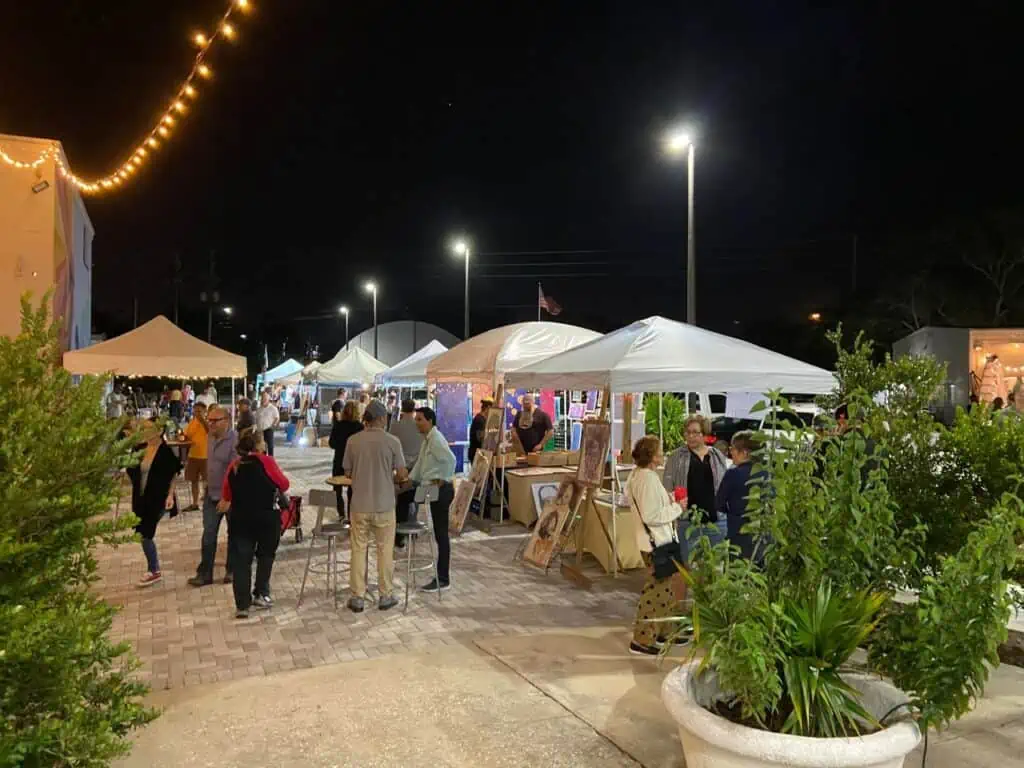
The AX Theater @ WADA is located on the ArtsXchange campus at 515 22nd Street South (home to the monthly Second Saturday Art Walk), and provides a beautiful outdoor gathering place in the heart of St. Pete’s arts community. When activated, the venue showcases art, food trucks, bars, local businesses and more, alongside performances and screenings on the newly-constructed stage. The new facility is a boon for the arts community in St. Pete and makes the ArtsXchange even more of a must-try experience.
First up for the new theater is a joint production with the Sunscreen Film Festival – a screening of LIFT, the moving and powerful documentary centered on Steven Melendez and his journey from a homeless child to a star in the world of ballet, now the Artistic Director of the NY Theatre Ballet. The screening takes place on Friday, April 28, a perfect pairing with St. Pete’s Academy of Ballet Arts, located on the ArtsXchange campus.
Melendez will be on site for a meet and greet beginning at 7 pm, followed by the screening at 8 pm and a Q&A session following the documentary. Tickets for the screening are available through the Sunscreen Film Festival, and be sure to scroll ALL the way down and select the nighttime showing at ArtsXchange (not the morning screening at The Sundial).
Two days later the ArtsXchange Stage will host a two-part celebration of International Jazz Day on Sunday, April 30. The headliner is the U.S. premier of Sincopa, a music-centered Mexican independent film that breaks away from Hollywood stereotypes of the country while telling a story about friendship. Much of the cast and production team are actually flying in from Mexico for the premier and will be on hand for a meet and greet at 6 pm and then a screening of Sincopa at 8 pm.
In between the meet and greet and the film, the incredible O Som Do Jazz septet will perform at 7 pm, recapturing the spirit of Brazilian Bossa Nova, Samba-jazz, and Ballao. Tickets for the Jazz Day celebration are $15 (or $12 for WADA members).
Finally, Mother’s Day will bring one of the year’s most emotional, moving, and absolutely important experiences to St. Pete. “The Instrument of Hope” will be a deep and sweeping conversation about gun violence in our community and our world, an intentional effort to keep the topic on the main stage. Hosted on Sunday, May 14, from 4-7 pm, the experience will feature a panel discussion among local and international leaders, followed by a performance from world-renowned Canadian musician Bria Skonberg.
Skonberg, who waived her usual fee to be a part of this special event, will be performing with the event’s namesake instrument, a trumpet titled The Instrument of Hope. The trumpet was created with spent bullet casings from the Parkland tragedy to serve as a reminder to never forget how important the conversation must be. The instrument will make its St. Pete debut for one night only. Tickets for the event are $15 (or $12 for WADA members).

If you haven’t been to an event at ArtsXchange, add it to your list soon. This bustling artistic hub is a melting pot of creativity, where local artists, performers, and art enthusiasts come together to celebrate the magic of the arts. Nestled in the heart of the city, ArtsXchange is a dynamic space that houses a myriad of studios, galleries, and performance spaces, showcasing the diverse talents of the community. From captivating visual art exhibitions to incredible live performances, ArtsXchange is a thriving cultural hub that ignites the senses and fosters a sense of community through the power of art.
The Warehouse Arts District Association is a non- profit arts organization dedicated to creating a vibrant arts community within and around the Warehouse Arts District in St. Pete. Their mission is to build and sustain a vibrant arts community that supports the success of all artists and the community at large through a broad spectrum of tools, including community revitalization, marketing, advocacy and educational programming.
They are a cultural arts destination in the heart of downtown St. Petersburg dedicated to flourishing our community through artistic endeavors, support, and highly curated art.





