About

Posts by :

Intrepid Makes Large Format Photography More Accessible With New Shutter and Lens

Intrepid Makes Large Format Photography More Accessible With New Shutter and Lens

A close-up of a wooden large format camera with bellows, mounted on a tripod against a blue background. A person is holding a remote control attached to the camera, preparing to take a photograph.

British large format photography company Intrepid Camera, known for its handmade 4×5 cameras, has launched a new lens and electronic shutter system for large format cameras on Kickstarter.

The Intrepid Lens and Shutter Project, which has already shattered its Kickstarter funding target after a day, comprises the Intrepid 150mm f/6.3 lens and the Intrepid I-0 Shutter.

Starting with the lens, it features a compact and lightweight Cooke triplet design. The 150mm f/6.3 lens, given the vast image area of large format, delivers a depth of field similar to an f/1.8 lens on a full-frame camera. Intrepid notes the lens has a big enough image circle to support tilt and shift movement, “one of the unique selling points of large format.”

A pair of hands holding two different-sized camera lenses against a black background. The left hand holds a larger lens with visible glass elements, while the right hand holds a smaller lens with a similar design.

The lens promises “excellent sharpness” when stopped down to f/11 and beyond and “nice bokeh” when used wide open at f/6.3. Intrepid notes that the lens delivers beautiful color rendering.

For lens design enthusiasts, here are some images from the notebook of Intrepid’s head designer (Will).

“There are plenty of 150mm 4×5 lenses out there,” Intrepid acknowledges, “but one of the main barriers to entry we get from first time customers is how intimidating it is to find all the second-hand equipment needed to put together a 4×5 kit.”
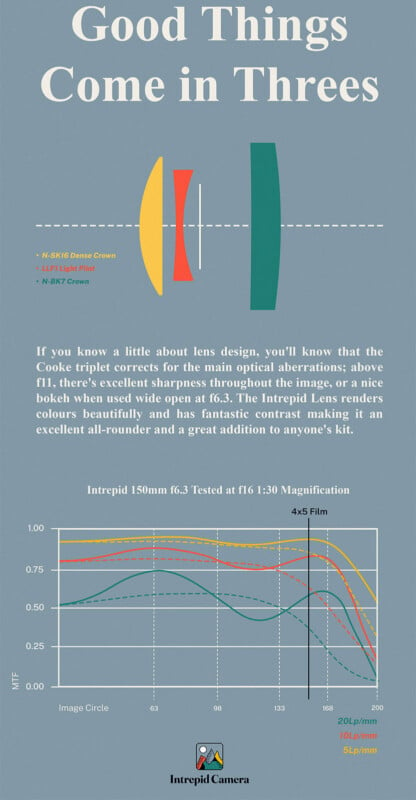
Informational poster advertising the Intrepid 150mm f6.3 camera lens. It features a chart comparing the MTF (Modulation Transfer Function) of different lenses, highlighting the sharpness and all-around performance of the Intrepid lens for 4x5 film photography.

With the film holders Intrepid launched last year, plus the new lens and shutter, Intrepid believes it has significantly reduced the barrier to entry for new customers.

A close-up of a camera lens module connected by a cable to a handheld device with an LCD screen and buttons. The setup is on a smooth, dark surface, with both devices casting slight shadows. The overall lighting is soft and dim.
Intrepid I-0 Shutter

Speaking of the Intrepid I-0 Shutter, the company says the shutter is “like a super smart cable release with a screen.” The electronic shutter is compatible with all Copal 0 size lenses and supports shutter speeds as long “as you want” to 1/125s. It also includes a self-timer function. “Just set your target aperture and ISO to get live EV readings so. You don’t have to keep going back to your light meter,” Intrepid explains.

The shutter includes a shutter-open warning, works with modern flash equipment via a 3.5mm jack, and can be controlled directly from a connected Mac or PC. The shutter mechanism has a rechargeable battery, which charges via USB-C. The shutter controller is enclosed within a weatherproof aluminum body and features a bright screen suitable for outdoor use.

Close-up of a black industrial camera lens mounted on a flat, square base. The lens has text on its rim and is connected by a cable extending from the left side. The background is a smooth, dark surface.

A person holds a square, black, wired camera and a rectangular remote control device in their hands against a gray background. The camera has a circular lens in the center, and the remote control has a digital display and various buttons.

Much like with the new 150mm f/6.3 lens, Intrepid is looking forward and considering new photographers with its electronic shutter.

“There are still a lot of second hand mechanical shutters out there, but they are not getting any younger and the skills required to repair them, as well as spare parts, are getting harder to come by. You don’t exactly get people starting a career in large format shutter repair anymore. So an alternative solution is quickly needed and we think we have it,” the company explains, noting that it has invested heavily into the design of this new shutter, which required 18 months of continuous work.

Pricing and Availability

The Intrepid 150mm f/6.3 lens is available to early backers for £189, which is just over $250. It is expected to ship in February 2025. The Intrepid I-0 Shutter starts as low as £289 (about $390) and includes the shutter mechanism itself and the shutter controller. The shutter is expected to begin shipping next March.

Photographers interested in diving headfirst into large format photography can pledge £729, or about $980, to get the 150mm f/6.3 lens, Intrepid I-O shutter, and Intrepid 4×5 camera in a bundle. This, like the shutter itself, will ship in March 2025. A complete breakdown of all available backer options is available on Kickstarter.

While all Kickstarter campaigns must come with the usual disclaimer below, it is worth noting that this is Intrepid Camera’s fifth Kickstarter campaign. While occasionally met with delays, the prior four have been successful and culminated in complete, shipped products.


Disclaimer: Make sure you do your own research into any crowdfunding project you’re considering backing. While we aim to only share legitimate and trustworthy campaigns, there’s always a real chance that you can lose your money when backing any crowdfunded project. PetaPixel does not participate in any crowdfunding affiliate programs.


Image credits: Intrepid Camera

A Gentle Portrait of Transness That Goes Against the Grain

A Gentle Portrait of Transness That Goes Against the Grain

Carson Stachura’s Palm Prize-winning series My Body is a Weapon (Waiting At Your Door) captures the realities of trans experience by placing agency in the hands of their subjects

September 25, 2024

There’s something otherworldly to Clem (As You Are), the photograph by Carson Stachura that won the judges’ panel special mention for the 2024 Palm Prize. In it, the eponymous subject stands, lit by theatrical lighting in a white shirt, cigarette in hand, and a pair of angel wings. According to Stachura, this image was born from a spontaneous shoot after the photographer remembered they had angel wings in their closet. Inspired by the Brooklyn drag scene, where people “take their existing look and fuck with it, and think of gender expression in a very dragged up way,” the photographer describes their practice as being deeply collaborative. “Conveying the experience of my subject is really crucial,” they explain. 

But while both their Palm Prize-winning photograph, and their series My Body Is a Weapon (Waiting at Your Door) explore ideas around gender presentation, they also challenge one of the most hotly contested ideas in contemporary queer culture: the trans archive, what it can hold, and the purpose that it can serve. From its genesis, Strachura’s series challenged the idea of how we might think of an archive; they reveal that My Body Is a Weapon came about while exploring the idea of “the archive as a site of violence and photography’s role in maintaining that.” For Strachura, this is rooted in ideas around the “trans portrait” in the work of sexology clinics, and the “post-transition glamour shots” in the Digital Trans Archive. The more time they spent diving into this archive, the more the idea became clear that “trans people experience the violence of being looked at without consent”.

Throughout their practice, Stachura aims to reorient this idea; in images like their self-portraits from the spring and summer of 2023, to the intimate embrace of Eliana and Claire (Long Distance Lovers), their images capture the realities of trans experience in a way that places agency in the hands of their subjects, a stark simplicity that so often is missing from our understanding of trans imagery. By capturing solitary moments rather than narratives of transition – Stachura says that “clinical view of transness as having a distinct beginning or end doesn’t resonate at all with me” – their series is able to focus on “gender fuckery in myself and my chosen family”. 

The idea of chosen family – something well known in queer circles, whether as a trope in so much of popular culture, or a way of understanding our own communities – is at the heart of the series My Body Is a Weapon, images that were shot “during my last semester of undergrad with an understanding of how that moment in time was fleeting. For a lot of us, it marked a period where we began articulating what we desired our bodies to be, as well as our relationships with each other,” says Stachura. There’s a comfort and ease to photos like Ezra, pre-op which reveal the intimacy of these relationships, and seem to capture Stachura’s hopes “not to participate as a voyeur”.

Alongside these portraits of chosen family, My Body Is a Weapon has a sly, if-you-know-you-know sense of humour embedded within it, from still lifes adorned with bananas, syringes, pills, and packers, to Untitled, a cracked egg presented without comment. Stachura hopes that their work will cause “viewers, trans people included, to think deeply about how they engage with trans history and what becomes illegible, not understood nor recognised, within these records”. They stress the fact that this work alone isn’t the only thing “redressing historical harm and archival violence”, emphasising how their photographs showcase just one of the many ways in which we might understand trans lives and communities. 

But it’s this focus on specific experiences and groups of people that gives the work is power, and which allows us to reconsider the role the archive plays in how we understand ourselves. In describing their process, it becomes clear that Stachura’s photos are propelled by the impulse to let their subjects see themselves, in whatever form that might take, informed by conversations that they have with subjects before any pictures are taken. Their hope is that the gender-fuckery and flamboyance of their images feel like “a still-resonant extension of the subject themself, and for the subject to ultimate feel and be affirmed”. It’s in this drive towards affirmation, and the desire to zero in on the details and intimacies of specific trans lives, as opposed to trying to speak to and for a capital-c Community, that My Body is a Weapon reveals the many ways in which we can embody and imagine trans experiences; that there are more things in heaven and earth than are dreamt of in a single archive.

The Palm* Photo Prize Exhibition is on show at 10 14 Gallery in London until 3 October 2024.





