About

Posts by :

Photographer returns to south Wales mines after 1980s strike

Photographer returns to south Wales mines after 1980s strike

5 hours ago

By Natalie Grice, BBC News

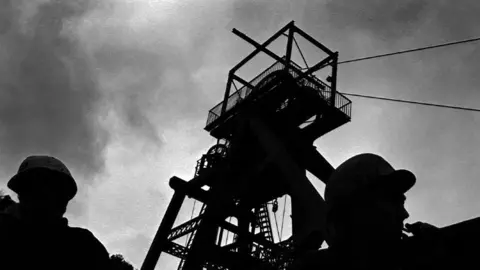
imageRoger Tiley Miners in silhouette at Celynen South before the strike had begunRoger Tiley

“I was planning to go and find a war or something when I finished my course. And in a way the war was on my doorstep.”

The “war” referred to by photographer Roger Tiley is the 1984-85 miners’ strike that began a few short months before he was due to finish his degree in Newport, and which altered the course of his emerging professional life.

It saw him roam the south Wales valleys, showing the mining community he had grown up in as it battled for its very existence, sending his photographs off to newspapers in London.

The year-long strike ended in defeat for the miners, and was followed by the rapid closure of the pits that had formed the backdrop to Roger’s life.

Now he has retraced his steps across the coalfield from the south-east Wales valleys where he grew up to his present home in the Swansea valley, to raise money for the Alzheimer’s Society and look at the transformation of the landscape in the intervening decades.

As a local boy, Roger had already spent some time taking pictures in the collieries in the year or so before the strike began, and this relationship allowed him access to communities which knew and trusted him.

“I’m originally from Cross Keys in the Gwent valleys and some of my friends went to work in the collieries,” he said.
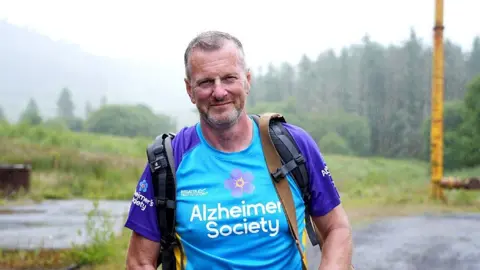
imageRoger Tiley walking in an Alzheimer's Society t-shirt

“Jobs didn’t seem to be much of a problem in the 1970s. If you wanted to work, you could get a job in a factory, in the steel industry or in the collieries. Within 10 or 15 miles of me there were quite a few collieries still working, around about eight.

“The miners’ strike was very hard but I think I look back on it with fond memories in the fact that people were so good to me and so helpful.

“It’s a time that was desperate for a lot of mining families up in the valleys and I think what they were fighting for I believed in.

“I was very careful of where I turned the camera because I didn’t want anybody using the pictures in the way that I didn’t intend them to be used.”

imageRoger Tiley Miners underground coming out of a liftRoger Tiley

In between taking photographs, Roger also got involved with helping support the miners and distributing food parcels, which he “really loved. I’m proud I had the opportunity to do that.”

One of the sites that holds particular resonance for him is Celynen South colliery near Abercarn in the Ebbw valley, where he first documented the working life of a colliery.

“That’s where I started taking pictures. I wrote to the manager and he said I could come up,” he explained.

“There’s two miners waiting to go underground and there’s a pithead wheel in the background and it’s a very graphic picture. Over the years it’s been used time and time again.”

Roger returned to the closed pit after the strike ended and he was commissioned to document the impact it had had on the valleys.

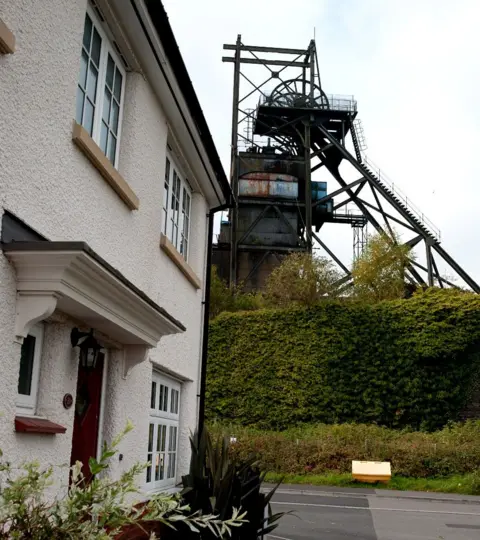
imageRoger Tiley Housing estate on the site of the former Celynen South collieryRoger Tiley

Roger returned to the closed pit after the strike ended and was commissioned to document the impact it had on the valleys.

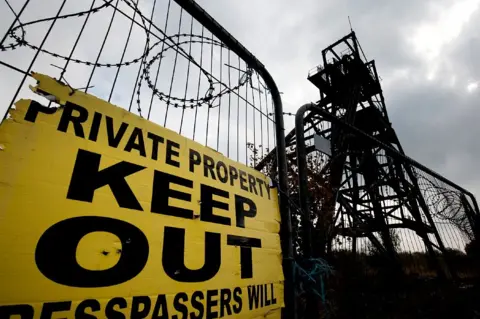
“One of the first set of pictures that I took of the actual area, the landscape, was Celynen South. It was very sad. In those days they didn’t fence things off. They just demolished the pit and you could just walk on to it, which I did.

“Some of the buildings were demolished, the pithead wheel was there but some of the ropes they used for the cage had gone. It just looked really sad.”

“There’s a housing estate on the colliery site now. There isn’t anything really to mark that there was a pit there.

“In a way I suppose that’s positive; it isn’t wasteland any more. It was for a good few years, but now at least there’s houses on there providing homes for people.”
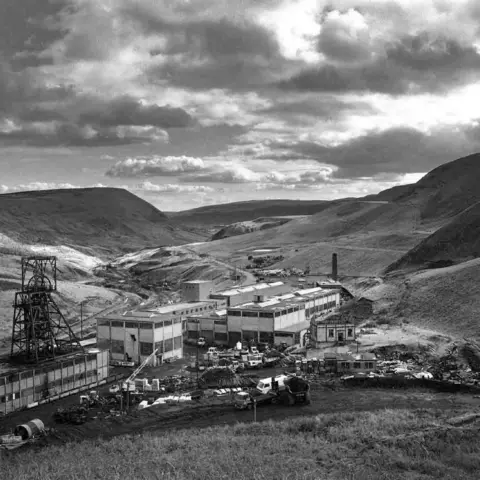
imageRoger Tiley Mardy colliery in 1985, with the pithead and other buildings in the forefront, and mountains behindRoger Tiley

The changes to the landscape vary widely across the former coalfields.

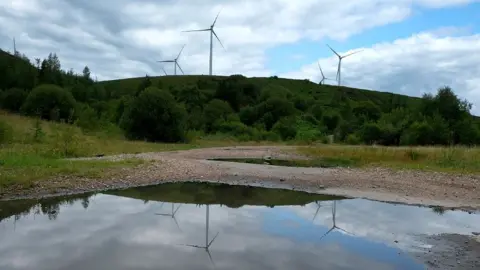
“Some have factory units on them, half-empty I would say. Mardy [colliery in Maerdy, Rhondda Cynon Taf] is one place where you could walk up there and unless you knew there was a colliery, you wouldn’t [be able to tell].

“There’s some concrete bases there from the buildings and there’s some tiles from the pit canteen that are still there, but youngsters wouldn’t really know that.”

Other places like Penrhiwceiber in the Cynon valley have become playing fields.
imageRoger Tiley Mardy colliery siteRoger Tiley

While he acknowledges the good in reusing sites, Roger laments the loss of so many jobs and the community they engendered.

“Each pit would have employed in the region of 1,000-plus men. If you multiply that by 30, 31 pits still working at the time of the strike, that’s a lot of men, and all the industries around it, suppliers etc.

“So you’re probably looking at 40,000-50,000 people employed in the south Wales coalfield, and that’s all gone.”
imageRoger Tiley Ray LawrenceRoger Tiley

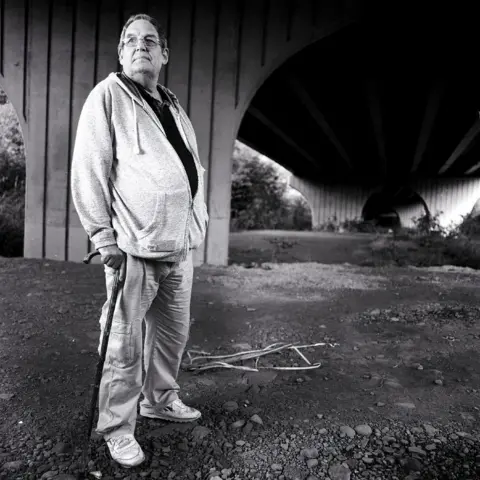
Ray Lawrence, NUM lodge secretary at Celynen South for 14 years, worked as an electrician for 25 years in the mine and joined Roger as he reached the pit on his six-day walk.

“It’s hard to imagine it now,” said Ray. “I’m looking around and it’s so peaceful. But 40 years ago there was a dirty great big hole in the ground there and every morning 500 or 600 men would disappear down there.

“The place was vibrant. There was the rattle of the trams, the whirr of the winder, everything was going on, it was alive,” he said.

“There was a fence where everyone would stop and have a cigarette when they came up or before they went down. It was a real, living experience.

“Mining is a difficult thing to explain. To people outside of it, they think it’s a dirty, horrible job, which it was, but the camaraderie made up for that and it’s hard to let it go. You talk to men 40 years after and the majority of them say ‘I’d go back tomorrow if I could’.”
imageRoger Tiley Zip World Tower with the old pit head winding gear seen through the windowRoger Tiley

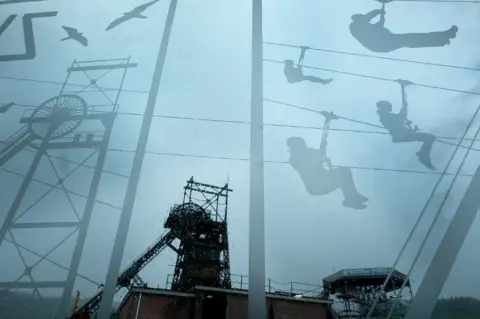
Liam Willetts is the marketing co-ordinator for Zip World Tower, a high-adrenaline activity complex on the site of the old Tower colliery near Hirwaun, Rhondda Cynon Taf, and one of the stopping points on Roger’s walk.

Tower was a rare success story post-strike, as its workforce banded together and bought it in 1994, keeping it operational until 2008 when it became the last deep coalmine in the UK to close.

Zip World opened zip lines and other attractions on the redeveloped land in 2021, but Liam said its mining past was central to the site.

imageLiam Willetts standing in the equipment room at Zip World Tower

Liam said: “The staff talk to all the customers, tell them the history of the site, and everyone’s really interested, especially the locals.

“It’s great to see that it’s been preserved in some sense as well. I think that was carefully thought through when building this site as a Zip World attraction.

“We’ve got some stories and newspaper cutouts that people like to look at. A huge part of the attraction is the history and the heritage.”
imageRoger Tiley Mine winding gear with a keep out sign, fencing and barbed wire in front of itRoger Tiley
imageRoper Tiley House near the winding gear at the former Penallta collieryRoper Tiley

The landscapes of the coalfields have changed enormously, sometimes beyond all recognition. Nature has reclaimed many, and the environmental impact in climate terms cannot be doubted.

Roger acknowledges this: “The valleys are very green now. I live in Ystradgynlais and it’s a stunning place. There’s people from outside coming in to live, it’s a pretty, much sought-after area.

“The old coal [railway] lines are being used for people commuting to Cardiff, Newport and Bristol.

“So they’ve changed. For the better? I don’t know. I grew up in the 60s and I played on the coal tips, so that’s what I love.

“But then you walk outside and there’s these beautiful walks on the mountains and everything is green and lush. It’s a difficult argument.”

The big picture: Louis Stettner on commuters in 1950s New York

The big picture: Louis Stettner on commuters in 1950s New York
image

The ability to manipulate a broadsheet newspaper on a crowded commuter train is one of those skills, like full attention and mental arithmetic, mostly lost to our digital world. Louis Stettner’s photographs from the 1950s are fascinated by these images of a New York newsprint world, the ways in which ordinary Americans demanded information morning and night, as if they had a feeling that might soon be going out of style.

Many of Stettner’s pictures of that period were taken at Penn station. They contrasted with an earlier series of portraits taken on the New York subway. There, subjects had looked his camera squarely in the eye. Here, his people are mostly in worlds of their own; he liked scenes from “the smoke, fumes, the bustle” of the city, in which there were “still moments or stray corners that have sometimes touched eternity”.

This image is included in a full retrospective monograph of Stettner’s long life and career (he died in 2016, aged 93). The collection traces the ways in which he developed a profound kind of empathy. Much of this, he later suggested, dated back to being a combat photographer during the second world war, an experience that gave him a deep sense of connection with “my fellow countrymen – fishermen, industrial workers, storekeepers – whom I had previously only brushed up against in Times Square”. Stettner was among those artists who took advantage of the GI bill to be based in Paris, where he befriended celebrated photographers, including Brassaï, and his work subsequently became an important link between French and American street portraiture. You can feel him experimenting with some of that Parisian spirit in these pictures from the 50s: in his interest in a society, rather than the individual, and in a quiet love of the quotidian, of people going about their routines, alone together.

Acclaimed local photographer Dan Jordan announces August display at Olean Library

Acclaimed local photographer Dan Jordan announces August display at Olean Library

Don’t miss the reception on August 2 to kick off the residency

From Dan Jordan,

The Olean Public Library will host an exhibition of my wildlife images during the month of August 2024. Almost all of the images were captured in 2024, so have never been exhibited before. There will be a reception on August 2 at 4 PM with refreshments served. At the reception, you can meet the artist (that’s me!) and ask any questions you may have about my display or my methods for capturing compelling wildlife photos.

I am presenting my images differently from past exhibitions. I will have clusters of photos of a common theme. As of now, I am planning on having 10 different clusters of images on display. There will be as many images on display as the ‘walls will hold’!

2024 has been a banner year for wildlife photography. My collection of images reflects that.

I hope you can attend the reception or visit the library any day during August to view my images. If you are coming from out of town specifically to see the exhibition, call the library to make sure that the exhibition room is not going to be occupied, they sometimes host meetings in that room. (716.372.0200)

I look forward to seeing you there!

Need2Know: Darnell Renee Photography opens studio in Prescott; NOAH Thrift Store in Prescott celebrates 25 years; Recovery Electric opens in Prescott Valley

Need2Know: Darnell Renee Photography opens studio in Prescott; NOAH Thrift Store in Prescott celebrates 25 years; Recovery Electric opens in Prescott Valley
image

Darnell Renee Photography opens studio in Prescott

Darnell Renee Photography cut the ribbon on its new studio at 110 S. Montezuma St., Suite H, in the Hotel St. Michael building in Prescott in June.

This page requires Javascript.

Javascript is required for you to be able to read premium content. Please enable it in your browser settings.

Why One Great Shot Is Better Than Hundreds in Landscape Photography |

Why One Great Shot Is Better Than Hundreds in Landscape Photography |

In landscape photography, there’s often a misconception that success is measured by the number of great shots captured in a single outing. However, this mindset can be limiting and lead to burnout for many. Sometimes, the true reward comes from capturing just one exceptional shot. Focusing on quality over quantity not only enhances your craft but also deepens your connection with the landscape. Here’s why and how to embrace this approach.

The Pressure of Multiple Shots

Modern digital photography makes it easy to take numerous photos in one session, potentially leading to:

  • Burnout: Constantly striving for multiple perfect shots can be exhausting.
  • Shallow Engagement: Rapid shooting can prevent a deep understanding of the landscape.
  • Overwhelmed in Post-Processing: Sorting through many images is time-consuming and can detract from the creative process.

The Joy of One Good Shot

Focusing on capturing one exceptional image can change your approach to photography today and long into the future:

  • Increased Focus and Patience: When aiming for just one good shot, you become more focused and patient. You spend more time observing the landscape, studying the light, and considering your composition, leading to more thoughtful and stronger images.

  • Mindful Observation: Instead of rushing to capture every potential scene, you slow down and observe more mindfully. You notice subtle changes in light, weather, and atmosphere that might have gone unnoticed in a hurried shoot.

  • Creative Fulfillment: There’s a unique satisfaction from knowing you have captured a moment perfectly. One well-executed shot that tells a story or evokes a strong emotion can be more rewarding than a hundred mediocre ones.

Case Study: Old Walls and Trees on a Hillside

Imagine exploring an undulating hillside with old stone walls intersecting at various points, creating a natural grid. At one such intersection, you spot two trees, perfectly placed to create a balanced composition. You decide to focus on capturing this scene.

You set up your tripod and compose your shot. The light is constantly changing as clouds move across the sky, casting shadows and beams of sunlight intermittently. Instead of trying to capture every variation, you choose to wait for the perfect moment when the light will highlight the trees and the walls, adding depth and contrast to the scene. This exact thing happened to me recently, and I was glad I was able to switch gears and focus on getting just one shot from the outing.

Techniques for Capturing One Good Shot

  1. Scout and Plan: Spend time scouting your location. Understand the best vantage points and plan your shoot around optimal lighting conditions. Arrive early and stay late for unique lighting opportunities.

  2. Use a Tripod: A tripod stabilizes your camera, allowing for precise compositions and long exposures. It also forces you to slow down and consider your shot more carefully. Once you have your composition locked in, you know you won’t have to reframe it again until that precise moment happens.

  3. Observe the Light: Light is the most critical element in landscape photography. Watch how it changes and interacts with the landscape. Be ready to capture the moment when the light is just right. There will no doubt be many near misses, and this is something you need to consider, but I suggest even taking these near-miss shots, as you never know if the light will return after all.

  4. Compose Thoughtfully: Pay attention to the composition. Use the rule of thirds, leading lines, and natural frames to create a balanced and engaging image. Once you have this done, it’s time to fine-tune and look for any elements that are intersecting or need to be removed from the scene.

  5. Be Patient: Patience is key. Good light and perfect moments don’t happen on demand. Be willing to wait and observe. At times, you may feel like giving up on your mission, but with practice, you will get the rewards.

  6. Shoot in raw: Shooting in raw format provides more flexibility in post-processing, allowing you to recover details from shadows and highlights and adjust the image without loss of quality. So check those settings are in place as you don’t want to get home and realize that you shot in JPEG.

  7. High-Speed Continuous Mode: For dynamic scenes where the light changes rapidly, using high-speed continuous mode can help you capture the perfect moment without missing it.

The Reward of Waiting

In our example, you patiently wait for the right moment when a beam of sunlight breaks through the clouds, illuminating the two trees and casting shadows that highlight the texture of the stone walls. This moment transforms the scene, adding depth and contrast that weren’t there before. You capture the shot, knowing you’ve created something special.

At its core, landscape photography is about capturing the essence of the natural world. It’s about being present, observing, and connecting with the environment. When you focus on getting one good shot, you’re forced to engage more deeply with the landscape, becoming attuned to its rhythms, light, and mood.

This approach not only leads to better photographs but also enriches your experience as a photographer. It reminds you why you fell in love with landscape photography in the first place – the joy of being in nature, the thrill of chasing the perfect shot, and the satisfaction of capturing a moment that resonates.

Conclusion

In landscape photography, sometimes less is more. Focusing on capturing one good shot can be more rewarding than trying to take multiple average ones. It encourages patience, mindful observation, and a deeper connection with the landscape. By embracing this approach, you’ll not only improve the quality of your photographs but also find greater fulfillment in your photography journey.

Remember, the goal is not to fill your memory card with countless images but to capture a moment that tells a story, evokes emotion, and showcases the beauty of the natural world. So next time you head out with your camera, slow down, observe, and aim for that one perfect shot. It might just be the most rewarding image you ever capture.

Have you tried this approach, and it failed or worked? Or perhaps you are a run-and-gun photographer who can’t be bothered with this waiting game? Let’s continue the conversation in the comments below.

Creating Modern Fashion Photography: Gian Paolo Barbieri

Creating Modern Fashion Photography: Gian Paolo Barbieri

As an innovator of fashion photography, Gian Paolo Barbieri’s various approaches and techniques helped to shape modern fashion photography.

Just as there was a reawakening of Italian fashion design, Barbieri made a point of becoming a friend of the designers. By befriending and eventually understanding their style and design, Barbieri was able to become a champion of the new era of Italian fashion and costume designers.

In doing so, Barbieri was able to be a driver of this reawakening of Italian fashion popularity.

Barbieri also helped to move fashion photography out of the catalogue by using innovative set design and styling. eclectic outdoor set design in exotic locations.

For Barbieri, fashion photography without art is empty, and so, he drew on his deep knowledge to enrich his shoots with references to art history.

Barbieri also relied on cinematic grandeur to help his images stand out. Not just replicating ideas, but shooting in a way to expand the conversation.

If you’re in the neighborhood, you can see Barbieri’s newest exhibit at House of Louvre Ostuni, in Ostuni, Italy. The exhibit is showing off many masterworks by Barbieri, as well as some previously unpublished photographs dating back to the 1960s.

All images used with permission.

Paratrooper in iconic 1967 Western Wall photograph dies at 81

Paratrooper in iconic 1967 Western Wall photograph dies at 81

Dr. Yitzhak Yifat, one of the three Israeli paratroopers seen in the 1967 photo of soldiers at the Western Wall, an iconic image of the Six-Day War, died on Saturday at the age of 81. Popularly dubbed “The Crying Paratroopers,” even though no one in it is crying, the photo became one of the most famous in Israeli history.

.htz-loader-circle{
-webkit-transform-origin:center center;
transform-origin:center center;
-webkit-animation:htz-loader-animation 1.5s infinite linear;
animation:htz-loader-animation 1.5s infinite linear
}
@-webkit-keyframes htz-loader-animation{
0%{
-webkit-transform:rotate(0);
transform:rotate(0)
}
100%{
-webkit-transform:rotate(-360deg);
transform:rotate(-360deg)
}
}
@keyframes htz-loader-animation{
0%{
-webkit-transform:rotate(0);
transform:rotate(0)
}
100%{
-webkit-transform:rotate(-360deg);
transform:rotate(-360deg)
}
}

The Journey from Technical Perfection to Creative Freedom in

The Journey from Technical Perfection to Creative Freedom in

Understanding the mechanics of a camera can be comforting. You set things up, press a button, and voilà, you get a photograph. However, there’s more to it than just pressing a button.

Coming to you from Alex Kilbee of The Photographic Eye, this thought-provoking video explores why pressing the shutter can cause so much anxiety. Kilbee starts by reminiscing about his first camera, a toy model. As a kid, he didn’t care about the technicalities. He just snapped pictures of friends without a second thought. This carefree approach changed as he learned more about photography. The more he learned, the more anxious he became.

Kilbee highlights the technical focus during his first year at photo school. It was all about film processing, image printing, and understanding apertures and shutter speeds. This technical knowledge felt safe and replicable. You follow steps and get predictable results, much like building a LEGO set with instructions. But this safety net of technicality also brought anxiety. Straying from the formula meant opening up to criticism.

Ansel Adams once said you don’t make a photograph just with a camera. You bring all your life experiences into it. Kilbee struggled with this idea. He wanted his photos to be edgy and cool but lacked the confidence to explore creatively. A specific assignment at photo school, shooting a still life, highlighted this struggle. His technically perfect photo was likened to a picture from a mundane magazine, which he found disheartening. This incident made him realize that technical proficiency alone wasn’t enough.

Kilbee’s journey toward embracing creativity took a turn when he discovered the Holga camera. A friend introduced him to this simple, plastic camera that stripped away all the technical concerns. It had basic settings and was all about capturing the essence of a moment. This experience was liberating, allowing him to focus on seeing the world differently and creating unique images.

Reflecting on his experiences, Kilbee found that overthinking technical perfection often overshadowed creativity. This realization was a turning point. He started incorporating his personal experiences and interests into his photography. This blend of technical skills and creative expression led to more fulfilling work.

Kilbee advises embracing both technical and creative aspects. Some of his photography, like portrait work, leans on technical precision. Other times, he lets go of technicalities to explore creativity, such as with his iPhone photography. This balance helps quiet the anxiety that comes with pressing the shutter and allows for a richer photographic journey. Check out the video above for the full rundown from Kilbee.

The end of an era in Lowville as Urbaniaks retire from photography business

The end of an era in Lowville as Urbaniaks retire from photography business
image

LOWVILLE — After 50 years of yearbook photos, senior pictures, weddings and commercial photography Tony and Linda Urbaniak have closed Urbaniak Studio and Color Lab.

The Urbaniaks met in high school, although Mr. Urbaniak studied to be a machinist at BOCES he had worked on the yearbook and decided to instead pursue a career in photography.

A new ‘mini monograph’ provides the perfect introduction to the divisive work of Mary Ellen Mark

A new ‘mini monograph’ provides the perfect introduction to the divisive work of Mary Ellen Mark

Thames & Hudson continues to make photography books more accessible by adding to its Photofile range.

This lineup of books showcases some of the finest photography from some of the best photographers of all time, all in an affordable and pocket-sized format. Each book provides a fantastic overview of the titular photographer’s work, and an insight into their practice via a detailed foreword. 

The award-winning photography book series already hosts an impressive list of photographers such as Sebastião Salgado, Helmut Newton, Gordon Parks, Don McCullin and Sophie Calle – and now comes the addition of Mary Ellen Mark.

Putla in front of a mirror. Falkland Road, Mumbai, 1978 (Image credit: © The Mary Ellen Mark Foundation)

Mary Ellen Mark was no doubt a divisive figure in the world of photography, but it cannot be understated that she left her mark on the medium.

As expressed in the book’s critical introduction, written by Caroline Bénichou, Mark’s work is often difficult to categorize, falling into the genres of reportage, documentary, and portraiture. 

But the one thing consistent in all her work is her ability to capture the human condition, capturing an empathetic bond between subject and viewer.

Tiny in her Halloween costume. Seattle, 1983 (Image credit: © The Mary Ellen Mark Foundation)

The 144-page ‘mini monograph’ includes images from Mark’s life’s work, including her celebrated series Ward 81, Falkland Road, Indian Circus and American Odyssey, as well as individual shots from her career not associated with a certain project.

Although the social context surrounding her subjects changes, Mark’s ability to capture each with an intimate and humane approach provides the viewer with greater insight and connection to them. Whether shots from a Hollywood set or an Indian circus, Mark transports you into the scene – and the Photofile book is a brilliant introduction to her work.

Mary Ellen Mark by Caroline Bénichou and published by Thames & Hudson is now available to order in the UK for £12.99. The US and Australian release date is yet to be confirmed.

(Image credit: © Thames & Hudson)

You may also be interested in our guides to the best books on photography, the best coffee table books, and the best books on portraits.