Art World News

Senior Art Director at Heart & Soul Marketing

Senior Art Director at Heart & Soul Marketing

Mediabistro: The #1 Media & Creative Job Board


Sorry, that job is no longer available.

Back to Jobs


Loading…

Cameron Art Museum hosting Handmade Holiday Market Nov. 4

Cameron Art Museum hosting Handmade Holiday Market Nov. 4
Photo: Cameron Art Museum

WILMINGTON (WWAY) — The Cameron Art Museum is hosting a Handmade Holiday Market on Saturday, November 4.

It’s happening from 10 a.m. to 4 p.m. at 3201 South 17th Street in Wilmington. There is a $5 entry fee, which includes entry into a drawing for a free household membership.

The event will help you get ready for gift giving this holiday season with a one-day shopping event featuring unique and handmade gift items created by local artists.

For more information visit CameronArtMuseum.org

The Harvest Room hosting November Art Market

The Harvest Room hosting November Art Market

The Harvest Room is hosting their first-ever Art Market and Small Business pop-up event Saturday Nov. 25 from 10 a.m. to 4 p.m.

In total, the show will feature 20 vendors selling art and four vendors selling food.

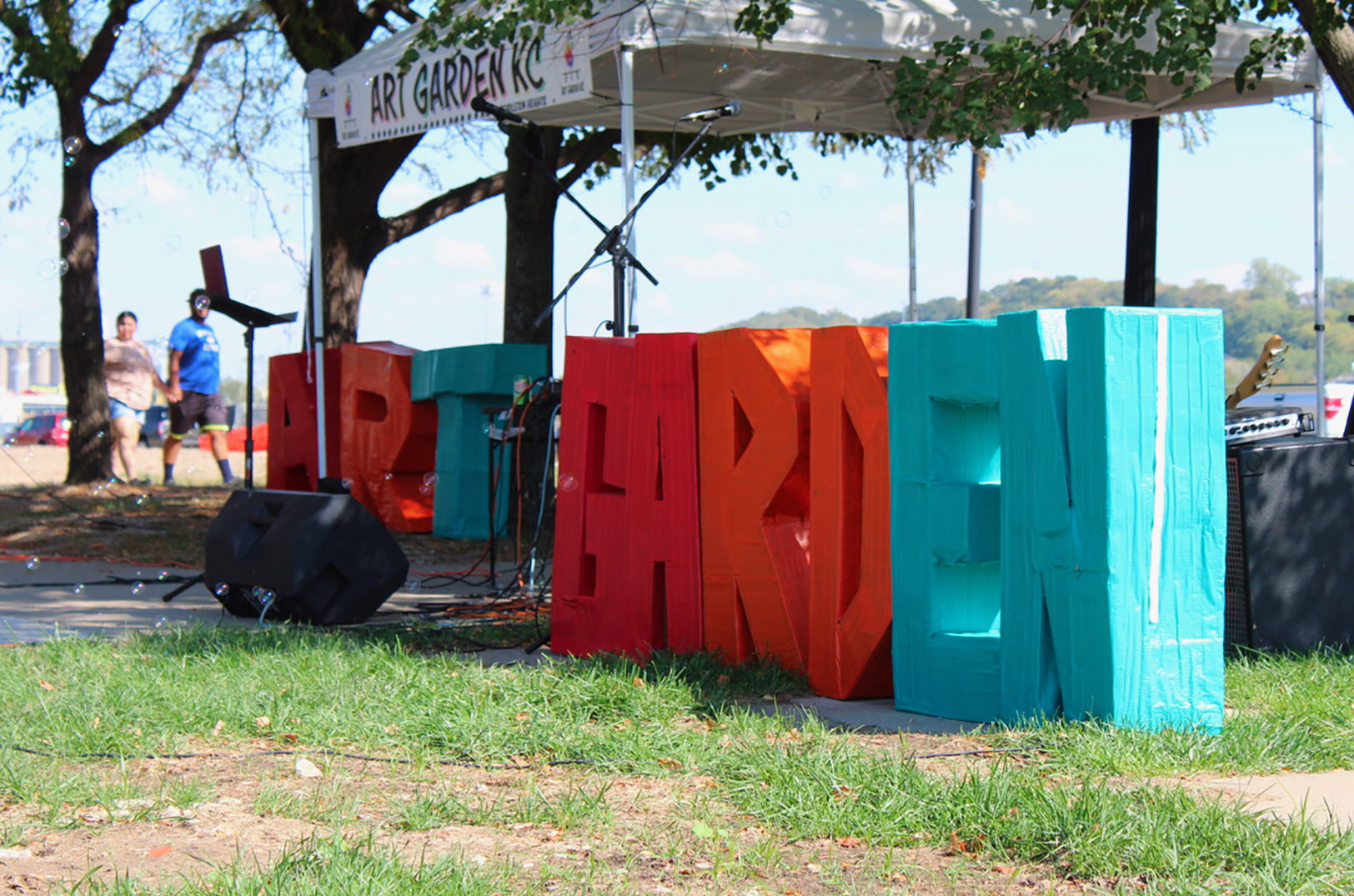
Art Garden KC grows maker market from Sunday pop-up to seasonal shopping experience

Art Garden KC grows maker market from Sunday pop-up to seasonal shopping experience

While unpredictable Midwest weather canceled the outdoor finale of Art Garden KC’s season this weekend at the Berkley Riverfront, the spirit of the maker market will pop up again soon with an indoor event in the Crossroads.

Art Garden KC’s Beggars Bazaar — set for 6 .m. to 9 p.m. Friday Nov. 3 — returns to the Beggars Table, 2010 Baltimore Ave., for First Friday. The open and inclusive church/gallery space is committed to supporting local arts, organizers said, making room for a number of Kansas City artists and makers.

Click here to learn more about Beggars Bazaar.

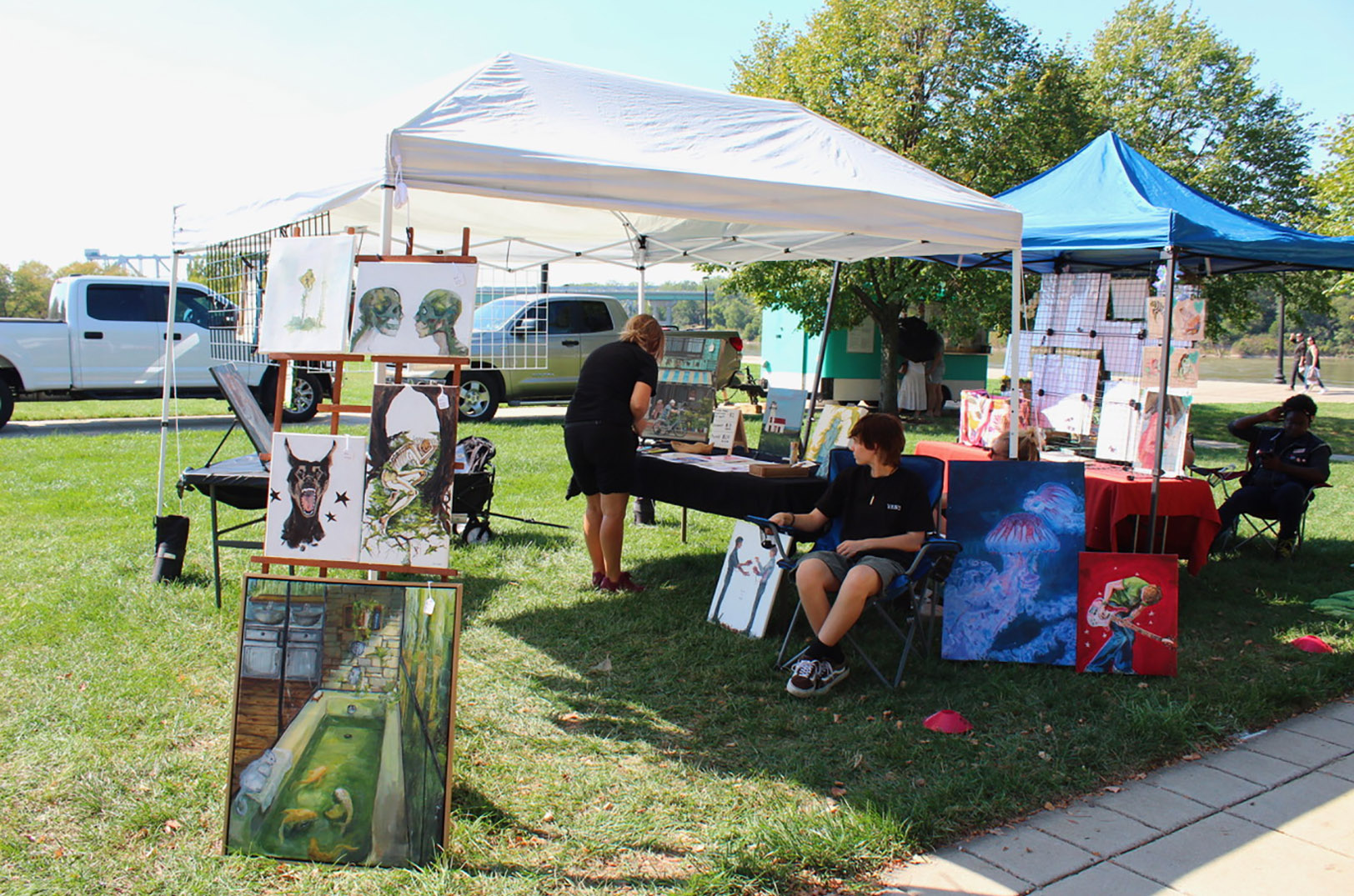
Art Garden KC, a grassroots, artist-led collective, organizes affordable, low barrier pop-up markets and festivals in Kansas City with the mission to create equal economic opportunity for local creative entrepreneurs while hosting engaging, community-centric events in safe, inclusive spaces for creative expression and collaboration.

It was set to close its third season — typically spanning April to October at Berkley Riverfront Park — this weekend with Halloween on the Riverfront, but the Sunday event was canceled because of recent prolonged rain and cold weather at the venue. 

More shopping opportunities are set to return on Black Friday, when Art Garden KC’s Merry Market opens at City Market. The holiday-focused event series runs weekends, Thanksgiving through Christmas.

Click here for details on the Merry Market.

Art Garden KC, fall 2023

It started with Sundays

Since 2021, Art Garden KC has brought together Kansas City artists every Sunday to build community and share their creations. Like many ventures popping up in the past few years, the effort was born amid new pandemic-era perspectives.

Bethany Alzandi, the founder of Art Garden KC, had just moved into the Pendelton Arts Block in Kansas City’s Northeast, an apartment community with a preference for artists and creatives in Pendelton Heights, with her husband Mustafa right before COVID-19 hit Kansas City.

Alzandi saw the need for a place for artists to come together more than ever, especially as COVID put a stop to all in person events in the community.

“You had a lot of great people and great artists that had moved in that were ready to start creating and collaborating and building some community programming in the Northeast area,” Alzanadi said.

“I feel like a lot of artists weren’t working or vending or showing their art throughout COVID,” she continued. “We felt that mental health had declined in the building we lived in, and substance abuse had gone up. So, we imagined that was something people were facing community wide.”

A year later, in spring 2021, Bethany and Mustafa organized their first event: a gathering of five artists in a field, coming together to share their crafts.

“We found an area across from our local coffee shop that was an outdoor space and chose to do something every Sunday. It was accessible for families, the after-church crowd, and a day when not much else was going on,” Alzanadi said. “We just started inviting artists from all over the city to come join us and hang out on Sundays.”

The Sunday meetups organically grew into an art market and received plenty of feedback from the community. They added spaces for other creatives to showcase their crafts, including an open mic and group yoga practice.

No imposters here

After organizing its 2022 season at City Market, the art fair found a new home at the Berkley Riverfront Park in 2023 with support from Port KC and the Troost Market Collective.

Art Garden KC, fall 2023

As its fiscal agent, Troost Market Collective allows Art Garden KC to keep its booth fees for vendors low — at just $10, Alzanadi said. Compared to other markets that might charge $150 to $500 in booth fees, this allows artists who are just starting out or have limited financial resources to participate in their festivals. 

Art Garden KC also provides local artists a place to build community and confidence, in addition to a venue to showcase and sell their work.  

“We had artists coming up and with tears in their eyes, saying, ‘Thank you so much. I made $300 today,’” Alzanadi said. “My husband and I looked at each other and said, ‘OK, we’ve got something here. There’s a need for this. The community supports it. Let’s start getting organized.’”

In the next year, Alzanadi said, she hopes to expand Art Garden KC by offering Vendor 101 classes to teach artists how to sell their work in markets and galleries. 

Alzandi has come far, she said — initially feeling like an imposter trying to break into the art scene when she first moved to Kansas City. Now, she’s inviting artists from across the city to hang out with her on Sundays.

“When you lower the booth fees, and you don’t tell people their art isn’t good enough to get in, it takes away that competitive nature,” Alzanadi said. “It takes away that fear and anxiety that most artists would feel when entering an art market or a gallery.”

Ida Applebroog, Whose Art Confronted Relationships, Dies at 93

Ida Applebroog, Whose Art Confronted Relationships, Dies at 93
image

She developed a varied but recognizable style in multiple mediums, characterized by the raw, mordant humor of a woman under no illusions.

Ida Applebroog, who confronted the violence, coercion and mortality that simmer beneath everyday relationships with a prolific stream of drawings, paintings, sculptures and videos, died on Oct. 21 at her home in Manhattan. She was 93.

Her death was confirmed by her art studio.

Ms. Applebroog’s sui generis practice first came to notice in the mid-1970s, when she started mailing self-published booklets of her art, with fragments of cryptic text, to artists and writers she admired. Though the booklets drew on her background in commercial art and have been compared to comic strips, they had a stranger tone and a deeper bite than the average cartoon.

Writing in The New York Times in 2010, Randy Kennedy called them “funny in a way that skews toward weird without losing the ha-ha.” But in their sometimes willful blankness, the way they quivered with allusions while skirting overt statements, they also demonstrated Ms. Applebroog’s comfort in grappling with the unspeakable, the unshakable and the unknown.

“I’m more interested in doing something to the viewer,” she said in “Call Her Applebroog,” a 2016 documentary directed by her daughter Beth B., “than saying something to the viewer.”

Ms. Applebroog’s “A Performance,” three volumes of lithographs, 1977-81.Emily Poole, via Hauser & Wirth

Over time Ms. Applebroog developed a varied but recognizable style in multiple mediums, characterized by the raw, mordant humor of a woman under no illusions. Calling herself an “image scavenger,” she sourced figures from popular media, continuing the drawing-board-like approach of her early booklets on a larger scale. She later turned to rougher edges and more shocking colors in expressionist paintings of women and men in naïve, ghostly outline, and more recently, her drawing hand compromised by arthritis, she focused on sculpting little birds with children’s clay.

Though she avoided direct polemic, her work was deeply involved with gender and authority; though she avoided personal revelation, it came straight from the heart. Even when she did make a political statement, she refused the easy comforts of certainty. And if her drawings could come across as violent or disturbing, it was only because she was working from life. In her 1983 photolithograph diptych “So?,” a woman saying “He says abortion is murder” is met by a group of men retorting, “Why else did God give us the bomb?”

“It’s hard to say ‘What is your work about,’” she said in a 2005 interview with the website Art21. “But for me it’s really how power works — male over female, parents over children, governments over people. Doctors over patients.”

“Galileo Chronology: I’m Dying,” 1975. Some of Ms. Applebroog’s early works have been compared to comic strips, though they had a stranger tone and a deeper bite than the average cartoon.Ken Adlard, via Hauser & Wirth

Ida Applebroog was born Ida Applebaum on Nov. 11, 1929, in the Bronx. Her father, Isidore Applebaum, had moved from Poland six years earlier, but brought over his wife, Sara, and his older daughter, Frieda, only that year. A third daughter, Gloria, was born eight years later.

The household was not a happy one. Sara was depressed, Isidore was at times violent, and both adhered to a confining version of ultra-Orthodox Judaism. Despite this less than encouraging environment, Ms. Applebroog’s artistic impulses developed early.

“The first time I ever did know I was an artist is when I was about 5 years old,” she recalled. “I wanted my father to draw something for me, and what he drew for me was a stick figure. And I showed him what I can do, and at that moment I knew I was the artist and he wasn’t.”

What she had drawn was a princess wearing a crown.

She finished high school against her father’s wishes. He was a furrier and wanted her to work for him. She did that, too, for a while — but after she told her mother that some customers had groped her while she modeled fur coats, she was allowed to stop.

Ms. Applebroog enrolled in the New York State Institute of Applied Arts and Sciences in 1948 and then worked briefly at an advertising agency. The sexual harassment there was even worse than it had been in her father’s shop, so she moved on to a job in the picture collection of the New York Public Library. Eager to broaden her education in both commercial and liberal arts, she took night classes at City College.

She married Gideon Horowitz in 1950. They had four children and, in 1956, moved to Chicago, where he was pursuing a doctorate at the University of Chicago’s School of Social Service Administration. Once her youngest was in kindergarten, Ms. Applebroog began studying at the School of the Art Institute of Chicago, where she was deeply struck by the work of Claes Oldenburg. She also made jewelry, which her husband and children sold at art fairs.

“Mercy Hospital,” 1969. After checking herself into the hospital with severe depression, Ms. Applebroog compulsively made dreamy, unnerving, semi-figurative drawings.via the artist and Hauser & Wirth. Photo by Emily Poole

In 1968, the family moved to San Diego, where Mr. Horowitz had been offered an academic position. Ms. Applebroog rented her first art studio, a 15-minute drive from home in a former Chinese market. She met the artists Judy Chicago, Miriam Schapiro and Kathy Acker and began to show her work. But sunny Southern California didn’t agree with her, and in 1969 she checked herself into Mercy Hospital San Diego with severe depression.

There she compulsively made drawings — dreamy, unnerving, semi-figurative ones. During a visit home, she had another creative breakthrough.

“I had four children,” she explained in a 2010 interview with NPR. “Anyone who’s ever been a mother knows that the place of sanctuary, of just having some very quiet time, is to go into the bathroom, say you’re taking a bath. I do drawing all the time. It’s like instant coffee. I just love drawing and it just comes out all the time. So I sat on the bathroom floor in front of a full-length mirror and I just did these drawings of my vagina.”

When she rediscovered these drawings, about 40 years later, she found that she had made 163 of them.

In 1974, Ms. Applebroog moved back to New York, settling first on Crosby Street in SoHo and later moving a block over, to Broadway. (Her family eventually followed.) She had been making biomorphic sculptures with muslin fabric and cellophane, but she was told that they looked too much like the work of the sculptor Eva Hesse, so she threw them away.

Instead she began making books — diarylike compilations of passages she had read, images that struck her or phrases that ran through her head, as well as the pamphlets she sent out from the Canal Street post office in Lower Manhattan. Soon people were asking to be added to her mailing list; it ultimately reached around 500.

Ms. Applebroog also fell in with a loose group of feminist artists and curators, including Ms. Schapiro, Lucy Lippard, Pat Steir and others, who were putting out a journal called Heresies. The artist Martha Rosler filmed her 1975 video “Semiotics of the Kitchen” in Ms. Applebroog’s Crosby Street kitchen.

“Chronic Hollow,” 1989.The Museum of Modern Art, New York, via Hauser & Wirth

Still, she would later chafe at the label “feminist artist,” as she chafed at every label. “I don’t consider myself a sculptor, or a painter, or a book artist or a conceptual artist,” she said in the Art21 interview. “I just make art.”

She began to chafe at her name, too. Her earliest work is still signed Ida Horowitz, but in 1975 she decided she no longer wanted to use any man’s name — not her husband’s, not her father’s — and she coined and adopted Applebroog.

Ms. Applebroog is survived by her children, Beth B., Paul Horowitz, Ned Horowitz and Debra Dodd; seven grandchildren; and her sister, Gloria Bornstein. Her husband died in 2015.

In 1978, a number of her films were screened at the Whitney Museum, and in 1980, Ms. Lippard asked her to make an installation for the windows of the nonprofit art space Printed Matter in TriBeCa. The diptych she made of an elderly man preparing for bed inaugurated a new, larger scale for her work. In 1981, when the gallerist Ronald Feldman moved his operation to SoHo, he gave her the first show. She would continue to show with him for nearly 30 years.

(Mr. Feldman liked playing practical jokes, like calling Ms. Applebroog to tell her she’d won the Publishers Clearing House sweepstakes. In 1998, when she received a phone call from the MacArthur Foundation telling her she’d won a so-called genius grant, Ms. Applebroog’s first response was “Tell Ron that isn’t funny.”)

“Portraits (Cardinal),” 2019.Emily Poole, via Hauser & Wirth

In 2009, she joined the Hauser & Wirth gallery. In 2012, she was included in the Documenta 13 festival in Kassel, Germany, and in 2021, the Reina Sofía museum in Madrid held a retrospective. Her work is in the collections of the Metropolitan Museum of Art, the Whitney Museum, the Museum of Modern Art and the Guggenheim Museum.

‘Ghost Rivers’ Visualizes a Mile-Long Stream Buried Deep Beneath Baltimore

‘Ghost Rivers’ Visualizes a Mile-Long Stream Buried Deep Beneath Baltimore

Photo © Public Mechanics. All images shared with permission

How much do we really know about the land we walk on each day? For those of us in urban areas, pavement and buildings mask what were once prairies, forests, or glaciers, with any natural terrain often disguised in swaths of concrete and blacktop.

But in some cities, the remnants of the former landscape still haunt the streets. From Paris to Auckland to New York, communities are deciding to daylight the streams and rivers that were buried underground during development as a way to reduce pollution from urban runoff and prevent disastrous flooding. Baltimore alone is home to nearly 50 waterways that run for miles across the city—including the well-known Jones Falls that flows beneath I-83—and a new public art project is drawing attention to one of the bodies hidden below several central and northern neighborhoods.


an aerial image of a blue river running through an intersection

Photo © Frank Hamilton

The creation of artist Bruce Willen of Public Mechanics, Ghost Rivers is a multi-site installation and walking tour that visualizes the path of Sumwalt Run, which travels in culverts nearly 40 feet below Remington and Charles Village. “I first stumbled across this buried stream eight or nine years ago, on an antique map of Baltimore. On this 1870s-era map, a creek and a large pond cut across several miles of central and north Baltimore, not far from where I live,” Willen tells Colossal. “I was curious about this missing stream that once ran just a few blocks from my house.”

While walking around his neighborhood a few years later, Willen could hear water run in the storm drains when he reached lower elevations, which revived his interest in the hidden streams and instigated Ghost Rivers. Ten installations currently comprise the project, which overlays a wavy blue line on the pavement to help visualize where Sumwalt Run once was. The stream is shown haphazardly cutting through the center of an intersection and across roadways, revealing an inherent incongruity with Baltimore’s grid and urban life.


A blue Ghost Rivers installation sign on a city street

Photo © Public Mechanics

Thanks to support from the Greater Remington Improvement Association, Willen learned there was community interest in learning about the hidden waterways as he developed the project, and so self-guided tours became an important component of Ghost Rivers—for those of us not in Baltimore, there’s also a virtual option with detailed histories, archival photos, and maps. He shares about the tours:

Walking along the hidden path of the stream and imagining lost landscapes and ecologies really changes how you perceive the urban environment. When you encounter this permanent cartographic overlay and follow it through the city streets, these visions become more real, impactful, and deeply engaging.

While not all cities boast installations to visually communicate their histories, reviving interest in these once-visible waterways tends to be part of the goal, something Ghost Rivers is particularly adept at. It reveals what’s been lost to urbanization, explains the effects of burying a body of water, and leads us down a path that envisions a more symbiotic, sustainable future.

The few remaining Ghost Rivers sites are slated for completion next year. Check out the project website for more information, and follow Willen on Instagram to keep up with his upcoming public artworks, including bus shelter seating and light installations.


A blue line like a river runs across a roadway

Photo © Public Mechanics

A blue Ghost Rivers installation sign in front of a brick building

Photo © Public Mechanics

a blue river runs across a roadway

Photo © Frank Hamilton

a blue line on the grounds runs across a road and into a greenspace

Photo © Public Mechanics

someone leads a Ghost Rivers tour near a blue installation sign

Photo © Side A Photography

Do stories and artists like this matter to you? Become a Colossal Member today and support independent arts publishing for as little as $5 per month. The article ‘Ghost Rivers’ Visualizes a Mile-Long Stream Buried Deep Beneath Baltimore appeared first on Colossal.

Passion for Art & Craft: Central Pa Guild of Craftsmen Winter Market

Passion for Art & Craft: Central Pa Guild of Craftsmen Winter Market

Shoppers, browsers, curiosity-seekers, and onlookers will find all the fa-la-la-la-la they need on December 2 when the Central PA Guild of Craftsmen presents the forty-sixth annual Winter Craft Market at the Nittany Valley Sports Centre in State College.

The local chapter of the Pennsylvania Guild of Craftsmen hopes the sizeable venue will attract more visitors than ever. 

“It’s a large, well-lit area, with plenty of room to spread out,” according to event committee member Christine Stangel. Since this year’s event will include more than fifty artisans, both participants and organizers appreciate the spacious venue.

Stangel goes on to explain that the guild had to cancel the Winter Craft Market for 2020 and 2021 due to the COVID pandemic.

“That time period hurt artists in general,” adds Tess Clapper, who also serves on the committee, “and some had to leave the art community.”

But the enthusiasm artists have for this market hasn’t waned, and organizers take pride in the diversity and quality of work shown. Each applicant must present work to a jury, which then selects artists to participate in the market. The use of a jury maintains a high standard of well-made, unique items.

“We also have to limit each media,” Clapper continues, “so you won’t see too many silversmiths or too many fabric artists.” Instead, participants will present varied types of art.

Diane Maurer, internationally renowned paper artist, says she feels “great about participating, knowing that this show is well-juried.” Continuing, the Spring Mills artist says, “You’ll find good, high-quality work here. Good artwork and fine craft.”

Maurer excels in marbling, collage, and surface design, a type of print or design used on a surface such as a wall or book cover. In 2018, the Metropolitan Museum of Art in New York City purchased forty of her papers.

“They’re now preserved and protected in archival sleeves,” she says, “and I consider that the high point of my career so far.”

Her biography also includes an appearance on Martha Stewert Living and a design purchased by Godiva Chocolatiers for worldwide distribution. Additionally, she has authored numerous books detailing her work, her methods, and her sources.

Maurer finds much of her inspiration in the outdoors. “I could see objects—streams or foliage—cut into images and made into a paper collage. Or I could trace an image in a fifteenth-century German work and use that in a paste paper.” 

She says she appreciates the way artists at this show take the time to talk to visitors about their art.

“They feel so passionate about their work,” she observes, “and enjoy explaining their techniques and what inspires them.”

New York native Bonnie Hedden designs jewelry, incorporating gold, sterling silver, and a variety of gemstones. The bracelets, earrings, necklaces, and rings she develops draw the viewer’s eye with gleaming metal, flowing compositions, and richly hued stones.

“Some artists will sketch things out,” she explains. “I let the stones speak to me—like putting together puzzle pieces.”

Some of her pieces feature imagery from nature. You’ll see leaves, vines, daisies, and other flowers. Other items seemingly echo, twist, wind, and coil, according to the shape of the opals, pearls, topaz, and other gemstones Hedden uses. Armed with her snips, files, vices, and torches, she approaches her work with a precise mastery.

“Details embellish the focal points,” she says, “and I just keep working until it’s done.”   

The Central PA Guild of Craftsmen’s juried Winter Craft Market takes place December 2 at the Nittany Valley Sports Centre in State College.

An avid exhibitor attending eighteen shows annually, Hedden won two prizes at the 2022 Lewiston Art Festival in New York state. She took home First Place for Artistic Craft as well as Best in Show.

“I really never expected it,” she recalls, “and I was just thrilled.”

Hedden has set up her cases and displays at the Winter Craft Market for ten years. And she appreciates the guild’s dedication to staging an event so consistently brimming with high-caliber work.

“The Centre County Chapter of the PA Craft Guild does such a great job,” Hedden says, “and the organizers work hard. And I enjoy seeing such quality work from all the artisans.”

Master artisan Ted Walker fabricates and designs silver jewelry in southcentral Pennsylvania.

As his business name, Reflections in Silver, suggests, each silver pendant, ring, earring, and necklace shimmers as light rebounds from it.

He describes his work as “flowing and calming.” Walker says the designs themselves simply come to him. “Sometimes I’ll see a shape in a dream or a daydream,” he says, “and I’ll start working with the silver and just see what happens.”

Spirals, coils, curls, and waves, all in silver, make up many of Walker’s pieces. He frequently adds accent points like a lapis bead tucked into the crest of a wave, or a green onyx nestled against a long loop, or a moonstone perching on the round of an earring.

“I feel flattered when someone spends hard-earned money on something I’ve made,” Walker says, “and a part of you goes away with that buyer. It makes me happy and honored when a person feels strongly enough to buy from me.”

His interest in silversmithing evolved from his mother’s talent for jewelry-making and his “rock-hound” grandfather, who ran a small shop in Lancaster.

“From a sort of family tradition, I found myself designing and making jewelry,” he recalls.

Walker, like other artists, felt the sting of loss during the years COVID shut down the Winter Craft Market. “I’m glad we’re back again,” he says. “Events like this need continuity. It’s always good to see familiar faces when you’ve developed a stream of good customers. And this is a really nice venue.”

The Sports Centre offers a size that appeals to vendors and organizers alike. Stangel adds, “We have plenty of free parking. We do ask a $5 admission fee that helps cover promotional activities.”

The Boy Scouts of America will hand out wristbands to those attending. The bands will allow patrons to leave the Sports Centre, check out some of the other events in the county, and return later.

The Clef Hangers, a vocal group from Mount Nittany Middle School, will serenade shoppers and enhance a festive atmosphere.

“This is a team effort from start to finish,” Clapper says, “and we like to say, ‘Shop local and buy handmade this season.’” T&G

Anne Dyer Walker is a Bellefonte freelance writer.

Yoko Ono and the Women of Fluxus Changed the Rules in Art and Life

Yoko Ono and the Women of Fluxus Changed the Rules in Art and Life
image

A show at the Japan Society focuses on four innovators who created a blueprint for a new society with postcards, scissors, chess sets and instructions.

Squatting over a large paper surface with a paintbrush dangling between her legs. Sitting onstage at Carnegie Hall while audience members come up to snip her clothing off with scissors. Blowing soap bubbles to make musical sounds. These are some of the actions taken in the name of art in “Out of Bounds: Japanese Women Artists in Fluxus” at the Japan Society, an exhibition that focuses on four revolutionary women, Shigeko Kubota, Takako Saito, Mieko Shiomi, and one you’ve probably heard of before, Yoko Ono.

Fluxus was founded in the early 1960s and paved the way for Conceptual art, Minimalism, performance and video. It saw the future in other words. Rather than create traditional paintings or sculpture, these artists did things like play games, mail postcards, cook meals and offer instructions inspired by notated musical scores. (The composer John Cage was a central figure.) There was a logic — or anti-logic — to this approach. Serious, “rational” society had produced mass destruction in the 20th century. Maybe novel methods of producing culture could serve as a salvo or blueprint for a new society.

But by focusing on four Japanese women, the show asks: Who stands the test of time? Who doesn’t? Was Fluxus really a blueprint for the future? The exhibition, organized by Midori Yoshimoto and Tiffany Lambert, with Ayaka Iida, features around 150 objects, which range from boxes full of curious objects to videos, films and photographs.

Shigeko Kubota, ”Flux Napkins” (c. 1967). Estate of Shigeko Kubota/Licensed by VAGA at Artists Rights Society (ARS), NY; via The Museum of Modern Art

One of the things that’s obvious immediately is just how international Fluxus was — a portent of today’s much more global art world. Kubota and Shiomi moved to New York in 1964 — partly because they felt their career prospects were limited in Japan — and quickly became involved with Fluxus. Kubota focused on everyday activities, preparing meals and making “Flux Napkins” (c. 1967).

Kubota’s infamous “Vagina Painting” (1965) was a performance in which she either attached a paintbrush to her underwear or inserted the brush into her body (the details of this are left a little unclear) and waddled over a large paper surface. The idea of “birthing” a painting and using the body in such a crudely basic way was echoed in feminist art by Ana Mendieta and Marina Abramovic, or Carolee Schneemann’s “Interior Scroll” (1975), which consisted of pulling a written text out of her own vagina. In many ways, this serves as a precursor of all the bodily performance you see in the art world today.

Kubota was also a pioneering video artist. (A recent exhibition at MoMA showcased a handful of her video sculptures.) One of her works here, “Video Poem” (1970-75), features a monitor playing close-up images of her face as she nestles inside a sleeping bag. It is a sweet, somewhat sad work (the sleeping bag was her ex-boyfriend’s), but not a blockbuster.

Shigeko Kubota, “Vagina Painting,” performed during Perpetual Fluxfest, Cinematheque, New York, July 4, 1965. The idea of “birthing” a painting in such a crudely basic way was echoed in other feminist art.The Museum of Modern Art/Licensed by SCALA/Art Resource, NY

Technology and its relationship with the body was a mainstay of Fluxus, as it was for other Fluxus artists like Nam June Paik, in the postwar era. Information theory was burgeoning alongside game theory — and games. These artists seized upon chess, a medieval war and strategy game, approaching it in an absurd, playful way, giving it exalted status.

Saito’s wildly imaginative and beautifully crafted chess sets are among the best works here. Saito’s “Sound Chess” from around 1977 is an interactive artwork in the form of a series of identical-looking wooden cubes containing different unknown objects (actually buttons, beans and bells). Pick them up and shake them, or attempt to play using hearing, memory and touch.

The artist’s “Grinder Chess” (c. 1964) uses mechanical drill attachments as chess pieces and designs chess sets made with tiny booklets as playing pieces or a glove as a board. What does it mean to remake chess? It means, quite literally, to remake the rules of the game. And yet, chess has become popular again, on the internet and the Netflix mini-series “The Queen’s Gambit” (2020). (For another take on chess in the art world, head downtown to Hamishi Farah’s paintings at Maxwell Graham’s gallery on the Lower East Side, where paintings of traditional black and white chess pieces are explored in a racial context.)

Takako Saito, “Sound Chess,” from around 1977. An interactive chessboard with 32 wooden cubes containing different unknown objects (actually buttons, beans and bells). Pick them up and shake them.The Museum of Modern Art/Licensed by SCALA/Art Resource, NY

Mieko Shiomi came out of experimental music and improvisation, and that is her strongest suit. A projected video here shows her performing in 1961 with Group Ongaku, a Japanese noise and sound ensemble, blowing soap bubbles. (The video also includes the artist Yasunao Tone, a founding member of the Japanese section of Fluxus who will be performing at the Japan Society in conjunction with this show.)

Shiomi also created “action poems,” including “Event for Late Afternoon” (1963) that consisted of lowering a violin from the top of a building to street level without making a sound. Long before the internet and its instant global connections, her “Spatial Poem” treated communication as a network. Shiomi provided participants with cards and instructions to write something on them, place them somewhere and report back to her. Then, like a social scientist, she would track and map the results. These are nice, poetic gestures, but don’t carry the punch of some of the others.

And then there was Yoko Ono. Her famous “Cut Piece” performed in New York in 1965 and filmed by the Maysles Brothers, is on view here. You see Ono sitting onstage at Carnegie Hall while members of the audience come up and cut off her clothing. “Cut Piece” — like her terrific “Grapefruit,” a book of instructions and drawings that invited readers to do things like laugh, cough or scream for various durations — has been performed by people around the world, taking on a new meaning based on the time and the setting.

Mieko Shiomi, “Spatial Poem No. 3” from 1968. Shiomi provided participants with cards and instructions to write something on them, place them somewhere and report back to her. The Museum of Modern Art/Licensed by SCALA/Art Resource, NY
Mieko Shiomi, “Spatial Poem No. 1,” 1965. The artist would distribute the poetic work and, like a social scientist, track and map the results. Ink and pencil on board with 69 cards mounted on pins, and typewriting on paper with cardboard box. The Museum of Modern Art/Licensed by SCALA/Art Resource, NY

Of course, Ono became best known outside the avant-garde art world as the partner of John Lennon — and, for decades, a scapegoat for the breakup of the Beatles, which many consider to be a convenient misogynist and anti-Asian claim. On the other hand, Ono’s infiltrating the Beatles might be among her best, unacknowledged performances ever. (What if Taylor Swift was showing up at art openings instead of football stadiums? That would be a game-changer.)

Peter Jackson’s recent film about the making of the last Beatles album, “Let It Be” (1970), captured Ono sitting in the studio doing Fluxus-y things: painting at an easel, eating a pastry, paging through a Lennon fan magazine. As Amanda Hess observed in The New York Times, it’s “as if she is staging a marathon performance piece, and in a way, she is.”

The American artist David Horvitz flips this scenario with a T-shirt that reads: “John Lennon Broke Up Fluxus.” This isn’t 100% true: George Maciunas, the Lithuanian-born artist who was a driving force behind Fluxus, died in 1978 and the movement foundered after that. After wedding Lennon in 1969 though, Ono did become apprehensive about performing “Cut Piece” — that is, sitting alone onstage as strangers approached her clutching scissors. (Ono’s wild, proto-punk music is now considered by some to be more radical and interesting than Lennon’s solo musical efforts.)

In 1971 Yoko Ono and her husband, John Lennon, posed behind a copy of Ono’s newly-published book of instructions, ‘‘Grapefruit’’ at a book signing session at Selfridge’s department store, London.Central Press/Getty Images
A page of instructions from ‘‘Grapefruit” (1964), one of Yoko Ono’s instruction pieces, at the exhibition “Yoko Ono: One Woman Show, 1960–1971,” at the Museum of Modern Art, 2015. Ruth Fremson/The New York Times

Like the Horvitz T-shirt, “Out of Bounds” offers a new way of thinking about Fluxus, placing Japanese women’s contributions at the center, and white European and American men in supporting roles. With a roster of ongoing activities, the exhibition also seems to suggest that maybe Fluxus never broke up at all, but continues every time we play “Sound Chess” or follow Ono’s “Grapefruit” instructions; listen to a heartbeat or the sound of the earth turning; step in all the puddles in a city or, as she suggested in “Map Piece” (1964), “Draw a map to get lost.”

The current art world is characterized by biennials, art fairs and the art market. This runs counter to the ethos of Fluxus, which focused on more ephemeral gestures and less on objects of value. And yet, the whole contemporary art world runs like a giant, high-stakes game. Who is visible? Who is marketable? Who counts? Maybe, with its emphasis on randomness and chance, Fluxus predicted something it didn’t even realize, and Ono & Company plotted, one canny gesture at a time, the world we live in.

Out of Bounds: Japanese Women Artists in Fluxus

Through Jan. 21 at Japan Society, 333 East 47th Street, Manhattan; (212) 832-1155, japansociety.org.

National Museum Of Women in the Arts Reopens Following 2-Year Renovation

National Museum Of Women in the Arts Reopens Following 2-Year Renovation
image

The National Museum of Women in the Arts in Washington, D.C. reopened October 21, 2023, following a more than two-year renovation for which it has raised $69 million. NMWA first opened to the public in 1987 as the only major museum in the world dedicated solely to championing women through the arts.

The renovation, completed by female architects and conservators, adds more flexible exhibition space, renovated and enlarged galleries, a renovated and updated performance hall, a new studio and classroom area, a refreshed façade, reworked infrastructure–security, collection storage, lighting, climate control, wireless–and brings the building into full ADA compliance.

Ironically, the museum’s Classical Revival style building was constructed in 1908 as a temple for the Masons, an organization that did not allow women members.

The NMWA’s inaugural major exhibition, “The Sky’s the Limit,” takes full advantage of the building’s expanded and upgraded spaces by featuring 33 large scale sculptures which dangle from the ceiling, cascade down walls and extend far beyond their footprint on the gallery floor.

“Presented in our transformed space, the artworks convey an energy and dynamism that dovetails with the urgency of the museum’s mission to oppose historic and contemporary gender inequality,” Kathryn Wat, Deputy Director for Art, Programs and Public Engagement and Chief Curator at National Museum of Women in the Arts, told Forbes.com. “Each artist revels in materiality and nothing is off limits. They work with an array of found objects including silver-plated vessels, t-shirts, wooden spools, hair combs, faux flowers, ostrich eggs, shells, a wooden chair, glass bottles, parasols and a wooden rhinoceros.”

Other works on view are composed from a mix of organic and industrial materials such as wool, paper, wire, resin, cedar wood, aluminum, wax and blown glass.

“In a world that continues to confront women with so many limitations, these artists are in control of their mediums and work fearlessly,” Wat said. “These artists are intent on inviting visitors to an experience. They don’t want you to stand still and look. They want you to move around, to physically engage with the works, and see new perspectives and—short of touching anything—to directly understand their impact.”

The Work for Equality Continues

NMWA’s Washington, D.C. location serves as an appropriate crucible and metaphor for the “dance” of women’s equality. A female vice president in the White House is followed by the constriction of women’s reproductive rights with the repeal of Roe vs. Wade in the Supreme Court.

So it goes in the art world as well.

“Many of the historic barriers that have faced women for years remain—from gender inequity in the art historical canon and gallery representation, to museum exhibitions and museum leadership–this is one of the reasons that our work is so essential,” Susan Fisher Sterling, Director of National Museum of Women in the Arts, told Forbes.com. “While some progress has been made, women continue to be overlooked by museums and undervalued by the art market.”

Data compiled in the 2022 Burns-Halperin report for 2008–20 finds that only 10.5% of acquisitions at 31 of the most prominent U.S. museums were works by female-identifying artists and only 14.9% of exhibitions were of work by female-identifying artists.

Why, in 2023, does the nation still need a gendered art museum? That’s why.

“Statistically, these disparities are significantly worse when we consider the intersectionality of gender, ethnicity, race and sexuality,” Fisher Sterling adds.

The National Museum of Women in the Arts puts its mission in its name. The countless institutions across the country that for 100 years operated as de facto national museums for men in the arts disguised their biases and then those biases became law.

“I look forward to the day when the ideals we promote at the National Museum of Women in the Arts become fully integrated into mainstream museums, the art market and art events around the world,” Fisher Sterling said. “Until that day, however, and I would venture to say, even thereafter, women artists need support and benefit from venues that specifically champion them and lead the way forward.”

With more than 6,000 artworks by 1,500 artists spanning the 16th century through today, no one does that better than NMWA.

Aiming to bring recognition to the achievements of women artists from all periods and nationalities by exhibiting, preserving, acquiring, and researching art by women and by teaching the public about their accomplishments, the museum’s renovated building will allow it to do so better than ever with an expanded program of gallery talks, open studios art making activities, tours, art making workshops, after hours events and speaker series.

More than simply a place to look at art, the NMWA is a place to talk about art, hear about art, make art and think about art.

“I want visitors to leave the museum feeling motivated and inspired, not just pleasant or passive,” Wat said. “I want to excite people into seeing the world in new ways and inspire them to act.”

What’s on View

Visitors experience art from the moment they enter the building. The rotunda features a dramatic six-foot-tall hanging sculpture by Portuguese artist Joana Vasconcelos, as well as paintings by self-taught American artist Clementine Hunter (1886/87–1988) and contemporary Indigenous Australian artist Audrey Morton Kngwarreye.

On view in the striking Great Hall are a series of black-and-white prom portrait photographs by Mary Ellen Mark and large-scale architectural photographs by German Candida Höfer. Portraits and self-portraits of women from across the centuries fill the mezzanine, with French Impressionist Eva Gonzalès’s (1849–1883) Portrait d’une jeune femme (Portrait of a Young Woman) (1873–74), Frida Kahlo’s (1907–1954) iconic Self-Portrait Dedicated to Leon Trotsky (1937) and South African Zanele Muholi’s photograph Katlego Mashiloane and Nosipho Lavuta, Ext. 2, Lakeside, Johannesburg (2007), among others.

In addition to “The Sky’s the Limit,” NMWA presents familiar favorites and never-before-exhibited recent acquisitions as part of “Remix: The Collection” upon reopening.

Smaller, focused exhibitions for Chinese American artist Hung Liu (1948–2021), French artist Antoinette Bouzonnet-Stella (1641–1676), and a close-up look into the practices and perspectives of eight contemporary artists via short documentary-style videos greet visitors. Additionally, nine new works by celebrated book artists inaugurate NMWA’s new Learning Commons and its reinvigorated Betty Boyd Dettre Library and Research Center.

DCCA hosts return of Holiday Art Market

DCCA hosts return of Holiday Art Market

The Dodge County Center for the Arts, 130 W. Maple Ave., Beaver Dam, will host its DCCA Holiday Art Market from noon to 5 p.m. Wednesday-Friday; 10 a.m. to 3 p.m. Saturday; and noon to 3 p.m. Sunday, Nov. 11-Dec. 26. An opening reception will be held from 1-3 p.m. Saturday, Nov. 11.

This celebration of art, craftsmanship, and holiday spirit, features one-of-a-kind gifts created by local artists from handcrafted jewelry to paintings and pottery. The Art Market offers work from more than 25 artists from all ages and backgrounds, with several artists showing and selling their art for the first time.

The DCCA will offer a gift-wrapping station at no additional charge. Free hot chocolate also available.

For more information, call 920-341-6278 or visit dodgecountyarts.org.