Art World News

Painting Stolen by American Soldier During World War II Returned to Germany

Painting Stolen by American Soldier During World War II Returned to Germany
Painting in a gold frame

Vienna-born artist Johann Franz Nepomuk Lauterer, who lived between 1700 and 1733, created Landscape of Italian Character along with a companion painting.
Art Recovery International

With help from the FBI, a painting that vanished during World War II has been returned home to Germany.

The work—Landscape of Italian Character—was painted by 18th-century Austrian artist Johann Franz Nepomuk Lauterer. Beginning in the 1920s, it was on view at a museum in Munich.

When war broke out in 1939, many paintings from the museum’s collections were relocated to safe locations. But according to a statement from the Bavarian State Painting Collections, “no evidence” suggested that Landscape of Italian Character had been evacuated,

“Its whereabouts remained unknown ever since the beginning of the war,” says the statement. “The possibility existed that it had been looted.”

Between 1965 and 1973, the Bavarian State Painting Collections launched an official search for the missing painting, which measures 7 by 10 inches, but came up empty.

Decades later, the painting surfaced on the American art market in 2011, when the descendants of an American soldier tried to sell it to the Bavarian State Painting Collections. Unfortunately, those negotiations broke down, and “all trace of the painting was lost for a second time,” per the statement. A year later, officials listed the piece with the German Lost Art Foundation.

But the painting’s saga was far from over. Last year, an individual in Chicago contacted Art Recovery International, a company specializing in recovering lost, stolen and looted artworks. The tipster claimed their uncle had brought a painting back to the United States after serving in World War II. This individual sent a few photos but otherwise didn’t share much information about the piece.

Back of 18th century painting

The wooden back of the missing painting

Art Recovery International

Christopher Marinello, a lawyer and the founder of Art Recovery International, worked with German art lawyers to identify the painting and track down the documentation associated with its disappearance.

The Chicago resident, who has not been identified, initially asked to be paid for the piece. “I explained our policy of not paying for stolen artwork and that the request was inappropriate,” Marinello tells Claire Savage of the Associated Press (AP).

Marinello then got in touch with the FBI’s Art Crime Team, which “confirmed the looting” and “provided the extra confidence to the possessor to surrender the painting unconditionally,” according to a statement from Art Recovery International.

Last week, officials held a small ceremony at the German Consulate in Chicago to officially return the painting to Germany, reports the AP. Bernd Ebert, a curator at the Alte Pinakothek in Munich, flew into town to retrieve it.

After bubble-wrapping and carefully situating the work in his suitcase, Ebert took it back to the museum, where conservators will be cleaning and restoring it. Soon, it will go on display at the museum alongside its companion painting. Together, the two small artworks depict a tranquil, pastoral scene in the Italian countryside, complete with shepherds and animals.

Ebert described the retrieval as “a very rare” and “exciting” moment for the museum, per the AP.

The recovery is also unusual for Art Recovery International, which typically searches for paintings looted by Nazis. Occasionally, however, it comes across cases like this one, “where Allied soldiers may have taken objects home as souvenirs or as trophies of war,” says Marinello in the company’s statement. “Being on the winning side doesn’t make it right.”

Get the latest stories in your inbox every weekday.

In ‘Atacama,’ Renewable Energy and Mining Converge in a Stunning Bird’s-Eye View of Human Impact

In ‘Atacama,’ Renewable Energy and Mining Converge in a Stunning Bird’s-Eye View of Human Impact

Valle de los Vientos Wind Farm, Atacama Desert, Chile (2017). All images © Jamey Stillings, courtesy of Steidl, shared with permission

An arid region with uncanny similarities to Mars, the Atacama Desert is sparsely inhabited by animal life but rich in mineral deposits. Located west of the Andes Mountains in northern Chile, the area is home to massive mines harvesting a third of the world’s copper and lithium supplies. These extractions date back to at least the 19th century, having scarred and damaged the landscape in the process.

The same dry, sun-soaked qualities that make the Atacama inhospitable uniquely position it as a lucrative site for generating wind and solar power, two forms of renewable energy that stand in opposition to the region’s history of fossil-fuel dependence. Santa Fe-based photographer Jamey Stillings spent part of 2017 flying over the region documenting the shift toward sustainable sources, now compiled in a recent book published by Steidl.

Dozens of aerial images fill the 160 pages of Atacama: Renewable Energy and Mining in the High Desert of Chile, juxtaposing the older mines with the newer solar and wind plants. Stillings not only captures the beautiful and saddening sights most humans will never witness firsthand but also illuminates our current crossroads: as we collectively consider how to live in ways that are less ecologically destructive, we also need to plan for realistic, and even obvious, alternatives like those available in Atacama and clearly identify how we’ll transition from one system to the next.

Atacama is available on Bookshop, and you can find more from the series, along with Stillings’ other projects, on Instagram.


an aerial image of a white circular form with extension on the bottom part on a brown landscape

Cerro Dominador Concentrated Solar Plant under construction, Chile (2017)

clouds hover over silver solar panels in a mountainous region

El Romero Solar Photovoltaic Plant, Chile (2017)

rectangles of aqua cloak a landscape

Mina SQM Lithium Mine, Salar de Atacama, Chile (2017)

a mountainous region in and oranges and purple

Aerial landscape, Atacama region, Chile (2017)

a geometric form of solar power sits on a darkened landscape

Pampa Elvira Solar Thermal Plant located at Minera Gaby Copper Mine, Chile (2017). ‘Atacama’ book cover

Do stories and artists like this matter to you? Become a Colossal Member today and support independent arts publishing for as little as $5 per month. The article In ‘Atacama,’ Renewable Energy and Mining Converge in a Stunning Bird’s-Eye View of Human Impact appeared first on Colossal.

STAGWELL (STGW) TO SELL CONCENTRICLIFE, INTEGRATED HEALTHCARE MARKETING AGENCY, TO ACCENTURE

STAGWELL (STGW) TO SELL CONCENTRICLIFE, INTEGRATED HEALTHCARE MARKETING AGENCY, TO ACCENTURE

NEW YORK, Oct. 25, 2023 /PRNewswire/ — Stagwell (NASDAQ: STGW), the challenger network built to transform marketing, today announced it has reached an agreement to sell its integrated healthcare marketing agency and pharmaceutical commercialization platform ConcentricLife to Accenture Song, the tech-powered creative group of Accenture (NYSE: ACN), for $245 million in cash.

“This disposition is consistent with our strategy of organizing our portfolio to focus on core digital services, including AI-based digital transformation; strengthening our balance sheet; and investing in our future,” said Mark Penn, Chairman and CEO Stagwell. “We believe Accenture Song will be a good home for ConcentricLife, consistent with their focus on growing presence in the healthcare and life sciences industry. We wish Ken and the leadership team the best in their new home.”

Completion of the transaction is subject to regulatory clearance and other customary closing conditions. Fairmount Partners is serving as the financial advisor to Stagwell for this transaction.

About ConcentricLife
ConcentricLife is an agency built to answer the rising customer demand on the health marketer. ConcentricLife spans three distinct specialist practices that bring over 20 years of deep subject matter expertise in rare disease, healthcare, and wellness, with sophisticated marketing capabilities spanning the organization. We put Health at the Center through our proprietary Human Connection Score™ designed to build optimal brand experiences at any stage of the health journey. For more information, visit www.concentric.life.

About Stagwell
Stagwell (NASDAQ: STGW) is the challenger network built to transform marketing. We deliver scaled creative performance for the world’s most ambitious brands, connecting culture-moving creativity with leading-edge technology to harmonize the art and science of marketing. Led by entrepreneurs, our 13,000+ specialists in 34+ countries are unified under a single purpose: to drive effectiveness and improve business results for their clients. Join us at www.stagwellglobal.com.

CONTACT: 
Sarah Arvizo
[email protected]

SOURCE Stagwell Inc.

The BBC’s Award-Winning ‘Planet Earth’ Returns for a Thrilling Yet Alarming Third Series

The BBC’s Award-Winning ‘Planet Earth’ Returns for a Thrilling Yet Alarming Third Series

The BBC’s award-winning series Planet Earth returned this month with eight episodic documentaries that showcase the most awe-inspiring, miraculous, and seemingly impossible-to-capture sights of the natural world. As usual, the stunning footage is paired with the iconic voice of now 97-year-old Sir David Attenborough and captures a wide range of animal life, from a rhinoceros lumbering through city streets to flamingoes attempting to nest among the flooded lands of the Yucatán Penninsula.

Shot in 43 countries for the past five years, the episodes are thematic, focusing on ecosystems like oceans and forests or topics like extreme living conditions and human impacts. As should be expected with anything planet-related in 2023, critics are warning that this season is as beautiful as it is frightening. The series includes the usual animal antics and predator vs. prey relationships, along with necessary adaptations and struggles faced by life on a planet facing catastrophic collapse and habitat destruction.

Watch the trailer above, and mark your calendars for November 4 when Planet Earth III premieres on BBC America in the U.S.


camels walk across the desert

two wolves cross ice

a rhino walks in the middle of the city

green frogs cling to each other in a cluster on leaves

Do stories and artists like this matter to you? Become a Colossal Member today and support independent arts publishing for as little as $5 per month. The article The BBC’s Award-Winning ‘Planet Earth’ Returns for a Thrilling Yet Alarming Third Series appeared first on Colossal.

How much will the Middle East art market be affected by political events?

How much will the Middle East art market be affected by political events?

Amid a region in conflict, Sotheby’s held its Middle East sale on Tuesday, securing high prices for some key lots, though achieving only a 54 per cent sell-through rate. How much this will calm the nerves of Middle East art market watchers, who are bracing for the shocks of the Israel-Gaza war, is unclear and largely depends on how far the political events will spread.

“Understandably, the mood of some buyers has been impacted by the devastating turmoil we are all seeing,” says Mai Eldib, Sotheby’s Middle East head of sales. “That said, since we opened the doors to the exhibition last week, we have seen good footfall, with people happy to celebrate the plethora of art from this rich region.”

The timing of the auction, coming less than three weeks after the start of the Israel-Gaza war, was hard to ignore. Works by modern masters, such as Shafic Abboud, Adam Henein and Mona Saudi, failed to move, and the Fahrelnissa Zeid piece that Sotheby’s had billed as the headline lot of the auction barely beat its low estimate of £350,000 ($424,392), selling for £355,600 – despite including a handwritten dedication from Zeid to her granddaughter on the back of the canvas. In perhaps an indication of how heavily the political events weighed on buyers, all works by Palestinian artists were sold, bar one, which also suggests the solidarity of collectors in the Arab market around the issue.

At 123 lots, the sale was also larger than most and achieved a total of £4.8 million, which is the highest for a Sotheby’s Middle East sale in London since 2016 – largely led by top lots. A beautiful, luminescent work of nestled blues by Lebanese modernist Huguette Caland justifiably surpassed its estimate of £200,000-£300,000 to bring in £445,000, marking an auction record for the artist. An equally strong work by the Palestinian artist Samia Halaby, whose retrospective is currently up at the Sharjah Art Museum, went for £381,000, well above its estimate of £100,000-£150,000. Painted in 1969, the voluminous geometric painting Seventh Cross No. 229 is from what is often considered one of the artist’s best periods of work.

The high sale total and records achieved suggest that strength in the market remains, particularly for established artists and top-tier works.

The Mena market’s upwards trajectory is markedly different to results elsewhere. As patchy sales at the Frieze fairs and Saturday’s Sotheby’s auction indicated, the mainstream modern and contemporary market is finally feeling the pinch of the Ukraine war, the interest rate hike and the cost of living crisis. The general market had been largely insulated from these shocks because of a series of rare single-owner collections that came to auction over the past year, which kept prices falsely inflated.

But the market, as always, has been on a different path. This autumn, all three of the major auction houses – Sotheby’s, with its sale on Tuesday; Christie’s, coming on November 9; and Bonhams, on November 15 – have put together impressively robust offerings. Sotheby’s large auction comprised parts of some major collections, including those of Maya Rasamny and Rana Sadik. Christie’s has a tranche of the famed Dalloul Art Collection, and Bonhams is bringing to market works by blue-chip modernists such as Shafic Abboud, Omar El Nagdi, and Shakir Hassan Al Said.

Generally, this strength in terms of supply demonstrates that sellers feel it is a good time to put works up for auction. A large part of the optimism stems from the growing share of Saudi buyers, both individual and institutional. Increasing numbers of Saudi modernist works are appearing on the auction block: Artists such as Mohammed Al Saleem, who was the founder of the Saudi Art House in Riyadh in the 1980s, used to be relatively infrequent at auctions; yesterday an Al Saleem work from 1986 blazed past his auction record, going for £889,000, from a £100,000-£150,000 estimate. Perhaps even more significant, again from Sotheby’s, were the sales of three works by Abduljabbar Al Yahya – Saudi modernist born in 1931 – that all went above estimate despite his art not having a huge market and it being his first time at auction.

“While auction houses always keep the identity of their buyers confidential, heated bidding for particular works has coincided with the entry of new bidders to the market from across the region” says Meagan Kelly Horsman, managing director of Christie’s Middle East.

“Over the past few years we have seen instances of extremely competitive bidding that can suggest to the market the involvement of regional institutions. There is a few factors to consider when looking at this: One, that when a work sells significantly above its estimate, that there is not one, but a minimum of two parties who are deeply engaged with the acquisition of the work. Secondly, what is it about the content that is engaging clientele to bid competitively? We have seen exceptional examples of modernist works obtain high prices due to the scarcity on the market, such as Dia Al Azzawi’s 1964 work on paper Gilgamesh Epic No 4, which realised $119,700 against an estimate of $15,000-$20,000 in our Dubai online sale in May of this year.”

Horsman, who took over from long-time Dubai head Michael Jeha, comes from a market background in the UAE and has helped Christie’s lift its faltering results from two years ago, when they dropped the Middle East sale from their calendar. That spring fixture has now reappeared as a Dubai online auction. Its first edition in this format was held in May and had a 90 per cent sell-through rate.

Sotheby’s did not disclose the buyer of the untitled Al Saleem painting, which takes inspiration from the Riyadh desert, but it seems likely that a Saudi collector or one of its new institutions would have bid so ferociously for the work by one of the country’s pioneers.

Saudi collectors have made their presence felt at the sales in other ways too. Some watchers note that there has been less nudity and fewer political works, as the sales tailor themselves to the tastes of a new and more conservative group of buyers – much as they did in the early days of the Dubai sales.

And more Saudi collections are coming to auction. The Sotheby’s sale included work from Shatha Ibrahim Al Tassan, an important early Riyadh collector who founded the Hewar Art Gallery in the Saudi capital in 2006. Al Tassan’s works were included among three other female collectors in the sale – including the late Rasamny, the widely admired collector who was an important supporter of Middle Eastern art, as first chairwoman of the Royal Academy and member of both the Tate and the British Museum’s Middle East and North Africa acquisition committees. Sotheby’s also offered works from Sadik, the Palestinian collector who lives in Kuwait and has also put together a hugely respected collection of Middle Eastern and international art.

The high quality of the Christie’s and Bonhams sales will probably lead to similar results. From the Dalloul collection – totalling 48 works – Christie’s has as its top lot Fille a l’imprime (Girl in a Printed Dress) (1938) by Mahmoud Said with an estimate of £350,000-£550,000. As an aside, Dalloul bought the same work in 2018 at Bonhams for £512,750 (including premium). An incandescent blue Kamal Boullata carries an estimate of £20,000-£30,000 but should probably go higher given the beauty of the work, and Palm Tree (2001), an extraordinary geometric painting – almost verging on the Casablanca School in style – by Ibrahim El-Salahi is on at £30,000-£50,000.

Lots in their various owner sales, to be held the same night, include a large-scale photograph from the Desert of Pharan series by Saudi artist Ahmed Mater (estimate £40,000-£60,000, from an edition of three plus an artist’s proof) and a softly geometric Etel Adnan (Untitled, 2003, with an estimate of £60,000-£80,000).

Bonhams’s top lot is a triptych from the Lebanese master Abboud from 1984, with an estimate of £300,000 to £500,000. An oil on wood panel by Kadhim Hayder, The Martyr from 1969, is given an estimate of £120,000 to £180,000, while Tekrarre (1985) by Charles Hossein Zenderoudi – one of a number of Iranian artists in the sale – carries an estimate of £80,000 to £100,000.

Though political events are shifting, the expanding base of buyers in the Middle East market – and the race for masterpieces – is set to carry the market forward.

Updated: October 25, 2023, 4:25 PM

Christopher Rothko on Preserving His Father’s Legacy

Christopher Rothko on Preserving His Father’s Legacy

With long silver hair and a sharp suit, he could pass for an ageing rockstar—or even British art dealer Ivor Braka. Nevertheless, Christopher Rothko does bear a striking resemblance to his father, the legendary Abstract Expressionist painter Mark Rothko.

Christopher speaks in a considered manner with soft tones, inherited perhaps from his father. Along with his sister, Kate, he has dedicated much of his life to nurturing his father’s legacy. And as he discusses Rothko’s desire to ‘raise painting to the level of poignancy of music and poetry’, it becomes clear how well placed he is to curate the artist’s first major survey in France since 1999.

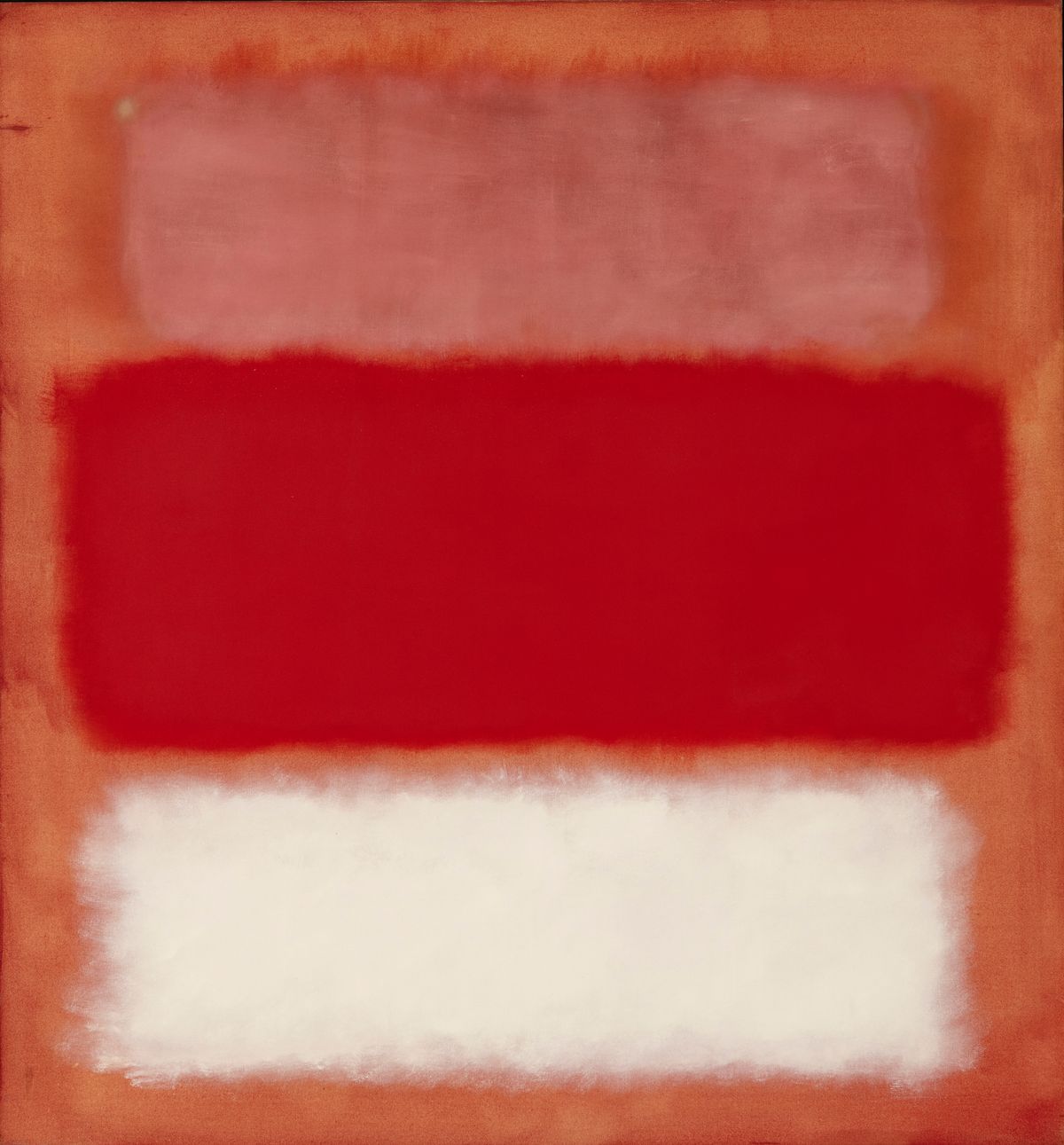
Mark Rothko, Light Cloud, Dark Cloud (1957). Oil on canvas. 169.6 x 158.8 cm. Modern Art Museum of Fort Worth Museum purchase, The Benjamin J. Tillar Memorial Trust. © 1998 Kate Rothko Prizel & Christopher Rothko - Adagp, Paris, 2023.

Mark Rothko, Light Cloud, Dark Cloud (1957). Oil on canvas. 169.6 x 158.8 cm. Modern Art Museum of Fort Worth Museum purchase, The Benjamin J. Tillar Memorial Trust. © 1998 Kate Rothko Prizel & Christopher Rothko – Adagp, Paris, 2023.

Christopher Rothko has curated a comprehensive retrospective at Bernard Arnault’s Fondation Louis Vuitton in Paris (18 October 2023–2 April 2024) with the Foundation’s artistic director Suzanne Pagé, whom he also partnered with back in 1999.

Rothko’s previous retrospectives in Europe have mainly included works from the Family Collection and the Mark Rothko Foundation, he explains.

‘These are easy paintings to get because we consider our collections essentially public. But I wanted to bring paintings that Europeans have never seen. So we have paintings from Utica, New York; Toledo, Ohio; Lincoln, Nebraska; and Tempe, Arizona, as well as from the Art Gallery of Ontario in Toronto.’

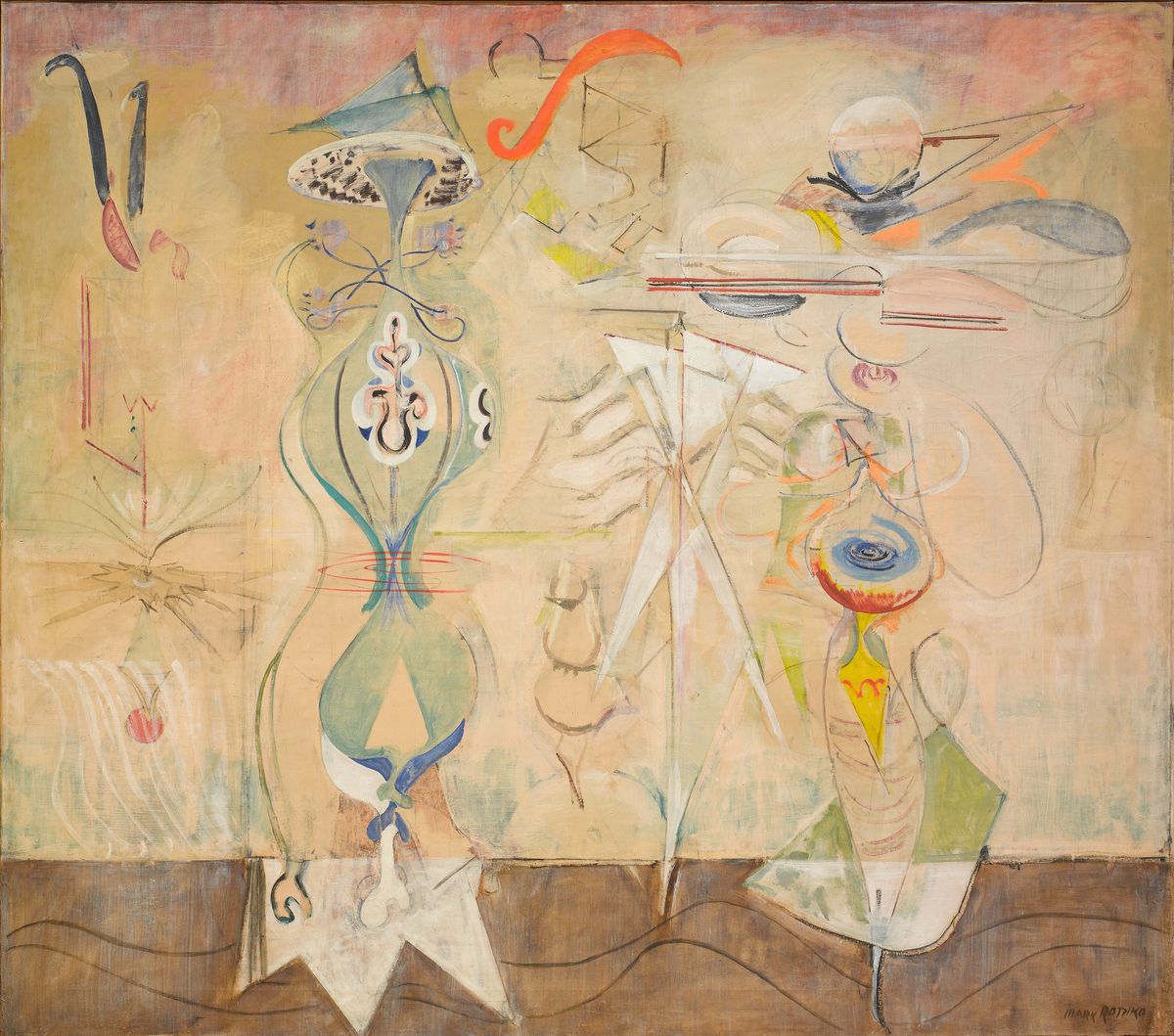
Hunting down these paintings and securing them for public exhibitions is clearly something that Christopher feels very strongly about. The show includes the early painting, Slow Swirl at the Edge of the Sea from 1944, which is in the permanent collection of the Museum of Modern Art (MoMA) in New York and has never before been loaned for an exhibition due to its historical significance.

‘It’s a painting of him and my mother shortly after they met. I grew up with that over my couch,’ he explains. This, coupled with the tragedy of losing both his parents by the time he was just six years old, surely made it impossible for even MoMA to turn him down.

Mark Rothko, Slow Swirl at the Edge of the Sea (1944). Oil on canvas. 191.1 x 215.9 cm. Museum of Modern Art, New York. Bequest of Mrs. Mark Rothko through The Mark Rothko Foundation, Inc. © 1998 Kate Rothko Prizel & Christopher Rothko - Adagp, Paris, 2023.

Mark Rothko, Slow Swirl at the Edge of the Sea (1944). Oil on canvas. 191.1 x 215.9 cm. Museum of Modern Art, New York. Bequest of Mrs. Mark Rothko through The Mark Rothko Foundation, Inc. © 1998 Kate Rothko Prizel & Christopher Rothko – Adagp, Paris, 2023.

His eyes light up when discussing some of these works, including the 1962 painting No. 1, White and Red from Toronto, which he describes as his ‘absolute favourite’.

He also recounts how he had never even seen No. 9/No. 5/No. 18 (1952) in the flesh before as the work has been in the same collection since 1971 after being sold by Marlborough Gallery.

‘It’s a spectacular painting and I’m very touched that they have agreed to lend,’ he says.

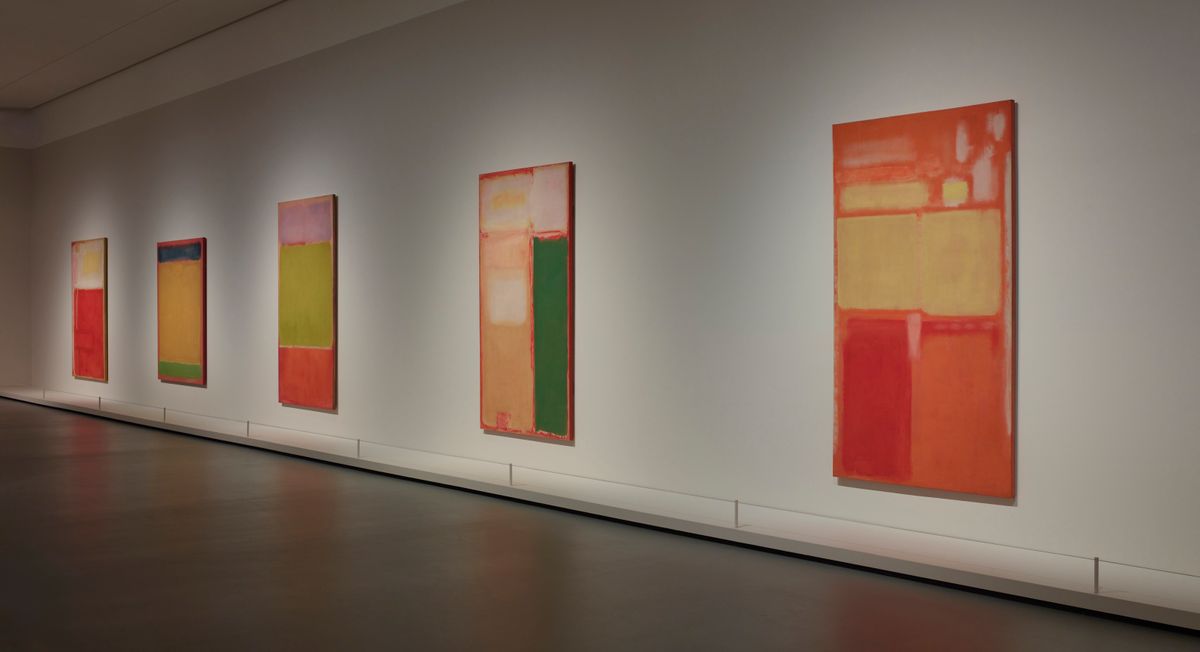
It’s equally moving to hear the presence of Rothko within the hanging of the show. ‘My father was very sensitive to what his works needed, and he was very clear that he wanted it to be a personal interaction between the painting and viewer.’

‘He wrote about this when he sent his paintings to the Whitechapel Gallery in 1961. He sent instructions for hanging the canvases low, near to the floor with lower lighting close enough together so they are in interaction with each other. So this is always where we start and then we listen to the paintings. They usually tell you when they’re happy or they’re not.’

Exhibition view: Mark Rothko, Fondation Louis Vuitton, Paris (18 October 2023–2 April 2024). © 1998 Kate Rothko Prizel and Christopher Rothko - Adagp, Paris, 2023.

Exhibition view: Mark Rothko, Fondation Louis Vuitton, Paris (18 October 2023–2 April 2024). © 1998 Kate Rothko Prizel and Christopher Rothko – Adagp, Paris, 2023. Courtesy Fondation Louis Vuitton, Paris.

It’s touching to think of these objects as vessels through which Christopher Rothko can somehow communicate with his father. In his eyes, Rothko was a family man who taught his son how to play chess and bestowed upon him a love of music, which seems so crucial to not only the artist himself, but also his son’s understanding of Rothko’s practice.

His father described Mozart as ‘smiling through tears’ when composing—an exquisitely poignant interpretation that gives us a window into Rothko’s psyche. Simple human emotions were the target for Rothko but he wanted viewers to question them to reveal the complexity of these emotional states, as well as the uneasiness and precariousness of our existence.

When Rothko died, the family lost the contents of his studio to his dealer, Marlborough Gallery. After years of court cases, they recovered some items including receipts for paint and a huge amount of turpentine used to thin the paints, further indicating how the artist would almost stain the canvas in many instances rather than applying layers of impasto.

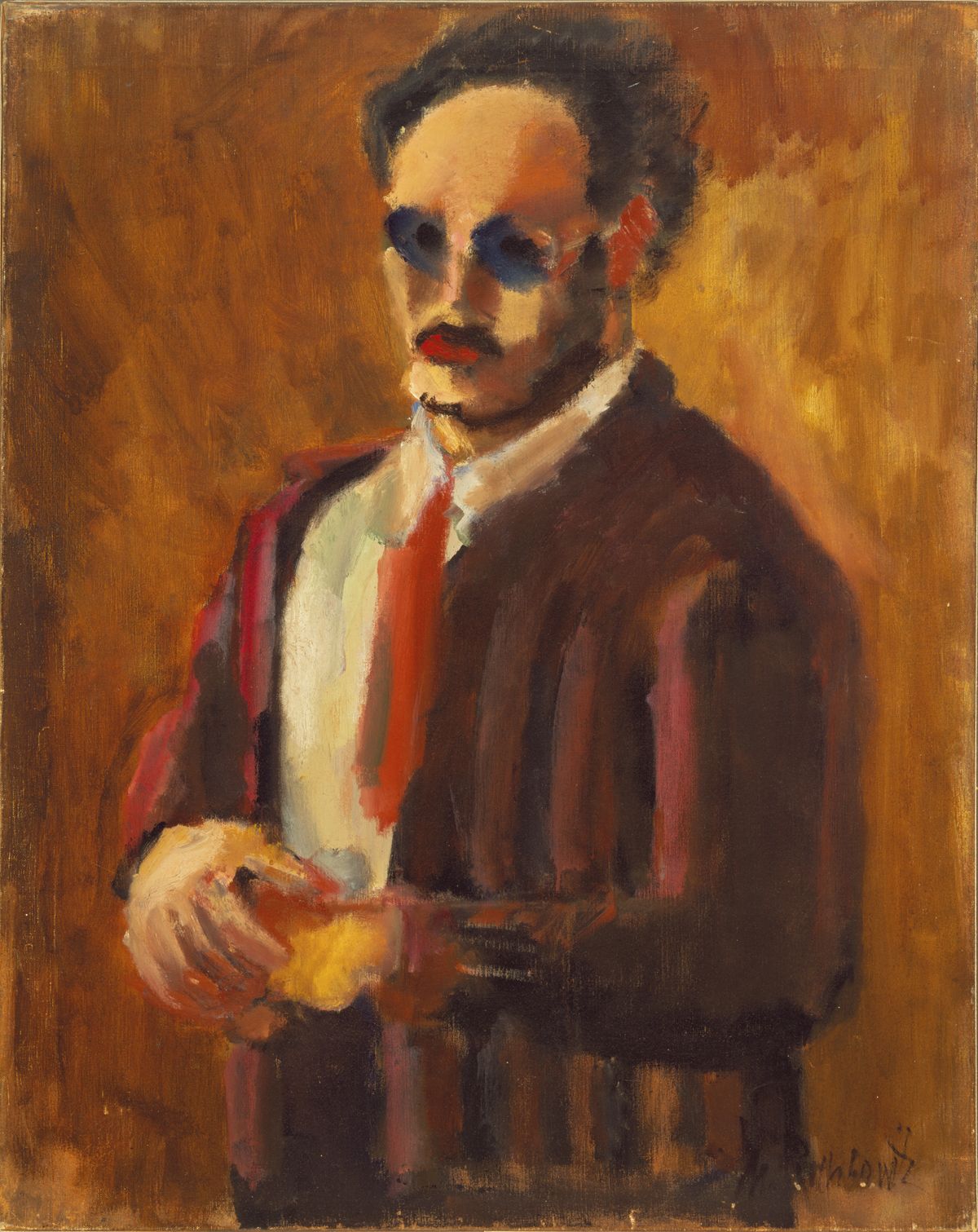
Mark Rothko, Self Portrait (1936). Oil on canvas. 81.9 x 65.4 cm. Collection of Christopher Rothko. © 1998 Kate Rothko Prizel & Christopher Rothko - Adagp, Paris, 2023.

Mark Rothko, Self Portrait (1936). Oil on canvas. 81.9 x 65.4 cm. Collection of Christopher Rothko. © 1998 Kate Rothko Prizel & Christopher Rothko – Adagp, Paris, 2023.

‘We still have some of the boards that he used to paint his works on paper, which is a very important part of his practice, especially later on,’ Christopher adds. It’s unsurprising when he suggests that his father would be appalled by not only the value of his works today, but the state of the art market as a whole. ‘For him, if paintings become a commodity or a trophy, he would be very upset by that.’

Rothko’s legacy remains in safe hands under the guidance and direction of his two children and this colossal show is evidence of the power his art still has to attract a new generation of admirers, while reminding the rest of us of his status as an unrivalled legend of abstract painting.

Main image: Exhibition view: Mark Rothko, Fondation Louis Vuitton, Paris (18 October 2023–2 April 2024). © 1998 Kate Rothko Prizel and Christopher Rothko – Adagp, Paris, 2023. Courtesy Fondation Louis Vuitton, Paris.

South Korea’s booming art market – driven by Gen Z

South Korea’s booming art market – driven by Gen Z

When people think about young adults and South Korea, K-Pop is probably what springs to mind, but a new art form is rising to the top of Instagram feeds – visual art. Phoebe Taylor, Communications Adviser (Digital) at the Asia New Zealand Foundation was recently in South Korea as part of an arts tour that included a stop at one of the world’s largest art fairs: Frieze. Here, she reflects on the emerging art trends she saw and the way younger generations approach the art world. 

South Korea’s art scene is dynamic. Some people tend to still carry a traditional view of Asia, but it’s not just lanterns and dragons. With public artworks on nearly every corner in Seoul, dotted around the city you’ll also find large museums exhibiting works on gaming with VR immersion pods, alongside smaller galleries exhibiting works by sculptor Anish Kapoor with lines out the door. 

A game machine in use at an exhibit in Seoul’s National Museum of Modern and Contemporary Art. Image: Phoebe Taylor

I was recently in South Korea with a group of New Zealand art curators to attend the Frieze Seoul art fair with the Asia New Zealand Foundation Te Whītau Tūhono. While assisting the delegation and getting content from the ground, I heard insights from the group of art fair-savvy curators, but it was impossible not to notice how the art scene differs from Aotearoa. 

Given the population of Seoul alone is five times the size of Aotearoa, you would expect everything to operate on a larger scale anyway, but visual art gets a special mention. Not only is there a heck of a lot of public artworks around, but there’s also a huge, growing market for private collections and acquiring works. 

For the first time in 2022, South Korea’s art market reached 1 trillion won ($750.85 million), according to data from the Ministry of Culture, Sports and Tourism. And it continues to grow. 

While I was, quite literally, walking through the art world in Seoul, I could see some notable emerging trends. There’s an emphasis on digital art and how it’s presented, and there’s also a rising trend of younger generations (Gen Z and millennials particularly) investing in the arts. 

Younger generations in South Korea are looking to art as an investment. Image: Phoebe Taylor

The rise of digital art and the enthusiasm from young collectors was evident at Frieze Seoul. Frieze is an international art fair that draws artists, galleries, and patrons from across the world, exhibiting works from major institutions. For Kiwis, think of it as the Fieldays of the art world. Entering the fair in the COEX Centre, attached to the enormous, maze-like Starfield Mall, you could easily guess who the organisers were trying to impress with the digital signage and influencer-targeted foliage photo walls.  

Frieze is where art trends emerge. Looking around, I could see the push digital art was making and even Whanki Kim ‘father of Korean contemporary art’ had his pieces digitised in an exhibition by LG OLED, signifying a new way to present work. 

Walking around Frieze Seoul as someone only just under the ‘millennial’ age group, I didn’t feel out of place. There were attendees of all ages, particularly from younger age brackets. While I’m not at New Zealand art fairs every weekend, this shift in audience age surprised me.  

The crowds at Frieze Seoul. Image: Phoebe Taylor

Seoul hosting Frieze is a big deal. It’s a recognition of Seoul’s growing significance as an art centre and it’s worth looking at what’s driving this art boom. 

The assumption that art collecting and art fairs are only for older enthusiasts is not quite accurate. Gen Z and Millennials in South Korea are embracing newer ways of displaying and collecting art. They’ve grown up in the era of the internet, they’re not afraid of the transition to online platforms (anyone remember the hype of NFTs?) and they’re interested in exploring non-traditional pathways. 

Investing in artwork as someone under 40 is becoming increasingly popular. In a report commissioned by the Korea Art Management Service (KAMS), Analysis of Korean Millennial and Generation Z Art Collectors, younger collectors (referred to in the article as ‘MZ’ – combining Millennial and Gen Z) are digital natives researching art through museum art classes and social media, and are apparently strongly influenced by celebrity art collector peers (including BTS’s RM, who posts about his passion for art and works from his collection, including a $1.2 million sculpture by American multidisciplinary artist Roni Horn). 

Trends in the art world change over time and – in South Korea at least – now they’re shifting further from physical pieces. Image: Phoebe Taylor

And while MZs might follow trends set by their idols, there’s another, simpler reason they buy art: they like it.  

Art investing is often seen as a rich person’s game. It’s impossible not to acknowledge the privilege of being able to participate in the world of visual art and yet, we’re seeing young South Koreans willing to invest in art earlier on and recognise its future value, like the way New Zealanders seem to do with houses. Perhaps South Koreans see art as an innovative way to invest considering the difficulty of purchasing real estate, or perhaps they place a higher value on art in recognising its longer-term value?  

Maybe we should take a leaf out of the MZ handbook and reevaluate where and what we place our value on. There’s a lot to be said about the impact that interest from young adults can have. Look at the wellused example of TikTok: over 700 million users worldwide are between the ages of 18 and 34. This age group is used to breaking stats and setting new records. 

People pose with a sculpture of Gangnam Style hands. Image: Phoebe Taylor

Watching the trajectory of South Korea’s art scene and the engagement of younger demographics is fascinating, and we can see that it’s making a global impact with international art fairs drawing their attention to Seoul. Personally, I won’t be investing in NFTs, but I’ll keep watching K-Dramas and keeping an eye out for the latest trends.

– Asia Media Centre

From Old Master Paintings to Royal French Furniture—the ‘Eccentric’ Collection of an Hermès Heir Heads to Sotheby’s

From Old Master Paintings to Royal French Furniture—the ‘Eccentric’ Collection of an Hermès Heir Heads to Sotheby’s

The late Hubert Guerrand-Hermès lived the glamorous life of a bon vivant, a connoisseur of art in all its forms. He was, after all, the great-great-grandson of the founder of Hermès and a top executive of the luxury empire, helping transform it from a French leather-goods maker into an international style powerhouse.

An aesthete of the highest order, Hermès surrounded himself with the spoils of his art de vivre—Old Master paintings, royal French furniture, contemporary art—in his grand Parisian residence, the Hôtel de Lannion on the Left Bank. (The mansion faces the Musée d’Orsay, where he served on the board of directors.)

Seven years since his death, Sotheby’s Paris has announced it will auction his sprawling estate. Roughly a thousand works of art, rare books, and precious objects will be offered in four auctions from December 13 to 19. And, while the Lannion is no longer decked out with Hermès’s collection, Sotheby’s will recreate the opulent home for the duration of the sale.

imageBather (1938), est. €150,000–€250,000. Courtesy of Sotheby’s Paris.” width=”550″ height=”1024″ srcset=”https://www.mecreates.com/story/news/wp-content/uploads/2023/10/hermes-picasso1-550×1024.jpg 550w, https://news.artnet.com/app/news-upload/2023/10/hermes-picasso1-161×300.jpg 161w, https://news.artnet.com/app/news-upload/2023/10/hermes-picasso1-825×1536.jpg 825w, https://news.artnet.com/app/news-upload/2023/10/hermes-picasso1-1100×2048.jpg 1100w, https://news.artnet.com/app/news-upload/2023/10/hermes-picasso1-27×50.jpg 27w, https://news.artnet.com/app/news-upload/2023/10/hermes-picasso1-1032×1920.jpg 1032w, https://news.artnet.com/app/news-upload/2023/10/hermes-picasso1-scaled.jpg 1376w” sizes=”(max-width: 550px) 100vw, 550px”>

Pablo Picasso, Bather (1938), est. €150,000–€250,000. Courtesy of Sotheby’s Paris.

“It is rare to find a collector with an equal passion and appreciation for classical arts, Old Masters, royal French furniture, cutting-edge design and the contemporary output of the likes of Lucio Fontana, Anselm Kiefer, Pierre Soulages,” said Mario Tavella, president of Sotheby’s France and chairman of Sotheby’s Europe. “You could definitely say he was an eccentric collector.”

“I recall many years ago we did a trip together in Scotland,” Tavella continued, “traveling around all of the historic houses and castles, and I recall being struck by his infinite curiosity.” Although one passion stood out from the rest. He harbored a most unusual fascination with Marie-Caroline, the Duchess of Berry. By marrying into the French royal family, the Italian princess became the daughter-in-law of King Charles X and the mother of the heir to the throne.

The library in Hubert Guerrand-Hermès's Hôtel de Lannion. Courtesy of Sotheby's Paris.The library in Hubert Guerrand-Hermès’s Hôtel de Lannion. Courtesy of Sotheby’s Paris.

Hermès’s obeisance to her is visible in every room of the Lannion, from the staircase hung with paintings of her castle (château de Rosny) to the library containing 200 volumes that bear her crest. In fact, “he attempted to reassemble her library [in] his home,” Tavella explained.

The Duchess of Berry—an ancestor of Hermès’s wife, coincidentally—had been “a champion of the arts herself, subsidizing theater productions, commissioning notable works from the Sèvres porcelain factory and collecting paintings by the Dutch painter Jan van der Heyden, among others,” said Tavella. “He would come to the room [at Sotheby’s] and fiercely bid—particularly, as you can imagine, when we had a Duchesse de Berry sale. I wouldn’t hesitate to say that he was obsessed with her.” 

A pair of topiary wild boars in patinated bronze by François-Xavier Lalanne (est. €100,000–€150,000). Courtesy of Sotheby's.

A pair of topiary wild boars in patinated bronze by François-Xavier Lalanne (est. €100,000–€150,000). Courtesy of Sotheby’s.

The items with the highest estimates include bronzes from François-Xavier Lalanne’s bestiaire: a pair of monkeys estimated to yield €1 million–€2 million ($1.1 million–$2.1 million) and a pair of topiary boars. Period furniture, too, is featured prominently, in particular a chair that belonged to Marie-Antoinette, part of her boudoir, the Cabinet de la Meridienne, at the Palace of Versailles. The royal chair in regilded sculpted walnut from the Louis XVI period bears the stamp of Georges Jacob, ca. 1784–85. 

Louis XVI-period gilded wood chair, stamped by G. Jacob, from Marie Antoinette's boudoir in Versailles, est. €300,000–€500,000. Courtesy of Sotheby's Paris.

Louis XVI-period gilded wood chair, stamped by G. Jacob, from Marie-Antoinette’s boudoir in Versailles, est. €300,000–€500,000. Courtesy of Sotheby’s Paris.

More Trending Stories:  

The World’s Most Popular Painter Sent His Followers After Me Because He Didn’t Like a Review of His Work. Here’s What I Learned 

Archaeologists Excavating the Tomb of Egypt’s First Female Pharaoh Found Hundreds of Jars Still Holding Remnants of Wine 

The Second Paris+ Started With a Bang. Could Art Basel’s New Venture Unseat Its Flagship Fair One Day? 

Is There a UFO in That Renaissance Painting? See 7 Historical Artworks That (Possibly) Depict Close Encounters With the Third Kind 

A Glasgow Museum Reveals a $3.7 Million Rodin Sculpture Has Been Missing From Its Collection for Nearly 75 Years 

What I Buy and Why: Art Entrepreneur Hélène Nguyen-Ban on Her Original ‘Art Crush’ and Owning a Half-Ton Book by Anselm Kiefer 

Christie’s 20th/21st Century Evening Sale Notches Steady Results, a Feat in the Current Tepid Art Market 

Four ‘Excellently Preserved’ Ancient Roman Swords Have Been Found in the Judean Desert 

An Early Edition of an ‘Unhinged’ Christopher Columbus Letter Outlining What He Discovered in America Could Fetch $1.5 Million at Auction 

Follow Artnet News on Facebook:
Want to stay ahead of the art world? Subscribe to our newsletter to get the breaking news, eye-opening interviews, and incisive critical takes that drive the conversation forward.

Silvermine Art Center’s Artisans Market: A Dazzling Display of Fine Art and Craftsmanship

Silvermine Art Center’s Artisans Market: A Dazzling Display of Fine Art and Craftsmanship


Mark your calendars for November 11th and 12th from 11 am to 4 pm as Silvermine Arts Center hosts a spectacular event with 15 talented artisans.


This not-to-be-missed fine art and craft fair will feature a diverse range of art, including ceramics, clothing, fiber, jewelry, sculptures, and exquisite wall art.

This event provides a unique opportunity for art enthusiasts to engage directly with the artisans themselves.

On display in Silvermine Galleries will be the Holiday Salon – the Gift of Art (Nov 11th – Dec 23rd) offering affordable works of art by our Guild of Artists working in a broad range of styles and media. 

But that’s not all! Silvermine Galleries Gift Shop will be expanded for the holidays and brimming with unique and enchanting treasures for you to explore and purchase for all your gift giving needs.

Every purchase you make supports individual artists and Silvermine.

Learn more: https://www.silvermineart.org/online-exhibition/early-bird-holiday-trunk-show/

Christie’s longtime global president Jussi Pylkkänen is stepping down

Christie’s longtime global president Jussi Pylkkänen is stepping down

Christie’s global president Jussi Pylkkänen will step down from his role next year in order to work as an independent art adviser, Christie’s chief executive Guillaume Cerutti announced Tuesday (24 October).

The Helsinki-born auctioneer, a mainstay at Christie’s sales for decades, will take part in this year’s autumn and winter auctions. He’ll take the Christie’s rostrum for the final time in London during the Old Masters evening sale on 7 December. For States-side Pylkkänen super-fans, the final opportunity to watch him wield the gavel will come on 9 November, at Christie’s evening sale of 20th-century art in New York.

“Jussi is a well-loved member of the Christie’s family,” Cerutti said in a statement. “We are very grateful for his tremendous contribution to Christie’s, as a respected art specialist, a remarkable business getter and one of our best auctioneers. We wish him the best on beginning this next phase of his career as an independent client adviser.”

Jussi has worked at the auction house in some capacity since the 1980s, and in 1995 became director of Christie’s Impressionist and modern art department, a position he held for a decade. He later served ten years as Christie’s president for Europe, the Middle East and Russia before his appointment as global president in 2014.

Blockbuster auctioneer

Pylkkänen is one of Christie’s most recognisable auctioneers. In 2017, he sold Leonardo da Vinci’s Salvator Mundi after a 19-minute bidding war for $450.3m (with fees), making the painting the most valuable artwork of all time. He also served as auctioneer during the 2022 sale in which Andy Warhol’s Shot Sage Blue Marilyn (1964) fetched $195 million (with fees). He was also auctioneer for the auction house’s sales of some of its most high-profile single-owner collections, including those of Paul Allen in 2022, Peggy and David Rockefeller in 2018 and Elizabeth Taylor in 2011.

“Christie’s is an inspiring place to work and has brought me great happiness across four decades working with the very best specialists in the market, at the very heart of the art world,” Pylkkänen said in a statement.

He added: “The art market continues to evolve and the extraordinary influx of buyers at the top of the market now offers me a unique opportunity to share my experience with a new generation of collectors who are keen to buy major works of art both privately and at auction.”

Auctioneers and advisers play musical chairs

Pylkkänen’s move keeps the revolving door spinning between high-level posts at major auction houses and private advisory. In 2013 Tobias Meyer, Sotheby’s top auctioneer at the time, resigned; four years later he was hired by the family of late publishing mogul S.I. Newhouse to advise on the handling of his prized art collection, much of which was ultimately consigned to Christie’s.

After Meyer’s departure, Sotheby’s acquired the boutique advisory firm Art Agency, Partners, bringing Amy Cappellazzo, Allan Schwartzman and Adam Chinn into the fold. Schwartzman departed in 2020 to start his own advisory firm, Schwartzman&. Cappellazzo left the auction house to form the 360-degree advisory firm Art Intelligence Global in 2021, joined by another former Sotheby’s rainmaker, Yuki Terase.

And after Sotheby’s chairperson Patti Wong announced her departure from the auction house in late 2022, she launched the Hong Kong-based advisory firm Patti Wong & Associates with two fellow former Sotheby’s colleagues.