Art World News

In ‘Felt Love,’ a Young Boy and His Mother Learn the Value of Spending Quality Time Together

In ‘Felt Love,’ a Young Boy and His Mother Learn the Value of Spending Quality Time Together

A mother working overtime at home as a seamstress finds it difficult to carve out a few moments for her son in “Felt Love,” a poignant short film about family, togetherness, and quality time. Created by a group of students at San Jose State University as a senior thesis project in 2020, the piece combines a miniature 3D set with 2D animation to tell the story of a young boy who learns the depth of his mother’s hard work and adoration and how she learns to share that with him.

Go behind-the-scenes of “Felt Love” on the project’s Instagram, and you might also enjoy the stop-motion short “Visible Mending” by Samantha Moore.


All images © Felt Love Film

a gif from a short animated film showing a young boy playing with a spool of thread and it gets away from him and rolls toward his mother, who is busy working

a still from a short animated film showing a young boy holding up a book he wants to read, but his mother is working hard at a sewing machine

a gif from a short animated film showing a clock ticking by and a young boy's leg's dangling from a chair, viewed from beneath the desk

Do stories and artists like this matter to you? Become a Colossal Member today and support independent arts publishing for as little as $5 per month. The article In ‘Felt Love,’ a Young Boy and His Mother Learn the Value of Spending Quality Time Together appeared first on Colossal.

Mvskoke Art Market Returns for Third Year

Mvskoke Art Market Returns for Third Year

April 16, 2024

FOR IMMEDIATE RELEASE

Mvskoke Art Market Returns for Third Year

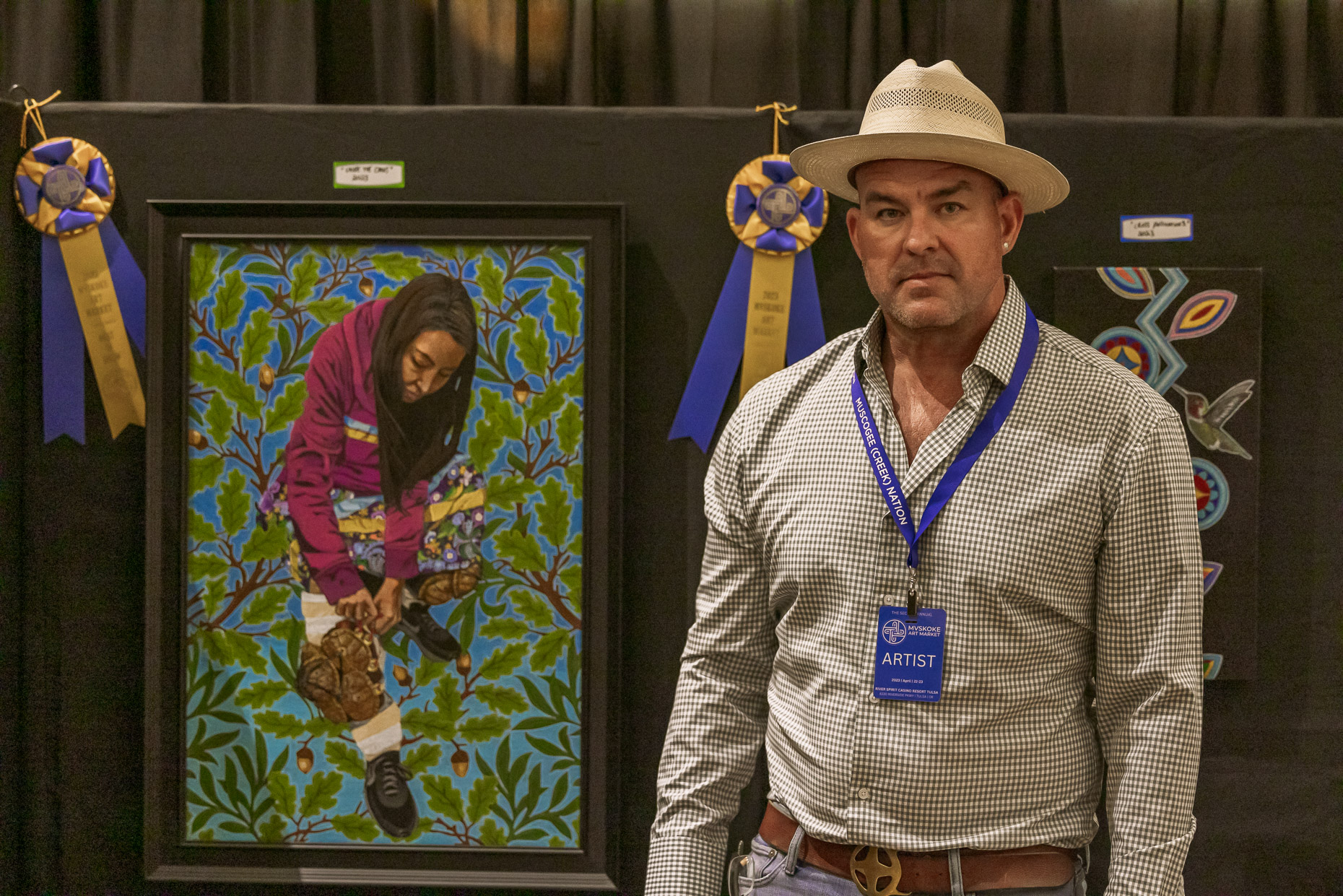
2023 Mvskoke Art Market 'Best of Show' winner, Starr Hardridge.2023 Mvskoke Art Market ‘Best of Show’ winner, Starr Hardridge.

TULSA, Okla. — The Third Annual Mvskoke Art Market will take place at River Spirit Casino Resort in Tulsa on April 20-21. The market has experienced significant growth in its first two years, and this year is no different. Artists participating increased from 60 and 82 in years one and two respectively, to 94 Native artists this year, representing over 30 tribes from across Oklahoma and Indian Country.  

The Market’s planning committee, building off past years’ success, have strived to come up with ideas to accommodate the growing popularity and improve the overall experience for attendees.  

Muscogee Nation Cultural Center and Archives Manager ShaVon Agee, has played a vital role in the Market’s planning and coordinating for the past three years.  

“We’ve expanded some space in the ballroom foyer in order to accommodate additional artists,” Agee said.   

She added that they’ve included an activity for children so that they may get involved as well.  

 “We will have a Mvskoke Motifs stamping activity where children can create their own piece of artwork using our traditional Mvskoke designs and patterns.”  

In addition to the showcase and purchasing of artwork in various mediums by renowned Native artists, visitors can enjoy educational presentations and panel discussions on early Muskogean, First American and Oklahoma Indian art. A book signing for the recently published biography of Muscogee Actor Will Sampson by Norma Sampson Bible and an All-Native comedy show are also included on the Market’s event schedule.  

For more information, follow the Mvskoke Art Market’s Facebook page at: www.facebook.com/mvskokeartmarket or visit their page  at: www.muscogeenation.com/mvskokeartmarket 

### 

Stunning Scenes Made from Paper Unfold in Shannon Taylor’s Miniature Compact Dioramas

Stunning Scenes Made from Paper Unfold in Shannon Taylor’s Miniature Compact Dioramas

All images © Shannon Taylor, shared with permission

On New Year’s Eve in 2022, a huge storm swept through the Bay Area, causing major flooding and damage to Shannon Taylor’s studio. “I had been preparing pieces for an upcoming show and had to move my entire studio to a small table in our dining room,” she tells Colossal. “Due to stress and lack of space, I started making these diorama pieces as a way to relax.”

Each exquisitely detailed miniature work is created from tiny watercolor paintings on paper, layered into antique cosmetic compacts that Taylor finds at flea markets, vintage shops, rummage sales, online, or from friends. “My favorite thing is when people have sent me their own, or oftentimes, their grandmother’s collections,” she says. “I love objects with history, and these cosmetic pieces are such personal items.”

From tiny seabeds brimming with clams, fish, and coral to elaborate buffet spreads in the Italian countryside, Taylor creates each tiny component by painting a picture and then snipping out the shape using detail scissors or an X-acto knife. Through trial and error, she figures out new scenes as she goes and ways to keep the itty-bitty pieces organized. “I learned to secure all of the cutouts in bead organizers because our Roomba dislodged a tray of hand-cut flowers… and then vacuumed them.”

Taylor has pieces in two group shows, including Wunderkammer at Beinart Gallery through April 21 and a twelfth-anniversary show at Arch Enemy Arts through April 28. She will also have work in Yokai at Haven Gallery, which opens on May 4, and a solo show opening in June at Arch Enemy Arts titled Star Garden. Find more on the artist’s website and Instagram.


a tiny diorama made from watercolor-painted paper inside of a vintage cosmetics compact depicting a pastoral Italian countryside scene on top and a dedacent spread of fish, pasta, and cheese in the bottom

a tiny diorama held in a person's hand, made from watercolor-painted paper inside of a long vintage cosmetics compact depicting a woodland scene at dusk

a tiny diorama made from watercolor-painted paper inside of a semi-circular vintage cosmetics compact depicting a ghost in a lush meadow with a couple of trees and a rainbow overhead

two tiny dioramas made from watercolor-painted paper inside of vintage cosmetics compacts depicting (on the left) a woodland scene with an owl and an orange moon with a face, and (on the right) a ghost standing next to a tree over a mirrored pond with wildflowers

a tiny diorama made from watercolor-painted paper inside of a vintage brass crab-shaped compact depicting a sea scene with coral, shells, and an octopus three brass ladle-like utensils with brass crab ornaments that open up to reveal miniature dioramas of sea-themed scenes inside

the exterior of a small, antique cosmetics compact with a starry scene applied to the front a tiny diorama made from watercolor-painted paper inside of a vintage cosmetics compact depicting a black stallion running underneath a double rainbow and pink clouds in a field of pink flowers

Do stories and artists like this matter to you? Become a Colossal Member today and support independent arts publishing for as little as $5 per month. The article Stunning Scenes Made from Paper Unfold in Shannon Taylor’s Miniature Compact Dioramas appeared first on Colossal.

Flip Through More than 5,000 Pages of This Sprawling 19th-Century Atlas of Natural History

Flip Through More than 5,000 Pages of This Sprawling 19th-Century Atlas of Natural History

Courtesy of the Biodiversity Heritage Library

In the early 19th century, German naturalist Lorenz Oken quickly established himself as a leader in the Naturphilosophie movement, a current of Idealism, which attempted to comprehend a total view of nature by investigating its theoretical structure—a precursor to the natural sciences as we know them today.

Oken’s seminal work Allgemaine Naturgeschichte Für Alle Stände, or General Natural History For All Classes, was published as a series of seven volumes between 1833 and 1843. At more than 5,000 pages in its entirety, the atlas depicts known species ranging from beetles and fish to birds and ferns. In many cases, insects or plants are shown in various stages of development, like a butterfly displayed alongside its larval and pupal forms.

Containing illustrations engraved and printed by a number of contributors, the vivid portrayals of wildlife and botanicals attempts to classify similar specimens, labeling them with both their common and scientific names and grouping like examples into compartments.

Explore Oken’s entire Allgemaine Naturgeschichte in the Biodiversity Heritage Library’s digital archive, where you can also download tens of thousands individual illustrations. You may also enjoy flipping through an eclectic array of rare Japanese schoolbooks,  admiring Elizabeth Gould’s detailed bird illustrations.


an 18th-century natural history book illustration of eels

an 18th-century natural history book illustration of moths, some shown at their larval and pupae stages

an 18th-century natural history book illustration of numerous beetles, organized by size and color into classifications in a chart

an 18th-century natural history book illustration of winged insects, classified into a grid

an 18th-century natural history book illustration of butterflies, some shown at their larval and pupae stages

an 18th-century natural history book illustration of numerous plants and botanicals categorized on the page into a grid

an 18th-century natural history book illustration of ferns, categorized on the page into a grid showing their seeds and different stages of growth

an 18th-century natural history book illustration of mushrooms

an 18th-century natural history book illustration of bird eggs and nests

an 18th-century natural history book illustration of bird eggs and nests

Do stories and artists like this matter to you? Become a Colossal Member today and support independent arts publishing for as little as $5 per month. The article Flip Through More than 5,000 Pages of This Sprawling 19th-Century Atlas of Natural History appeared first on Colossal.

On-demand Webinar: How to Master the Art of CRM-Driven Digital Marketing

On-demand Webinar: How to Master the Art of CRM-Driven Digital Marketing

  • image

    On-demand Webinar: How to Master the Art of CRM-Driven Digital Marketing   
    Visit

Unlock strategies to captivate guests, drive bookings, and cultivate enduring loyalty

Explore the powerful synergy between CRM and digital marketing. Don’t miss this exclusive on-demand webinar with hotel marketing experts Eve Tronson, Vice President, Digital Strategy, CRM & Loyalty at Viceroy Hotel Group and Tina Markowitz, Vice President, Global Digital Strategy at Cendyn.

During this webinar, you’ll learn more about:

  • The benefits of integrated CRM data
  • How guest insights lead to data-driven precision
  • Strategies for marketing optimization
  • Successful outcomes from real-world case studies
  • …and so much more!

Learn from the experts how integrated CRM data can empower hotels with invaluable insights into guest preferences, behaviors, and trends, enabling you to create hyper-targeted marketing campaigns that resonate with your audience. Don’t miss out!

Watch the webinar here.

About Cendyn

Cendyn is a catalyst for digital transformation in the hospitality industry. We help hotels around the globe drive profitability and guest loyalty through an integrated technology platform that aligns revenue, eCommerce, distribution, marketing, and sales teams with centralized data, applications, and analytics, so they can capture more demand and accelerate growth. With operations across the globe, in the United States, Germany, United Kingdom, Singapore, Bangkok, and India, Cendyn serves tens of thousands of customers across 143 countries. To find out more, visit www.cendyn.com.

In Sicily, Mount Etna Blows an Unprecedented Frequency of Rare Volcanic Smoke Rings

In Sicily, Mount Etna Blows an Unprecedented Frequency of Rare Volcanic Smoke Rings

Known to locals as the “Lady of the Rings,” Sicily’s Mount Etna is both the highest island mountain in the Mediterranean and the most active stratovolcano in the world. The magnificent landform has even more impressive qualities considering it emits elegant smoke rings, known as volcanic vortex rings, high into the sky. A video from The Straits Times documents the fascinating formations as they drift through the atmosphere.

The rings appeared for the first time since last December when a small vent opened on the Southeast cater. This phenomenon rarely occurs because of the specific conditions required for the vapors and gases to produce the forms. When enough pressure builds up inside the volcano, magma inside the crater propels condensed gases like water vapor up through the vent.

Scientists say Mount Etna produces more vortex rings than any other volcano on Earth. The New York Times reported that the frequency this month “has broken all previous records,” according to Boris Behncke, a volcanologist at the National Institute of Geophysics and Volcanology of Catania.

If you’re up for some more drama in the earth’s crust, you might enjoy exploring an aerial view of Iceland’s Fagradalsfjall volcano or an award-winning animation about some unsuspecting birds and a sudden BOOM.


All images © The Straits Times

a gif of a volcanic vortex ring moving through the sky

Mount Etna emitting a series of volcanic vortex rings

a detail of a volcanic vortex ring from Mount Etna showing the gaseous form in the air

Do stories and artists like this matter to you? Become a Colossal Member today and support independent arts publishing for as little as $5 per month. The article In Sicily, Mount Etna Blows an Unprecedented Frequency of Rare Volcanic Smoke Rings appeared first on Colossal.

Mastering the art of digital marketing: Insights from premier business schools

Mastering the art of digital marketing: Insights from premier business schools

In today’s digital age, marketing has undergone a significant transformation, with businesses leveraging digital channels to reach and engage with their target audiences. Digital marketing has emerged as a cornerstone of modern business strategies, offering unparalleled opportunities for brand visibility, customer engagement, and revenue generation. Leading business schools such as the Indian School of Business (ISB) and the Indian Institute of Management Indore (IIMI) offer specialized programs aimed at equipping marketing professionals with the skills and insights needed to thrive in the digital landscape. In this article, we delve into the key concepts, strategies, and best practices of digital marketing, drawing insights from ISB’s Post Graduate Certificate Program in Digital Marketing (PCPDM), Digital Marketing for Business Growth and Customer Acquisition (DMA), Digital Transformation (DT) program, and IIMI’s Executive Program in Digital Marketing (EPDM).

ISB PCPDM: Navigating the digital marketing landscape

The Post Graduate Certificate Program in Digital Marketing (PCPDM) offered by ISB provides participants with a comprehensive understanding of digital marketing fundamentals, strategies, and tools. Through a blend of theoretical insights and hands-on exercises, participants learn to leverage digital channels such as social media, search engine optimization (SEO), and email marketing to drive brand awareness, customer engagement, and conversion. ISB’s renowned faculty and industry experts provide participants with cutting-edge insights and practical guidance, enabling them to develop and implement effective digital marketing campaigns that deliver measurable results.

ISB DMA: Accelerating business growth through digital marketing
The Digital Marketing for Business Growth and Customer Acquisition (DMA) program at ISB is tailored for marketing professionals seeking to harness the power of digital channels to drive business growth and customer acquisition. The program focuses on advanced digital marketing strategies, including data-driven decision-making, customer segmentation, and personalized marketing. Participants learn to leverage analytics tools and metrics to track and optimize campaign performance, maximizing return on investment (ROI) and driving sustainable business growth. With a focus on innovation and agility, ISB DMA equips participants with the skills and knowledge needed to stay ahead in a rapidly evolving digital landscape.

ISB DT: Embracing digital transformation for competitive advantage
The Digital Transformation (DT) program at ISB explores the strategic imperatives and organizational implications of digital disruption. Participants gain insights into emerging technologies such as artificial intelligence, machine learning, and blockchain, and their impact on business models, customer experiences, and industry dynamics. Through case studies, simulations, and interactive sessions, participants learn to develop and execute digital transformation strategies that drive innovation, efficiency, and competitive advantage. ISB DT fosters a culture of digital innovation and leadership, empowering organizations to thrive in an increasingly digital world.

IIMI EPDM: Mastering digital marketing strategies for success
The Executive Program in Digital Marketing (EPDM) offered by IIMI is designed for marketing professionals looking to enhance their digital marketing capabilities and stay abreast of industry trends. The program covers a wide range of topics, including content marketing, social media strategy, digital advertising, and e-commerce. Participants gain hands-on experience with digital marketing tools and platforms, enabling them to develop and execute integrated digital marketing campaigns. With a focus on real-world applications and best practices, IIMI EPDM equips participants with the skills and confidence to drive business results and stay ahead in today’s competitive digital landscape.

FAQs:

1. How do these digital marketing programs differ from traditional marketing education?
These digital marketing programs offer a hands-on, practical approach to learning, focusing on the latest digital tools, strategies, and trends. Unlike traditional marketing education, which may be more theoretical, these programs provide participants with actionable insights and skills that can be immediately applied in real-world settings.

2. What are the key challenges organizations face in implementing digital marketing strategies?
Organizations often face challenges such as data privacy concerns, technological complexity, and resource constraints when implementing digital marketing strategies. Additionally, keeping pace with rapidly evolving digital trends and consumer behaviours can pose challenges for organizations seeking to maintain a competitive edge in the digital landscape.

3. How can professionals leverage digital marketing education to advance their careers?
Digital marketing education provides professionals with the knowledge and skills needed to excel in today’s digital economy. By staying abreast of the latest digital marketing trends, tools, and strategies, professionals can position themselves as valuable assets to their organizations and enhance their career prospects. Additionally, digital marketing education offers opportunities for networking and professional development, enabling professionals to connect with industry experts and peers and stay ahead of the curve in their field.

Disclaimer: This content was authored by the content team of ET Spotlight team. The news and editorial staff of ET had no role in the creation of this article.

Modern History of China’s Art Market

Modern History of China’s Art Market

An art historian and columnist based in New York, Kejia Wu has dedicated her career to the Chinese contemporary art scene and its market since the 1990s. Relocating to the United States fifteen years ago, she has amassed unique expertise over the years, publishing various reports, notably for TEFAF, and contributing to the Chinese edition of the Financial Times. She authored the first book on the modern history of the art market in China, A Modern History of China’s Art Market, which was published last year. In her work, Kejia Wu sheds light on a lesser-known historical episode: the confiscation of artworks and antiques by the Red Guards during the Cultural Revolution (1966-1976) and their partial restitution under the supervision of Xi Zhongxun (1913-2002), father of Xi Jinping. This period was succeeded by the gradual integration with Hong Kong’s art market and the emergence of the first Chinese auction houses from the 1990s onward.

In the ensuing interview, she delves into the historical, political, economic, and artistic implications of China’s art market, which has transitioned from near annihilation to securing the second position globally within half a century, with 19% of the world market in 2023 according to the Art Market Report 2024 by Art Basel & UBS.

Portrait of Kejia WU. Courtesy of Kejia WuPortrait of Kejia WU. Courtesy of Kejia Wu

Remy Jarry: How does the Chinese art market differ from the Western market from a historical perspective?

Kejia Wu: Throughout the imperial dynasties to the Republican era of the first half of the 20th century, China has a continuous history of art collecting. However, there has never been an auction house like those in the West from the 18th century onwards. Art dealers and collectors primarily engaged in direct transactions among themselves.

After the founding of the People’s Republic of China in 1949, art collecting was gradually banned in the 1950s, as it was perceived to represent a capitalist and bourgeois lifestyle. Nonetheless, it was still possible to secretly exchange artworks. It was after the Cultural Revolution in 1966 that significant changes occurred, marked by campaigns encouraging Red Guards to forcibly enter collectors’ homes.

RJ: One of the chapters of your book is precisely devoted to these confiscations. How did they take place?

KW: Many of the private collections were confiscated by the Red Guards and placed in state-owned warehouses. Collectors were sometimes subjected to physical violence, including beatings. Artworks such as ink paintings or porcelain pieces were often destroyed, burned or smashed. If you were discovered attempting to sell art privately, you were arrested and imprisoned. Consequently, the market came to a full stop.

Starting in the early 1970s, state-owned antique stores, often called “friendship shops” (友谊商店), began to open, allowing foreign visitors to purchase antiques at low prices. Thus, state-controlled art trading activities became authorized, primarily aimed at generating foreign currency reserves for the state, which was facing great economic difficulties.

RJ: Are these confiscations from private collectors comparable to those of the Nazis?

KW: It’s not exactly the same thing since the Nazis took the art collections of Jewish families and invaded other countries. So, there were different intentions. In terms of ideological basis and social context, the situation in China was more akin to what happened in the Soviet Union. Class struggle was the driving force behind art confiscations in China.

Furthermore, most of the Red Guards were very young and had little or no knowledge of the works they destroyed, nor did they maintain clear records of confiscations. Although official data is lacking, the massive scale of destruction and confiscation undoubtedly ranks among the largest scales in East Asia.

RJ: A restitution process was formally launched by the State in the 1980s. What conclusions can we draw from it?

Inaugural Taos Queer Art Market debuts on 4/20

Inaugural Taos Queer Art Market debuts on 4/20
image

Taos artists are gearing up to welcome a new pop-up market this month: the Taos Queer Art Market. Premiering at Taxonomy on Saturday April 20, the Taos Queer Art Market features 12 local LGBTQ+ artists and makers selling a unique assortment of jewelry, art, upcycled apparel, tintype photographs, sweet treats and more!

The debut market includes an array of vendors such as local silversmith Gabi Hawes, Mood Bake Baby, Iggy’s Knives, Sensual Sin Studio, Office of BS, candles and self-care products from Sacred Hound Apothecary’s Brandi Perry, plus many others. The paparazzi will even be in attendance as Nicole Katzman of Taos Tin Type is geared up to photograph tintypes throughout the day.

Kentuck Art Market heading next to Tuscaloosa river market this Saturday

Kentuck Art Market heading next to Tuscaloosa river market this Saturday

By WVUA 23 Digital Reporter Josie Wahl

Queen City Park near the Tuscaloosa River Market is hosting Kentuck Art Center‘s latest Saturday Art Market April 20.

The monthly art market is happening across the Tuscaloosa River Market at Queen City Park, which is next to the library at 1901 Jack Warner Parkway in Tuscaloosa 9:30 a.m. to 2 p.m.

As always, the event is free and family friendly.

There is a variety of vendors, artists and craft stations for the children.

Artists attending include:

If you are wanting to apply for a spot to sell your art at a future market, it is $20 for a space rental, $40 if you are setting up a tent, $10 for a table rental and $1 for a metal chair rental. The table and chair rentals are only available for art markets hosted at the main event space in Kentuck’s Courtyard of Wonders.




