Art World News

Miniatua Puts the Micro in Microchip in a Series of Remarkably Precise Miniature Computers

Miniatua Puts the Micro in Microchip in a Series of Remarkably Precise Miniature Computers

IBM 5150. All images © Miniatua, shared with permission

“I think it’s important to understand our roots, where the technology we use came from, and I believe these machines and the people who made them should be celebrated,” says Nicolas Temese, a.k.a. Miniatua. By day, the Montréal-based artist works as a technical director at an animation studio, and in his spare time, he tends to the exacting details of minuscule, vintage hard drives, floppy disks, and keyboards.

Temese has been fascinated by computers and science since childhood. “The first computer I ever played with was an 8-bit Atari 800XL,” he says, sharing that during the last ten years, his interest in engineering of early technology grew. He spends hours poring over manuals and documentation of retro models, fascinated by the inner workings and intent on being able to recreate every detail as faithfully as possible. “IBM had incredible, clean industrial design back then, with great aesthetic that still look amazing to this day,” he says.

Ranging from 1:10 to 1:16 scale, Temese’s editions are fashioned from polystyrene sheets that he delicately cuts and shapes before gluing and sanding the components and adding a coat of paint. For softer accessories like cushions, he uses polymer clay. “I recently started using resin printing to add details on some of my miniatures, but I have a few projects that I make entirely by hand,” he says. “Depending on the project or deadline it can take me a few months. The longest project I worked on was eight months.”


A miniature IBM 704 computer.

IBM 704

Many of Temese’s iterations are based on actual models that hit the market in the second half of the 20th century, from room-sized data processors like the IMB 704 to game-changing desktop versions like the IBM 5150. Introduced on August 12, 1981, the 5150 was the first widely available personal model, marking a paradigm shift in computing, business, and society as a whole. He also pays a lot of attention to lighting and documentation, mimicking the style of photography used in advertising during each machine’s respective era.

Temese recently embarked on his first fictional examples, creating a model of the WOPR, or War Operations Plan Response, from WarGames. The 1983 film follows the exploits of a high school-aged character named David Lightman, played by a young Matthew Broderick, who inadvertently hacks into a military central computer, thinking he has accessed a game, only to find himself enmeshed in escalating tensions between nations headed to a seemingly inevitable World War III.

“The WOPR was a challenge because of the electronics mostly,” Temese says. “I changed my approach a few time while building it, and the design of the electronics had to change a few times.” Recently, he created a scale model of David’s bedroom, where a phone, coding books, and other electronics complete with illuminated details flank a boxy setup.

Learn more about each piece and find many more images on Miniatua’s website and Instagram.


Detail of a miniature IBM 704 computer.

Detail of IBM 704

A miniature IBM 5150 computer.

IBM 5150

A miniature IBM 704 computer.

IBM 704 Vanguard

A miniature IBM 1401 computer.

IBM 1401

A scale model of David Lightman's bedroom from the film 'WarGames.'

David’s Room from ‘WarGames’

A scale model of David Lightman's bedroom from the film 'WarGames.'

Detail of David’s Room from ‘WarGames’

The fictional military central computer called WOPR from the film 'WarGames.'

‘WarGames’ WOPR

The fictional military central computer called WOPR from the film 'WarGames.'

Detail of ‘WarGames’ WOPR

A miniature model HP 264X computer held in the palm of a hand.

HP 264X

A miniature model HP 264X computer on a cutting mat.

HP 264X

Do stories and artists like this matter to you? Become a Colossal Member today and support independent arts publishing for as little as $5 per month. The article Miniatua Puts the Micro in Microchip in a Series of Remarkably Precise Miniature Computers appeared first on Colossal.

Madison Avenue Takes On Capitalism

Madison Avenue Takes On Capitalism

The greatest economic engine for progress in human history is increasingly becoming a toxic word among younger Americans, despite simultaneously loving most of what the system produces. It’s a classic “Madison Avenue” challenge– and so we brought in some of world’s top agencies to tackle it.

By Seth Matlins and Randall Lane, Forbes Staff


One of the pioneers of modern marketing, Leo Burnett, popularized a new way of looking at advertising, the “Chicago School,” which held that the key to an effective campaign revolved not around the slick slogans coming out of New York or California agencies at the time, but the product itself. “Before you can have a share of market,” he said, “you must have a share of mind.” There’s an obvious corollary: dominant market share requires positive perception maintenance. That translates into vigilance at juggernauts like Apple and Disney. An unexpected challenge for fast-growing innovators like Tesla and Zoom. Business school case studies about once-beloved icons like Sears and Kodak.

But if you look at the brand within the American economic system most brand- challenged right now – one that both dominates practically and yet struggles attitudinally— it might well be capitalism itself. Despite its historic role as the greatest prosperity engine ever created, and despite the resilience of U.S. productivity and employment figures even during this rocky time, capitalism, has become increasingly unpopular within the country synonymous with it. Just 57 percent of Americans have a positive view, according to a massive Pew Research survey last summer, versus 65 percent in 2019, numbers that comport with numerous other polls, including ours, conducted with The Harris Poll.

Drill down by age cohort, and those results become positively alarming: among adults under 30, only 40 percent have positive feelings (compared with 44 percent who said the same about socialism). America’s next generation of leaders seems more keen to create the next AOC than the next AOL. And oblivious to what socialism means when applied dogmatically across a country, whether Venezuela today or East Germany a generation ago.

As with many image problems, there’s a root cause at the product level. Over the past decades, millions have seen less opportunity, glacial equity progress, and a less-level playing field. For young Americans loaded with student debt but lacking a clear path to upward mobility, capitalism, the product, seems particularly flawed right now. early 80 percent of Americans want capitalism to evolve, according to the Harris Poll survey commissioned by Forbes in January. And so it will: capitalism is a living, dynamic product by design. Like Detroit in the 1970s or Apple in the 1990s, it self-corrects, as it has for centuries. But that self-correction requires a customer base whose minds are open to the product, rather than rejecting it out of hand and entirely.

That’s what makes a “rebranding” so critical, because if people reject the brand, the word, they won’t participate in evolving the product. So, Forbes put out an 18-page request-for-proposal) to some of America’s top advertising agencies, experts in the art and science of persuasion, asking them to pitch ideas on behalf of a unusual pro-bono client – capitalism – with the objective of catalyzing a cultural conversation, destigmatizing the word among young adults. In short, we wanted ideas that would deliver an “oh, I never thought of capitalism that way” reaction. Our target? Americans 18-35 who reject capitalism as the cause of inequity, rather than a possible solution for it).

The Forbes name would appear nowhere on the work; rather we’d contribute $1 million in media value toward the start of a public service campaign (one we hope others will join) for the “winning” idea.

We know there’s urgency and think there’s opportunity. Many who dislike “capitalism” may not fully understand it, what is and isn’t, does and doesn’t. Some tend to conflate it with greed or politics, without actively considering the societal wealth and creativity it engenders. By focusing on the brand, we hope to create a productive conversation about capitalism’s future. Given that it’s much harder to change perceptions once formed than to create them, the urgency feels real.


Ultimately, four highly-respected agencies —AKQA, Anomaly, Goodby Silverstein & Partners, and Whalar, a creators’ agency—took us up on the challenge, each dedicating literally hundreds of hours towards this cause, pro-bono, while retaining all right, interest, and ownership in their ideas.

As if to reinforce capitalism’s taint, each of these agencies, engines of the capitalist system themselves, told us that the decision to participate was fraught with and required reconciling their own discomforts with capitalism, especially among their young, creative workforce, before committing. “We resisted this project,” said Jamie Gutfreund at Whalar. “Many times, and in many ways, struggling to overcome our own deep-seated challenges with capitalism.” Another agency leader described the “full-blown existential crisis” one of their strategists had during the process, while a third told us of the near rebellion the mere thought almost created.

Getting and understanding the personal, of course, has spawned some of the greatest advertising work ever. It’s where the human and motivating insights live. As we sat in on these pitches, there was always passion, and sometimes pain. All did their own research, looking for ways into to solving for a massive cultural and marketing challenge. The anecdotes, and video testimonials like this, this and this, made those survey numbers very real.

As the agencies presented, we asked for questions: the core of the idea, what it says about capitalism, it’s offer, or ask, to the audience, and its ability to prompt conversations. Certain that the mere word was so toxic, we’d lose our audience the moment we said it, AKQA and another agency went for the strong stuff: rather than a “rebrand”, they advocated for full renaming. Just as Kentucky Fried Chicken became KFC to distance itself from the stigma of “fried”, they felt a fresh start trumped fighting against entrenched biases. Their arguments and ideas were strong.

Ultimately, though, we decided we couldn’t change perceptions of the word without using the word, which took us to Goodby Silverstein & Partners, and Whalar. Great marketing ideas often spring from a simple human insight, observation, or fact. For Goodby, the insight driving their idea was that the audience’s rejection of the system wasn’t about disdain but disappointment; a disappointment with capitalism because of their desire to succeed within it, while remaining hopeful about its promise,

So, how would we get them to listen? How would we overcome confirmation bias and, in an instant, find a way to get to the “oh, I never thought of it that way” reaction at the heart of the brief?

Goodby answered these questions and the brief by asking one. Simply: Does capitalism suck?

Of course, it doesn’t. But of course, we’d hear a resounding “yes” from those whose perceptions we are trying to shift. For Goodby, starting the cultural conversation requires “getting people to question their beliefs about capitalism (and) presenting both sides of the coin,the hope and the hopelessness” as Jeff Goodby, one of the firm’s founders told us.

It looks like this:

In the executions, both sides are presented, hopelessness and hopefulness together. Leading with the former the work blunts confirmation bias, creating room for the other side of the coin—in which the “oh, I never thought about it that way” reaction lives. Jeff Goodby describes it this way: “We’re trying to start a conversation about a rather esoteric topic, but in a decidedly not esoteric way.”

Whalar, the creator agency, took a different strategic approach, rooted in a different core insight. What their research showed was that while there are lots of monologues about capitalism among the audience (in particular on TikTok) there isn’t a lot of conversation about it, as the TikTok videos linked to previously illustrate.

Whalar advocated for a “show not tell” strategy, reframing capitalism and capitalists both, by putting it and them in action. From their presentation:

“People need to talk about capitalism. But talking isn’t enough. For capitalism is imperfect. Instead, people need to see capitalism in action.”

To show “capitalism in action,” and not surprisingly given the agency’s focus, they recommended turning to creators—capitalists, entrepreneurs, and small businesses unto themselves—leveraging their influence and audience relationships to not only create a conversation and campaign, but commerce too.

Reminiscent of Bono’s (RED), Whalar advocated for partnerships with a portfolio of creators creating a for-profit brand,“Imperfect Capitalist,” that fuels cultural conversation, and a merchandise collection reminding the audience that though perfection may be a noble aspiration it’s rarely a reasonable expectation. It might look like this:


To Whalar, the creators serve as both message and medium, acknowledging their role within the system, not shying from the word, and actively driving commerce and cultural change. Following in tradition of brands and companies from Patagonia to Unilever, this effort seeks to become self-sustainable.

While Whalar’s work lives outside the brief, Goodby’s work nailed it, and Forbes will put its promised $1 million in media towards this effort, starting immediately, the first effort in the launch of The Capitalism Campaign. Whalar’s work is expected to launch in October, a second effort to bring more young adults into driving capitalism’s continued evolution.

Because when practiced correctly, capitalism isn’t a zero-sum game: it benefits people—consumers, employees, investors, the world. The work of these two agencies represent what their “client” stands for – a collaborative system that, however flawed, ultimately leans toward progress.

MORE FROM FORBES

Alex Delotch Davis named executive director of SCAD FASH Museum of Fashion + Film

Alex Delotch Davis named executive director of SCAD FASH Museum of Fashion + Film
Alex Delotch Davis

Savannah College of Art and Design (SCAD) has named Alex Delotch Davis as executive director for the university’s SCAD FASH Museum of Fashion + Film in Atlanta and Lacoste, France.

A SCAD alumnus with an M.A. in luxury & fashion management, Delotch Davis brings more than 15 years of experience as an arts marketer, strategist, and connector in Atlanta’s arts and cultural scene. 

In the role, Delotch Davis will lead exhibition development, marketing, fundraising, and overall strategic vision and direction for SCAD FASH, SCAD FASH Lacoste, and SCAD Atlanta exhibitions.

Additionally, Delotch Davis will serve as a university ambassador to the local arts community, museum patrons, and fashion and film industries. Delotch Davis’s efforts will support SCAD FASH’s mission to serve as a creative resource for students of all ages, providing inspiration to visitors through exhibitions, films and programming.  

“I’m excited and humbled by the opportunity to be part of this diverse and innovative organization,” said Delotch Davis said in a press release. “I’m energized by what is on the horizon for SCAD FASH, the museum is a treasure for the community and it is an honor to amplify the outstanding exhibitions and programming. As an alumnus of SCAD Atlanta, I’m also thrilled to be part of an institution that supports the development of artists and cultivates opportunities in creative industries, which aligns very much with my personal and professional values.” 

Delotch Davis previously oversaw marketing and partnership strategy for the High Museum of Art, managing all special initiatives for the museum as well as directing the museum’s digital, print, broadcast, and social media campaigns.  

Kari Herrin, SCAD’s Senior Vice President of Brand Experience said, “Alex Delotch Davis is an incredibly talented force in Atlanta’s dynamic arts and cultural scene. Her keen sense of creative strategy, vision, and a connective spirit to champion love and appreciation for artists and designers throughout the community will be a tremendous asset to SCAD FASH. We are fortunate to have her leading SCAD FASH forward with inspiring exhibitions, programming and activations to enhance the bond between the university and community, and reinforcing the museum’s renown on an international scale.” 

Prior to joining the High Museum, Delotch Davis led experiential marketing programs and branded activations for Cadillac throughout the southeast, expanding the luxury car brand’s footprint at global arts events including Art Basel Miami. Previously, Delotch Davis also held senior marketing and public relations roles at Bloomingdales, Bill Lowe Gallery, and the City of Atlanta Mayor’s Office of Cultural Affairs.

Delotch Davis currently serves on the board of Atlanta Celebrates Photography and was recently appointed to Mayor Andre Dickens’ Atlanta Arts Advisory Committee. 

To learn more about SCAD FASH, visit scadfash.org.  

image

A Custom 3D Printer Weaves Two Colors of Clay into Elaborately Textured Sculptures

A Custom 3D Printer Weaves Two Colors of Clay into Elaborately Textured Sculptures

All photos by Matt Dayak, © Brian Peters, shared with permission

Through his innovative Dyadic Series, artist and designer Brian Peters defies the limits of clay and technologies. The collection is comprised of cylindrical sculptures that expertly weave soft blue and green with the natural color of ceramic, all created with a custom 3D printer.

Rather than achieve the two-toned compositions through glazes or paints, Peters coded the machine to fabricate each sculpture with both the pigmented and raw materials—most 3D printers add layers from a single body of wet clay—and the resulting forms elegantly entwine unique, textured patterns.

Born out of more than a decade of research into ceramics and the fabrication process, the series is proof that more variations in this technology are possible. Peters shares:

The idea of printing in two (or more) colors simultaneously has been something that has intrigued me for a while, and I finally developed the expertise in building 3D printers to pursue the idea. This new field of exploration is very exciting because you are able to directly print with color, rather than glazing the color afterwards, and will allow me to explore different patterns and textures (such as the woven-like texture created with this first collection).

Based in Pittsburgh, Peters frequently works on large-scale architectural works and wall sculptures, which you can find on his site. He’s currently in the midst of several commissions and building another 3D printer with new capabilities, so follow him on Instagram for updates. (via Design Milk)


A detail of a 3d-printed sculptures in green and beige with a unique textured pattern

A 3d-printed sculpture in blue and beige with unique textured patterns

A detail of a 3d-printed sculpture in blue and beige with a unique textured pattern

A 3d-printed sculpture in green and beige with unique textured patterns

A detail of a 3d-printed sculpture in blue and beige with a unique textured pattern

A detail of a 3d-printed sculpture in green and beige with a unique textured pattern

Two 3d-printed sculptures in green and beige with unique textured patterns

A detail of a 3d-printed sculpture in green and beige with a unique textured pattern

Do stories and artists like this matter to you? Become a Colossal Member today and support independent arts publishing for as little as $5 per month. The article A Custom 3D Printer Weaves Two Colors of Clay into Elaborately Textured Sculptures appeared first on Colossal.

Patrick Fisher’s road from rock shows to Greater Pittsburgh Arts Council CEO

Patrick Fisher’s road from rock shows to Greater Pittsburgh Arts Council CEO

Patrick Fisher’s route to his new position as CEO of Greater Pittsburgh Arts Council has followed an indirect but always arts-tethered path.

After earning an associate’s degree in sports entertainment promotional management from Northwood University in Midland, Michigan, and a bachelor’s degree in business administration and management from Penn State Erie, the 38-year-old native of Cochranton, Crawford County worked for two regional airlines and a private equity group in Alaska. He then joined an arts council in Jacksonville, Florida, which led to a five-year stint as executive director of Erie Arts & Culture.

However, the journey’s true point of origin began in his teens. 

“When I was 15, I started going up to Erie from my small town to attend punk and rock concerts,” he recalls. “Truthfully, that was when I started to develop as a person. Through that scene, I first was exposed to a community in a real sense. A lot of the bands I was watching had a substance about them. They were talking about global issues I had not known about. That exposure to the DIY community really taught me about supporting the community that you’re a part of. And that small efforts can go a long way.”

During his post-university travels, Fisher found himself helping his community by writing foundation grants for musician friends or recording local artist videos in his cabin outside of Fairbanks, Alaska. 

Two immersive years as a community collaboration manager for the Cultural Council of Greater Jacksonville provided solid training in arts administration.

His leadership at Erie Arts & Culture from 2018-2023 received numerous accolades for boosting the city’s arts community. He established an artist residency program that paired visiting artists with local industry, secured more than $1 million in grant funding, oversaw the creation and installation of more than 65 new public art assets, and developed a five-year strategic plan focused on capacity building, lifelong learning and placemaking and placekeeping.

NEXTpittsburgh caught up with Fisher as he readied the moving van for Pittsburgh.

* * *

Fisher gives his dogs Opal (front) and Bronson treats in his Strip District apartment. Both dogs are three-legged rescues. Photo by Sebastian Foltz.

NEXTpittsburgh: You mentioned that, though you don’t personally identify as an exhibiting artist, you’re never without a camera.

Patrick Fisher: I have my camera with me all the time. Pretty much every photo we ever used over the last five years through Erie Arts & Culture’s marketing collateral is a photo I took. It’s important for artists and arts organizations to tell the story of their impact. That is why I always have my camera, because photos often support impact storytelling better than just text alone. 

NEXTpittsburgh: GPAC’s retiring CEO Mitch Swain has helped shape the organization into a comprehensive support resource for Pittsburgh artists. Do you envision other service areas the Council might explore?

Fisher: Even before applying for this position, I was very familiar with the Council and the staff. There’s a great team in place, and I’m really excited to be joining them. I’m very much aware of the history that Pittsburgh has around the arts and producing strong arts organizations, but also producing really impactful artists that have either had a very significant impact at a regional level or a national and international level. 

Mind you, we have to do a lot of active listening and strategic planning. But I think that as I move into Pittsburgh, the question I’m going to continue to come back to is: What does the Arts Council specifically have to lead the charge on in order to make Pittsburgh one of the best Tier 2 cities for an artist to live and work? To me, that means not solely focusing on the commerce activity of the arts but the artistic process as well. 

“When I was 15, I started going up to Erie from my small town to attend punk and rock concerts,” Fisher recalls. “Truthfully, that was when I started to develop as a person.” Photo by Sebastian Foltz.

NEXTpittsburgh: Has GPAC done an assessment of the post-pandemic status of the region’s artists and arts organizations? Assessing what the impact of that disruption has been? 

Fisher: I’ve been reading about the number of artists living in poverty and some of the great concerns that artists have in Pittsburgh around housing and studio space and access to healthcare. If we want to be a great city for an artist to live and work, collectively we’re going to have to resolve those issues. 

We want Pittsburgh to be a place where artists can thrive. Artists invest sweat equity into the communities where they’re living. They also contribute to a positive impact on the quality of life for everybody else as well. 

NEXTpittsburgh: Funding for the arts, especially grassroots or community-based arts, is always an uphill climb. Are there new approaches you’re thinking GPAC might develop?

Fisher: I think there are. There are opportunities to go after more private capital and venture capital, but with that, you have to be really cautious about what you commit yourself to as an organization. Because at the end of the day, we should be focusing on those donors that want to give to us because they’re aligned with our mission and the work that we do. 

NEXTpittsburgh: Do you have ideas as to how culture and creativity can be a bigger part of everyday life here in Pittsburgh?

Fisher: One of the things that really attracts me to Pittsburgh is that there is a breadth of cultural identities. The arts, and creativity as a whole, are a spectrum — a range of disciplines and processes and identities and purposes and everything else that falls into that spectrum. And if you’re only prioritizing a small portion of that spectrum, then that means you’re not going to be able to successfully weave it into the fabric of everyday life. 

It’s important to recognize the talent that exists at a community and neighborhood level. It’s often easy to think about the institutions and the talent that is present in institutions, but there is also great talent present at the neighborhood level. 

If you are embracing that full spectrum of the arts in your community, then you’ll make sure you are not perpetuating any idea around a dominant culture. Recognizing and valuing that spectrum in every stage of the process is really important.

For me, it’s a question of how do we make the Arts Council mission resonate with as much of our population as possible. You do that by telling the story of your impact. 

NEXTpittsburgh: Which is why you always have your camera at the ready. 

Fisher: I think that through impact storytelling we’ll certainly be able to continue to tell a great story around the Arts Council and the folks that we serve and how our work impacts the community at large. 

People in Public Service: Lee Wojnar, Action-Oriented Visionary

People in Public Service: Lee Wojnar, Action-Oriented Visionary

Lee Wojnar maintains his vision on community resilience with an eye to future generations. As president of the board of the Olympia Tumwater Foundation he continues to cultivate meaningful connections with the people who live, work, and visit Thurston County, and specifically Tumwater. During the day, he’s the Chief Marketing Officer at OBEE Credit Union. Artist, photographer, hiker, husband, and father of five, now adult, girls, Lee shares the richness of his life with others.

Lee Wojnar’s Path to Washington and Volunteering

Lee grew up on the east coast. “I put myself through school,” he recalls, He graduated from the University of the Arts in Philadelphia. He owned his own production company for 18 years until he was recruited by Intel. He and his young family settled in the Pacific Northwest. Lee was on the forefront of digital imaging and became a senior marketing manager.

Lee reflects on his various volunteer activities. “I didn’t think I would ever do this kind of work,” he shares. “My family didn’t do this. Giving back and helping others is part of me now. It’s important.”

Lee and Anne Wojnar attending the Saint Martin’s Gala Fundraiser, which supports student scholarships. Photo courtesy: Lee Wojnar

His early volunteering was with the Tumwater Youth Program (TYP), through the City of Tumwater. It’s an after-school program for students. “I hung out with the kids,” smiles Lee, as he remembers the various events and conversations with students.

Lee served on the United Way of Thurston County Board for nine years including time as president. “I learned more about the community,” he says of his experiences with this agency. He still volunteers with Capital Soccer Fields and works to support maintenance of the complex.

Large group of people dressed up and posing for a photo inside a banquet hall behind a table
Lee served with the United Way board, including time as president. The organization thoroughly supports our community by investing in local nonprofits doing important work. Photo courtesy: Lee Wojnar

Leadership at OBEE

Lee brings his community spirit into his work at the OBEE. For example, the credit union supports the Thurston Asset Building Coalition, which partners with community organizations to help people with limited incomes to broaden and stabilize their resources such as housing, income, education or food. One project provided no-cost tax preparation. OBEE also supports the Thurston County Food Bank and United Way.

Lee has overseen growth in OBEE’s business from $98 million to over a half billion in assets. Originally OBEE served only the brewery workers, but is has expanded to include anyone who lives, works or worships in the state of Washington. Out of state Pabst employees can also join.

The Olympia Tumwater Foundation

As president of the Olympia Tuwmater Foundation, Lee works hard to support their mission, which honors the legacy of the Schmidt family by maintaining and providing Brewery Park at Tumwater Falls for use by the public. It awards annual scholarships to graduating seniors. It also preserves the historic Schmidt House and records of the Olympia Brewing Company, a Northwest iconic brewery.

Brewery Park hosts 250,000 visitors each year. People come to see the salmon hatchery, walk the trails, breathe in nature, and take a break. The expansion of the Washington Department of Fish and Wildlife salmon hatchery and construction of the Deschutes Valley Trail (ADA-compliant walking and bicycling trail sponsored by the City of Tumwater) happened with generous easements from the Foundation. “It’s a special unique space,” says Lee. “I don’t want it to go commercial.” Future generation will continue to enjoy the park, which is free to visitors.

Many people are surprised to learn the oft visited and local favorite park in Tumwater is privately owned. The 15-acre park is known for photography-inspiring waterfalls, impressive rock formations, scenic walking path, picnic areas and play areas. Plans for the History & Nature Center are well underway, with the first $2 million secured. Major fundraising efforts are moving forward to build a multi-use facility that will serve as a learning center and display space. As board president, Lee is leading the campaign.

“I work with Lee on the Olympia Tumwater Foundation board, and he approaches nonprofit work with excitement, energy and passion thus creating meaningful assets in Thurston County,” notes Dan Jones, CEO ThurstonTalk.com.

President Lee Wojnar presents a scholarship to Meridee Hill.
The Olympia Tumwater Foundation awards scholarships to local high school seniors. Pictured: President Lee Wojnar presents a scholarship to Meridee Hill. Photo courtesy: Lee Wojnar

People may also be unaware of the generous scholarships awarded annually to graduating seniors. It’s another way the Foundation believes in investing in the future. You might want to visit the Schmidt House, which is registered on the National Register of Historic Places. The well-tended grounds feature statues from Europe brought here by Leopold Schmidt. Walk around native gardens and see the reflecting pool.

Enjoying the Pacific Northwest

Lee’s days are full. However, he manages time to smoke his own salmon “I have my own smoker,” he says. He also likes to get his hands dirty, rebuilding engines or with a carpentry project.  “My dad was an electrician,” he adds.

log cabin in grass
Lee and his father built this lovely log cabin.
Photo courtesy: Lee Wojnar

He enjoys being a good neighbor. You can ask him about rescuing a friend’s cat in the middle of the night. He and his wife also have fun with neighbor Bill Carter. In winter, you might find Lee blowing snow off driveways. “I am a firm believer that you help when you can,” says Lee. He and his wife Ann like to hike and ride bikes together.

Volunteering in Thurston County

There are more volunteer opportunities in our community than one might imagine. Whether you can support financially or with your time and talents, there is surely something that aligns with your interests: children, animals, land preservation, elder care, art, education. “If everyone does a little, it makes a difference,” says Lee, adding, “And, it’s highly appreciated.”

Thank you, Lee, for your continued involvement in our community.

Print Friendly, PDF & Email

Fordism Comes to the Gallery—and AI Comes for the Artists

Fordism Comes to the Gallery—and AI Comes for the Artists

“The keyword of the new [20th] century was modernity. Modernity meant believing in technology and not craft, human perfectibility, not original sin. And above all in a ceaseless consumption of things and the images of things.”

—Robert Hughes, The Shock of the New,
Episode One: “Mechanical Paradise”

In recent years, the tech industry’s tendency towards promotional mania has accelerated at a rate of speed that might have surprised even Gilles Deleuze and Félix Guattari. From crypto to NFTs to the metaverse, there have been successive waves of supposedly bold futures ushered on and off stage as if through a revolving door.

Enter AI art, stage left. From The New York Times to the Los Angeles Times, to The Atlantic and many more besides, the topic of AI art is nearly impossible to avoid in media. Unlike previous waves however, AI art shows signs that it will have a more lasting and profound impact.

In preparation for writing this essay, I did a bit of searching on Twitter (that carousel, spinning ever faster, in a burning house) for the phrase “AI Art.” Although, as a technologist and critic of the tech industry generally—and its so-called “AI” manifestation specifically—I am familiar with the mechanics of systems such as Dall-E, and products such as Microsoft Designer, I was curious to see how the application of algorithmic systems to the creation of art was being discussed and presented.

Judging from the results (and here you may assume the usual caveat about my method being “unscientific”), there are two opposed camps, shouting past each other, with clashing incentives: the artists who, rightfully, understanding that systems such as Stable Diffusion are built upon using their work without payment or attribution, are raising alarms, and the AI enthusiasts, companies, and camp followers declaring that the sci-fi future of their dreams has, at long last, arrived.

My own sympathies are entirely with the artists, whom I see as fellow workers and targets of exploitation. Besides, it’s difficult to have too much fellow feeling for whoever is behind efforts such as “Dream Girl AI” or “taylor swift ai art” producing an unending stream of synthetic images, each different in setting and yet identical in dull affect.

But if we can leave questions of aesthetics—and, for the moment, exploitation (or, as many artists unequivocally describe it, theft)—aside, the questions that next come to mind are: Why is this happening? And why is it happening now? Why, to put it in material terms, was Stability AI, (for example)—the organization behind Stable Diffusion—recently able to raise $ 101 million in funding? Who is looking to benefit from so-called AI art—and how?

The answer can be found in Fordism—the application of industrial methods of production and consumption named after Henry Ford—to the creation of art or, more precisely, images. This has been tried in the past: Andy Warhol’s Factory, nearly anything by Jeff Koons, and the mass reproduction of Keith Haring’s “Dancing Man” are three celebrated examples. But with the creation of systems for ingesting existing art as patterns, and then, using those patterns as the raw material for generating “new” images via text prompt, this is being industrialized on a scale Warhol’s Marilyn only hinted at.

Walter Benjamin, in his 1953 essay “The Work of Art in the Age of Mechanical Reproduction,” described the 20th-century social and technological conditions that, in time, would inform the work of these later artists as they (very deliberately) embraced the age of mechanized reproduction:

In principle a work of art has always been reproducible. Man-made artifacts could always be imitated by men. Replicas were made by pupils in practice of their craft, by masters for diffusing their works, and, finally, by third parties in the pursuit of gain. Mechanical reproduction of a work of art, however, represents something new.

Later in his essay, Benjamin defines the “newness” of mechanical reproduction as being its impact on a key aspect of art across time—“authenticity”:

The authenticity of a thing is the essence of all that is transmissible from its beginning, ranging from its substantive duration to its testimony to the history which it has experienced. Since the historical testimony rests on the authenticity, the former, too, is jeopardized by reproduction when substantive duration ceases to matter. And what is really jeopardized when the historical testimony is affected is the authority of the object.

By applying computation on a massive scale, in an updated application of Fordist methods, to the creation of art, Silicon Valley completes this break with authenticity. There is, for these systems, no artist (besides those whose body of work form the foundational data sets); there are only images.

By using the term “Fordism” to describe AI art, I’m not merely employing a (hopefully) clever metaphor, but also recentering the role of profit incentives—always at the heart of capitalist activity—in this still unfolding story. I’m thinking of the art market and the fact that, even at its most exploitative, prior to the creation of Fordist image production via algorithm, there was still the requirement to involve and pay an actual human artist. If you wanted a reproduction of a Caravaggio fresco on the wall of your McMansion, you had no choice but to find a talented artist to paint it for you. Gallery owners needed a stream of work from both new and established artists to attract sales. Though deeply flawed in ways artists are very familiar with, the art market still demands what could be called bespoke creative labor in much the same way auto manufacturing, prior to Ford’s Taylorist innovations of the early 20th century, required skilled artisans who shaped materials into moving machines.

Whether high art or low, kitsch or avant-garde, the production of art remained safe at the point of creation (if not reproduction) from being consumed by automation—and protected, therefore, from the tech industry’s well-worn rentier tactic of imposing itself between us and the things we need. (Not to mention the things we merely want, from the ability to create and record texts to the music we wish to listen to.) The application of machine learning methods such as diffusion (which, in brief, uses a process of iterative processing—diffusion—matching output to text input) to image creation threatens to disrupt (in a real, and not simply a marketing sense) the relationship between artist and creation. Not by using machines that can match, let alone exceed, human creativity but by narrowing the definition of art to fit within the confines of what image synthesis systems can do.

To get a better understanding of what I mean by the term “Fordist image production,” consider the system, DALL-E, produced by OpenAI. Like other such systems, DALL-E (and it’s still-in-development successor, DALL-E 2) can produce visuals based on text prompts. You can, for example, type as input, “a dog, playing with a ball in the style of Picasso” and the system, using its combined corpuses of text and images, will output a synthetic result that more or less meets the criteria (more information about how DALL-E works is here).

As part of the DALL-E 2 development program called “Extending Creativity” (the use of “extending” here is intriguing, suggesting something in need of amplification or modification—much the way binoculars extend the range of vision), OpenAI stated that it enlisted the help of “more than 3,000 artists from more than 118 countries [who] have incorporated DALL·E into their creative workflows.” One effort was OpenAI”s collaboration with Austrian artist, writer, and curator Stefan Kutzenberger which OpenAI describes as

a project conceived by Austrian artist Stefan Kutzenberger and Clara Blume, Head of the Open Austria Art + Tech Lab in San Francisco, DALL·E was used to bring the poetry of revolutionary painter Egon Schiele into the visual world. Schiele died at 28, but Kutzenberger—a curator at the Leopold Museum in Vienna, which houses the world”s largest collection of Schiele’s works—believes that DALL·E gives the world a glimpse of what Schiele’s later work might have been like if he had had a chance to keep painting. The DALL·E works will be exhibited alongside Schiele’s collection in the Leopold Museum in the coming months.

The project uses DALL-E to create new works in the style of an artist who died over a hundred years ago. One of Kutzenberger’s prompts was “A painting of tall trees walking along a road, with chirping and trembling birds in front of a white sky in them in the style of Austrian expressionist Egon Schiele.” Time has, sadly but quite naturally, deprived us of Schiele himself. But through the use of DALL-E as an image production assembly line, the relationship between artist and image is deconstructed and used as raw material—like parts in a Ford assembly plan—for the manufacture of supposedly new images. Yet the resulting images, forever dependent on the past—on Schiele’s existing work—are actually old, trapping the viewer in a time loop of kitsch, presented as brilliantly new.

In 1928, construction of the Ford Motor Company’s sprawling River Rogue facility was completed. As an integrated manufacturing complex, River Rogue combined the ingestion and processing of raw materials with the production, via assembly line, of automobiles. So-called “AI art” systems such as DALL-E are also integrated manufacturing complexes (data centers instead of auto plants) ingesting our text and images as raw material to create a method for removing the artist from the art. And unlike River Rouge, whose workers’ efforts to organize in 1936, under the slogan “Unionism, Not Fordism,” were met with brutal beatings—a public relations disaster for the company that helped lead, within just a few years, to the recognition of the United Auto Workers—DALL-E’s employers never have to worry about strikes. Which perhaps is also the point.

Decoding the art of collaboration with Sriram Padmanabhan, Danone India

Decoding the art of collaboration with Sriram Padmanabhan, Danone India

Sriram Padmanabhan, marketing director, Danone India

This week’s episode features Sriram Padmanabhan, marketing director, Danone India, who emphasises the importance of independence in marketing, allowing teams to think freely and challenge preconceived notions, providing support for teams during difficult times and constantly evolving with the changing markets and consumers.

He stresses on the need to challenge traditional notions and work together across different functions within the organisation.

Padmanabhan believes that the strength of the marketing function lies in its ability to be close to market reality and be the voice of the consumer. However, the weakness of being inundated with data and the threat of being unable to keep pace with the fast-evolving consumers are also some points he touched upon.

He believes that it is of utmost importance to be open to new ways of thinking in order to keep up with rapidly changing markets.

Padmanabhan further emphasises the need to work together across different functions within the organisation and to give teams the freedom to experiment and fail fast. Additionally, he highlights the importance of collaboration with external partners in order to build something larger and better.

Watch the full episode here:

Power of simplicity and common sense is immense if applied with creativity: Tushar Malhotra, Bisleri International

Tushar Malhotra, head of marketing, Bisleri International highlights the power of simplicity mixed with creativity can make a big impact in marketing.

“,”next_sibling”:[{“msid”:100981305,”title”:”Fuel companies on ‘convenience’ drive to draw in buyers”,”entity_type”:”ARTICLE”,”link”:”/news/marketing/fuel-companies-on-convenience-drive-to-draw-in-buyers/100981305″,”category_name”:null,”category_name_seo”:”marketing”}],”related_content”:[],”msid”:100987057,”entity_type”:”ARTICLE”,”title”:”Decoding the art of collaboration with Sriram Padmanabhan, Danone India”,”synopsis”:”In this weeku2019s episode of u2018The Independent Marketer, Sriram Padmanabhan, marketing director, Danone India highlights the importance of collaboration with external partners in order to build something larger and better.”,”titleseo”:”marketing/decoding-the-art-of-collaboration-with-sriram-padmanabhan-danone-india”,”status”:”ACTIVE”,”authors”:[{“author_name”:”BE Staff”,”author_link”:”/author/479256949/be-staff”,”author_image”:”https://etimg.etb2bimg.com/authorthumb/479256949.cms?width=100&height=100&hostid=281″,”author_additional”:{“thumbsize”:false,”msid”:479256949,”author_name”:”BE Staff”,”author_seo_name”:”be-staff”,”designation”:”Staff Writer”,”agency”:false}}],”Alttitle”:{“minfo”:””},”artag”:”ETBrandEquity”,”artdate”:”2023-06-14 13:33:24″,”lastupd”:”2023-06-14 13:33:33″,”breadcrumbTags”:[“danone india”,”sriram padmanabhan”,”independent marketer series”,”independent marketer”,”Sriram Padmanabhan danone india”,”danone cmo”,”independence in marketing”,”marketing function”,”collaboration”],”secinfo”:{“seolocation”:”marketing/decoding-the-art-of-collaboration-with-sriram-padmanabhan-danone-india”}}” data-authors=”[” be data-category-name=”Marketing” data-category_id=”381″ data-date=”2023-06-14″ data-index=”article_1″ readability=”2.837094017094″>

In this week’s episode of ‘The Independent Marketer, Sriram Padmanabhan, marketing director, Danone India highlights the importance of collaboration with external partners in order to build something larger and better.

BE Staff

  • Updated On Jun 14, 2023 at 01:33 PM IST

imageSriram Padmanabhan, marketing director, Danone India”>

Sriram Padmanabhan, marketing director, Danone India

This week’s episode features Sriram Padmanabhan, marketing director, Danone India, who emphasises the importance of independence in marketing, allowing teams to think freely and challenge preconceived notions, providing support for teams during difficult times and constantly evolving with the changing markets and consumers.

He stresses on the need to challenge traditional notions and work together across different functions within the organisation.

Padmanabhan believes that the strength of the marketing function lies in its ability to be close to market reality and be the voice of the consumer. However, the weakness of being inundated with data and the threat of being unable to keep pace with the fast-evolving consumers are also some points he touched upon.

He believes that it is of utmost importance to be open to new ways of thinking in order to keep up with rapidly changing markets.

Padmanabhan further emphasises the need to work together across different functions within the organisation and to give teams the freedom to experiment and fail fast. Additionally, he highlights the importance of collaboration with external partners in order to build something larger and better.

Watch the full episode here:

Power of simplicity and common sense is immense if applied with creativity: Tushar Malhotra, Bisleri International

Tushar Malhotra, head of marketing, Bisleri International highlights the power of simplicity mixed with creativity can make a big impact in marketing.

  • Published On Jun 14, 2023 at 01:33 PM IST

Join the community of 2M+ industry professionals

Subscribe to our newsletter to get latest insights & analysis.

Download ETBrandEquity App

  • Get Realtime updates
  • Save your favourite articles


Scan to download App


Sriram Padmanabhan, marketing director, Danone India

This week’s episode features Sriram Padmanabhan, marketing director, Danone India, who emphasises the importance of independence in marketing, allowing teams to think freely and challenge preconceived notions, providing support for teams during difficult times and constantly evolving with the changing markets and consumers.

He stresses on the need to challenge traditional notions and work together across different functions within the organisation.

Padmanabhan believes that the strength of the marketing function lies in its ability to be close to market reality and be the voice of the consumer. However, the weakness of being inundated with data and the threat of being unable to keep pace with the fast-evolving consumers are also some points he touched upon.

He believes that it is of utmost importance to be open to new ways of thinking in order to keep up with rapidly changing markets.

Padmanabhan further emphasises the need to work together across different functions within the organisation and to give teams the freedom to experiment and fail fast. Additionally, he highlights the importance of collaboration with external partners in order to build something larger and better.

Watch the full episode here:

Power of simplicity and common sense is immense if applied with creativity: Tushar Malhotra, Bisleri International

Tushar Malhotra, head of marketing, Bisleri International highlights the power of simplicity mixed with creativity can make a big impact in marketing.

“,”next_sibling”:[{“msid”:100981305,”title”:”Fuel companies on ‘convenience’ drive to draw in buyers”,”entity_type”:”ARTICLE”,”link”:”/news/marketing/fuel-companies-on-convenience-drive-to-draw-in-buyers/100981305″,”category_name”:null,”category_name_seo”:”marketing”}],”related_content”:[],”msid”:100987057,”entity_type”:”ARTICLE”,”title”:”Decoding the art of collaboration with Sriram Padmanabhan, Danone India”,”synopsis”:”In this weeku2019s episode of u2018The Independent Marketer, Sriram Padmanabhan, marketing director, Danone India highlights the importance of collaboration with external partners in order to build something larger and better.”,”titleseo”:”marketing/decoding-the-art-of-collaboration-with-sriram-padmanabhan-danone-india”,”status”:”ACTIVE”,”authors”:[{“author_name”:”BE Staff”,”author_link”:”/author/479256949/be-staff”,”author_image”:”https://etimg.etb2bimg.com/authorthumb/479256949.cms?width=100&height=100&hostid=281″,”author_additional”:{“thumbsize”:false,”msid”:479256949,”author_name”:”BE Staff”,”author_seo_name”:”be-staff”,”designation”:”Staff Writer”,”agency”:false}}],”Alttitle”:{“minfo”:””},”artag”:”ETBrandEquity”,”artdate”:”2023-06-14 13:33:24″,”lastupd”:”2023-06-14 13:33:33″,”breadcrumbTags”:[“danone india”,”sriram padmanabhan”,”independent marketer series”,”independent marketer”,”Sriram Padmanabhan danone india”,”danone cmo”,”independence in marketing”,”marketing function”,”collaboration”],”secinfo”:{“seolocation”:”marketing/decoding-the-art-of-collaboration-with-sriram-padmanabhan-danone-india”}}” data-news_link=”https://brandequity.economictimes.indiatimes.com/news/marketing/decoding-the-art-of-collaboration-with-sriram-padmanabhan-danone-india/100987057″>

The economic potential of generative AI: The next productivity frontier

The economic potential of generative AI: The next productivity frontier

AI has permeated our lives incrementally, through everything from the tech powering our smartphones to autonomous-driving features on cars to the tools retailers use to surprise and delight consumers. As a result, its progress has been almost imperceptible. Clear milestones, such as when AlphaGo, an AI-based program developed by DeepMind, defeated a world champion Go player in 2016, were celebrated but then quickly faded from the public’s consciousness.

Generative AI applications such as ChatGPT Copilot, Stable Diffusion, and others have captured the imagination of people around the world in a way AlphaGo did not, thanks to their broad utility—almost anyone can use them to communicate and create—and preternatural ability to have a conversation with a user. The latest generative AI applications can perform a range of routine tasks, such as the reorganization and classification of data. But it is their ability to write text, compose music, and create digital art that has garnered headlines and persuaded consumers and households to experiment on their own. As a result, a broader set of stakeholders are grappling with generative AI’s impact on business and society but without much context to help them make sense of it.

The speed at which generative AI technology is developing isn’t making this task any easier. ChatGPT was released in November 2022. Four months later, OpenAI released a new large language model, or LLM, called GPT-4 with markedly improved capabilities. Similarly, by May 2023, Anthropic’s generative AI, Claude, was able to process 100,000 tokens of text, equal to about 75,000 words in a minute—the length of the average novel—compared with roughly 9,000 tokens when it was introduced in March 2023. And in May 2023, Google announced several new features powered by generative AI, including Search Generative Experience and a new LLM called PaLM 2 that will power its Bard chatbot, among other Google products.

To grasp what lies ahead requires an understanding of the breakthroughs that have enabled the rise of generative AI, which were decades in the making. For the purposes of this report, we define generative AI as applications typically built using foundation models. These models contain expansive artificial neural networks inspired by the billions of neurons connected in the human brain. Foundation models are part of what is called deep learning, a term that alludes to the many deep layers within neural networks. Deep learning has powered many of the recent advances in AI, but the foundation models powering generative AI applications are a step-change evolution within deep learning. Unlike previous deep learning models, they can process extremely large and varied sets of unstructured data and perform more than one task.

Foundation models have enabled new capabilities and vastly improved existing ones across a broad range of modalities, including images, video, audio, and computer code. AI trained on these models can perform several functions; it can classify, edit, summarize, answer questions, and draft new content, among other tasks.

All of us are at the beginning of a journey to understand generative AI’s power, reach, and capabilities. This research is the latest in our efforts to assess the impact of this new era of AI. It suggests that generative AI is poised to transform roles and boost performance across functions such as sales and marketing, customer operations, and software development. In the process, it could unlock trillions of dollars in value across sectors from banking to life sciences. The following sections share our initial findings.

For the full version of this report, download the PDF.

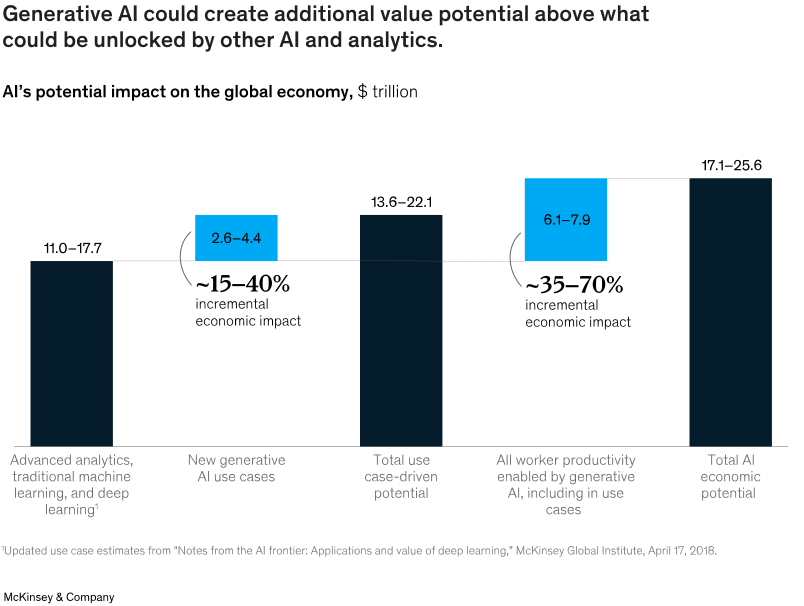
Generative AI’s impact on productivity could add trillions of dollars in value to the global economy. Our latest research estimates that generative AI could add the equivalent of $2.6 trillion to $4.4 trillion annually across the 63 use cases we analyzed—by comparison, the United Kingdom’s entire GDP in 2021 was $3.1 trillion. This would increase the impact of all artificial intelligence by 15 to 40 percent. This estimate would roughly double if we include the impact of embedding generative AI into software that is currently used for other tasks beyond those use cases.

About 75 percent of the value that generative AI use cases could deliver falls across four areas: Customer operations, marketing and sales, software engineering, and R&D. Across 16 business functions, we examined 63 use cases in which the technology can address specific business challenges in ways that produce one or more measurable outcomes. Examples include generative AI’s ability to support interactions with customers, generate creative content for marketing and sales, and draft computer code based on natural-language prompts, among many other tasks.

Generative AI will have a significant impact across all industry sectors. Banking, high tech, and life sciences are among the industries that could see the biggest impact as a percentage of their revenues from generative AI. Across the banking industry, for example, the technology could deliver value equal to an additional $200 billion to $340 billion annually if the use cases were fully implemented. In retail and consumer packaged goods, the potential impact is also significant at $400 billion to $660 billion a year.

Generative AI has the potential to change the anatomy of work, augmenting the capabilities of individual workers by automating some of their individual activities. Current generative AI and other technologies have the potential to automate work activities that absorb 60 to 70 percent of employees’ time today. In contrast, we previously estimated that technology has the potential to automate half of the time employees spend working. The acceleration in the potential for technical automation is largely due to generative AI’s increased ability to understand natural language, which is required for work activities that account for 25 percent of total work time. Thus, generative AI has more impact on knowledge work associated with occupations that have higher wages and educational requirements than on other types of work.

The pace of workforce transformation is likely to accelerate, given increases in the potential for technical automation. Our updated adoption scenarios, including technology development, economic feasibility, and diffusion timelines, lead to estimates that half of today’s work activities could be automated between 2030 and 2060, with a midpoint in 2045, or roughly a decade earlier than in our previous estimates.

Generative AI can substantially increase labor productivity across the economy, but that will require investments to support workers as they shift work activities or change jobs. Generative AI could enable labor productivity growth of 0.1 to 0.6 percent annually through 2040, depending on the rate of technology adoption and redeployment of worker time into other activities. Combining generative AI with all other technologies, work automation could add 0.2 to 3.3 percentage points annually to productivity growth. However, workers will need support in learning new skills, and some will change occupations. If worker transitions and other risks can be managed, generative AI could contribute substantively to economic growth and support a more sustainable, inclusive world.

The era of generative AI is just beginning. Excitement over this technology is palpable, and early pilots are compelling. But a full realization of the technology’s benefits will take time, and leaders in business and society still have considerable challenges to address. These include managing the risks inherent in generative AI, determining what new skills and capabilities the workforce will need, and rethinking core business processes such as retraining and developing new skills.

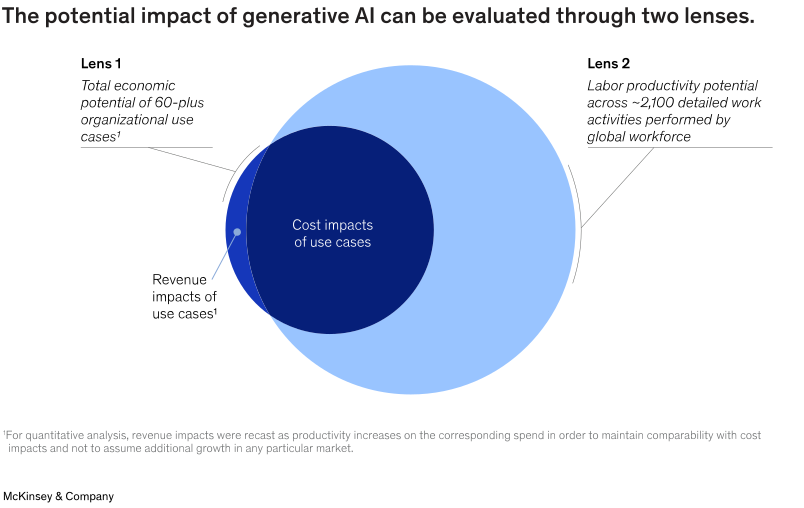
Generative AI is a step change in the evolution of artificial intelligence. As companies rush to adapt and implement it, understanding the technology’s potential to deliver value to the economy and society at large will help shape critical decisions. We have used two complementary lenses to determine where generative AI, with its current capabilities, could deliver the biggest value and how big that value could be (Exhibit 1).

The potential impact of generative AI can be evaluated through two lenses.

The first lens scans use cases for generative AI that organizations could adopt. We define a “use case” as a targeted application of generative AI to a specific business challenge, resulting in one or more measurable outcomes. For example, a use case in marketing is the application of generative AI to generate creative content such as personalized emails, the measurable outcomes of which potentially include reductions in the cost of generating such content and increases in revenue from the enhanced effectiveness of higher-quality content at scale. We identified 63 generative AI use cases spanning 16 business functions that could deliver total value in the range of $2.6 trillion to $4.4 trillion in economic benefits annually when applied across industries.

That would add 15 to 40 percent to the $11 trillion to $17.7 trillion of economic value that we now estimate nongenerative artificial intelligence and analytics could unlock. (Our previous estimate from 2017 was that AI could deliver $9.5 trillion to $15.4 trillion in economic value.)

Our second lens complements the first by analyzing generative AI’s potential impact on the work activities required in some 850 occupations. We modeled scenarios to estimate when generative AI could perform each of more than 2,100 “detailed work activities”—such as “communicating with others about operational plans or activities”—that make up those occupations across the world economy. This enables us to estimate how the current capabilities of generative AI could affect labor productivity across all work currently done by the global workforce.

Some of this impact will overlap with cost reductions in the use case analysis described above, which we assume are the result of improved labor productivity. Netting out this overlap, the additional economic benefits of generative AI beyond those use cases—or the many small increases in productivity that are likely to materialize when the technology is applied to knowledge workers’ activities—amounts to an additional $6.1 trillion to $7.9 trillion annually (Exhibit 2).

Generative AI could create additional value potential above what could be unlocked by other AI and analytics.

While generative AI is an exciting and rapidly advancing technology, the other applications of AI discussed in our previous report continue to account for the majority of the overall potential value of AI. Traditional advanced-analytics and machine learning algorithms are highly effective at performing numerical and optimization tasks such as predictive modeling, and they continue to find new applications in a wide range of industries. However, as generative AI continues to develop and mature, it has the potential to open wholly new frontiers in creativity and innovation. It has already expanded the possibilities of what AI overall can achieve (see sidebar “How we estimated the value potential of generative AI use cases”).

In this section, we highlight the value potential of generative AI across business functions.

Generative AI could have an impact on most business functions; however, a few stand out when measured by the technology’s impact as a share of functional cost (Exhibit 3). Our analysis of 16 business functions identified just four—customer operations, marketing and sales, software engineering, and research and development—that could account for approximately 75 percent of the total annual value from generative AI use cases.

Using generative AI in just a few functions could drive most of the technology’s impact across potential corporate use cases.

Notably, the potential value of using generative AI for several functions that were prominent in our previous sizing of AI use cases, including manufacturing and supply chain functions, is now much lower. This is largely explained by the nature of generative AI use cases, which exclude most of the numerical and optimization applications that were the main value drivers for previous applications of AI.

In addition to the potential value generative AI can deliver in function-specific use cases, the technology could drive value across an entire organization by revolutionizing internal knowledge management systems. Generative AI’s impressive command of natural-language processing can help employees retrieve stored internal knowledge by formulating queries in the same way they might ask a human a question and engage in continuing dialogue. This could empower teams to quickly access relevant information, enabling them to rapidly make better-informed decisions and develop effective strategies.

In 2012, the McKinsey Global Institute (MGI) estimated that knowledge workers spent about a fifth of their time, or one day each work week, searching for and gathering information. If generative AI could take on such tasks, increasing the efficiency and effectiveness of the workers doing them, the benefits would be huge. Such virtual expertise could rapidly “read” vast libraries of corporate information stored in natural language and quickly scan source material in dialogue with a human who helps fine-tune and tailor its research, a more scalable solution than hiring a team of human experts for the task.

In other cases, generative AI can drive value by working in partnership with workers, augmenting their work in ways that accelerate their productivity. Its ability to rapidly digest mountains of data and draw conclusions from it enables the technology to offer insights and options that can dramatically enhance knowledge work. This can significantly speed up the process of developing a product and allow employees to devote more time to higher-impact tasks.

Following are four examples of how generative AI could produce operational benefits in a handful of use cases across the business functions that could deliver a majority of the potential value we identified in our analysis of 63 generative AI use cases. In the first two examples, it serves as a virtual expert, while in the following two, it lends a hand as a virtual collaborator.

Across the 63 use cases we analyzed, generative AI has the potential to generate $2.6 trillion to $4.4 trillion in value across industries. Its precise impact will depend on a variety of factors, such as the mix and importance of different functions, as well as the scale of an industry’s revenue (Exhibit 4).

For example, our analysis estimates generative AI could contribute roughly $310 billion in additional value for the retail industry (including auto dealerships) by boosting performance in functions such as marketing and customer interactions. By comparison, the bulk of potential value in high tech comes from generative AI’s ability to increase the speed and efficiency of software development.

In the banking industry, generative AI has the potential to improve on efficiencies already delivered by artificial intelligence by taking on lower-value tasks in risk management, such as required reporting, monitoring regulatory developments, and collecting data. In the life sciences industry, generative AI is poised to make significant contributions to drug discovery and development.

We share our detailed analysis of these industries below.

Technology has been changing the anatomy of work for decades. Over the years, machines have given human workers various “superpowers”; for instance, industrial-age machines enabled workers to accomplish physical tasks beyond the capabilities of their own bodies. More recently, computers have enabled knowledge workers to perform calculations that would have taken years to do manually.

These examples illustrate how technology can augment work through the automation of individual activities that workers would have otherwise had to do themselves. At a conceptual level, the application of generative AI may follow the same pattern in the modern workplace, although as we show later in this chapter, the types of activities that generative AI could affect, and the types of occupations with activities that could change, will likely be different as a result of this technology than for older technologies.

The McKinsey Global Institute began analyzing the impact of technological automation of work activities and modeling scenarios of adoption in 2017. At that time, we estimated that workers spent half of their time on activities that had the potential to be automated by adapting technology that existed at that time, or what we call technical automation potential. We also modeled a range of potential scenarios for the pace at which these technologies could be adopted and affect work activities throughout the global economy.

Technology adoption at scale does not occur overnight. The potential of technological capabilities in a lab does not necessarily mean they can be immediately integrated into a solution that automates a specific work activity—developing such solutions takes time. Even when such a solution is developed, it might not be economically feasible to use if its costs exceed those of human labor. Additionally, even if economic incentives for deployment exist, it takes time for adoption to spread across the global economy. Hence, our adoption scenarios, which consider these factors together with the technical automation potential, provide a sense of the pace and scale at which workers’ activities could shift over time.

The analyses in this paper incorporate the potential impact of generative AI on today’s work activities. The new capabilities of generative AI, combined with previous technologies and integrated into corporate operations around the world, could accelerate the potential for technical automation of individual activities and the adoption of technologies that augment the capabilities of the workforce. They could also have an impact on knowledge workers whose activities were not expected to shift as a result of these technologies until later in the future (see sidebar “About the research”).

Automation potential has accelerated, but adoption to lag

Based on developments in generative AI, technology performance is now expected to match median human performance and reach top-quartile human performance earlier than previously estimated across a wide range of capabilities (Exhibit 5). For example, MGI previously identified 2027 as the earliest year when median human performance for natural-language understanding might be achieved in technology, but in this new analysis, the corresponding point is 2023.

As a result of generative AI, experts assess that technology could achieve human-level performance in some technical capabilities sooner than previously thought.

As a result of these reassessments of technology capabilities due to generative AI, the total percentage of hours that could theoretically be automated by integrating technologies that exist today has increased from about 50 percent to 60–70 percent. The technical potential curve is quite steep because of the acceleration in generative AI’s natural-language capabilities.

Interestingly, the range of times between the early and late scenarios has compressed compared with the expert assessments in 2017, reflecting a greater confidence that higher levels of technological capabilities will arrive by certain time periods (Exhibit 6).

Our analysis of adoption scenarios accounts for the time required to integrate technological capabilities into solutions that can automate individual work activities; the cost of these technologies compared with that of human labor in different occupations and countries around the world; and the time it has taken for technologies to diffuse across the economy. With the acceleration in technical automation potential that generative AI enables, our scenarios for automation adoption have correspondingly accelerated. These scenarios encompass a wide range of outcomes, given that the pace at which solutions will be developed and adopted will vary based on decisions that will be made on investments, deployment, and regulation, among other factors. But they give an indication of the degree to which the activities that workers do each day may shift (Exhibit 7).

As an example of how this might play out in a specific occupation, consider postsecondary English language and literature teachers, whose detailed work activities include preparing tests and evaluating student work. With generative AI’s enhanced natural-language capabilities, more of these activities could be done by machines, perhaps initially to create a first draft that is edited by teachers but perhaps eventually with far less human editing required. This could free up time for these teachers to spend more time on other work activities, such as guiding class discussions or tutoring students who need extra assistance.

Our previously modeled adoption scenarios suggested that 50 percent of time spent on 2016 work activities would be automated sometime between 2035 and 2070, with a midpoint scenario around 2053. Our updated adoption scenarios, which account for developments in generative AI, models the time spent on 2023 work activities reaching 50 percent automation between 2030 and 2060, with a midpoint of 2045—an acceleration of roughly a decade compared with the previous estimate.

Adoption is also likely to be faster in developed countries, where wages are higher and thus the economic feasibility of adopting automation occurs earlier. Even if the potential for technology to automate a particular work activity is high, the costs required to do so have to be compared with the cost of human wages. In countries such as China, India, and Mexico, where wage rates are lower, automation adoption is modeled to arrive more slowly than in higher-wage countries (Exhibit 8).

Generative AI’s potential impact on knowledge work

Previous generations of automation technology were particularly effective at automating data management tasks related to collecting and processing data. Generative AI’s natural-language capabilities increase the automation potential of these types of activities somewhat. But its impact on more physical work activities shifted much less, which isn’t surprising because its capabilities are fundamentally engineered to do cognitive tasks.

As a result, generative AI is likely to have the biggest impact on knowledge work, particularly activities involving decision making and collaboration, which previously had the lowest potential for automation (Exhibit 9). Our estimate of the technical potential to automate the application of expertise jumped 34 percentage points, while the potential to automate management and develop talent increased from 16 percent in 2017 to 49 percent in 2023.

Generative AI could have the biggest impact on collaboration and the application of expertise, activities that previously had a lower potential for automation.

Generative AI’s ability to understand and use natural language for a variety of activities and tasks largely explains why automation potential has risen so steeply. Some 40 percent of the activities that workers perform in the economy require at least a median level of human understanding of natural language.

As a result, many of the work activities that involve communication, supervision, documentation, and interacting with people in general have the potential to be automated by generative AI, accelerating the transformation of work in occupations such as education and technology, for which automation potential was previously expected to emerge later (Exhibit 10).

Advances in technical capabilities could have the most impact on activities performed by educators, professionals, and creatives.

Labor economists have often noted that the deployment of automation technologies tends to have the most impact on workers with the lowest skill levels, as measured by educational attainment, or what is called skill biased. We find that generative AI has the opposite pattern—it is likely to have the most incremental impact through automating some of the activities of more-educated workers.

Another way to interpret this result is that generative AI will challenge the attainment of multiyear degree credentials as an indicator of skills, and others have advocated for taking a more skills-based approach to workforce development in order to create more equitable, efficient workforce training and matching systems. Generative AI could still be described as skill-biased technological change, but with a different, perhaps more granular, description of skills that are more likely to be replaced than complemented by the activities that machines can do.

Previous generations of automation technology often had the most impact on occupations with wages falling in the middle of the income distribution. For lower-wage occupations, making a case for work automation is more difficult because the potential benefits of automation compete against a lower cost of human labor. Additionally, some of the tasks performed in lower-wage occupations are technically difficult to automate—for example, manipulating fabric or picking delicate fruits. Some labor economists have observed a “hollowing out of the middle,” and our previous models have suggested that work automation would likely have the biggest midterm impact on lower-middle-income quintiles.

However, generative AI’s impact is likely to most transform the work of higher-wage knowledge workers because of advances in the technical automation potential of their activities, which were previously considered to be relatively immune from automation (Exhibit 11).

Generative AI could have the biggest impact on activities in high-wage jobs; previously, automation’s impact was highest in lower-middle-income quintiles.

Generative AI could propel higher productivity growth

Global economic growth was slower from 2012 to 2022 than in the two preceding decades. Although the COVID-19 pandemic was a significant factor, long-term structural challenges—including declining birth rates and aging populations—are ongoing obstacles to growth.

Declining employment is among those obstacles. Compound annual growth in the total number of workers worldwide slowed from 2.5 percent in 1972–82 to just 0.8 percent in 2012–22, largely because of aging. In many large countries, the size of the workforce is already declining. Productivity, which measures output relative to input, or the value of goods and services produced divided by the amount of labor, capital, and other resources required to produce them, was the main engine of economic growth in the three decades from 1992 to 2022 (Exhibit 12). However, since then, productivity growth has slowed in tandem with slowing employment growth, confounding economists and policy makers.

Productivity growth, the main engine of GDP growth over the past 30 years, slowed down in the past decade.

The deployment of generative AI and other technologies could help accelerate productivity growth, partially compensating for declining employment growth and enabling overall economic growth. Based on our estimates, the automation of individual work activities enabled by these technologies could provide the global economy with an annual productivity boost of 0.2 to 3.3 percent from 2023 to 2040, depending on the rate of automation adoption—with generative AI contributing 0.1 to 0.6 percentage points of that growth—but only if individuals affected by the technology were to shift to other work activities that at least match their 2022 productivity levels (Exhibit 13). In some cases, workers will stay in the same occupations, but their mix of activities will shift; in others, workers will need to shift occupations.

Generative AI could contribute to productivity growth if labor hours can be redeployed effectively.

History has shown that new technologies have the potential to reshape societies. Artificial intelligence has already changed the way we live and work—for example, it can help our phones (mostly) understand what we say, or draft emails. Mostly, however, AI has remained behind the scenes, optimizing business processes or making recommendations about the next product to buy. The rapid development of generative AI is likely to significantly augment the impact of AI overall, generating trillions of dollars of additional value each year and transforming the nature of work.

But the technology could also deliver new and significant challenges. Stakeholders must act—and quickly, given the pace at which generative AI could be adopted—to prepare to address both the opportunities and the risks. Risks have already surfaced, including concerns about the content that generative AI systems produce: Will they infringe upon intellectual property due to “plagiarism” in the training data used to create foundation models? Will the answers that LLMs produce when questioned be accurate, and can they be explained? Will the content generative AI creates be fair or biased in ways that users do not want by, say, producing content that reflects harmful stereotypes?

There are economic challenges too: the scale and the scope of the workforce transitions described in this report are considerable. In the midpoint adoption scenario, about a quarter to a third of work activities could change in the coming decade. The task before us is to manage the potential positives and negatives of the technology simultaneously (see sidebar “Using generative AI responsibly”). Here are some of the critical questions we will need to address while balancing our enthusiasm for the potential benefits of the technology with the new challenges it can introduce.

Companies and business leaders

How can companies move quickly to capture the potential value at stake highlighted in this report, while managing the risks that generative AI presents?

How will the mix of occupations and skills needed across a company’s workforce be transformed by generative AI and other artificial intelligence over the coming years? How will a company enable these transitions in its hiring plans, retraining programs, and other aspects of human resources?

Do companies have a role to play in ensuring the technology is not deployed in “negative use cases” that could harm society?

How can businesses transparently share their experiences with scaling the use of generative AI within and across industries—and also with governments and society?

Policy makers

What will the future of work look like at the level of an economy in terms of occupations and skills? What does this mean for workforce planning?

How can workers be supported as their activities shift over time? What retraining programs can be put in place? What incentives are needed to support private companies as they invest in human capital? Are there earn-while-you-learn programs such as apprenticeships that could enable people to retrain while continuing to support themselves and their families?

What steps can policy makers take to prevent generative AI from being used in ways that harm society or vulnerable populations?

Can new policies be developed and existing policies amended to ensure human-centric AI development and deployment that includes human oversight and diverse perspectives and accounts for societal values?

Individuals as workers, consumers, and citizens

How concerned should individuals be about the advent of generative AI? While companies can assess how the technology will affect their bottom lines, where can citizens turn for accurate, unbiased information about how it will affect their lives and livelihoods?

How can individuals as workers and consumers balance the conveniences generative AI delivers with its impact in their workplaces?

Can citizens have a voice in the decisions that will shape the deployment and integration of generative AI into the fabric of their lives?


Technological innovation can inspire equal parts awe and concern. When that innovation seems to materialize fully formed and becomes widespread seemingly overnight, both responses can be amplified. The arrival of generative AI in the fall of 2022 was the most recent example of this phenomenon, due to its unexpectedly rapid adoption as well as the ensuing scramble among companies and consumers to deploy, integrate, and play with it.

All of us are at the beginning of a journey to understand this technology’s power, reach, and capabilities. If the past eight months are any guide, the next several years will take us on a roller-coaster ride featuring fast-paced innovation and technological breakthroughs that force us to recalibrate our understanding of AI’s impact on our work and our lives. It is important to properly understand this phenomenon and anticipate its impact. Given the speed of generative AI’s deployment so far, the need to accelerate digital transformation and reskill labor forces is great.

These tools have the potential to create enormous value for the global economy at a time when it is pondering the huge costs of adapting and mitigating climate change. At the same time, they also have the potential to be more destabilizing than previous generations of artificial intelligence. They are capable of that most human of abilities, language, which is a fundamental requirement of most work activities linked to expertise and knowledge as well as a skill that can be used to hurt feelings, create misunderstandings, obscure truth, and incite violence and even wars.

We hope this research has contributed to a better understanding of generative AI’s capacity to add value to company operations and fuel economic growth and prosperity as well as its potential to dramatically transform how we work and our purpose in society. Companies, policy makers, consumers, and citizens can work together to ensure that generative AI delivers on its promise to create significant value while limiting its potential to upset lives and livelihoods. The time to act is now.

Bend Cultural Tourism Fund awards $400,000 to arts and culture organizations

Bend Cultural Tourism Fund awards $400,000 to arts and culture organizations

BEND, Ore. (KTVZ) — The Bend Cultural Tourism Commission, a Visit Bend Project overseeing the Bend Cultural Tourism Fund, announced it has awarded $400,000 in funding to grantees in arts and culture.

The funds will help local organizations leverage marketing resources to attract more cultural tourists during the shoulder seasons and winter months. Funding begins July 1, 2023.

The Bend Cultural Tourism Fund, now in its eighth year, invests in cultural activities that draw visitors from beyond a 50-mile radius, benefiting the local economy and community, funding new activities through the Catalyst Grant program (Intended to support the bold ideas that aren’t yet fully developed, but can demonstrate extraordinary potential for increasing Bend’s off-season cultural tourists), as well as long standing cultural traditions via the Marketing Grant program (intended to support high quality cultural tourism activities that demonstrate a clear and measurable economic benefit in Bend).

Since its inception in 2015, the BCTF has awarded $2,032,105 for 102 projects. For a full list of past projects and funding amounts, visit the BCTF website here.

“The Bend Cultural Tourism Fund is an important way for Visit Bend to diversify tourism offerings in our city, especially during our shoulder seasons,” said Kevney Dugan, CEO of Visit Bend. “We are thrilled about the grantees, all of whom will bring enriching cultural and arts experiences to Bend as long term investments into our city.”

The Bend Cultural Tourism Commission met Monday, June 5, 2023, for its annual grant review meeting, scoring and ranking 32 completed applications (21 Marketing Applications, 11 Catalyst Grant Applications) with a total requested amount of $1,257,075.

The following 15 applicants all scored over 79 points or more (out of 100) in the scoring matrix and were recommended by the Commission, then approved by the Visit Bend Board of Directors:

  • High Desert Museum
    • $48,000: To fund marketing efforts for “Something in the Woods: Sasquatch in the High Desert,” a new exhibit that will use art, science, history, and popular culture to highlight the diverse stories and perspectives around this popular creature in the High Desert.
  • Lay It Out Events
    • $42,000: To fund marketing efforts for the Bend Fall Festival’s Art in Action Avenue. 
  • Scalehouse
    • $30,000: To fund marketing efforts for Bend Design 2023, a two-day creative conference.
  • BendFilm
    • $47,000: To fund the marketing efforts for the 20th annual BendFilm Festival.
  • The Greenhouse Cabaret
    • $23,000: To fund marketing efforts for four plays and musicals in the shoulder season.
  • Bend Yoga Festival, LLC
    • $37,000: To fund marketing efforts for the Bend Yoga Festival, a four-day yoga immersion, with more than 65 yoga intensives, 32 presenters, wellness sessions, photography & art workshops and more.
  • 1988 Entertainment LLC
    • $35,000: To fund marketing efforts for shoulder season concerts. 
  • OUT Central Oregon
    • $30,000: To fund marketing efforts for WinterPride Fest activities, including Wigs…an Ice Breaker, Welcoming Snocial, Drag Brunch and more.
  • Old Mill District
    • $20,000: To fund marketing efforts for three post-Labor Day concerts: Kidz Bop on Sept. 8, Jelly Roll on Sept. 12, and The Counting Crows on Sept. 14.
  • Downtown Bend Business Association
    • $20,000: To fund marketing efforts for Downtown Holiday events.
  • High Desert Makers
    • $26,500: To fund marketing efforts for the Central Oregon Maker Faire, held at COCC campus in September 2023.
  • High Desert Music Collective
    • $9,000: ​​To fund marketing efforts for the HomeGrown Music Festival 2024, the fourth annual High Desert Music Collective’s 4/20 celebration and 2nd annual HomeGrown Music Festival.
  • 4 Peaks Presents LLC (Catalyst Grant)
    • $10,000: To fund the research and development of a new October Festival. 
  • Central Oregon Center for the Arts (Catalyst Grant)
    • $12,500: To partially fund planning and consulting for COCA, which intends to build a facility that will be Central Oregon’s home for the performing and visual arts.
  • Vamonos Outside (the Children Forest of Central Oregon)  (Catalyst Grant)
    • $10,000: To fund the first outdoor-focused film festival for Latinx community members.

 ABOUT VISIT BEND: Visit Bend is a non-membership, non-profit economic development organization dedicated to promoting tourism responsibly on behalf of the City of Bend. We’re a leading provider of information on Bend, Oregon hotels, restaurants, activities, and Oregon vacation planning. To learn more or to order a complimentary Official Visitor Guide to Bend, contact Visit Bend at 1-800-949-6086 or visit visitbend.com

ABOUT THE BEND CULTURAL TOURISM FUND: The Bend Cultural Tourism Fund (BCTF) is a grant program dedicated to enhancing the local economy through the promotion and cultivation of Bend’s cultural tourism programs, with an emphasis on activities that help attract cultural tourists during the shoulder seasons and winter months. For more information, please see the website at https://culture.visitbend.com.