Art World News

Meet Randy Soriano, First ED of the Hawai‘i LGBT Legacy Foundation

Meet Randy Soriano, First ED of the Hawai‘i LGBT Legacy Foundation


Ohana Pride

Photo: Courtesy of the Hawai‘i LGBT Legacy Foundation. Photo Credit: Mahina Choy Ellis


In our vibrant and diverse community, a dynamic leader has emerged to champion the rights and well-being of the LGBTQIA+ community. Randy Soriano, the newly appointed Executive Director of the Hawai‘i LGBT Legacy Foundation, is igniting a wave of positive change and bringing forward a fresh perspective to uplift and empower marginalized voices. With his commitment to inclusivity, advocacy and community building, Soriano is poised to leave an indelible mark on the legacy of LGBTQIA+ activism in the Aloha State.


The foundation will benefit from his professional skills as a marketing, communications and management professional with more than 15 years of experience at industry-leading companies in Hawai‘i. Before joining the Hawai‘i LGBT Legacy Foundation, Randy spent nearly a decade leading the marketing department at Title Guaranty Hawai‘i, the state’s largest and oldest kama‘āina title and escrow company.


Dedicating himself to his values through years of leadership as a nonprofit executive, Soriano specializes in program development, project management and fundraising. His passion for connecting people and serving the community has been proven through countless hours devoted to various nonprofit and community organizations. He is a Past President of the Rotary E-Club of Hawai‘i, serving a two-year term that oversaw an aggressive strategic plan to grow the Club’s membership and community partnerships.


41870 1pridehnl2014 0009

Photo: Kelli Bullock


He is also a board member at the Hawai‘i Health and Harm Reduction Center, serving on the marketing and fundraising committee. In 2022, Randy served as the Chairperson of Honolulu Pride, leading the organization to its largest parade and festival to date. He has also previously served as Board Secretary of the Hawai‘i LGBT Legacy Foundation and is a recent graduate of the Filipino Chamber of Commerce of Hawai‘i’s Fellows Program.


He was an honoree at the 2019 Business of Pride Awards presented by Pacific Business News, which recognizes individuals who excel professionally and are leaders in advocacy for the LGBTQIA+ community. In 2022, Randy was the recipient of Pacific Edge Magazine’s Young Professional of the Year award.


“I’m grateful to be able to combine my passions for connecting and empowering people with my marketing and management experience in a position that will effect positive change for the LGBTQIA+ and MVPFAFF communities. Our rights to exist and thrive are under attack, and it’s so important to create a space for people to be heard and feel safe,” says Soriano.


Q&A With Randy Soriano


For those who may be unfamiliar with your programs, can you share the current initiatives of the Hawai‘i LGBT Legacy Foundation?


RS: The Hawai‘i LGBT Legacy Foundation produces Honolulu Pride, hosts the LGBTQ+ Center and creates programs that inform, unify and empower Hawai‘i’s LGBTQIA+ community. We’ve expanded on educational and cultural programming through our Māhūi committee that leads our Rainbow Town Halls and our annual Pride Pāʻina Lā ʻOhana event.


The Foundation also provides in-kind and financial support to organizations addressing social, cultural and economic inequalities. Our mission is to help LGBTQIA+ people live happy, healthy and productive lives as integral members of Hawai‘i’s larger, diverse communities.


What are your plans as the first Executive Director of the Hawai‘i LGBT Legacy Foundation?


RS: The Executive Director position is an exciting step for the Foundation because it’s an investment in the growth and sustainability of the organization. Our plans are focused on increasing representation and equity for the LGBTQIA+ and MVPFAFF communities through programming and events. This will include the expansion of Honolulu Pride to a Pride 365 concept, which will offer programs throughout the year for the queer community. We have a lot of large projects in the pipeline, including the return of the Vision Without Limits Gala on July 20th at Hyatt Regency and a stacked lineup for Honolulu Pride in October featuring parade grand marshal and festival headliner Sasha Colby, winner of season 15 of Rupaul’s Drag Race.


What unique challenges is the Hawai‘i LGBT Legacy Foundation facing in 2023?


RS: We represent a community whose rights are being targeted by anti-trans policies and rhetoric throughout the nation. In a recent press release by Human Rights Campaign, a record of more than 520 anti-LGBTQ+ bills have been introduced in state legislatures, with over 220 targeting transgender and non-binary people. 70 anti-LGBTQ laws have been enacted, 15 of those banning gender-affirming care for trans youth.


In a time when we face increased opposition, the Foundation is committed to improving representation and support through educational programs and community engagement campaigns.


What can the LGBTQIA+ community expect in terms of expanded programs and services?


RS: We’re introducing programs and services that will engage more intersections of our community. On June 24 from 11 a.m. to 3 p.m. at Hawai‘i State Art Museum, we will be partnering with Spill the Tea Café and Mark Kanemura on a family event called “I Am a Rainbow,” which will be the launch of Mark’s first keiki book of the same name. The event will feature art workshops, keiki art gallery, drag artists, drag story time, food vendors, a dance party and a book reading and signing by Mark.


We will be expanding the Rainbow Town Hall offerings throughout the year as well. Topics will include kūpuna care and resources, allyship and inclusivity training, diversity in marketing and more.


SEE ALSO: Honolulu Pride: LGBTQIA+ Events in June 2023


How can readers best support the Hawai‘i LGBT Legacy Foundation and its mission in 2023 and beyond?


RS: If you’re interested in supporting the Hawai‘i LGBT Legacy Foundation, we encourage you to visit our community calendar and attend any of our events and programs. Also, everything that is done by the Foundation is supported by grants and community giving, so we encourage those who have the resources to consider donating or joining our monthly recurring giving program, Rainbow Giving. Mahalo for continuing to support the LGBTQIA+ and MVPFAFF communities.


LGBTQ+ Center Honolulu is moving to Waikīkī Business Plaza, 2270 Kalākaua Ave. hawaiilgbtlegacyfoundation.com, @honolulupride

New exhibit uses Boulder County farms to bring agriculture to life

New exhibit uses Boulder County farms to bring agriculture to life

An experimental new exhibit by the Longmont Museum and the Boulder Museum of Contemporary Art asks visitors a question: what is their relationship with the farmland that surrounds them?

The multi-venue exhibition, “agriCULTURE: Art Inspired by the Land,” opens next week at both museums as well as at three Boulder County farms. The Agricultural Heritage Center and Ollin Farms in Longmont and Milk and Honey Farm in Boulder will house artwork from the project June 10 through Sept. 4. The exhibit will be at the Longmont Museum through Jan. 7 and through Oct. 1 at BMoCA.

Eighteen artists from within and outside Boulder County were matched with local farms based on their agricultural interests. The artists were commissioned to create works that reflect the practices of Front Range farmers and even pose solutions to farming-related issues. The resulting pieces accomplish this through various forms, including sculptures, paintings and ceramics.

Jared Thompson, curator of the Longmont Museum’s arm of the exhibition, said the goal of “agriCULTURE” is to bring the link between humans and nature to life through art.

“It’s really about connecting to the land, and farmers have such a strong connection to land,” he said. “It’s great to see all of our work finally coming to fruition and actually see artwork in the gallery.”

The exhibition is four years in the making. On top of delays from the COVID-19 pandemic, the long timeframe comes from the curators wanting artists to spend at least a year with their farm partners, which gave them the opportunity to experience all four seasons. The whole thing, Thompson said, has tread new ground, particularly the aspect of pairing artists with community members.

“It definitely is an interesting process,” he said. “There’s a lot of moving parts, so there’s lots to manage, but it’s well worth it.”

At the Longmont Museum, large sculptural pieces dominate the special exhibit gallery, including a carousel inside parts of a grain silo and a massive grid-patterned screen made from corn stalks against one of the walls. Taking up around a third of the gallery is a sprawling inflatable sculpture by Boulder-based artist Nicole Banowetz.

The sculpture’s large nylon tubes depict a futuristic fictional mechanism, Banowetz said, something farmers could use to send oxygen and nutrients into the soil. Banowetz was paired with Esoterra Culinary Garden in east Boulder County, which grows food for restaurants using chemical-free methods.

“I really love collaborating with scientists in general, and at least in the case of Esoterra, it’s very scientific,” Banowetz said, pointing to how the soil is often tested for microbes. “Art really can help speak about … our relationship with nature and where our food comes from.”

Banowetz was inspired by the farm’s use of microbes and pollinators to rejuvenate the land’s unhealthy soil. She hopes her sculpture will make people consider the damage humans have made to soil through pesticides.

“I want people to think about the way they are interacting with soil, specifically,” she said. “We need to promote that ecosystem without damaging it. We are a part of it, but we shouldn’t try to control it by destroying things.”

Across the gallery hangs the corn stalk screen, created by Boulder County artist Patrick Marold. Marold harvested the stalks with local fifth-generation farmer Keith Bateman, who he was paired with for the exhibit. The screen, he said, aims to depict the scale of produce that commercial farmers such as Bateman need to “feed the masses.”

“Agriculture in art has always been important to me,” Marold said. “I work from the landscape and the land, and I’m interested in how we, as humans, relate to it. It’s almost like I was waiting for (this exhibition).”

Apart from the environmental message of his piece, Marold wants the screen to capture the beauty of the material itself. People often take it for granted, he said.

“You see beautiful pastures and fields of corn, and there’s an organization to it that every farmer uses,” he said. “There’s a lot of beauty in the way those plants are planted and organized.”

Like the Longmont Museum, BMoCA’s “agriCULTURE” exhibit is a blend of art from several media; there’s even a piece that incorporates dirt from one of the partner farms. Marketing manager Jennifer Chaparro said the exhibit is a good fit with the museum’s mission of making art accessible.

“We definitely like to bring in different elements of the community, because it reaches more people and affects more people,” she said.

Opening receptions for “agriCULTURE” will be held Thursday at BMoCA, 1750 13th St. and Friday at the Longmont Museum, 400 Quail Road from 6 to 8 p.m. More information, including a map of exhibits, can be found at bit.ly/3ITU0VW.

POD: Jasmine Williams, Curator and Creative Producer

POD: Jasmine Williams, Curator and Creative Producer

Jasmine Williams moved from Mississippi to Austin, Texas on a whim. She had just lost her job in housing, which provided her a home. While some of her friends were visiting, they brought up the idea of her moving to Austin. With no job prospects that she could find at the time in her field of marketing and corporate relations, she took the chance and left the Magnolia State in 2018.

She was happy in Austin, where she learned she could make a living from creativity and entrepreneurship. She began delving more into her family lineage as well as Mississippian culture and history. Eventually, she ended up creating ’SippTalk, an online forum that highlights Mississippi creatives and culture through various multimedia forms.

“I found myself gravitating to the same work of creating community safe spaces, documentation, and I wanted to do it in a community that was closer to home,” Williams told the Mississippi Free Press.

Staying in Austin began to make less sense, so at the end of 2019, she moved to Jackson, Miss., a city with a large creative community and a place where many of her connections were based.

“I wanted to learn more about oral history and archives and really tell the stories of the people that are here because there’s so much I didn’t know,” Williams said.

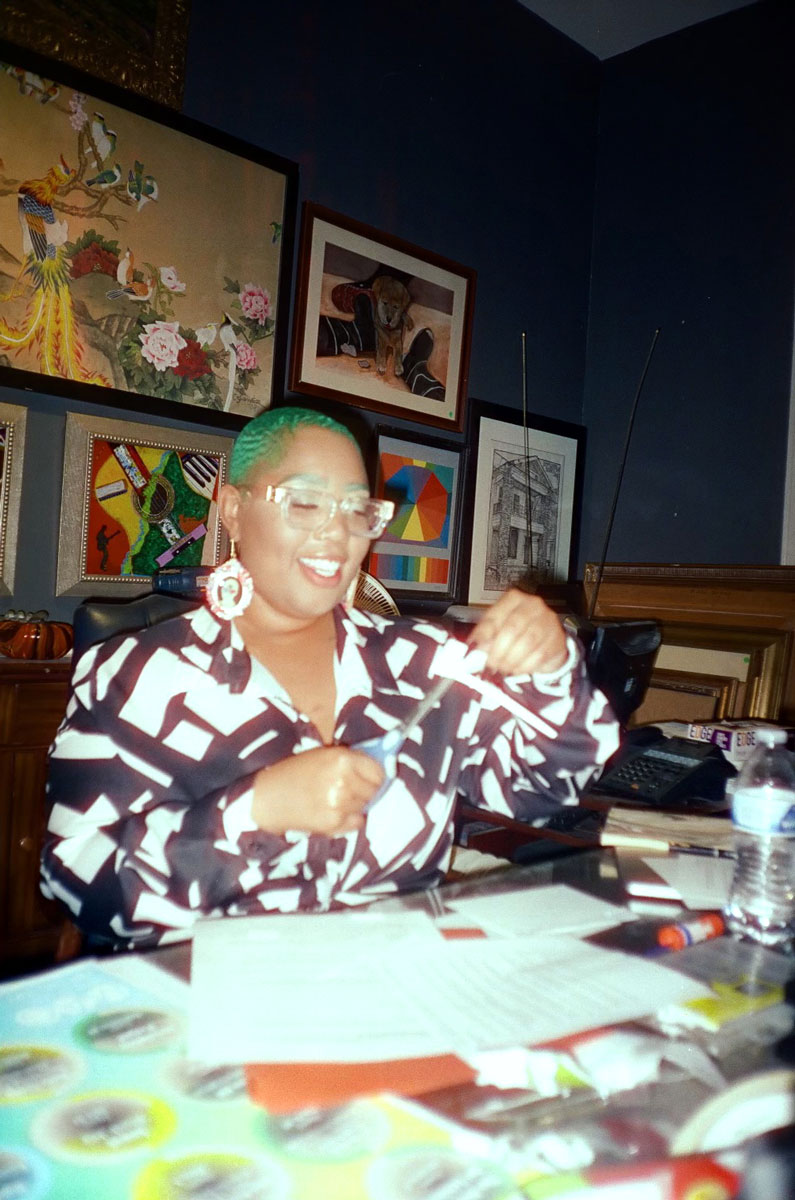
Jasmine Williams sitting at a cluttered desk, cutting something with scissors
While living in Austin, Texas, Jasmine Williams began to learn more about her home state of Mississippi and her family lineage, which inspired her to create ’SippTalk, an online forum that highlights Mississippi culture and creatives through various multimedia forms. Photo courtesy DeJarius Evans

A few weeks following her return to Mississippi, Williams met artist Nick Cave. After telling him how much she enjoyed his work, he hired her to organize a call-and-response to his “Beyond the Cave” exhibit at the Mississippi Museum of Art in downtown Jackson.

The event brought together more than 42 local creators from Jackson and across the state who created responses to Cave’s work through visual art, music, photography, dance and other forms of creative expression. Williams curated the event with friends Meredith Williams, Miranda Hicks and Charity Hicks, also known as rapper Vitamin Cea.

“We didn’t really know the journey that we were embarking on or like what we were really building, but we trusted the people that were around us,” Williams said. “To see the reactions from kids to elders who felt seen, felt special and were excited, that really did it for me. I knew that I wanted to continue to create safe spaces for Black folks to feel seen, regardless of what that looks like.”

This event helped her build a relationship with the art museum and ultimately acquire a position as associate curator of public programs and community engagement. In this role, she has organized events such as “Art and Voice as Healing,” Museum After Hours with The Mashup, the Food Truck Festival with Magnolia Market, and Art Night.

“I never saw myself working in a museum because I love the grassroots aspect; I love being able to create something that’s fresh and new,” Williams said. “I felt like it had to happen outside the walls of an institution, and I felt like I would have to sacrifice my creativity in order to fit into an institution. I think building that relationship did help them to think more about what community and including people really looks like.”

The associate curator said that transitioning into having an institutional mindset has been a challenge but that her experience has come with its own set of advantages like stability, resources and a set location and space that is always present for people to connect to.

The Columbus, Miss., native said she loves that people can see reflections of themselves and can affirm that they belong through the programs and events she organizes. The more opportunities she finds to provide people with a sense of community, the more she feels inspired to keep creating.

“There’s a narrative about Jackson not being safe … so having these programs and they happen safely, people are enjoying themselves, (and) we get to a real representation of what Jackson looks like,” the curator said.

Jasmine Williams headshot, seen with green hair and clear glasses
Jasmine Williams is a creative producer, which encompasses not only writing, film and storytelling, but also captures the experiences of southern Black folks. Photo courtesy Justin Hardiman

Williams also serves as an artist-in-residence for the Mississippi Museum of Art. On Saturday, June 3, from 1 p.m. to 3 p.m., she and Sarah Jené will be on-site to premiere their outdoor installation “How We Get Over: We Grow On” in the Art Garden. The project, which will be open to the public during the museum’s hours of operation until Sept. 3, 2023, is an exploration of Black grief and Black southern traditions around grief.

Jené curated an opening ceremony that pays homage to the Black church and the tradition of testifying.

“We both lost family members to COVID, and it was just bringing up a lot of emotions that were bigger than just losing someone,” Williams said. “We were trying to create a space that just holds space for folks to deal with the plethora of what grief is, expanding on what we think about grief, and even talking more about what perpetual grief looks like and why Black folks experience grief differently.”

In the future, Williams wants to organize an arts and music festival and find opportunities for creatives to learn more about what it means to sustain oneself through art. Jackson’s creative ecosystem has always been there with artists doing the work to keep it going, the curator explained, emphasizing that the main thing that is still largely missing in her view are the eyes and resources to take it to the next level.

“Everybody is creating their own universe and doing things to push themselves forward,” she said. “We are going to look up (one day), and we are going to be at the place that we dreamed about because we’ve just been doing the work and people feel motivated.”

“How We Get Over: We Grow On” premieres outside the Mississippi Museum of Art (380 S. Lamar St., Jackson) on Saturday, June 3, 2023, with a launch event from the participating artists taking place from 1 p.m. to 3 p.m. The installation will remain on display until Sept. 3, 2023. For more information on the art museum, visit msmuseumart.org

Marketing, Not The City, Is Saving Architecturally Significant Homes

Marketing, Not The City, Is Saving Architecturally Significant Homes

If renowned modernist painter Gordon Smith hadn’t lived to 101 years of age, it’s highly probable that his Arthur Erickson designed house — probably the most famous Erickson residence in the country — wouldn’t have survived.

The small house, built in 1964, with extensive glazing and cantilevered beams, sits nestled within a forest setting near the ocean in West Vancouver, on a lot worth millions. Considering the land value, a lot of buyers would have knocked the house down, cleared the trees and built a mansion. But Smith, who commissioned Erickson to build the house for him and his artist wife Marion, who died in 2009, lived in the house until his death in 2020. The couple didn’t have children, and Smith wisely left the house in the hands of Equinox Galleries owner Andy Sylvester and curator Daina Augaitis, who’ve spent the last two years restoring it.

As a fundraising drive for the Arthur Erickson Foundation, they are showing off the results with group tours on June 24. It is the first public viewing of the famous modernist house, which includes a new display of contemporary art on the walls (Smith donated much of his own stellar collection when he was alive). The $500 ticket also includes an optional tour of artist-writer Douglas Coupland’s house nearby, hosted by Coupland himself. (Coupland was a dear friend of Smith’s). 

Architecturally Significant Homes
Gordon Smith’s 1964-built house. (Arthur Erickson Foundation)

And tickets are being snapped up — which tells you something about the level of interest in Erickson’s work. It tells you something else, too, says heritage expert and consultant Don Luxton

“It tells you something about marketing,” he says. “The Smith House is the greatest house that Erickson did, arguably, and the fact it’s preserved is a triumph. You never keep everything, but it shows that it’s possible to find the right owners for these buildings. And that that house had an audience.”

Not all midcentury modern houses are so lucky. Back in the 1950s and 1960s architects who favoured modern designs had free rein on Vancouver’s North Shore, particularly in West Vancouver, with its ocean views and rugged forested slopes. Land was relatively cheap and the geography a welcome challenge to the new generation of designers who were keen on integrating the lush surroundings. They built a lot of modern houses with a particular West Coast style. 

But with land now at a premium, and real estate investment a key market driver, it’s difficult to justify a small house on a large lot, says Luxton. That makes marketing of the houses key to their survival — especially without crucial government policies in place to save them, including incentives, such as tax breaks for those owners that do preserve them, he says.

“Nobody is trying to help these [home owners], so the fact that any of these buildings survive is remarkable,” he says. “The hope for them is you’ve got to increase the value of the building in terms of how you market them, and you have to make it a prestige thing. That works in other jurisdictions, in Palm Springs especially. People are mad to buy these midcentury modern houses, especially if a star lived there. But it’s a different market in Palm Springs.

“So there is a lot that’s working against the buildings in Vancouver, and mainly it’s just sheer land value.”

The latest Real Estate Board of Greater Vancouver statistics show that despite interest rates doubling, home prices have increased about 5% year to date. Near record-low inventory has created a competitive price environment despite the increased cost of borrowing, according to the board. Buyers are looking, which puts pressure on vulnerable West Coast Modern homes that are relatively small in relation to their lot size. 

Architecturally Significant Homes
5791 Telegraph Trail (LeHomes Realty Premier)

That’s the problem for the house designed and lived in by architect Robert Hassell, at 5791 Telegraph Trail, in West Vancouver, which is listed for $1.99M. The tall cedar-clad structure called Hassell House is being marketed as a teardown with no regard for its provenance. On the other hand, there is also the Bowker House, a Fred Hollingsworth and Barry Downs collaboration that is on the market for the first time in more than 50 years that is being marketed for its midcentury prestige and splendor, with 20-foot-high cathedral ceilings, exposed wood expanse and considerable glazing and views of Howe Sound. The 2,794-sq.-ft house, built on a large lot at 6850 Hycroft Rd. in West Vancouver, is listed for $3.198M.

Luxton says it’s difficult to tell what percentage of the houses have been lost and how many have been saved because so many are undocumented. 

The Bowker House (Royal LePage Sussex)

West Vancouver has identified 124 houses built between 1945 and 1975 as having architectural importance. Only six are municipally designated heritage buildings from that time period. But their preservation depends on the property owners who appreciate them, and little else. 

Maintenance of the homes is up to the owner, and if a house falls into disrepair there’s little that can protect it, says Luxton. 

 “It’s hard to say what percentage are disappearing but certainly there is an erosion of the building stock, and except for some prominent buildings, not everything is going to be saved. 

“At least [realtor] Trent Rodney and some others are trying to market these things. At least there is more awareness.”

Rodney made a splash last summer when his firm sold a 2,434-sq.-ft Erickson house on Eagleridge Drive, known by architects as Catton House and re-named Starship House by Rodney because of its angular shape. That house sold for $4.3M and made it clear that West Coast Modern houses have an audience that is willing to shell out. Critics complained about the re-naming of significant homes for marketing purposes, but Luxton says the names don’t matter as much as the fact that the houses are surviving.

Architecturally Significant Homes
Catton House, AKA Starship House (West Coast Modern)

Rodney is currently marketing another Erickson house, this one in the seven-acre Monteverdi Estates that Erickson designed beginning in 1979. The community consists of 20 homes, most of them on a hillside, with landscaping by legendary landscape architect Cornelia Oberlander. But house No. 8 is on a flat lot, and it’s the first time it’s been on the market in a decade, according to Rodney.  

“A lot of people think it is a strata community because of the extra community space, but it’s not,” says Rodney. 

Not one house in Montiverdi Estates has been torn down. And Rodney — who has carved out a successful niche selling the general West Coast Modern style — says he hasn’t sold a house that got demolished yet. Instead, he has buyers, mostly creative types, patiently waiting for exceptional examples of midcentury or West Coast Modern houses to come up for sale. His strategy is that he prices the houses for their value, not just the cost of the land. 

“The reason we haven’t had one demolition is we charge a premium for the architecture as a work of art. So when we market a piece of architecture, people understand there is a premium attached to the building and the architectural significance there.”

Luxton took the same approach years ago as founding director of Heritage Vancouver. By telling the story behind a house, he says they gave the building cachet. Suddenly people would want to own a home by Samuel Maclure, a West Coast architect from a much earlier period. 

Again, it comes back to the marketing. 

“You have to see them as having a pedigree, like collecting fine old cars,” says Luxton. “It’s a prestige thing. Erickson houses are being bought by people who treasure them. They have real value to people. But those are the exceptions.

“Your average run-of-the-mill midcentury modern building might not hit that level.”

As the market heats up, those houses will just become demo bait. 

Mystical Forests Meet Cavernous Classical Interiors in Eva Jospin’s Cardboard Sculptures

Mystical Forests Meet Cavernous Classical Interiors in Eva Jospin’s Cardboard Sculptures

“Galleria” (2022), cardboard, wood, brass, embroidery, and drawings, 128 x 96 1/2 x 230 1/4 inches. All images © Eva Jospin, courtesy of the artist and Mariane Ibrahim. Photographs by Alum Gálvez

In the hands of Eva Jospin, humble cardboard transforms into atmospheric forests, architectural wonders, and mysterious monuments. For more than a decade, the Paris-based artist has explored the possibilities of the corrugated material, layering it to create solid pieces that can be carved to reveal detailed landscapes and interiors. In her solo exhibition Folies at Mariane Ibhrahim, an immersive, site-specific installation challenges notions of scale, while a range of drawings and three-dimensional pieces expand on the possibilities of paper with the addition of bronze and silk tapestries.

At nearly 20 feet long, “Galleria” creates a portal or a gateway with an ornate, coffered ceiling, lined with niches—or perhaps windows—that reveal wooded scenes, woven textiles, and small drawings. The entrance, flanked by trees and textures redolent of rough marble, invites viewers in through a mystical archway. And in “Grotte,” a roughly hewn architectural niche or apse punctuated by trinkets like seashells and string suggests a grotto, a cavern that is often associated with religious devotion and a place to collect sacred items.


A sculpture of a grotto made of cardboard.

“Grotte” (2023), cardboard, brass, and shells, 27 1/2 x 27 1/2 x 19 3/4 inches

Jospin invokes the classical style often associated with historical significance and influence, from ancient ruins to cultural institutions to cathedrals, questioning notions of power and importance. The title, French for “follies,” references the 18th-century European tradition of building extravagant structures purely for decoration, often inspired by crumbling Roman temples or Medieval castles. (Marie Antoinette famously commissioned an entire rural village in the Trianon gardens of Versailles.)

Jospin explores the intersections of nature and the handmade through meticulously carved tree limbs, stone outcrops, and refined surfaces. By using industrial, everyday materials like cardboard, which is often employed temporarily and then discarded, she examines relationships between the quotidian and the sacred, fragility and resilience, and ephemerality and permanence.

Folies continues through September 9 in Mexico City. Find more on Mariane Ibhrahim’s website.


Detail of a sculpture made from cardboard with shells and other items stuck inside.

Detail of “Grotte”

A sculpture of a forest made from cardboard.

“2 Forêts” (2023), cardboard and wood, 37 x 109 1/2 x 11 3/4 inches

A sculpture of a forest made from cardboard.

“Forêt Noir” (2019), bronze, 30 3/4 x 27 1/8 x 5 7/8 inches

Two detail images of artworks made from cardboard.

Left: Detail of “2 Forêts.” Right: Detail of “Forêt Noir”

An architectural installation made of cardboard.

Interior of “Galleria”

A detail of an installation made from cardboard.

Detail of “Galleria”

Two details of an architectural installation made from cardboard.

Left: Ceiling detail of “Galleria.” Right: Texture detail of “Galleria”

Do stories and artists like this matter to you? Become a Colossal Member today and support independent arts publishing for as little as $5 per month. The article Mystical Forests Meet Cavernous Classical Interiors in Eva Jospin’s Cardboard Sculptures appeared first on Colossal.

ENGEL VÖLKERS, Luxury service at its best

ENGEL VÖLKERS, Luxury service at its best

Engel & Völkers Santa Monica is a global luxury service brand. To them, luxury is more than a price point. Luxury is a top-to-bottom service and attention to detail.

“With every property we endeavor to sell, lease or acquire for our clients, we pride ourselves on providing excellence in care,” Broker Sandra Miller said. “From unrivaled global marketing leveraged with a state-of-the-art technology platform to tough real-world negotiations, we are passionate about what we do and strive to exceed your expectations in all aspects of the marketing and sale of your property.”

At Engel & Völkers Santa Monica, their passion is exceeding client expectations, so it’s only natural they align themselves with exceptional real estate professionals to serve clients across the globe. “It’s why we don’t simply have agents, but rather, trusted advisers to guide clients through their home journey with precise knowledge, distinguished care and a bit of fun,” she said. “Our business contributes to the culture and community of Santa Monica by hosting family friendly holiday events at our office. We participate in the Montana Avenue Art Walk, Halloween Hop, and Holiday Hop where families get to take a photo in our office with Santa Claus.”

Engel & Völkers Realtor Sandra Miller has been proudly serving the Santa Monica community for 20 years.

The company was founded in 1977 in Hamburg, Germany. They have divisions in residential and commercial real estate as well as private aviation and yachting. With over 11,000 trusted real estate advisors in over 730 shops around the globe and a presence in over 30 countries on four continents, they are among the most skilled professionals in their field. Their real estate advisors specialize in the highest level of hyper-local knowledge and customer service to help each client find the home and neighborhood of their dreams. “I am truly honored & grateful to be voted Santa Monica’s most loved real estate agent! Engel & Völkers Santa Monica, a global luxury service brand, and I would be honored with the opportunity to serve you,” she said.
“With every property we endeavor to sell, lease or acquire for our clients, we pride ourselves on providing excellence in care. From unrivaled global marketing leveraged with a state-of-the-art technology platform to tough real-world negotiations, we are passionate about what we do and strive to exceed your expectations in all aspects of the marketing and sale of your property.”

US (PA): Marketing campaign started to fill vacant Fifth Season facility

US (PA): Marketing campaign started to fill vacant Fifth Season facility
image

The facility formerly used by indoor vertical farming startup Fifth Season, which shuttered last October, is now undergoing a marketing campaign to bring in a new lease holder or a new owner.

In marketing materials produced by commercial real estate firm CBRE Inc., the “fully equipped state-of-the-art facility” located at 1050 Talbot Ave. in Braddock is listed as having over 58,000 square feet of space.

An automated storage and retrieval system, which can be removed, and an automated building management system for heating, ventilation and air conditioning are listed as facility amenities, as is the solar microgrid system that Fifth Season had installed on-site weeks before its closure.

CBRE described the building as a “vertical farming/food facility” and included a sketch of an architectural floor plan outlining various spaces that could be used for growing, producing or storing food products, as well as spaces for preparing, processing and packaging food goods for distribution.

Jason Cannon, a senior vice president at CBRE, did not immediately respond to a request for comment, nor did Shawn Fox, president of RDC Inc., the company that owns the building.

Read more at bizjournals.com

It Takes Two to Tango: Florentijn Hofman’s ‘Double Ducks’ Set Sail in Hong Kong’s Victoria Harbour

It Takes Two to Tango: Florentijn Hofman’s ‘Double Ducks’ Set Sail in Hong Kong’s Victoria Harbour

“Double Ducks.” All images © Studio Florentijn Hofman and AllRightsReserved, shared with permission. Photos by ARR

Vying to be the world’s largest bathtub toy is a game that two can play. Ten years after his enormous rubber duck sailed through Hong Kong’s Victoria Harbour, Dutch artist Florentijn Hofman marks the occasion with Double Ducks. The identical inflatable artworks sit side-by-side in the waterway, designed to be hitched to tugboats and escorted in all of their sunny splendor, foregrounding the famous panoramic views of the city’s skyline.

Known for his playful, monumental installations, Hofman approached the project as a celebration of friendship and joy. The pair represent unity and togetherness, drawing on the symbolism of the symmetrical Chinese characters “囍” (happiness) and “朋” (friends). “Due to COVID we learned that spending time together is so valuable,” Hofman says in a statement. “Making moments and memories for real, living in the here and now, are things to cling on to… ‘Double Ducks’ is not about looking into the past but enjoying the moment together!”

Hofman collaborated with with creative brand AllRightsReserved to facilitate the floating sculptures in addition to dozens of installations and interactive activities throughout the city. Admiralty MTR station in the central business district sports a giant yellow face peering from its half-moon shaped window—the largest of 18 train station installations—and 24 images of the playful pair accompany iconic locations, like the Clock Tower on the shore of Tsim Sha Tsui, Kowloon, The Hong Kong Space Museum, and the historic Lan Kwai Fong neighborhood. The more, the merrier!

The floating sculptures are stationed near Tamar Park and the Central and Western District Promenade, and will embark for the first time on June 10, sailing for approximately two weeks. Find more on the Double Ducks website, and follow Hofman’s Instagram for updates.


Two giant inflatable rubber ducks in Hong Kong Harbor.

Two giant inflatable rubber ducks in Hong Kong Harbor.

A giant inflatable duck in Hong Kong Harbor.

Two giant inflatable rubber ducks in Hong Kong Harbor.

Two giant inflatable rubber ducks in Hong Kong Harbor.

Two giant inflatable rubber ducks being towed under a bridge in Hong Kong.

Two giant inflatable rubber ducks in Hong Kong Harbor.

Do stories and artists like this matter to you? Become a Colossal Member today and support independent arts publishing for as little as $5 per month. The article It Takes Two to Tango: Florentijn Hofman’s ‘Double Ducks’ Set Sail in Hong Kong’s Victoria Harbour appeared first on Colossal.

Rockford art and nonart students work together to create a one night only exhibit

Rockford art and nonart students work together to create a one night only exhibit

An art exhibition that blossomed from several academic disciplines coming together will open for one night only.

Jason Judd is an art teacher and the business academy lead at Auburn High School. He said he and other teachers of the academy wanted to create a cross-curriculum project.

“My history of being in the art business,” he said, “I saw a really amazing opportunity where these worlds collided. I was like, ‘well, I mean, I did budgets, we did marketing, we had to do design, we had to do technical writing.’”

This is the first time that students from the academy’s science, English, business, math, graphic design, and art classes created something together.

Judd said the project started out with the science class making tie dye fabrics, after that the art students manipulated the cloth.

“Then that set the stage for math to use the exhibition for budgeting,” Judd explained, “for English, to use it for technical writing, and for design to take all those elements and to design a brochure.”

“Abstract Creations” will display from 5:30 p.m. to 7:30 p.m. Friday, June 2 at Octane restaurant in Rockford. A silent auction will also take place.