Art World News

In Drew Simms’s Short Film, Yellowstone National Park’s Gentle Giants Hunker Down in Subzero Temperatures

In Drew Simms’s Short Film, Yellowstone National Park’s Gentle Giants Hunker Down in Subzero Temperatures

Rugged survivors of the Northern Great Plains, bison were nearly eliminated in the late 19th century due to overhunting. The creatures’ highly profitable, heavy wool hides were fashionable for jackets, and the U.S. government also sanctioned their slaughter as a way to compel Native Americans, who relied on the animals for sustenance, onto reservations. Still listed as a “near threatened” species and considered “ecologically extinct,” bison no longer play a role in prairie biodiversity. But their survival today is due in large part to dedicated, often Indigenous-led regeneration efforts across the plains.

Since prehistoric times, the only place where bison have lived continuously is in what is now Yellowstone National Park. The massive animals, which can weigh up to 2,000 pounds, develop a burly undercoat of coarse fur that protects them from the elements, keeping them warm and comfortable in temperatures as low as -40 degrees Fahrenheit. On a week-long camping trip last winter, photographer Drew Simms captured families of bison, along with other critters who frequent the area, in the stunning short film “-37°F in Yellowstone National Park.”

Featuring some of the thousands-strong herd that wanders freely through the expansive park and nearby areas of Montana, Simms observed steaming geysers, sly coyotes, and ice-coated mineral deposits in otherworldly scenes captured during the season when up to 200 inches of snow coats the landscape.

Follow more of Simm’s adventures on his YouTube channel and Instagram. (via The Kid Should See This)


All images © Drew Simms

A family of three bison in the snow, their coats covered in frost.

An icy cascade of snow and mineral deposits in orangey, pinkish hues at Yellowstone National Park.

Do stories and artists like this matter to you? Become a Colossal Member today and support independent arts publishing for as little as $5 per month. The article In Drew Simms’s Short Film, Yellowstone National Park’s Gentle Giants Hunker Down in Subzero Temperatures appeared first on Colossal.

Thousands of Porcelain Pieces Undulate Across Rebecca Manson’s Elegantly Draped Wings

Thousands of Porcelain Pieces Undulate Across Rebecca Manson’s Elegantly Draped Wings

“Grafted Wing” (2023), porcelain, glaze, pigment, adhesive, canvas, hardware, dye, thread, 223 x 218 x 10 centimeters. All images © Rebecca Manson, shared with permission

“I’ve always been captivated by the fluidity of ceramics,” says Rebecca Manson. Invoking metamorphosis in material and subject matter, the artist fashions large-scale wings and bodies that gracefully drape from gallery walls with eyespots and other patterns cloaking the forms.

Scaling upwards of seven feet, Manson’s sculptures comprise thousands of individual components that the artist and her team of assistants refer to as “smushes,” small bits of clay they flatten in their hands. The pieces are tedious to make, although the process can be meditative when there’s a rhythm that builds, particularly when constructing enormous numbers like the 200,000 required for her upcoming solo show at Josh Lilley in London.


a close up image detailing the small ceramic segments that cloak the wing. the top left is orange and black and the bottom right is blue and white

Detail of “Grafted Wing” (2023), porcelain, glaze, pigment, adhesive, canvas, hardware, dye, thread, 223 x 218 x 10 centimeters

A combination of memories, found objects and images, emotions, and formal inquiries permeate Manson’s sculptures, and she likens her process to translation: an initial sketch comprising drawings, glaze tests, and digital mockups leads to a silhouette traced onto the canvas at a much larger scale. She then works on the “smushes,” which are bisque-fired according to size and clay type. Manson explains the process:

Then, they are all tediously glazed. They often serve as tiny little test tiles, allowing us to explore infinite glaze interactions and application results. Some are dunked by the handful, then loaded into the kiln one by one. Others are sprayed, hand painted, etc. Variety is the name of the game when it comes to developing a rich palette. And the ability to work in cycles—each cycle is a response to the prior.

Porcelain pieces in lavender, crimson, and beige emerge from the artist’s studio before being attached to the wings in dense, feather-like clusters, animating the otherwise rigid material.

A few of the works that will be on view at Josh Lilley in March were created during a residency with The Arctic Circle, which brought Manson in close contact with the rapid decline of the frozen landscape. “My life will never be the same after that,” she tells Colossal. “Making this work has been therapeutic. Look at the harshness of nature, whose one goal is to survive, and the burden of grief begins to lift. Death does not always imply sadness, and change, whether natural or not, is inevitable. It’s important to try and shift away from a human-centric ego from time to time.”

In addition to the show in London, Manson will also have a solo exhibition in May at The Modern Art Museum of Fort Worth. Until then, visit her Instagram for more.


a massive wing made of white and brown ceramic segments and black veins

a large scale wing with green, purple, and brown ceramic segments arranged in in a lepidopteric pattern

“Xanthoria Wing”

a detail image of green, purple, and brown ceramic pieces

Detail of “Xanthoria Wing”

a massive butterfly wing in shades of red, beige, and brown hangs from the wall

“CRISPR wing” (2023), porcelain, glaze, pigment, adhesives, canvas, hardware, dye, paint, 193 x 228 x 10 centimeters

a close-up image of small ceramic segments clustered in reds, browns, and yellows

Detail of “CRISPR wing” (2023), porcelain, glaze, pigment, adhesives, canvas, hardware, dye, paint, 193 x 228 x 10 centimeters

a massive moth form drapes across the corner of a gallery wall. tiny ceramic segments in whites, oranges, browns, and reds cloak its body

“Pelt of a Giant Hawk Moth” (2022), porcelain, canvas, glaze, adhesives, 233 x 173 x 8 centimeters

Do stories and artists like this matter to you? Become a Colossal Member today and support independent arts publishing for as little as $5 per month. The article Thousands of Porcelain Pieces Undulate Across Rebecca Manson’s Elegantly Draped Wings appeared first on Colossal.

Brendon Burton Captures Intimate Portraits of North America’s Metamorphosing Rural Landscapes

Brendon Burton Captures Intimate Portraits of North America’s Metamorphosing Rural Landscapes

All images © Brendon Burton, shared with permission

Last summer, Brendon Burton hit the road from his home in Portland, Oregon, and wandered across the great western expanses of Idaho, Montana, North Dakota, and Utah. In the fall, he captured misty scenes around the Pacific Northwest and then headed east to New York and West Virginia, where the trees burst with autumnal orange and red hues. Focusing his lens on abandoned structures and isolated landscapes, the photographer (previously) emphasizes the tenuousness of memory, passing time, and places left behind.

Burton’s dreamlike images are characterized by dilapidated farmhouses, empty roads, and sprawling fields, often caught in a moment of temporary transformation, like when a flock of birds interrupts the quietude of a rural road or a stormy sky releases a dramatic rainbow.

Typically devoid of people, Burton’s images are often fixed on architectural details and artifacts left by past occupants. Rather than focusing on decay, he considers what liminality, or being in-between, physically looks like as landscapes and structures metamorphose through time. The cycle of the seasons plays out in the trees surrounding an Appalachian church or the emergence of a smiley face on timber land on an Oregon hillside. Planted by a lumber company about fifteen years ago, the expressive emblem is composed of larch, which turns yellow and drops its needles each year, amid a sea of Douglas fir.

Burton continues to work toward a book of photographs, which he aims to publish later this year. Find more on his website, Behance, and Instagram.


An abandoned, white farmhouse on a lush green hillside.

A msiley face appears in a hillside made of evergreen trees.

A collie looks in from outside an abandoned house or church. A piano sits in the room.

A drone shot of a white church in a valley during autumn.

An abandoned farmhouse in between two trees in a rolling field.

Birds fill the sky above a grassland.

A drone view of an abandoned farmhouse on a rural expanse of land with a hill in the background

A misty, wooded road with a row of six crows on the pavement in various states of hopping around and taking wing.

Do stories and artists like this matter to you? Become a Colossal Member today and support independent arts publishing for as little as $5 per month. The article Brendon Burton Captures Intimate Portraits of North America’s Metamorphosing Rural Landscapes appeared first on Colossal.

Opinion | ‘Barbie,’ ‘Saltburn,’ Louis Vuitton: When Culture Becomes a TikTok Craze

Opinion | ‘Barbie,’ ‘Saltburn,’ Louis Vuitton: When Culture Becomes a TikTok Craze
image

In today’s creative economy, the tail increasingly wags the dog. Marketing is driving culture as promotional campaigns overshadow the offerings they seek to elevate — in fashion, music, art and film. With fashion weeks taking place around the world and awards season well underway, the hype machine is operating at full throttle. But few products, if any, can compete with such fanfare. On the runway, the red carpet and beyond, culture is at risk of being subsumed by the sound and the fury, the hype and the buzz, of its own promotion.

Fashion houses seemingly no longer hire creative directors for their design skills or aesthetic vision but for their marketing prowess. “The marketing guys frankly have invaded the companies,” Sidney Toledano, the former chief executive of Dior, said recently. This explains why there is less creativity on the runway and the most high-profile appointment in fashion last year was the rapper and music producer Pharrell Williams. In June, Mr. Williams presented his first men’s wear collection for Louis Vuitton, which, while confident and commercial, lacked “any new shapes, or ways of addressing the body, or thinking about luxury,” as the fashion critic Cathy Horyn put it. For Louis Vuitton, however, the show was an unqualified success: The star-studded spectacle attracted over a billion online views.

Marketing is nothing new, whether it’s deployed to promote consumer goods or creative works. First came the product, then the persuasion. But now the hype often precedes and overwhelms the product, to the point that the product seems almost irrelevant to its own success. “We have long moved beyond fabricating and selling products,” said Louis Vuitton’s chief executive, Pietro Beccari, contending that “fashion is becoming music, becoming pop culture, becoming a spectacle itself.”

“Barbie,” the top-grossing film of 2023, with nearly $1.5 billion in ticket revenues, was a sensation even before it opened in theaters. Its ubiquitous marketing campaign cost an estimated $150 million, more than its $145 million production budget. (In comparison, marketing across sectors averaged 10.6 percent of company budgets in 2023, according to a major industry survey.) Somewhere along the way, Barbiemania took on a life of its own, spawning countless social media memes and hundreds of items of bright pink merchandise. “It stopped becoming a marketing campaign and took on the quality of a movement,” said the Warner Bros. president of global marketing, Josh Goldstine.

Mr. Goldstine’s comment points to a new and expanded promotional terrain. Marketing campaigns provide the spark, but the news media kindles the conversation. By publishing articles about buzzy cultural offerings, the media responds to public interest, but also its own incentives: More clicks, views and engagement for sites and platforms. Performance metrics have laid bare the advantages of covering popular content. Social media works in tandem with these other promotional channels to reinforce the scale and scope of the phenomenon. Consider “Saltburn,” which, despite its lukewarm critical reception, has become “the most talked-about film of awards season” thanks to TikTok, where “Saltburn”related videos have netted almost four billion views.

As the chatter builds online and off, a self-perpetuating cycle takes hold: The campaign provides an occasion for press coverage; news articles fuel social media activity; viral excitement leads to more news and more posts, snowballing into a giddy and unstoppable “movement.” The chatter coalesces into an autonomous phenomenon, a meta-subject that is itself dissected and discussed, making the publicists of stars like Taylor Swift and Beyoncé famous in their own right.

In the 1990s, before the explosion of the internet, consumers had grown jaded about marketing and its methods, which they found manipulative. To influence this media-literate group, campaigns had to become subtler and cleverer. The internet gave advertisers even more opportunity to make ads that didn’t look like ads. But the rise of social media has taken this one step further: Consumers have become active participants in the marketing of culture, posting and sharing content that is effectively promotional, even if not intended as such. (The “Saltburn”-inspired reaction memes, dance videos, cocktail recipes and scented candles that went viral on TikTok before getting picked up by the press are cases in point.) Rather than cajole or badger, campaigns now invite consumers to join the conversation. They’ve recognized that anyone can amplify their message, whether through social media, traditional media or brand partnerships. It’s the ultimate soft sell.

Promotional movements have become as impressive as the products themselves, perhaps even more so. “Just as perfection only exists as an ideal never quite made flesh,” Whizy Kim wrote of “Barbie” for Vox, “Greta Gerwig’s desperately anticipated film based on the blonde plastic doll will necessarily disappoint some when the fantasy of its stunning promotion gives way to the reality of seeing the actual movie.” There have always been runaway hits, such as “Titanic” and “Gangnam Style,” but the product now seems strangely more like the beneficiary than the source of its promotional allure.

A video ad for the Christie’s 2017 “Salvator Mundi” auction might be an allegory for our time. Titled “The Last da Vinci: The World Is Watching,” the video never shows the actual painting but rather the misty-eyed, mouth-agape reactions of viewers, including Leonardo DiCaprio and Patti Smith. While the work had been dogged by questions about its condition and attribution, it overcame the issues raised by critics to become the most expensive artwork ever sold, fetching $450.3 million — a result that was deemed “a triumph for the dark art of marketing.” “Why Would Anyone Pay $450 Million for the ‘Salvator Mundi’?” an Artnet News headline asked, and answered: “Because They’re Not Buying the Painting.”

More cultural industries are prioritizing promotion over product as their traditional businesses arrive at impasses and breaking points. Some industries have faced declining profits, including music and film, where digital distribution has undermined long established revenue streams. Others have reached record heights, as in the case of luxury fashion, where megabrands have grown so large that a slowdown feels inevitable. Whether victims of changing business models or of their own success, these industries have come to view their core products with a degree of pessimism: Can they continue to deliver?

Marketing, on the other hand, confronts none of these inherent limits. In the best-case scenario, promotional efforts strike gold and trigger a popular craze, a mass movement. Today’s cultural phenomena, from “Barbie” to Taylor Swift, have approached a kind of sublime, with earnings that defy comprehension and fans so rapturous their cheers have caused seismic activity. But it is not just the cultural industries that benefit. For audiences, too, promotion adds value. Just as the crowd at the “Salvator Mundi” auction “gasped and whooped” at the artwork’s winning bid, we applaud the spectacle of success. It becomes a sufficient reason in itself to consume culture.

This stands in stark contrast with the ’90s, when consumers viewed marketing with suspicion and rebuked artists for going mainstream. The idea of selling out spoke to us because we encountered art in private. Discovering that something which had resonated with us so deeply was in fact a product of mass appeal brought with it a sense of betrayal. But today we venerate what is popular. We recognize that we are one in an army of consumers, and this knowledge conditions our experience of culture. In commercially successful art we find a sense of belonging. We take part in something larger than ourselves. We join the conversation. We become culturally conversant and delight in shared references. We like and comment and win public approbation. If art is a means to an end for others, why not for us, too?

Natasha Degen is a professor at the Fashion Institute of Technology and the author of “Merchants of Style: Art and Fashion After Warhol.”

The Times is committed to publishing a diversity of letters to the editor. We’d like to hear what you think about this or any of our articles. Here are some tips. And here’s our email: letters@nytimes.com.

Follow the New York Times Opinion section on Facebook, Instagram, TikTok, X and Threads.

In This Award-Winning Short Film, Two Birds Race to Save Their Eggs When the World Goes ‘BOOM’

In This Award-Winning Short Film, Two Birds Race to Save Their Eggs When the World Goes ‘BOOM’

It’s just another pleasant day on the island among a flock of feathered friends when the earth comes literally crashing down. In a desperate bid to save their four eggs, two sparring bird parents try to reconcile their differences while making a grand escape down the side of an erupting volcano, attempting various ways to keep their offspring out of harm’s way. Whether tossed up into a tree or clutched with both wings, getting the awkward orbs to safety proves quite the feat.

Directed by students at the École des Nouvelles Images, “BOOM” has been shortlisted in the best animated short film category for an Oscar at this year’s Academy Awards. The piece has screened at numerous festivals and won thirty additional awards during the past two years, including a gold medal at the 2023 Student Academy Awards.


All images © École des Nouvelles Images

Two orange birds stand beneath a dead tree, on the limb of which is an egg.

A gif of an orange bird carrying two eggs in its wings and stopping another one from rolling down the hill with its foot.

Do stories and artists like this matter to you? Become a Colossal Member today and support independent arts publishing for as little as $5 per month. The article In This Award-Winning Short Film, Two Birds Race to Save Their Eggs When the World Goes ‘BOOM’ appeared first on Colossal.

A New Book Reveals Ernest Cole’s Clear-Eyed Photos of Civil Rights America

A New Book Reveals Ernest Cole’s Clear-Eyed Photos of Civil Rights America

All images from ‘Ernest Cole: The True America,’ Aperture (2023), © 2023 Ernest Cole Family Trust, shared with permission

In 1966, photographer Ernest Cole packed up his robust collection of negatives and fled his native South Africa.

A Black man living under apartheid, Cole documented the horrific injustices and inequities permeating life around him, from brutal police encounters and segregated spaces to overpacked trains forcing commuters to hang off the sides. The images were clarifying, and when published in 1967 with his first-person writings in the book House of Bondage, they became one of the most influential photo collections of the 20th century, influencing public opinion about apartheid around the world and gaining Cole widespread recognition.

Because of its revelatory nature, the tome sent the photographer into permanent exile and prompted him to settle in New York City, where he lived until his death from cancer in 1990. He was 49 years old.


musicians in polka dots play in front of residential buildings surrounded by a group of people

What quickly became clear to Cole in his adopted home was that his experience as a Black South African living under apartheid was not unlike that of being Black in the U.S. The photos in House of Bondage, he said, “should give readers some feeling of what it is like to be a black man in South Africa. And they may also explain why in, of all countries, I should feel somewhat at home in the United States.”

Cole found himself in Civil Rights-era America, after all, and continually drew similarities between his exile and people of the African diaspora. He photographed the residents of Harlem and Midtown before visiting the rural South and other major cities like Chicago, Cleveland, Memphis, and Los Angeles. He always insisted that his ten-month stay in New York City taught him so much about racism in America that the discrimination and hatred experienced in his subsequent travels were no surprise.


During his lifetime, Cole kept this body of work largely secretive, and it was thought to be lost until 2017 when it turned up in Sweden. And now for the first time, the images are compiled in a book published by Aperture that offers a more robust, nuanced look at the influential photographer’s sensibilities.

The True America spans 1968 to 1971, encompassing the fraught time before and after Martin Luther King Jr.’s assassination. Included in its 300-plus pages is a trove of images in color and black-and-white, documenting protests, impromptu street performances, and daily public life all happening during a volatile, and often violent, time. Incisive and clear-eyed like The House of Bondage, the photos of The True America show a nation of strong emotions and convictions, capturing moments of joy and celebration alongside resolute fights for justice and equality.

As Raoul Peck writes in the preface, the photographer “resisted becoming a ‘chronicler of misery,’” and quotes Cole:

When I left home I thought I would focus my talents on other aspects of life which I assumed would be more hopeful and some joy to do. However, what I have seen in this country over the past two years has proved me wrong. Recording the truth at whatever cost is one thing but finding one having to live a lifetime of being the chronicler of misery and injustice and callousness is another.

The True America is available from Bookshop.


a young girl with tulle in her hair holds two small American flags with her arms folded and looking to the right of the camera. she's wearing a short sleeve plaid shirt

a man leans on the hood of a car and plays the guitar. another man leans against the same hood in the background and other cars are lined up behind him

Do stories and artists like this matter to you? Become a Colossal Member today and support independent arts publishing for as little as $5 per month. The article A New Book Reveals Ernest Cole’s Clear-Eyed Photos of Civil Rights America appeared first on Colossal.

Explore Maze-Like Passageways Exploding with Elaborate Mosaics at Philadelphia’s Magic Gardens

Explore Maze-Like Passageways Exploding with Elaborate Mosaics at Philadelphia’s Magic Gardens

All images © Philadelphia’s Magic Gardens, shared with permission

When mosaic artist Isaiah Zagar moved to Philadelphia’s South Street in the 1960s, he saw an opportunity to not only revitalize a neglected area but transform it into a haven for creatives. He established his studio there and was joined by a community of artists and activists who saw potential and wanted it to thrive, even preventing a major highway construction project that would have obliterated the neighborhood.

In 1991, Zagar began to work in a couple of vacant lots adjacent to his studio, initially coating the walls of the buildings on either side in colorful tesserae, then sculpting partitions and passageways through the center and creating an immersive art environment. But in 2004, the landowner decided to sell the property and called for the artwork to be dismantled.

The local community hastened to Zagar’s aid, helping to purchase the land. Soon, Philadelphia’s Magic Gardens was incorporated as a nonprofit with a mission to preserve the existing work for all to enjoy while allowing the artist to continue develop even more grottos, paths, and tunnels. “It’s incredible to see what one man’s mind created,” says preservation manager Stacey Holder. She continues:

It’s important to celebrate these places that are special in our towns and cities—these places that ignite curiosity and wonder. It’s locations like PMG that inspire creativity and innovation in our communities, and because of that, it’s crucial to protect and preserve them.


An aerial overview of Philadelphia's Magic Gardens, which consist of walls and structures completely covered in mosaics.

Photo by Fred Scruton

Sculpted metal, wood, and concrete forms entice us through maze-like passageways, meandering beneath arches, up steps, and alongside mixed-media assemblages crafted from found objects like glass bottles, bicycle wheels, dinnerware, and architectural elements. Many of the pieces interspersed throughout the gardens were collected by the artist and his wife Julie during their travels, especially in Mexico. Painted clay figures, carved wood, straw paintings, and metal assemblages by nearly two dozen artists are incorporated throughout the mosaics, many of which are commissions made collaboratively between Zagar and other artists.

Open to the public, the Magic Gardens hosts regular tours, workshops, performances, and temporary exhibitions. Currently in the process of revamping its indoor galleries, there will soon be a refreshed space to showcase work by visiting artists, with some new mosaics, too. And as 2024 marks the organization’s 20th anniversary, a slew of celebratory events will be announced in the coming months, which you can keep an eye out for on the website and Instagram.


A detail of a colorful metal decoration featuring a figure wearing a hat.

Photo by Pinball Photos, LLC

Two passageways of mosaicked walls of a public art installation in Philadelphia.

A detail of wood carvings among a wall of mosaics.

Photo by Pinball Photos, LLC

Steps and mosaicked walls of a public art installation in Philadelphia.

A long passageway and an arch completely covered in mosaic.

A wooden carved angel next to a bike wheel.

Photo by Pinball Photos, LLC

Do stories and artists like this matter to you? Become a Colossal Member today and support independent arts publishing for as little as $5 per month. The article Explore Maze-Like Passageways Exploding with Elaborate Mosaics at Philadelphia’s Magic Gardens appeared first on Colossal.

Marketing and Sponsorship: The PBR’s Dr. Dirt, Randy Spraggins, makes an art form of trucking and spreading just the right soil

Marketing and Sponsorship: The PBR’s Dr. Dirt, Randy Spraggins, makes an art form of trucking and spreading just the right soil

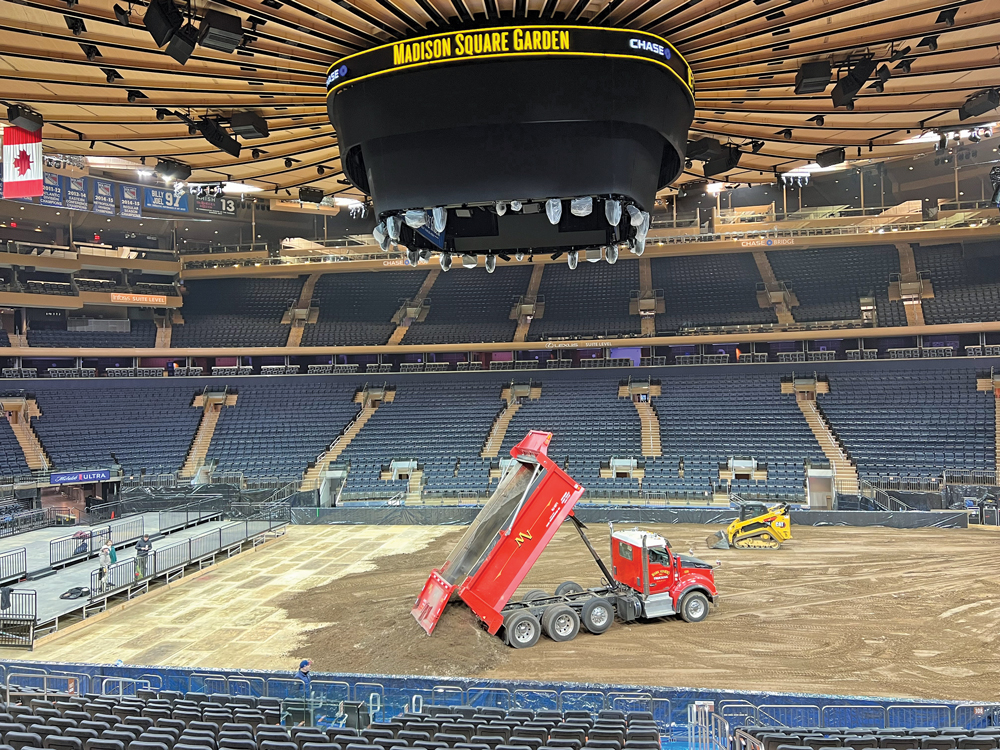
Getting an arena ready for a PBR event is dirty work, from selecting the right soil and transporting it to spreading the surface at the venue.Terry Lefton

Most action on the floor of Madison Square Garden happens after dark. But on a recent frigid Manhattan morning on that same floor, it was just 8:30 and Randy Spraggins was already hours late — and a bit stressed. He wanted to get 750 tons of dirt onto the MSG floor by 6 a.m.; instead, it was just beginning to be spread around by a series of oversized dump trucks and front-end loaders.

For all of the Professonal Bull Riders’ 30-plus years, Spraggins, who describes himself as a lifelong cowboy, has been the circuit’s doyen of dirt, trucking and installing the surfaces on which PBR riders perform in and out of venues across the country. His company, Special-T-Tracks, has assembled dirt floors for events at locations as diverse as the deck of an aircraft carrier and in the middle of Times Square.  

This day, however, his focus is on MSG, which, like Manhattan, is uniquely difficult to navigate. Spraggins’ dozen or so trucks have to make the 13-mile trip to and from Lyndhurst, N.J., where the dirt is located and processed, and then drive those same trucks, each loaded with 20 tons of soil, from MSG street level to the arena floor on five. Getting all that dirt up and down those ramps takes three to four hours alone.  

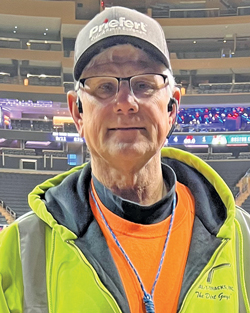
Spraggins

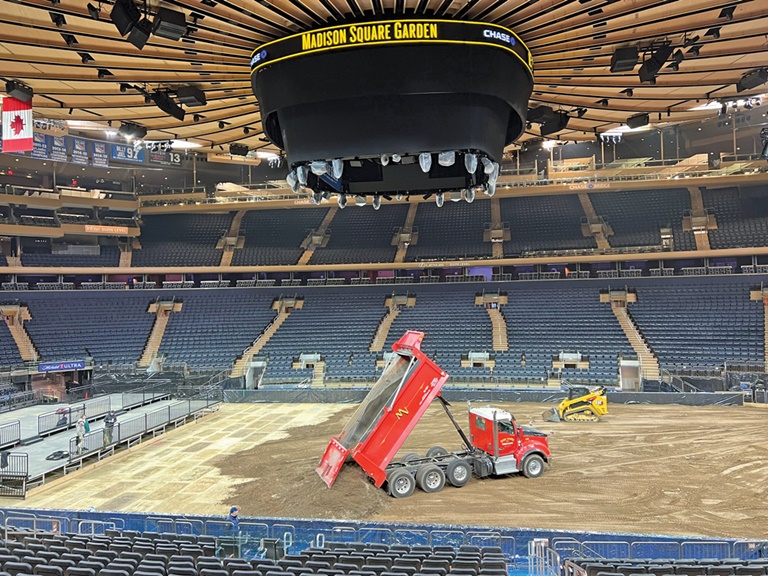
It’s the PBR’s 17th visit to MSG. Still, Spraggins, who caught the dirt bug early, as the son of a heavy construction equipment salesman, calls MSG “more logistically challenging than almost any. Most of our heavy lifting is at nighttime in the cloak of darkness.” Not so this day, but dirt is starting to be dumped underneath the MSG scoreboard.  

Adding to the pressure constraints: A Rangers game the night before and another scheduled for the day after the Monster Energy Buck Off ends on Sunday.  

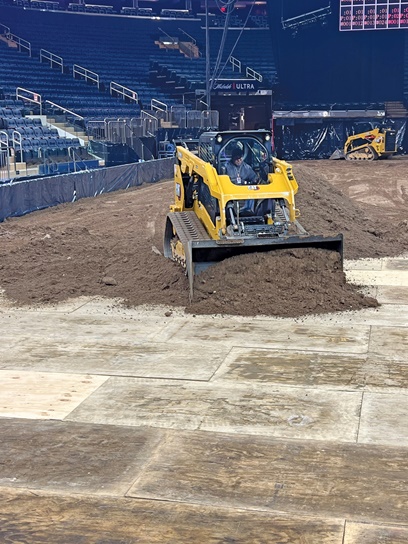
It’s quite a jigsaw puzzle. On top of the Rangers’ home ice, there’s a layer of plastic and fiberglass, followed by a plywood floor generally customized for each venue. On top of that, heavy equipment is starting to dump and spread what will be 12 inches of a sandy soil mix. On top of that, there’s 12 semis that hold lighting and audio, and pens for the bulls. 

“It’s gotten more complex, since we’re doing our own lighting and audio,” said Luke Kaufman, director of live events, a 13-year veteran of the tour. “Concerts like Billy Joel or Phish, they get to set up on a solid base. We build on top of dirt.” 

After the event, all that soil must be removed, cleaned of any bull, er … debris, and trucked back to Lyndhurst. So essentially, those 750 tons of dirt, eventually spread across the MSG floor, are rented for the weekend. That’s not always the case. There are tour stops where the PBR keeps its own topsoil nearby, including Houston and Las Vegas. The ideal dirt for PBR? Spraggins addresses that issue with the ardor of a vintner debating the climate’s impact on wine grapes. 

Terry Lefton

“What makes the perfect ground to buck on is particle size and a certain amount of clay mix,” he said. “Sand makes it workable; you don’t want it too hard or too soft.  

“You want them to be able to get a good foothold but also safe once they get bucked off, it can’t be a concrete-hard floor. They come off with some force, so you don’t want it rock hard, but still firm, you don’t want to break them either.”

Quality dirt varies by region. Kaufman says access to the best soil is getting more difficult every year, and dreams about holding every event on the Fort Worth topsoil, on which the PBR held last year’s Finals.

“You want it to pack well,” he said, as the MSG floor was now fully covered by dirt. “It should pack well, still be soft on top and then it’s about how you groom and finesse the surface. Whatever it is, I know Randy will get it in and out in time. He’s just the best in the world when it comes to laying dirt.”

Terry Lefton can be reached at tlefton@sportsbusinessjournal.com

FAUM’s Candle Chess Set Takes the Classic Game to a Fiery New Level

FAUM’s Candle Chess Set Takes the Classic Game to a Fiery New Level

All photos © FAUM

Melding traditional techniques with an appreciation for beeswax as a sculptural material, FAUM released an elegant chess set to serve as a new addition to cozy, candle-lit game nights. The entire board takes on a neutral color palette with naturally pigmented wax in sage and ivory tones, and 32 iconic game pieces are transformed into pleasing, abstracted forms topped with a wick. With each candle lit, a dramatic game is ensured as you keep your opponents in check and potentially burn it all down in defeat. The move is yours.

Find the set in FAUM’s shop, and follow the maker on Instagram for more updates.


Left: “Queen” in sage, Right: “King” in ivory

The candle-maker and sculptor works inside her studio, surrounding by candles big and small.


Do stories and artists like this matter to you? Become a Colossal Member today and support independent arts publishing for as little as $5 per month. The article FAUM’s Candle Chess Set Takes the Classic Game to a Fiery New Level appeared first on Colossal.

Cyberdrone Transforms Marketing With Drone Art

Cyberdrone Transforms Marketing With Drone Art

Cyberdrone Transforms Marketing With Drone Art


image

January 20, 2024 10:20 PM EST

A high-tech company specializing in UAV technology and unforgettable experiences through drone light shows is using the sky as an advertising platform. They transform traditional brand promotion and storytelling into a futuristic tool that truly delivers results.

image

Innovation meets inspiration atCyberdrone, a company that has turned its swarm technology into a vibrant art form in the sky for self-expression, presentations, and entertainment. Their drones are lightweight, fast, and capable of bringing any concept to life, sure to captivate the hearts and minds of all audiences.

“The sky is everywhere, and so are we,” said Bernd Seitter, Cyberdrone’s CEO. “We’ve brought our shows to deserts, performed over lakes, and synchronized with live performances in stadiums. We translate your brand’s voice into the language of light and share it worldwide.”

Cyberdrone is often the first to try something new in their niche. This was the case with shows where light figures were integrated into the urban landscape, interacting with the architecture. It was also true for immersive shows, where drones fly at low altitudes, literally encircling the audience.

Those preferring to stay outside could see any Cyberdrone performance within a 5-kilometer radius, thanks to their fleet’s brightly equipped LEDs. It’s also worth noting the endurance of these drones. Any scale of performance can captivate the viewers for up to 20 minutes, an industry-leading show duration.

“We embrace animations of every complexity with open arms and thrive on creative challenges,” Bernd Seitter, Cyberdrone’s CEO, shared.

Renowned for seamless transitions, Cyberdrone ensures the sky never dims before the eyes.

Interested customers can also play with adrone simulator on Cyberdrone’s website, allowing people to immerse themselves in the possibilities of customized drone displays.

It’s crucial to highlight that the company complies with all global drone regulations, backed by high-quality equipment and software. This ensures that their shows are not only visually stunning but also exceptionally safe.

Impactful Marketing Strategies

Swarm technology and the creative vision of the Cyberdrone team have naturally evolved from mere entertainment to a powerful marketing tool.

Bright light displays grab the attention of both invited spectators and passersby, recorded and shared widely on social media. Brands create viral content with versatile drone shows, a key element in any marketing strategy. And these are just a handful of the advantages.

Cyberdrone transforms brands and events into memorable experiences, connecting emotionally with a wide audience. Each unique performance, tailored to client requests, hits the marketing mark precisely.

In today’s world, eco-friendliness is crucial, and Cyberdrone embodies these values. Reusable, pollutant-free, and compact for easy transport, their drones offer environmental benefits, ensuring marketing campaigns align with current environmental consciousness.

Experience Economy with Drone Art

Experiences sell. Beyond unique propositions and flawless services, it’s the emotions and fresh experiences that make audiences love a product, brand, or personality. In today’s industries, those embracing the experience economy, especially with drone light shows, are winning.

Businesses generate excitement for launches and events. Public celebrations innovate, drawing larger crowds. Tourist destinations elevate with drone shows, offering a modern, high-tech experience. Sports teams, musicians, and nonprofits leverage drone shows for emotional impact. Artists and cultural organizers use drone tech for dynamic sky-based art installations—whether to advocate for causes, celebrate heritage, or push artistic boundaries.

“Art has a way of stirring emotions, and drone shows are no exception. Watching the excitement in our audience’s eyes, we can see how it’s paving the way for the future of the experience economy,” Bernd Seitter, Cyberdrone’s CEO, said.

Versatile and Unique Entertainment from Every Angle

Take a look at what drones are capable of in a video reel that showcases some of Cyberdrone’s performances. It’s an eco-friendly alternative to many kinds of outdoor displays. And it’s an eye-catching advertisement where the limit is not the sky, but the imagination.

[embedded content]

Cyberdrone started with smaller shows using 100-500-1000 drones, but now, armed with a fleet of thousands,is geared up for truly grand spectacles.

Conclusion

To discover more about Cyberdrone’s advertising solutions or to book a call, visit their website. For a burst of creativity, check out their Instagram page @cyberdrone, and get a glimpse of the business side of things on LinkedIn.

Contact Info:
Name: Marina Leivald
Email: Send Email
Organization: Cyberdrone
Website: https://www.cyberdrone.com/

Release ID: 89119103

If there are any errors, inconsistencies, or queries arising from the content contained within this press release that require attention or if you need assistance with a press release takedown, we kindly request that you inform us immediately by contacting [email protected]. Our reliable team will be available to promptly respond within 8 hours, taking proactive measures to rectify any identified issues or providing guidance on the removal process. Ensuring accurate and dependable information is our top priority.


Serious News for Serious Traders! Try StreetInsider.com Premium Free!


You May Also Be Interested In