Art World News

Works by Canadian abstractionist Jean-Paul Riopelle rack up $8m at Heffel’s evening sale in Toronto

Works by Canadian abstractionist Jean-Paul Riopelle rack up $8m at Heffel’s evening sale in Toronto

Spearheaded by the Montreal-born abstractionist Jean-Paul Riopelle, with helping hands from his mentor, Paul-Émile Borduas and fellow Canadian painter Emily Carr, Heffel’s two-part autumn evening sale yesterday (23 November) made $17.2m (with fees; all prices in US dollars).

Canada is currently celebrating the centenary of Riopelle’s birth. A major survey of the artist is on show at the National Gallery of Canada (NGC) in Ottawa (until 7 April 2024) and a special $2 coin (a “toonie”) has been issued featuring a portion of his monumental work L’Hommage à Rosa Luxemburg (1912).

“Tonight’s auction, coinciding with Riopelle’s 100th birthday, marks a momentous occasion in the art world,” said the auctioneer Robert Heffel, who took the rostrum alongside his brother, David. “The resounding success and record results showcased exceptional art, global collector enthusiasm, and a thriving auction market.”

Seven works by Riopelle were on offer last night, including a bronze sculpture, which in total generated a robust $8.1m (with fees)—almost half of the total evening sale. All this for an artist who once said, “I have never wanted to paint thickly—paint tubes are much too expensive”.

Topping the bill was Sans titre (Composition #2) (1951) a sizeable palette-knife-and-drip painting on canvas, measuring 127cm by 162cm. It drew bids from around the globe and was finally hammered down at $3.4m ($4.1m with fees ). That was followed by Self, a rare self portrait, which took in $2.3m ($2.8m with fees), more than four times its high estimate, prompting Robert Heffel to quip, “this is getting exciting”.

Riopelle previously made a splash at Heffel in 2017, when his painting Vent du nord (1952-53) garnered nearly $5.5m (with fees), easily surpassing the pre-sale estimate of a mere $750,000 to $1.1m. That sale is the second-most valuable ever made at Heffel, behind only Lawren Harris’s Mountain Forms (1926), which shattered Canadian records in 2016 when it sold for just over $8m.

Borduas also had a big night in Toronto. His Miniatures empressees (1955) matched its high estimate, taking in $880,000 ($1m with fees), though that fell far short of his Figures schematiques, which sold for $2.6m at a Heffel sale in 2018. Another highlight of the sale’s first leg was Christopher Pratt’s oil on board painting, titled August 1939, which reached the artist’s established auction record, of $238,000 ($265,000 with fees)—well above its estimate of $128,000 high estimate.

The early sale also included a pair of Andy Warhol prints featuring the late Queen Elizabeth II and the pop star Mick Jagger, Henry Moore’s sculpture Family Group, several works by Jack Bush, and those by Alexander Colville and the ever-popular Jean Paul Lemieux. But it was E.J. Hughes who turned heads when his watercolour, Mouth of the Courtenay River, was hammered down at $279,000 ($335,000 with fees), more than six times its high estimate.

The sale’s second leg saw sparks for Emily Carr’s large oil painting Alert Bay (Indian in Yellow Blanket); works by James Wilson Morrice, A.Y. Jackson and the Group of Seven, Alexander Colville and Cornelius Krieghoff also come to the block during this portion of the evening. Carr’s canvas opened at $643,000 but bidding was hesitant, finally topping $740,000, before tapping out at $1m million ($1.2m with fees). And Carr’s Forest Interior, an oil on paper on board work, took in $425,000 ($511,250), easily topping its high estimate.

The 2023 Ocean Photographer of the Year Contest Highlights the Stunning Sights Above and Below the Surface

The 2023 Ocean Photographer of the Year Contest Highlights the Stunning Sights Above and Below the Surface

Jack Pokoj, a lizardfish’s open mouth reveals its last meal, Philippines. All images courtesy of Ocean Photographer of the Year, shared with permission

The waters surrounding the Philippines were fruitful for photographers this year, producing several winning images of the 2023 Ocean Photographer of the Year contest. From a boastful lizardfish to a tiny paper nautilus floating among volcanic debris, the lauded shots document marine life above and below the surface, glimpsing not only the stunning beauty of land and sea creatures but also the threats many face given a warming planet and rampant pollution. Some of our favorite photos are shown here, and if you’re in Sydney, you can see the full collection through May 26, 2024, at the National Maritime Museum.


a nautilus with a red eye is surrounded by innumerable bubbles

Jialing Cai, a Paper Nautilus drifts on a piece of ocean debris at night, surrounded by heavy sediment, Philippines

a polar bear walks toward a waterfall against a bright orange backdrop

Michael Haluwana, illuminated by the Arctic sun, a polar bear walks across a glacier that is adorned by a waterfall, Arctic

a red crab rests in the center of wispy gray tendrils

Andrei Savin, a crab sits in the centre of a sea anemone as it sways in ocean current, Philippines

an airborne penguin flies across the water

Craig Parry, a gentoo penguin, the fastest penguin species in the world, charges across the water, Antarctica

a manatee lounges in water backlit by sunlight

Sylvie Ayer, a manatee enjoys the crystal-clear waters of the Homosassa River, Florida

a red nautilus is atop a translucent blue jellyfish against a black backdrop

Renee Cappozzola, a female paper nautilus with egg case rides a small jellyfish, taken on a blackwater dive, Anilao, Philippines

an aerial image of a polar bear grasping onto melting ice

Florian Ledoux, a polar bear cub contends with the fragility of melting ice, Svalbard, Norway

Do stories and artists like this matter to you? Become a Colossal Member today and support independent arts publishing for as little as $5 per month. The article The 2023 Ocean Photographer of the Year Contest Highlights the Stunning Sights Above and Below the Surface appeared first on Colossal.

Hera’s Imaginative New Murals Question the Animal Impulse to Migrate

Hera’s Imaginative New Murals Question the Animal Impulse to Migrate

“We all are Birds of Migration. Some With Feathers, Some Without” (2023). All photos by Brian Tallman, shared with permission

A mouse-costumed girl sitting on a duffel bag, a bird balancing on a unicycle, and bright blue narwhals swimming along the train line in Stavanger, Norway, are a few characters in Hera’s new murals considering the nuances of immigration and movement. “We all are Birds of Migration. Some With Feathers, Some Without” is a collection of works that ask viewers to recognize that mobility and resettling have been essential to human survival for millennia. The artist (previously) says:

We all exist today because our ancestors at some point either freely migrated to greener pastures, more fertile grounds, greater resources, and safer living conditions, or were forcibly moved from one place to another at some point at some point in history. Not even the most nationalist nationalist can deny the factual reality: humans still exist today because they migrated, they moved themselves, their families, their genes across lands, seas, continents.

Commissioned by Nuart—check out the 2023 edition of its annual festival in Aberdeen—the gestural murals are part of the Planes, Trains & Automobiles project bringing public artworks to high-visibility spots like airports and transit centers. The location also dovetails with Hera’s interest in migration, particularly as it relates to daily commutes. She says, “Some could argue that this does not count as an act of migration. But doesn’t it? Do students not leave their home, travel for miles and miles, to make more of themselves? Do commuters not leave their homes and families in order to make a living, and provide for their existence?”

The figures feature Hera’s signature wide, glassy eyes and costumes that transform them into scavenger-like creatures. Imbued with a sense of resilience, the characters emphasize the innate, animal impulse to travel and migrate that proliferates throughout the natural world.

See some of the works take shape on the artist’s Instagram.


a bird rides a unicycle

a mural of a redheaded girl and narwhals in a train station

a woman with a yellow backpack walks in front of a mural of a girl wearing a mouse costume sitting on a duffel bag. a bird perches on a rolling suitcase to her left

two figures sit reading wearing a mouse and cat costume

a mural of blue narwhals behind a train track

a mural of narwahls and a redheaded girl behind a train track

Do stories and artists like this matter to you? Become a Colossal Member today and support independent arts publishing for as little as $5 per month. The article Hera’s Imaginative New Murals Question the Animal Impulse to Migrate appeared first on Colossal.

Mail art meets NFTs for all in the ‘MoMA Postcard’ programme

Mail art meets NFTs for all in the ‘MoMA Postcard’ programme

The Museum of Modern Art (MoMA) in New York has invited the public to participate in what the museum describes as “an experiment in collective creativity on blockchain” in a new digital initiative, MoMA Postcard. This programme comes soon after the museum’s release of free mementoes minted as non-fungible token (NFT) editions, launched during the recent exhibition Refik Anadol: Unsupervised. These tokens continued MoMA’s exploration of and engagement with the technologies of web3, the latest iteration of the internet, built on blockchain technology and controlled by its users.

While the market for NFTs has slowed since its initial hype in 2021, museums and institutions are beginning to step further into web3 through exhibitions and programmes, with MoMA Postcard as one such example. In recent months, HEK (House of Electronic Arts) in Basel presented Exploring the Decentralized Web—Art on the Blockchain, curated by Sabine Himmelsbach and Boris Magrini. NFT-based artworks are also now in the collections of institutions such as Kadist in Paris and San Francisco, the Los Angeles County Museum of Art, the Centre Pompidou in Paris and Deji Art Museum in Nanjing.

MoMA itself recently acquired two notable NFT artworks: Refik Anadol’s Unsupervised—Machine Hallucinations—MoMA (2022), which was on display in the lobby until late October, and an edition of Ian Cheng’s blockchain-based generative artwork 3FACE (2022).

There are numerous historical examples of co-created artist and literary projects, but this one uniquely leverages technology as muse, medium and messenger

Sasha Stiles, poet and artist

MoMA Postcard takes its cues from mail art, a practice that first emerged in the 1950s when artists began to send and exchange works of art through the US postal service. Key figures such as Ray Johnson sent chain letters inviting recipients to add to what was enclosed and to pass the updated artwork on to someone new, driving forward this format of creative correspondence that has continued to this day. Madeleine Pierpont, the web3 associate at MoMA, sees a “natural synergy” between mail art and blockchain technology, as both “enable global transmission of information”, and for MoMA Postcard to be an opportunity to explore the co-creation and community aspect of web3.

To create with MoMA Postcard, people download Bitmark’s Autonomy app and claim a blank card to start. Users can then create a stamp, or digital image, within a 10 by 10 pixel grid using MoMA’s colour palette, before signing it off in a signature box. Once a stamper confirms their stamp on the blockchain, their token of ownership and contribution is automatically recorded in the postcard’s data on the blockchain. The contributor is then invited to send the postcard on to another person—until all 15 stamps have been filled.

Each postcard is co-created by all its stampers. It is a living and growing artwork that is only complete when all 15 contributions have been submitted. Pierpont says that this is a key aspect of the initiative as it encourages communities to form around MoMA Postcard, with each postcard acting as a micro community of its own, fostering collaboration and exchange. Further, each postcard is co-owned by its 15 contributors. No single person is able to own a postcard on their own or to make any buying and selling decisions without involving all of its owners. This feature makes it difficult for financial and market speculation to form around the postcard, and drives attention towards the collaborative process and community instead.

To introduce the project and illustrate its possibilities to a diverse audience, MoMA released First 15 as a soft launch of the initiative on 3 October, inviting 15 artists to create postcards together. These artists come from diverse backgrounds and practices but are united by their shared engagement with and understanding of blockchain technology. Each artist devised a verbal prompt for a postcard, which was then passed around all the participating artists to create a collection of digital mail art. Sasha Stiles, a Kalmyk American poet and artist, designed her prompt to be: “using only black, dark green, light green and white, please draw your letters: A,R,S,(design blank space),A,U,T,O,P,O,E,T,I,C,A”. “I knew right away that I wanted to do something poetic,” Stiles says, “to pay homage to the long literary tradition of the ‘exquisite corpse’, and so my first question was how to make language work inside the constraints of the pixel grid.”

In asking each artist to draw a letter and thus collectively create a font, Stiles’s prompt also strengthens the personal and intimate touch that MoMA Postcard invites contributors to share in the use of handwritten signatures as sign-offs on each stamp.

Operator, the Lumen Prize-winning duo of Ania Catherine and Dejha Ti, whose work engages with privacy and technology, feel that “it’s an interesting choice to have artists sign their stamps because typically, the artist’s ‘signature’ for a digital artwork is not shown in this way”. In rendering the individual’s signature visible, it reinforces their hand and presence.

The MoMA Postcard pixel grid image Puce Radial Etching, for which Operator (the Lumen Prize-winning duo of Ania Catherine and Dejha Ti) was the “prompting artist”—the first of 15 co-owners and co-creators Courtesy MoMA

When taking part in MoMA Postcard on the Autonomy app, users receive Ethereum and Tezos wallet addresses automatically generated in the app and have access to a glossary of web3 terminology written by the MoMA team, as well as other digital artworks featured on the app’s home page. Stiles sees MoMA Postcard as a “brilliant concept” for how it introduces blockchain technology. “There are numerous historical examples of co-created artist and literary projects,” Stiles says. “But this one uniquely leverages technology as muse, medium and messenger.”

“The museum is still very much in an experimentation and exploration phase,” Pierpont says, “and we want to really think carefully about how we can engage with the space with intention and in a way that provides value”. MoMA Postcard marks the next step in these efforts, and over the following few months the museum will also be launching an online exhibition in partnership with Feral File, a digital art platform founded by Bitmark and artist Casey Reas, featuring artists including Yoko Ono, Holly Herndon and Mat Dryhurst, and Danielle Brathwaite-Shirley.

  • Clara Che Wei Peh is a Singapore-based curator and art writer specialising in emerging technologies. Her curated projects include Art Dubai Digital 2023

First Friday Peterborough celebrates local creatives with outdoor holiday market on December 1

First Friday Peterborough celebrates local creatives with outdoor holiday market on December 1
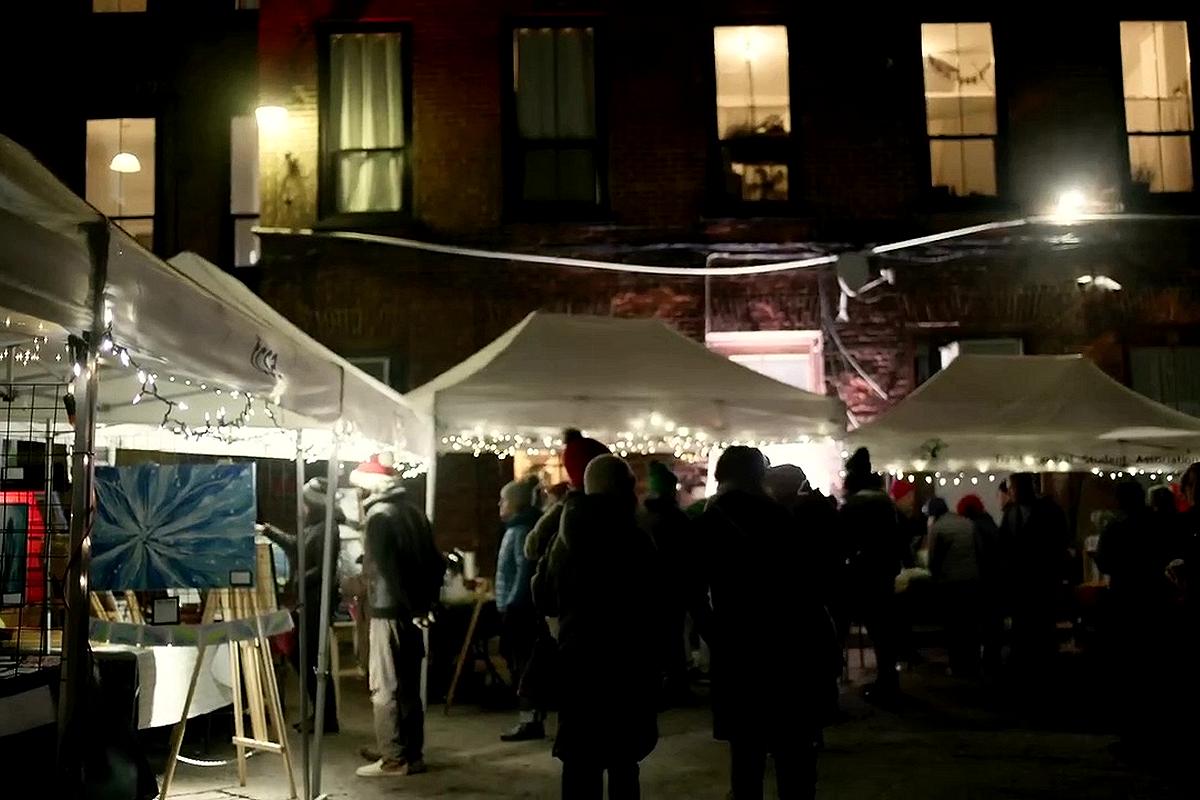
The Commerce Building Courtyard in downtown Peterborough will be transformed into a festive market on December 1, 2023 for the Neighbourhood Holiday Market organized by The Neighbourhood Vintage in partnership with First Friday Peterborough. The evening event during the First Friday art crawl features work from 20 local artists and artisans, live music performances, and food and drink. Pictured is the December 2022 market. (kawarthaNOW screenshot of First Friday Peterborough video)

December’s First Friday art crawl in downtown Peterborough is celebrating local creatives with a special outdoor holiday market.

Organized by The Neighbourhood Vintage in partnership with First Friday Peterborough, the Neighbourhood Holiday Market takes place in the Commerce Building Courtyard at 383 Water Street from 5 to 9 p.m. on December 1.

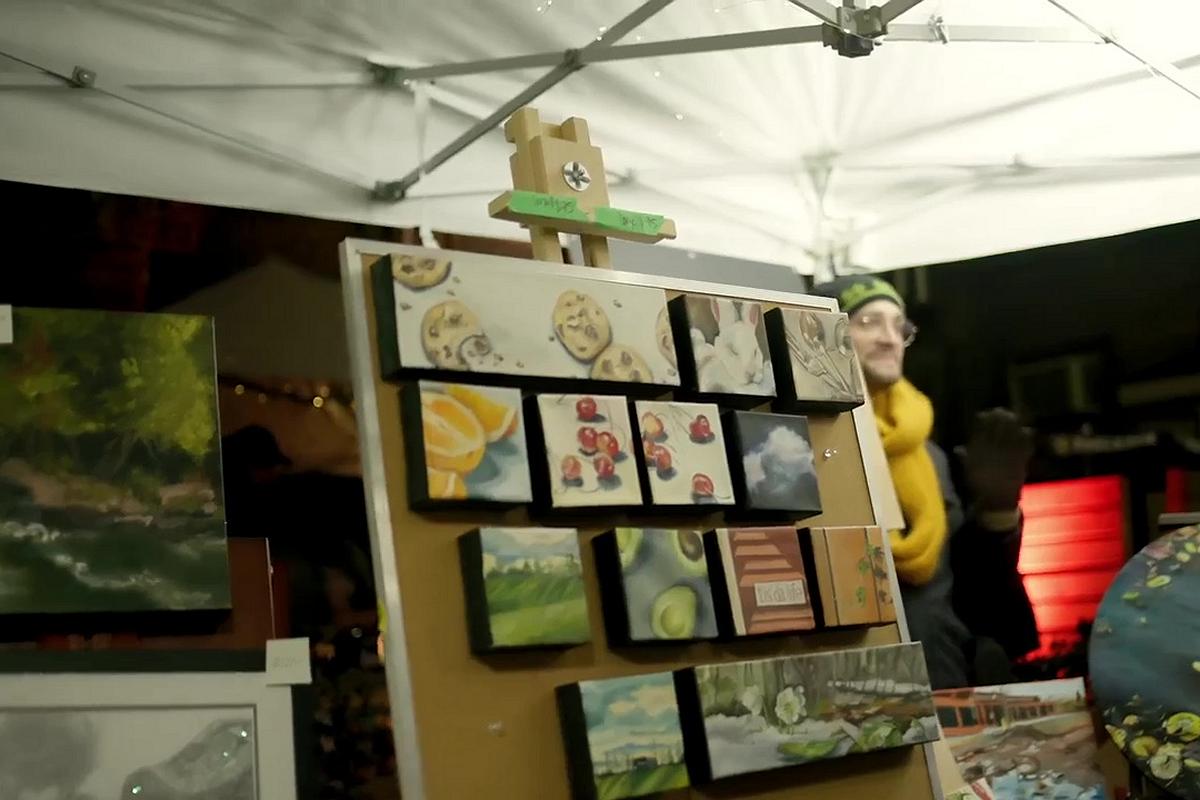
The family-friendly and accessible market will feature works from 20 local artist and artisan vendors, live music performances by local musicians Benj Rowland, Brooklyn Doran, and Caitlin O’Connor, and food and drink offered by local eateries Kit Coffee, La Hacienda, and St. Veronus and two local breweries.

Advertisement – content continues below


Tweet this quote

The first winter outdoor market in the Commerce Building Courtyard took place during last December’s First Friday art crawl, followed by a spring outdoor market during June’s event.

“The markets have been such a wonderful way for our community to come together,” says Jacquelyn Craft, owner of The Neighbourhood Vintage at 391 Water Street who organizes the markets, in a media release. “I love being able to create community events that showcase the vibrant creative talent here in Peterborough. From artists to makers, musicians to restaurants, there are so many talented members in our community and this has been a really great way for the public to discover them.”

The vendors participating in the Neighbourhood Holiday Market include Burn Island, Marrs Brand, Meowlinda, Olive Cedar Studio, Habitual Moon, 8th Troupe, City House Country House, Steaped Slow Ceramics, Keetarella, Take Cover Books, Whimsy & Wonder, Open Sky Stories, Away Designs, Miguel’s Art, The Artful Apricot, Ella Mollie, Well Grounded, TSC Studio/Gallery (Marcia Watt), Cheesecrafts, and Knitsbymich.

VIDEO: First Friday Peterborough December 2022 Outdoor Market

Advertisement – content continues below


Tweet this quote

The Neighbourhood Holiday Market is a great opportunity to find unique holiday gifts produced by local creatives while supporting both the arts community and the local economy.

“We get really excited about our outdoor events for First Friday since they always feel extra special,” says First Friday Peterborough marketing and events coordinator Melissa Wilson. “There’s music and food, and the energy and atmosphere is always so positive. It’s always so gratifying to see our hard work pay off when the community gets together to enjoy and celebrate the arts before the holiday season.”

Run by volunteers, First Friday Peterborough is a monthly art crawl event showcasing local artists at downtown galleries, studios, shops, and cafes. Admission to all locations is free. For more information and to keep up to date on future art crawls and markets, visit First Friday Peterborough on Facebook and Instagram.

Organized by The Neighbourhood Vintage in partnership with First Friday Peterborough, the Neighbourhood Holiday Market in the Commerce Building Courtyard in downtown Peterborough on December 1, 2023 is a great opportunity to find unique holiday gifts produced by local creatives while supporting both the arts community and the local economy. (kawarthaNOW screenshot of First Friday Peterborough video)

Low wages leave US arts workers with few prospects

Low wages leave US arts workers with few prospects

Passion does not pay the rent. Entry- and mid-level workers at US art institutions often earn wages below the cost of living. A pay equity project in the Berkshires is attempting to change that pay to a living wage.

A region where tourism is largely fuelled by the arts, drawing millions of visitors annually, the creative corridor involved in the pay equity project stretches from Berkshire County in western Massachusetts, to Columbia County in eastern New York state’s Hudson Valley. Only 39% of entry- and mid-level workers can imagine a future employed by an art or culture institution in the region, according to the recent Berkshire/Columbia Counties Pay Equity Project Report.

“We’re seeing this conversation across the country,” says Janis Martinson, the executive director of the Mahaiwe Performing Arts Center in Great Barrington, Massachusetts. “Non-profit organisations are contributing to the [gross domestic product] far ahead of its compensation to its employees. It’s on the organisations to do better for the employees who work so hard and with such dedication.”

Aron Goldman presents findings of the report, which canvassed more than 900 staff
Leigh Davis

Attracting and retaining talent to keep a creative economy afloat requires a “narrative shift” away from viewing arts and culture workers as luxuries and instead as essential workers, says Aron Goldman, the report’s author. “As long as working in the arts is considered a privilege, only the privileged will work in this field.”

Among the 38 organisations that submitted data for the report—institutions with annual operating budgets ranging from $4,000 to $19m, including Art Omi arts centre in Columbia County, New York State and the Berkshire Art Center in Stockbridge, Massachusetts, and collectively employing almost 1,000 people—nearly one third (29.5%) of employees are full-time but earn less than $50,000 annually. This is well below the average annual salary in Massachusetts this year of $76,600 and, in New York, $74,870, according to Forbes data.

All sacrifice, few benefits

Only about half of respondents reported that their pay completely covered their housing, transportation, food, healthcare, utilities and recreation costs. Between 25% and 48% of entry- and mid-level workers lack even the most common types of benefit, such as health insurance, retirement plans, dental insurance and paid time off. As a result, most entry- and mid-level workers have multiple jobs—not by choice, but out of necessity.

A significant portion of the 67-page report is devoted to anonymous employee responses to open-ended questions. Respondents across the board expressed a sense of conflict between their love of the arts and the financial realities of trying to survive on pay that comes in below a living wage.

“Paying someone so little puts them in a perpetual state of worry, unease and hopelessness,” one respondent said. Another said the ratio of “rent to income is becoming more impossible… Owning a house seems impossible.” Another said: “I love working for the arts, but as I get older, I need to be saving more money, and it’s very hard to do with my salary.”

“We must start the work to get to more than just a liveable wage, more than just the bare minimum for survival”

Martinson says she expected comments about employees having trouble making ends meet, but did not expect “to hear about the physical and mental health effects and relationship stress” caused by this economic precarity. “Those are very real symptoms of something we need to fix. It calls on our conscience to fix that.”

“We can’t just say, ‘Oh, it’s too hard to do it’,” says Jeremy Adams, the co-executive director of Art Omi. “We have to hold our feet to the fire to say, ‘This is going to happen.’ We know we’re not going to be able to flick a switch to get salaries where we want them to be, but [we must] start the work to get to more than just a liveable wage, more than just the bare minimum for survival.”

Rich culture, poor reward

At Jacob’s Pillow, a performing arts centre, residency programme and school in Becket, Massachusetts, the administration’s focus for the next three years will be on creating a structure of salary grades matching the market equivalent. “Our business models need to be adjusted,” says the organisation’s deputy director A. J. Pietrantone. “It’s not a one-fix thing, but a long-term evolution we need to take on.”

A pay equity summit to track what changes the region’s arts organisations have made is in the works for 2024. “Organisations can share their stories over the past year—wins, challenges and where they crashed and burned,” says Kristen van Ginhoven, the co-founder and artistic director of WAM Theatre in Lenox, Massachusetts. She and Aron Goldman are taking the report on the road and are already scheduled to make presentations on board meeting agendas at the invitation of regional arts and culture institutions. “Because we’re getting regional momentum and speaking as a group, we can apply for grants and advocate as a cohort for financial aid for each organisation,” says Van Ginhoven.

For Martinson, the report has underlined the discrepancy between the region’s rich cultural offerings and the poor compensation received by many of the people making it possible. “It’s important for people to know that the arts they are enjoying are being created in a way that is respectful of the people working to create it,” she says.“I genuinely believe that is the expectation of people consuming the art and if we don’t tell the story, they won’t know any difference.”

Kate’s 5 fun things to do this weekend in Waterloo region and area: Nov. 24-26

Kate’s 5 fun things to do this weekend in Waterloo region and area: Nov. 24-26

As we near the end of November, the weather outside is not quite frightful, but it’s going to be cool and cloudy with the chance for flurries.

It’s the first weekend of Winter Wander-land in Stratford, with a carousel, firepits, s’mores and blacksmith demonstrations. The event also runs Dec. 2 and 3.

A special Holiday Magic concert is being held at Wesley United Church in Cambridge on Saturday and Sunday featuring Grand River Voices with Guelph-based band The Kramdens.

A Spark to Start is a series of short plays about climate change that’s being hosted by English and theatre students at the University of Guelph with shows Friday and Saturday evening.

At the Guelph Little Theatre, there’s a live in the lobby concert with local singer-songwriter Gayle Ackroyd Friday night.

As for parades this weekend, here’s where you can catch Santa:

  • Ayr-North Dumfries on Saturday at 1 p.m.
  • Elora on Saturday at 6:15 p.m.
  • Puslinch on Sunday at 2 p.m.

Read the full list of local parades.

If you need to drive this weekend, here are some local prices:

Phil Kline’s Unsilent Night

Friday 6 p.m.

Downtown Galt, Cambridge

Walk through the downtown core and interact with 30 light installations along a route while the music of Phil Kline is played.

The event is part of Winterfest in the city which runs through to the end of the year.

WATCH | The city has a recap video of the event from 2019:

[embedded content]

University of Waterloo Art Gallery open house

Saturday 10 a.m. to 6 p.m.

East Campus Hall, University of Waterloo, 263 Phillip St., Waterloo

The free event is a chance to see what students at the university are creating while also taking curator’s tours with Ivan Jurakic and Peter Flannery, with poetry readings by Roshan James.

There’s an exhibition by Sharl G. Smith called Shelter II, which is co-presentation with the Canadian Clay and Glass Gallery. There will also be a fine arts alumni panel discussion at 3 p.m.

Mindful Movement in the Woods

Saturday 10 a.m. to 11:30 a.m.

Huron Natural Area

This free, drop-in class will walk people through how to connect with nature and mediate while surrounded by trees and birds.

The description says, “similar to tai chi, this type of movement helps support health and harmony of body and mind.” The class runs in rain or snow, so dress according to the weather.

A mascot that looks like a man wearing a blue cowboy hat with a red band around it and a white star at the front
The Kitchener Rangers are heading down the highway to Guelph on Saturday hoping for yet another win in what has been a very hot start to the season. (Kate Bueckert/CBC)

Kitchener Rangers at Guelph Storm

Saturday 4 p.m.

Sleeman Centre, Guelph

Hockey fans, it’s time for the local rivalry to heat up as the Storm play host to the Rangers in Saturday afternoon action. This is always a fun game with fans from both sides in the stands.

There are Friday night home games, too. The Rangers are hosting the Owen Sound Attack while the Storm will host the North Bay Battalion at 7:30 p.m.

Holiday and winter markets

Once again, it’s a busy weekend for craft and maker markets. Plan your shopping accordingly.

Multiple days:

  • A Merry Little Christmas Market — Friday 5 p.m. to 9 p.m., Saturday 10 a.m. to 4 p.m. — St. Agatha Community Centre. Admission is by donation of non-perishable food items or feminine hygiene products.
  • Gaslight District Christmas Market — Friday 5 p.m. to 10 p.m., Saturday 12 p.m. to 10 p.m., Sunday 12 p.m. to 5 p.m. — in The Gaslight District of Cambridge. This is a weekly market that runs until Dec. 17.
  • A Very Merry Indigenous Art Market — Saturday and Sunday, 11 a.m. to 4 p.m. — at Kitchener’s city hall.

Friday night:

  • Sip ‘n’ Shop — Friday 4 p.m. to 9 p.m. — St. Jacobs Farmers Market.
  • Cranberry Market — Friday 6 p.m. to 11 p.m. — Trillium Waldorf School in Guelph.

Saturday:

Sunday:

How Allapattah became the centre of Miami’s art scene

Unlock the Editor’s Digest for free

On a warm Miami night in early November this year, the opening of Katia David Rosenthal’s new gallery, KDR, which had just moved from Little Havana to the industrial neighbourhood of Allapattah, was joyously crowded. People drank and chatted at the reception, enjoying the autumn weather, as breezes stirred the palm trees and wild chickens, a normal part of the landscape, looked for appetiser crumbs.

Don and Mera Rubell, Miami’s influential contemporary-art collectors, hugged Max Voloshyn, who, with his wife, Julia, had just launched their gallery Voloshyn on the same block, featuring eastern European art. “We are about to have four art galleries lined up,” said Andrew Reed, owner of Andrew Reed Gallery, which also shares the block with Mindy Solomon Gallery. “I don’t think I’ve ever seen something like this here.” Soon afterwards, La Cometa gallery also launched in the neighbourhood.

A woman in white and a man in black stand in front of a large blue sculpture
Julia and Max Voloshyn of Voloshyn Gallery

Allapattah has been touted as Miami’s next art-world hotspot since at least 2019, when the Rubells opened the Rubell Museum to show their collection. The same year, developer Jorge Pérez, chair of the Related Group and principal private donor to the Pérez Art Museum Miami, inaugurated his contemporary art space, El Espacio 23, in the area. Marquez Arts Projects and immersive extravaganza Superblue also reside there. As Art Basel Miami Beach brings even more art to the city in early December, Allapattah has become a standout district.

People take selfies in front of a large black and white photographic mural crowded with figures
‘The Chronicles of Miami’ by JR, which premieres at Superblue during Miami Art Week © Oriol Tarridas

Much has changed since the first artist-run spaces and commercial galleries opened in Miami in the Eighties and Nineties. Bakehouse Art Complex, Locust Projects and Dimensions Variable all started in the neighbourhood of Wynwood, along with BFI in the Design District, Diaspora Vibe in Little Haiti and Oolite Arts in Miami Beach. Art Basel may have helped shape a cultural ecosystem in Miami but Miami’s people have, without a doubt, made it an art beacon in its own right.

Before buying an old warehouse in Wynwood in 2000, Brook Dorsch, who now co-runs Emerson Dorsch, operated an art gallery from his own walk-up apartment. It was an inspiration, says Leyden Rodriguez-Casanova, who co-founded Dimensions Variable with Frances Trombly: “His first apartment had all the windows drywalled, and he lived in the bedroom while the rest of the space was all walls, and that’s where he was showing exhibitions. I remember thinking, this guy is insane.

“The city was full of artists who took it upon themselves to create something new. That energy left a huge impression on me and what I do today,” he adds. This year, a book, an exhibition at Dimensions Variable (December 6-26) and a digital archive, all titled Making Miami, will tell the story of those artists who worked and made the city’s art community from 1996 to 2012.

Orange lilies very close up with the sea in the distance
‘On the Shoreline Before the Setting Sun’ by Kate Bickmore at Andrew Reed Gallery © Courtesy the artist/gallery

To survive Miami’s rising housing costs, most art spaces and commercial galleries had to move neighbourhoods through the years, from Wynwood (rebranded as the Arts District in the early 2000s) to Little Haiti, Little River or Allapattah, chasing affordable housing as the city continued to grow, change and gentrify. Wherever artists go, real estate value also goes up: after the inception of Art Basel Miami Beach in 2002, developers saw the value in Wynwood and started buying warehouse buildings. Gentrification happened so fast that, by 2015, most artists and the working-class community were priced out.

“The city was overflowing with artists, but it was hard to find a decent place to rent,” says Rodriguez-Casanova, who thinks the city is in a similar spot today: Miami has officially become the least affordable housing market in the country. Most non-profits that offered free studio spaces to artists have had to change their model or start charging modest rates. For Lorie Mertes, executive director of Locust Projects, “It is difficult to see how our city becomes less affordable to sustain the cultural and economic diversity that makes us so exciting.”

A smiling woman with long brown hair
Mindy Solomon of Mindy Solomon Gallery © Monica McGivern

Since 2017, Mindy Solomon has co-organised Progressive Art Brunch, a programme where art dealers open to the public several Sundays throughout the year for gallery-hopping. “It started as a conversation between myself and Tyler Dorsch, who co-founded Emerson Dorsch Gallery, during our long walks together thinking about the arts community and ways that we could grow and bring more people in,” Solomon says. Dainy Tapia, the creator of ArtSeen 365 on social media, shares information daily about every contemporary art show in Miami and south Florida.

But can the city’s own scene be self-supporting as it expands? To Fredric Snitzer, who opened in 1977, more people must engage with art for galleries to thrive outside of Miami Art Week. “I want the city to be a hotbed of collectors and enthusiasm all year round. But I just don’t see it yet,” he says. But Dejha Carrington, co-founder and executive director of Commissioner, a local organisation that empowers Miamians to collect art and support artists, remains optimistic. “We want to break access barriers and debunk the idea that a collector looks a certain way and is wealthy,” she says. “When someone who has never collected art acquires their first piece, it’s magic.”

From the art market to creative fungi: panels at Art Basel Miami Beach

Unlock the Editor’s Digest for free

During Art Basel Miami Beach, the city is transformed into a hotbed for art deals and debates. Art Basel’s Conversations programme this year brings together 30 cultural experts to discuss topics from international art markets to creative fungi that shed light on local art scenes as well as some of the pressing questions facing the industry.

This year the programme has a special emphasis on Latin America. A talk from artist and teacher María Magdalena Campos-Pons, whose spiritual multimedia works draw on her Afro-Cuban roots, traces her 40-year trajectory from the Cuban countryside to her current retrospective at the Brooklyn Museum in New York.

Photo of a woman in a simple red dress against a black background. The photo is embroidered with red thread on her hair
‘Red Composition’ (detail) (1997) by María Magdalena Campos-Pons © María Magdalena Campos-Pons. Photo: courtesy the artist

In Collecting in Brazil, a panel of collectors and gallerists look at the continent’s largest art market in light of the government’s new commitment to the arts, following last year’s election of President Luiz Inácio Lula da Silva. “The change of government seems to be giving Brazilian art a renewed momentum,” says panellist Luisa Strina, founder of Galeria Luisa Strina in São Paulo, who sees this as an exciting time for the country’s art market as it has “still plenty of room for growth”.

The programme also looks closer to home. Figures representing Florida’s dynamic non-profit art spaces, such as Bakehouse Art Complex and the Atlantic Center for the Arts, come together to discuss the importance of artist residencies in fostering local talent. The state’s ecosystem is also the subject of From Supercontinents to Florida, which explores artistic responses to this unique ecology, climate change and the impact of technology.

A man in a blue jacket sits on gnarled tree roots
Artist James Bridle, who is talking about art using the natural world

Science also goes under the microscope in Biohacking Creativity as artists Xin Liu, Eduardo Kac and James Bridle consider the implications of artworks that use non-human species such as bacteria, fungi and viruses as collaborative agents. Found in Translation, meanwhile, looks at whether we can use different forms of knowledge and language, such as pre-Hispanic dances, to reconstruct lost histories.

Finally, Renewing the Institution brings together experts from newly opened or redesigned US art museums to share how they are finding innovative ways to engage with audiences and create institutions for current times.

“Public education is a museum’s superpower, we are one of the last places on earth where you can learn in public and not be judged,” says speaker Tonya M Matthews, president of the International African American Museum in Charleston, which opened in June after two decades of planning. “We must grow in our ways of thinking, reckoning and reconciling our past and our present as we expand into our future. That’s why museums must fill in the gaps that expand the narrative.”

The Conversations programme runs December 7-9, artbasel.com

Eugenio López Alonso: collector with an international perspective on the local

Unlock the Editor’s Digest for free

Making my way down the driveway of a low-slung Modernist building in a posher part of Mexico City, I was stopped in my tracks by the cartoony monumentality of Urs Fischer’s “Bad Timing, Lamb Chop!”, an aluminium sculpture of a half-empty cigarette pack merging into a wooden chair. There’s more attention-grabbing work inside the house: to the right of the main entrance hangs Robert Rauschenberg’s “Forge”, a two-metre-high Combine piece, uniting metal, paper, a sock and a necktie, while up on a mezzanine sits Carl Andre’s emblematic “Lead Aluminum Alloy Square”. These are just a few of the works Eugenio López Alonso lives with.

A large aluminium sculpture of a half-empty cigarette pack merging into a wooden chair
‘Bad Timing, Lamb Chop!’ by Urs Fischer © Courtesy the artist/Museo Jumex

López Alonso is the sole heir to Grupo Jumex, which makes Mexico’s favourite brand of packaged fruit juices, and with those resources he created Fundación Jumex in 2001 to promote the production and research of contemporary art. The foundation in turn runs Colección Jumex, with more than 3,200 artworks, and Museo Jumex, essential art institutions in Mexico City. “It all started,” he says as we talk in his library, “when I walked into Sotheby’s in 1994 wanting to buy a respectable painting.” It may have started modestly, but it has in many ways reshaped the landscape of contemporary art in Mexico City.

As a child, López Alonso says, he was very curious, “to the point of being irritating”, especially about culture and its objects, the things people surrounded themselves with and the histories that accompanied them: the golden rococo surfaces of Versailles, old dynasties as portrayed by Velázquez. His parents — “not art people, they were more into jewellery” — took him on a tour of Europe’s greatest hits and it was there that he first felt the collector’s urge. Ironically for a collector distinguished for his vision in contemporary art, “I am interested in the past more than I am in the future . . . The past is what makes us, the present we are just living in.”

A wheelbarrow filled with Christmas baubles
‘Carretilla III’ (1999) by Gabriel Kuri © Courtesy the artist/Museo Jumex. Photo: Emilio Breton

He is recognised for being an early champion of the 1990s and 2000s generation of Mexican artists who, with his help, have achieved visibility in international markets and institutions. More importantly, their practices can be read within a global context, thanks in large part to the multicultural collection that López Alonso has put together, where Olafur Eliasson sits next to Abraham Cruzvillegas, Andy Warhol next to Francis Alÿs. These correspondences are evident in one of López Alonso’s many entertaining areas, where a golden Damien Hirst pill shelf and photographic Paul McCarthy works serve as backgrounds for Gabriel Orozco’s “Oval Billiard Table” (1996) and Gabriel Kuri’s “Carretilla I and IV” (1999), two wheelbarrows filled to the brim with popcorn and Christmas ornaments respectively.

By going against the grain of Mexican collections at the time — which were mostly focused on Modernism, muralism and Frida Kahlo — and through his championing of this local generation of artists, he has managed to alter the focus of Mexico’s institutions and collectors. (It also helped there were young artists hungry for a more international presence and a less nationalistic visual language.) The excitement in his voice about the success of the artists he has championed remains childlike: “I never expected it, for their value to blow up like that, it made me feel like one of those wise collectors and marchands d’art from past eras.”

Very large inflated capsule pills in red and yellow hanging outside a pale museum
‘Pharma©opia’ (1992) by General Idea outside Museo Jumex © Moritz Bernoully
View upwards of the corner of a pale stone-clad building with triangular peaks on the roof
Museo Jumex was designed by David Chipperfield © Courtesy Museo Jumex. Iwan Baan

He is proudest of his (free-to-enter) museum, however, and particularly that its architect David Chipperfield was in May this year awarded a Pritzker prize, his profession’s most prestigious honour. For López Alonso, this was assurance that his legacy was on the right path, that he was endowing the people of Mexico with something worthwhile. He was adamant in having a foreign architect design the headquarters of his institution when it moved from the outskirts of the city into its centre 20 years ago: “Why could Spain and the US have all these beautiful buildings designed by internationally renowned architects but not Mexico City? I wanted that for us too.”

Like his collection, López Alonso embodies this contradictory but pragmatic position, of an international perspective that focuses on growing and developing the local. Fundación Jumex is known for its expansive grant programmes for Mexican art students looking to study abroad, for the production and research of exhibitions and for the editorial projects based on them. This keeps the foundation, as he likes to put it, “significant, for generations to come”.

View of the edge of an oval billiard table
‘Oval Billiard Table’ (1996) by Gabriel Orozco © Courtesy the artist/Museo Jumex. Photo: Emilio Breton

Part of his keeping up with the times is, obviously, a relationship with art fairs, which he values. “They bring wealth and opportunity to a city, more importantly they keep the art world going: people party there, they splurge, but art fairs also cultivate new collectors and new audiences, essential elements of a healthy art world.”

But when it comes to the market, he abhors speculation and trusts his taste. “When people start telling you how great you are, what a great eye and expensive collection you have, you start buying [according to] your ego. That’s foolish . . . speculation destroys careers, I saw that in the 1980s . . . In the end everything comes back to its rightful place.”


fundacionjumex.org