Native

An Inside Look at Anish Kapoor’s Next Act

An Inside Look at Anish Kapoor’s Next Act

In a former boat repair workshop in Venice, down a narrow alley just off the Grand Canal dead-ending at the water’s edge, hides a space now used as a painting studio with Corinthian columns and skylights overhead. Towering canvases hang on every surface. Many more are stacked like dominoes in the corners. A bloody shade of red, the artist’s signature color, mixed from an oil paint base of alizarin crimson, is pervasive in the abstract work here.

“I’ve used it again and again and again and again,” says Anish Kapoor, the 69-year-old British Indian artist behind this particular hue, chatting in his newly occupied Venice studio in August. Kapoor has spent decades exploring the possibilities of this corporeal color, in three-dimensional objects forged from silicone, wax and other malleable materials and, increasingly, in gobs of thick paint on canvas.

Both Kapoor’s wax and silicone works, often on canvas, led him to painting as “a logical step,” he says. Many of the works in his studio remain untitled.

Both Kapoor’s wax and silicone works, often on canvas, led him to painting as “a logical step,” he says. Many of the works in his studio remain untitled.

Mattia Balsamini

Visitors step inside Leviathan, a giant inflated structure at the Grand Palais in Paris.

Visitors step inside Leviathan, a giant inflated structure at the Grand Palais in Paris.

Raphael Gaillarde / Getty Images

Kapoor is best known as a sculptor of monumental, abstract, perception-defying works of public art, mirrored surfaces that seem to have no beginning or end, like Cloud Gate, better known as “The Bean,” his apparently seamless 110-ton stainless steel ellipse in Chicago’s Millennium Park, and immersive forms so enormous they consume entire building interiors, like Leviathan, his bulbous PVC balloon installation that filled the Grand Palais in Paris in 2011.

Kapoor has had a decades-long obsession with negative space, with the void—the “non-object,” he calls it—in all its permutations, cutting up museums and galleries with site-specific gashes in the walls and black holes in the floors that seem to have no end.

In 2016, he sealed a deal with British technology firm Surrey NanoSystems for the exclusive use of Vantablack, touted as the blackest substance on earth, a technological marvel developed for scientific and stealth applications and produced in a high-temperature reactor. Kapoor had to sign an agreement under the Official Secrets Act at the British Home Office before he could negotiate a lock on its artistic use.

A number of artists began criticizing Kapoor publicly after news broke of his monopoly on the “world’s blackest black.” British painter Stuart Semple responded tongue-in-cheek by unveiling what he called the “pinkest pink,” offering his fluorescent hue for sale online, but requiring each buyer to first confirm “you are not Anish Kapoor, you are in no way affiliated to Anish Kapoor, you are not purchasing this item on behalf of Anish Kapoor.” Kapoor replied with an image on Instagram of his middle finger drenched in Semple’s “pinkest pink.”

“That silly young fellow,” says Kapoor of his 43-year-old faux nemesis. “I understand the impulse to say, ‘How can a color be exclusive?’ But it isn’t a color.”

Vantablack is not even “a paint,” he explains, but “a highly complicated, bloody difficult, damned expensive technical process, and extremely fragile,” less a color than the absence of it, absorbing light, so that a coating applied in lab conditions makes three-dimensional objects, like a sphere protruding from a cube, appear head-on to be entirely flat. “Is there an object? Is there not an object? Is it real, not real?” says Kapoor of the mystifying work he produced with the material after years of trial and error, unveiling the first pieces at an exhibition in Venice in spring 2022.
Non-Object Black 2019

Non-Object Black 2019 shows off Vantablack, the world’s blackest substance, which Kapoor has exclusive rights to use artistically.

Dave Morgan

Kapoor’s art often requires teams of collaborators to execute, and months—even years—to bring to fruition. Along with the technicians, fabricators and stone carvers employed by his London studio over the years, he’s tapped structural engineers, architects, shipbuilders and mirror-makers, among other experts. As a respite from his laborious collaborative work, in recent years he’s been embracing a more solitary focus on painting, spending hours alone working in his studios in London and Venice.

“Having this physical work that he can make immediately and by himself I think just gives him an energy, an outlet,” says Greg Hilty, partner and curatorial director at Lisson, a gallery in London where Kapoor’s work is regularly on exhibition, “and, also, is a counterpoint to some of the more shiny work, the sublime work. In his mind, they couldn’t exist in the world without each other.”

Kapoor’s canvases sometimes have a three-dimensional quality, jutting out from the surface as they blur the lines between painting and sculpture. They tend to be spontaneous, visceral works, exploring messy, violent, often sexual themes, in brutal abstractions conjuring flesh ripped open exposing viscera and blood, fiery rivers of lava rushing past. A trio of large paintings hanging in the Venice studio feature the outlines of a prone figure gushing torrents of red. “It’s the body, if you like, expunging its interior,” says Kapoor. The piece was inspired, in part, by a late medieval painting he saw hanging in Padua depicting the death of the Madonna.

Still, this high-octane body of work is particularly jarring taken alongside the cold precision of Kapoor’s conceptual sculptures.

“You know there are two sides to Anish, what I call the clean side, the polished side, and then there’s the dirty side, and it was when I saw the dirty side that I understood the clean side as well,” says British curator Norman Rosenthal, former exhibitions secretary of the Royal Academy of Arts in London, who helped organize Kapoor’s first showing there in 2009.

black white and red painting in studio

“In my heart, I’m still a sculptor, even if I’m making paintings,” says Kapoor.

Mattia Balsamini

Kapoor painting - no caption

“I’m making paintings, in a way, of things, and then I spend the rest of my time getting rid of things,” he says.

Mattia Balsamini

Kapoor echoes the sentiment. “There’s this way in which I’ve worked which is very pure, very clean and all that,” he says, of his precise sculptural work. “But I had a feeling there’s something else, which is more essential. I don’t know what the word is, because they’re both essential, in fact. They’re not in conflict, but they are different ways of seeing the world.”


Kapoor was born in Mumbai when it was still called Bombay, in 1954, to a Punjabi Hindu father and a mother of Iraqi Jewish heritage. He arrived in London for art school in 1973. Eighteen years later he won the Turner Prize, Britain’s highest art accolade. In 2013, he was knighted by Elizabeth II for “services to visual arts” in her annual birthday honors.

“I’ve always had a very strange relationship to England and to London,” he says, reflecting on his adopted country, India’s former colonial ruler. “I’ve lived there longer than I’ve lived anywhere else, had my children there, got married there, built too many homes there … it’s a complicated history with England for me—Sir-bloody-Anish, all that crap. So, in a sense you get drawn into the establishment, but at the same time I’ve always felt uncomfortable about it.”

Now, after 50 years living in Britain, Kapoor has begun shifting his center of gravity to Venice. “What I like about being in Italy is, unequivocally, I’m a foreigner and I like that,” he says.

“Venice,” says Hilty, “represents in many ways historically and symbolically an opening up of Europe to the wider world, in some ways a meeting of East and West, kind of like Istanbul. And that’s Anish’s world, really, neither west nor east but some dynamic fusion or dialogue between them.”   

In 2018, Kapoor took over the Palazzo Priuli Manfrin, an abandoned Venetian landmark, with layers of history extending back to the 16th century and a grand ballroom overlooking the Cannaregio Canal, announcing his intention to establish a foundation headquarters, a future home for his archive and a new creative hub there. “In very large terms I try to think of it as a working space in which I might leave some works and maybe ask some artists to come and do something else, or use part of it,” he says.

Last year, with restoration work on the building ongoing, he set up his new painting studio across town. This winter he plans to move the studio into a much larger space nearer the palazzo, in a former factory building with room enough to also produce sculpture on-site.

Paint-stained rags on the floor resemble the folds and undulations of the clothing in the ceiling art found at Palazzo Priuli Manfrin.

Paint-stained rags on the floor resemble the folds and undulations of the clothing in the ceiling art found at Palazzo Priuli Manfrin.

Mattia Balsamini

Kapoor has been enthralled with Venice since 1990 at least, when he was chosen to represent Britain at the 44th contemporary art Biennale. The work he showed at the British Pavilion—including Void Field (16 imposing sandstone blocks on the floor) and The Healing of St. Thomas (a red gash in the wall)—won him the Premio Duemila for artists under 35 (even though, controversially, Kapoor had turned 36 by then). “On the day of the opening, I walked into a restaurant, the whole restaurant stood up and applauded,” he says. “That was so touching, wonderful.”

He returned frequently to Venice over the years, showing new work during subsequent Biennales. Eventually he bought an apartment there. “I’ve had this very long association with Venice,” he says. “I’ve always felt it to be good to me, and good to the work. I like that it’s a village and that it’s cosmopolitan. I still have my studio in London, spend roughly half my time between here and there, but I do feel more and more that it’s home, Venice.”

Though works on paper and canvas have always been part of his practice, they’ve become much more of a focus over the last ten years as he’s embraced a new parallel path to his work as a sculptor. “I’ve watched so many colleagues do what they do and then they do what they do. It’s not my road,” he says. “I’m interested in what I don’t know and what I haven’t done. I feel that’s the real mission of the artist.”

Kapoor Painting in Studio and ladder

“I do a lot of blue and black and red,” Kapoor says. “The whole thing of painting is giving appearance to objects. What the black things are doing is exactly the opposite of that.”

Mattia Balsamini

A smock, shoes and book of Hindu hymns accompany a mid-century modern chair in Kapoor’s studio, “a place of experimentation, mostly of failure,” he says.

A smock, shoes and book of Hindu hymns accompany a mid-century modern chair in Kapoor’s studio, “a place of experimentation, mostly of failure,” he says.

Mattia Balsamini

These days when he’s in painting mode, whether he’s in London or Venice, Kapoor tries to finish a canvas a day. “I’m pretty prolific—I’ve got a hell of a lot of work. I probably let 10 percent out into the world on a yearly basis,” he says. To store it all, recently Kapoor purchased a huge warehouse north of London. Much of the unreleased work there, he says, will be donated to the foundation eventually, so that his children won’t be responsible for managing these portions of his estate after he’s gone—he has a son and two daughters from two different marriages.

Even away from the studio his output is impressive. Along with homes outside London and in Venice, he has places in Harbour Island in the Bahamas and in Jodhpur, India. He produces works on paper at all of the sites, mostly colorful gouache abstractions. There are literally hundreds stashed in drawers at the London studio, categorized based on where they’re made. The Jewish Museum in New York will showcase a few of them in a works-on-paper show next year.

In recent years Kapoor’s paintings have become a much bigger presence in his gallery and museum shows, often presented alongside his precise machine-made sculptural objects. A whole crop of new paintings will make their public debut in November in a broad survey of his new work at the Lisson Gallery’s New York outpost, opening just after Kapoor’s mini-retrospective in Florence, Italy, at the Palazzo Strozzi art space.


By now Kapoor has begun mastering the bewildering maze of pedestrian roads and bridges that snake through the Venice canals. “I’m mostly successful in finding ways of going through the back streets where there aren’t thousands of tourists,” he says as we cut across town for a late lunch in August.

When he bought the sprawling Palazzo Priuli Manfrin from the local government—which lacked the funds to restore it—he had little idea what he’d do with the space. Curator Mario Codognato, a Venice native and old friend of Kapoor’s from his early days as a young artist in London, first introduced him to the building.

Codognato, the former chief curator of the MADRE contemporary art museum in Naples, where he often showed Kapoor’s art, has been working on the renovation ever since, after signing on as director of Kapoor’s new foundation. “The project grew so organically,” says Codognato, who first suggested basing the foundation in Venice. Initially, he found a smaller site for the headquarters inside an existing art foundation before hearing about the Palazzo Priuli Manfrin.

Over the last 20 years some of the most important palazzos in Venice, historic landmarks once occupied by the city’s most powerful families, have been snapped up by deep-pocketed buyers, among them some of the world’s biggest contemporary art collectors, who’ve opened them up to the public as private museums—showcases for their art foundations—adding bookshops, ticket offices and sleek new gallery spaces. French fashion tycoon François Pinault runs two outposts of his Pinault Collection, at the Palazzo Grassi and Punta della Dogana. The Prada Foundation also has an art space in Venice. And billionaire investor Nicolas Berggruen is finishing up work on two more foundation spaces, including the 18th-century Palazzo Diedo near Kapoor’s foundation.

“The thing about all these foundation buildings, and there are more and more of them, is that they are done to the nines; they are really done. I want to do exactly the opposite,” says Kapoor. “I don’t want to touch it, or hardly touch it.”

Kapoor scrapped early plans from a local architect, Giulia Foscari, for a bookshop and café on the ground floor, preferring to leave the whole site open-ended for now, with simple infrastructure upgrades. “There will be beautiful rooms to show works in, to make works in … and then we’ll see,” he says.

Kapoor hopes to preserve the sense of decay in the space, cleaning up the 18th-century frescoes and other decorative elements left behind over the years but not changing much else. “I don’t want restoration; what I want is conservation,” he says.

The palazzo was in decent shape when Codognato first found it. Kapoor, an astute student of history, says he was drawn to the building with its soaring double-height ballroom before he learned of its role in the history of art in Venice.

The first portions of the building were completed in the 16th century, when it was home to the aristocratic Priuli family, who produced three doges, the rulers of Venice. In the late 18th century, the palazzo underwent upgrades under a new owner, Girolamo Manfrin, a social-climbing tobacco merchant who burnished his reputation as a tastemaker by opening up his home, and its important collection of art, to prominent figures of the day.

“Mr. Manfrin was a great art collector. He had everything from Giorgione’s La Tempesta to various Rembrandts, all sorts of magical stuff, which I didn’t know when we were negotiating for the building,” says Kapoor.

After Manfrin’s death in 1801 or 1802 (questions remain about the exact year), some of his collection wound up eventually at the Gallerie dell’Accademia, one of the most venerable art institutions in Venice. Over the years Manfrin’s palazzo went into decay. Catholic nuns moved in for a time in the 1900s. The building, though, had been empty for years by the time Kapoor stepped in.

Work has gone slowly in the five years since he first saw the site. “Doing anything in Venice is a nightmare,” he says of the bureaucracy. A completion date for construction still hasn’t been set. “It is an artist’s project,” says Codognato, “so, in a way [it’s] permanently in progress.”

In a full-circle moment during last year’s Biennale, Kapoor was invited to exhibit his own work among Manfrin’s collection at the Gallerie dell’Accademia, as part of an ongoing program showcasing contemporary art. Though Manfrin’s palazzo was still a work in progress, he decided to put renovations on hold so he could also show work there. “We did this folly of expanding the exhibition into this half-destroyed, half-not building,” says Codognato. “The fire brigade were not enthusiastic about it. We had to do a lot of work to make them happy.”

Kapoor filled the ballroom with heaps of red wax, part of a theatrical installation, Symphony for a Beloved Sun, he’d shown years earlier in Berlin. Concave mirror works, turning the world upside down, were displayed under an 18th-century fresco of Medusa. “Obviously, she has to have the mirror,” says Kapoor, of the choice of backdrop.

Though the show closed in October of last year, there are a few remnants in the building as we tour the palazzo. Mount Moriah at the Gate of the Ghetto, an inverted mountain of silicone and red paint that had anchored the entry, lies partially dismantled. The piece, referencing the historic Jewish ghetto of Venice—the main entrance is just across the canal—might be reinstalled after the renovation is done.

Known to appreciate the “non-object,” Kapoor examines piles of pigment at the palazzo where a multicolored mixed-media work, White Sand, Red Millet, Many Flowers, once stood.

Known to appreciate the “non-object,” Kapoor examines piles of pigment at the palazzo where a multicolored mixed-media work, White Sand, Red Millet, Many Flowers, once stood.

Mattia Balsamini

Fractal towers of powdered pigment were removed, part of another piece from the Kapoor archive, White Sand, Red Millet, Many Flowers, leaving behind colored outlines on the floor. “It’s the absent work,” says Kapoor as we walk through the space. The piece, which dates back to 1982, is a variation on his early breakout pigment series, 1,000 Names, which was inspired in part by the colors of India following his first return trip after art school in the late 1970s.

“I went with my parents, my brothers and my wonderful girlfriend at the time. We just traveled—architecture, temples, all that business,” he says. “I saw stuff, felt connected, and then I came back from that trip and a few months later I began to make my first pigment works.”

Kapoor, the eldest of three brothers, was born into a well-heeled Indian family six years after the country won independence from Britain. His father, a hydrographer, in charge of map-making in the Indian Navy, encouraged his sons to follow in his footsteps with professional careers. Kapoor’s mother, an amateur dressmaker, cantor’s daughter and “Sunday painter,” was more open to her eldest son’s artistic interests. She made copies of works by Henri Matisse, he says. “I would finish them for her, and go off in a different direction, start with Matisse and then go somewhere else.”

When Kapoor was a teenager, his family moved to the foothills of the Himalayas, where he and one of his brothers attended one of India’s most prestigious private academies, the Doon School, the country’s answer to Eton, the elite British boarding school. Kapoor, who is dyslexic, says he “hated every single second of it. I was a terrible, terrible student, terrible at sports, a complete slacker.”

At 16, Kapoor and his brother Roy, who is a year younger, were dispatched on their own to Israel, which was offering residency to Indian Jews. “My mother was obsessed with getting us out of India,” he says. With the country struggling through a population surge and conflict with neighboring Pakistan, she hoped for a better life elsewhere.

Kapoor finished high school on a kibbutz south of Haifa and then, in a bid to make his father happy, began studying engineering at the University of the Negev (now Ben-Gurion University) in southern Israel. “I did six months. … I just couldn’t deal with it,” he says. After dropping out, he returned to the kibbutz for a bit of soul-searching. “I decided, in the midst of all my inner turmoil, I was going to be an artist,” he says.

When an art school in Jerusalem rejected his application, he hitchhiked across Europe with a Swedish friend, starting in Istanbul, en route to a new life in London.

It was the early 1970s, a time of creative and political ferment in England. Kapoor enrolled at the Hornsey College of Art in London, where he found a sense of belonging. “For the first time in my life I felt free,” he says.

The school was a hotbed of radical ideas and experimental art. Marina Abramović, then a pioneering young performance artist, was a visiting tutor. Artist Paul Neagu, a mentor on the faculty, encouraged Kapoor to think conceptually. “It really gave me the sense that being an artist, or being an object-maker, wasn’t necessarily about the object; it was about propositions through the object,” he says. “Paul didn’t use those words at all, but he worked in a way that prompted that kind of thinking for me.”

After graduation, Kapoor’s work quickly attracted attention. In 1982, when he was 28, he showed his first pieces in Venice, in the Aperto section of the Biennale devoted to young artists. “I showed next to Julian Schnabel, who put all his work in my space. We had an almighty brawl. It wasn’t very nice, but in retrospect it’s very funny,” recalls Kapoor with a laugh. “We’ve since become friends.”

Kapoor in 1986

Early in his career, Kapoor (above, in 1986 with an untitled work) created whimsical sculptures coated in powdered pigments.

Jack Mitchell / Getty Images

But it was representing Britain at the Biennale eight years later that pushed his career into the stratosphere, opening the door to the technically challenging monumental work that followed. “Then in the art world—it’s gone now—there was strongly a sense that just because it’s big doesn’t mean that it’s good, and if it’s big, it’s probably crap,” he says. “And I tried to jump in with both feet, to take on the idea that scale is properly, fully a tool of sculpture, that we must not be embarrassed by it.”

In 1999, Kapoor beat out Jeff Koons to win the commission for a public sculpture in Chicago’s Millennium Park with his proposal for Cloud Gate. “Everybody said a mirrored object of this scale, it’s impossible, can’t be done,” he says. In the six years it took to complete, the budget for the 66-foot-long, 33-foot-high funhouse mirror spiraled from $8 million originally to $23 million by the time it was completed in 2005, receiving a rapturous welcome from the public as it helped usher in the selfie era as one of the first truly viral works of public art.

Cloud Gate

Cloud Gate, nicknamed “The Bean,” remains a draw in Chicago.

Patrick Pyszka

“When it first opened there were thousands of people, and, as ever, I go, ‘Oh no, what have I done? Disneyland, it’s so popular,’” says Kapoor. “And so, I decided to go to Chicago and sit with it, and I sat with it for two or three days, and I realized something. Going back to scale, I realized it’s a big object and not a big object, a big object and a small object. It has no joints at all; you can’t tell how big it is. When you’re near it, it’s enormous, and when you step back from it, it’s not that enormous. The shifting scale felt to me, in my terms at least, there’s a poetic quality to it. And for me that saved it.”

Kapoor’s work hasn’t always gotten such a warm response. In 2015, he unveiled a series of site-specific installations in the gardens of the Palace of Versailles outside Paris. Dirty Corner, a 200-foot-long biomorphic Corten steel funnel that seemed to erupt from the earth, was quickly maligned in the French press—the Le Figaro newspaper dubbed it the “queen’s vagina”—and marred by vandals who covered it in antisemitic graffiti. “I think it was an inside job,” says Kapoor, who met with French President François Hollande, eventually, to discuss the defacements.

Kapoor has been outspoken on many issues over the years—as a frequent fixture in the British press, he has used his stature to campaign against Brexit; rail against India’s Hindu nationalist prime minister, Narendra Modi; and advocate for refugees in the global crisis. Still, he has often said his work, as an artist, has nothing to say. “I don’t set out to make political message art. Agitprop is agitprop, doesn’t make great art,” he says. His abstractions, though, are deeply rooted in art history and in heady metaphysical notions, referencing the avant-garde ideas of early conceptual artists like Russian Kazimir Malevich and Frenchman Marcel Duchamp.

Still, there’s sometimes a prankster quality to Kapoor’s more provocative work. “I quite like being naughty and controversial,” he says.

The wax- and oil-based Svayambhu moves slowly through the Royal Academy of Arts in London, leaving a sticky trail of goo.

The wax- and oil-based Svayambhu moves slowly through the Royal Academy of Arts in London, leaving a sticky trail of goo.

Dave Morgan

His 2007 piece Svayambhu, which in Sanskrit means “self-made,” features ten tons of red wax and Vaseline paint on a track. The piece, tailored to the space where it’s shown, squeezes through doorways, splattering violent red streaks on the walls as it goes. It made a proper mess of the 19th-century galleries at the Royal Academy of Arts when it was installed there in 2009, squeezing through five separate doorways.

A critic in the Guardian, praising the show as “exhilarating,” “self-critical,” “funny and uncomfortable,” wrote that the piece transformed the Royal Academy galleries into “a kind of alimentary canal, an intestinal tract.”

The piece, which has continued to wreak havoc on museum galleries, traveled to Florence in October for Kapoor’s show at the Palazzo Strozzi before it continues on to the United States next year for a planned retrospective at the Minneapolis Institute of Art.

The work started with a simple notion of creating a form by pushing something through something else, before layers of meaning began to gel on top. “Suddenly it becomes a train, and all the associations with it, being blood—you know, blood-red—associations to everything from the Holocaust to, all kinds,” says Kapoor. “I think that’s the quality of the work: its ability to accumulate to itself layers of meaning.”

Get the latest Travel & Culture stories in your inbox.

Growing with New Mexico: Art

Growing with New Mexico: Art

Symbols are woven into the fabric of society, and embedded with meanings. In New Mexico, our rich artistic heritage give those symbols a unique significance. 

For many creators, life revolves around painting, weaving, and carving stories into art. New Mexico captures an unbroken chain of artistic imagination that has withstood the test of time. 

Renowned Acoma potter Eric Louis makes every piece with an admiration for his lineage.

“My great-grandmother Marie Z. Chino is one of the most renowned potters from Acoma, so I can go back four generations,” said Louis.  

This multigenerational legacy shows how passionate artists are to carry on the legacy passed down to them through families and communities. 

Former KOB anchor and native New Mexican, Carla Aragon, is still inspired by our state’s mysticism.

“New Mexico is just such a jewel. We have that here, and so many times we take it for granted. We’ve had that here for centuries,” said Aragon.  

The art created by generations in New Mexico has played a pivotal role in preserving their heritage and history.

New Mexico history author and scholar Mary Montaño studies that history, dating back thousands of years. 

“Humans haven’t always been literate, and really the only way to understand your world or know what’s going on is to see pictures of it,” said Montaño.

Symbols and patterns, initially etched into the canvas of Mother Earth by Pueblo people thousands of years ago, eventually evolved into a form of language. 

In Albuquerque, the Petroglyphs National Monument stands as a living form of the drawings made thousands of years ago. For the first time, symbols came to define the lifeblood of a population and found their voice. 

Zapotec weavers like Alex Mendoza carry on the visual traditions of their people, ensuring that these symbols continue to thrive.

“Each of these motifs does have a meaning.” He represents the connection between art and culture, highlighting the significance of each symbol,” said Mendoza. 

New Mexico has been home to legendary artists such as Georgia O’Keeffe, Will Schuster, R.C. Gorman, Judy Chicago, and Maria Martinez, whose works have made it into the history books. 

Present-day Pueblo potters like Eric Louis draw inspiration from a silent muse; Nature. 

“The majority of our designs are coming from nature, and that’s all of us, across all cultures,” said Louis.

 Alex Dukepoo, a Laguna potter, acknowledges the legacy he is creating is important. 

“[Art is a] representation that will outlive that person.” Eric Louis agrees, saying, “I feel that responsibility to teach my children. To me, it’s important to pass that on because it can captivate a new audience.” 

Artistic momentum in New Mexico keeps clay in the kiln, chalk to paper, and paint on canvas. Thousands of years of art produced in this state prove that the possibilities for the evolution of creativity are endless.

Indigenous Artist Samantha TwoCrow: Beads of Life

Indigenous Artist Samantha TwoCrow: Beads of Life

An Indigenous Northern Michigan artist in the modern world.

This article first appeared in Traverse Northern Michigan. Find this story and more when you explore our digital issue library. Want Traverse delivered to your door or inbox monthly? View our print subscription and digital subscription options.

As a member of Peshawbestown’s Grand Traverse Band of Odawa and Ojibwe Indians, Samantha TwoCrow grew up surrounded by artists. Her mother, an Indian boarding school survivor, taught beadwork. Her father was a painter, as was her grandfather, who lived on Beaver Island and taught her how to traditionally harvest black ash, birch bark, deer hides, copper and porcupine quills for basket making and beading.

“My creativity is deeply rooted as an Indigenous woman,” TwoCrow says. “We lived so intelligently in our cultural traditions, using sustainable, Indigenous materials and leaving Mother Earth intact.”

beaded moccasins, Samantha TwoCrow

Photo by Dave Weidner

placemats Samantha TwoCrow

Photo by Dave Weidner

beadwork necklace Samantha TwoCrow

Photo by Dave Weidner

TwoCrow was always passionate about her art, but never believed she could make a living with it, so she began a career in accounting with the tribe. The job put food on the table, but it didn’t feed her soul, so she later quit and enrolled at Northwestern Michigan College to study fine arts.

The 37-year-old wife and mom of four (who is also the director of Indigenous education at Suttons Bay Schools) is currently working on two pieces to be unveiled at the prestigious 2023 Santa Fe Indian Market—her second year as an invited solo artist. Her work has previously won awards at the Santa Fe show and her beadwork is also held by the Smithsonian National Museum of the American Indian. Follow her work on Instagram @sam2crow.

bead work of Samantha TwoCrow

Photo by Dave Weidner

San Antonio artist Andy Benavides wins open call for 50-foot Spurs mural

San Antonio artist Andy Benavides wins open call for 50-foot Spurs mural

Visual artist and educator Andy Benavides has won an open call to create a 50-foot mural downtown celebrating the San Antonio Spurs — and the Alamo City native will collect a $100,000 honorarium as part of the deal.

Benavides, who’s also known for consulting on projects including San Pedro Creek Culture Park, secured the project through an open call released last month by Centro San Antonio, a local nonprofit that promotes living and working downtown. Issued through Centro’s Art Everywhere initiative, the honorarium will pay Benavides for the supplies, time and labor needed to execute the massive creation.

The Spurs-themed mural on the side of the Houston Street Garage, 111 College Street, will stand 50 feet high and 15 feet wide, making it one of the center city’s largest and most prominent pieces of public art. It’s intended to commemorate the city’s 50-year love affair with its NBA franchise.

“Notification of winning this decision was beyond words, and the emotions were off the chart!” Benavides said in a statement. “As it is now and forever will be, the San Antonio Spurs are our team ‘por vida.’”

The project — whose open call drew national attention — is part of Centro’s Art Everywhere Project, which has installed more than 140 creative works since its 2020 launch. The initiative commissions local artists to add their creative flourishes to empty urban windows and wall spaces.

Benavides was one of three semifinalists on the project and his initial design is now undergoing review by the Spurs and other stakeholders, according to Centro officials. He’s expected to start work on the mural Nov. 1 and wrap it up by Dec. 1.

Centro officials wouldn’t discuss specifics of Benavides’ design but say they expect to hold a public unveiling before the mural begins to take shape.

“The response we received was truly overwhelming and reaffirms the deep support and admiration that our city and community hold for our Spurs,” Centro San Antonio CEO Trish DeBerry said in a statement. “The Art Everywhere initiative has consistently offered opportunities for local artists, and I’m absolutely thrilled with the collaborative effort between our team and the Spurs in selecting the winning muralist.”

Subscribe to SA Current newsletters.

Follow us: Apple News | Google News | NewsBreak | Reddit | Instagram | Facebook | Twitter| Or sign up for our RSS Feed

Cree musician embraces culture for classical music album, Prairie Dusk

Cree musician embraces culture for classical music album, Prairie Dusk

Reviews and recommendations are unbiased and products are independently selected. Postmedia may earn an affiliate commission from purchases made through links on this page.

Article content

In 2020, Jessica McMann and her husband moved to Cochrane, a shift that had more of an impact than the musician and composer had perhaps been anticipating.

The flautist holds a Bachelor of Music degree from the University of Calgary and was required to study composition as part of her course load. But it wasn’t until the pandemic that she began composing in earnest and delving into her culture, inspired by the view outside.

Advertisement 2

Story continues below

This advertisement has not loaded yet, but your article continues below.

Article content

Article content

“Outside my studio window, I’m on the third floor, you can see the dusk happening from east to west because we are south-facing,” says McMann. “On the east, you have Cochrane, on the west, you have Morley and Star Ranch and the landscape of the reserve. In that moment of dusk – I just wrote it in that moment of seeing that change of colour. When I started working on the album, I started to reflect on what that meant. I looked at the pieces I already had written and I realized there was something about coming home, there’s something about my life as a Prairies person, as a Sixties Scoop adoptee, there is something about that journey. There is something about being from the Prairies and living on the Prairies and what does that mean to me as a Cree person.”

There is nothing on McMann’s new album, Prairie Dusk, to suggest she is a relative newbie to composing. The recording features McMann on flute and voice, American Navajo pianist Connor Chee, violist Holly Bhattacharya and Metis baritone Jonathon Adams but the compositions all came from McMann. This lineup will also be featured in an upcoming tour of western Canada, which includes an Oct. 29 show at Found Books in Cochrane.

Article content

Advertisement 3

Story continues below

This advertisement has not loaded yet, but your article continues below.

Article content

The album, which also comes out Oct. 29, begins with Kayas-ayiwan, a haunting mix of piano flourishes and viola/flute lines gently drifting atop a windy backdrop that is meant to evoke “the ancient ones” of McMann’s culture. It’s followed by the multi-movement The River Has Man Ways of Being, which was partially inspired by a story of McMann’s late Cree grandmother. It’s followed by Stories for My People, which McMann composed in 2020 after receiving a grant from Calgary Arts Development and was inspired by Canadian residential schools. The mournful Lament for Small Souls follows, which blends McMann’s traditional Cree/a capella vocals with flute and was written in response to the discovery of mass graves of residential school children.

McMann was adopted by non-Indigenous parents in Alberta at the age of two as part of the Sixties Scoop, which refers to a period from the 1960s to 1991 when thousands of Indigenous children were forcibly removed from their families. The multi-disciplinary artist had explored this history before in her dance pieces, but Prairie Dusk is the first time it has been incorporated into her music.

Advertisement 4

Story continues below

This advertisement has not loaded yet, but your article continues below.

Article content

She was in high school when she began searching for and found her birth family.

“I started making those connections into Cree culture,” McMann says. “I feel like it’s a scattered experience but I feel more lucky than most because I know a lot of adoptees struggle with meeting their birth families. That doesn’t always go very well. I’m lucky in the fact that I had a positive relationship with my late grandmother and that I know my family and my extended family and they know me. A lot of adoptees don’t have that.”

McMann studied classical piano and then flute while growing up in Calgary. She also played in a Christian-rock band called Fresh New Vibes, which toured a circuit of Lutheran churches, from her pre-teen years until she began university. Her debut album, 2021’s Incandescent Tales, was recorded at the Banff Centre and featured traditional and contemporary music by other composers.

In August, McMann, Chee, Bhattacharya and Adams entered the National Music Centre studios in Calgary with producer Kenna Burima for a two-week session to record Prairie Dusk. McMann is already at work on a follow-up, an alt-pop album that will feature her vocals more dominantly. As a composer, McMann has been busy with commissions. She has worked with Early Music Vancouver and Vancouver’s re:Naissance Opera. She is also writing for a number of Indigenous opera singers in Canada, including Marion Newman and the Indigidivas and Jonathon Adams.

Advertisement 5

Story continues below

This advertisement has not loaded yet, but your article continues below.

Article content

“There is this whole other life that started in 2020,” McMann says.

As with Incandescent Tales, McMann opted to use as many Indigenous artists as possible. That includes musicians but also collaborators such as Tianna Delorm, a nêhiyaw artist from Cowessess First Nation who designed the album cover.

“In classical music, it’s a very small community and we don’t often see the same level of support for that,” McMann says. “I believe there is an essence of voice that comes through when we have our own people on projects.”

Prairie Dusk comes out on Oct. 29. Jessica McMann,  Connor Chee, Holly Bhattacharya and Jonathon Adams will perform at Found Books in Cochrane on Oct. 29.

Article content

Comments

Postmedia is committed to maintaining a lively but civil forum for discussion and encourage all readers to share their views on our articles. Comments may take up to an hour for moderation before appearing on the site. We ask you to keep your comments relevant and respectful. We have enabled email notifications—you will now receive an email if you receive a reply to your comment, there is an update to a comment thread you follow or if a user you follow comments. Visit our Community Guidelines for more information and details on how to adjust your email settings.

Join the Conversation

    Advertisement 1

    Story continues below

    This advertisement has not loaded yet, but your article continues below.

    This Week in Flyers

    Untold Stories of San Luis Valley

    Untold Stories of San Luis Valley

    Colorado’s Fort Garland Museum in the Sangre de Cristo National Heritage Area reveals the converging stories of Hispanic, Native American and African American cultures in the 19th century.

    A sea of silvery native shrubs and potato fields stretch across southern Colorado’s vast San Luis Valley. To the west lies the headwaters of the Rio Grande, where craggy rhyolite canyons hint of a turbulent volcanic past. To the east, the 14,000-foot peaks of the Sangre de Cristo range cradle Great Sand Dunes National Park and Preserve. Throughout, wild horses, crumbling adobe churches and sandhill cranes dot the landscape.

    The valley is home to deep-rooted culture and history, particularly at the intersection of Hispanic, Native American and African American heritage. That’s one of the reasons the region was designated as a national heritage area — the Sangre de Cristo National Heritage Area — in 2009.

    “The valley is an interesting and unexpected convergence of people who have had to learn how to live with each other,” said Eric Carpio, director of the Fort Garland Museum and Cultural Center, which is among nearby attractions the National Park Service suggests to Great Sand Dunes visitors. “Sometimes it has resulted in remarkable collaborations, and other times with violence and trauma. But for a long time, much of its history was swept under the rug.”

    So, for the last few years, Carpio and his staff have made bold and elegant moves to better share some of the valley’s complicated legacies. To fully grasp the magnitude of what they’ve done, it’s necessary to first know a bit about the valley’s history.

    People have lived in the region since at least the time of the mammoths. Navajo, Ute, Apache, Kiowa and Comanche all called it home. After the Spanish arrived in 1598, the Hispanic population gradually grew to prominence. Then in 1848, the Treaty of Guadalupe Hildago ceded the San Luis Valley and much of the West from Mexico to the United States. Residents suddenly found themselves living in U.S. territory, and many lost their property when their land grants were revoked.


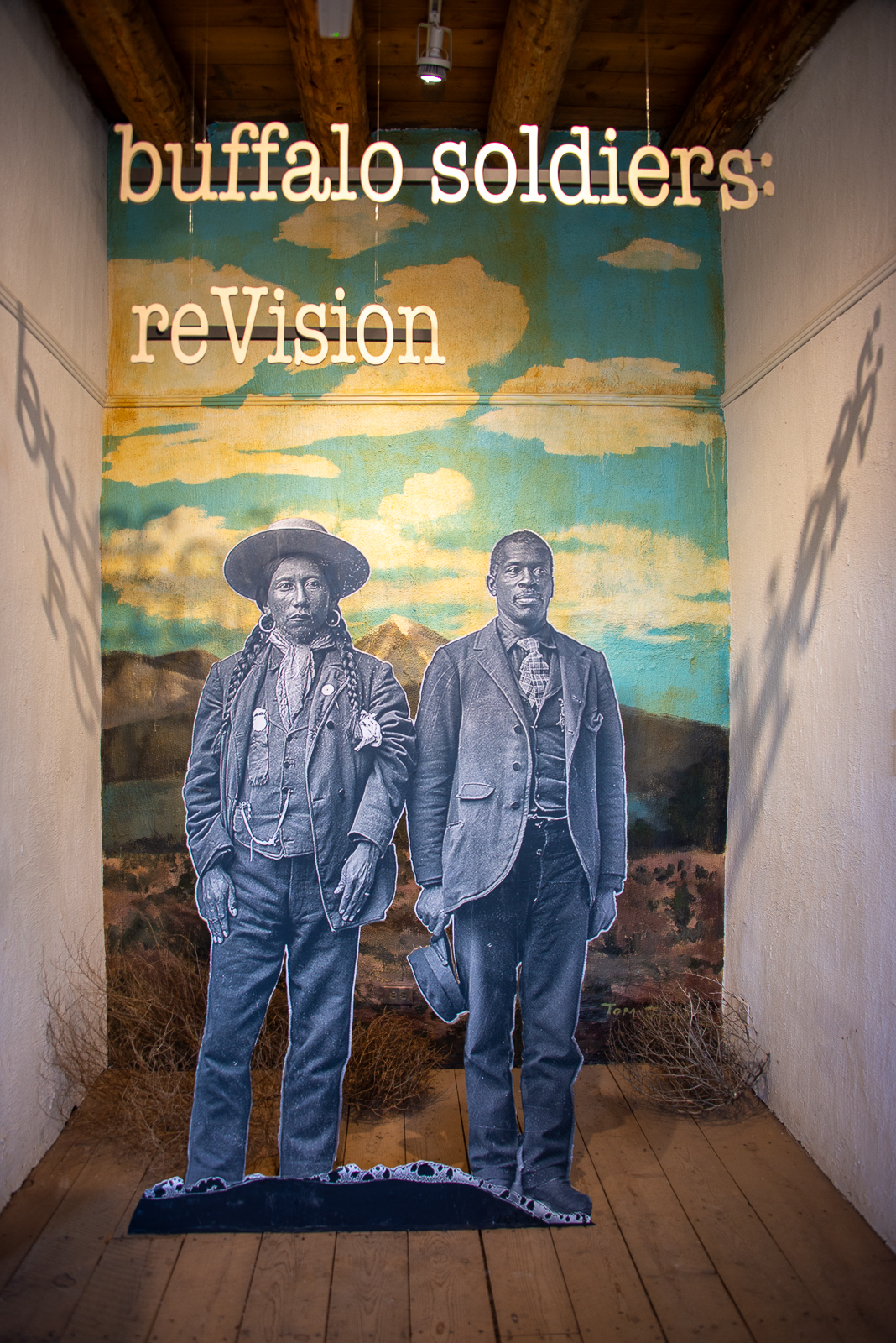
    Buffalo Soldiers exhibit sign

    Signage for Fort Garland Museum’s “buffalo soldiers: reVision” exhibit, which runs through 2025.

    camera icon

    ©Steve Alberts

    By 1858, Fort Garland was built to protect Manifest Destiny, the philosophy that the United States had a divine mission to expand westward into what it inaccurately touted as virgin lands and create a transcontinental nation.

    After the Civil War, the all-Black 9th Calvary became stationed at the fort. They were dubbed the Buffalo Soldiers by Comanches and Cheyennes — one possible reason, historians believe, was due to their physical fortitude and hair, which the Native Americans generally perceived to be curly. Tasked with protecting white settlers, the Buffalo Soldiers often had the unenviable duty of being on the front lines of Native American removal. They were well-respected by the U.S. government for their valiant and honorable service, and they often established friendships with Native Americans.

    “Here in the valley, we are at the intersection of several Indigenous homelands, the northernmost edge of Spanish and Mexican settlement, and American westward expansion,” Carpio said. “Ultimately, this region was shaped by how those relationships evolved. It’s a wildly complex history which still directly impacts how people live their lives today.”

    So, how did a rural, small-town museum go about unraveling such an intricate, nuanced puzzle?

    The first step was dismantling the 69-year-old centerpiece of the fort-turned-museum: a life-size mannequin of Kit Carson, an American brigadier general perhaps best known for his merciless campaign against the Diné people (also known as Navajo).

    The museum then began collaborating with Tribal partners and artist Chip Thomas, an African American physician who worked on the Navajo Nation for 35 years. In June 2021, the exhibit “Unsilenced: Indigenous Enslavement in Southern Colorado” officially took Carson’s place, in the very rooms of the fort that were likely his historical living quarters.

    The exhibit includes two room-sized translucent cloths, each with a page from an 1865 document printed on them. The title reads “List of Indian Captives Acquired by Purchase,” and underneath are the names of enslaved people, with ages and Tribal affiliations. As Carpio points out, most of the Indigenous names have been changed to Western ones, as women and children were often baptized into the Catholic Church and prohibited from speaking their Native language. This led to generations of Native Americans who had lost all connection to their cultural traditions and Tribal heritage, including a Navajo boy who Carson kept enslaved.

    Though those practices ended 150 years ago, the reverberations of that detachment are still affecting the community. “A lot of families have come forward and told us they had heard their ancestors were enslaved but doubted the story because no one ever heard about Native American enslavement,” Carpio said. “Now families have felt validated that there’s truth to the stories their parents and grandparents told.”

    One visitor even found his ancestor’s name in the documents. “The emotion that’s suddenly unleashed from that, the pain and anger of their heritage stripped away, there’s a lot of history we have to unpack,” Carpio said. “That’s what we’re trying to reconcile. Sharing these powerful images hopefully starts a dialogue.”

    In 2022, the museum expanded its efforts by hosting the temporary exhibit “Merciless Indian Savages,” in which Pyramid Lake Paiute artist Gregg Deal interpreted what American Democracy means in Indian Country. Then this summer, “buffalo soldiers: reVision” opened as a collection of works by eight artists. The exhibit runs through 2025.

    “How did formerly enslaved peoples rationalize the subjugation of another race, and in what ways do Buffalo Soldiers connect with the lands they were helping to take away from Indigenous people?” asked Thomas, in an artist’s statement. “The land provided solace and space for contemplation, maturation and dreaming of new possibilities in a way the black soldier couldn’t consider in the Reconstruction South.”

    Telling stories such as these through contemporary art is an unusual choice for a history museum, but Carpio says the approach has started a lot of meaningful dialogue. “Particularly in communities of color, artists are the knowledge keepers,” he said. “Plus, artists have a good way of not hitting you over the head with it, opening new perspectives without being condemning.”

    Earlier this year, the museum earned a finalist spot in the National Medal for Museum and Library Science, and visitors often tell Carpio that it’s a more welcoming and relevant space to them now than it was before. After viewing the exhibits, one couple even asked Carpio how they could better honor the Buffalo Soldiers and Native Americans who once lived in the valley.

    “That people came in and reflected on the exhibits in that way, in all of our wildest hopes and goals as a museum, that’s it,” Carpio said. “And the stories are still expanding. We have empty rooms in some of our exhibit spaces as a signal to the community there’s more to be done. The reconciliation and healing is ongoing.”

    Lebanon native’s photo of SCI Cresson wins first place at Art of the State 2023

    Lebanon native’s photo of SCI Cresson wins first place at Art of the State 2023

    Lebanon County native Michael Hower was awarded the first prize in photography/digital media of Art of the State 2023 for an almost three-foot print of Transparency. He took the award-winning photograph at SCI Cresson, an abandoned prison in western Pennsylvania.

    Art of the State 2023 will display 86 art pieces, ranging from photography/digital media to work on paper, painting, sculpture, and craft, produced by 86 artists from across the state until Jan. 7, at the State Museum of Pennsylvania. This is Hower’s second year exhibiting and first year winning.

    “The Art of the State Pennsylvania is a very exclusive juried art show. You have about a 2 percent chance of getting into it roughly. There were over 1,800 entries this year,” Hower said. “It’s a show that I covet.”

    A Cumberland County resident, 44-year-old Hower is the son of Jonestown residents, a Northern Lebanon alumnus of 1997, a Cornwall Manor employee of 26 years, and the father of an 8- and 14-year-old. He has practiced photography for the past 12 years since his oldest son was 2.

    “I went to art school, and I studied painting and drawing,” Hower said of his background. “And I actually never took the photography course because at that time … it was still all film. And I had little interest in spending time in the dark room and learning that whole process. It seemed completely foreign to me.”

    Hower experienced burnout with these art mediums during college and stopped until he started making collages as a new father.

    “I started seeking out things to photograph to use in the collages,” Hower said. “And the immediacy of … digital photography worked well because I could just go out, take a picture, put the memory card in the computer, download it, work on it, print it out, and use it. So over time, that wasn’t even over a lot of time, I started to recognize that the pictures were better than the collages.”

    This realization led Hower to upgrade from using a point-and-shoot and, in an effort to learn how to use his new camera, read a book about it from cover to cover “about seven times.”

    When asked how his background in art contributed to his growth as a photographer, Hower said, “There are some of the basic principles of design and composition and color, that sort of stuff came over. But there was also the learning of a brand-new medium, and it being exciting. And it didn’t have the ‘baggage’ that came with the other stuff.”

    “So, I had that sort of design sensibility that I was a good foundation to learn the photography from. And through the years, too, it’s something I’ve noticed, and something I’ve been told by other people and critics is that my photos have a very painterly quality to them.”

    Regarding his sources of creative inspiration, Hower said, “I have photographer friends, but I don’t spend a lot of time looking at works of famous photographers. I’m more apt to still look at works of artists that do painting or installation pieces, cultural pieces, stuff of that nature. I still go back to the more art side of it.”

    Michael Hower at a photography exhibit. (Provided by Michael Hower)

    Hower started his photography career seeking “old garages” and “canal locks,” spaces of graffiti and abandonment, to photograph.

    “I often say to people, ‘My subject matter is that of urban exploration. But I am not an urban explorer,’” Hower said. “I seek out places that I know where there’ll be opportunities and where I’ll have permission.”

    In addition to being the type of person who doesn’t “operate well in the thrill of the moment,” Hower said being a father requires him to research locations before visiting them because his time out in the field is limited.

    Hower grew up with parts of the Union Canal in his backyard and visited canal lock sites as his father wrote articles about the canal for the Lebanon Daily News. His father still had some original documents, and Hower used them as fuel for his research. “From there, it just snowballed into doing more research and finding bigger and better and more exciting places.”

    “It was the discovery of the old Michter’s Distillery in southeastern Lebanon County,” Hower said of how his fascination with abandoned spaces began. “Most of it’s largely gone now. They saved a warehouse and one of the original buildings. But it was sort of an ‘aha’ moment. Like I had grown up in Lebanon County … but here is this place that I had never seen. I had never heard of.”

    Hower said places of industry often tell stories with multiple layers that connect to the history of a municipality, a state, or a country.

    “I’m not interested in a neat-looking abandoned house along the side of the road,” Hower said of what he does, and doesn’t, look for when shooting pictures. “If there’s no story to me, the visual interest, it goes by the wayside.”

    “For example, there’s a ghost town I like to photograph called Concrete City outside Wilkes-Barre,” Hower said. “It was a miner’s village. But it was a cutting-edge design for the 1910s that they built the buildings out of all poured concrete.”

    Delaware, Lackawanna & Western Railroad Co. owned the coal company and the railroad company that transported the anthracite. Following a Supreme Court case and the breaking up of the monopoly, the Glen Alden Coal Co. purchased the homes almost a century ago and subsequently abandoned them.

    Alongside Art of the State 2023, Hower will be part of a two-person show on “abandoned prisons” at the Howard County Arts Council in Ellicott City, Maryland, that opens in December.

    Hower also booked a solo show featuring about 40 photographs on “abandonment and graffiti” at The Boyer Gallery of The Hill School in Pottstown that opens in January.

    In addition to preparing for his upcoming exhibits, Hower continues to work on his portfolio of abandoned prisons. In the past year, he took trips to Ohio and Tennessee with that purpose and is “taking any opportunity as they arise really,” he said.

    Click here to view more of Hower’s photography.

    Questions about this story? Suggestions for a future LebTown article? Reach our newsroom using this contact form and we’ll do our best to get back to you.

    Do you want to see more from LebTown?

    Support local news. Cancel anytime.

    Already a member? Login here

    Free news isn’t cheap. If you value the journalism LebTown provides to the community, then help us make it sustainable by becoming a champion of local news. You can unlock additional coverage for the community by supporting our work with a one-time contribution, or joining as a monthly or annual member. You can cancel anytime.

    #placement_660354_0_i{width: 100%;margin: 0 auto;}

    #placement_660352_0_i{width: 100%;margin: 0 auto;}

    Announcing the 2023 Soros Arts Fellows

    Announcing the 2023 Soros Arts Fellows

    NEW YORK—The Open Society Foundations today announced the recipients of their 2023 Soros Arts Fellowships, the preeminent award supporting socially engaged art. This year marks the fellowship’s largest cohort, awarding $100,000 to 18 mid-career artists for impact-driven art projects that propose bold solutions to address the climate crisis, reclaim and uplift indigenous knowledge, and imagine and build sustainable futures.

    Open Society’s 2023 Fellowships are centered around the theme of “Art, Land, and Public Memory,” focusing on artists who are pursuing projects that offer tangible solutions to address environmental harms. The fellowships recognize artists from around the world—from Brazil, Colombia, Guinea, Iraq, Mexico, Morocco, Palestine, Philippines, Portugal, Puerto Rico, St. Maarten, South Africa, Syria, Mandan, Hidatsa, Arikara, Lakota Tribes, the U.S. and their diasporas. Their work also engages communities in which they work across the Global South, places often on the frontlines of the climate crisis and environmental injustice driven by global settler colonialism, capitalism, and white supremacy. 

    “Art and culture are essential drivers for social change,” said Tatiana Mouarbes, Open Society’s team manager for Culture and Art, Expression. “One of the greatest challenges of the 21st century is the health of our planet. Through their art and culture work, the 2023 Soros Arts Fellows are taking action to help heal a planet in crisis through community-led solutions for environmental justice. We are proud to support their visions.” 

    In addition to unrestricted funding, the fellowships offer recipients a holistic suite of services and resources to help the artists build sustainable artistic careers, including leadership development, mentorship, peer-to-peer exchanges, and networking opportunities.  

    Working in diverse forms and global contexts, some of the artists and projects include: 

    • Chemi Rosado-Seijo (Puerto Rico) is working with residents to transform the community of El Cerro into a “Green Barriada,” a self-sustaining and environmentally resilient community
    • Martha Atienza (Philippines) is creating a series of collaborative artworks with fishing communities of Bantayan Island to raise awareness of environmental justice, displacement, and cultural erasure
    • Mónica De Miranda (Portugal) is working with African migrant communities in Lisbon to document stories of migration and land ecologies, bringing together artists, activists, and ecologists to reimagine more inclusive, equitable, and sustainable public spaces
    • Jordan Weber (U.S.) is producing a regenerative ecologies project to transform a square acre of forest in East Detroit into an air remediation zone, trauma informed community center, and open-air environmental justice classroom

    With a long history of supporting arts and culture to advance social change, the Open Society Foundations recognize the importance of artists’ contributions and the essential role that art plays in civic discourse and open societies. In particular, the Foundations seek to honor the aesthetic, political, and capacity needs of arts leaders, individual artists, and cultural activists.  

    Since 2018, the Soros Arts Fellowship has awarded more than $3 million in unrestricted funding to 29 artists around the world; this year’s $1.7 million is the largest annual amount to date. The fellowship was on a hiatus from 2021–2022 during the height of the COVID-19 pandemic, when more than $500,000 was awarded to support existing fellows.  

    The 2023 Soros Arts Fellowship selection committee includes Azu Nwagbogu, curator and founder of African Artists’ Foundation; Diane Lima, curator of the 35th Bienal de São Paulo; Eriola Pira, curator at the Vera List Center for Art and Politics; Helena Nassif, director of Culture Resource (Al Mawred Al Thaqafy); Paulina Suárez, general director of Ambulante; Rocío Aranda-Alvarado, senior program officer, Creativity and Free Expression, Ford Foundation; Siobhan Riordan, consultant and creative Strategist; Tania El Khoury, artist and director of the Center for Human Rights and the Arts at Bard College; Open Society’s Culture and Art staffers Tatiana Mouarbes, Ayoka Wiles, and Ibrahima Niang, and Alvin Starks, director, Narrative and Culture Change at Open Society-United States. 

    2023 Soros Arts Fellows

    Bilia Bah will produce a collaborative and participatory theater production to launch public dialogue around climate change, urbanization, and the impacts of unregulated water drilling across Conakry, Guinea.

    Cannupa Hanska Luger will publish SURVIVA, centering Indigenous knowledge and survival practices related to land, climate, and the environment— and to boldly assert how Indigenous technologies are critical to sustaining life and humanity worldwide.

    Carolina Caycedo will produce We Place Life at the Center—Situamos la vida al centro, bringing together ancestral and embodied approaches to the natural world as alternatives to the global climate crisis, grounded in field research and engagement with Natives, campesino/peasant communities, and climate activists throughout the Americas.

    Chemi Rosado-Seijo will work with residents of El Cerro, Puerto Rico, to transform the community into a “Green Barriada,” a self-sustaining and environmentally resilient community.

    Dalton Paula will organize Quilombo-Escola, an arts and education project that supports Afro-Brazilian artists through artistic residencies and training, and fosters community collaboration and exchanges with art, the environment, and ancestral and traditional knowledge rooted in a Quilombo perspective across Brazil.

    Deborah Jack will create To Make A Map of My Memory: Wayfinding Along Synaptic Topographies, linking cultural memory preservation in St. Maarten with climate justice through an archive of oral histories, a connected film and multimedia installation.

    Fehras Publishing Practices (Kenan Darwich and Sami Rustom) will create Hader Halal (With Regard to Presence) a multi-format project that aims to reclaim forgotten collective memory in the Eastern Mediterranean and North Africa region and rewrite narratives of modern Arab history from a queer, migrant, and feminist perspective.

    Ixchel Tonāntzin Xōchitlzihuatl will organize We the Trees, a multi-tribal art and land rematriation project in the Ecuadorian Amazon.

    Jordan Weber will organize a regenerative ecologies project in East Detroit that will revitalize a square acre of forest as an air remediation zone, a trauma informed community center, an open-air environmental justice classroom, and a site for conifer tree transplants to counter the harmful effects of pollution from nearby automobile plants.

    Martha Atienza will organize collaborative artworks and actions with fisherfolk and farmer communities on Bantayan Island and its group of islets in the Philippines for Tigpanalipod (The Protectors) to raise awareness around environmental justice, displacement, and cultural erasure.

    Molemo Moiloa will produce a series of art and community engaged works under the framework of the “house of ungovernability,” an informal center for sharing and co-developing tactics for sustaining in times of uncertainty, rooted in our relationships to the land.

    Mónica de Miranda will work with African migrant communities in Lisbon to document stories of migration and land ecologies for Where cities are invisible, gardens grow, bringing together artists, activists, and ecologists to reimagine more inclusive, equitable, and sustainable public spaces.

    Nida Sinnokrot will produce Storytelling Stones: How far does your mother’s voice carry?, a series of collaborative and site-specific sculptures that uplift indigenous practices and reclaim cultural memory, expand discourse and action on environmental justice, and activate public spaces in ways that are resonant and impactful for Palestinian and indigenous communities globally.

    Omar Berrada will examine anti-Black racism in North Africa and propose poetic re-articulations of Moroccan identity, reclaiming marginalized narratives and invoking histories of pan-African solidarity.

    Rijin Sahakian, through images and text, will trace the legacies of war-making on the physical, cultural, and psychic landscapes between Iraq and America, centering the Iraqi experience.

    Sari Dennise will organize Almárcigo, a collaborative, multidisciplinary, and archival project with communities in Xochimilco, Mexico to preserve and articulate water-related knowledge and practices, and promote shared learning around alternative ways of being with the environment.

    Yto Barrada will expand botanical literacy to disseminate radical ways of making and thinking with the Mothership Manifesto, a collaborative, multidisciplinary, transgenerational and educational textile project at the Mothership, an eco-feminist residency, garden, and studio in Tangier, Morocco.